

Global Blockchain in Banking Market Size and Forecast – 2026-2033
The global blockchain in banking market is estimated to be valued at USD 14.72 Bn in 2026 and is expected to reach USD 220.43 Bn by 2033, reflecting a compound annual growth rate (CAGR) of 47.2% from 2026 to 2033.
Key Takeaways of the Blockchain in Banking Market
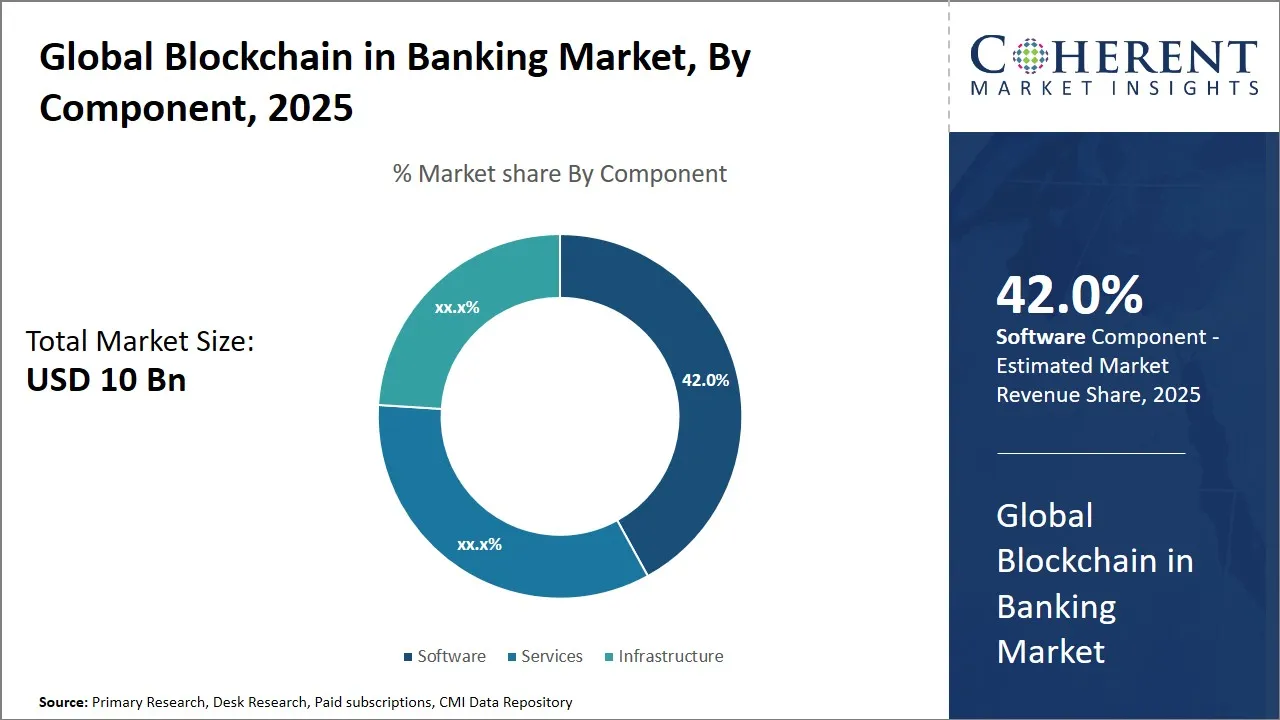
- The software segment is expected to account for 43% of the blockchain in banking market share in 2026.
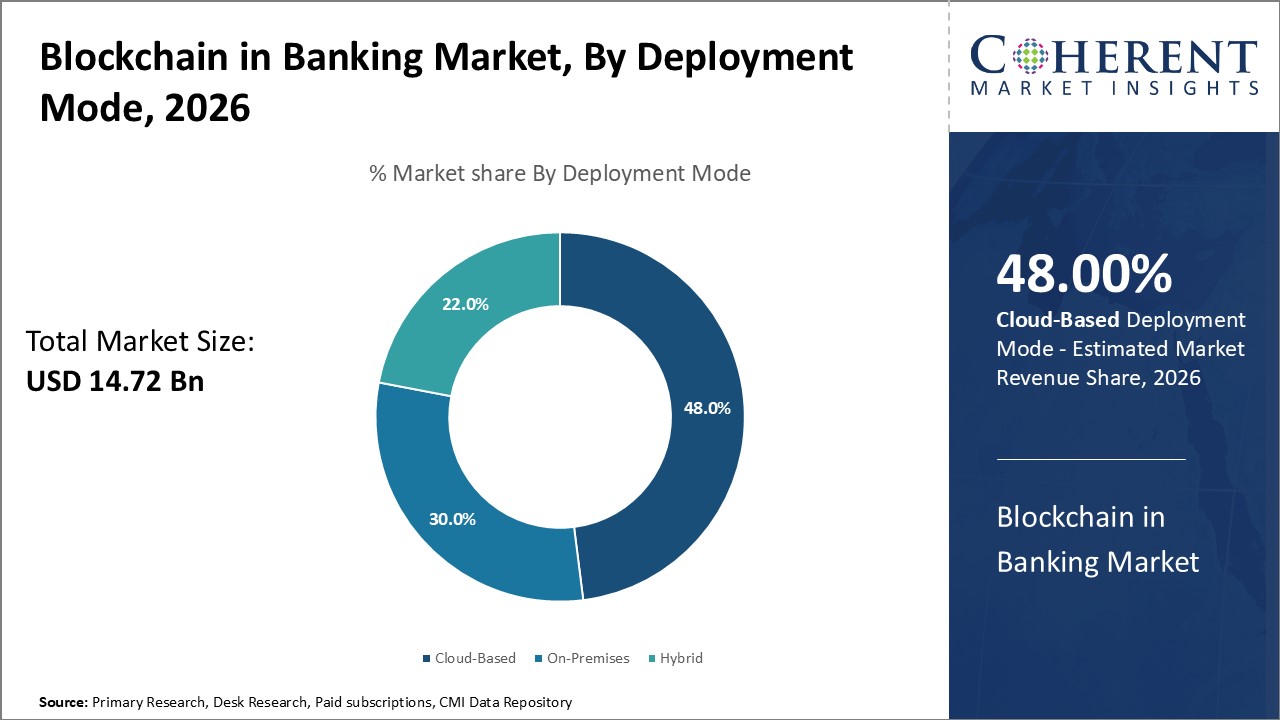
- The cloud-based segment is projected to capture 48% of the market share in 2026.
- The cross-border payments and remittances segment is expected to command 34% share in 2026.
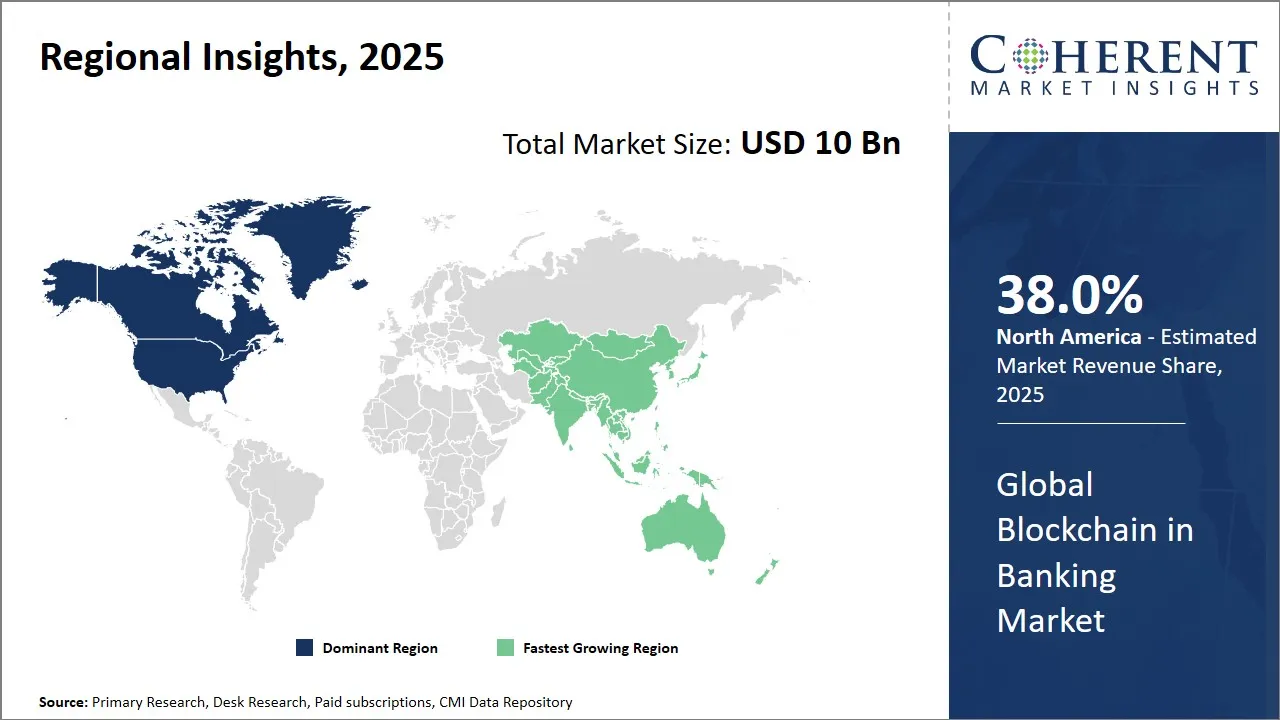
- North America will dominate the blockchain in banking market in 2026 with an estimated 38%
- Asia Pacific will hold 27% share in 2026 and record the fastest growth.
Current Events and Its Impact
Current Events | Description and its Impact |
Launch of MONY by JP Morgan |
|
Segmental Insights
- Current Industry Events of 2026
- Market Size Estimation
- Regional Breakdown
- Competitive Landscape
- Customer Intelligence
- Segmental Analysis
- Pricing Analysis
- Key Market Drivers, Challenges & Future Trends
- Customized Insights Section
Why Does Software Dominate the Global Blockchain in Banking Market in 2026?
The software segment is expected to hold 43% of the global blockchain in banking market share in 2026. The lead role of software in banking’s blockchain space comes from how it builds and runs custom solutions for financial use. Rather than just linking parts together, these tools include platforms, apps, backend links, plus rule-based frameworks improving data flow, safety in transfers, along with system compatibility. Financial organizations require sophisticated tools to link emerging blockchain systems with existing frameworks and legacy platforms, whilst complying with rigorous security standards and regulatory requirements. Owing to these complexities, consistent demand drives advancement in specialized programming, integration methods, and optimization tailored to this particular form of digital architecture.
Software enables banks to speed up operations - through smart contracts, digital identification, or automation - that streamline workflows. A stronger emphasis on tools that manage scale, protect privacy, yet ensure agreement across systems shows how banks adapt to rules and local data laws. Also, growing interest in DeFi drives demand for flexible, simple software able to process intricate deals on blockchains.
Cloud Based Segment Dominates the Blockchain in Banking Market
The cloud-based segment is expected to hold 48% of the market share in 2026. The rise stems from their ability to provide exceptional scalability along with low costs, fitting modern evolving banking demands. As cloud systems let banks launch blockchain networks without large upfront investments usually tied to local hardware. Such adaptability matters greatly due to the trial-driven phase of blockchain projects, during which institutions test various scenarios prior to expanding proven solutions.
Cloud setups help launch blockchain systems quicker through pre-built tools, along with built-in security features. Since cloud resources adjust automatically, banks can increase or decrease processing ability based on demand, especially useful during peak times such as cross-border payments. Because it naturally enables global access to information, staff in different locations collaborate efficiently through extended financial systems.
For instance, in September 2024, National Australia Bank announced they have extended their long-term agreement with Amazon Web Services (AWS) as part of its multi-cloud strategy that continues to bolster the bank’s technology capability to improve customer experiences. The agreement enables NAB to accelerate the migration of key critical workloads to AWS cloud infrastructure and further develop its Generative AI capabilities.
(Source: news.nab.com.au)
Why is Cross-Border Payments and Remittances the Most Widespread Application in the Blockchain in Banking Market?
The cross-border payments and remittances segment is expected to hold 34% of the blockchain in banking market share in 2026. The rise comes from blockchain tackling key issues in cross-border payments. Even though common, outdated systems often run slowly, cost more, yet give little transparency across global finance networks. Using a shared online record, transfers finish faster, cutting wait times significantly, sometimes down to seconds.
The transparent and fixed structure of blockchain information increases trust among users, making checks easier while reducing opportunities for fraud. Rather than relying on complicated global banking networks, banks can adopt shared digital records, lowering costs yet improving speed. These advances help more people reach financial tools, particularly in regions with few banks where sending money overseas is essential.
Pricing Analysis
Trade Finance & Letter of Credit Solutions | Cross-Border Payments and Remittances | Digital Identity and KYC Solutions |
IBM Trade Finance Solutions
| Ripple
| Microsoft Azure Blockchain Identity Solutions
|
JPMorgan's JPM Coin and Onyx Platform
| Stellar Network Solutions
| Hyperledger Indy-based Solutions
|
Regional Insights
North America Blockchain in Banking Market Analysis and Trends
North America is expected to exhibit the fastest growth in the market contributing 38% share in 2026. The expansion comes from a well-established financial system linked to strong tech networks along with supportive regulations. Multiple fintech centers exist, while big banks adopted blockchain early, helping build a solid market setup. Government agencies across the U.S. and Canada gradually built guidelines permitting innovation while keeping strict safety controls and this helped blockchain spread more easily. Meanwhile, established firms along with startups teamed up with financial institutions to trial shared digital ledgers for payments, clearing processes, and verifying identities. Big players including IBM, Microsoft, JPMorgan Chase, and Bank of America drive progress, helping keep North America ahead in this space.
Asia Pacific Blockchain in Banking Market Analysis and Trends
The Asia Pacific region is projected to lead the market with a 27% share in 2026. The market expands due to better digital banking systems, rising funding for blockchain firms, while governments in places such as China, Japan, Singapore, and South Korea back these changes. More users wanting clear, fast financial services help speed up usage. Across the area, regulators are becoming more accepting of blockchain, introducing test zones plus trial initiatives centered on this tech. A strong web of technology firms, combined with innovative financial institutions adopting blockchain for cross-border payments, commerce funding, or verification tasks, is pushing change. Major contributors such as Huawei, Ant Group, SBI Holdings, and DBS Bank play essential roles, making the Asia Pacific area the fastest-moving in bank-related blockchain growth.
Global Blockchain in Banking Market Outlook for Key Countries
Why is U.S. Emerging as a Major Hub in the Blockchain in Banking Market?
The U.S. keeps leading in blockchain use for banking, thanks to advanced finance systems and strong technology driven mindset. Instead of old-school approaches, firms such as JPMorgan Chase use tools like JPM Coin and Onyx to drive change. At the same time, Bank of America concentrates on filing many blockchain patents, adding energy to industry growth. Now, oversight bodies like the SEC and FinCEN give firmer guidelines, less guesswork, more structure, to support breakthroughs without risking financial stability. In step with these efforts, corporations including IBM and Microsoft supply key infrastructure plus consulting know-how, enabling smoother bank integration of blockchain.
Is China the Next Growth Engine for the Blockchain in Banking Market?
China's blockchain in banking market is expanding fast, supported by government efforts tied to its digital money goals. Rather than just funding it, officials encourage adoption through initiatives led by the PBOC. This central bank focuses on tech advances for the digital yuan alongside safer trade financing systems. Instead of waiting, major institutions like ICBC have started live projects with firms including Ant Group. These collaborations target payment solutions, supply chains, and handling loan risks more effectively. National strategies guide this growth while R&D spending helps maintain momentum across sectors.
U.K. Blockchain in Banking Market Analysis and Trends
The U.K. continues to play an essential role in Europe’s blockchain banking sector, thanks to supportive regulations alongside a solid network of new fintech financial technology firms and established banks. Because of initiatives like innovation hubs and sandbox programs, the Financial Conduct Authority fosters testing of blockchain-based financial solutions. Major institutions including Barclays and HS2C are putting resources into trial runs using distributed ledger tech to boost trade operations and oversight processes. Meanwhile, companies such as R3 and ConsenSys build custom business-level blockchains for financial use cases - helping reinforce Britain's standing in this evolving space.
Singapore Blockchain in Banking Market Analysis and Trends
Singapore is a major player in blockchain adoption across Asia Pacific, owing to advanced policies from agencies including MAS that back technological experimentation. Rather than waiting, authorities actively promote systems improving international money transfers and shortening transaction delays while streamlining regulatory checks. Among key players, DBS Bank introduced tools powered by distributed ledger technology. Positioned centrally within global commerce routes, the nation benefits from tight coordination between regulators and private firms driving next-generation financial services.
Germany Blockchain in Banking Market Analysis and Trends
Germany is key in Europe's blockchain in banking market, where traditional banks are willing to adopt new technologies. Instead of resisting change, officials from Berlin and the central bank back trials that explore tokenized assets along with digital compliance tools. Rather than working alone, Deutsche Bank teams up with companies such as SAP or IBM to test distributed ledger systems for smoother processes. Thanks to its robust manufacturing backbone plus cautious but evolving rules, progress in financial blockchains moves forward at a consistent pace.
Vendor and Banking Consortium Landscape Analysis in Blockchain Banking
Vendor | Key Focus / Use Cases | Use Cases |
IBM | Enterprise blockchain solutions for trade finance, payments, KYC & compliance | Identified as a major player in blockchain for banking & financial services markets globally; listed across multiple market reports as top vendor. |
Microsoft | Cloud-hosted blockchain infrastructure & BaaS for banks | Named a key vendor in global blockchain banking market. |
Amazon Web Services | Blockchain-as-a-Service, permissioned DLT networks for banks | Recognized among top blockchain platform providers used by financial institutions. |
Oracle | Enterprise blockchain integration & BaaS solutions for banking | Included consistently in global competitive landscapes. |
Consensys | Ethereum-based blockchain solutions and tooling used by banks | Listed among key market competitors in blockchain for banking. |
Market Players, Key Development, and Competitive Intelligence
Key Developments
- In September 2025, Deutsche Bank announced that it has successfully conducted its first euro-denominated cross-border payment via Partior’s blockchain platform. The transaction was performed together with DBS, Southeast Asia’s largest bank by assets.
- In December 2024, Germany's largest financial institution, Deutsche, started utilizing blockchain technology. For this, they are developing their own layer-2 blockchain on Ethereum. The bank hopes to address compliance challenges and bridge the gap between decentralized public blockchains and the regulated financial sector by using ZKsync technology.
Top Strategies Followed by Global Blockchain in Banking Market Players
Player Type | Strategic Focus | Example |
Established Market Leaders | VISA USDC Settlement Launch | On December 16 2025, Visa Inc. announced the launch of USDC settlement in the U.S., marking a major milestone in the company’s stablecoin settlement pilot program and strategy to modernize its settlement layer underpinning global commerce. For the first time, U.S. issuer and acquirer partners can settle with Visa in Circle’s USDC, a fully reserved, dollar-denominated stablecoin. |
Mid-Level Players | Business Agreement | On December 15, 2025, Coinbase, the leading publicly-listed firm for digital assets, and Chainlink, the industry-standard oracle platform, announced the selection of Chainlink's Cross-Chain Interoperability Protocol (CCIP) as the exclusive bridging solution for all Coinbase Wrapped Assets, enabling cross-chain transfers and expansion. |
Small-Scale Players | Global Acclaim | On October 6, 2025, AMINA Bank AG, a Swiss Financial Market Supervisory Authority regulated crypto bank with global reach, became the first regulated bank worldwide to offer staking services for POL, the native token securing the Polygon ecosystem. |
Market Report Scope
Blockchain in Banking Market Report Coverage
| Report Coverage | Details | ||
|---|---|---|---|
| Base Year: | 2025 | Market Size in 2026: | USD 14.72 Bn |
| Historical Data for: | 2020 To 2024 | Forecast Period: | 2026 To 2033 |
| Forecast Period 2026 to 2033 CAGR: | 47.2% | 2033 Value Projection: | USD 220.43 Bn |
| Geographies covered: |
| ||
| Segments covered: |
| ||
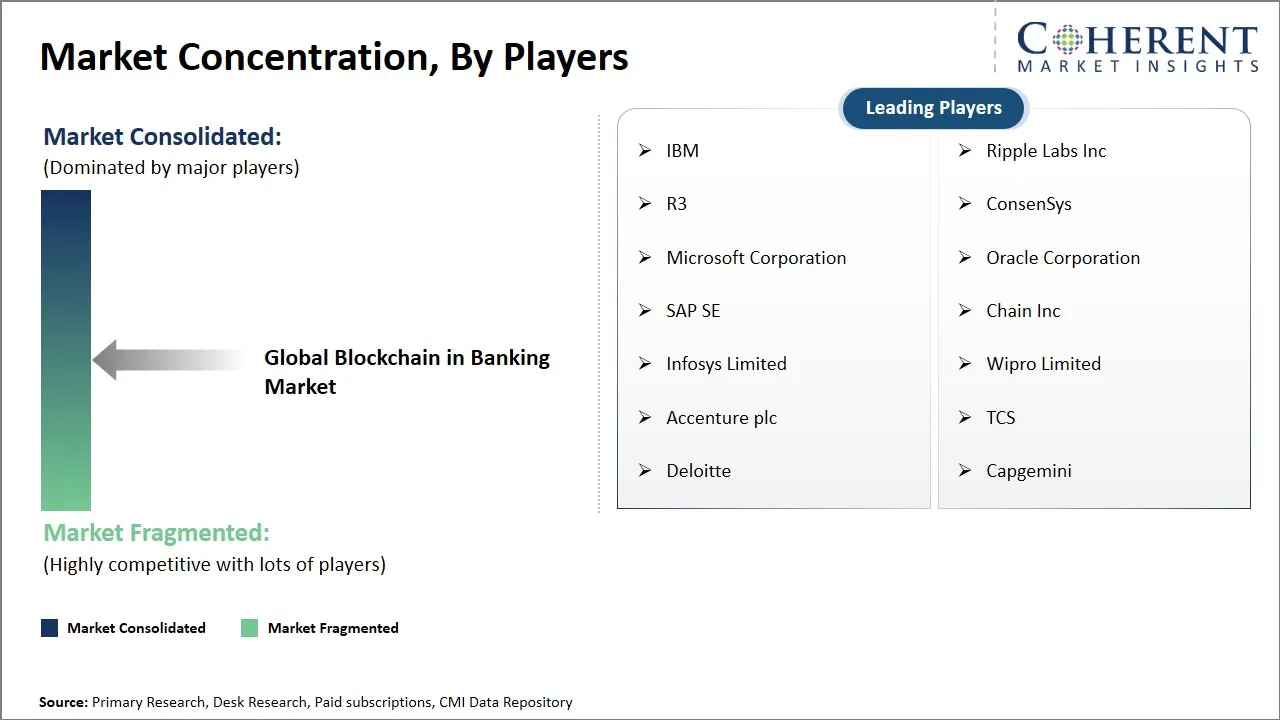
| Companies covered: | IBM, Ripple Labs Inc, R3, ConsenSys, Microsoft Corporation, Oracle Corporation, SAP SE, Chain Inc, Infosys Limited, Wipro Limited, Accenture plc, TCS, Deloitte, and Capgemini | ||
| Growth Drivers: |
| ||
| Restraints & Challenges: |
| ||
Global Blockchain in Banking Market Dynamics
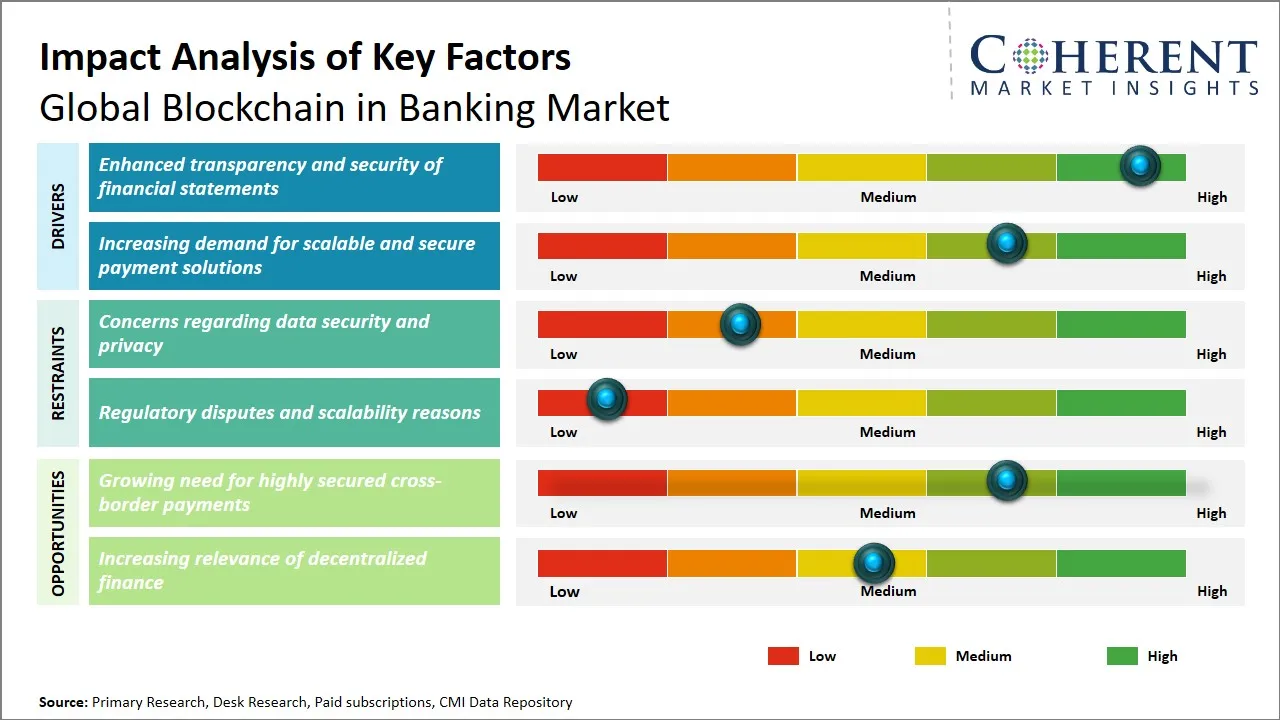
Global Blockchain in Banking Market Driver - Enhanced Transparency and Security of Financial Statements
The use of blockchain in banking grows because it makes financial records more open and secure. While traditional banks struggle with fake data, scams, or mistakes, trust and rules can suffer. A distributed ledger keeps each transaction safe from changes, creating a permanent log visible only to approved users. Because updates are shared across networks instantly, checks become faster; audits gain accuracy through live tracking instead of delayed reports. Moreover, stronger safety steps built into blockchain, like code-based protection and group validation, shield private money details from online threats or tampering. Since banks now focus more on accurate records and meeting rules, the system’s reliable method for clear transaction logs plays a key role in its wider use across finance.
For instance, in November 2025, DBS and Kinexys by J.P. Morgan announced they are exploring the development of an interoperability framework to enable tokenized value transfers between both banks’ on-chain ecosystems, DBS Token Services and Kinexys Digital Payments.
(Source: dbs.com)
Global Blockchain in Banking Market Opportunity - Growing Need for Highly Secured Cross-Border Payments
The growing global reach of trade finance across nations has boosted interest in secure, fast ways to send money across borders, creating strong potential for blockchain use in banking worldwide. Old-style international transfers tend to take time, cost a lot, and remain unclear because they pass through several middlemen and outdated bank networks. Instead of relying on those methods, blockchain uses a shared, tamper-proof record that allows instant clearing and full tracking from start to finish. Financial players now test this tech to reduce dangers like scams, illegal fund moves, or digital attacks, improving safety standards for overseas transactions.
Moreover, rules tied to AML and KYC checks push firms toward blockchain systems offering safe, unchangeable logs. While developing economies grow their international trade, quicker and steadier money transfer solutions become essential, spurring wider use of blockchain technology. At the same time, digital currency advances, like CBDCs, align well with blockchain networks, allowing smooth, protected, affordable overseas transfers. These factors and a focus on safety, speed, efficiency, highlight how blockchain is becoming key in reshaping global payment flows across banks.
Analyst Opinion (Expert Opinion)
- The global blockchain in banking market shows strong expansion, fueled by actual use of distributed ledgers in key banking operations. As more financial players adopt the tech, efficiency in international transfers improves - also boosting clarity in processes. Settlement certainty gains traction, especially through live deployments. Commercial lenders and fintech innovators drive these advances, often shifting approaches between trials and scale-up.
- Widespread change depends on clear rules along with scalable technology. Although partnerships help set standards for blockchain use, unclear regulations or compatibility issues still block progress. It is really important solving these problems while building flexible yet rule-following systems and this step is key if banks want real-world blockchain results, particularly moving past small test runs.
Speak to the analyst
Want personalized insights?
Take the findings above to one of our principal consultants, or have the report rebuilt around the segments, geographies and competitors you actually track.
Market Segmentation
- Component Insights (Revenue, USD Billion, 2021 - 2033)
- Software
- Services
- Infrastructure
- Deployment Mode Insights (Revenue, USD Billion, 2021 - 2033)
- Cloud-Based
- On-Premises
- Hybrid
- Application Insights (Revenue, USD Billion, 2021 - 2033)
- Cross-Border Payments and Remittances
- Fraud Detection and Risk Management
- Trade Finance and Supply Chain
- Smart Contracts
- Digital Identity and KYC
- Asset Management and Tokenization
- Regional Insights (Revenue, USD Billion, 2021 - 2033)
- North America
- U.S.
- Canada
- Latin America
- Brazil
- Argentina
- Mexico
- Rest of Latin America
- Europe
- Germany
- U.K.
- Spain
- France
- Italy
- Russia
- Rest of Europe
- Asia Pacific
- China
- India
- Japan
- Australia
- South Korea
- ASEAN
- Rest of Asia Pacific
- Middle East
- GCC Countries
- Israel
- Rest of Middle East
- Africa
- South Africa
- North Africa
- Central Africa
- North America
- Key Players Insights
- IBM
- Ripple Labs Inc
- R3
- ConsenSys
- Microsoft Corporation
- Oracle Corporation
- SAP SE
- Chain Inc
- Infosys Limited
- Wipro Limited
- Accenture plc
- TCS
- Deloitte
- Capgemini
Sources
Primary Research Interviews
- Senior Banking Technology Officers
- Blockchain Solution Providers & Vendors
- Financial Services Compliance Managers
- Digital Banking Innovation Directors
Databases
- Bloomberg Terminal Financial Database
- S&P Capital IQ Banking Analytics
- Thomson Reuters Eikon Financial Markets
- IBISWorld Industry Research Database
Magazines
- Banking Technology Magazine
- American Banker
- The Banker (Financial Times)
- Fintech Finance Magazine
Journals
- Journal of Banking & Finance
- International Journal of Bank Marketing
- Journal of Financial Services Research
Newspapers
- Financial Times
- The Wall Street Journal
- Reuters Financial News
- Banking Exchange
Associations
- American Bankers Association (ABA)
- Institute of International Finance (IIF)
- Blockchain in Transport Alliance (BiTA)
- Global Blockchain Business Council (GBBC)
Public Domain Sources
- Federal Reserve Economic Data (FRED)
- World Bank Open Data
- Bank for International Settlements (BIS) Reports
- Securities and Exchange Commission (SEC) Filings
Proprietary Elements
- CMI Data Analytics Tool
- Proprietary CMI Existing Repository of information for last 8 years
Get access to 250+ pages report
Every segment, forecast, competitor profile and data table behind the analysis above — available for instant download.
- ESOMAR Member
- ISO 9001:2015 Certified
- D-U-N-S Registered
- GDPR & CCPA Compliant
Missing comfort of reading report in your local language? Find your preferred language:
Transform your Strategy with Exclusive Trending Reports
Frequently Asked Questions
The global blockchain in banking market is estimated to be valued at USD 14.72 Bn in 2026 and is expected to reach USD 220.43 Bn by 2033.
The CAGR of global blockchain in banking market is projected to be 47.2% from 2026 to 2033.
Enhanced transparency and security of financial statements and increasing demand for scalable and secure payment solutions are the major factors driving the growth of the global blockchain in banking market.
Concerns regarding data security and privacy and regulatory disputes and scalability reasons are the major factors hampering the growth of the global blockchain in banking market.
In terms of component, software is estimated to dominate the market revenue share in 2026.
No, banks are primarily using blockchain for payments, settlements, trade finance, compliance, and tokenized assets rather than direct crypto trading.
Yes, blockchain provides immutable, auditable transaction records, enhancing transparency and simplifying regulatory reporting.