

Global Trade Finance Market Size and Forecast – 2026-2033
The global trade finance market is estimated to be valued at USD 55.12 Tn in 2026 and is expected to reach USD 74.51 Tn by 2033, exhibiting a compound annual growth rate (CAGR) of 4.4% from 2026 to 2033.
Key Takeaways of the Global Trade Finance Market
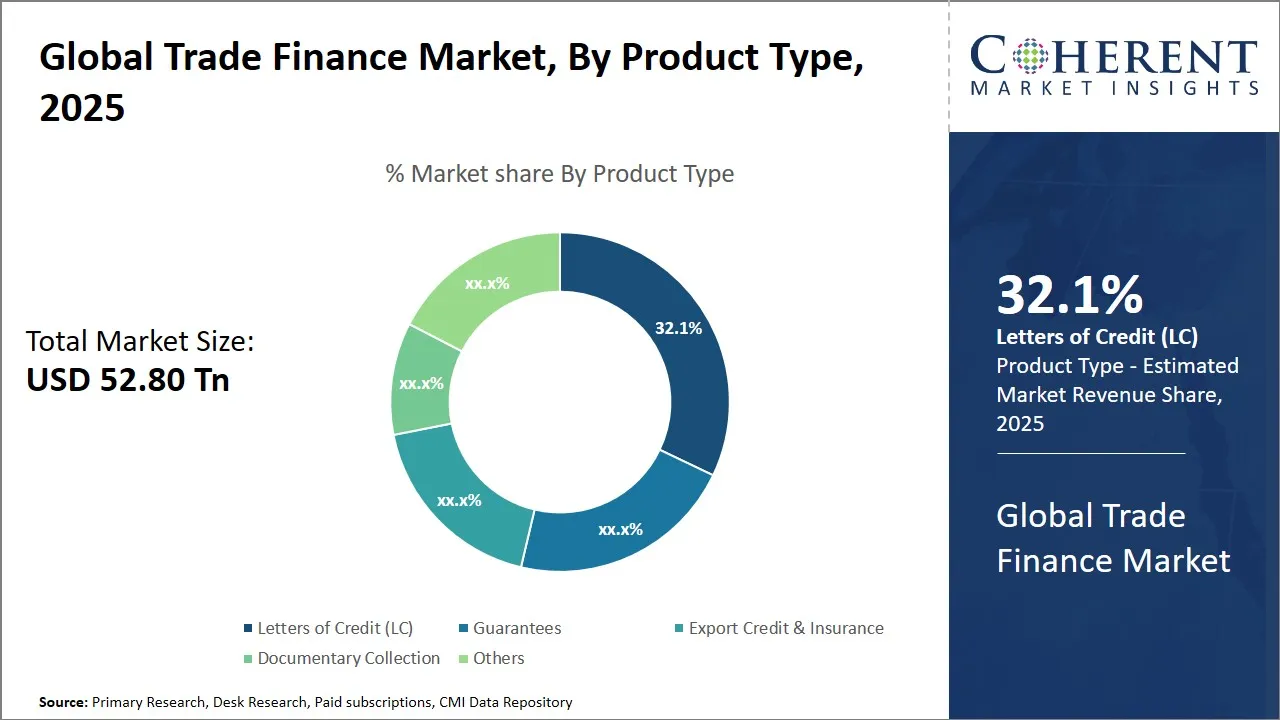
- The Letters of Credit (LC) segment is expected to lead the market holding a share of 33.1 % in 2026.
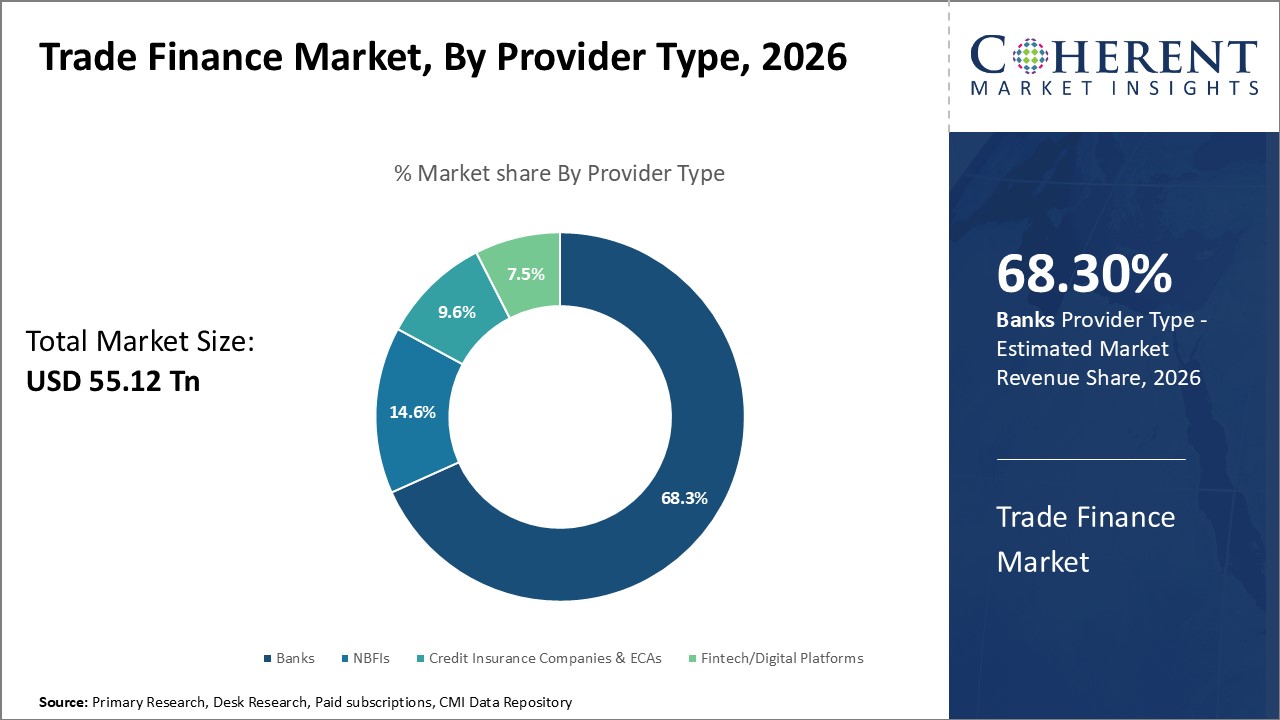
- The banks segment is projected to dominate with a share of 68.3 % in 2026.
- The international trade finance segment leads the market holding an estimated share of 65.4 % in 2026.
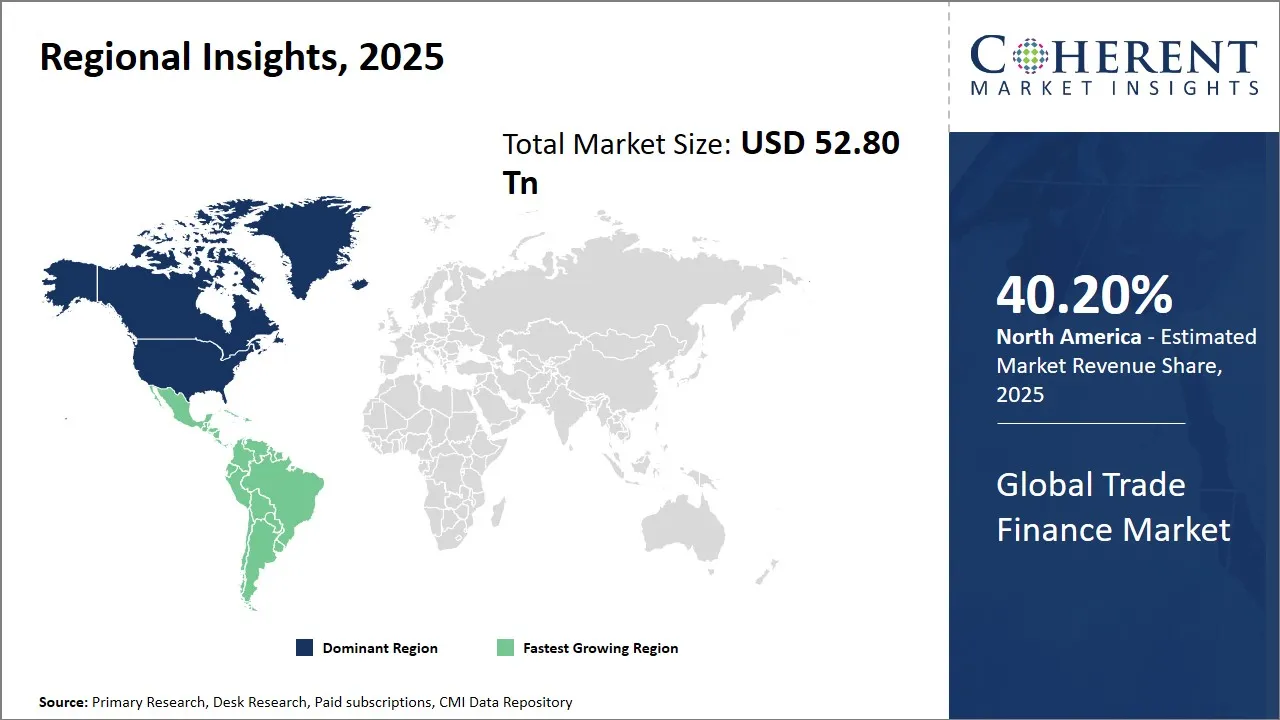
- North America, holding an expected share of 40.2 % in 2026, is projected to dominate the market.
- Latin America, holding an estimated share of 6.7 % in 2026, shows the fastest growth in the market.
Market Overview
The market is seeing the growing integration of digital technologies such as blockchain, artificial intelligence, and cloud computing. These innovations enhance transparency, reduce processing times, and minimize fraud risks in trade transactions. Also, sustainable trade finance is gaining traction as businesses and financial institutions prioritize Environmental, Social, and Governance (ESG) criteria. The shift towards digitization combined with the emphasis on sustainability is redefining traditional trade finance processes, improving accessibility, and fostering inclusive growth worldwide.
Current Events and Its Impact
Current Events | Description and its Impact |
Geopolitical and Trade Developments |
|
Economic and Infrastructure Trends |
|
Segmental Insights
- Current Industry Events of 2026
- Market Size Estimation
- Regional Breakdown
- Competitive Landscape
- Customer Intelligence
- Segmental Analysis
- Pricing Analysis
- Key Market Drivers, Challenges & Future Trends
- Customized Insights Section
Global Trade Finance Market Insights, By Product Type – Letters of Credit (LC) is Driving Credibility and Security in Global Trade Finance
Letters of Credit (LCs) is expected to hold the largest share of 33.1% of the global trade finance market in 2026, showing their important role in securing payments and reducing counterparty risks in international trade. They provide assurance to exporters that payment will be made once contractual terms are met, fostering trust in high-value sectors like machinery, electronics, and commodities. Recent digitization trends—such as HSBC’s use of blockchain-enabled eLCs through Contour—have streamlined verification and reduced processing times, increasing transparency and efficiency.
LCs remain useful for emerging markets, where legal and financial systems vary a lot, providing a trusted mechanism that balances security with liquidity. The move toward electronic and blockchain-based LCs continues to modernize this traditional instrument, reinforcing its status as a cornerstone of cross-border ecommerce.
Global Trade Finance Market Insights, By Provider Type – Banks Lead as Pillars of Trust and Infrastructure in Trade Finance Provision
Banks are projected to dominate the trade finance landscape with a 68.3% of the market share in 2026, using their huge global networks, capital strength, and compliance capabilities. Their expertise in underwriting risk, managing currency exposure, and facilitating cross-border payments makes them important to trade ecosystems. Continuous investment in digital platforms enhances efficiency and client experience—illustrated by Standard Chartered’s partnership with TradeIX and the Marco Polo Network to automate document processing and enable real-time trade data visibility.
While fintech challengers offer niche solutions, banks keep a competitive edge through deep client relationships and regulatory credibility. Their ability to bundle products—such as LCs, guarantees, and supply-chain finance—adds to their dominance as trusted intermediaries enabling global trade.
Global Trade Finance Market Insights, By Trade Type – International Trade Finance acts as a Catalyst for Cross-Border Commerce Expansion
International Trade Finance is projected to account for 65.4% of the global market in 2026 because of the rise in cross-border trade and diversified global supply chains. These instruments reduce risks of currency volatility, political instability, and extended payment cycles. The rise of emerging markets as trade hubs makes demand for secure financing mechanisms.
A good example is DBS Bank’s trade finance support for ASEAN exporters, making possible smoother payments and liquidity amid complex regional trade routes. Digital trade platforms and regulatory harmonization, such as e-document recognition under the U.K. Electronic Trade Documents Act, are boosting transaction speed and trust. As global commerce grows, international trade finance remains indispensable in bridging financial and geographic gaps across borders.
Pricing Analysis of the Trade Finance Market
Instrument | Typical Fee Structure | Sample/Estimated Pricing |
Letters of Credit (LC) issuance & confirmation | Often a % of LC value plus flat fees & courier/SWIFT charges. | For developed markets: ~0.25%-0.50% of LC value. For emerging markets: ~2.00%-4.00% of LC value. Example: Bank may charge 0.35% on a USD 1,000,000 LC = USD 3,500. |
Documentary Collections/DA-DP | Less formal than LCs; usually flat fee plus small % of value. | For a USD 500,000 document collection might cost USD 500-1,000 plus ~0.10% = USD 500. |
Trade Loans/Pre-/Post-Shipment Finance | Pricing often in interest/spread + facility fees; expressed as % annual cost. | In some emerging markets, cost of trade loans ~8% annual interest equivalent. If USD 2,000,000 facility for one year: interest ~USD 160,000 + fees. |
Supply-Chain Finance/Receivables Discounting | Typically discount rate + platform/participation fees; less standardized publicly. | Estimate: discount margin perhaps 3%-6% of receivables value for mid-tier corporate in emerging market. |
Bank Guarantees/Standby LCs | Similar to LC fees; plus risk-premium for issuer. | Example: 1.00% of guarantee amount = USD 10,000 on USD 1,000,000 guarantee (plus issuance fee USD 300-500). |
Regional Insights
North America Trade Finance Market Analysis and Trends
North America, holding a share of 40.2% in 2026, is expected to dominate the global trade finance market because of advanced financial infrastructure, high regulatory transparency, and the high presence of global banking institutions with deep expertise in cross-border financing. The region’s dominance come from its strategic trade relationships—especially with Europe, Asia Pacific, and Latin America—and its leadership in trade digitization and risk management solutions. The U.S. and Canada drive regional growth through well-established export credit agencies, such as the U.S. EXIM Bank and Export Development Canada (EDC), which provide extensive trade credit insurance and guarantees supporting exporters and SMEs.
North American banks, including JPMorgan Chase, Citigroup, Bank of America, and Wells Fargo, offer sophisticated trade finance products such as letters of credit, guarantees, and supply chain financing added with real-time analytics and compliance tools. The adoption of blockchain and AI-based trade finance platforms, pushed by U.S. banks partnering with Komgo and Marco Polo, increases transparency, reduces fraud risks, and improves transaction efficiency.
Latin America Trade Finance Market Analysis and Trends
Latin America, holding a share of 6.7% in 2026, is projected to show the fastest growth in the global trade finance market because of rising cross-border trade, diversification of export markets, and growing participation in global value chains. The region’s trade finance landscape is evolving as countries such as Brazil, Mexico, Chile, and Colombia modernize financial regulations and strengthen partnerships with international banks and multilateral institutions. Increasing trade integration through agreements like Mercosur and collaborations with the Inter-American Development Bank (IDB) and CAF (Development Bank of Latin America) have increased access to financing for exporters and SMEs.
Latin American economies benefit from strong export sectors in agriculture, energy, and mining, which heavily rely on trade finance instruments such as letters of credit, guarantees, and export credit facilities to mitigate payment and geopolitical risks. Big regional banks including Banco do Brasil, BBVA, Santander, and Itaú Unibanco are investing in digital trade platforms and risk-mitigation technologies to streamline documentation and make payments faster.
Global Trade Finance Market Outlook for Key Countries
China Trade Finance Market Analysis and Trends
China continues to lead within Asia Pacific because of its position as the world’s largest exporter and a central node in global supply chains. State-owned banks such as Industrial and Commercial Bank of China (ICBC) and China Construction Bank dominate the trade finance landscape, offering comprehensive services including letters of credit, export credit insurance, and supply chain financing. The government supports export growth through policies that push digital trade finance adoption, including blockchain pilots to reduce fraud and make transactions faster. Also, China’s Belt and Road Initiative adds to international trade connectivity, making demand for trade finance solutions locally and along connecting regions.
India Trade Finance Market Analysis and Trends
India trade finance market is rapidly evolving, driven by rising export volumes in textiles, pharmaceuticals, and IT services. The government promotes trade finance through programs that improve MSME access to finance and the digitization of trade documents under its Digital India initiative. Public and private sector banks like State Bank of India, HDFC Bank, and Axis Bank are key players enhancing trade finance offerings with technology-enabled platforms, which optimize workflow and compliance. India’s increasing participation in regional trade agreements and initiatives to simplify customs and regulatory procedures further supports the expanding trade finance ecosystem.
U.S. Trade Finance Market Analysis and Trends
The U.S. continues to lead in trade finance because of its diversified economy, strong regulatory framework, and advanced financial services industry. Big multinational banks such as JPMorgan Chase, Citibank, and Bank of America provide extensive trade finance solutions including working capital loans, export credit guarantees, and risk mitigation products. The institutional ecosystem is very developed with strong government support from agencies like the Export-Import Bank of the U.S., which plays a big role in facilitating exports and foreign trade. Innovations in fintech, especially in trade finance digitization and automation, also add to the U.S.’s prominent position in the market.
Germany Trade Finance Market Analysis and Trends
Germany trade finance market thrives within Europe because of its status as Europe’s largest exporter and industrial powerhouse. The trade finance ecosystem is supported by a network of specialized banks such as Commerzbank and Deutsche Bank, which offer sophisticated trade finance products made for Germany’s automotive, machinery, and chemical industries. The government promotes trade finance through export credit agencies like Euler Hermes that provide insurance and guarantees to mitigate risks. Furthermore, Germany’s strategic location within the EU and active participation in multilateral trade agreements enhance the flow of goods and corresponding trade finance needs. Integration with EU-wide digital platforms for customs and trade finance also improves efficiency.
U.A.E. Trade Finance Market Analysis and Trends
The U.A.E. represents a big hub in the Middle East and Africa region because of its strategic geographic location connecting Asia Pacific, Europe, and Africa. Trade finance in the U.A.E. grows because of financial leaders such as Emirates NBD and Mashreq Bank, which offer cutting-edge digital solutions including blockchain-based trade platforms. The government’s ambitious vision to move the economy away from hydrocarbons and invest a lot in logistics and free trade zones underpins this growth. The U.A.E.’s proactive stance on regulatory reforms, cross-border trade facilitation, and partnership with global trade finance providers adds to the overall market expansion and make it a gateway for regional and international trade finance activities.
Market Players, Key Development, and Competitive Intelligence
Key Developments
- On October 22, 2025, XDC Ventures, the investment arm of the XDC Network, opens new tab, announced the acquisition of Contour Network, the leading blockchain-based platform for digitized letters of credit (LCs).
- In September 2025, Swift announced that it will add a blockchain-based shared ledger to its technology infrastructure, a pivotal step for global finance that promises to make instant, always-on cross-border transactions possible at unprecedented scale.
- In September 2025, CGI, one of the largest independent IT and business consulting services firms in the world, announced its partnership with Barclays to integrate CGI Trade360, CGI’s global trade finance solution, with Konsole from Komgo, the largest multi-bank trade finance platform.
- In April 2025, Komgo launched GTK – Global Trade Konnect, Komgo’s next-generation business application for trade finance. GTK is a web-based application for enterprise-wide corporates, simplifying daily guarantee-related and trade finance operations. It enables the digital management of all incoming and outgoing trade instruments in one secure, unified platform.
Top Strategies Followed by Global Trade Finance Market Players
- Established leaders in the industry invest a lot in research and development (R&D) to drive innovation and make high-performance financial products and services.
- HSBC and J.P. Morgan are investing in blockchain-based trade platforms like Contour and Liink, focusing on digitizing Letters of Credit and trade documentation.
- Mid-level players in the global trade finance market have made their strategies around delivering cost-effective, balanced solutions that appeal to price-sensitive consumers without significantly affecting quality.
- TradeIX (a key partner in the Marco Polo Network) is offering affordable, API-based trade finance tools to mid-sized exporters and importers, enabling them to access supply chain financing without heavy onboarding costs or complex integrations.
- Small-scale players bring unique dynamism to the trade finance market by targeting niche segments with specialized or highly innovative product offerings.
- Finverity, a London-based fintech, specializes in emerging market supply chain finance, providing liquidity solutions made for SMEs in Africa and the Middle East, thereby addressing financing gaps underserved by global banks.
Market Report Scope
Trade Finance Market Report Coverage
| Report Coverage | Details | ||
|---|---|---|---|
| Base Year: | 2025 | Market Size in 2026: | USD 55.120 Tn |
| Historical Data for: | 2020 To 2024 | Forecast Period: | 2026 To 2033 |
| Forecast Period 2026 to 2033 CAGR: | 4.4% | 2033 Value Projection: | USD 74.510 Tn |
| Geographies covered: |
| ||
| Segments covered: |
| ||
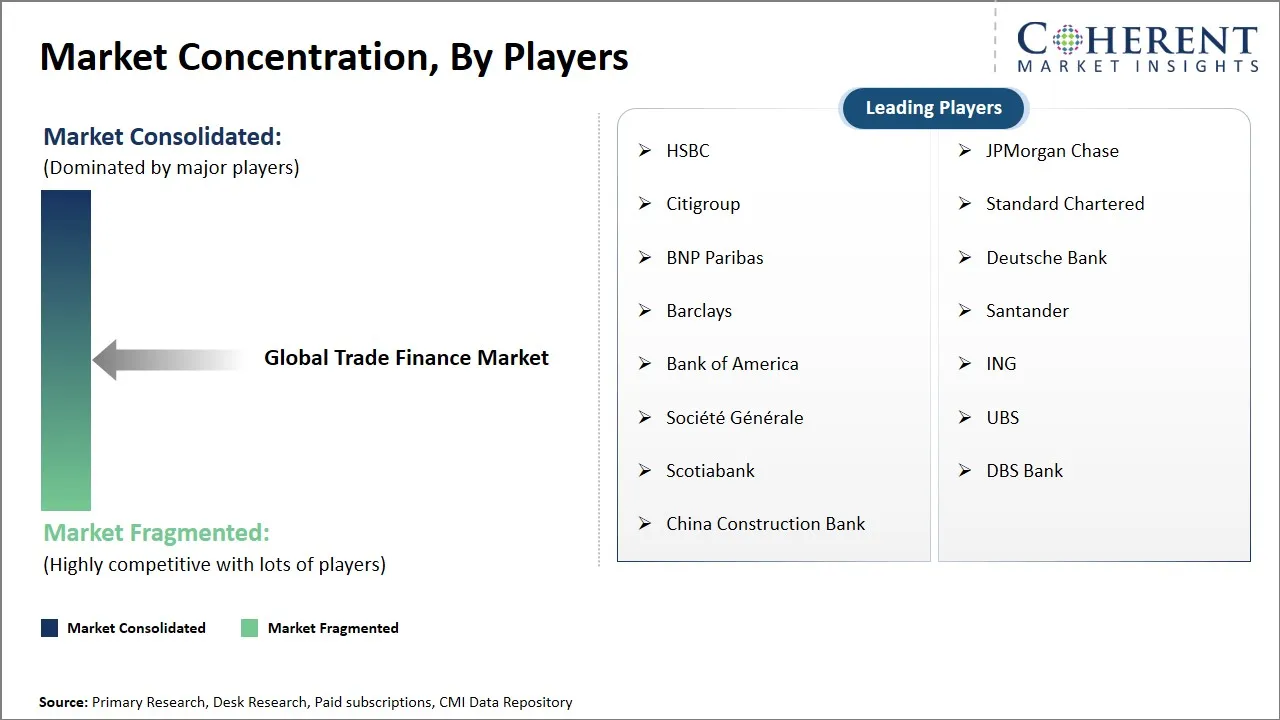
| Companies covered: | HSBC, JPMorgan Chase, Citigroup, Standard Chartered, BNP Paribas, Deutsche Bank, Barclays, Santander, Bank of America, ING, Société Générale, UBS, Scotiabank, DBS Bank, and China Construction Bank | ||
| Growth Drivers: |
| ||
| Restraints & Challenges: |
| ||
Market Dynamics
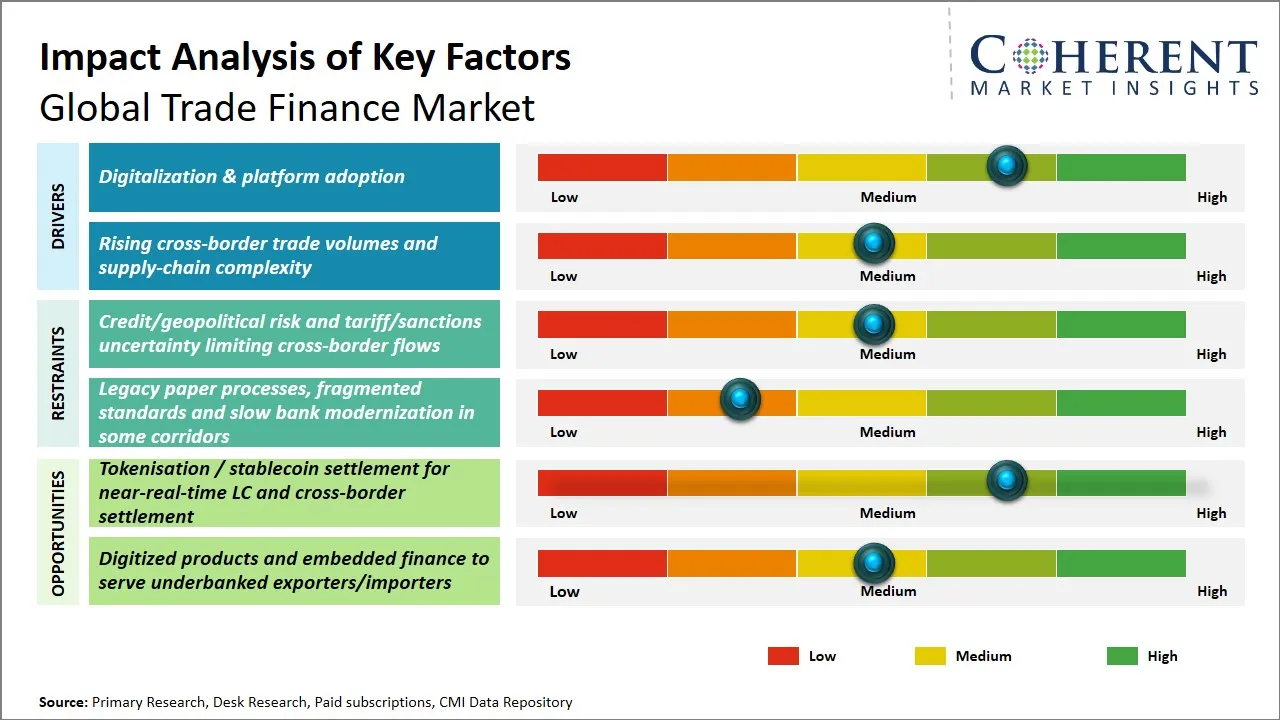
Global Trade Finance Market Driver – Digitalization & Platform Adoption
Persistent credit and geopolitical risks continue to constrain global trade finance, especially amid rising tariffs, sanctions, and political tensions that disrupt established supply chains. Exporters and financiers face heightened uncertainty due to currency volatility, compliance costs, and shifting trade alliances. The Russia–Ukraine conflict, for instance, has led to restructured trade corridors and reduced financing flows through sanctioned regions, forcing banks to reassess credit exposures and compliance mechanisms.
These geopolitical disruptions increase financing costs and restrict liquidity, particularly for SMEs operating in high-risk markets. As a result, global trade participants are prioritizing enhanced due diligence, political risk insurance, and diversified trade routes to mitigate exposure and sustain cross-border operations.
Global Trade Finance Market Opportunity – Tokenization and Stablecoin Settlement for Near-Real-Time Letters of Credit and Cross-Border Transactions
Tokenization and stablecoin-based settlement offer transformative potential for global trade finance by enabling real-time processing of Letters of Credit and cross-border payments. Converting trade assets into blockchain-based tokens ensures secure, auditable, and programmable transactions, while stablecoins facilitate instant, low-cost fund transfers without reliance on traditional banking intermediaries. An example is Standard Chartered’s partnership with Partior, a blockchain-based network enabling instant cross-border settlements using tokenized deposits.
These innovations cut settlement times from days to minutes, improving liquidity, reducing fraud, and enhancing transparency. As financial institutions and regulators increasingly test tokenized trade ecosystems, stablecoin-enabled trade finance is emerging as a cornerstone for the next phase of digital, efficient, and inclusive global commerce.
Analyst Opinion (Expert Opinion)
- The trade finance ecosystem sees outdated, paper-heavy processes and siloed systems across banks, corporates, and regulators. This fragmentation makes transactions slower and affects transparency and scalability.
- Ongoing geopolitical conflicts, tariff disputes, and sanctions are affecting confidence among global lenders. Banks are becoming more careful, tightening credit lines, and increasing compliance scrutiny—particularly for SMEs and emerging market traders. This has made a liquidity squeeze that directly contradicts the market’s goal of fostering inclusive trade growth, leaving smaller exporters stranded in a tightening credit environment.
- While regulation is needed for integrity and risk mitigation, inconsistent global standards and over-stringent compliance requirements are affecting trade finance fluidity. Divergent Know-Your-Customer (KYC) rules and anti-money-laundering frameworks force financial institutions to allocate excessive resources to documentation rather than innovation. Without harmonized regulatory cooperation, even the most advanced digital trade solutions will struggle to scale effectively across borders.
Speak to the analyst
Want personalized insights?
Take the findings above to one of our principal consultants, or have the report rebuilt around the segments, geographies and competitors you actually track.
Market Segmentation
- Product Type Insights (Revenue, USD Tn, 2021 - 2033)
- Letters of Credit (LC)
- Guarantees
- Export Credit & Insurance
- Documentary Collection
- Others
- Provider Type Insights (Revenue, USD Tn, 2021 - 2033)
- Banks
- Non-Banking Financial Institutions (NBFIs)
- Credit Insurance Companies & ECAs
- Fintech/Digital Trade Finance Platforms
- Trade Type Insights (Revenue, USD Tn, 2021 - 2033)
- International Trade Finance
- Domestic Trade Finance
- End-Use Industry Insights (Revenue, USD Tn, 2021 - 2033)
- Manufacturing
- Automotive & Transportation
- Energy & Power
- Metals & Mining
- Agriculture & Commodities
- Food & Beverage
- Consumer Goods & Retail
- Pharmaceuticals & Healthcare
- Construction & Infrastructure
- Textiles & Apparel
- Electronics & Technology Equipment
- Regional Insights (Revenue, USD Tn, 2021 - 2033)
- North America
- U.S.
- Canada
- Latin America
- Brazil
- Argentina
- Mexico
- Rest of Latin America
- Europe
- Germany
- U.K.
- Spain
- France
- Italy
- Russia
- Rest of Europe
- Asia Pacific
- China
- India
- Japan
- Australia
- South Korea
- ASEAN
- Rest of Asia Pacific
- Middle East
- GCC Countries
- Israel
- Rest of Middle East
- Africa
- South Africa
- North Africa
- Central Africa
- North America
- Key Players Insights
- HSBC
- JPMorgan Chase
- Citigroup
- Standard Chartered
- BNP Paribas
- Deutsche Bank
- Barclays
- Santander
- Bank of America
- ING
- Societe Generale
- UBS
- Scotiabank
- DBS Bank
- China Construction Bank
Sources
Primary Research Interviews
Stakeholders
- Trade Finance Officers and Relationship Managers from leading banks
- Corporate Treasurers and CFOs from Export-Import Businesses
- Fintech Executives from Digital Trade Finance Platforms
- Supply Chain Finance Managers and Global Trade Advisors
- Legal and Compliance Experts specializing in international banking regulations
- Risk Analysts and Credit Insurance Providers
- Blockchain and Tokenization Technology Consultants in trade finance innovation
Databases
- World Trade Organization (WTO) Trade Finance Database
- International Chamber of Commerce (ICC) Trade Register
- Asian Development Bank (ADB) Trade Finance Gaps Report
- U.S. Department of Commerce – International Trade Administration (ITA)
- Bank for International Settlements (BIS) – Trade Credit Statistics
- OECD Trade in Value Added (TiVA) Database
Magazines
- Global Finance Magazine
- The Banker
- Trade Finance Global Magazine
- Fintech Futures
- Treasury Today
- Global Trade Review (GTR)
Journals
- Journal of International Money and Finance
- Review of Financial Studies in Emerging Markets
- Journal of Banking & Finance
- Global Policy and Economics Journal
- Journal of Financial Innovation and Technology
Newspapers
- The Financial Times (U.K.)
- The Wall Street Journal (U.S.)
- The Economic Times (India)
- South China Morning Post (Hong Kong)
- Gulf Business (U.A.E.)
- Business Standard (India)
Associations
- International Chamber of Commerce (ICC)
- Bankers Association for Finance and Trade (BAFT)
- Asian Bankers Association (ABA)
- International Trade and Forfaiting Association (ITFA)
- World Trade Organization (WTO)
- The Digital Standards Initiative (DSI)
Public Domain Sources
- World Bank – Global Financial Development Database
- International Monetary Fund (IMF) – Global Financial Stability Report
- United Nations Conference on Trade and Development (UNCTAD)
- WTO – Annual World Trade Statistical Review
- ResearchGate – Open-access trade finance research papers
- Bank for International Settlements (BIS) – Global Trade Credit Insights
Proprietary Elements
- CMI Data Analytics Tool
- Proprietary CMI Existing Repository of Information for the Last 8 Years
Get access to 250+ pages report
Every segment, forecast, competitor profile and data table behind the analysis above — available for instant download.
- ESOMAR Member
- ISO 9001:2015 Certified
- D-U-N-S Registered
- GDPR & CCPA Compliant
Missing comfort of reading report in your local language? Find your preferred language:
Transform your Strategy with Exclusive Trending Reports
Frequently Asked Questions
The global trade finance market is estimated to be valued at USD 55.120 trillion in 2026 and is expected to reach USD 74.510 trillion by 2033.
The CAGR of the global trade finance market is projected to be 4.4% from 2026 to 2033.
Digitalization & platform adoption and rising cross-border trade volumes and supply-chain complexity are the major factors driving the growth of the global trade finance market.
Credit/geopolitical risk and tariff/sanctions uncertainty limiting cross-border flows and legacy paper processes, fragmented standards and slow bank modernization in some corridors are the major factors hampering the growth of the global trade finance market.
In terms of product type, the Letters of Credit (LC) segment is estimated to dominate the market revenue share in 2026.
Blockchain enables secure, transparent, and tamper-proof transactions, reducing fraud and paperwork while speeding up settlements.
Fintechs are digitizing trade finance workflows, offering faster approvals, better risk analytics, and improved SME inclusion.