

Global Blowout Preventer Market Size and Forecast – 2026-2033
The global blowout preventer market is estimated to be valued at USD 7,834.3 Mn in 2026 and is expected to reach USD 10,690.0 Mn by 2033, exhibiting a compound annual growth rate (CAGR) of 4.5% from 2026 to 2033.
Key Takeaways of the Blowout Preventer Market
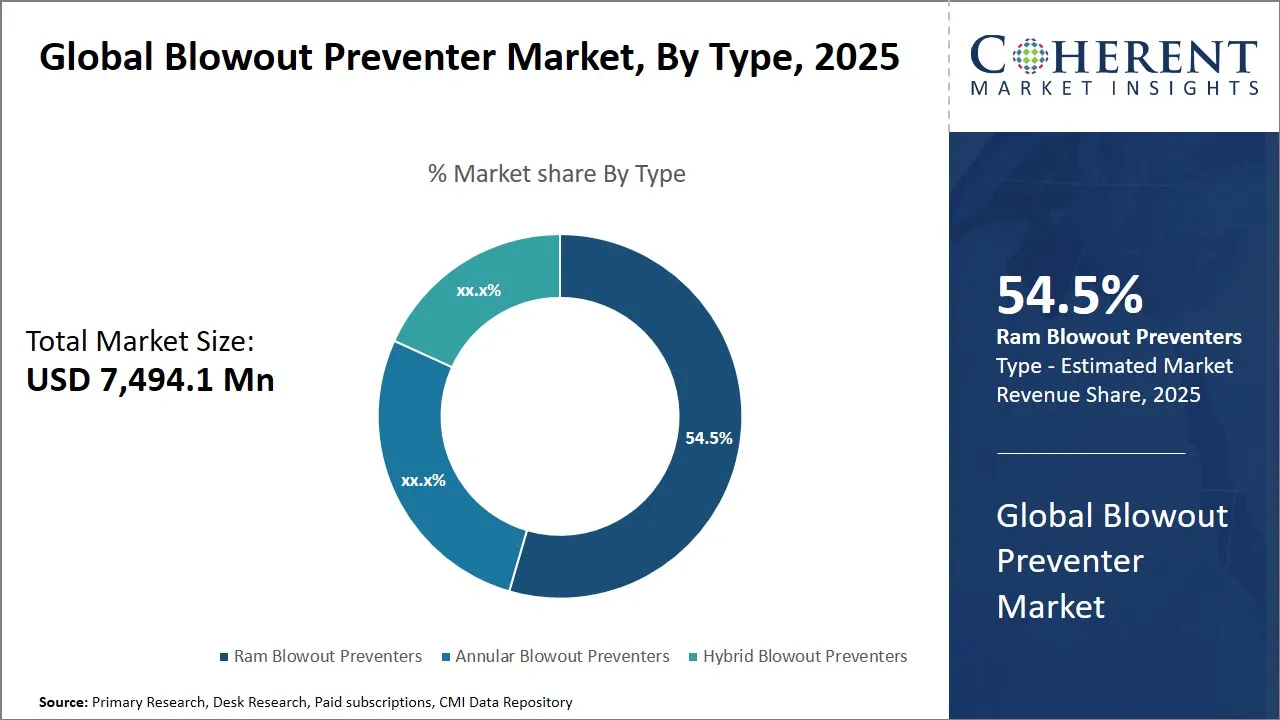
- Ram blowout preventers segment is projected to account for 55.5 % of the global blowout preventer market share in 2026.
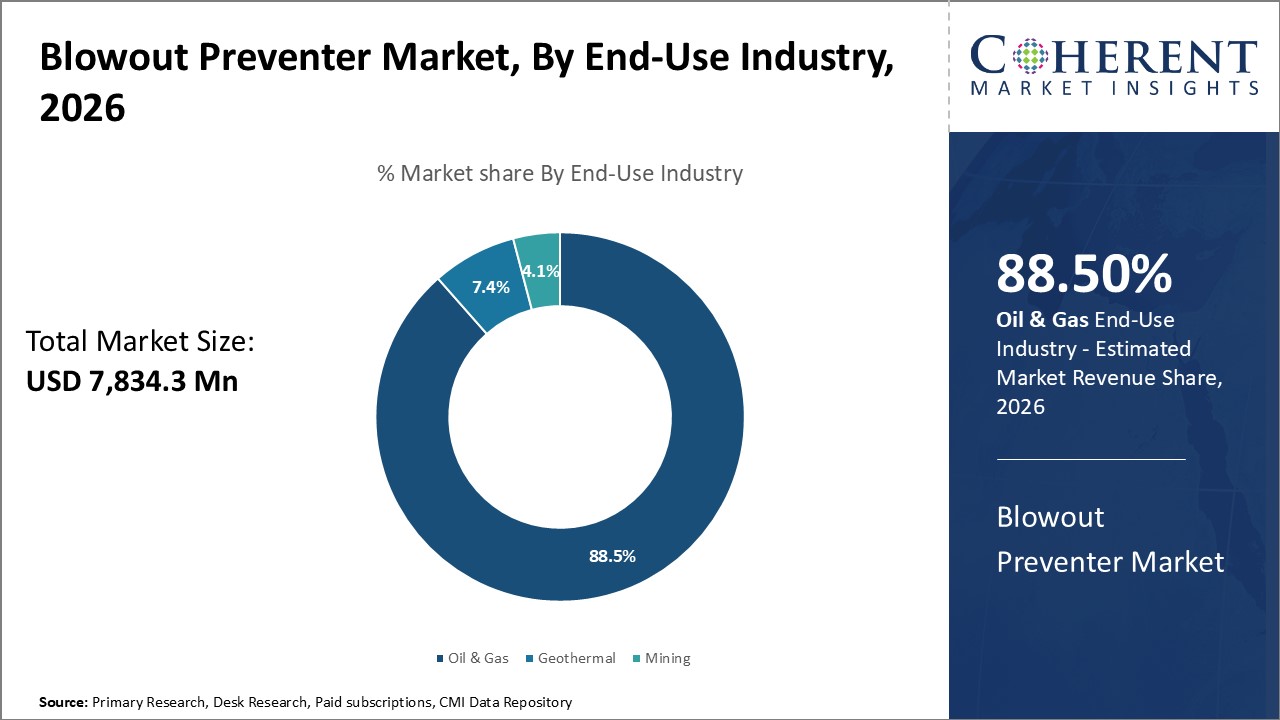
- The oil & gas segment is expected to dominate the blowout preventer market in 2026 with 88.50 % share.
- The onshore segment is estimated to capture 67.9 % of the market share in 2026.
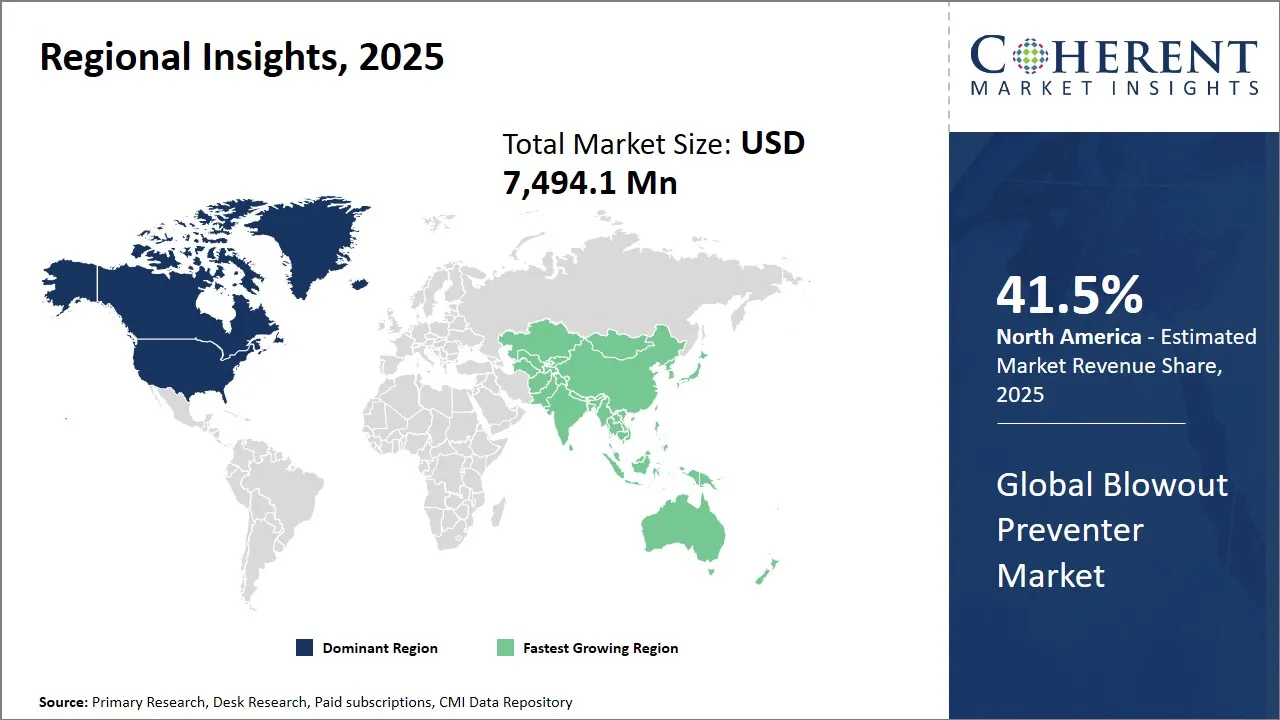
- North America is expected to lead the blowout preventer market in 2026 with a 41.5 % share. Asia Pacific is anticipated to be the fastest-growing region, with a projected market share of 25.8% in 2026.
Market Overview
One of the prominent market tendencies is the growing use of automated and remotely controlled blowout preventers, which can be explained by the development of digital technologies and the growing importance attributed to the issue of operational safety and efficiency. Also, the environmental issues and pressure by regulation are making businesses to upgrade their current equipment to more reliable and technologically advanced blowout preventers, which gives rise to innovation and potential growth in the industry.
Current Events and Its Impact
Current Events | Description and its Impact |
2023 U.S. BSEE Final Well Control Rule tightening offshore BOP requirements |
|
New wave of deepwater and ultra-high-pressure projects (e.g., Chevron Anchor, TotalEnergies Kaminho and 20k-psi class) |
|
Segmental Insights
- Current Industry Events of 2026
- Market Size Estimation
- Regional Breakdown
- Competitive Landscape
- Customer Intelligence
- Segmental Analysis
- Pricing Analysis
- Key Market Drivers, Challenges & Future Trends
- Customized Insights Section
Blowout Preventer Market Insights, By Type - Ram Blowout Preventers Segment Dominates the Market Driven by Superior Sealing and Reliability
Ram blowout preventers segment is expected to account for 55.5% of the market share in 2026. This is mainly because of their strong construction and high sealing capacities that could easily avoid uncontrolled discharge of fluid and hydrocarbons during the drilling activities. Ram BOPs are also drilled using hydraulically activated rams which constantly seal the wellbore by squeezing around the open pipe or by closing the open hole entirely. The mechanism can be easily adapted to applications where a high mechanical seal is needed to assure well integrity in extreme pressure situations.
In 2022, Cameron, a Schlumberger company, deployed advanced Dual Ram BOPs for offshore rigs in the U.S. Gulf of Mexico, capable of maintaining well control under pressures exceeding 15,000 psi. These systems enhanced operational safety and reliability, reducing downtime and operational risks during deepwater drilling campaigns.
Blowout Preventer Market Insights, By End-use Industry - Oil & Gas Segment Pivotal Role Propelling Demand Through Expansive Drilling Activities
The oil & gas segment is set to hold 88.50% of the blowout preventer market share in 2026. This eminence can be explained by the fact that the BOPs are critical in the safety and compliance of the operations in the oil and gas drills, which is still vast and sophisticated to date worldwide. The blowout preventers cannot be overlooked in the prevention of disastrous blowouts in the course of the exploratory drilling as well as the production drilling and therefore they are essential in the development of the oil and gas fields.
The ongoing demand of reaching new reserves, such as unconventional and deepwater reserves has resulted in the application of more advanced BOP systems. Such systems need to have the ability to cope with increased pressure, formations that are variable and extended operational times. In addition, the high level of safety standards and environmental control in the oil and gas business increases the need to aim at high-quality blowout prevention equipment to prevent disasters that may cause environmental harm and losses.
Blowout Preventer Market Insights, By Location - Onshore Prevalence Supported by Operational Accessibility and Cost Efficiency
Onshore segment is projected to hold 67.9% of the market share in 2026. This supremacy is informed by the operational flair that comes with onshore drilling as opposed to offshore operations. Onshore drilling location allows easier transportation of equipment, maintenance and man power which is translated into less logistical complexity and less cost. These aspects create a more cost-efficient environment on the use and maintenance of blowout preventers.
Onshore fields typically entail a wide range of geology with the need to adjust the BOP solution that is flexible enough to accommodate the different pressure and well specifications. The onshore drilling conditions allow installation to be more easily affected and the deployment of blowout preventers takes a shorter time to react to changing well conditions. Moreover, the weaker environmental regulation compared to offshore drilling makes the onshore operations less prone to delay and regulatory inconveniences to promote the constant use of BOP.
Regional Insights
North America Blowout Preventer Market Analysis and Trends
The North America region is projected to lead the market with a 41.5% share in 2026, due to the good infrastructure of the oil and gas industry, technological advancement, and the tight safety measures. The U.S. and Canada are empires of the well-developed market consisting of offshore and onshore drilling operations, which requires complex blowout preventer (BOP) system to guarantee safety in functioning and compliance with the regulations.
The policy of the governmental activities in this region is focused on environmental protection and preventing accidents, which serves as an additional driver of the demand on high reliability and modernized BOP. The leading companies of this industry, including National Oilwell Varco (NOV), Cameron (a Schlumberger corporation) and GE Oil & Gas have their large manufacturing and research hubs here, with the latter being the source of innovation and strong supply background.
Asia Pacific Blowout Preventer Market Analysis and Trends
The Asia Pacific region is expected to exhibit the fastest growth in the market contributing 25.8% share in 2026, as a result of the increase in the exploration and production (E&P) operations in countries such as China, India, and Malaysia. The growth drivers are increasing offshore projects, new natural gas and oil reserves, and the expenditure of more government actions on the energy security. Also, some countries in the Asia Pacific are tightening regulatory provisions concerning the safety of drilling activities, which prompts the need to seek advanced BOP systems.
This market ecosystem is changing and the support comes by the rising local producers like Tendeka (sells BOP components) and the effective involvement of global giants like TechnipFMC and Schlumberger. Its dynamic trading environment that is accompanied by the growth in foreign direct investments and public-private partnerships allow it to adopt innovative technologies faster and expand its supply chains making it the fastest growing market.
Global Blowout Preventer Market Outlook for Key Countries
U.S. Blowout Preventer Market Analysis and Trends
The blowout preventer business in the U.S. is characterized by the developed oil and gas industry, offshore within the Gulf of Mexico and onshore shale developments. Strict federal standards such as those provided by agencies such as the Bureau of Safety and Environmental Enforcement (BSEE) require the implementation of well-known and advanced blowout preventer systems, which is likely to create innovation. Major manufacturers like Cameron and NOV have substantial manufacturing units and technological testing facilities in this region, supplying the high-performance BOPs according to the high safety standards. Key R&D activities also take place in the U.S. which encourages development of automated and intelligent BOP technology that enhances blowout detection and blow out control.
China Blowout Preventer Market Analysis and Trends
The fast industrialization of China and increasing energy need also contribute to exploration and offshore drilling activities, especially in the South China Sea. Through policies and subsidies, the government promotes the increase in capacity of domestic production and the modernization of the drilling equipment which reinforces the blowout preventer market growth. Some of the Chinese firms such as China Oilfield Services and Sinosun Technologies are taking a more direction of working with international suppliers in an effort to enhance the quality and reliability of the equipment.
Brazil Blowout Preventer Market Analysis and Trends
The oil field in the pre-salt region offers extensive offshore oil fields and this offshore oil field can be considered the main factor affecting the Brazil blowout preventer market because it needs unique BOP systems that can withstand extreme pressure and deepwater environment. Petrobras is a state-owned oil conglomerate in Brazil, which is a key factor in the increasing demand by massive exploration.
The firm works in close cooperation with such manufacturers as Technip FMC and NOV, deploying new BOP technologies in relation to deepwater settings. The regulatory particularism of Brazilian environmental protection also improves the safety and blowout prevention attention, which contributes to the necessity of high reliability and resilience of BOP elements.
India Blowout Preventer Market Analysis and Trends
The increasing interest of India’s domestic production of fossil fuels highlights the importance of blowout preventers especially with the trend of increase in offshore operations in Mumbai High and Krishna-Godavari fields. Governments efforts to increase energy autonomy and partnership with foreign energy companies have enhanced the investments in oilfield equipment.
The firms such as Cairn India (which is part of Vedanta) and ONGC team up with international equipment vendors such as Schlumberger and Weatherford to acquire BOPs that are internationally standardized. Furthermore, India is increasingly improving the regulatory conditions to assure a safer drilling process, which is even more stimulating the demand on the market.
Norway Blowout Preventer Market Analysis and Trends
Norway still dominates in deepwater drilling technologies in the European region with the aid of its developed North Sea oil and gas industry. The high environmental regulations and focus on job safety by the Norwegian governments give rise to the use of new innovative technologies in blowout preventers.
One of the domestic players that have facilitated the development of the market is Statoil (since renamed Equinor) and Aker Solutions that are working in conjunction with international players like Cameron and GE Oil & Gas. The extensive involvement of Norway’s in offshore research combined with its well-developed supplier base makes it a large market for highly specialized equipment of blowout preventers to be used in extreme conditions.
Digitalization and Real-Time Monitoring in BOP Systems
- Digitalized BOP systems capture vast volumes of operational data, including hydraulic pressure readings, cycle counts, asset information, historical maintenance, leak detection, and test results.
- Real-time data collection enables 24/7 monitoring, with up to tens of thousands of data tags streamed continuously via secure communication channels (e.g., VSAT satellite).
- Data storage platforms (such as OSIsoft PI Historian) integrate operational data with asset metadata (make/model, serial number, installation date, historical tests).
- Preventive maintenance and health indices are calculated from historical and operational data, allowing rapid anomaly reporting and regulatory compliance.
- Real-time monitoring dashboards provide actionable insights to field engineers and rig personnel for quick response and maintenance planning.
- The dataset covers both surface and subsea BOP systems and supports integration of engineering documentation and historical test data for comprehensive monitoring.
- Asset condition, cycle history, control system performance, and test results are visualized and tracked for regulatory reporting and risk mitigation.
Market Players, Key Development, and Competitive Intelligence
Key Development
- In June 2024, INTLEF launched the QL-type blowout preventer, which enables quick and effortless bonnet opening or closing for ram seal or assembly replacement.
Top Strategies Followed by Global Blowout Preventer Market Players
- The established market leaders usually invest a lot in research and development (R&D) to facilitate innovation to create high-performance BOPs satisfying the changing needs of the oil and gas sector. Such businesses focus on the technological developments like cellular control of pressure, safety, and automation in order to make their products unique.
- As an example, Cameron EVO Compact BOL integrates high-level pressure control software and automated diagnostics, enhancing the real-time control and reliability of operations during the drilling of deepwater.
- Mid-level players would have a slightly different strategy as they are more concerned with offering effective solutions that could be affordable and high quality. Having noted the financial limitations of most oilfield operators, these companies make their products to be basic in terms of performance and safety rather than having the extra features that define the best of the best devices. This pricing will enable them to attract price-sensitive buyers particularly in developing regions, small drilling companies and contractors.
- Worldwide Oilfield Machine manufactures Hydraulic Ram BOPs as an example, which provide the much-needed well control capabilities at a reduced price than the expensive models of the multinational giants. These companies serve regional operators and independent drillers who are interested in simple solutions that are not expensive to add to full digital automation.
- The presence of small-scale players in the global blowout preventer market brings specific niches and targeting specific features and innovative versions of the product that can meet the needs of specific customers. It could be the development of lighter, smaller blowout preventers to use in the unconventional drilling processes, or the incorporation of digital monitoring tools to enhance the transparency of their operations, but these companies are using the latest technology to make them stand out among the crowd of a highly competitive market.
- For example, Shenkais Compact Modular BOP Series is designed to suit unconventional and shallow drilling actions and focuses on portability and easy maintenance. AXON, in its turn, is oriented towards the digital integration of its BOPs sensor-based monitoring systems can deliver operators predictive maintenance alerts and pressure analytics.
Market Report Scope
Blowout Preventer Market Report Coverage
| Report Coverage | Details | ||
|---|---|---|---|
| Base Year: | 2025 | Market Size in 2026: | USD 7,834.3 Mn |
| Historical Data for: | 2020 To 2024 | Forecast Period: | 2026 To 2033 |
| Forecast Period 2026 to 2033 CAGR: | 4.5% | 2033 Value Projection: | USD 10,690.0 Mn |
| Geographies covered: |
| ||
| Segments covered: |
| ||
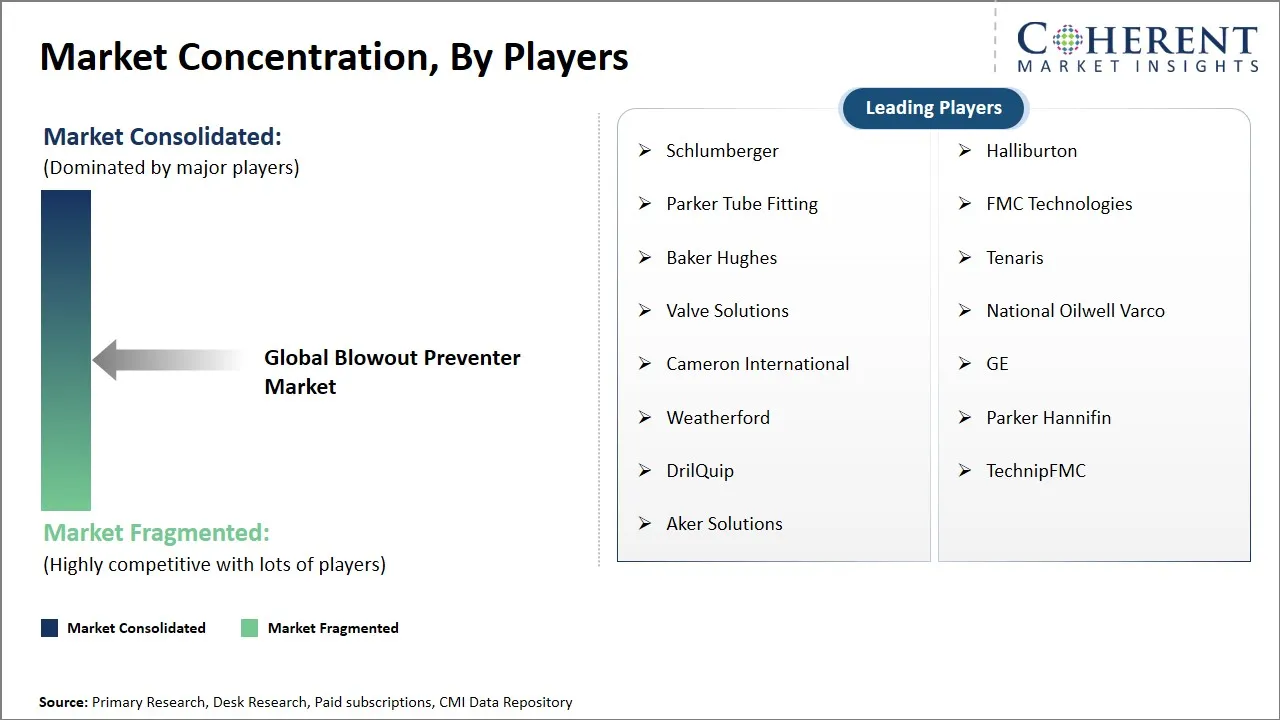
| Companies covered: | Schlumberger, Halliburton, Parker Tube Fitting, FMC Technologies, Baker Hughes, Tenaris, Valve Solutions, National Oilwell Varco, Cameron International, GE, Weatherford, Parker Hannifin, DrilQuip, TechnipFMC, and Aker Solutions | ||
| Growth Drivers: |
| ||
| Restraints & Challenges: |
| ||
Blowout Preventer Market Dynamics
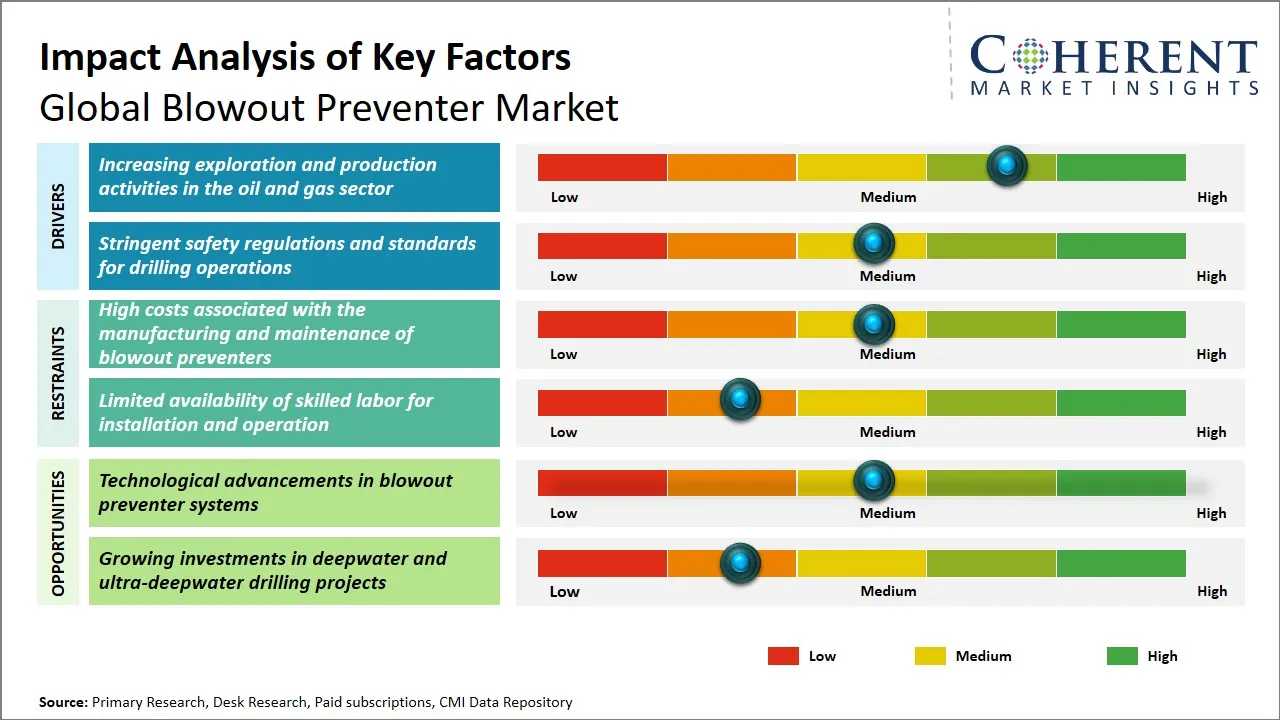
Blowout Preventer Market Driver - Increasing Exploration and Production Activities in the Oil and Gas Sector
The increasing exploration and production (E&P) operations in the oil and gas industry are to a great extent driving the demand of blowout preventers (BOPs) in the world. The necessity to use the advanced equipment of well control is urgent as the companies working in the sphere of energy explore new and rather problematic fields (deepwater, ultra-deepwater, and unconventional reserves) in order to provide the safety of the work and protect the nature. As the world tries to fulfill its energy needs and substitute the dwindling mature fields, the focus of the E/P operators has shifted towards effective safety systems to forestall the occurrence of the blowouts hence BOPs are essential.
As an example, Shell and Equinox have recently (2024) expanded their deep-water drilling projects in the Gulf of Mexico and the pre-salt basins of Brazil’s requiring high-pressure underwater BOP systems to sustain high-pressure extreme well conditions.
Blowout Preventer Market Opportunity - Technological Advancements in Blowout Preventer Systems
There have been notable growth opportunities in the global market of blowout preventer which is attributable to the ever-increasing technological development in the BOP systems. The introduction of digital, smart sensors, real-time monitoring, and automation are some of the innovations transforming the efficiency and safety standard of blowout preventers. The contemporary BOPs are becoming smarter diagnostic making operators able to anticipate possible malfunctions in the early stages and perform preventive maintenance and shorten the downtime to the minimum and eliminate operational risks. Also, in materials science, increased strengths and corrosion resistance of components increased the lifespan of BOP systems even in severe offshore pipeline conditions.
As an example, in 2024, Cameron (a Schlumberger company) launched its next-generation BOP, which has built-in condition-based monitoring sensors that transmit real-time to surface control units to enhance fault diagnostics. On the same note, NOV introduced digital BOP control pods, which could monitor the hydraulic and ram position in real-time thus eliminating the chances of blowouts to a large extent.
Analyst Opinion (Expert Opinion)
- The global market for blowout preventer is expected to grow significantly, as a result of the growing attention to safety and risk management in the oil and gas industry. The information provided by the Offshore Technology Conference (2023) and the World Petroleum Congress (2022) has revealed major innovations, and such companies as Schlumberger and Dover Precision Components are on the forefront of developing the BOP technology and design.
- The introduction of a new state of the art BOP with improved monitoring systems by Schlumberger’s is an indication of how the market is responding to the increasing demand of real time data and reliability in blowout prevention. The importance of regulatory compliance and the development of smart technologies as a foundation to enhance operational safety and efficiency was discussed at these conferences as a necessity.
- However, challenges such as high maintenance costs and the need for skilled personnel were frequently noted as barriers to market expansion. Companies that invest in R&D to develop cost-effective and user-friendly BOP solutions and engage in strategic partnerships with drilling contractors will likely gain a competitive edge. Ultimately, the growth of the global blowout preventer market will depend on its ability to innovate while addressing the stringent safety requirements of the evolving oil and gas sector.
Speak to the analyst
Want personalized insights?
Take the findings above to one of our principal consultants, or have the report rebuilt around the segments, geographies and competitors you actually track.
Market Segmentation
- Type Insights (Revenue, USD Mn, 2021 - 2033)
- Ram Blowout Preventers
- Annular Blowout Preventers
- Hybrid Blowout Preventers
- End-use Industry Insights (Revenue, USD Mn, 2021 - 2033)
- Oil & Gas
- Geothermal
- Mining
- Location Insights (Revenue, USD Mn, 2021 - 2033)
- Onshore
- Offshore
- Regional Insights (Revenue, USD Mn, 2021 - 2033)
- North America
- U.S.
- Canada
- Latin America
- Brazil
- Argentina
- Mexico
- Rest of Latin America
- Europe
- Germany
- U.K.
- Spain
- France
- Italy
- Russia
- Rest of Europe
- Asia Pacific
- China
- India
- Japan
- Australia
- South Korea
- ASEAN
- Rest of Asia Pacific
- Middle East
- GCC Countries
- Israel
- Rest of Middle East
- Africa
- South Africa
- North Africa
- Central Africa
- North America
- Key Players Insights
- Schlumberger
- Halliburton
- Parker Tube Fitting
- FMC Technologies
- Baker Hughes
- Tenaris
- Valve Solutions
- National Oilwell Varco
- Cameron International
- GE
- Weatherford
- Parker Hannifin
- DrilQuip
- TechnipFMC
- Aker Solutions
Sources
Primary Research Interviews
- R&D Director – Leading Blowout Preventer Manufacturer
- Procurement Manager – Major Oilfield Service Provider
- Product Development Head – Well-Known Blowout Preventer Brand
- Safety & Compliance Manager – Blowout Preventer Certification Body
Stakeholders
- Manufacturers (e.g., Schlumberger, Halliburton, Baker Hughes, Weatherford)
- End-use Sectors
- Offshore Drilling Operators
- Onshore Drilling Companies
- Oil & Gas Exploration and Production Firms
- Regulatory & Certification Bodies
- Oilfield Services Companies
- Technology Integration Players: Providers of automation and remote monitoring for BOP systems
Databases
- UN Comtrade Database (trade data of blowout preventers and components)
- India Import Export (EXIM) Database (regional trade data)
Magazines
- Oil & Gas Journal – Industry trends and technology updates
- Offshore Engineer – Technical developments and project insights
- World Oil – Market dynamics and drilling technology
- Rigzone Magazine – Operational news and BOP market developments
- Energy Intelligence – Market forecasts and regulatory updates
Journals
- Journal of Petroleum Technology – Advances in blowout preventer technology
- SPE Drilling & Completion Journal – Research on well control systems
- Journal of Loss Prevention in the Process Industries – Safety and risk analysis
- International Journal of Pressure Vessels and Piping – Engineering and materials research
- Offshore Mechanics and Arctic Engineering Journal – Offshore rig equipment studies
Newspapers
- Financial Times – Oil and gas market developments impacting BOP demand
- The Wall Street Journal – Industry news and analysis
- The Guardian – Environmental and regulatory issues in drilling safety
- Asia Times – Regional offshore drilling market trends
Associations
- American Petroleum Institute (API) – Standards and certification for BOPs
- International Association of Drilling Contractors (IADC)
- Society of Petroleum Engineers (SPE)
- Offshore Operators Committee (OOC)
Public Domain Sources
- U.S. Department of Energy – Reports on drilling safety and well control
- U.S. Bureau of Safety and Environmental Enforcement (BSEE) – Safety regulations and compliance
- European Commission – Offshore safety directives
- International Energy Agency (IEA) – Market outlook and technology trends
- National Institute of Occupational Safety and Health (NIOSH) – Safety standards
Proprietary Elements
- CMI Data Analytics Tool, Proprietary CMI Existing Repository of information for last 8 years.
Get access to 250+ pages report
Every segment, forecast, competitor profile and data table behind the analysis above — available for instant download.
- ESOMAR Member
- ISO 9001:2015 Certified
- D-U-N-S Registered
- GDPR & CCPA Compliant
Missing comfort of reading report in your local language? Find your preferred language:
Transform your Strategy with Exclusive Trending Reports
Frequently Asked Questions
The global blowout preventer market is estimated to be valued at USD 7,834.3 Mn in 2026 and is expected to reach USD 10,690.0 Mn by 2033.
The CAGR of the global blowout preventer market is projected to be 4.5% from 2026 to 2033.
Increasing exploration and production activities in the oil and gas sector and stringent safety regulations and standards for drilling operations are the major factors driving the growth of the global blowout preventer market.
High costs associated with the manufacturing and maintenance of blowout preventers and limited availability of skilled labor for installation and operation are the major factors hampering the growth of the global blowout preventer market.
In terms of type, the ram blowout preventers segment is estimated to dominate the market revenue share in 2026.
Schlumberger, Halliburton, Parker Tube Fitting, FMC Technologies, Baker Hughes, Tenaris, Valve Solutions, National Oilwell Varco, Cameron International, GE, Weatherford, Parker Hannifin, DrilQuip, TechnipFMC, and Aker Solutions are the major players.
North America is expected to lead the global blowout preventer market in 2026.