

Car Security Market Size and Forecast – 2026 to 2033
Car Security Market is estimated to be valued at USD 17.12 Bn in 2026 and is expected to reach USD 33.15 Bn in 2033, exhibiting a compound annual growth rate (CAGR) of 9.9% from 2026 to 2033.
Key Takeaways
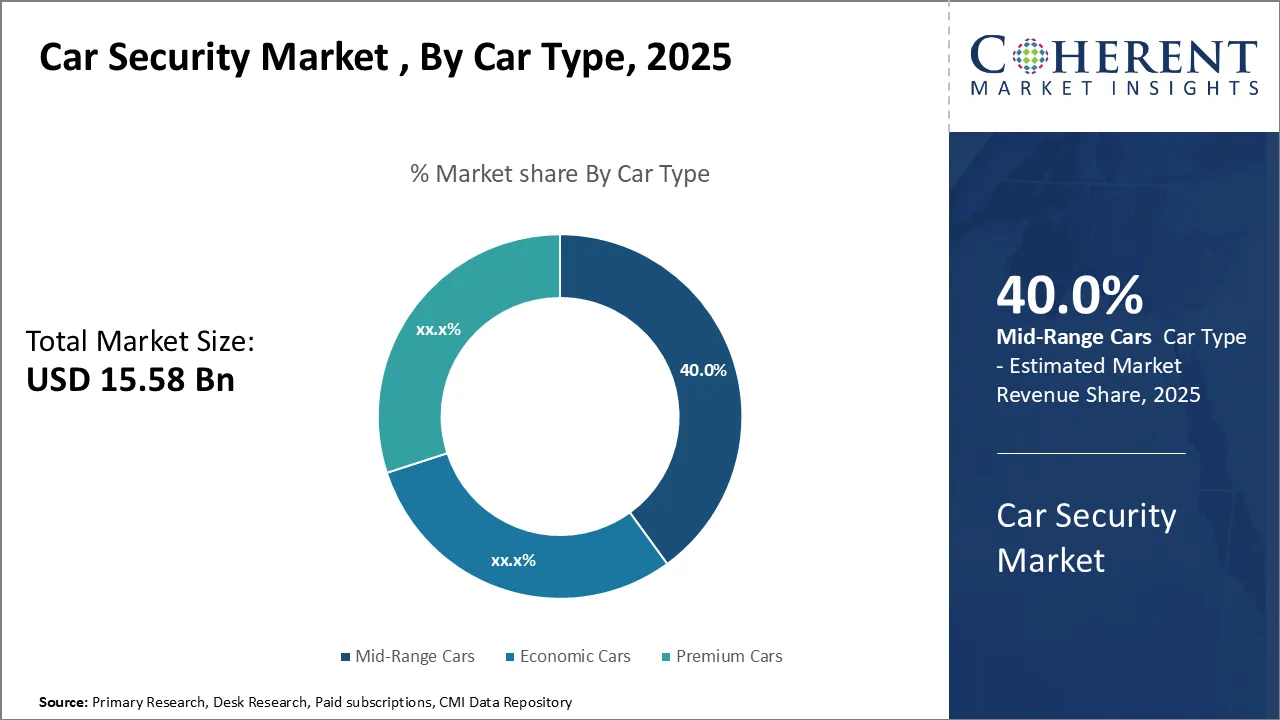
- By Car Type, Mid-Range Cars acquires the prominent market share of 41% in 2026 owing to growing consumer awareness regarding the depreciation of vehicles, especially cars.
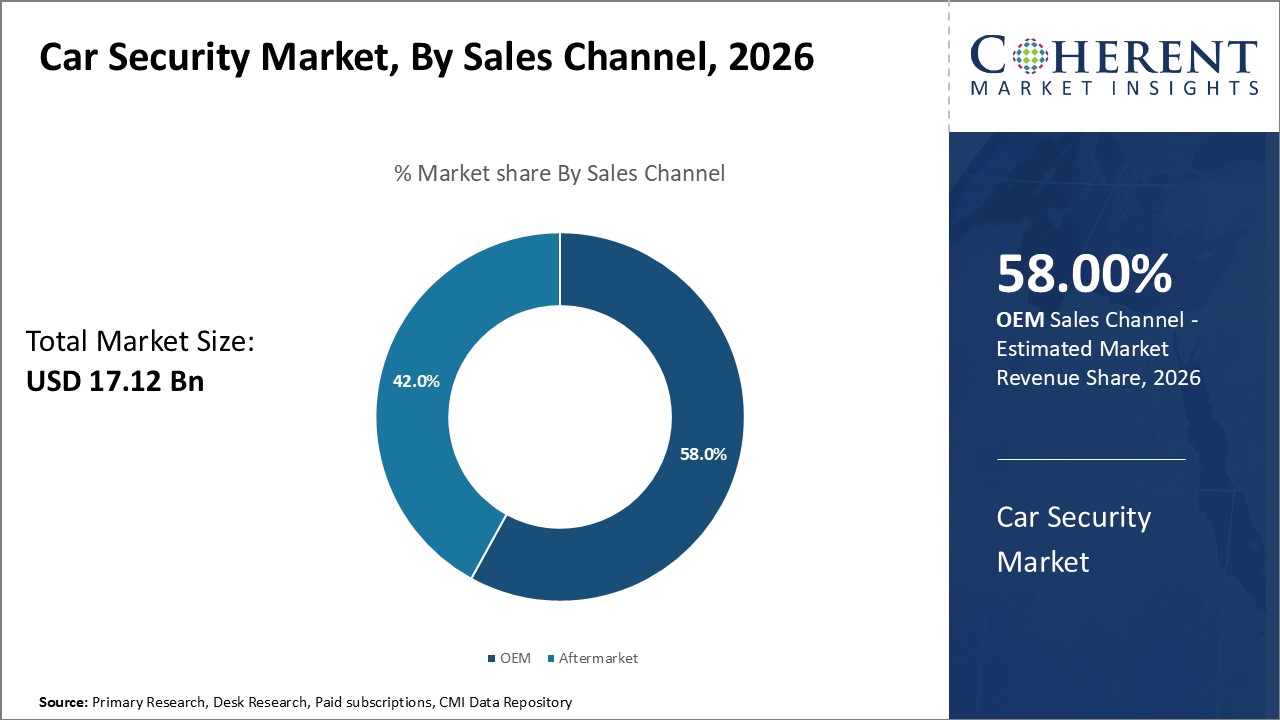
- By Sales Channel, OEM hold the largest market share in 2026 on account of regulatory mandates for vehicle security.
- By Product Type, Remote Central Locking dominates the overall market in 2026 owing to the rising consumer preference for convenience.
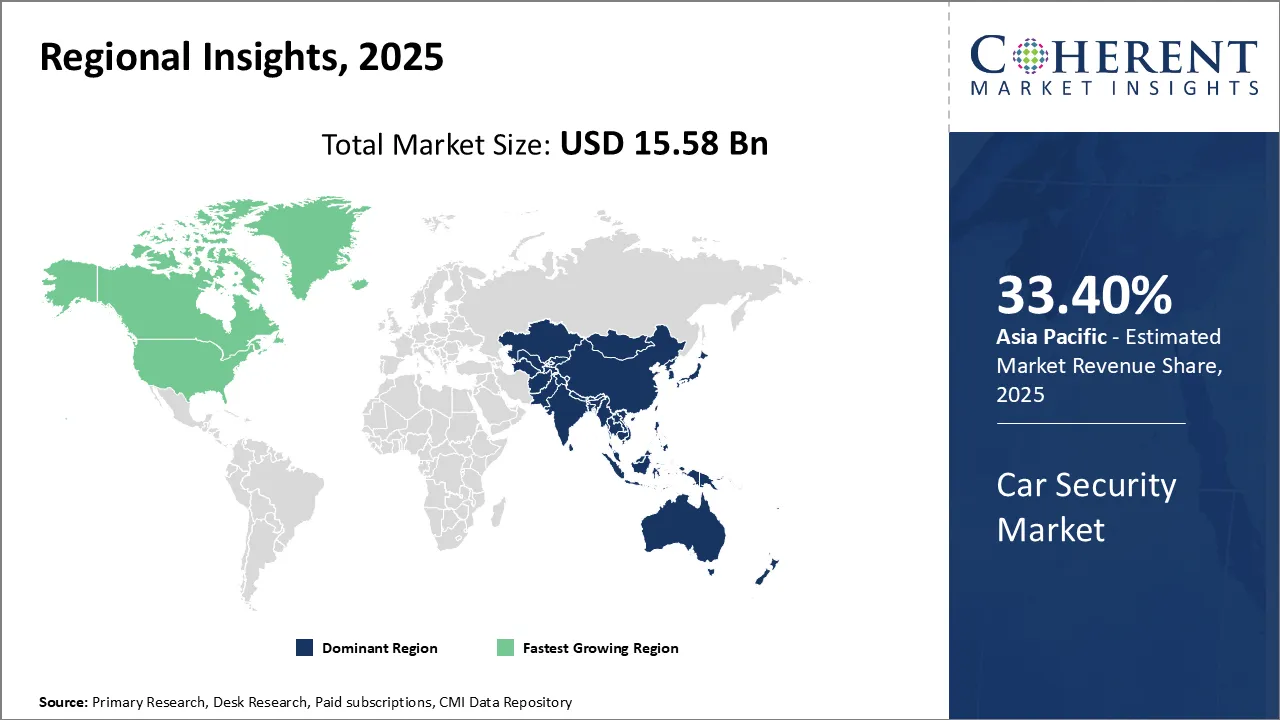
- By Region, Asia-Pacific dominates the overall market with an estimated share of 33.4% in 2026 owing to rapid expansion of the automotive sector.
Market Overview
A car security system, also known as a vehicle security system, is an advanced electronic device installed in automobiles to deter theft of the vehicle or its contents. The specific features and capabilities of car security systems can vary depending on the type of car. High-end luxury vehicles like the BMW 7 Series, Jaguar XK, Audi A6, and others often come equipped with state-of-the-art and sophisticated security systems. These systems encompass various types of security measures, such as immobilizers that prevent the car from being driven away by locking the steering wheel, gear lever, or pedals in position.
Current Events and Its Impact
Current Events | Description and its impact |
Global Rise in Vehicle Theft Rates |
|
Economic Volatility & Supply Chain Issues |
|
Geopolitical Tensions and Cybersecurity Threats |
|
Segmental Insights
- Current Industry Events of 2026
- Market Size Estimation
- Regional Breakdown
- Competitive Landscape
- Customer Intelligence
- Segmental Analysis
- Pricing Analysis
- Key Market Drivers, Challenges & Future Trends
- Customized Insights Section
Car Security Market Insights, by Car Type - Mid-Range Car contribute the highest share of the market owing to its Growing Adoption of Connected Car Technologies
Mid-Range Cars acquires the prominent market share of 41% in 2026. Mid-range cars play a pivotal role in driving growth within the car security market, primarily due to their rising adoption among middle-income consumers across both developed and emerging economies. As these vehicles strike a balance between affordability and modern features, they are becoming increasingly popular among urban buyers. However, their higher visibility and prevalence on roads make them common targets for theft and vandalism. This, in turn, fuels the demand for robust yet cost-effective car security systems.
Car Security Market Insights, by Sales Channel - OEM contribute the highest share of the market owing to its Brand Differentiation and Competitive Advantage
OEMs (Original Equipment Manufacturers) are a major driving force in the car security market, as they are responsible for integrating security features directly into vehicles during the manufacturing process. With growing consumer demand for safety and rising concerns over vehicle theft and cyber threats, OEMs are embedding advanced security systems such as smart keys, immobilizers, remote central locking, GPS-based tracking, and biometric access as standard or optional features. Regulatory mandates across regions—such as mandatory immobilizers or reverse parking sensors—are also compelling OEMs to comply by equipping vehicles with built-in security technologies. For instance, in April 2025, Solera Cap HPI and RWA Automotive collaborated to launch Ignite Network Intelligence, a data-driven solution for used vehicles. With this tool, OEMs can monitor and assess used car performance across the market, analyze how out-of-network pricing impacts residual values, and leverage insights to enhance network efficiency and optimize sales channels.
Car Security Market Insights, by Product Type - Remote Central Locking contribute the highest share of the market owing to its Urbanization and Theft Prevention Needs
Remote central locking is a key segment in the car security market, driven by the rising consumer demand for convenience, safety, and modern vehicle functionality. This system allows drivers to lock or unlock all doors simultaneously from a distance using a remote key fob, smartphone app, or smart key. It enhances security by reducing the likelihood of break-ins, especially in high-risk urban environments, while also offering ease of use for drivers. As technology advances, remote central locking systems are becoming standard features in a wide range of vehicles, including entry-level and mid-range models. OEMs are increasingly integrating these systems during manufacturing to meet consumer expectations and comply with safety regulations. For instance, in February 2025, Renault India announced significant updates to its Kiger and Triber car lines for 2025, focusing on improved accessibility and upgraded features across all models. The updated Kiger and Triber models will come standard with features such as power windows on all four doors and remote central locking throughout the entire lineup.
Role of AI (Artificial Intelligence) in the Car Security Market
AI-powered cameras and sensors can analyze surroundings continuously to detect suspicious activity, such as unauthorized access or potential break-ins, and alert the vehicle owner or security service immediately. ADT and Ford have announced a collaboration to create a solution aimed at safeguarding both vehicles and their cargo from theft. They will invest in a new joint venture offering a vehicle security service that combines ADT’s monitoring with Ford’s AI-powered cameras. Canopy will utilize cameras, acoustic sensors, and AI technology to help ADT and vehicle owners monitor their vehicles. It will record and stream live video, send alerts to both ADT and the owner, use audio warnings to deter thieves, and employ AI to differentiate between real threats and false alarms.
Regional Insights
Asia Pacific Car Security Market Trends
Asia-Pacific dominates the overall market with an estimated share of 33.4% in 2026. Rising vehicle ownership, accelerating urbanization, and increasing concerns over theft and cyber threats are driving the Asia-Pacific car security market growth. As connected and autonomous vehicles become more popular, consumers and manufacturers alike are demanding advanced security systems such as immobilizers, GPS tracking, and AI-powered cybersecurity solutions. Automakers are increasingly integrating biometric authentication and passive keyless entry, especially in mid-range and premium vehicles. In countries like China, India, and Japan, regulatory mandates and safety standards are compelling OEMs to equip vehicles with robust, built-in security technologies to ensure compliance and enhance consumer trust. In June 2026, Chery launched the all-new QQ Domi, a compact electric hatchback in China. It features a wraparound interior with two color options (black-grey and pink-grey), a 7-inch digital instrument panel, a 10.25-inch central touchscreen, voice recognition, keyless entry and start.
North America Car Security Market Trends
The North American automotive cybersecurity market is rapidly expanding as consumers demand secure vehicle networks and data protection, and as regulatory compliance becomes increasingly essential. OEMs are actively implementing multi-layered cybersecurity strategies to protect data from external threats and prevent unauthorized access. Regulatory bodies like UNECE and NHTSA are enforcing strict security standards. U.S. regulations now require cyber threat reporting, secure access systems, and strong privacy protections. These mandates are shaping the region's automotive security landscape by compelling OEMs to embed comprehensive security features and ensure real-time monitoring to maintain compliance. For instance, in January 2026, Honda Motor announced its plan to launch a compact electric vehicle in North America by as early as 2026, aiming for a price point of around $30,000 as it works to catch up in the battery-powered car market. Such vehicle innovations is expected to propel the car security market revenue.
India Car Security Market Trends
Automakers in India are actively adopting voice, facial, and fingerprint sensors to address growing concerns over hacking and relay attacks. Encrypted rolling codes and smart key systems are now standard in many mid-range and luxury vehicles. Fleet operators are rapidly implementing GPS and IoT-enabled real-time tracking solutions. Features such as geofencing, AI-powered predictive analytics, and mandatory government GPS requirements are accelerating adoption. India’s AIS-140 standard further strengthens fleet security by mandating the use of GPS and GSM-based tracking devices in commercial and public transport vehicles, driving widespread deployment of certified security technologies. For instance, Hyundai has revealed new features of the upcoming Alcazar ahead of its launch. The SUV will include dual-zone automatic climate control with a touch-sensitive control panel. It will also offer a Digital Key, enabling users to lock or unlock the vehicle by tapping their smartphone or smartwatch on the door handle. This Digital Key can be shared with up to three users or seven linked devices simultaneously..
United States Car Security Market Trends
More than 70% of new cars in the United States now feature in-car Wi-Fi, V2X communications, and internet-connected telematics. To prevent remote hijacking and unauthorized access, automakers are deploying intrusion detection systems, network firewalls, encrypted wireless protocols, and secure OTA updates. Regulators like NHTSA and UNECE (R155/R156) enforce cybersecurity management standards, secure OTA updates, and mandatory threat monitoring. Automakers must comply to avoid penalties, protect customer data, and build trust. Additionally, automakers and Tier-1 suppliers are increasingly launching bug bounty programs to proactively find and fix vulnerabilities, enhancing transparency, accelerating responses, and anticipating emerging threats.
Market Report Scope
Car Security Market Report Coverage
| Report Coverage | Details | ||
|---|---|---|---|
| Base Year: | 2025 | Market Size in 2026: | USD 17.12 Bn |
| Historical Data for: | 2020 To 2024 | Forecast Period: | 2026 To 2033 |
| Forecast Period 2026 to 2033 CAGR: | 9.9% | 2033 Value Projection: | USD 33.15 Bn |
| Geographies covered: |
| ||
| Segments covered: |
| ||
| Companies covered: | Omron Corporation, Tokai Rika Co., Ltd., Valeo S.A., Continental AG, Delphi Automotive PLC, Robert Bosch GmbH, Denso Corporation, Mitsubishi Electric Corporation | ||
| Growth Drivers: |
| ||
| Restraints & Challenges: |
| ||
End-user Feedback and Unmet Needs in the Car Security Market - End-user Feedback and Unmet Needs
- Demand for Seamless User Experience: End users increasingly want car security systems that offer strong protection without complicating vehicle access or operation. Complex authentication processes or frequent false alarms frustrate consumers. They prefer intuitive, hassle-free solutions like passive keyless entry and biometrics that balance convenience with security.
- Need for Enhanced Cybersecurity Awareness: Many users lack awareness about potential cyber threats targeting connected vehicles. This knowledge gap limits adoption of advanced security features. Consumers seek better education and clear communication from OEMs about risks and protective measures to boost confidence in vehicle cybersecurity systems.
- Integration with Smart Devices and Ecosystems: Users want their car security systems to seamlessly integrate with smartphones, smart homes, and IoT ecosystems. Current fragmentation reduces convenience and limits control options. Unified platforms that allow remote monitoring, alerts, and control via familiar devices are in high demand.
Car Security Market Trend
Rising Adoption of Connected Vehicle Security
With more vehicles connected via internet and IoT, manufacturers are focusing on robust cybersecurity solutions like intrusion detection, encrypted communications, and secure OTA updates. Protecting vehicle networks from hacking and unauthorized access is now a critical priority shaping product development and investments.
Expansion of GPS and IoT-based Tracking Solutions
Real-time vehicle tracking using GPS combined with IoT sensors is growing rapidly for theft prevention and fleet management. Features like geofencing, remote immobilization, and AI-powered analytics enhance security and operational efficiency.
Car Security Market Opportunity
Expansion in Emerging Markets
Rapid urbanization and rising vehicle ownership in emerging economies like India, Southeast Asia, and Latin America offer huge growth potential. Increasing awareness about vehicle theft and cyber threats drives demand for advanced security solutions, creating opportunities for OEMs and aftermarket providers to introduce affordable, innovative technologies tailored to these markets.
Car Security Market News
- In June 2025, Innoviz Technologies Ltd. launched InnovizSMART Long-Range, a high-performance LiDAR sensor designed for smart applications like security, mobility, robotics, aerial use, and intelligent traffic management.
- In April 2025, Chinese SUV maker Jetour planned to enter select European markets in the third quarter, aiming to expand sales across most of the continent by 2027.
- In March 2025, Toyota began selling a $20,000 smart electric car in China this week as it intensifies efforts to regain market share in the world’s largest auto market. The company aims to attract buyers with advanced features that rival those of Chinese competitors.
- In October 2024, the software company of Hyundai Motor Group, Hyundai AutoEver Corp., announced its plan to expand its automotive cybersecurity business by establishing a new division to handle the escalating risks to the global auto industry's transition to connected automobiles and other forms of future mobility.
- In April 2024, Toyota Kirloskar Motor (TKM) launched the All-New Toyota URBAN CRUISER TAISOR in India today, adding a sporty model to its versatile SUV lineup. With this launch, Toyota re-enters the A-SUV market, aiming to offer Indian customers a sense of prestige through modern styling, advanced security features, and cutting-edge technologies.
Analyst Opinion (Expert Opinion)
- The car security market is undergoing a structural transformation that is no longer optional but imperative, driven by a convergence of digital integration and evolving threat vectors. What once revolved around mechanical locks and basic alarms has evolved into a complex ecosystem requiring multi-layered cybersecurity, AI, and real-time connectivity. OEMs that continue to treat security as a post-sale accessory rather than a core product feature will inevitably lose ground.
- The proliferation of connected vehicles, which now comprise over 70% of new cars sold in developed markets like the U.S. and above 50% in China, has transformed every vehicle into a potential entry point for cybercriminals. A 2023 Upstream Security report revealed a 380% increase in cyberattacks targeting automotive systems between 2020 and 2023, most of which were directed at APIs and telematics. This is not a future risk—it’s a current battlefield.
- AI and behavioral biometrics are quickly becoming the front line of vehicle security. For example, Tesla’s use of Sentry Mode, an AI-powered surveillance system, is a clear signal that passive security is no longer sufficient. Similar technologies that integrate facial recognition for driver authentication, already seen in the Genesis GV60 and Nio ET7, are transitioning from luxury perks to baseline requirements.
- From a regulation standpoint, the UNECE WP.29 R155/R156 cybersecurity and software update regulations, enforced across Europe, are setting the global tone. These standards mandate that manufacturers must implement cybersecurity management systems across the vehicle lifecycle. Companies like Volkswagen and BMW are already reengineering their vehicle architectures to comply, giving them an early mover advantage.
Speak to the analyst
Want personalized insights?
Take the findings above to one of our principal consultants, or have the report rebuilt around the segments, geographies and competitors you actually track.
Market Segmentation
- Global Car Security Market, By Car Type (Revenue, USD Bn, 2021 - 2033)
- Economic Cars
- Mid-Range Cars
- Premium cars
- Global Car Security Market, By Sales Channel (Revenue, USD Bn, 2021 - 2033)
- OEM
- Aftermarket
- Global Car Security Market, By Product Type (Revenue, USD Bn, 2021 - 2033)
- Immobilizer system
- Remote Central Locking System
- Alarm System
- Other Systems
- Global Car Security Market By Region (Revenue, USD Bn, 2021 - 2033)
- North America
- U.S.
- Canada
- Latin America
- Brazil
- Argentina
- Mexico
- Rest of Latin America
- Europe
- Germany
- U.K.
- Spain
- France
- Italy
- Russia
- Rest of Europe
- Asia Pacific
- China
- India
- Japan
- Australia
- South Korea
- ASEAN
- Rest of Asia Pacific
- Middle East
- GCC Countries
- Israel
- Rest of Middle East
- Africa
- South Africa
- North Africa
- Central Africa
- North America
- Company Profiles
- Omron Corporation
- Tokai Rika Co., Ltd
- Valeo S.A
- Continental AG
- Delphi Automotive PLC
- Robert Bosch GmbH
- Denso Corporation
- Mitsubishi Electric Corporation
Sources
Primary Research interviews
- Automotive OEM cybersecurity leads
- Tier-1 security system suppliers
- Connected vehicle platform engineers
- Fleet operators and logistics heads
- Regulatory compliance officers
Databases
- SAE MOBILUS
- IEEE Xplore Digital Library
- NHTSA recall and defect databases
- UNECE Regulations Repository
- U.S. DOT Vehicle Safety Databases
Magazines
- Automotive News
- Car and Driver
- Autocar
- AutoTech Review
- Wired (Mobility section)
Journals
- IEEE Transactions on Intelligent Transportation Systems
- Journal of Automotive Safety and Security
- Sensors (MDPI)
- Journal of Cybersecurity
- Vehicle System Dynamics
Newspapers
- The Wall Street Journal (Automotive & Tech)
- The Guardian (Technology)
- The Economic Times (Auto section)
- The Hindu Business Line (Auto)
- The New York Times (Automobiles)
Associations
- Society of Automotive Engineers (SAE)
- Auto-ISAC (Automotive Information Sharing & Analysis Center)
- IAATI (International Association of Auto Theft Investigators)
- ACEA (European Automobile Manufacturers’ Association)
- ACMA (Automotive Component Manufacturers Association of India)
Public Domain sources
- U.S. Department of Transportation (DOT)
- UNECE WP.29 R155 & R156 documentation
- European Commission Mobility and Transport Portal
- AIS-140 Guidelines (India)
- Transport Canada Vehicle Safety Reports
Proprietary Elements
- CMI Data Analytics Tool, and Proprietary CMI Existing Repository of information for last 8 years
Get access to 250+ pages report
Every segment, forecast, competitor profile and data table behind the analysis above — available for instant download.
- ESOMAR Member
- ISO 9001:2015 Certified
- D-U-N-S Registered
- GDPR & CCPA Compliant
Missing comfort of reading report in your local language? Find your preferred language:
Transform your Strategy with Exclusive Trending Reports
Frequently Asked Questions
The Car Security Market is estimated to be valued at USD 17.12 Bn in 2026, and is expected to reach USD 33.15 Bn by 2033.
The CAGR of the Car Security Market is projected to be 9.9% from 2026 to 2033.
The CAGR of the Car Security Market is projected to be 9.9% from 2026 to 2033.
Growing Awareness and Concerns and Suitable regulatory policies and laws are the factors contributing to the growth of the market.
Major players operating in the market include Omron Corporation, Tokai Rika Co., Ltd., Valeo S.A., Continental AG, Delphi Automotive PLC, Robert Bosch GmbH, Denso Corporation, Mitsubishi Electric Corporation
Asia-Pacific dominates the overall market with an estimated share of 33.4% in 2026.