

Global Boron Compounds Market Size and Forecast – 2026-2033
The Global Boron Compounds Market is estimated to be valued at USD 4,474.4 Mn in 2026 and is expected to reach USD 6,316.9 Mn by 2033, exhibiting a compound annual growth rate (CAGR) of 5.1% from 2026 to 2033.
Key Takeaways of the Boron Compounds Market
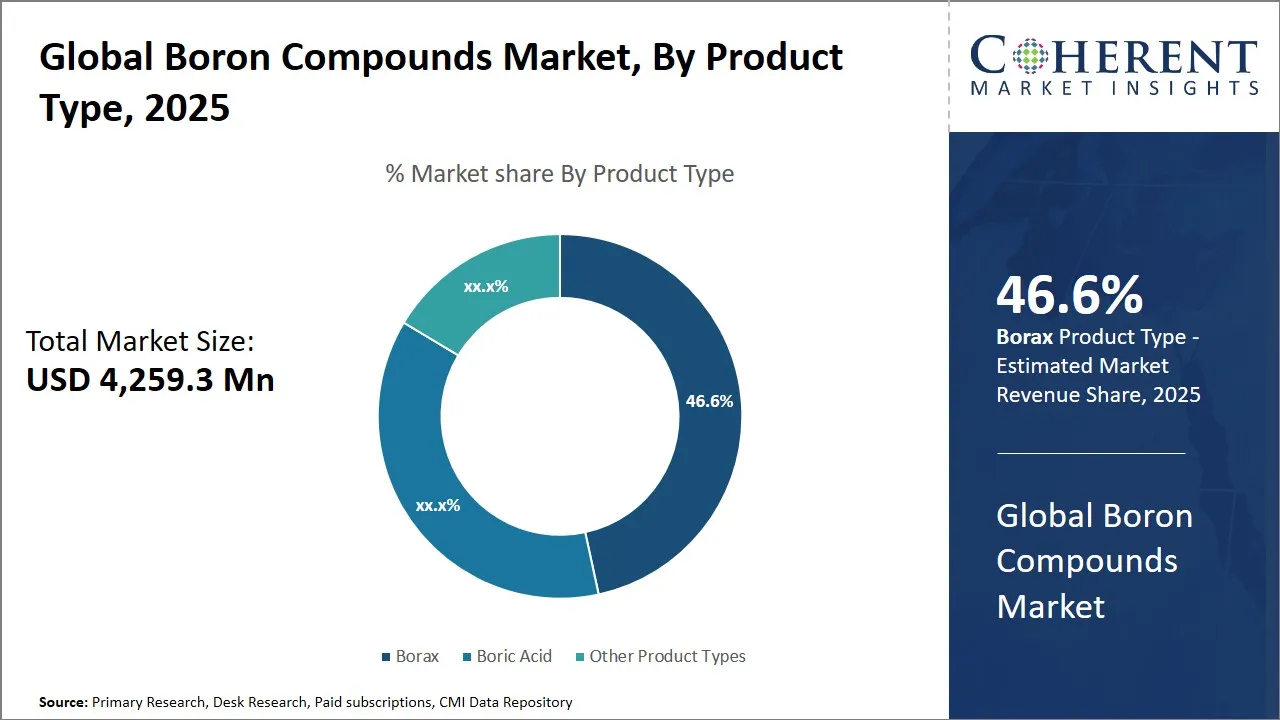
- The borax segment is expected to account for 47.6 % of the boron compounds market in 2026, driven largely by its versatile applications across multiple industrial sectors.
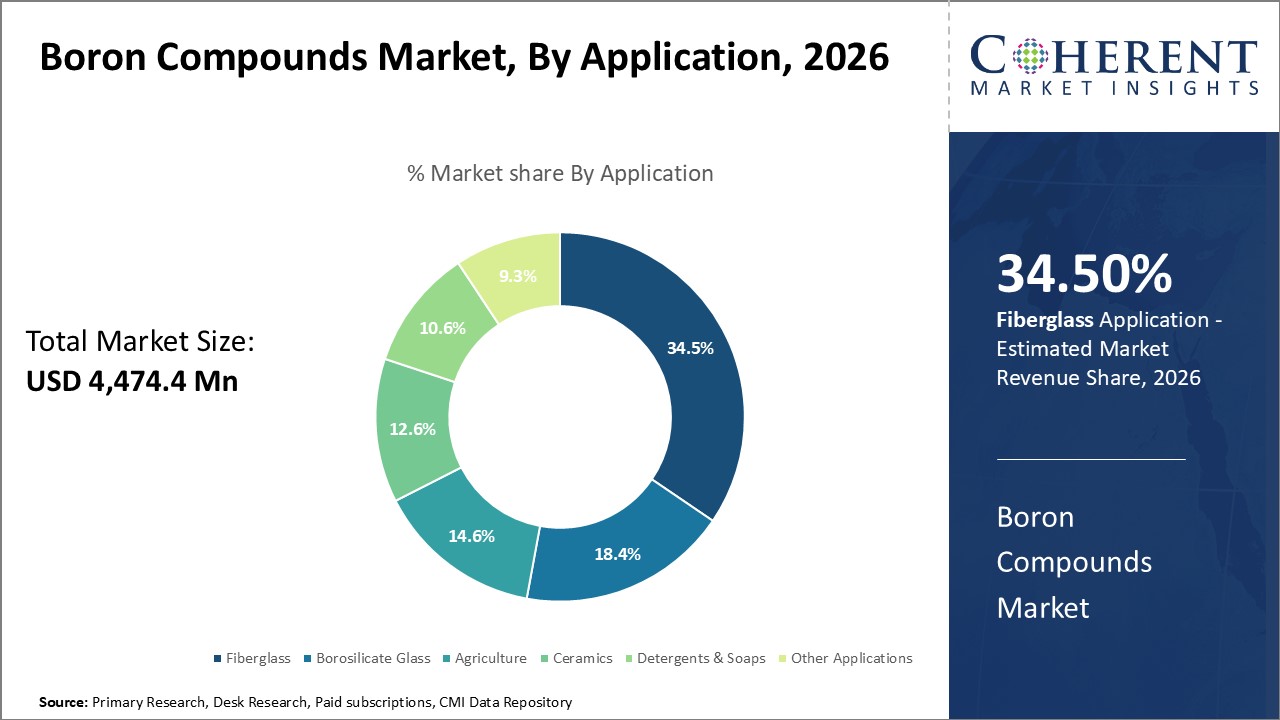
- The fiberglass segment is projected to capture 34.5 % of the global boron compounds market in 2026, mainly due to the essential role of boron compounds in manufacturing high-performance and sustainable fiberglass materials.
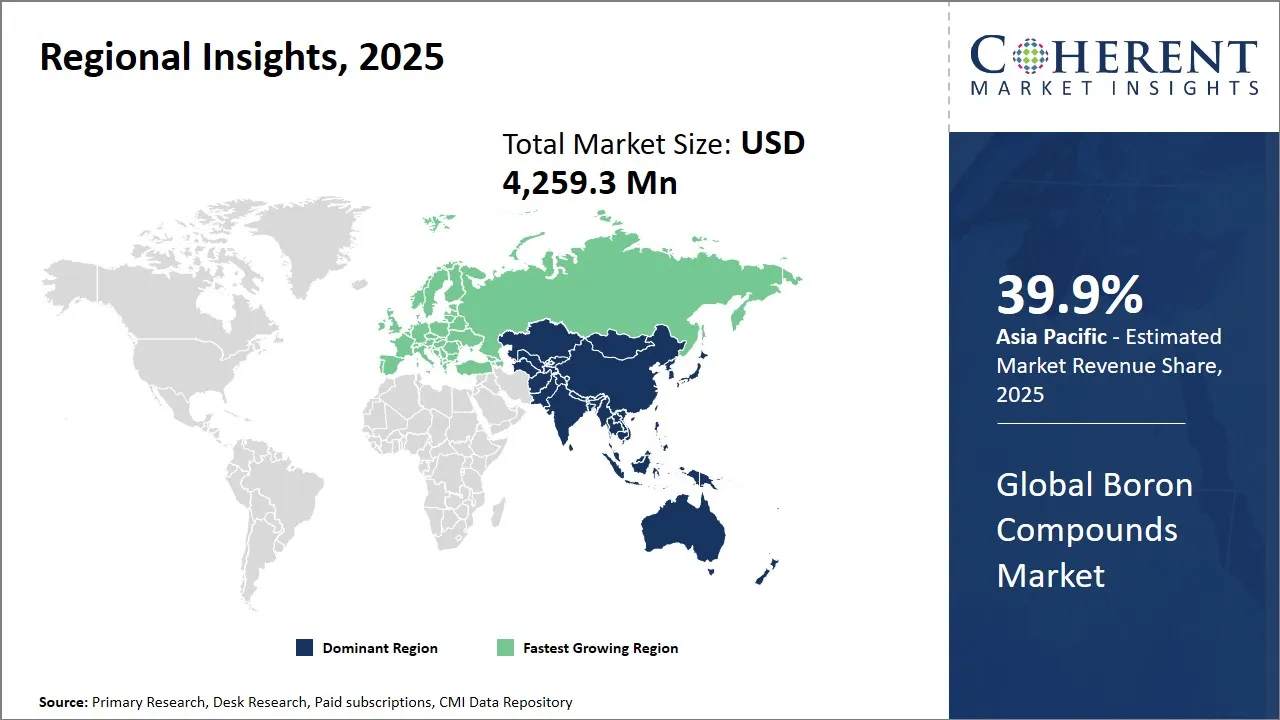
- Asia Pacific is projected to lead the boron compounds market in 2026 with a 39.9 % share, driven by strong glass, ceramics, and agriculture demand. Europe is projected to hold 25.8% of the market share in 2026, exhibiting the fastest growth due to renewable energy and insulation applications.
Market Overview
A key market trend is the increasing focus on green and eco-friendly boron compounds, driven by escalating regulations and a preference by consumers for green products. Furthermore, development in the application of boron compounds, especially in high-tech industries such as electronics and energy storage, is encouraging innovation.
Current Events and Its Impact
Current Events | Description and its impact |
Eti Maden signs Emet boron oxide plant contract (February 5, 2025) |
|
Türkiye opens Bigadiç Granular Boron facility (September 15, 2024) |
|
Segmental Insights
- Current Industry Events of 2026
- Market Size Estimation
- Regional Breakdown
- Competitive Landscape
- Customer Intelligence
- Segmental Analysis
- Pricing Analysis
- Key Market Drivers, Challenges & Future Trends
- Customized Insights Section
Boron Compounds Market Insights, By Product Type – Borax Segment Dominates the Market due to its Versatility and Extensive Industrial Applications
Borax segment is expected to hold 47.6% share of the boron compounds market in 2026, which can be attributed mainly to its wide-ranging functionality across a number of industrial sectors. Borax, chemically known as sodium borate, acts as a raw material in manufacturing glass, detergents, ceramics, and fertilizers, thus establishing the demand for it consistently.
Its growth is driven chiefly by its role in fiberglass and borosilicate glass production. In this way, the process becomes cost-effective and more eco-friendly, especially in the face of growing industrial emphasis on green production.
Boron Compounds Market Insights, By Application – Fiberglass Segment Dominates the Market due to Boron Compounds’ Essential Role in Enhancing Material Properties and Expanding Industrial Use
Fiberglass segment is projected to hold 34.5% share of the global boron compounds market in 2026, primarily due to the fact that boron compounds are essential in making modern fiberglass materials that meet advanced standards of performance and sustainability. In manufacturing fiberglass, it is noted that borax and boric acid are vital because they provide the means to melt and form glass fibers with qualities superior to existing ones. The addition of boron not only lowers the processing temperature but also enhances the strength, flexibility, and chemical resistance of the resulting fiberglass products.
Among the factors contributing to such a trend in the consumption of boron compounds in fiberglass production is the rapid growth of the industries that use these products, specifically, construction, automotive, aerospace, and electronics. The addition of boron makes fiber-reinforced polymers (FRPs) more durable and reduces the weight of automotive parts, while in construction, fiberglass offers corrosion resistance, as well as thermal insulation.
Regional Insights
Asia Pacific Boron Compounds Market Analysis and Trends
The Asia Pacific region is projected to lead the market with a 39.9% share in 2026, propelled by the significant industrial ecosystem in the region, tremendous raw material availability, and continuous support of governments regarding chemical manufacturing industries.
In addition, proactive government policies for industrial growth, export facilitation, and research & development stimulate innovation and growth in boron compounds applications. Leading companies like Rio Tinto (with its Borax operations in Boron, California, plus global supply), 3M, and China's Fangyuan Boron Chemical Industry Co. have strengthened their competitive position in the Asia Pacific region with production capacity investments and local partnerships to meet demand.
Europe Boron Compounds Market Analysis and Trends
The Europe region is expected to be the fastest growing, at 25.8% in market share by 2026, driven by strong demand from glass, ceramics, and high-tech manufacturing industries. The focus on energy efficiency, new advanced materials, and environmental sustainability is increasing the adoption of boron-based products in fiberglass, borosilicate glass, and insulation. Germany, the U.K., and France are major drivers leading the way with technology in specialty chemicals and electronic-grade boron compounds used in electric vehicles and batteries.
The European Union's (due to REACH and regulatory concerns) strict environmental and chemical safety regulations have also resulted in greater adoption of refined boron products with lower ecological footprints by encouraging producers to develop cleaner methods of extraction and synthesis. Moreover, the region’s robust automotive and renewable energy sectors are increasingly utilizing boron compounds in permanent magnets, lightweight composites, and solar glass applications. Major global players like Eti Maden, Rio Tinto, and BASF, along with regional producers, are investing in R&D and partnerships to enhance product purity, performance, and sustainability.
Global Boron Compounds Market Outlook for Key Countries
U.S. Boron Compounds Market Trends
The U.S. boron compounds market is characterized by strong industry presence and technological advancements. The country hosts significant production facilities, notably the Borax operations of Rio Tinto in California, which remain one of the essential suppliers of refined boron products to the world. Demand for the U.S. boron compounds market is well established across agriculture, manufacturing, and pharmaceuticals. Regulatory frameworks supportive of environmental safety and driving innovation encourage research into new applications of boron, driving product development forward. Additionally, trade relations ensure a stable supply of raw boron ores from countries like Turkey and Argentina, complementing domestic production.
China Boron Compounds Market Trends
China, with its huge industrial base, retains the lead in manufacturing capacity and consumption of boron compounds. Heavy investments in chemical processing plants and infrastructure facilitate bulk production to cater to a wide range of end-use segments such as glass fiber, agriculture, and detergents. Government policies on self-reliance and resource security further strengthen domestic mining and refining activities, while international collaborations are encouraged for the transfer of technology. Key companies such as Fangyuan Boron Chemical and China National Chemical Construction Corporation drive supply and product portfolio expansion to meet emerging internal demand.
Chile Boron Compounds Market Trends
Chile’s boron compounds market is expanding rapidly, driven by its status as one of the world’s largest boron mineral producers via SQM. The country’s well-developed mining sector, supported by government incentives and stable export policies, positions Chile as a critical player in the global boron supply chain. The regional market benefits from technological innovation in extraction and processing methods, leading to higher yields and product diversification. Chilean boron compounds serve both local agricultural markets and global industrial applications, with a steadily growing emphasis on sustainability and environment-friendly mining techniques adopted by key players.
India Boron Compounds Market Trends
India's boron compounds market is growing steadily, driven by the country's increasing agricultural production and industrialization, especially in the industries of chemicals and glass. The government's emphasis on Make in India initiatives and infrastructural development favors home production of boron products, thereby reducing imports. Companies like Borax Morarji and Gujarat Borosil Limited are major players contributing to the market growth by introducing advanced product lines and investing in R&D for better-quality products. Moreover, import policies encourage collaborations with foreign suppliers as a means of satisfying specialized demand segments.
Turkey Boron Compounds Market Trends
Turkey holds an advantageous position in the world's boron market, given its substantial resources of ore located mainly in western provinces. The country's boron industry enjoys strong governmental support, export-friendly policies, and continuous technological upgrading in mining and refining processes. Turkish companies are leading players both within the country for domestic supply and in international exports, while a wide range of derivatives has been developed for use in glass manufacturing, agriculture, and detergents. Geographically, Turkey bridges Europe and Asia Pacific, thus offering ease of trade logistics and the ability to penetrate multiple regional markets.
Supply Chain Sustainability and ESG Practices in Boron Mining
- Utilization of solar-powered extraction, resulting in CO₂ emissions reductions of approximately 30% in some operations.
- Initiatives to further a zero-waste vision to return as much as 95% of waste materials generated from processing to construction projects for repurposing.
- Advanced automated and efficient equipment and waste management to reduce the environmental impact of extraction companies and supply chains.
- Focus on worker rights, transparency throughout the supply chain, and interviews with users on technology access in vulnerable communities.
- Compliance with stricter environmental regulations and practices, most recently in Europe and North America.
Market Players, Key Development, and Competitive Intelligence
Key Developments
- In October 2025, CNT scientists were awarded a patent for an adsorbent specifically designed for the extremely efficient separation of boron compounds from water. In June 2025, researchers at the Nanotechnology Centre, CEET, VSB - TUO were similarly granted a patent for an innovative and highly promising adsorbent for the sorption of boron compounds from water (Patent 310487). The development of the boron sorbent is part of broader research into developing advanced polymer ion-exchange adsorbents which can achieve high performance with repeated use.
- In March 2025, a team of researchers from Russia synthesized a novel compound to be used for boron neutron capture therapy (BNCT), which is a potential treatment for advanced cancers using the boron-10 isotope. Specifically, the new compound was shown to be low in toxicity, have excellent water solubility, and significantly reduced the volume of chemicals needed to be infused.
Top Strategies Followed by Global Boron Compounds Market Players
- Key players spend a notable percentage of their spending on research and development (R&D) for supplying and developing cutting edge boron compounds to meet the current performance needs of boron consuming industries. These industries include agriculture, glass makers, and detergent producers. The players that are in this category will want to strive for technology advancement efforts in developing differentiated products that provide maximum performance for effectiveness and duration, while still remaining environmentally responsible.
- For instance, Rio Tinto's Borates division focuses on high-purity boric acid and borax purposed for specialty glass and ceramics, and the production of borosilicate products that are utilized by companies such as Corning and Schott AG.
- Mid -scale players look to offer a balance of cost-effectiveness with consistent product quality that can pique the interest of consumers who are price-sensitive, particularly for use in many fields where cost is a primary purchasing factor. While it is easy to assume that mid-level participants offer boron products due to lower quality performed as poorly as lower prices, in this market, value is established through the participant's commitment to transitioning the product manufactured at lower prices without compromising necessary performance values.
- For example, FMC Corporation has effectively solidified its clientele in Asia Pacific by providing moderately priced borax pentahydrate for detergent manufacturing while continuing to supply products globally.
- Small operators establish competitive advantages focused on specialized features and innovative applications of boron compounds designed for narrow market needs. Through the use of new technologies - including cutting-edge synthesis approaches and customized formulations - they can differentiate themselves from commodity-based products. This technology emphasis will allow smaller companies to better target regional or industrial market segments where customization, responsiveness, and technical service are paramount.
Market Report Scope
Boron Compounds Market Report Coverage
| Report Coverage | Details | ||
|---|---|---|---|
| Base Year: | 2025 | Market Size in 2026: | USD 4,474.4 Mn |
| Historical Data for: | 2020 To 2024 | Forecast Period: | 2026 To 2033 |
| Forecast Period 2026 to 2033 CAGR: | 5.1% | 2033 Value Projection: | USD 6,316.9 Mn |
| Geographies covered: |
| ||
| Segments covered: |
| ||
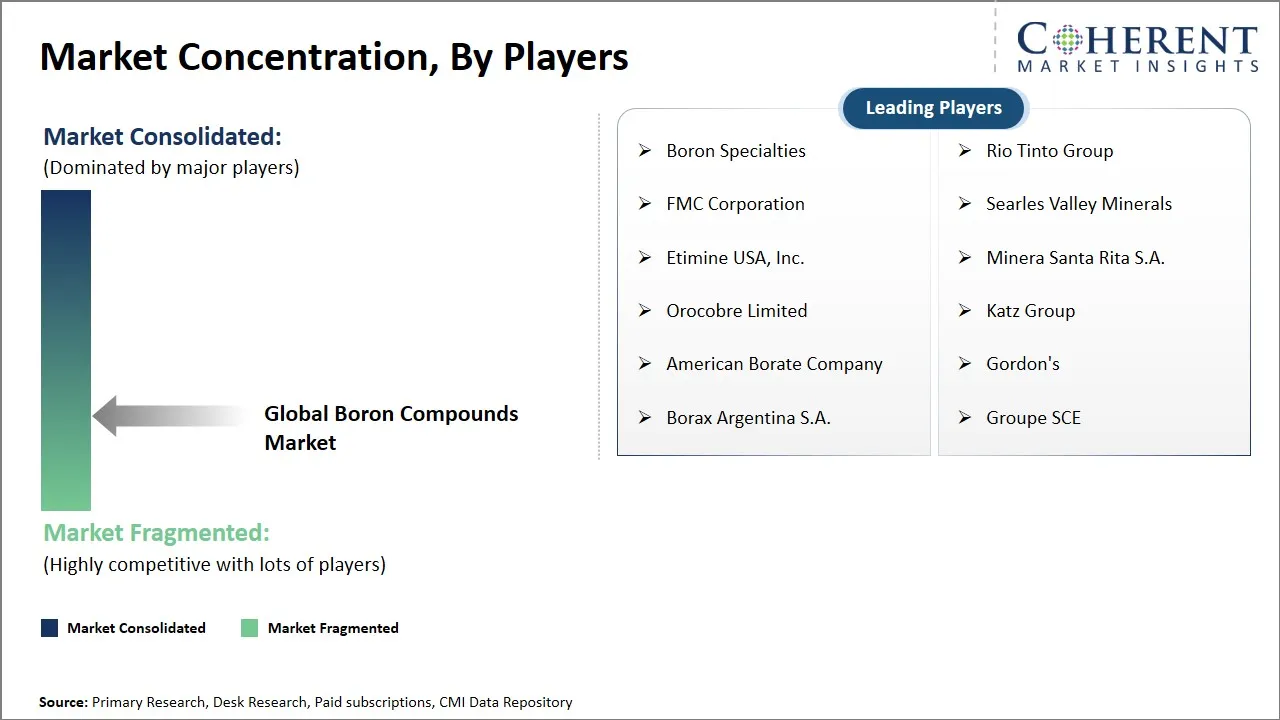
| Companies covered: | Boron Specialties, Rio Tinto Group, FMC Corporation, Searles Valley Minerals, Etimine USA, Inc., Minera Santa Rita S.A., Orocobre Limited, Katz Group, American Borate Company, Gordon's, Borax Argentina S.A., and Groupe SCE | ||
| Growth Drivers: |
| ||
| Restraints & Challenges: |
| ||
Boron Compounds Market Dynamics
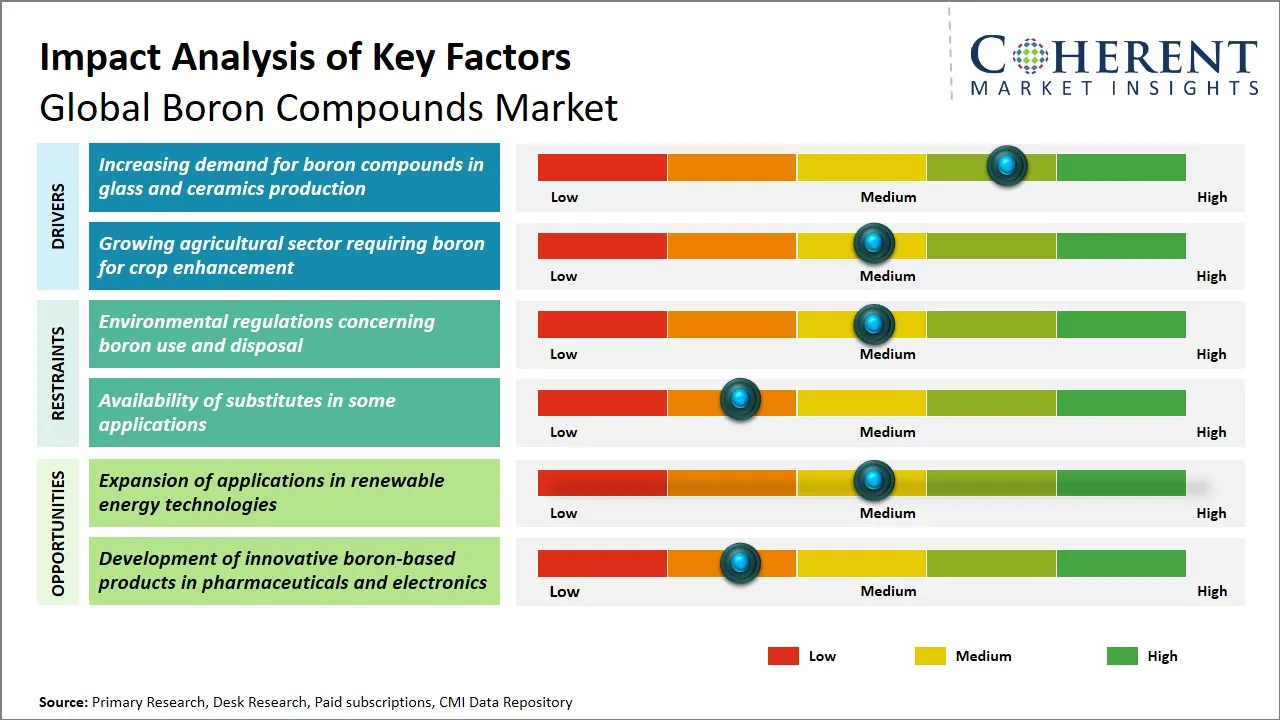
Boron Compounds Market Driver - Increasing Demand for Boron Compounds in Glass and Ceramics Production
Boron compounds are seeing an increase in demand as a result of their usage throughout glass and ceramics production's widespread adoption because of their notable properties that impact product performance, durability, etc. Boron compounds, ie boric acid and borax, are important fluxing agents in manufacturing glass, lowering the melting temperature of raw materials and improving properties such as thermal resistance, chemical stability, and optical clarity. Properties include use in a variety of specialty glass, such as borosilicate glass, boron used in laboratory equipment, cookware and other high-performance optical components.
For example, Schott AG utilizes boron compounds to create Duran borosilicate glass, used for laboratory glassware and cookware due to its high durability and optical clarity. Adding boron lowers the melting temperature of silica, improving processing efficiency and, ultimately, product durability. This temperature lowering is especially valuable for industries producing displays, fiberglass, and architectural glass.
Boron Compounds Market Opportunity - Expansion of Applications in Renewable Energy Technologies
The global boron compounds market is expected to undergo significant growth driven by the expanding applications in renewable-for-energy technologies. Due to heightened global focus on sustainability and clean energy, boron compounds have evolved as important materials in emerging energy, for example, developing and manufacturing advanced energy solutions.
A significant opportunity is from the use of boron-based materials in the manufacturing of high-efficiency solar panels. For example, to manufacture boron-doped silicon for photovoltaic cells, which enhances the conductivity and efficiency of solar cells, thus improving overall energy conversion rates, and will impact the overall scaling of solar energy installations around the world.
For example, American Pacific Borates Ltd (ABR) collaborated on boron-rich compounds for solid-state batteries with an aim of providing ionic conductivity and stability in energy storage applications and offers boron compounds a key factor for enabling renewable energy value chain.
Analyst Opinion (Expert Opinion)
- The global market for boron compounds is expected to grow significantly due to an increase in consumer demand in agricultural, ceramics, and electronics industries. Reports from the International Boron Symposium (2023) and the Global Chemical Conference (2022) identified key innovations in boron extraction and boron compound application methods from industry leaders including Rio Tinto and Kramer Industries.
- As an example of the industry reaction to sustainability and regulatory pressures, Rio Tinto's recent success with developing a processing method for boron that is more efficient and better for the environment is leading the way for other companies.
- The symposium discussion highlighted increased boron use in fertilizers specifically to improve crop yields, and also addressed its other uses mostly for increasing durability in glass and ceramics products. Throughout the conferences, barriers for market expansion were often linked to supply chain issues or rising raw material costs.
- Companies that focus on research and development in order to develop high performance boron compounds and have strategic relationships with manufacturers should have a competitive edge entering this market. Overall, the key issue will be the overall ability of this market to develop ways to innovate while also meeting sustainability and efficiency needs in producing borate.
Speak to the analyst
Want personalized insights?
Take the findings above to one of our principal consultants, or have the report rebuilt around the segments, geographies and competitors you actually track.
Market Segmentation
- Product Type Insights (Revenue, USD Mn, 2021 - 2033)
- Borax
- Boric Acid
- Other Product Types
- Application Insights (Revenue, USD Mn, 2021 - 2033)
- Fiberglass
- Borosilicate Glass
- Agriculture
- Ceramics
- Detergents & Soaps
- Other Applications
- Regional Insights (Revenue, USD Mn, 2021 - 2033)
- North America
- U.S.
- Canada
- Latin America
- Brazil
- Argentina
- Mexico
- Rest of Latin America
- Europe
- Germany
- U.K.
- Spain
- France
- Italy
- Russia
- Rest of Europe
- Asia Pacific
- China
- India
- Japan
- Australia
- South Korea
- ASEAN
- Rest of Asia Pacific
- Middle East
- GCC Countries
- Israel
- Rest of Middle East
- Africa
- South Africa
- North Africa
- Central Africa
- North America
- Key Players Insights
- Boron Specialties
- Rio Tinto Group
- FMC Corporation
- Searles Valley Minerals
- Etimine USA, Inc.
- Minera Santa Rita S.A.
- Orocobre Limited
- Katz Group
- American Borate Company
- Gordon's
- Borax Argentina S.A.
- Groupe SCE
Sources
Primary Research Interviews
- R&D Director – Leading Boron Compounds Manufacturer
- Procurement Manager – Major Industrial Chemicals Distributor
- Product Development Head – Well-Known Boron-Based Specialty Chemicals Brand
- Sustainability Manager – Industrial Minerals Certification Body
Stakeholders
- Manufacturers
- End-use Sectors
- Glass & Ceramics
- Agriculture (Fertilizers, Pesticides)
- Detergents & Cleaning Products
- Electronics & Semiconductors
- Construction Materials
- Flame Retardants
- Regulatory & Certification Bodies
- E-commerce Platforms and Industrial Chemicals Retailers
- Technology Integration Players: AI-based material science and supply chain optimization providers
Databases
- UN Comtrade Database
- India Import Export (EXIM) Database
- USGS Mineral Commodity Summaries
Magazines
- Chemical Week – Trends in industrial minerals and boron compounds
- Industrial Minerals Magazine – Innovations in boron and specialty chemicals
- Chemical Engineering News – Market updates and growth opportunities in boron compounds
- Global Chemicals Insights – Industry updates for boron-based products
Journals
- Journal of Materials Chemistry – Formulation trends in boron compounds
- International Journal of Inorganic Chemistry – Nutritional and industrial applications of boron
- Journal of Industrial and Engineering Chemistry – Effects of boron compounds in manufacturing
- Journal of Applied Chemistry – Benefits and safety of boron in industrial applications
- Chemical Reviews – Research on boron-based materials and their applications
Newspapers
- The Financial Times – Market growth of boron compounds and specialty chemicals
- The Guardian – Environmental and regulatory trends in boron mining and use
- Asia Chemical Journal – Growth of boron compound consumption in Asia-Pacific
- European Chemical News – Boron regulation and health policies in Europe
Associations
- European Borates Association (EBA)
- Industrial Minerals Association Europe (IMA-Europe)
- American Chemical Society (ACS)
- International Council on Boron Chemistry
- Society for Mining, Metallurgy & Exploration (SME)
Public Domain Sources
- US Environmental Protection Agency (EPA) – Guidelines for boron compounds in industrial and consumer products
- European Commission – CLP Regulation and Toy Safety Directive for boron compounds
- World Health Organization (WHO) – Safety standards and health impact studies on boron
- OECD – Nutritional and safety assessments for boron compounds
Proprietary Elements
- CMI Data Analytics Tool, Proprietary CMI Existing Repository of information for last 8 years.
Get access to 250+ pages report
Every segment, forecast, competitor profile and data table behind the analysis above — available for instant download.
- ESOMAR Member
- ISO 9001:2015 Certified
- D-U-N-S Registered
- GDPR & CCPA Compliant
Missing comfort of reading report in your local language? Find your preferred language:
Transform your Strategy with Exclusive Trending Reports
Frequently Asked Questions
The global boron compounds market is estimated to be valued at USD 4,474.4 Mn in 2026 and is expected to reach USD 6,316.9 Mn by 2033.
The CAGR of global boron compounds market is projected to be 5.1% from 2026 to 2033.
Increasing demand for boron compounds in glass and ceramics production and growing agricultural sector requiring boron for crop enhancement are the major factors driving the growth of the global boron compounds market.
Environmental regulations concerning boron use and disposal and availability of substitutes in some applications are the major factors hampering the growth of the global boron compounds market.
In terms of product type, borax is estimated to dominate the market revenue share in 2026.
Boron Specialties, Rio Tinto Group, FMC Corporation, Searles Valley Minerals, Etimine USA, Inc., Minera Santa Rita S.A., Orocobre Limited, Katz Group, American Borate Company, Gordon's, Borax Argentina S.A., and Groupe SCE are the major players.
Asia Pacific is expected to lead the global boron compounds market in 2026.