

Global Broth Market Size and Forecast – 2026-2033
The Global Broth Market is estimated to be valued at USD 6.12 Bn in 2026 and is expected to reach USD 9.52 Bn by 2033, exhibiting a compound annual growth rate (CAGR) of 6.5% from 2026 to 2033.
Key Takeaways of the Broth Market
- The Chicken Broth segment is expected to account for a 32.6 % share of the market in 2026.
- The Organic Segment commands an estimated 57.9 % share of the market in 2026.
- The Canned Broth segment is set to account for a 35.9 % share of the market in 2026.
- North America is set to lead the global broth market in 2026 with a 37.3 % share. Asia Pacific, with a 19.5% share, will be the fastest-growing regional market.
Market Overview
Among the most noticeable market trends is the increasing demand for plant-based and organic broths resulting from the changing lifestyle habits of consumers toward healthier options as well as sustainable options. Additionally, innovations in packaging and the increase in the availability of ready-to-drink broths are enhancing product reach and convenience, driving the market. The growth in e-commerce channels is also contributing, significantly aiding in expanding market coverage through different regions of the world.
Current Events and Its Impact
Current Events | Description and its impact |
Tariff-driven cost inflation hits mainstream broth |
|
U.S. and state actions on PFAS in food packaging |
|
Segmental Insights
- Current Industry Events of 2026
- Market Size Estimation
- Regional Breakdown
- Competitive Landscape
- Customer Intelligence
- Segmental Analysis
- Pricing Analysis
- Key Market Drivers, Challenges & Future Trends
- Customized Insights Section
Broth Market Insights, By Product Type - Chicken Broth Segment Dominates the Market Due to Its Culinary Versatility
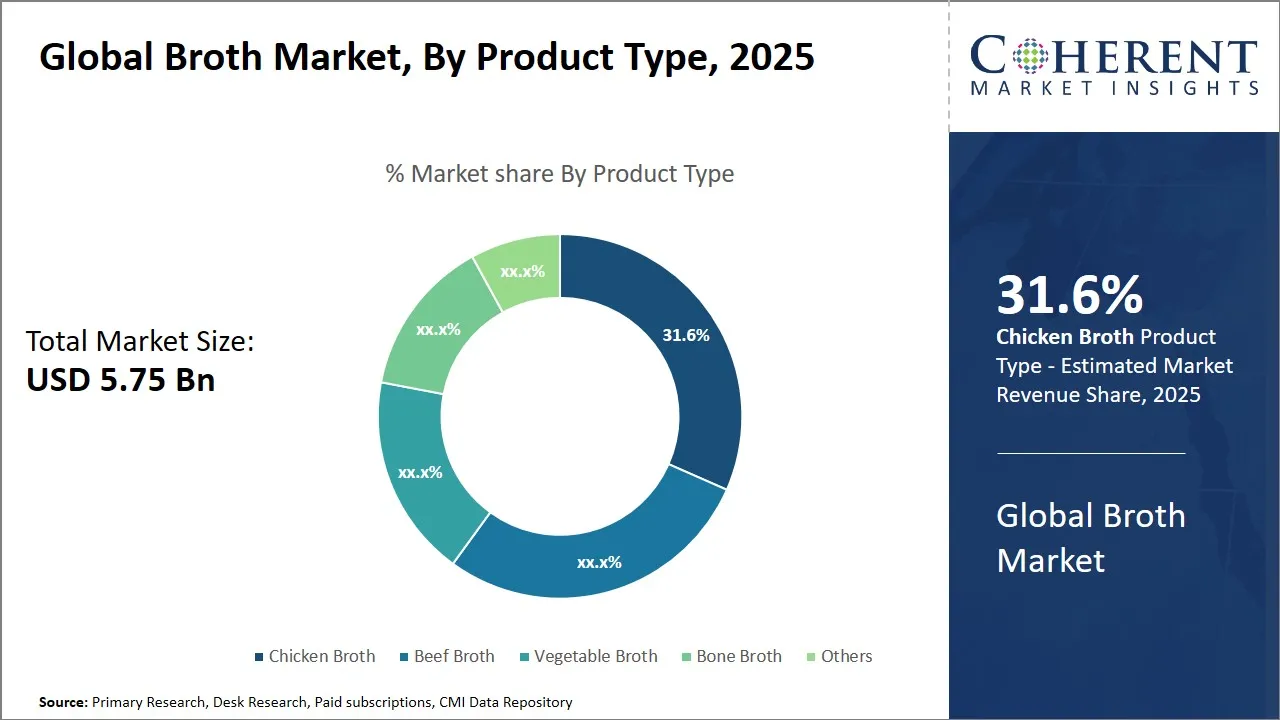
The Chicken Broth segment is expected to contribute 32.6% share of the market in 2026, attributing to its common culinary versatility and consumer fondness towards known flavors. Chicken broth is a driving force in both home kitchens and the foodservice sector due to its delicate flavor profile. It can be used in a wide range of product applications, from soups and stews to sauces and gravies. The international appeal of chicken broth across culinary cultures leads to a staple item that has ongoing demand.
Broth Market Insights, By Category – Organic Segment Dominates the Market Driven by Rising Consumer Preference for Health-focused and Eco-sustainable Food Options
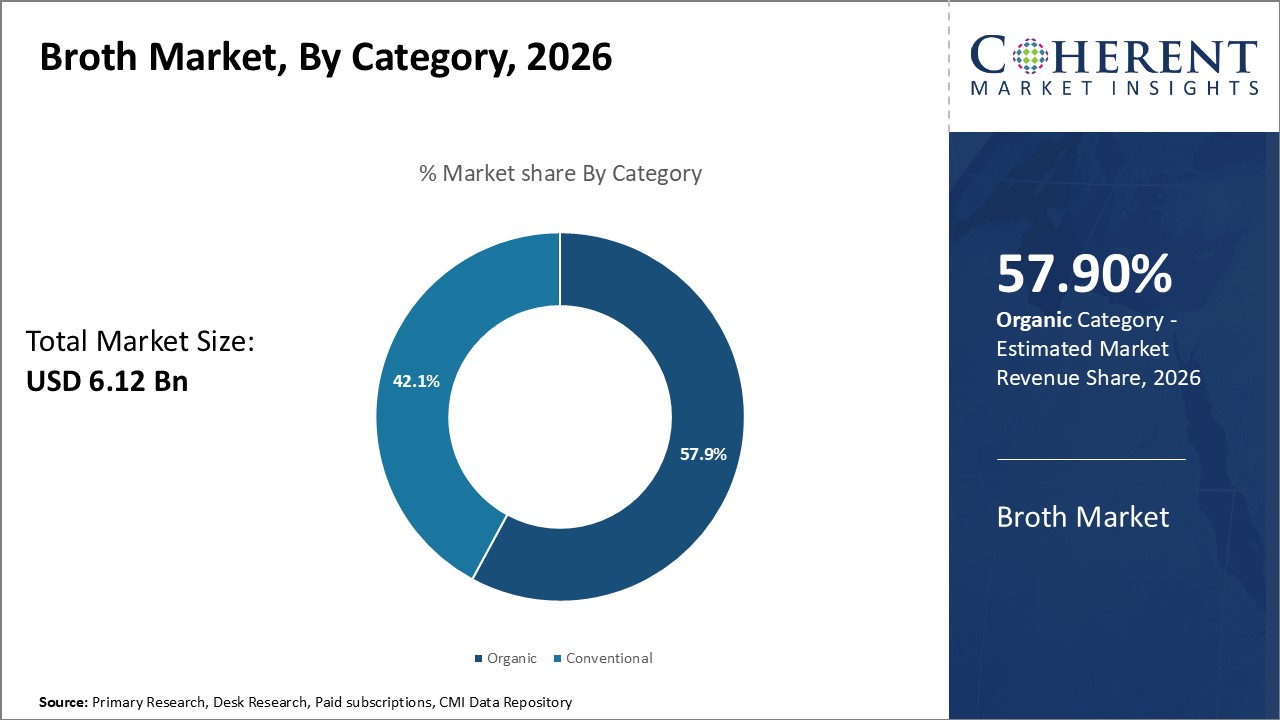
The organic segment is forecasted to grab 57.9% of the market share in 2026 as a result of increasing consumer preference for healthy and sustainable foods. The growing awareness of the potential risks associated with chemical pesticides, synthetic fertilizers, and genetically modified organisms (GMOs) has propelled organic broths into the spotlight. These products are now being specifically targeted at the new wave of environmentally and health-conscious consumers.
The organic segment guarantees safer, cleaner, and more natural resources, catering to those consumers who emphasize sourcing and transparency in the manufacturing process; this shift is also influencing the demand for broth products. Consumers are increasingly looking for broth due to its nutritional and restorative benefits.
Broth Market Insights, By Packaging Type - Canned Broth Segment Is Leading the Market, Fueled by Strong Demand Among for Retail and Commercial Buyers
Canned Broth segment is set to hold 35.9% share of the market in 2026. The unique aspect of canning broth packaging is the airtight canning technology that preserves both flavor and nutrients, making broth safe over a longer duration at room temperature without needing refrigeration. This unique feature is increasing popularity among consumers seeking reliable pantry staples, while reducing waste and making themselves available 24 hours a day.
Regional Insights

North America Broth Market Analysis and Trends
The North America market is projected to lead with a 37.3% share in 2026, due to a developed market environment with established supply chains, sophisticated food manufacturing facilities, and strong consumer demand for health and convenience foods. Furthermore, a strong presence of leading food and beverage players like Campbell Soup Company, The Kraft Heinz Company, and Nestlé USA enables a wide product line with organic, clean-label, and specialty broths.
North American trade dynamics allow for both export and import of raw materials and finished products of broth, driving consistent growth of the market. Expanding bases of consumers looking for plant-based and ready-to-cook food options also enable product diversification.
Asia Pacific Broth Market Analysis and Trends
The Asia Pacific region is expected to exhibit the fastest growth in the market contributing 19.5% share in 2026, owing to intensely changing consumer life styles, urbanization, and rising disposable incomes. The cultural culinary heritage in China, Japan, and South Korea, which by its nature encompasses broth-based fare, accelerates demand for both traditional and newer broth products.
Government efforts related to food safety and the modernization of food processing industry also create an environment conducive to market development. The region has a mix of established industry players such as Nissin Foods Holdings, Nanyang Brothers Food Company, and local brands focused on regional taste perception serving various consumer segments. Trade liberalization and foreign direct investment have also facilitated faster technology development and distribution network widening in the broth market.
Global Broth Market Outlook for Key Countries
U.S. Broth Market Trends
The U.S. broth market is dominated by high demand for organic, natural, and specialty broths among consumers due to growing health consciousness. Major players like Campbell Soup Company and Pacific Foods promote innovation in plant-based and convenience formats like ready-to-use cartons and broth concentrates. The large foodservice and retail sectors offer varied channels for product presence, facilitating continuous innovation and penetration. Additionally, regulations from the FDA assure high product quality in compliance with customer expectations.
Japan Broth Market Trends
Japan remains at the forefront with mass consumption of broth as a staple ingredient in ancestral dishes like ramen and miso soup. Major companies such as Nissin Foods Holdings and Ajinomoto use high cultural affinity to expand their portfolios, including health-enhanced and instant broths. The emphasis of food safety regulations in the country, paired with the improvement of food processing technology, promotes the production of high-end broths for both domestic and export markets.
China Broth Market Trends
In China, the broth market is quickly expanding, as city dwellers are adopting more convenient cooking helpers to complement their busy lives. Companies such as Tingyi (Cayman Islands) Holding Corporation, along with Uni-President Enterprises Corporation are introducing and expanding product lines with new options besides traditional bone broth, such as specifically targeted vegetable broth products for health-conscious consumers. The government push to modernize food safety laws and strengthen local food brand promotion also increases this market potential. Furthermore, a rising trend of international trade brings multinational broth companies.
Germany Broth Market Trends
Germany's broth market takes advantage of high consumer demand for organic and sustainably sourced broth products, reflecting broader European trends. Large players such as Knorr (Unilever) and Maggi (Nestlé) have made significant investment in product innovation with bean-based, vegan, and low-sodium varieties given high visibility on store shelves. Stringent food safety legislation and supply chain openness, plus a solid retail infrastructure, enable consistent market penetration and innovation.
India Broth Market Trends
India's broth market is at an emerging stage but developing rapidly owing to changing eating patterns, rising urbanization, and growing demand for easy-cook solutions. Domestic players like MTR Foods and global players are introducing broth products targeted toward vegetarian and regional flavor profiles. The government's friendly policies toward food processing and packaging, along with broadening cold-chain logistics, improve availability and consumer confidence. In addition, the growth of organized retail and online commerce platforms offers new distribution and market channels for products.
Macro and Micro Economic Factors Impacting Broth Market Growth
Macroeconomic Factors
- Global Economic Trends & Disposable Income: Ongoing economic growth and disposable income growth increases spending on premium, organic or health-oriented items, such as broths.
- Policy Changes & Tariffs: The market is impacted by trade policy changes and tariffs across significant producing or consuming areas, including the U.S., EU, and Asia Pacific, which will affect pricing strategies and the stability within the supply chain.
- Supply Chain & Geopolitical Uncertainties: Ongoing disruptions in the supply chain, impact from transportation costs, and prevailing geopolitical uncertainty can affect the availability of raw materials, production continuity, and pricing for the final product.
- Growth of Online Retail: The rise of e-commerce creates additional non-traditional access to specialty broths and allows for global action in terms of market expansion and penetration.
Microeconomic Factors
- Consumer Behavior: The movement to natural, organic, or minimally processed foods creates an influence in product development space. Gen Z and young adults emphasize core markets for premium or healthier products.
- Product Extension Innovation: The growing preference for plant-based broths, new flavors (mushroom, seafood, herbal-infused, etc.), and extension in applications to include ready-to-drink allow brands to serve multiple consumer segments.
- Pricing Dynamics: The conventional broth segment has rapidly expanded amid a changing economy based on affordability and availability. Supermarkets and hypermarkets use promotion discounts to entice price-sensitive consumers; this was more impactful among consumers during the pandemic; still impacts market share and competition.
Market Players, Key Development, and Competitive Intelligence
Key Developments
- In June 2024, Campbell introduced a new line of spicy broths under its Swanson brand, featuring flavors like spicy chicken and beef broths infused with jalapeño and chili peppers.
Top Strategies Followed by Global Broth Market Players
- Established Players: Leading companies within the industry are significantly investing in research and development (R&D) for the development of premium innovative broth products intended to fulfill rising consumer needs around quality, health attributes, and convenience. They also aim to increase their global footprint by extending various distribution channels and penetrating emerging markets in Asia, Latin America, Africa, etc.
- For instance, Nestlé's Maggi Professional brand created ready-to-use liquid broths for the foodservice industry with convenience and flavor consistency as selling points.
- Mid-Level Players: Companies further down the ladder have tended to create more balance by producing value alternatives. These products maintain reasonable quality-for-price ratios, catering to price-sensitive consumers who seek value while sacrificing as little as possible in the trade-off. Mid-level companies improve or bolster their market position through joint ventures and strategic alliances that improve their access to modern technologies, increased production capacities, and regionally wider acceptance.
- For instance, General Mills (Progresso) was able to revamp its line of broths by adding reduced sodium and gluten free broths, allowing for better price positioning mostly due to supply chain efficiencies.
- Small-scale players: Smaller companies are successful due to the specialized niches they carve out in the broth market, generally through some form of new product distinction or specialty characteristic, like organic offerings, allergen free, or artisanal kitchen preparation methods that make them distinct among mainstream broth offerings. These same companies often adopt new technologies much more quickly than larger companies, whether through new extraction methods or packaging that many larger firms do not adopt due to price.
- For example, Osso Good Co. produces in small lots, and flash freezes to retain nutrients and flavor integrity to position itself as a clean, chef-crafted product.
Market Report Scope
Broth Market Report Coverage
| Report Coverage | Details | ||
|---|---|---|---|
| Base Year: | 2025 | Market Size in 2026: | USD 6.12 Bn |
| Historical Data for: | 2020 To 2024 | Forecast Period: | 2026 To 2033 |
| Forecast Period 2026 to 2033 CAGR: | 6.5% | 2033 Value Projection: | USD 9.52 Bn |
| Geographies covered: |
| ||
| Segments covered: |
| ||
| Companies covered: | Campbell Soup Company, Del Monte Foods (College Inn), Unilever (Knorr), Pacific Foods of Oregon, Manischewitz, General Mills (Progresso), SunOpta, Borough Broth, and Broffees Ltd t/a British Broth Company. | ||
| Growth Drivers: |
| ||
| Restraints & Challenges: |
| ||
Broth Market Dynamics
Broth Market Driver - Increasing consumer preference for healthy and nutritious food options
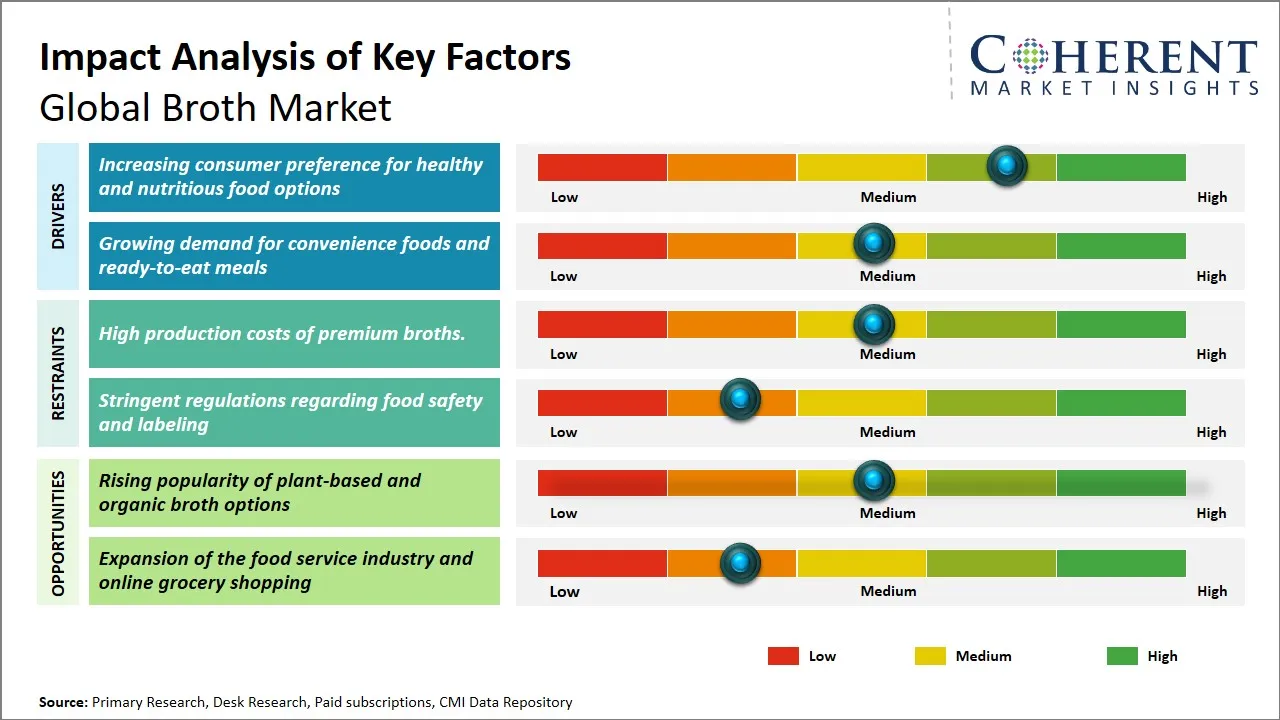
The increasing consumer preference for healthy lifestyles has positively impacted the demand for healthy and wholesome food products, which in turn has positively impacted the worldwide broth market. Consumers today are increasingly looking for convenient and health-promoting options that promote wellness, immunity, and balanced nutrition, nutritional supplements and broth is appealing because it is made from natural ingredients and has perceived health benefits. This demand is being further strengthened by the heightened awareness of clean-label products that are void of artificial additives, preservatives, and high sodium, which positions broth as functional foods and a part of a person’s dietary needs.
For example, in the U.S., Kettle & Fire came out with collagen-rich bone broths targeting gut health and immunity, supporting the now increasing focus on functional nutrition.
Broth Market Opportunity - Rising Popularity of Plant-Based and Organic Broth Options
As health consciousness continues to grow across the world, the number of consumers seeking alternatives to the traditional meat broth increase with each season. Consumers are pursuing clean-label products with wellness and sustainable value in mind. Continued growth of veganism, vegetarianism, and flexitarian eating experiences will promote demand for plant-based broths made from functional ingredients, such as mushrooms, seaweed, vegetables, and legumes. These ingredients represent nutrient-rich, flavorful, and allergen-friendly alternatives.
The Broth Sisters created dehydrated plant-based broth powders using mushrooms, seaweed, and legumes as an easy and shelf-stable “all-purpose broth,” made without any animal-derived broth ingredients or safety issues.
Analyst Opinion (Expert Opinion)
- The broth industry is rapidly growing as consumers seek better meal options that are healthy, easy to use, and flavorful. The Food Innovation Summit (2023) and the Natural Products Expo (2022, p. 33) provided compelling data points about this rapidly growing market category, featuring speaking programs and exhibitor profiles. Notable companies like Kettle & Fire and Pacific Foods highlighted their success in addressing emerging consumer demand for bone broth, offering nutrient-rich and high-quality organic products. Kettle & Fire, for example, has recently introduced a ready to eat bone broth that has added functional ingredients such as collagen.
- Kettle & Fire is responding directly to consumers looking for flavorful health-tonics. The conversations at these events also reinforced a growing trend for greater transparency in sourcing and production, where consumers are increasingly leaning towards buying clean-label products, or products without unnecessary or unexplained ingredients. Concerns about the easiest form of competition which is still more at-home cooking, combined with steadily increasing, fluctuating, and in some cases unstable, ingredient prices, were at least a regularly mentioned challenge for future growth.
- Products that combine comforting flavor, add value, and have additional product line options, such as vegan or reduced sodium broth, will most likely capture the largest share of this market. It was also suggested that with an increasing focus on health and wellness in their offerings, companies will most likely gain more visibility and access while partnering with a health focused retailer.
Speak to the analyst
Want personalized insights?
Take the findings above to one of our principal consultants, or have the report rebuilt around the segments, geographies and competitors you actually track.
Market Segmentation
- Product Type Insights (Revenue, USD Bn, 2021 - 2033)
- Chicken Broth
- Beef Broth
- Vegetable Broth
- Bone Broth
- Others
- Category Insights (Revenue, USD Bn, 2021 - 2033)
- Organic
- Conventional
- Packaging Type Insights (Revenue, USD Bn, 2021 - 2033)
- Canned Broth
- Boxed & Carton Broth
- Regional Insights (Revenue, USD Bn, 2021 - 2033)
- North America
- U.S.
- Canada
- Latin America
- Brazil
- Argentina
- Mexico
- Rest of Latin America
- Europe
- Germany
- U.K.
- Spain
- France
- Italy
- Russia
- Rest of Europe
- Asia Pacific
- China
- India
- Japan
- Australia
- South Korea
- ASEAN
- Rest of Asia Pacific
- Middle East
- GCC Countries
- Israel
- Rest of Middle East
- Africa
- South Africa
- North Africa
- Central Africa
- North America
- Key Players Insights
- Campbell Soup Company
- Del Monte Foods (College Inn)
- Unilever (Knorr)
- Pacific Foods of Oregon
- Manischewitz
- General Mills (Progresso)
- SunOpta
- Borough Broth
- Broffees Ltd t/a British Broth Company.
Sources
Primary Research Interviews
- R&D Director – Leading Broth Manufacturer
- Procurement Manager – Major Food Retailer with broth sales
- Product Development Head – Culinary Brand specializing in broths and liquid stocks
- Sustainability Manager – Food Certification Body, focusing on broth production standards
Stakeholders
- Manufacturers
- End-use Sectors
- Ready-to-eat and convenience food producers
- Foodservice & HORECA (hotels, restaurants, catering)
- Wellness, functional beverage brands offering bone broth and specialty broths
- Regulatory & Certification Bodies (e.g., USDA, FSSAI, FDA, European Commission)
- E-commerce Platforms and Retailers (Amazon, Walmart, Flipkart, specialty health platforms)
- Technology Integration Players: Food traceability solution providers, clean label certifications
Databases
- UN Comtrade Database – International trade statistics of soups, broths, prepared stocks
- India Import Export (EXIM) Database – Indian market data for broth, soup and liquid meal exports/imports
Magazines
- Nutrition & Wellness Magazine – Emerging health trends and recipes in broth consumption
- Health & Nutrition Business – Innovations in savory liquid nutrition (bone broth, vegan broth)
- Global Health Insights – Market adoption of functional broths
- Broth Business Review – Market updates and growth opportunities in global broth sector
Journals
- International Journal of Food Science – Nutritional benefits and ingredient profiles of broths
- Journal of Food Science & Technology – Novel formulation and packaging of broths
- Journal of Culinary Science – Culinary trends and consumer behavior in broth consumption
- Food Research International – Protein and mineral bioavailability in bone/vegetable broths
Newspapers
- The Financial Times – Market growth and consumer shifts toward natural and functional broths
- The Guardian – Trends in plant-based and bone broth consumption
- Asia Food Journal – Rapid growth of prepared broth consumption in APAC
- European Nutrition News – Broth regulation and policy developments
Associations
- Soup & Broth Manufacturers Association
- International Foodservice Manufacturers Association (IFMA)
- Clean Label Project
- USDA (for regulatory standards and guidelines)
- Food Industry Association (FIA)
Public Domain Sources
- FDA – Guidelines for prepared foods, soupy stocks, and liquid broths
- USDA – Standards for broth and stock production
- European Commission – Food Supplements and Broth Regulation
- OECD – Food safety, nutritional, and labeling requirements for broth products
Proprietary Elements
- CMI Data Analytics Tool, Proprietary CMI Existing Repository of information for last 8 years
Get access to 250+ pages report
Every segment, forecast, competitor profile and data table behind the analysis above — available for instant download.
- ESOMAR Member
- ISO 9001:2015 Certified
- D-U-N-S Registered
- GDPR & CCPA Compliant
Missing comfort of reading report in your local language? Find your preferred language:
Transform your Strategy with Exclusive Trending Reports
Frequently Asked Questions
The global broth market is estimated to be valued at USD 6.12 Bn in 2026 and is expected to reach USD 9.52 Bn by 2033.
The CAGR of global broth market is projected to be 6.5% from 2026 to 2033.
Increasing consumer preference for healthy and nutritious food options and growing demand for convenience foods and ready-to-eat meals are the major factors driving the growth of global broth market.
High production costs of premium broths. and stringent regulations regarding food safety and labeling are the major factors hampering the growth of global broth market.
The increasing popularity of plant-based diets is driving demand for plant-based broths made from vegetables, mushrooms, and legumes, aligning with consumer preferences for healthier, sustainable options.
In terms of Product Type, Chicken Broth is estimated to dominate the market revenue share in 2026.
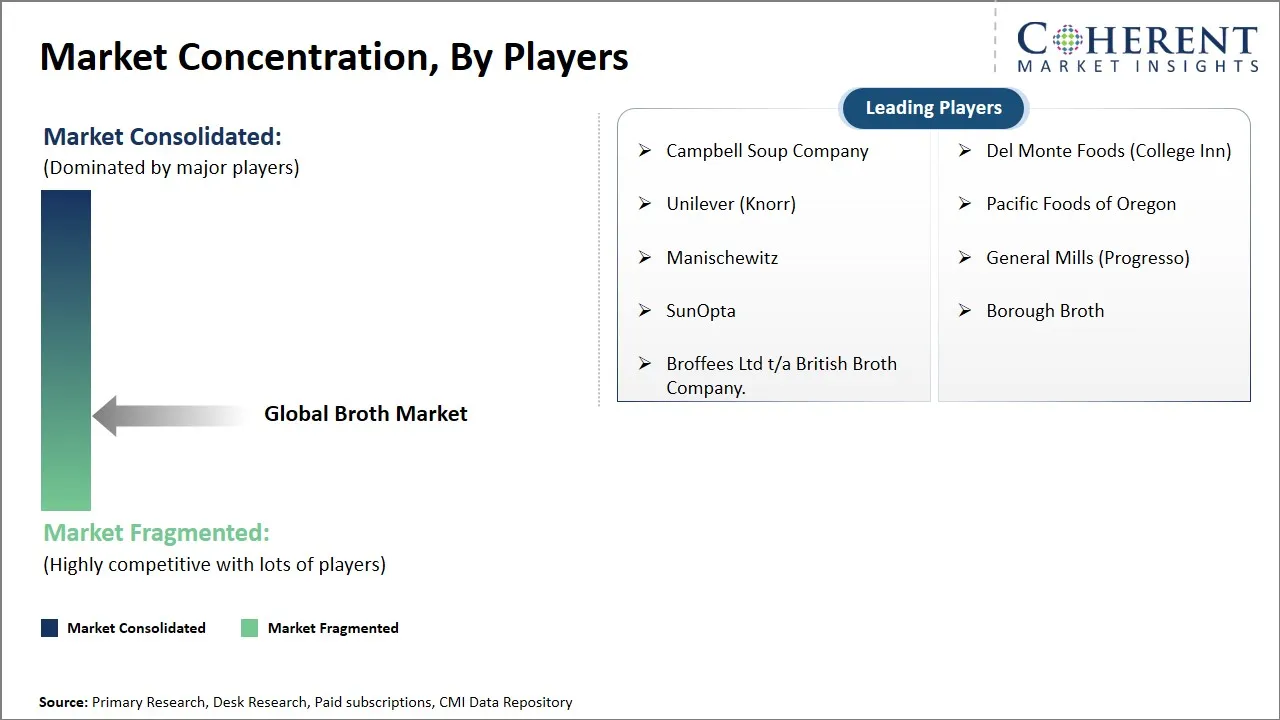
Campbell Soup Company, Del Monte Foods (College Inn), Unilever (Knorr), Pacific Foods of Oregon, Manischewitz, General Mills (Progresso), SunOpta, Borough Broth, and Broffees Ltd t/a British Broth Company. are the major players.