

Global Building Twin Market Size and Forecast
The Global Building Twin Market is estimated to be valued at USD 3.40 Bn in 2026 and is expected to reach USD 18.65 Bn by 2033, exhibiting a compound annual growth rate (CAGR) of 27.5% from 2026 to 2033.
Key Takeaways of the Building Twin Market
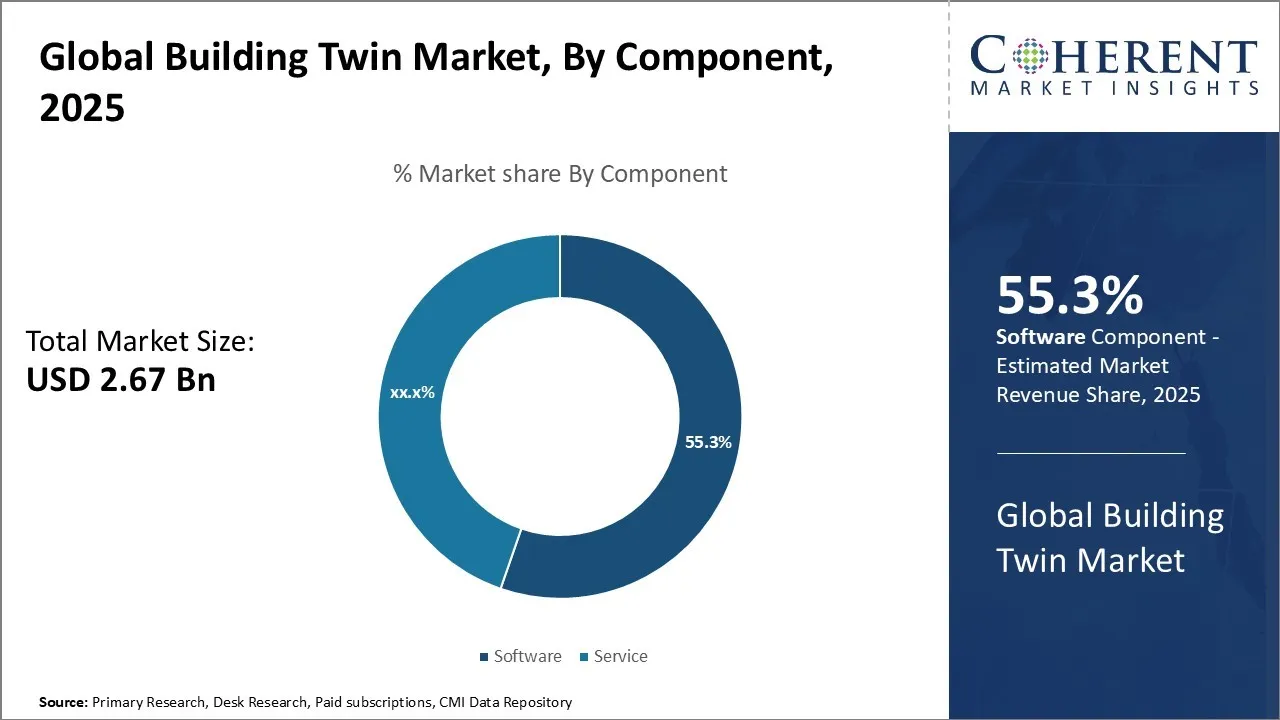
- The software segment leads the market holding an estimated share of 56.3% in 2026.
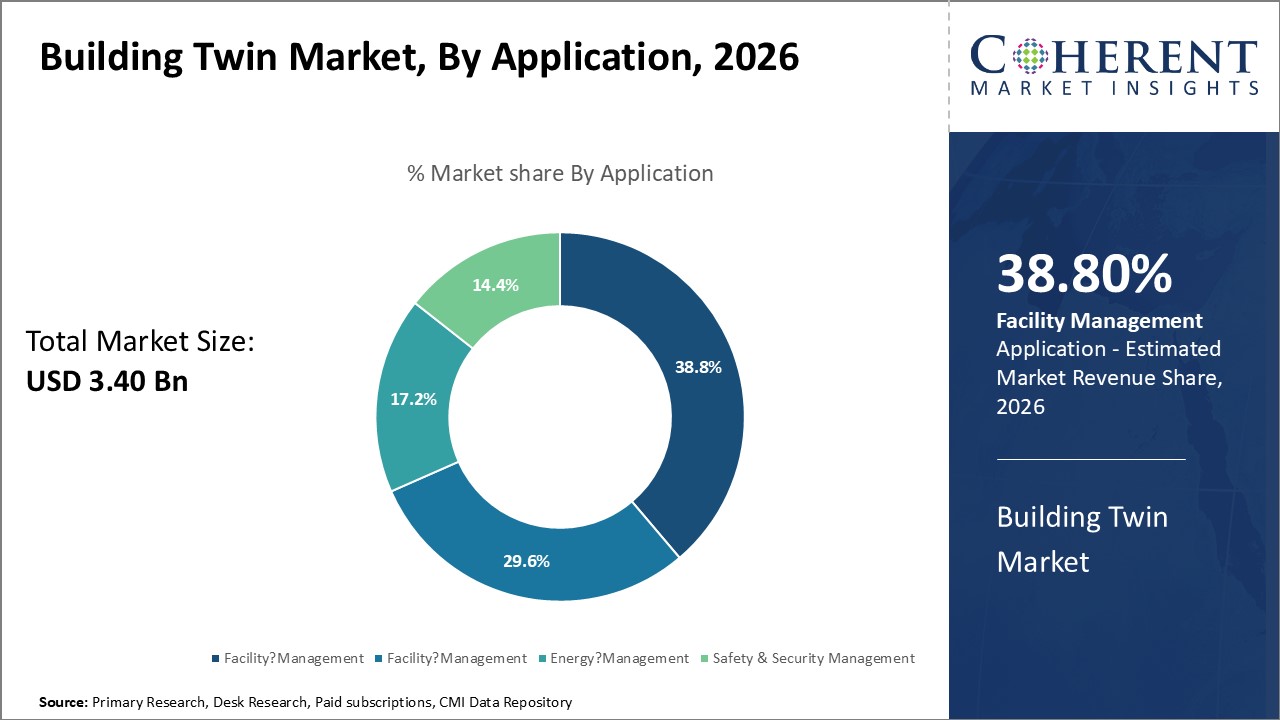
- The facility management segment leads the market holding an estimated share of 38.8% in 2026.
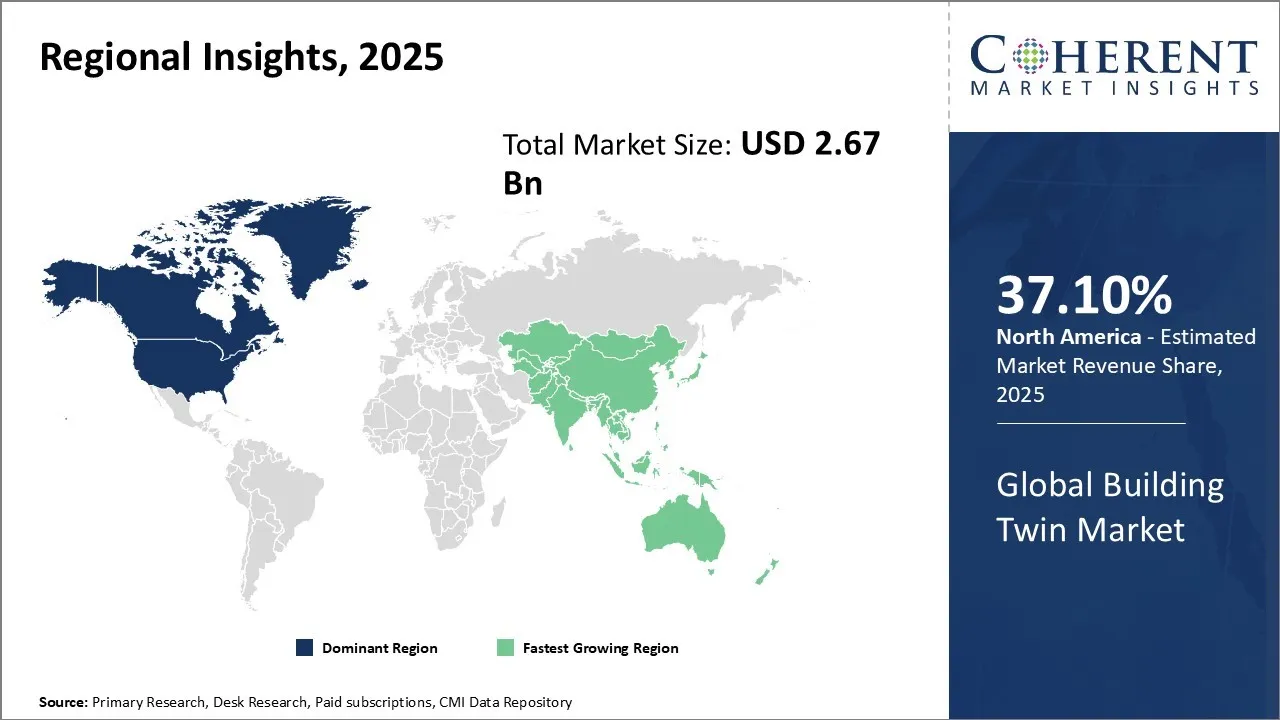
- North America is estimated to lead the market with a share of 37. 1% in 2026.
- Asia Pacific, holding a share of 22. 4% in 2026, is projected to be the fastest growing region.
Market Overview
Current market trends indicate a rapid integration of Building Information Modeling (BIM) with digital twins to enhance building lifecycle management, predictive maintenance, and energy efficiency. The development of smart cities and IoT-enabled infrastructure is adding to this demand, as stakeholders are working on sustainability and operational optimization. Also, data analytics and cloud computing are making possible more sophisticated simulations and real-time monitoring, adding to market growth.
Current Events and their Impact
Current Events | Description and its impact |
Macro-Level Technological Advancements in Digital Twins and IoT |
|
Regional Regulatory and Sustainability Initiatives |
|
Segmental Insights
- Current Industry Events of 2026
- Market Size Estimation
- Regional Breakdown
- Competitive Landscape
- Customer Intelligence
- Segmental Analysis
- Pricing Analysis
- Key Market Drivers, Challenges & Future Trends
- Customized Insights Section
Global Building Twin Market Insights, by Component – Software Leads Due to its Critical Role in Building Twin Technology Integration and Management
The software segment dominates the global building twin market, holding an estimated share of 56.3% in 2026. Building twin software includes multiple data streams from IoT sensors, BIM (Building Information Modeling), and real-time operational systems, helping stakeholders make accurate digital replicas of physical environments.
Also, cloud-based solutions offer scalability and flexibility, which are very important for large-scale building operations and complex infrastructure projects. Additionally, advanced analytics capabilities embedded in building twin software enable predictive insights that optimize operational efficiency, reduce maintenance costs, and improve occupant comfort.
Also, the integration of artificial intelligence (AI) and machine learning (ML) technologies within software platforms improves their ability to detect anomalies, forecast equipment failures, and automate response actions. These software solutions also support energy management systems by simulating energy consumption patterns and making possible dynamic adjustments to reduce waste and improve sustainability.
Global Building Twin Market Insights, by Application – Facility Management Leads Driven by Operational Efficiency and Cost Optimization Needs
Facility management represents the largest application segment within the global building twin market, holding an estimated share of 38.8% in 2026, mainly due to its pivotal role in improving building operational efficiency and reducing costs across the asset lifecycle. Building twins used for facility management allow operators to monitor, analyze, and control various systems such as HVAC, lighting, security, and utilities in an integrated manner, providing a holistic view of the building’s performance.
A primary factor fueling the growth of building twin applications in facility management is the increasing demand to optimize resource utilization. Digital twins enable real-time tracking of energy consumption, equipment status, and environmental conditions, empowering facility managers to implement proactive strategies that reduce waste and lower operational expenses.
Moreover, with buildings becoming more complex and equipped with a plethora of interconnected systems, traditional facility management approaches have become insufficient. Building twins streamline data collection and visualization, making it easier for managers to diagnose issues promptly and prevent system failures, thereby enhancing asset reliability and longevity.
The growing emphasis on occupant comfort and safety also complements the facility management segment’s expansion. Building twins help maintain optimal indoor environmental conditions and facilitate compliance with safety regulations through continuous monitoring and automated adjustment mechanisms. This not only improves occupant satisfaction but also supports regulatory adherence, reducing liabilities and potential costs related to non-compliance.
Impact of Artificial Intelligence ( AI) on the Building Twin Market
Artificial Intelligence (AI) is playing a transformative role in the building twin market by enabling real-time data processing, predictive analytics, and automation within digital twin models. With AI, building twins are no longer just static 3D replicas—they become intelligent systems capable of simulating occupant behavior, energy use, and equipment performance. This empowers facility managers and developers to make proactive decisions on maintenance, energy optimization, and space utilization, enhancing building performance while aligning with sustainability goals.
A real-world example is Microsoft’s AI-integrated Azure Digital Twins, which has been used in the Frasers Property Australia’s smart building projects. By combining AI with IoT sensors and building models, the platform enables predictive maintenance, anomaly detection, and occupant experience insights.
Regional Insights
North America Building Twin Market Analysis and Trends
North America, holding a share of 37.10% in 2026, is expected to dominate the global building twin market, driven by a mature technological ecosystem, strong government support, and wide adoption across commercial and residential sectors. The United States and Canada have well-established smart city initiatives and sustainable building regulations encouraging the integration of digital twin technologies for energy efficiency, facility management, and predictive maintenance. North America hosts a significant presence of top industry players such as Autodesk, Bentley Systems, and Microsoft, which offer advanced digital twin platforms and integrated building solutions. Additionally, the availability of robust IT infrastructure, high investments in R&D, and collaborations between tech startups and construction firms fuel innovation and market leadership. Trade dynamics favor North America through established partnerships with global technology vendors, ensuring access to cutting-edge software and hardware necessary for the building twin ecosystem.
Asia Pacific Building Twin Market Analysis and Trends
The Asia Pacific region, holding a share of 22.4% in 2026, is expected to exhibit the fastest growth in the global building twin market due to rapid urbanization, large-scale infrastructure projects, and expanding smart city programs in countries like China, India, Japan, and South Korea. Governments in this region are actively promoting digitization across construction and real estate sectors through favorable policies, investments in IoT and AI technologies, and public-private partnerships.
The presence of emerging technology firms like Huawei, Siemens (regional offices), and local innovators contributes to customized building twin solutions tailored for densely populated urban environments. Furthermore, Asia Pacific’s dynamic trade environment and growing digital infrastructure development accelerate the adoption rate of building twin technologies, helping property developers, facility managers, and governments optimize operational efficiency and sustainability targets.
Global Building Twin Market Outlook for Key Countries
U.S. Building Twin Market Analysis and Trends
The market in the U.S. benefits from the country’s leadership in technology innovation and widespread acceptance of Building Information Modeling (BIM) integrated digital twins. Major companies including Autodesk and Bentley Systems have headquarters or significant operations here, driving advanced research and customized applications for commercial real estate, industrial facilities, and critical infrastructure. Federal and state government incentives related to energy efficiency and building performance standards further encourage adoption. The US market’s innovation capacity allows for scalable deployment of building twins with enhanced analytics and AI-driven predictive capabilities.
China Building Twin Market Analysis and Trends
The market growth in China is propelled by massive urban development and smart city initiatives across multiple provinces. The government’s strategic support for digital infrastructure aligns closely with building twin applications in large residential complexes and industrial parks. Chinese technology giants like Huawei and ZTE, alongside international firms operating locally, develop integrated solutions combining IoT, cloud computing, and AI for real-time monitoring and management of buildings.
Germany Building Twin Market Analysis and Trends
Germany continues to lead in Europe’s building twin market due to its strong industrial base and sustainability-focused regulations. Companies like Siemens and SAP contribute significantly by incorporating digital twin technology into their building automation and smart factory portfolios. The country’s emphasis on "Industrie 4.0" and energy-efficient building codes creates a conducive environment for digital twins to optimize facility lifecycle management and resource consumption.
India Building Twin Market Analysis and Trends
India’s market exhibits considerable potential as the construction sector digitizes amid rapid urbanization and smart city projects. Government policies such as Digital India and Make in India promote technology adoption, including building twin solutions that enhance infrastructure monitoring, disaster management, and maintenance efficiencies. Local technology firms are innovating to address challenges related to affordability and low bandwidth, tailoring solutions for diverse building types across metropolitan and tier-2 cities.
U.K. Building Twin Market Analysis and Trends
The U.K. building twin market benefits from progressive government mandates on sustainability and digital transformation in construction. The U.K. government’s BIM Level 2 mandate fosters a culture of digital integration in infrastructure projects, facilitating the natural progression towards digital twin technology in building management. Leading companies, such as Bentley Systems and Siemens, provide advanced software and consulting services to optimize urban development projects and retrofit existing buildings. The U.K. market’s emphasis on regulatory compliance and environmental goals continues to drive innovation and demand for building twin solutions.
Market Players, Key Development, and Competitive Intelligence
Key Developments
- In June 2025, the Digital Twin Consortium (DTC) announced a liaison agreement with Geospatial World. By combining their expertise, the entities aim to accelerate the integration of geospatial technologies with BIM and digital twins.
- In June 2025, SNCF Gares&Connexions, France’s national railway operator, joined forces with Akila, a leader in digital twin and AI platforms to deploy a groundbreaking real-time AI and simulation platform at Monte-Carlo train station in Monaco. This project is a major milestone for smart transportation infrastructure and smart cities, and was achieved by implementing the Akila digital twin platform while integrating NVIDIA Omniverse libraries and the newly announced NVIDIA Omniverse Blueprint for Smart City AI to deliver an application of NVIDIA 3-computer Physical AI architecture.
- In May 2025, the Building Digital Twin International Congress (BDTIC) celebrated its fifth edition on in Kaunas, Lithuania. The Congress is organized by the Building Digital Twin Association (BDTA) in collaboration with Kaunas University of Technology (KTU) and the SmartWins project.
- In February 2025, the 4th Annual Digital Built World Summit, was held at Doltone House Darling Island in Sydney, Australia, which brought together over 300 leaders from the architecture, engineering, and construction (AEC) sectors, as well as asset owners and government representatives. This premier event focused on the digital transformation of infrastructure assets and the built environment, emphasizing themes such as digital twins, automation, asset management, engineering, and Infrastructure 4.0.
Market Report Scope
Building Twin Market Report Coverage
| Report Coverage | Details | ||
|---|---|---|---|
| Base Year: | 2025 | Market Size in 2026: | USD 3.40 Bn |
| Historical Data for: | 2020 To 2024 | Forecast Period: | 2026 To 2033 |
| Forecast Period 2026 to 2033 CAGR: | 27.5% | 2033 Value Projection: | USD 18.65 Bn |
| Geographies covered: |
| ||
| Segments covered: |
| ||
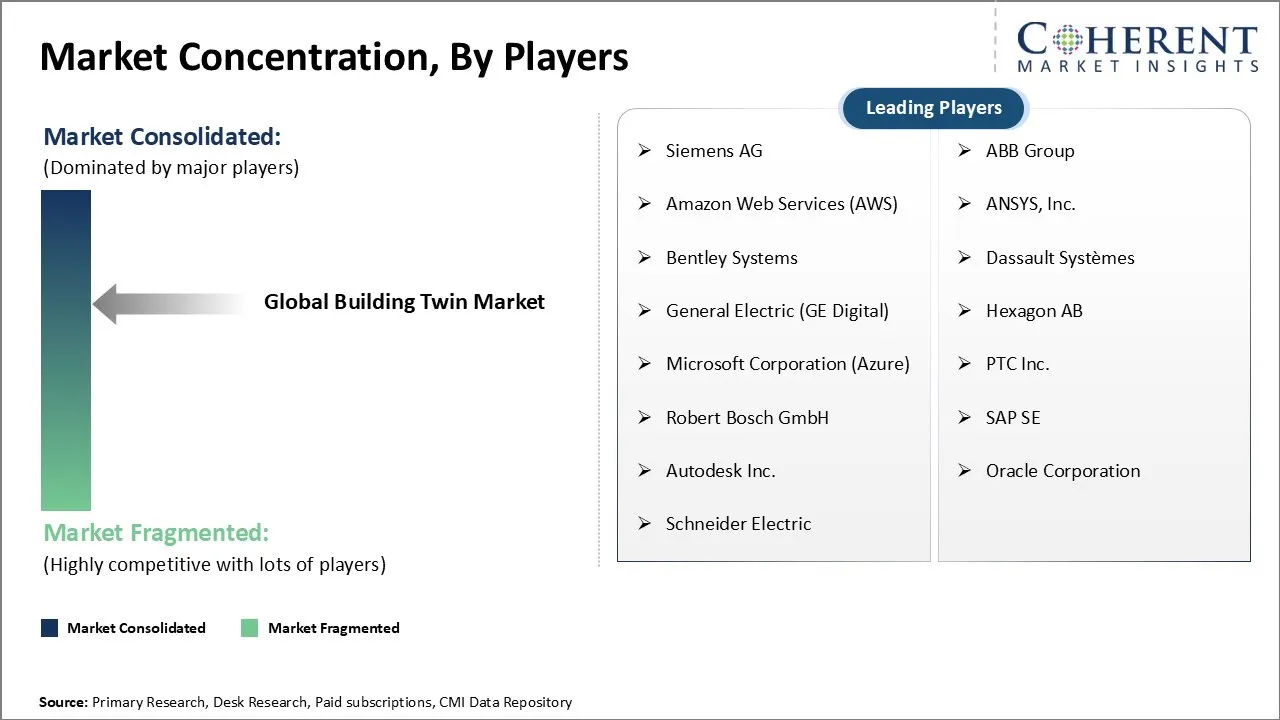
| Companies covered: | Siemens AG, ABB Group, Amazon Web Services (AWS), ANSYS, Inc., Bentley Systems, Dassault Systèmes, General Electric (GE Digital), Hexagon AB, Microsoft Corporation (Azure), PTC Inc., Robert Bosch GmbH, SAP SE, Autodesk Inc., Oracle Corporation, and Schneider Electric | ||
| Growth Drivers: |
| ||
| Restraints & Challenges: |
| ||
Market Dynamics
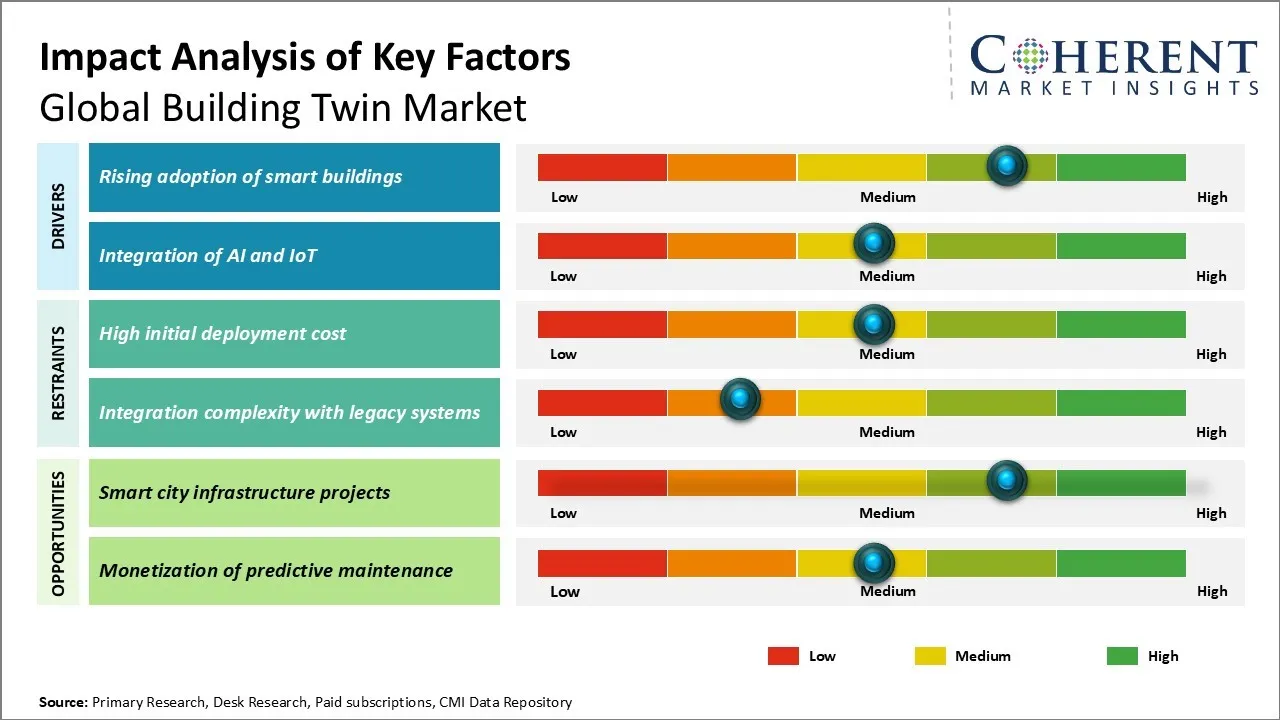
Global Building Twin Market Driver – Rising Adoption of Smart Buildings
Smart buildings utilize advanced automation systems to optimize energy consumption, enhance occupant comfort, and improve operational efficiency. To effectively manage and monitor these complex systems, stakeholders are turning to building twins, which provide a real-time, digital replica of physical assets. This digital representation allows facility managers and engineers to simulate different scenarios, predict maintenance needs, and streamline building operations with greater precision.
Furthermore, as sustainable construction and energy-efficient designs become priorities globally, building twins enable continuous performance monitoring and facilitate proactive adjustments to reduce environmental impact. For instance, CapitaSpring, a 280-meter smart skyscraper in Singapore developed by CapitaLand, is equipped with AI-powered energy systems and IoT-based building management tools, and it has achieved Green Mark Platinum certification. The growing focus on occupant safety and regulatory compliance also encourages the use of digital twins for predictive analytics and risk mitigation.
Global Building Twin Market Opportunity – Expansion through Smart City Infrastructure Projects
As urbanization accelerates worldwide, governments and private sectors are increasingly investing in smart city initiatives aimed at enhancing urban planning, sustainability, and operational efficiency. Building twins, which are digital replicas of physical assets, play a crucial role in these projects by enabling real-time monitoring, predictive maintenance, and optimized resource management of city infrastructure. The integration of IoT sensors, big data analytics, and AI within building twins facilitates proactive decision-making, thus improving energy efficiency, reducing costs, and enhancing citizen services.
Moreover, the rising emphasis on reducing carbon footprints and complying with environmental regulations further propels demand for building twin technology as cities strive for greener solutions. For instance, India's Smart Cities Mission, which spans 100 cities, integrates sustainability certification frameworks into urban infrastructure projects.
With major smart city projects underway in regions like Asia Pacific, Europe, and North America, the building twin market is poised to benefit from increasing collaboration between urban planners, technology providers, and municipal authorities. This synergy not only accelerates the adoption of advanced digital twins but also drives innovation in infrastructure management platforms tailored for complex urban ecosystems.
Analyst Opinion (Expert Opinion)
- Artificial intelligence is evolving digital twins from passive replicas into intelligent systems that simulate, predict, and optimize building operations. With AI, building twins can autonomously flag inefficiencies, anticipate maintenance needs, and enhance energy strategies—pushing the industry toward self-regulating smart buildings.
- The integration of edge computing allows building twins to process data locally and instantly, reducing latency and dependence on cloud infrastructure. This is especially critical for time-sensitive operations like HVAC control and emergency response, where split-second decisions improve both performance and safety.
- Augmented and virtual reality are transforming how users engage with building twins—offering immersive visualization for facility managers, architects, and tenants. From remote walkthroughs to virtual commissioning, these technologies are bridging physical and digital spaces with unprecedented clarity and efficiency.
Speak to the analyst
Want personalized insights?
Take the findings above to one of our principal consultants, or have the report rebuilt around the segments, geographies and competitors you actually track.
Market Segmentation
- Component Insights (Revenue, USD Bn, 2021 - 2033)
- Software
- Service
- Application Insights (Revenue, USD Bn, 2021 - 2033)
- Facility Management
- Predictive Maintenance
- Energy Management
- Safety & Security Management
- Regional Insights (Revenue, USD Bn, 2021 - 2033)
- North America
- U.S.
- Canada
- Latin America
- Brazil
- Argentina
- Mexico
- Rest of Latin America
- Europe
- Germany
- U.K.
- Spain
- France
- Italy
- Russia
- Rest of Europe
- Asia Pacific
- China
- India
- Japan
- Australia
- South Korea
- ASEAN
- Rest of Asia Pacific
- Middle East
- GCC Countries
- Israel
- Rest of Middle East
- Africa
- South Africa
- North Africa
- Central Africa
- North America
- Key Players Insights
- Siemens AG
- ABB Group
- Amazon Web Services (AWS)
- ANSYS, Inc.
- Bentley Systems
- Dassault Systèmes
- General Electric (GE Digital)
- Hexagon AB
- Microsoft Corporation (Azure)
- PTC Inc.
- Robert Bosch GmbH
- SAP SE
- Autodesk Inc.
- Oracle Corporation
- Schneider Electric
Sources
Primary Research Interviews
Stakeholders
- Construction Companies and Contractors (e.g., Project Managers, Site Supervisors)
- Formwork Manufacturers and Suppliers (e.g., Doka, Peri, ULMA, etc.)
- Architects and Structural Engineers involved in large-scale infrastructure projects
- Real Estate Developers and Building Construction Companies
- Equipment Leasing Firms specializing in formwork solutions
- Sustainability Experts and Green Building Consultants (with focus on digital twin integration in green buildings)
Databases
- Eurostat
- U.S. Census
- OECD
Magazines
- Construction Today
- Concrete Construction Magazine
- Building Design + Construction (BD+C)
- Formwork Construction Magazine
Journals
- Journal of Construction Engineering and Management
- Construction and Building Materials Journal
- Automation in Construction Journal
- Journal of Building Engineering
Newspapers
- The Construction Index
- Construction Week Online
- The Guardian (UK)
- The Economic Times (India)
Associations
- International Concrete Repair Institute (ICRI)
- The Concrete Society (UK)
- National Association of Home Builders (NAHB)
- The Formwork Association (UK)
- American Concrete Institute (ACI)
Public Domain Sources
- U.S. Census Bureau
- EUROSTAT
- United Nations Economic Commission for Europe (UNECE)
- World Bank
- ResearchGate
Proprietary Elements
- CMI Data Analytics Tool, Proprietary CMI Existing Repository of Information for the Last 8 Years.
Get access to 250+ pages report
Every segment, forecast, competitor profile and data table behind the analysis above — available for instant download.
- ESOMAR Member
- ISO 9001:2015 Certified
- D-U-N-S Registered
- GDPR & CCPA Compliant
Missing comfort of reading report in your local language? Find your preferred language:
Transform your Strategy with Exclusive Trending Reports
Frequently Asked Questions
The global building twin market is estimated to be valued at USD 3.40 billion in 2026 and is expected to reach USD 18.65 billion by 2033.
The CAGR of the global building twin market is projected to be 27.5% from 2026 to 2033.
Rising adoption of smart buildings and integration of AI and IoT are the major factors driving the growth of the global building twin market.
High initial deployment cost and integration complexity with legacy systems are the major factors hampering the growth of the global building twin market.
In terms of component, software is estimated to dominate the market revenue share in 2026.
Siemens AG, ABB Group, Amazon Web Services (AWS), ANSYS, Inc., Bentley Systems, Dassault Systèmes, General Electric (GE Digital), Hexagon AB, Microsoft Corporation (Azure), PTC Inc., Robert Bosch GmbH, SAP SE, Autodesk Inc., Oracle Corporation, and Schneider Electric are the major players in the global building twin market.
North America is expected to lead the global building twin market in 2026.