

Global Butter Packaging Market Size and Forecast – 2026 To 2033
The Global Butter Packaging Market is estimated to be valued at USD 3,126.8 Mn in 2026 and is expected to reach USD 4,827.2 Mn by 2033, exhibiting a compound annual growth rate (CAGR) of 6.4% from 2026 to 2033. The dairy industry is experiencing growing demand for convenient, shelf-stable and sustainable packaging solutions, as well as a greater preference for packaging that helps to maintain the freshness, taste, texture and cleanliness of butter.
In addition, adoption of sustainable butter packaging solutions is bolstered by the growth of organized retail channels, premium butter formats and innovative techniques in recyclable material. In March 2022, Amcor introduced a grease resistant and long shelf-life compostable paper packaging solution for butter and margarine, marking a change in the packaging industry towards sustainable butter packaging formats, replacing traditional paper-aluminum structures. (Source: Amcor)
Key Takeaways of the Global Butter Packaging Market
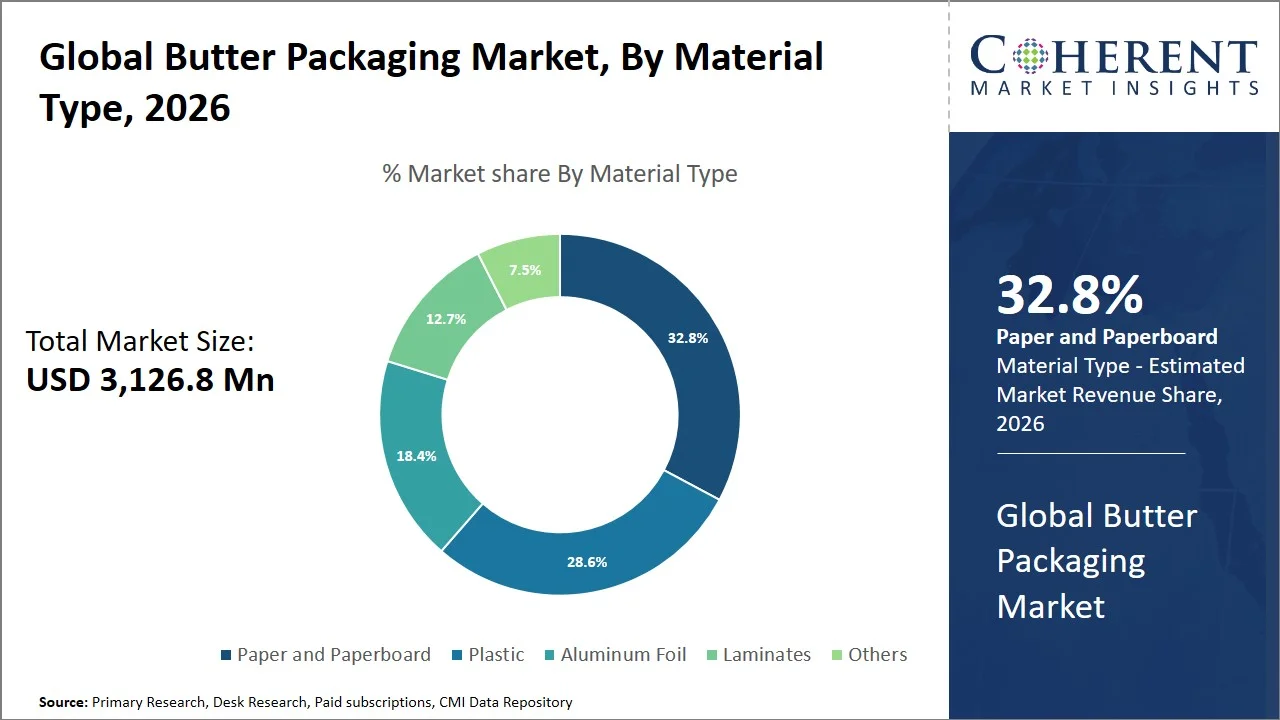
- By material type, paper and paperboard is expected to lead the global butter packaging market with a 32.8 % share in 2026, as grease-resistant fiber wraps allow brands to reduce plastic while protecting butter freshness and foldability. In March 2025, Novolex announced that its TerreGloss and Terrecote compostable butter wraps, manufactured by Shields, received BPI certification for commercial composability and the 2025 Gold Award for Sustainability from the Flexible Packaging Association.
- By packaging type, tubs and cups are expected to dominate with 34.6 % of the market share in 2026, supported by reseal ability, portion convenience, and strong fit with spreadable and family-size butter formats. In June 2024, Saputo Dairy UK removed non-recyclable cover papers from Clover, Utterly Butterly, and Country Life Spreadable packs, making the spread packaging fully recyclable.
- By butter type, regular butter is expected to account for 48.6 % of the market share in 2026, reflecting its core role in household, bakery, and foodservice consumption where standard wrap and carton formats remain cost-efficient. In April 2026, USDA NASS reported that U.S. butter production reached USD 3.20 billion in 2025, 6.7% higher than 2024, reinforcing scale demand for high-throughput butter packaging.
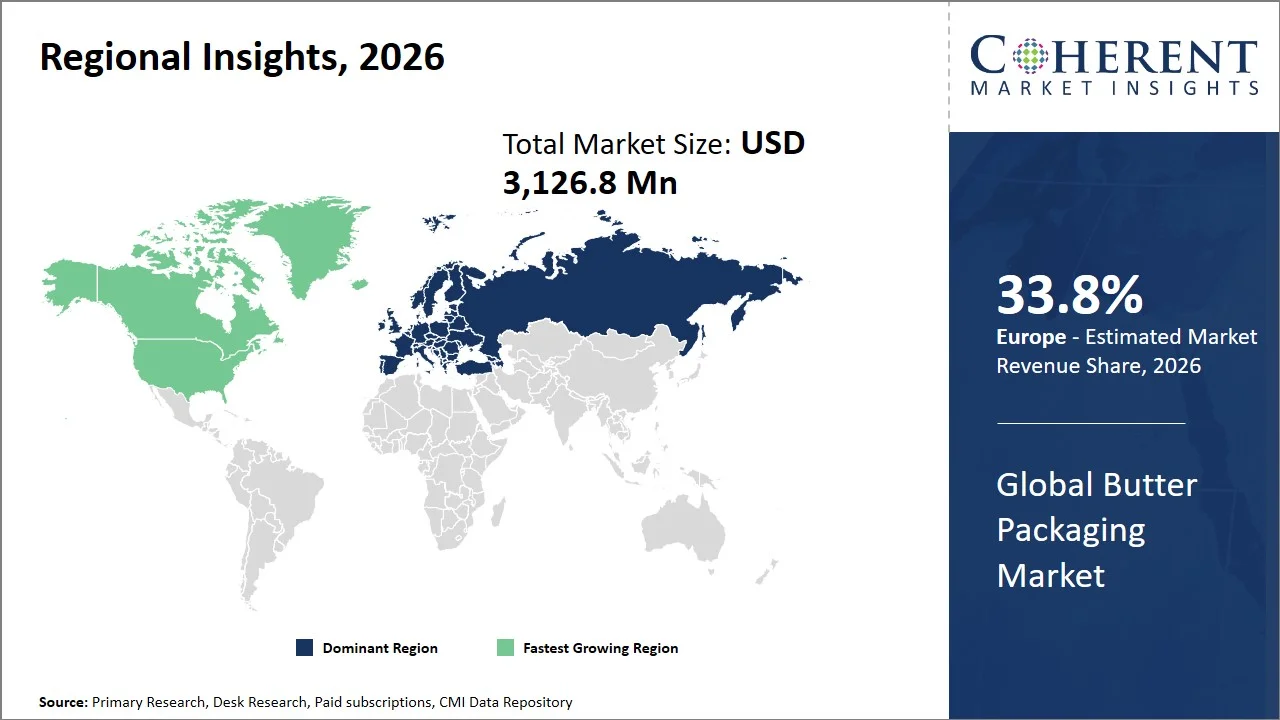
- Europe is expected to dominate the market with a 33.8 % share in 2026, supported by mature dairy retail, premium private-label butter, and strict circular packaging rules that accelerate material redesign. In February 2025, the EU Packaging and Packaging Waste Regulation entered into force, requiring lifecycle packaging compliance and targeting economically viable recyclability for all packaging by 2030.
- North America is expected to be the fastest-growing region while holding a 28.4 % share in 2026, aided by high butter output, strong refrigerated retail networks, and regulatory pressure on recyclable food packaging. In May 2026, California approved permanent SB 54 rules, creating an Extended Producer Responsibility (EPR) program for packaging and single-use plastic food service ware.
- Barrier-led Fiberization: Butter packaging innovation is shifting from simple material replacement to performance parity, where paper-based structures must deliver grease resistance, dead-fold, seal integrity, machinability, and shelf-life protection together. These benefits converters combining coating science with food-contact compliance, while giving dairy brands a route to sustainability claims without compromising product quality or line productivity.
- Retail-ready Premiumization: Packaging is increasingly becoming a commercial differentiator rather than only a cost component. Stronger branding space, portion-friendly formats, resealable convenience, and sustainability cues help butter brands defend shelf visibility in crowded chilled aisles. This direction supports higher-value packaging partnerships, especially for premium, private-label, and spreadable butter ranges seeking stronger consumer recall and repeat purchase.
Segmental Insights
Why Does Paper and Paperboard Dominate the Global Butter Packaging Market?
Paper and paperboard are expected to dominate the global butter packaging market with a 32.8% share in 2026, as butter brands increasingly require packaging that balances grease resistance, printability, recyclability, and compatibility with chilled distribution. The segment benefits from strong demand among premium block butter, bakery butter, and private-label dairy brands where pack appearance and sustainability messaging influence shelf selection. On the supply side, coated paper technologies are improving moisture and grease barriers without depending on complex multilayer plastic structures. Paper-based wraps also suit automated wrapping lines and support high-quality branding for retail packs. In December 2023, Sirane added Earthfilm Butter-Wrap to its Earth Packaging range, offering plastic-free, paper-recyclable butter wrap with water-based barrier coatings and options for butter tub lids.
- Current Industry Events of 2026
- Market Size Estimation
- Regional Breakdown
- Competitive Landscape
- Customer Intelligence
- Segmental Analysis
- Pricing Analysis
- Key Market Drivers, Challenges & Future Trends
- Customized Insights Section
Why Do Tubs and Cups Represent the Largest Packaging Type Segment in the Global Butter Packaging Market?
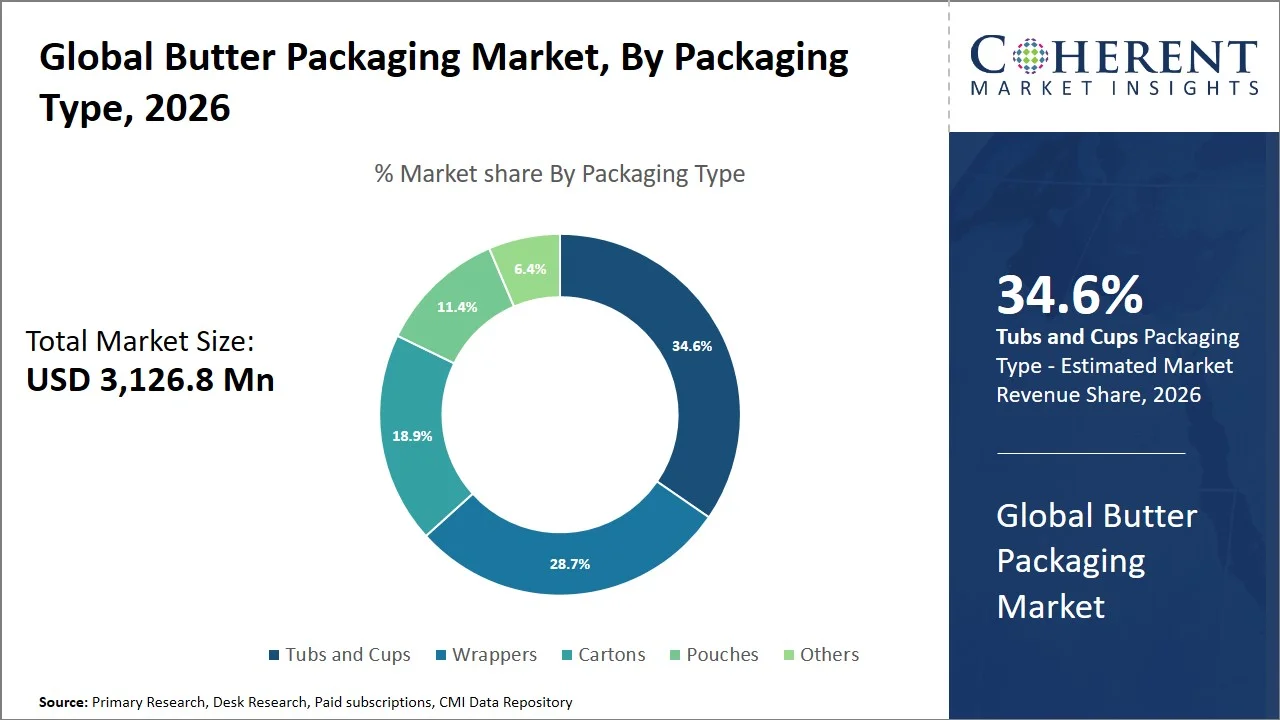
Tubs and cups packaging type segment are expected to hold the largest share 34.6% in 2026, supported by their strong fit with spreadable butter, blended butter, flavored butter, and family-use chilled products. Unlike simple wrappers, tubs protect softer butter formats from deformation, allow repeated opening and closing, and improve portion control for household consumption. Retailers also prefer tubs because they stack efficiently in refrigerated aisles and provide larger label surfaces for flavor, nutrition, and sustainability claims. Packaging suppliers are improving tub design through fiber-based, oil-resistant, and tamper-evident structures that reduce reliance on plastic liners. In January 2024, Upfield launched a plastic-free, recyclable paper tub for its plant butters and spreads, made from compressed wet paper fibers and designed to be waterproof, oil-proof, and recyclable in local paper streams.
Why Does Regular Butter Dominate the Global Butter Packaging Market?
Regular butter is expected to dominate the global butter packaging market with a 48.6% share in 2026, as it remains the most standardized butter format across retail, bakery, foodservice, and industrial ingredient channels. Its packaging demand is anchored in high-volume block, portion, bulk, and foodservice formats that require strong fat barrier protection, cold-chain durability, and consistent pack machinability. Demand is especially strong from bakeries, confectionery producers, hotels, restaurants, and household consumers using butter as a core cooking and baking ingredient. On the supply side, large dairy processors are expanding butter lines that can handle multiple butter formats and certifications for international customers. In October 2025, Fonterra announced a USD 75 million investment to expand butter production at Clandeboye, adding capacity for butter formats tailored to global ingredients customers and professional kitchens. (Source: Fonterra)
Global Butter Packaging Market Dynamics
Key Market Drivers
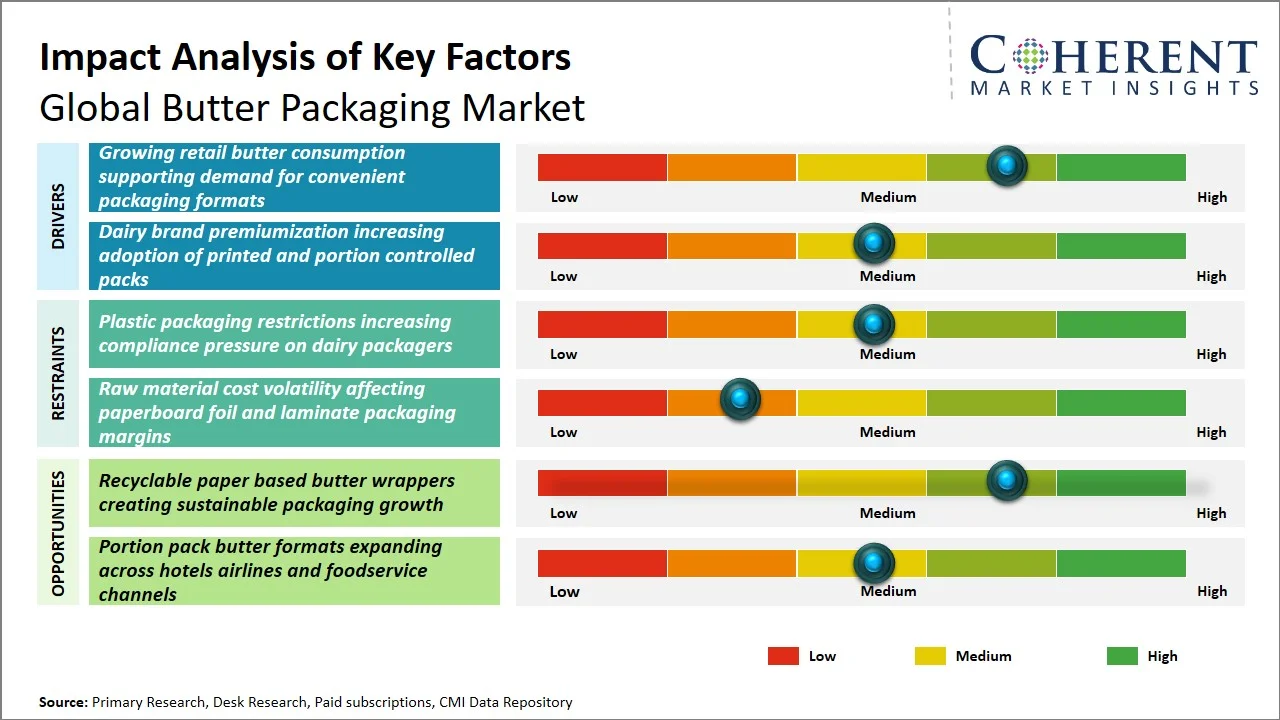
- Growing Retail Butter Consumption Supporting Demand for Convenient Packaging Formats: Supermarkets, private label brands and dairy processors are prioritizing easier-to-store, open, reseal, recycle and identify packaging formats on chilled shelves for retail butter packaging. This driver is particularly critical for butter distributed via the modern grocery, discount retail and online grocery channels, where the packaging should be able to withstand the handling by the consumer, facilitate shelf replenishment, and provide protection to the fat-rich product. So, butter wrappers, as well as different tubs and cartons, are being redesigned with the purpose of being more functional, recyclable at home and with a better shelf communication. In May 2024, Aldi announced that it would replace non-recyclable packaging on two own-label block butter lines with a paper-based wrap recyclable at home, helping remove more than 10 tons of non-recyclable packaging annually. (Source: Packaging Gateway)
- Dairy Brand Premiumization Increasing Adoption of Printed and Portion-Controlled Packs: Printed and portion-controlled packs are gaining traction as dairy brand premiumization evolves from commodity packs to higher impact print, shaped pack, branded tub and custom format that convey taste, origin, recipe use and indulgence. This is especially applicable to flavored butter, chef inspired butter, hotel butter servings, bakery butter and private label high-end ranges. Packaging is now directly involved in margin expansion due to its ability to allow the food to command higher prices, to differentiate in competitive chilled aisles and to enhance foodservice presentation. On the supply side, converters and butter processors are offering more customizable formats, including tubs, chef rolls, dollops, and pre-portioned packs. In April 2026, Butterball Farms highlighted its support for CPG brands and private-label buyers through custom flavored butter development and multiple pack formats, including tubs, pre-portioned dollops, and bulk packaging. (Source: Butterball Farms)
Emerging Market Trends
- Shift Toward Fiber-Based and Mono-Material Butter Packaging: Butter packaging is moving toward fiber-based and easier-to-recycle material structures as dairy brands respond to retailer sustainability targets, consumer waste concerns, and tightening food-contact packaging rules. The trend is not only about replacing plastic or foil, but also about achieving the right barrier performance for a high-fat product. Butter needs protection against grease migration, oxidation, moisture loss, odor absorption, and cold-chain handling stress. As a result, suppliers are focusing on coated paperboard, recyclable wraps, and simplified material combinations that reduce end-of-life complexity. This trend supports the growth of paper and paperboard formats while creating new opportunities for coating suppliers, packaging converters, and dairy companies that can maintain product freshness without using hard-to-recycle multilayer structures.
- Expansion of Premium, Flavored, and Occasion-Based Butter Formats: Butter is increasingly being positioned as a value-added food experience rather than only a staple dairy ingredient. This is encouraging wider use of differentiated packaging for flavored butter, garlic butter, herb butter, breakfast butter, bakery butter, and chef-style cooking butter. Packaging formats are adapting to this shift through better graphics, clearer flavor cues, smaller serving formats, and tub structures that support repeated use. This trend is commercially important because it allows dairy brands to create higher-margin SKUs from the same core butter base. It also strengthens private-label opportunities, as retailers can launch premium butter ranges with distinctive packaging and limited-edition flavors. For packaging suppliers, this creates demand for flexible decoration, short-run printing, format customization, and premium shelf-ready presentation.
Current Events and their Impact
Current Events | Description and its Impact |
EU PPWR PFAS Rules Applying from August 2026 |
|
U.S. FDA PFAS Phase-Out in Grease-Proof Food Packaging, February 2024 |
|
U.K. Packaging EPR Base Fees Published, June 2025 |
|
Regional Insights
Why Does Europe Dominate the Global Butter Packaging Market?
Europe is expected to dominate the global butter packaging market with a 33.8% share in 2026, supported by its mature dairy processing base, high packaged butter penetration, and strong demand for premium, traceable, and sustainability-compliant dairy formats. The region has a well-developed chilled retail infrastructure, enabling wider use of wraps, tubs, cartons, and branded portion packs across supermarket and foodservice channels. European butter brands also require packaging that can meet stricter recyclability, food-contact, and labeling expectations while preserving product quality in cross-border distribution. In March 2026, Agriland reported that, according to the European Commission’s latest milk market report, EU butter production increased by over 6% in 2025, with strong growth in Germany, France, the Netherlands, and Poland, reinforcing demand for butter packaging solutions across the region.
Why is North America Emerging as the Fastest-Growing Region in the Global Butter Packaging Market?
North America is expected to be the fastest-growing region with a 28.4% share in 2026, driven by strong retail butter consumption, rising preference for convenient tubs and portion packs, and active replacement of complex plastic structures with recyclable and lighter packaging formats. The region benefits from advanced dairy processing plants, established cold-chain logistics, and high private-label penetration across grocery and club-store channels. Butter packaging demand is also gaining from foodservice, bakery, and meal-preparation usage, where product protection and portion control are critical. In October 2023, U.S.-based packaging company, Berry Global introduced a new line of recyclable polypropylene butter tubs designed to reduce plastic usage while maintaining product freshness and shelf life, supporting sustainability goals across North American dairy packaging.
Global Butter Packaging Market Outlook for Key Countries
Why is the U.S. a Key Market for the Global Butter Packaging Market?
The U.S. is a key market for butter packaging due to its large retail dairy base, strong refrigerated grocery infrastructure, and high consumption of butter across household, bakery, foodservice, and prepared-food applications. Packaging demand is supported by multiple formats, including sticks, blocks, tubs, cups, bulk packs, and portion-controlled units for restaurants and institutional users. U.S. consumers also show strong acceptance of resealable and value-added butter formats, creating demand for tubs, printed wraps, and high-barrier food-contact materials. The country’s packaging ecosystem is advanced, with converters, dairy processors, and retailers focusing on shelf appeal, convenience, and compliance. In December 2025, Dairy Processing reported that USDA data showed U.S. per capita butter consumption reached a record USD 9.10 Bn in 2024, higher than 6.5 pounds in 2023.
Why is India Important in the Global Butter Packaging Market?
India is important in the global butter packaging market because of its large dairy base, rising packaged food consumption, and expanding demand for branded butter, bakery ingredients, and value-added dairy products. Butter packaging demand is closely linked to urban retail growth, modern trade, e-commerce grocery, and institutional foodservice adoption. The market also benefits from domestic dairy cooperatives and private processors investing in cold-chain, processing, and packaging infrastructure. India’s consumption is largely domestic, which supports high-volume packaging for retail packs, foodservice butter, and ingredient-use formats. In September 2025, USDA FAS New Delhi forecast India’s butter production and consumption to increase in 2026, with butter production projected at 7.44 MMT and consumption at 7.36 MMT, supported by household and processed-food demand.
Why Does China Support Growth in the Global Butter Packaging Market?
China supports growth in the global butter packaging market through expanding bakery, foodservice, coffee-shop, tea-shop, and premium dairy applications that use butter as a functional and flavor ingredient. While traditional household butter consumption is still developing, demand is increasingly shaped by urban bakery chains, Western-style baked goods, premium desserts, and processed foods. This creates packaging requirements for imported butter blocks, industrial butter packs, foodservice cartons, and premium retail formats. Domestic dairy processors are also shifting toward higher-value dairy products to improve milkfat utilization, increasing the need for scalable packaging lines and differentiated pack structures. In November 2025, United States Department of Agriculture (USDA) Beijing reported that large Chinese dairy processors were investing in cheese, butter, and functional powders, while restaurant, bakery, and coffee-shop adoption was expected to support butter demand.
Why is Germany a Strategic Country in the Global Butter Packaging Market?
Germany is a strategic country for butter packaging because it combines a strong dairy processing base, advanced packaging technology, sustainability-led material selection, and high retail quality standards. German consumers are highly responsive to recyclable packaging, clear labeling, and premium dairy positioning, which supports demand for paper wraps, tubs, portion packs, and technically validated packaging formats. The country is also important for packaging machinery, automation, coating technologies, and circular packaging research, making it influential beyond domestic butter consumption. Dairy processors require packaging that can support chilled logistics, export readiness, and efficiency in high-speed filling or wrapping lines. In 2025, DMK Group reported that German dairies collected around 32.5 million tons of milk, around 0.9% higher than the previous year, supporting continued processing demand across butter and other dairy categories.
Why is France an Important Growth Market for the Global Butter Packaging Market?
France is an important growth market for butter packaging due to its strong butter culture, premium dairy heritage, and high use of butter in retail, bakery, pastry, foodservice, and culinary applications. French butter brands often compete through origin, quality, fat content, artisanal positioning, and premium presentation, making packaging design, print quality, portioning, and protection important commercial factors. The country also supports demand for imported and domestic butter packaging because retail and professional kitchen users require consistent quality, traceability, and chilled-chain reliability. In June 2026, CNIEL stated that France has been the world’s leading butter importer for more than 25 years, importing nearly 250,000 tons, equivalent to around half of national consumption, highlighting the country’s strategic role in packaged butter flows.
Technology Adoption Landscape in the Global Butter Packaging Market
Technology | Adoption Level | Key Application Area | Business Impact |
PFAS-free grease barrier coatings | High | Paper wraps and paperboard butter packs | Enables oil resistance while supporting regulatory compliance and recyclable material claims. |
High-speed butter wrapping and forming lines | High | Block butter, sticks, and portion packs | Improves throughput, pack consistency, hygiene control, and large-scale dairy manufacturing efficiency. |
In-mold labeling and high-definition tub printing | Medium | Branded tubs and cups | Enhances shelf visibility, premium positioning, and private-label differentiation in chilled retail. |
Modified atmosphere and oxygen-barrier laminates | Medium | Premium butter, flavored butter, and export packs | Helps reduce oxidation risk and protects flavor quality during longer distribution cycles. |
Tamper-evident and resealable lid systems | Medium | Spreadable butter tubs and foodservice packs | Improves consumer confidence, repeat-use convenience, and suitability for household storage. |
Lightweighting and material downgauging tools | Medium | Plastic tubs, cartons, wraps, and secondary packaging | Reduces material cost, EPR exposure, transport weight, and sustainability burden. |
How are Sustainable Barrier Materials and Premium Butter Formats Creating New Growth Opportunities in the Global Butter Packaging Market?
Sustainable barrier packaging represents one of the strongest growth opportunities in the global butter packaging market because butter requires packaging that can manage grease, moisture, oxygen, odor, and cold-chain exposure simultaneously. As dairy brands shift toward recyclable paperboard, coated wraps, and simplified plastic structures, packaging suppliers that can deliver performance without compromising recyclability will gain stronger positioning. The opportunity is also supported by premium butter formats, including flavored butter, spreadable butter, culinary butter, and portion-controlled butter for hotels, bakeries, airlines, and restaurants. These products require differentiated packaging with stronger graphics, better portion control, secure sealing, and higher shelf appeal. Companies that combine sustainable materials with premium pack design can support brand owners in both compliance and margin expansion. The most attractive commercial space is likely to emerge where packaging enables a clear sustainability claim, protects product freshness, and helps butter brands move from commodity pricing toward value-added retail and foodservice positioning.
Market Players, Key Development, and Competitive Landscape
Key Developments
- In September 2025, ProAmpac announced that its ButterFresh Parchment received OK compost HOME certification from TÜV Austria. The wax-free and PFAS non-intent printed butter wrap is designed for butter, margarine, and other oil-based solid products, offering grease resistance, dead-fold performance, freshness protection, and compostability. This development strengthens the shift toward certified sustainable butter wraps.
- In January 2024, Upfield launched a plastic-free, recyclable paper tub for its plant butters and spreads. The packaging was developed with Footprint, MCC, and Pagès Group, using compressed wet paper fibers that are waterproof, oil-proof, and recyclable in local paper waste streams. This supports the broader move from conventional plastic tubs to fiber-based rigid packaging formats.
Competitive Landscape
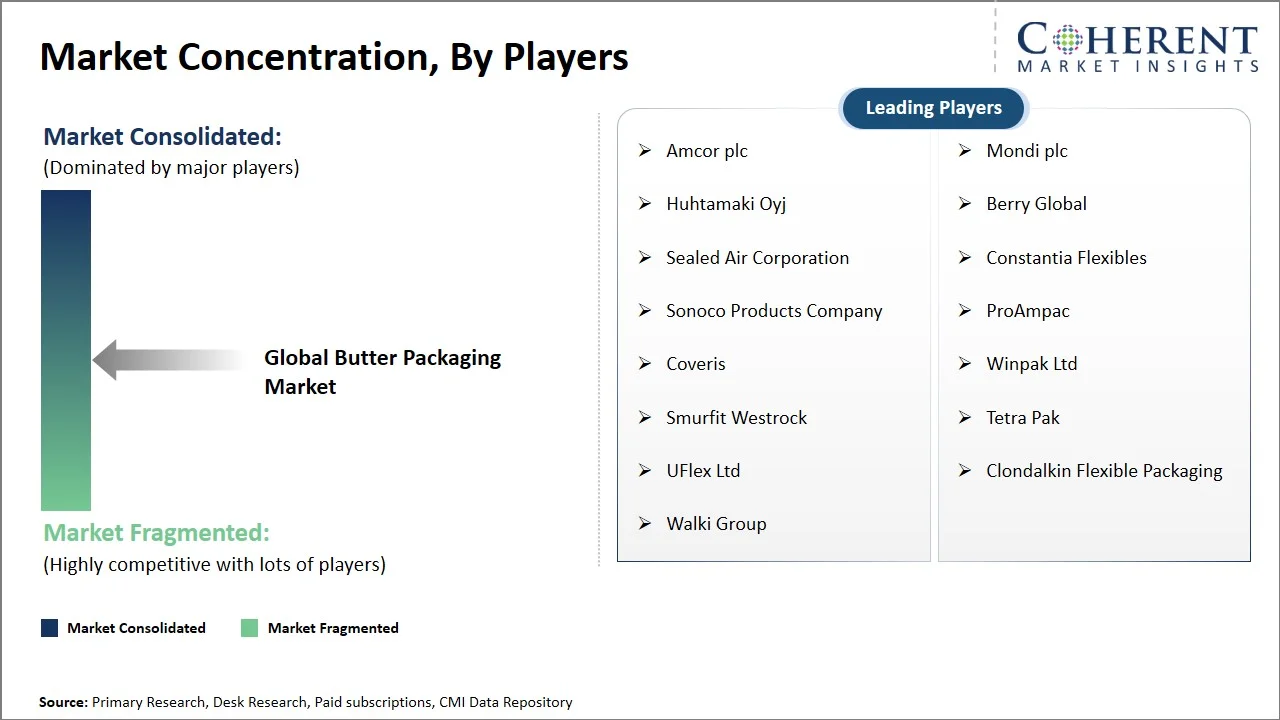
The global butter packaging market is moderately fragmented, with competition comprising flexible packaging converters, paperboard packaging suppliers, rigid plastic packaging manufacturers, dairy packaging machinery providers, and integrated packaging companies. Competition is shaped by material performance, food-contact compliance, cost efficiency, sustainability credentials, and the ability to support both high-volume dairy manufacturers and premium retail brands.
Key focus areas include
- Product quality and differentiation: Companies compete on grease resistance, cold-chain durability, print quality, seal integrity, and shelf presentation.
- Technology adoption and process efficiency: Automated wrapping, filling, sealing, and forming compatibility is critical for large dairy processors.
- Pricing and cost competitiveness: Material cost, pack weight, production speed, and waste reduction strongly influence supplier selection.
- Capacity expansion and supply reliability: Dairy manufacturers prefer suppliers that can support seasonal demand, private-label volumes, and multi-region distribution.
- Certifications, compliance, and quality control: Food-contact safety, migration testing, recyclability validation, and audit readiness are becoming stronger differentiators.
- Distribution network and customer reach: Suppliers with regional converting assets and dairy-sector relationships can respond faster to brand and retailer requirements.
- Format differentiation: Competition is increasing in paper wraps, resealable tubs, portion packs, premium printed cartons, and foodservice butter units.
- Sustainable positioning: Recyclable, compostable, lightweight, PFAS-free, and lower-plastic solutions are becoming key commercial levers.
Market Report Scope
Butter Packaging Market Report Coverage
| Report Coverage | Details | ||
|---|---|---|---|
| Base Year: | 2025 | Market Size in 2026: | USD 3,126.8 Mn |
| Historical Data for: | 2020 To 2024 | Forecast Period: | 2026 To 2033 |
| Forecast Period 2026 to 2033 CAGR: | 6.4% | 2033 Value Projection: | USD 4,827.2 Mn |
| Geographies covered: |
| ||
| Segments covered: |
| ||
| Companies covered: | Amcor plc, Mondi plc, Huhtamaki Oyj, Berry Global, Sealed Air Corporation, Constantia Flexibles, Sonoco Products Company, ProAmpac, Coveris, Winpak Ltd, Smurfit Westrock, Tetra Pak, UFlex Ltd, Clondalkin Flexible Packaging, and Walki Group | ||
| Growth Drivers: |
| ||
| Restraints & Challenges: |
| ||
Analyst Opinion (Expert Opinion)
- The global butter packaging market is likely to move from cost-led packaging selection toward performance-led and compliance-led decision-making. Over the forecast period, brands will not only evaluate packaging on price, but also on recyclability, grease-barrier performance, line compatibility, and ability to support premium retail positioning. Suppliers that can combine sustainability with product protection will be better placed to capture long-term contracts.
- Transformative growth is expected to come from next-generation fiber-based wraps, recyclable coated papers, lightweight tubs, and mono-material packaging formats. These solutions can reshape the market by reducing dependence on complex laminates and difficult-to-recycle structures. As retailers and dairy brands strengthen sustainability targets, packaging innovation will become a key route for product differentiation rather than only a compliance requirement.
- Key risks include higher material costs, performance limitations of recyclable barrier structures, compliance testing complexity, and potential trade-offs between sustainability and product protection. Market players should focus on PFAS-free grease barriers, lightweight packaging, recyclable mono-material designs, premium print capabilities, and close collaboration with dairy brands to develop packaging that supports both compliance and commercial differentiation.
Speak to the analyst
Want personalized insights?
Take the findings above to one of our principal consultants, or have the report rebuilt around the segments, geographies and competitors you actually track.
Market Segmentation
- Material Type Insights (Revenue, USD Mn, 2021 - 2033)
- Paper and Paperboard
- Plastic
- Aluminum Foil
- Laminates
- Others
- Packaging Type Insights (Revenue, USD Mn, 2021 - 2033)
- Tubs and Cups
- Wrappers
- Cartons
- Pouches
- Others
- Butter Type Insights (Revenue, USD Mn, 2021 - 2033)
- Regular Butter
- Spreadable Butter
- Salted Butter
- Unsalted Butter
- Others
- End User Insights (Revenue, USD Mn, 2021 - 2033)
- Dairy Manufacturers
- Food Processing Companies
- Retail Private Labels
- Others
- Regional Insights (Revenue, USD Mn, 2021 - 2033)
- North America
- U.S.
- Canada
- Latin America
- Brazil
- Argentina
- Mexico
- Rest of Latin America
- Europe
- Germany
- U.K.
- Spain
- France
- Italy
- Russia
- Rest of Europe
- Asia Pacific
- China
- India
- Japan
- Australia
- South Korea
- ASEAN
- Rest of Asia Pacific
- Middle East
- GCC Countries
- Israel
- Rest of Middle East
- Africa
- South Africa
- North Africa
- Central Africa
- North America
- Key Players Insights
- Amcor plc
- Mondi plc
- Huhtamaki Oyj
- Berry Global
- Sealed Air Corporation
- Constantia Flexibles
- Sonoco Products Company
- ProAmpac
- Coveris
- Winpak Ltd
- Smurfit Westrock
- Tetra Pak
- UFlex Ltd
- Clondalkin Flexible Packaging
- Walki Group
Source
Primary Research Interviews
- Butter packaging manufacturers (paper wraps, cartons, foil, laminates, plastic tubs, cups, lids, pouches, portion packs)
- Flexible packaging converters (grease-resistant wraps, laminated papers, coated paper, foil-paper structures, printed films)
- Rigid packaging manufacturers (tubs, cups, resealable lids, injection-molded and thermoformed packs)
- Dairy manufacturers (regular, spreadable, salted, unsalted, flavored, private-label butter)
Butter processors, cooperatives, creameries, and contract packers using automated packaging systems - Material suppliers (paper, foil, polymers, coatings, adhesives, inks, barrier materials)
- Packaging machinery suppliers (wrapping, filling, sealing, carton forming, portion-pack lines)
- Retailers and private-label buyers sourcing packaged butter
- Foodservice, bakeries, and institutional buyers using bulk and portion packs
- Sustainability, compliance, recycling, and packaging regulation consultants
Stakeholders
- Packaging manufacturers: Amcor, Mondi, Huhtamaki, Berry Global, Sealed Air, Constantia Flexibles,
- Sonoco, ProAmpac, Coveris, Winpak, Smurfit Westrock, Tetra Pak, UFlex, Clondalkin, Walki, Sirane, Wipak
- Dairy producers: Arla, Lactalis, Fonterra, Saputo, DFA, Ornua, Land O’Lakes, DMK, Müller, Amul, FrieslandCampina
- Paper suppliers: Stora Enso, Billerud, Metsä Board, Sappi, WestRock, International Paper, Graphic Packaging
- Resin suppliers: Dow, ExxonMobil, SABIC, LyondellBasell, Borealis, Braskem
- Foil suppliers: Hindalco, Novelis, Constantia, UACJ Foil
- Coatings/adhesives/inks: Henkel, H.B. Fuller, Siegwerk, Sun Chemical, ACTEGA, BASF, Arkema
- Machinery: Syntegon, IMA, GEA, Krones, Trepko, Benhil
- Retail ecosystem: Walmart, Costco, Kroger, Aldi, Lidl, Tesco, Carrefour
- Foodservice ecosystem: bakeries, QSRs, hotels, institutional kitchens
- Recycling ecosystem: recyclers, EPR bodies, recovery organizations
Databases
- UN Comtrade, ITC Trade Map – trade data
- FAOSTAT, OECD-FAO – dairy production and demand
- USDA (NASS, ERS, FAS) – butter production and trade
- Eurostat, EU PRODCOM – European production data
- U.S. Census, USITC, BLS – shipments, pricing, costs
- FAO, EC Milk Observatory – dairy trends
- National dairy boards – country-level statistics
- Company reports and technical documents
Magazines / Industry Publications
- Packaging Europe, Packaging Dive, Packaging Gateway, Packaging World
- Dairy Foods, Dairy Industries International, Dairy Reporter
- Food Packaging Forum, Food Engineering, Food Processing
- Plastics News, Sustainable Plastics, Resource Recycling
- Paper360, EUWID
- Baking Business, Bakery and Snacks
- Recycling Today, Waste Management World
Journals
- Food Packaging and Shelf Life
- Packaging Technology and Science
- Journal of Food Engineering
- Food Control
- Journal of Dairy Science
- International Dairy Journal
- Journal of Cleaner Production
- Resources, Conservation and Recycling
- Waste Management
- Polymers, Coatings
- Sustainable Materials and Technologies
Credible News Sources
- Food Dive, Food Business News, Dairy Reporter
- Packaging Europe, Packaging Dive
- Food Manufacture, Bakery and Snacks
- Sustainable Plastics, Plastics News
- Agriland, The Grocer
Associations
- International Dairy Federation
- Global Dairy Platform
- Dairy UK, European Dairy Association
- U.S. Dairy Export Council, IDFA
- Dairy Farmers of Canada, Indian Dairy Association
- Flexible Packaging Europe, FPA
- Fibre Box Association, Plastics Industry Association
- Association of Plastic Recyclers, RecyClass
- Sustainable Packaging Coalition, 4evergreen
- European Aluminium Foil Association
Public Domain Sources
- U.S. FDA, USDA
- European Commission, EFSA, ECHA
- UK DEFRA, Environment Canada
- CalRecycle
- FSSAI, BIS India
- China SAMR, Japan MHLW
- ISO, ASTM, TAPPI standards
Proprietary Elements
- CMI Data Analytics Tool, Proprietary CMI Existing Repository of information for last 10 years.
Get access to 250+ pages report
Every segment, forecast, competitor profile and data table behind the analysis above — available for instant download.
- ESOMAR Member
- ISO 9001:2015 Certified
- D-U-N-S Registered
- GDPR & CCPA Compliant
Missing comfort of reading report in your local language? Find your preferred language:
Transform your Strategy with Exclusive Trending Reports
Frequently Asked Questions
The CAGR of the global butter packaging market is projected to be 6.4% from 2026 to 2033.
The global butter packaging market is estimated to be valued at USD 3,126.8 million in 2026 and is expected to reach USD 4,827.2 million by 2033.
North America is expected to be the fastest-growing region in the global butter packaging market, supported by strong retail butter demand, foodservice usage, and rising adoption of recyclable and convenient packaging formats.
The market is witnessing a shift toward recyclable paper-based wraps, lightweight tubs, portion-controlled packs, and packaging formats that improve product freshness, shelf visibility, and consumer convenience.
Sustainability is becoming important as dairy brands and retailers are moving toward recyclable, compostable, and lower-plastic packaging solutions to meet regulatory requirements and consumer preference for environmentally responsible packaging.
Growing retail butter consumption supporting demand for convenient packaging formats and dairy brand premiumization increasing adoption of printed and portion controlled packs are the major factors driving the growth of global butter packaging market.
In terms of material type, paper and paperboard is estimated to dominate the market revenue share in 2026.