

Global Capsule Hotels Market Size and Forecast – 2026-2033
The Global Capsule Hotels Market is estimated to be valued at USD 367.7 Mn in 2026 and is expected to reach USD 571.5 Mn by 2033, exhibiting a compound annual growth rate (CAGR) of 6.5% from 2026 to 2033.
Key Takeaways of the Capsule Hotels Market
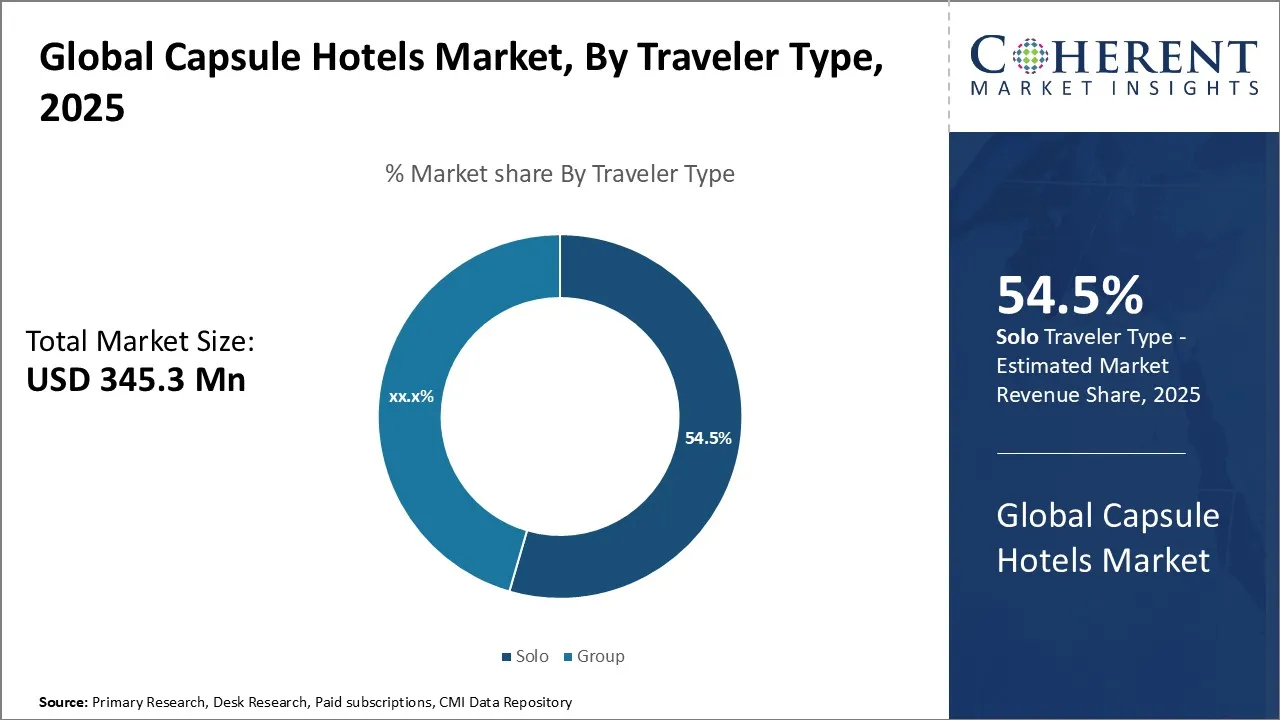
- The solo segment is projected to account for 55.5% of the market share in 2026, driven by travelers’ strong preference for convenience, affordability, and the personalized experiences that capsule hotels uniquely deliver.
- The short-term stays (up to 2 days) segment is expected to capture 58.9 % of the market share in 2026, largely reflecting the dynamics of urban travel and the growing demand from transit-oriented travelers.
- The 18–24 years age group is projected to hold 37.8 % share of the global capsule hotels market in 2026, driven by their willingness to embrace innovative lodging options and their strong preference for affordable travel experiences.
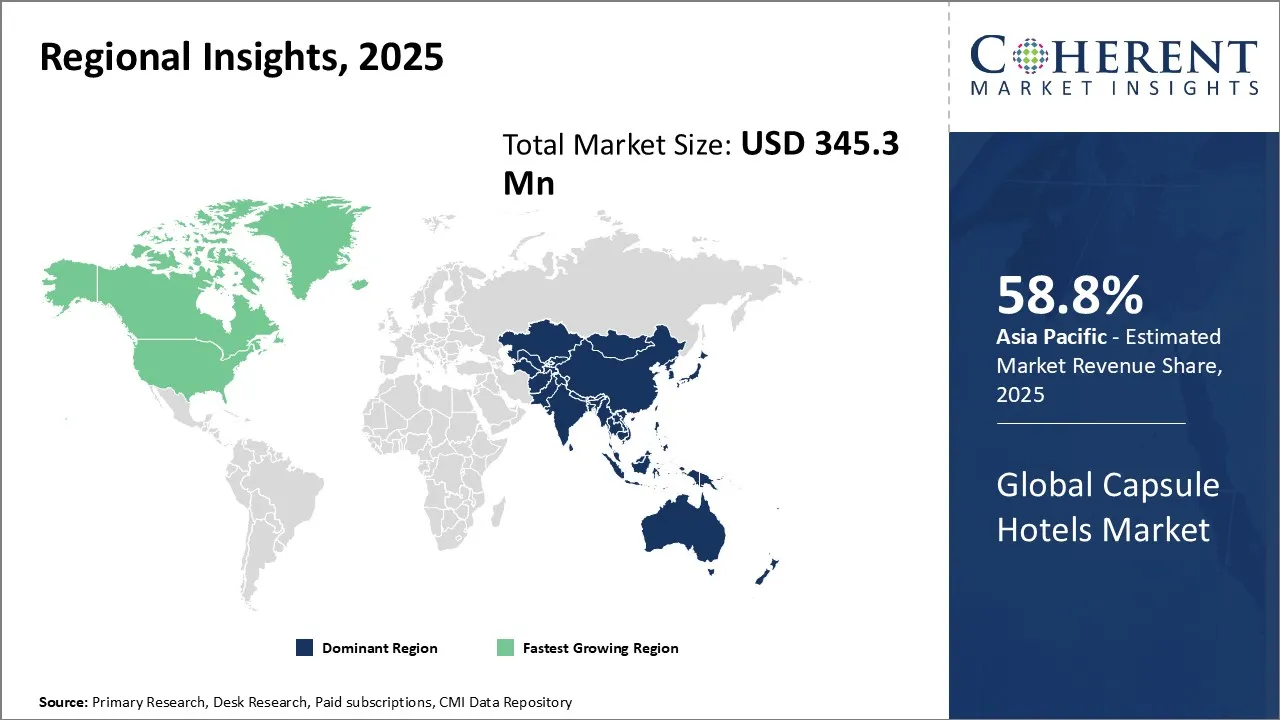
- Asia Pacific is expected to lead the global capsule hotels market in 2026 with a 58.8 % share, driven by rapid urbanization, booming tourism, and the strong adoption of compact, affordable lodging options in countries such as Japan, China, and South Korea. North America, with a 25.5% share, will be the fastest-growing region in 2026, fueled by the rising demand from budget-conscious millennials and business travelers, as well as the growing popularity of capsule hotels in major urban hubs like New York, Los Angeles, and Toronto.
Market Overview
Market trends indicate a strong shift towards integrating advanced technology within capsule hotels, such as IoT-enabled amenities and automated check-in systems, enhancing guest convenience and operational efficiency. Additionally, sustainability practices and eco-friendly designs are gaining traction, catering to environmentally conscious travelers. The growing popularity among millennials and solo travelers, combined with expansion in emerging markets, is further propelling the market forward.
Alongside these developments, floating hotels are emerging as a novel concept in hospitality, offering unique experiences for niche travelers. In parallel, luxury hotels continue to set new benchmarks in comfort and exclusivity, influencing consumer expectations and inspiring innovative design trends across the broader lodging sector.
Current Events and Its Impact
Current Events | Description and its impact |
Expansion of capsule concepts beyond Japan |
|
Smart, contactless tech adoption |
|
Segmental Insights
- Current Industry Events of 2026
- Market Size Estimation
- Regional Breakdown
- Competitive Landscape
- Customer Intelligence
- Segmental Analysis
- Pricing Analysis
- Key Market Drivers, Challenges & Future Trends
- Customized Insights Section
Capsule Hotels Market Insights, By Traveler Type – Solo Segment Dominates the Market Due to its Independence and Affordability
The solo segment is expected to represent 55.5% share of the market in 2026, due to their preference for convenience, cost-efficiency, and the tailored experience that capsule hotels provide. The independent nature of solo travelers aligns well with the compact and self-contained design of capsule accommodations, offering them privacy and comfort without the need for extensive space or communal interaction demands typical of larger hotel setups.
A key driver for the popularity of capsule hotels among solo travelers is affordability. Solo travelers, including backpackers, business travelers on tight schedules, and young professionals, often seek budget-friendly lodging options that still meet essential comfort standards. Capsule hotels offer an economical alternative to traditional hotels and hostels, allowing these travelers to allocate more resources toward their travel activities rather than accommodation costs. This is especially appealing in metropolitan cities where hotel rates can be prohibitively high.
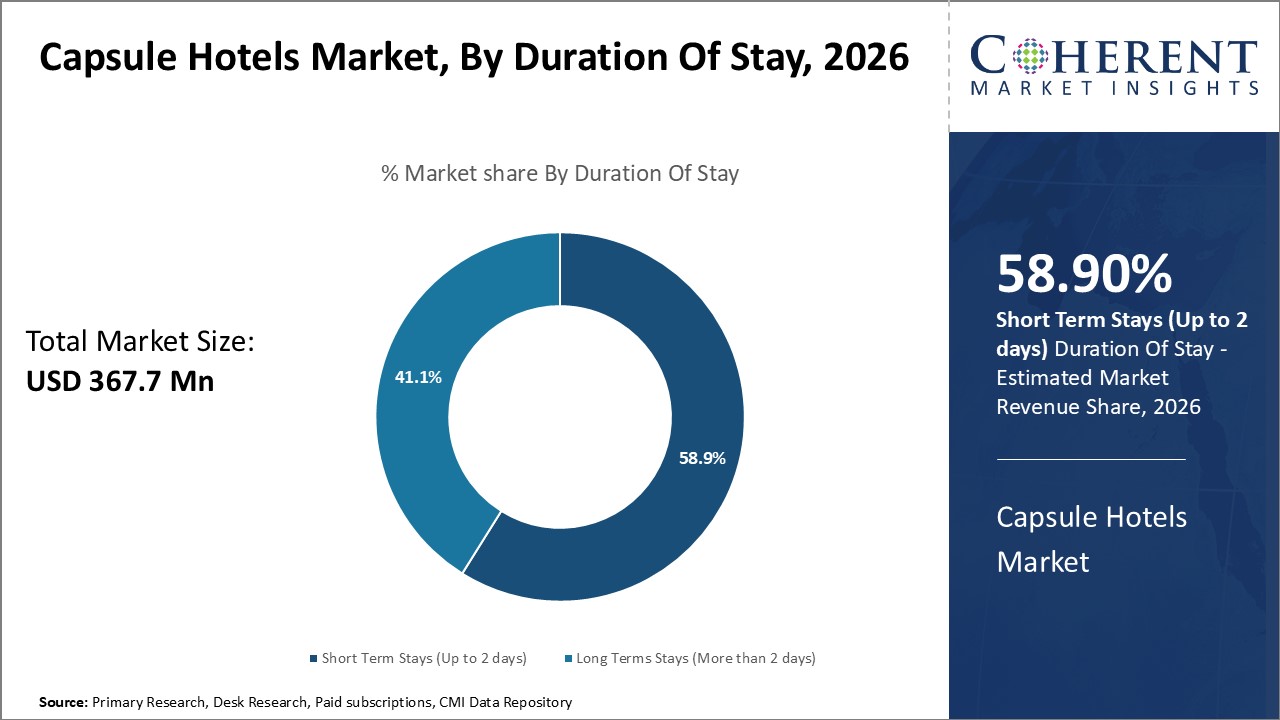
Capsule Hotels Market Insights, By Duration of Stay - Short Term Stays (Up to 2 days) Segment Dominates the Market due to Urban Utility and Transit-Focused Demand
The short term stays (up to 2 days) segment is projected to hold 58.9% share of the market in 2026, primarily due to the nature of urban travel and transit needs. Capsule hotels have carved a niche providing quick, efficient rest points for travelers who require accommodation close to transportation hubs such as airports, train stations, and city centers. This transient nature of use is a core element driving the demand for short-term bookings.
Travelers opting for short stays are typically business professionals, layover passengers, and tourists on brief city visits, all requiring minimal yet sufficient accommodation for resting and recharging. The compact, no-frills design of capsule hotels perfectly caters to these duration-sensitive travelers who prioritize accessibility and speed over extensive hotel services or prolonged comfort.
Capsule Hotels Market Insights, By Age Group - 18-24 Years Segment Dominates the Market Driven by its Travel & Experience Lifestyle
The 18-24 years segment is projected to command 37.8% share in the global capsule hotels market in 2026, largely propelled by this demographic’s openness to innovative accommodations and budget-conscious travel habits. This younger cohort, primarily students, early-career professionals, and first-time travelers, values affordability, unique experiences, and social connectivity—traits well embodied by capsule hotels.
The inclination towards cost-effective travel strongly benefits the capsule hotel segment among 18-24-year-olds. Many in this age range either have limited disposable income or seek to optimize their travel budgets, making the economically priced capsule hotels an attractive option. The affordability factor does not only ease access but also encourages frequent traveling, which suits the explorative mindset typical of younger travelers.
Regional Insights
Asia Pacific Capsule Hotels Market Analysis and Trends
The Asia Pacific region is projected to lead the market with a 58.8% share in 2026, driven by the region's mature hospitality infrastructure, high urban density, and rapidly evolving travel culture. Countries like Japan and China have long embraced capsule hotels as budget-friendly, efficient lodging options, especially in megacities with space constraints. Additionally, government initiatives promoting domestic and international tourism have facilitated growth in the hospitality segment, including capsule hotels.
The market ecosystem is bolstered by a well-established network of technology-savvy travelers and vibrant urban centers that demand innovative accommodation solutions. Notable companies such as First Cabin and Nine Hours in Japan, alongside China's YOTEL, have led technological integration and service expansion, pushing the market forward through enhanced customer experiences and operational efficiencies.
North America Capsule Hotels Market Analysis and Trends
The North America region is expected to exhibit the fastest growth in the market contributing 25.5% share in 2026, fueled by urbanization, high real-estate costs, and demand for affordable short-stay options in cities like New York, Los Angeles, and Toronto. Millennials, Gen Z travelers, and business commuters are driving adoption, while operators like Pod Hotels (U.S.) and Capsule Hotel Toronto are leading innovation with modular, tech-enabled pods. Government tourism support and rising international events further boost market expansion, making capsule hotels a cost-effective and space-efficient alternative in the region.
Global Capsule Hotels Market Outlook for Key Countries
Japan Capsule Hotels Market Trends
Japan's capsule hotels market has been leveraging its pioneering role in this accommodation style since the late 1970s. The country benefits from a well-established, mature ecosystem supported by strong domestic travel demand and an influx of international tourists seeking unique lodging experiences. Companies such as Nine Hours and First Cabin offer innovative capsule concepts prioritizing technology, comfort, and minimalism, attracting business travelers and tourists alike. Additionally, Japan's favorable government policies encouraging tourism and urban regeneration projects have further solidified its position as a dominant market.
China Capsule Hotels Market Trends
China's rapidly urbanizing population and expanding middle-class contribute to the growing demand for affordable, convenient lodging options like capsule hotels. The government's push toward domestic tourism and smart city initiatives supports infrastructure developments that favor capsule hotel integration. Key players like YOTEL and Zhejiang-based local brands are driving market expansion by introducing high-tech capsules and enhancing service scalability. Moreover, China's vast connectivity and digital payment ecosystems enhance the operational efficiency of capsule hotels and elevate customer experiences.
South Korea Capsule Hotels Market Trends
South Korea’s capsule hotels market is characterized by a tech-savvy population and a high density of urban centers, fostering a favorable environment for capsule hotel development. The government’s strategic focus on tourism, coupled with cultural trends toward minimalism and convenience, propels demand. Companies such as Guest House Seoul and Hotel The Designers offer capsule accommodations catering to budget travelers and young professionals. Additionally, Seoul's status as a business and cultural hub enhances the need for flexible lodging options that capsule hotels provide.
U.A.E Capsule Hotels Market Trends
In the U.A.E, particularly Dubai, the capsule hotels market is gaining momentum driven by a robust influx of international business and leisure travelers seeking affordable, time-efficient lodging. The government’s broad economic diversification strategy heavily emphasizes tourism infrastructure and hospitality innovation, creating an enabling environment for capsule hotel growth. Market players like The Capsule Hotel Dubai and local boutique brands are capitalizing on this by offering modern, luxury-infused capsule experiences that blend affordability with the region’s high service standards, targeting millennials and short-stay visitors.
Germany Capsule Hotels Market Trends
Germany's capsule hotels market is emerging steadily within its dense urban zones like Berlin and Frankfurt, where there is increasing demand for compact and affordable accommodations, especially among young travelers and business visitors. The market benefits from Germany's strong tourism ecosystem and supportive urban policies that encourage innovative hospitality solutions. Companies such as A&O Hotels and Hostel and CityHub Germany have introduced capsule-style concepts that combine hostel affordability with enhanced privacy, catering efficiently to the evolving travel preferences in the country. Germany’s trade openness and membership in the EU also facilitate cross-border travel demand, further stimulating the capsule hotel model.
Macro and Micro Economic Factors Impacting on Capsule Hotels Market Growth
Macro-Economic Factors
- Global Tourism Growth: Rising international and domestic tourism increases the demand for affordable lodging options, especially among budget travelers and backpackers.
- Urbanization: Rapid development of urban centers drives the demand for space-efficient accommodations. High real estate costs make the capsule hotel model attractive in densely populated cities.
- Changing Traveler Demographics: Growth in solo travelers, millennials, Gen Z, and digital nomads, all seeking practical and budget-friendly stays.
- Economic Volatility & Inflation: Increases in travel costs (airfares, hotel rates) shift travelers towards cost-effective solutions such as capsule hotels.
- Technology Adoption and Remote Work: Broader acceptance of remote work and online booking platforms boost market accessibility, catering to staycations and flexible accommodation needs.
- Cultural Trends: Minimization preferences and experience-driven travel habits promote capsule hotels for their simplicity and novelty.
Micro Economic Factors
- Space Efficiency: Capsule hotels maximize revenue per square foot, appealing to operators facing rising urban real estate costs.
- Technological Integration: Use of automation, mobile apps, self-check-in, and smart pods improves customer experience and reduces operational costs.
- Flexible Booking Models: Hourly or short-stay rentals cater to travelers with variable schedules and increase occupancy rates.
- Sustainability Initiatives: Incorporating eco-friendly materials and energy-efficient operations addresses rising consumer demand for sustainable travel options.
- Location Strategy: Situating pod hotels near airports, business districts, and tourist attractions boosts relevance and appeal.
Market Players, Key Development, and Competitive Intelligence
Key Developments
- In January 2025, Uumen Hotel unveiled plans to open Finland’s first micro-room hotel in Tampere by May 2025. Situated in the historic Finlayson factory district, the property will feature compact five-square-meter rooms inspired by Japan’s capsule hotels. Each unit will include a comfortable bed, storage space, and privacy features, while shared bathrooms help maintain affordability—making it an appealing option for budget travelers seeking a unique stay experience.
- In January 2025, Indonesian capsule hotel and cabin brand, Bobobox announced the addition of five new properties, expanding its nationwide network to 37 locations. The new openings include Bobocabin Dieng, Bobopod Thamrin, Bobocabin Sukawana, Bobocabin Patra Parapat, and Bobocabin Ijen. Looking ahead, the company aims to launch 12 additional sites in 2025, targeting popular travel hotspots such as Surabaya, Medan, Bali, and Bromo.
- In October 2024, Panda Pod Hotel debuted in Vancouver, Canada offering affordable pod-style accommodations tailored to digital nomads and solo travelers. With nightly rates under USD 100 (including taxes), the hotel provides a budget-friendly alternative in one of Canada’s most expensive cities. Designed for independent travelers, it features a self-check-in system and streamlined amenities that emphasize simplicity, efficiency, and cost-effectiveness without sacrificing comfort.
Top Strategies Followed by Global Capsule Hotels Market Players
- Established players in this domain heavily invest in research and development (R&D) to drive innovation and deliver high-performance products that meet evolving consumer demands for comfort, convenience, and technology integration. This approach allows them to penetrate emerging markets with growing urban populations and increasing demand for affordable yet premium accommodation options, thereby solidifying their footprint and reinforcing their brands on a global scale.
- For instance, First Cabin has integrated aviation-inspired luxury capsule suites to target business travelers, blending affordability with premium comfort.
- Mid-level players in the capsule hotels market adopt a somewhat different approach, focusing on delivering cost-effective solutions that strike a balance between quality and affordability. Their target demographic primarily consists of price-sensitive consumers, including budget travelers, business commuters, and young tourists seeking convenient lodging options without luxury price tags. To strengthen their competitive position, these companies frequently engage in collaborations and partnerships that bolster their production capabilities and facilitate technology sharing.
- For example, Bobobox has expanded aggressively across Indonesia with modular capsule hotels and Bobocabin units in scenic tourist locations, combining affordability with a tech-enabled booking app for convenience. The Pod Hotels in Singapore balance affordability and quality by targeting both budget tourists and short-stay business travelers with shared amenities and compact yet well-designed capsule spaces.
- Small-scale players in the capsule hotels market adopt highly specialized strategies to remain competitive amid larger incumbents. These companies often carve out distinct niches by developing innovative products that incorporate unique features—such as modular designs, eco-friendly materials, or personalized smart controls—that differentiate them from standard capsule models. Embracing cutting-edge technologies, from IoT integration to AI-powered guest services, is a common trend among these smaller players aiming to offer novel experiences that appeal to tech-savvy and discerning clientele.
- For instance, Panda Pod Hotel (Canada) offers eco-friendly and budget-friendly pod-style accommodations for digital nomads and backpackers, incorporating shared workspaces and sustainable building materials. Some boutique capsule hotels in Japan and Europe differentiate themselves with thematic designs—such as anime-themed capsules or wellness-focused pods with sleep-enhancing lighting and air-quality controls.
Market Report Scope
Capsule Hotels Market Report Coverage
| Report Coverage | Details | ||
|---|---|---|---|
| Base Year: | 2025 | Market Size in 2026: | USD 367.7 Mn |
| Historical Data for: | 2020 To 2024 | Forecast Period: | 2026 To 2033 |
| Forecast Period 2026 to 2033 CAGR: | 6.5% | 2033 Value Projection: | USD 571.5 Mn |
| Geographies covered: |
| ||
| Segments covered: |
| ||
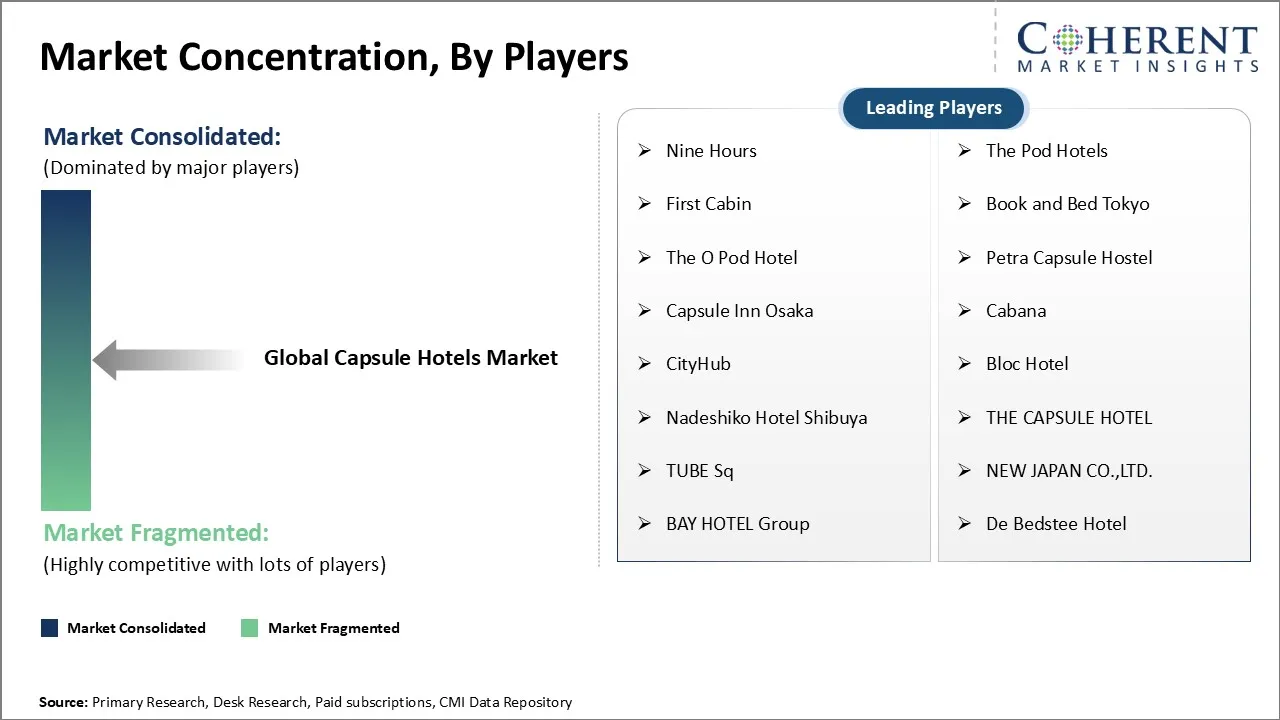
| Companies covered: | Nine Hours, The Pod Hotels, First Cabin, Book and Bed Tokyo, The O Pod Hotel, Petra Capsule Hostel, Capsule Inn Osaka, Cabana, CityHub, Bloc Hotel, Nadeshiko Hotel Shibuya, THE CAPSULE HOTEL, TUBE Sq, NEW JAPAN CO.,LTD., BAY HOTEL Group, and De Bedstee Hotel | ||
| Growth Drivers: |
| ||
| Restraints & Challenges: |
| ||
Capsule Hotels Market Dynamics
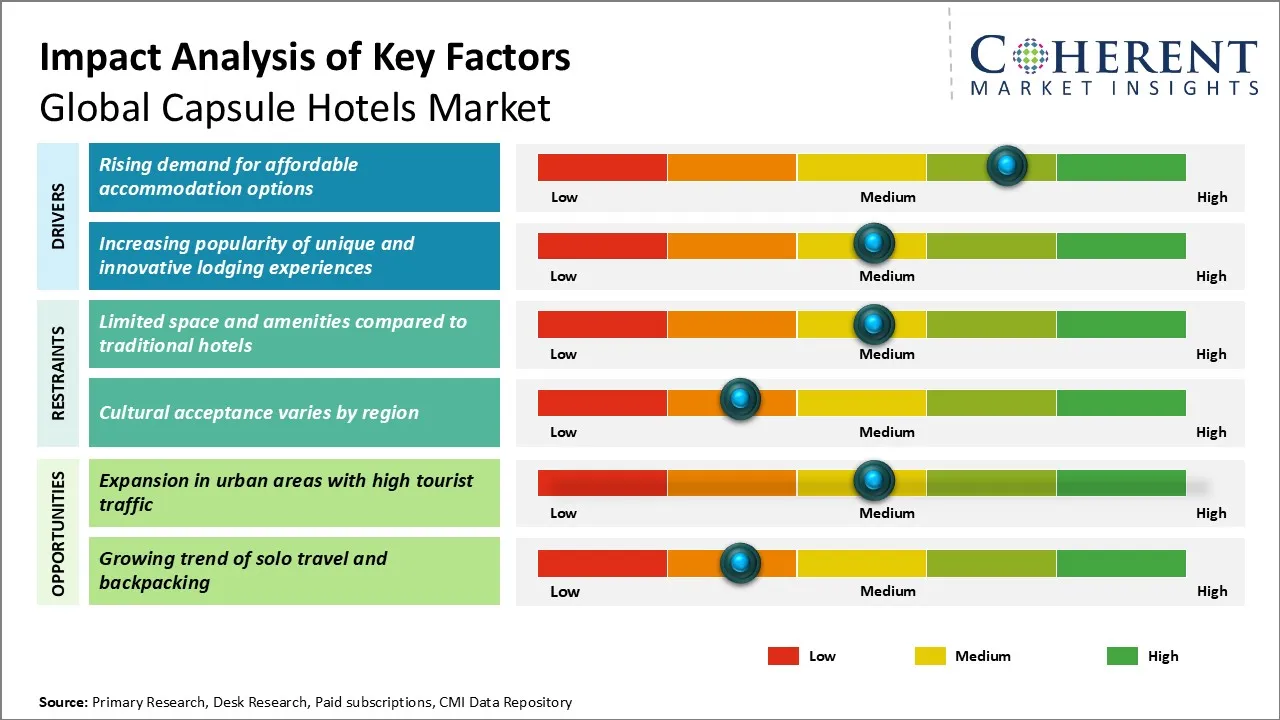
Capsule Hotels Market Driver - Rising Demand for Affordable Accommodation Options
The increasing need for budget-friendly lodging solutions is significantly propelling the growth of the global capsule hotels market. As travel becomes more accessible and common among millennials, solo travelers, and business professionals, there is a growing preference for economical yet convenient accommodation. Capsule hotels offer compact, cost-effective spaces that fulfill the basic needs of comfort and privacy without the high price tags associated with traditional hotels. Moreover, urbanization and the surge in domestic and international tourism have intensified the demand for such affordable options, especially in densely populated cities where real estate costs escalate traditional hotel pricing.
For instance, According to the United Nations World Urbanization Prospects 2022 revision, urban populations are projected to increase from 4.4 Bn in 2020 to 6.7 Bn by 2050, with Asia accounting for 68% of global urban dwellers. This demographic transformation directly correlates with increased demand for affordable urban accommodation solutions.
Capsule Hotels Market Opportunity - Expansion in Urban Areas with High Tourist Traffic
The global capsule hotels market is poised for significant growth through strategic expansion in urban areas characterized by high tourist traffic. As urban centers continue to attract a growing number of domestic and international travelers seeking affordable and convenient accommodation options, capsule hotels present an innovative solution that maximizes space efficiency while catering to budget-conscious tourists. Cities that serve as major transportation hubs, cultural landmarks, or business centers—such as Tokyo, New York, London, and Singapore—offer fertile ground for capsule hotel operators to capitalize on the increasing influx of short-stay visitors.
For instance, Tokyo’s Shinjuku Kuyakusho-mae Capsule Hotel continues to thrive by attracting business commuters and international tourists who need short, affordable stays near one of the busiest transport districts in the world.
Analyst Opinion (Expert Opinion)
- The global capsule hotels market is experiencing rapid evolution, driven by the surge in budget travel and the growing appeal of minimalist accommodation. Insights from the Global Hospitality Expo (2023) and the Urban Travel Forum (2022) highlighted innovative trends, with brands like Nine Hours and Yotel redefining urban lodging experiences.
- Nine Hours’ recent expansion into major cities with high demand for affordable yet stylish accommodations reflect a strategic response to urbanization and transient lifestyles. Discussions at these conferences emphasized the importance of technology integration, such as mobile check-ins and smart room controls, to enhance guest experiences in compact spaces. However, challenges like limited space and privacy concerns were identified as potential drawbacks that could deter some travelers.
- Companies that focus on creating comfortable, multifunctional environments with high design standards will likely attract a diverse clientele. Additionally, effective marketing strategies that highlight the unique experiences offered by capsule hotels can drive awareness. Ultimately, the capsule hotels market's growth will rely on its ability to innovate while addressing consumer desires for affordability, convenience, and unique urban experiences in an increasingly competitive hospitality landscape.
Speak to the analyst
Want personalized insights?
Take the findings above to one of our principal consultants, or have the report rebuilt around the segments, geographies and competitors you actually track.
Market Segmentation
- Traveler Type Insights (Revenue, USD Mn, 2021 - 2033)
- Solo
- Group
- Duration of Stay Insights (Revenue, USD Mn, 2021 - 2033)
- Short Term Stays (Up to 2 days)
- Long Terms Stays (More than 2 days)
- Age Group Insights (Revenue, USD Mn, 2021 - 2033)
- 18-24 Years
- 25-39 Years
- 40-54 Years
- 55+ Years
- Booking Mode Insights (Revenue, USD Mn, 2021 - 2033)
- Offline
- Online
- Regional Insights (Revenue, USD Mn, 2021 - 2033)
- North America
- U.S.
- Canada
- Latin America
- Brazil
- Argentina
- Mexico
- Rest of Latin America
- Europe
- Germany
- U.K.
- Spain
- France
- Italy
- Russia
- Rest of Europe
- Asia Pacific
- China
- India
- Japan
- Australia
- South Korea
- ASEAN
- Rest of Asia Pacific
- Middle East
- GCC Countries
- Israel
- Rest of Middle East
- Africa
- South Africa
- North Africa
- Central Africa
- North America
- Key Players Insights
- Nine Hours
- The Pod Hotels
- First Cabin
- Book and Bed Tokyo
- The O Pod Hotel
- Petra Capsule Hostel
- Capsule Inn Osaka
- Cabana
- CityHub
- Bloc Hotel
- Nadeshiko Hotel Shibuya
- THE CAPSULE HOTEL
- TUBE Sq
- NEW JAPAN CO.,LTD.
- BAY HOTEL Group
- De Bedstee Hotel
Sources
Primary Research Interviews
- Operations Director – Leading Capsule Hotel Chain (Japan)
- Expansion Manager – Southeast Asian Capsule Hotel Operator
- Chief Strategy Officer – Budget Hospitality Group in Europe
- Innovation Head – Modular Accommodation Design Firm
Stakeholders
- Capsule Hotel Operators and Chains
- End-use Segments:
- Budget Travelers & Backpackers
- Digital Nomads and Remote Workers
- Airport Transit Passengers
- Urban Residents (short-stay accommodations)
- Regulatory & Certification Bodies (Tourism, Safety, and Hospitality Standards)
- Online Travel Agencies (OTAs) and Aggregator Platforms (Booking.com, Agoda, Hostelworld)
Databases
- United Nations World Tourism Organization (UNWTO) Database
- STR Global Hospitality Data
- India Import Export (EXIM) Database (for capsule hotel prefabrication modules, imports/exports)
Magazines
- Hospitality Design Magazine – Capsule hotel design innovations
- Hotelier Middle East – Trends in compact and budget accommodations
- Travel Weekly – Global tourism and hospitality updates
- Business Traveller Magazine – Urban capsule hotel adoption
Journals
- International Journal of Hospitality Management – Trends in budget and micro-accommodations
- Journal of Tourism and Hospitality – Market growth of compact hotels
- Journal of Sustainable Tourism – Eco-friendly capsule hotel practices
- Cornell Hospitality Quarterly – Operational efficiency in capsule hotels
Newspapers
- The Guardian – Rise of pod hotels in Europe and UK
- South China Morning Post – Capsule hotel adoption in Asia-Pacific
- The New York Times – Capsule hotels in urban US markets
Associations
- World Travel & Tourism Council (WTTC)
- Pacific Asia Travel Association (PATA)
- American Hotel & Lodging Association (AHLA)
- European Travel Commission (ETC)
Public Domain Sources
- UNWTO – Global tourism and hospitality outlook
- OECD – Tourism trends and international mobility
- IATA – Passenger flow trends impacting airport capsule hotels
- World Bank – Urbanization and travel demand statistics
Proprietary Elements
- CMI Data Analytics Tool, Proprietary CMI Existing Repository of information for last 8 years.
Get access to 250+ pages report
Every segment, forecast, competitor profile and data table behind the analysis above — available for instant download.
- ESOMAR Member
- ISO 9001:2015 Certified
- D-U-N-S Registered
- GDPR & CCPA Compliant
Missing comfort of reading report in your local language? Find your preferred language:
Transform your Strategy with Exclusive Trending Reports
Frequently Asked Questions
The global capsule hotels market is estimated to be valued at USD 367.7 Mn in 2026 and is expected to reach USD 571.5 Mn by 2033.
The CAGR of global capsule hotels market is projected to be 6.5% from 2026 to 2033.
Rising demand for affordable accommodation options and increasing popularity of unique and innovative lodging experiences are the major factors driving the growth of the global capsule hotels market.
Limited space and amenities compared to traditional hotels and cultural acceptance varies by region are the major factors hampering the growth of the global capsule hotels market.
In terms of traveler type, solo is estimated to dominate the market revenue share in 2026.
Nine Hours, The Pod Hotels, First Cabin, Book and Bed Tokyo, The O Pod Hotel, Petra Capsule Hostel, Capsule Inn Osaka, Cabana, CityHub, Bloc Hotel, Nadeshiko Hotel Shibuya, THE CAPSULE HOTEL, TUBE Sq, NEW JAPAN CO.,LTD., BAY HOTEL Group, and De Bedstee Hotel are the major players.
Asia Pacific is expected to lead the global capsule hotels market in 2026.