

Global Ceramic Bead Market Size and Forecast – 2026-2033
According to Coherent Market Insights, the global ceramic bead market is estimated to be valued at USD 421.5 Mn in 2026 and is expected to reach USD 565.9 Mn by 2033, exhibiting a compound annual growth rate (CAGR) of 4.3% from 2026 to 2033.
Key Takeaways of the Ceramic Bead Market
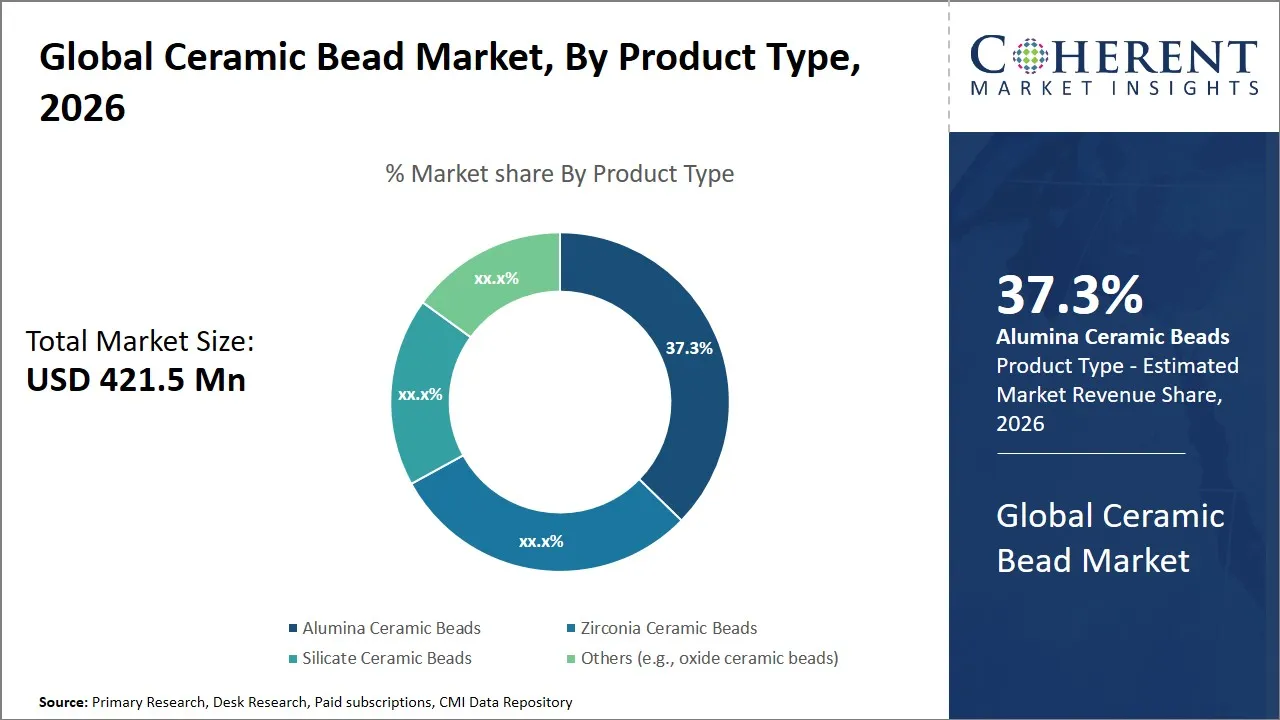
- Alumina ceramic beads segment is expected to hold a 37.3 % of the ceramic bead market share in 2026.
- The abrasives segment is projected to capture 31.8 % of the global ceramic bead market share in 2026.
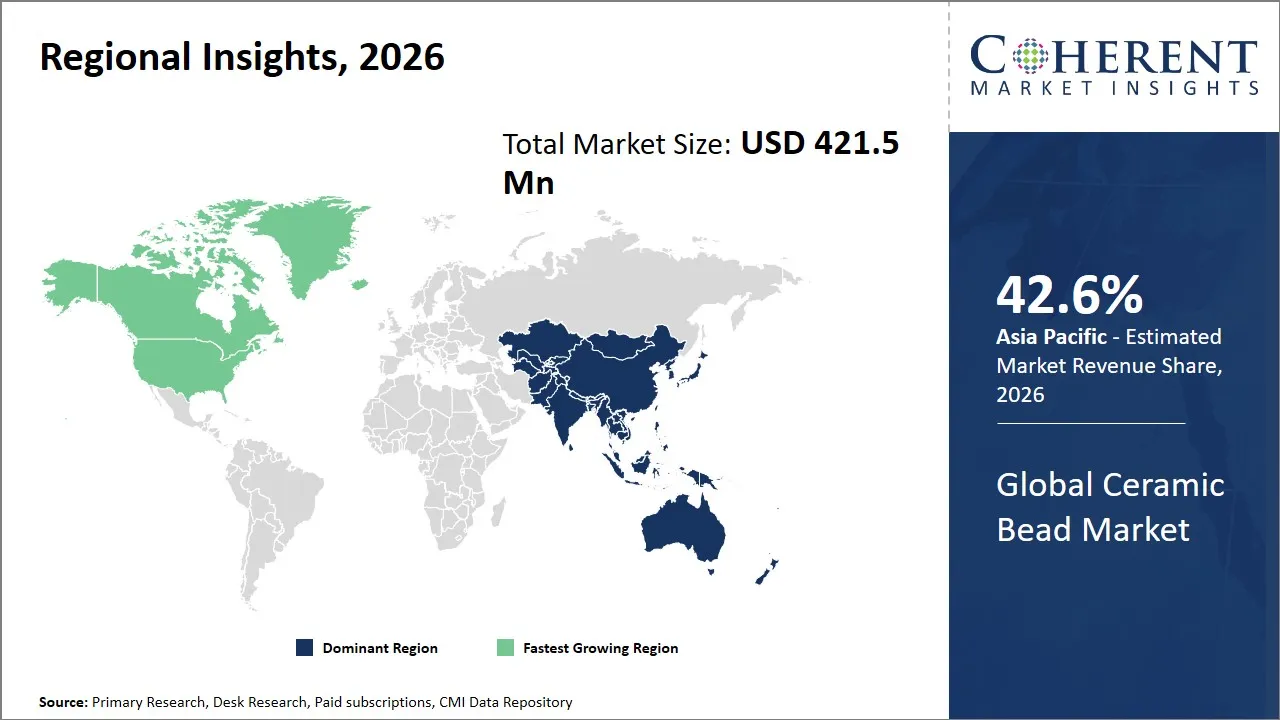
- The Asia Pacific region is expected to lead the ceramic bead market with a 42.6 % share in 2026.
- The North America region is projected to see the fastest growth, contributing a 21.3 % share in 2026.
Market Overview
- A key market trend is the rising adoption of eco-friendly and high-performance ceramic beads, propelled by advancements in material science and increasing environmental regulations.
- Additionally, the integration of ceramic beads in additive manufacturing and precision engineering is fueling innovation.
- Emerging economies are witnessing higher industrialization rates, contributing to market momentum.
- Companies are also focusing on product customization and expanding distribution channels to cater to diverse industrial needs, strengthening the competitive landscape globally.
Current Events and Its Impact
Current Events | Description and its Impact |
China’s Rare Earth & Critical Material Export Controls |
|
Geopolitical Trade Tensions (APAC–U.S./EU) |
|
Segmental Insights
- Current Industry Events of 2026
- Market Size Estimation
- Regional Breakdown
- Competitive Landscape
- Customer Intelligence
- Segmental Analysis
- Pricing Analysis
- Key Market Drivers, Challenges & Future Trends
- Customized Insights Section
Why Do Alumina Ceramic Beads Dominate the Global Ceramic Bead Market in 2026?
Alumina ceramic beads segment is expected to hold 37.3% of the global ceramic bead market share in 2026, and this has been gained by their brilliant blend of strength, chemical stability and thermal resistance. The outstanding wear and abrasion resistance of the alumina ceramic beads segment has been one of the main reasons that have resulted in the growth of the segment since it is highly recommended in challenging industry operations.
Alumina beads in contrast to other ceramic beads can withstand severe mechanical forces and corrosive conditions, which guarantee extended service duration and decreased replacement rate. This reliability offers a great deal of downtime and maintenance savings to the end users, which is of great importance in the production industry, and the materials processing industry.
In the mining industry, alumina ceramic beads are used in high-impact grinding applications where durability is crucial. For instance, during the grinding of minerals like copper and gold, alumina ceramic beads are preferred over other materials because they can endure the severe mechanical forces and abrasive conditions without degrading quickly, thus ensuring a longer operational life and reducing downtime.
Abrasives Segment Dominates the Ceramic Bead Market
The abrasives segment is projected to capture 31.8% in the global ceramic bead market share in 2026, due to the importance of ceramic beads in improving the process of surface finishing and polishing within various industries. The underlying driver to this segment is the growing need in manufacturing to work with precise finishing solutions that are motivated by the rising quality requirements and technological progress. Ceramic beads especially the ones produced out of alumina offer excellent hardness and wear resistance and are therefore the best abrasive material to be used in fine polishing, grinding and deburring.
Such industries like automotive, aerospace, electronics and metal fabrication are starting to use ceramic bead-based abrasives to provide the accurate surface texture and elimination of flaws. The increased complexity of the manufactured components such as the utilization of sophisticated alloys and composites would require the use of abrasives that would provide uniform performance without reducing the integrity of the material that is undergoing processing. Ceramic beads are satisfying this need because of the same size of particles and because of their round shape, which encourages controlled abrasion and reduces surface damage.
Regional Insights
Asia Pacific Ceramic Bead Market Analysis and Trends
The Asia Pacific region is projected to lead the market with a 42.6% share in 2026, due to the fact that the region is well instituted in terms of manufacturing ecosystem and industrial strength. A high level of chemical, automotive, electronics and aerospace industries are present in such countries as China, Japan and South Korea and they are the large end users of ceramic beads. Producers are also supported by availability of raw materials and relatively low cost of production as opposed to the Western countries.
The governments of the major players in this part of the world have been encouraging the use of modern manufacturing techniques and innovations using friendly policies and subsidies. There is also the strong export infrastructure that enables trade dynamics which make Asia Pacific a manufacturing hub and a principal source of export of ceramic beads in the world market. Famous businesses that have led to this market leadership include 3M China, NGK Spark Plug Co., Ltd., and Taizu New Materials whose investments in research and development and expansion of production facilities are the basis of market leadership in this region.
North America Ceramic Bead Market Analysis and Trends
The North America region is expected to exhibit the fastest growth in the market contributing 21.3% share in 2026, because it is interested in high-technology application and is keen on quality standards, particularly in defense, aerospace, and technology aspects. The existence of world-famous companies such as Saint-Gobain, CeramTec, and Morgan Advanced Materials compel the creation of more sophisticated ceramic bead products of improved durability and precision.
Innovation and adoption are further boosted by government backing in the form of research grants and development of the infrastructure. The trade policies are biased towards high-technology importation and exportation of materials and close partnerships between industry participants and academics promote an active environment that allows the company to achieve rapid growth in the market. Its high-performance and specialty ceramic beads in medical and electronic products in the North American markets are a major factor that has contributed to its rapid development.
Global Ceramic Bead Market Outlook for Key Countries
Why is China Dominating the Ceramic Bead Market?
The Chinese ceramic bead market is still powerful because of its end-to-end supply chain, low-cost production and large scale industrial need in automotive, electronics and coatings. The major home-based enterprises like Taizu New Materials and Tianma Ceramic Materials Co. have opened large scale production units which are backed by government incentives of technological modernization. The export-oriented trade policies of Chinas help it to become a significant supplier to the world markets and investments in modern material research are still underway to improve the product quality and variety.
Japan Ceramic Bead Market Trends
Japan has remained the market leader in the focus on innovation and precision manufacturing. The high-end industries in the country including semiconductors, aerospace, and medical machinery demand ceramic beads to have high standards which are met by the local market leaders such as NGK Spark Plug and CoorsTek Japan. Japanese companies think much about the research and development to introduce the new technologies in the sphere of ceramic beads that allow to be used with better results. Favored government policies to boost high technology ceramics and existence of high-technology manufacturer groups keep Japan’s strategic position in the world market.
Why Is the U.S. a Leader in the Ceramic Bead Market?
The U.S. is an expert in the manufacturing of high-performance ceramic beads in the aerospace, defense and health equipment. The material science has improved due to the efforts of industry giants such as Saint-Gobain and Morgan Advanced Materials to attain high industry demands. Funding of innovation and cooperation in the sector of defense through US government guarantees the development of cutting-edge products. Its position as a regional powerhouse and technological leader is strengthened by the fact that the country has very developed distribution channels as well as advanced manufacturing facilities.
Germany Ceramic Bead Market Trends
The Germany ceramic bead market enjoys a good industrial foundation and dominance in the automotive and precision engineering industry. Rauschert GmbH and CeramTec are companies that produce ceramic beads with high quality and at the European quality standards and automotive requirements. The innovation on manufacturing is supported by the government and the involvement of Germanys in the European Union trade network gives an opportunity to reach a large customer base and support the export operations. The emphasis on the environment-friendly and sustainable production processes is also in tandem with the changing regulatory standards in the area.
India Ceramic Bead Market Trends
India is a developing industry with a rising demand owing to the rise in automobile, electronic and construction industries. The local production of ceramic beads is encouraged by the governments that are pushing towards Make in India and higher expenditure on infrastructure. There are such renowned firms as Vibrant Ceramic Materials and Harsha Engineers that serve the needs of the local market and export as well. Though not yet as developed as the developed markets that are already in existence in South Asia Pacific and North America, Indias strategic location and cost advantages make it an important participant in the growth story of the ceramic bead market.
Supply Chain Metrics
Metric | Description | Relevance |
Lead Time | Time from order to delivery | Impacts timely delivery and inventory levels |
Inventory Turnover | Ratio of COGS to average inventory | Reflects inventory efficiency |
On-Time Delivery (OTD) | % of orders delivered on time | Critical for customer satisfaction |
High-Energy Milling vs Low-Energy Milling Split
Parameter | High-Energy Milling | Low-Energy Milling |
Energy Consumption | High energy input is required to break down materials effectively. | Lower energy input as it focuses on slower, controlled milling. |
Particle Size Distribution | Achieves a finer particle size with more uniform distribution. | Results in larger particle sizes and a broader distribution. |
Material Wear & Tear | Higher wear on equipment due to intense energy input | Less wear on equipment and more controlled particle formation. |
Market Players, Key Development, and Competitive Intelligence
Key Developments
- Saint-Gobain’s ZirPro maintains the largest global share in ceramic bead manufacturing, producing over 28,000 metric tons annually. Its “Zirmil” and “ER120” product lines are used in more than 64 countries for pharmaceutical, inkjet, and mining applications. The company has over 1,200 clients globally and maintains six production sites across Europe, Asia Pacific, and North America.
- Toray produces more than 14,500 metric tons of zirconia and alumina-based ceramic beads annually. Its proprietary microstructure control technology ensures a bead breakage rate under 0.7% in continuous grinding processes. Toray's beads are used by over 500 electronics manufacturers in Japan, South Korea, and Taiwan, especially in semiconductor polishing and LED surface treatments.
- In November 2025, Toronto’s Gardiner Museum, devoted to ceramics, reopened after USD 11 Mn The museum now boasts a gallery dedicated to Indigenous ceramics, expanded education facilities and enough space to display around 40% of its collection.
Top Strategies Followed by Global Ceramic Bead Market Players
Player Type | Strategic Focus | Example |
Established Market Leaders | Heavy investment in R&D and innovation | For example, such as Saint-Gobain has been relentlessly advancing the characteristics of ceramic beads used in abrasive blasting and polishing processes to maintain long-lasting service provision even at extreme temperatures. |
Mid-Level Players | Balance cost and sustainability | An example is the case of Tosoh Corporation, which provides cost-efficient ceramic beads that appeal to those industries that need to have a reliable substitute to high quality products. Having placed an emphasis on a competitive pricing model, these players are assured of a stable performance of the products in addition to attracting the consumers with limited budgets. |
Small-Scale Players | Niche specialization & innovative variants | As an example, such companies as Almatis and Hoganas are at the forefront in providing state-of-the-art fabrication technologies or novel ceramic sets. An example is Almatis, which makes use of proprietary methods to make ultra-fine ceramic beads with functions designed specifically to be used with high precision in the semiconductor industry. |
Market Report Scope
Ceramic Bead Market Report Coverage
| Report Coverage | Details | ||
|---|---|---|---|
| Base Year: | 2025 | Market Size in 2026: | USD 421.5 Mn |
| Historical Data for: | 2020 To 2024 | Forecast Period: | 2026 To 2033 |
| Forecast Period 2026 to 2033 CAGR: | 4.3% | 2033 Value Projection: | USD 565.9 Mn |
| Geographies covered: |
| ||
| Segments covered: |
| ||
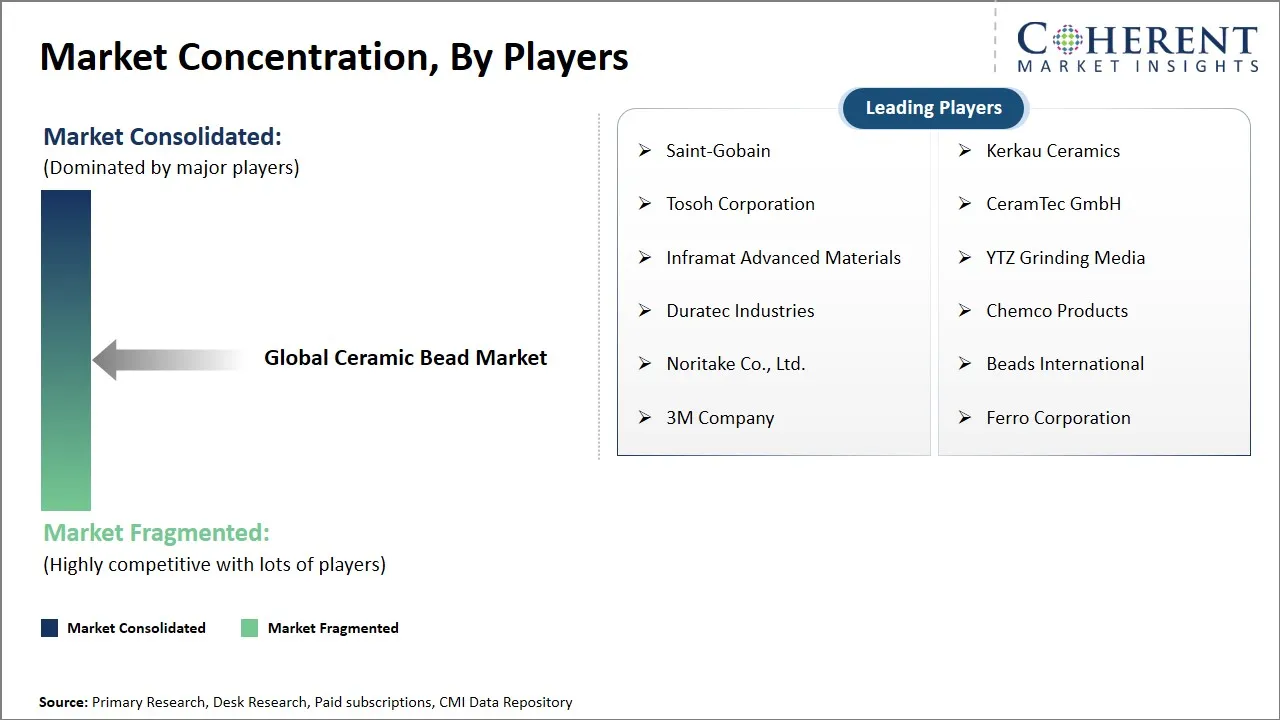
| Companies covered: | Saint-Gobain, Kerkau Ceramics, Tosoh Corporation, CeramTec GmbH, Inframat Advanced Materials, YTZ Grinding Media, Duratec Industries, Chemco Products, Noritake Co., Ltd., Beads International, 3M Company, and Ferro Corporation | ||
| Growth Drivers: |
| ||
| Restraints & Challenges: |
| ||
Ceramic Bead Market Dynamics
Ceramic Bead Market Driver - Increasing Demand for Specialized Abrasives in Various Industries
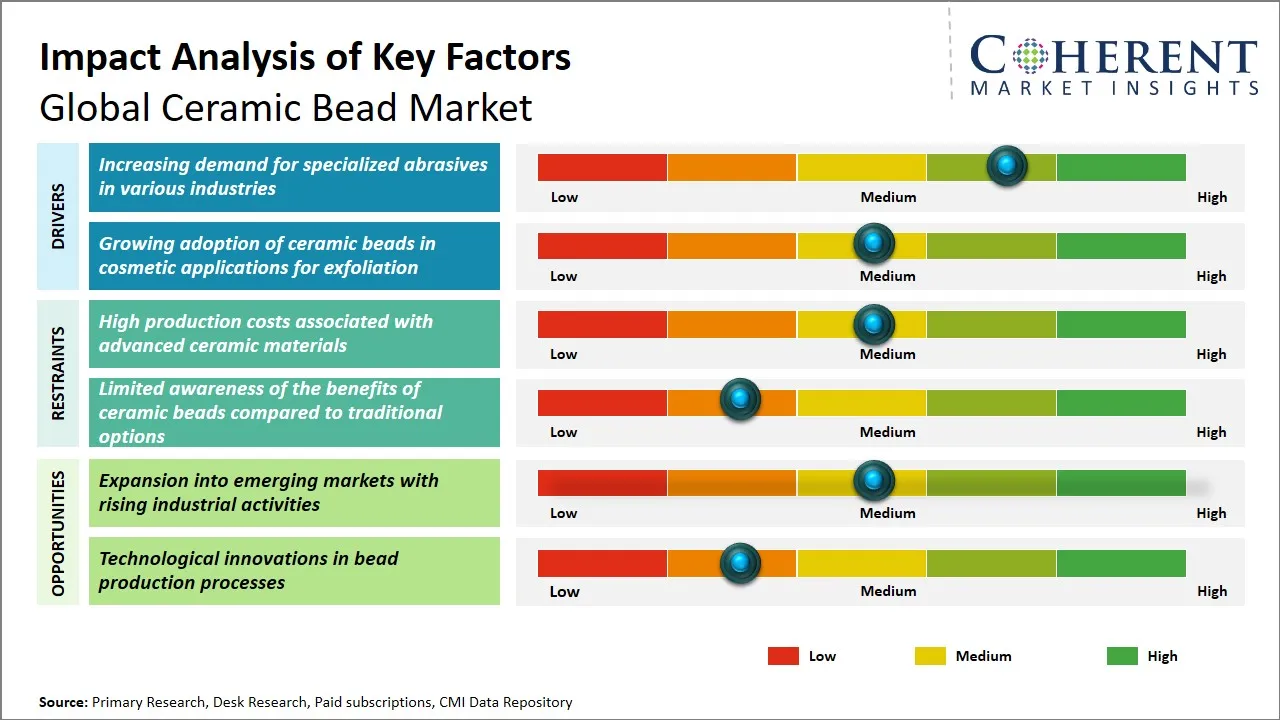
The increasing requirement in specialized abrasives is a great driving force behind the demand of ceramic beads in various industries. Ceramic beads are some of the best abrasive media since they are very hard, durable and do not wear or corrode and can therefore be used in precision surface analysis treatment and finishing. Automobiles, aerospace, electronics, and manufacturing are some of the industries shifting towards using ceramic beads in cleaning and deburring, as well as polishing components that have to be polished with high quality and consistency of the finish.
For example, Toyota uses ceramic beads in its engine manufacturing process to ensure the parts are deburred with high precision, which helps in achieving better engine performance and reducing wear and tear. This shift towards specialized abrasives is driven by the need for high-quality finishes in critical parts, which ceramic beads provide due to their durability and ability to maintain their shape even under high wear conditions.
Ceramic Bead Market Opportunity - Expansion into Emerging Markets with Rising Industrial Activities
The global ceramic beads market is one of the opportunities that the company can leverage on to expand into emerging markets that have been experienced in terms of high rates of industrialization and development of infrastructures. Most of the countries in the regions such as Asia Pacific, Latin America, and Africa are also experiencing faster growths in industries such as automotive, aerospace, electronics, construction and medical products, which are among the key end-users of ceramic beads. The growing need of high-performance materials with better durability, thermal protection, and wear-protecting features is in line with the exceptional characteristics of ceramic beads, which form good adoption opportunities.
For instance, the automotive industry in India is growing quickly, with manufacturers like Mahindra & Mahindra and Tata Motors adopting ceramic beads for precision polishing and surface finishing of automotive components like engine parts and brake discs. This demand is driven by the need for high-performance materials with better durability and wear resistance.
Analyst Opinion (Expert Opinion)
- Ceramic bead will see a massive development as more oil and gas, automobile and electronic industries will need them as they are tougher and they do not heat up so easily. Things learned at the International Ceramic Society Conference (2023) and the Global Materials Expo (2022) created a very important understanding of the trends, as companies such as Saint-Gobain and 3M have become pioneers in creating ceramic bead compositions to use in the high-performance sector.
- The recent introduction by Saint-Gobain’s of ultra-durable ceramic beads in an industrial abrasive operation highlights the preoccupation of the industry on efficiency improvement and minimization of wear and tear on machines. Conferences held in these countries underlined the growing need of alternatives to conventional materials which are greener and in particular efforts by the companies to make their production more sustainable. The shortcomings like high costs of production and the complexity of the manufacturing processes were often quoted as the reasons why they could not get adopted in high numbers.
- Firms that invest in research and development to improve manufacturing efficiencies and liaise with the end-users to come up with differentiated solutions are bound to gain competitive advantage. Finally, the development of the ceramic bead market will rely on the constant innovation and possibility to answer the requirements of the industry to the performance and sustainability.
Speak to the analyst
Want personalized insights?
Take the findings above to one of our principal consultants, or have the report rebuilt around the segments, geographies and competitors you actually track.
Market Segmentation
- Product Type Insights (Revenue, USD Mn, 2021 - 2033)
- Alumina Ceramic Beads
- Zirconia Ceramic Beads
- Silicate Ceramic Beads
- Others (e.g., oxide ceramic beads)
- Application Insights (Revenue, USD Mn, 2021 - 2033)
- Abrasives
- Paints and Coatings
- Cosmetics
- Biomedical
- Others (e.g., filtration, catalysts)
- Regional Insights (Revenue, USD Mn, 2021 - 2033)
- North America
- U.S.
- Canada
- Latin America
- Brazil
- Argentina
- Mexico
- Rest of Latin America
- Europe
- Germany
- U.K.
- Spain
- France
- Italy
- Russia
- Rest of Europe
- Asia Pacific
- China
- India
- Japan
- Australia
- South Korea
- ASEAN
- Rest of Asia Pacific
- Middle East
- GCC Countries
- Israel
- Rest of Middle East
- Africa
- South Africa
- North Africa
- Central Africa
- North America
- Key Players Insights
- Saint-Gobain
- Kerkau Ceramics
- Tosoh Corporation
- CeramTec GmbH
- Inframat Advanced Materials
- YTZ Grinding Media
- Duratec Industries
- Chemco Products
- Noritake Co., Ltd.
- Beads International
- 3M Company
- Ferro Corporation
Sources
Primary Research Interviews
- CEO – Leading Ceramic Bead Producer (e.g., Saint-Gobain ZirPro or Kings Beads equivalent)
- Supply Chain Director – Major Ceramic Grinding Media Distributor
- Production Lead – Zirconia/Alumina Bead Manufacturer
- Sustainability Officer – Ceramic Abrasive Certification Authority
Stakeholders
- Manufacturers
- End-use Sectors
- Grinding & Milling Industry (Mining, Paints, Pigments)
- Shot Peening & Blasting (Aerospace, Automotive)
- Electronics & Semiconductors (Ceramic Beads for Components)
- Regulatory & Certification Bodies (e.g., EPA for ceramic dust handling, REACH compliance for zirconia beads in EU)
- E-commerce Platforms and Retailers (IndiaMart, Alibaba Industrial Suppliers)
- Technology Integration Players: Advanced ceramics producers using grinding beads
Databases
- UN Comtrade Database (HS 69: Ceramic products, including beads and grinding media)
- India Import Export (EXIM) Database (Ceramic beads imports)
- USGS Mineral Commodity Summaries (Clays, zirconia, alumina for ceramics)
- Eurostat Trade Statistics for Chemicals and Ceramics
Magazines
- Chemical Processing Magazine – Trends in ceramic grinding media
- Ceramics World Review – Applications in ceramic bead manufacturing
- Industrial Minerals – Market dynamics for ceramic abrasives
- Surface & Coatings Technology – Shot peening innovations with beads
Journals
- Journal of Ceramic Science and Technology – Ceramic bead properties and production
- Minerals Engineering – Ceramic beads in fine grinding mills
- Journal of Materials Science – Durability of ceramic grinding beads
- Chemical Engineering Journal – Synthesis of zirconia beads
Newspapers
- Business Standard (India) – Ceramic beads market growth in Asia
- Reuters – Supply chain for industrial ceramic materials
- The Wall Street Journal – Demand in electronics and aerospace
Associations
- International Ceramic Abrasive Association (or equivalents like EFSA for abrasives)
- Ceramic Grinding Media Producers Group
- Society of Bead Researchers (industrial applications)
- European Ceramic Industry Council (Cerame-Unie)
- Surface Finishing Association (for blasting beads)
Public Domain Sources
- EPA – Safety Data Sheets for ceramic beads and dust exposure
- European Commission – REACH regulations on ceramic microparticles
- World Health Organization – Standards for ceramic abrasive exposure
- USGS – Statistics on ceramic raw materials (zirconia, alumina)
- OECD – Trade and sustainability reports for advanced ceramics
Proprietary Elements
- CMI Data Analytics Tool, Proprietary CMI Existing Repository of information for last 8 years.
Get access to 250+ pages report
Every segment, forecast, competitor profile and data table behind the analysis above — available for instant download.
- ESOMAR Member
- ISO 9001:2015 Certified
- D-U-N-S Registered
- GDPR & CCPA Compliant
Missing comfort of reading report in your local language? Find your preferred language:
Transform your Strategy with Exclusive Trending Reports
Frequently Asked Questions
The global ceramic bead market is estimated to be valued at USD 421.5 Mn in 2026 and is expected to reach USD 565.9 Mn by 2033.
Ceramic beads are hard, wear-resistant spherical media used mainly for grinding, dispersion, shot peening, blasting, and surface finishing.
Lower contamination, higher wear resistance, better energy transfer in milling, longer service life, and improved final product quality.
The CAGR of global ceramic bead market is projected to be 4.3% from 2026 to 2033.
Increasing demand for specialized abrasives in various industries and growing adoption of ceramic beads in cosmetic applications for exfoliation are the major factors driving the growth of the global ceramic bead market.
High production costs associated with advanced ceramic materials and limited awareness of the benefits of ceramic beads compared to traditional options are the major factors hampering the growth of the global ceramic bead market.
In terms of product type, alumina ceramic beads are estimated to dominate the market revenue share in 2026.