

Global Cleanroom Technologies Market Size and Forecast – 2026 To 2033
The global cleanroom technologies market is expected to grow from USD 5.50 Bn in 2026 to USD 7.50 Bn by 2033, registering a compound annual growth rate (CAGR) of 4.8% from 2026 to 2033. The global cleanroom technologies market is driven by rapid expansion of advanced healthcare infrastructure. On January 20, 2026, Genentech announced an expansion of its initial investment in a new Holly Springs, North Carolina manufacturing facility in the U.S. The increased investment will more than double the total commitment for the company’s first-ever East Coast manufacturing facility to approximately USD 2 billion. (Source: Genetech)
Key Takeaways of the Global Cleanroom Technologies Market
- The hardwall cleanrooms segment is expected to account for 46.0 % of the global cleanroom technologies market share in 2026. Growth in biologics & vaccine production is a major factor driving the growth of the segment. On November 19, 2025, Moderna announced a USD 140 million investment to complete its end-to-end mRNA manufacturing network in Massachusetts, U.S., adding fill-finish capabilities to its Norwood facility. (Source: Fierce Pharma)
- The installation services segment is estimated to capture 52.0 % of the market share in 2026. Adoption of energy-efficient cleanroom systems is driving the demand for installation services. On September 18, 2025, Trane Technologies expanded its smart HVAC systems in 2025, focusing on predictive energy optimization for high-control environments like pharmaceutical cleanrooms and semiconductor fabs. (Source: Trane Technologies)
- The pharmaceuticals segment is estimated to capture 33.0 % of the market share in 2026. Rapid growth of the bio-tech industry is a primary factor for the growth of the segment. On May 28, 2026, Pfizer entered a USD 10.5 billion partnership with Innovent Biologics to co-develop 12 cancer drugs, including antibody-drug conjugates and multi-specific antibodies. (Source: Pfizer)
- North America is expected to dominate the cleanroom technologies market in 2026 with a market share of 37.0 %. Steady growth in medical device manufacturing is a major factor responsible for the growth of the regional market. On February 18, 2026, Johnson & Johnson announced a more than USD 1 billion investment in a next generation cell therapy manufacturing facility in Pennsylvania, U.S. (Source: Johnson & Johnson)
- Asia Pacific is expected to account for 29.0 % share in 2026 and is projected to record the fastest growth over the forecast period. Adoption of smart & modular cleanrooms (IoT-based systems) is a major factor driving the growth of the cleanroom technologies market in Asia Pacific. On February 26, 2026, Samsung Electronics accelerated the cleanroom construction schedule at its Pyeongtaek Fab 5 (P5) facility in South Korea. The company has advanced core infrastructure work by several months as part of its broader “Shell First” strategy of securing production space ahead of market demand. (Source: Samsung)
- Rapid adoption in semiconductor and advanced electronics manufacturing: The growth in demand for chips, microprocessors and advanced electronics is driving the cleanroom standards to new heights. Semiconductor foundry and fabrication factories are spending substantially in ultra-high-grade cleanrooms (ISO Class 3-5) to reduce particle contamination.
- Growth of modular and prefabricated cleanroom systems: Transition from traditional built-in cleanrooms to modular & prefabricated designs that are quicker to install, easier to scale & more cost-effective. These technologies help pharmaceutical, biotech and electronic industries to expand flexibly, particularly in fast-growing areas where time-to-production is crucial.
Segmental Insights
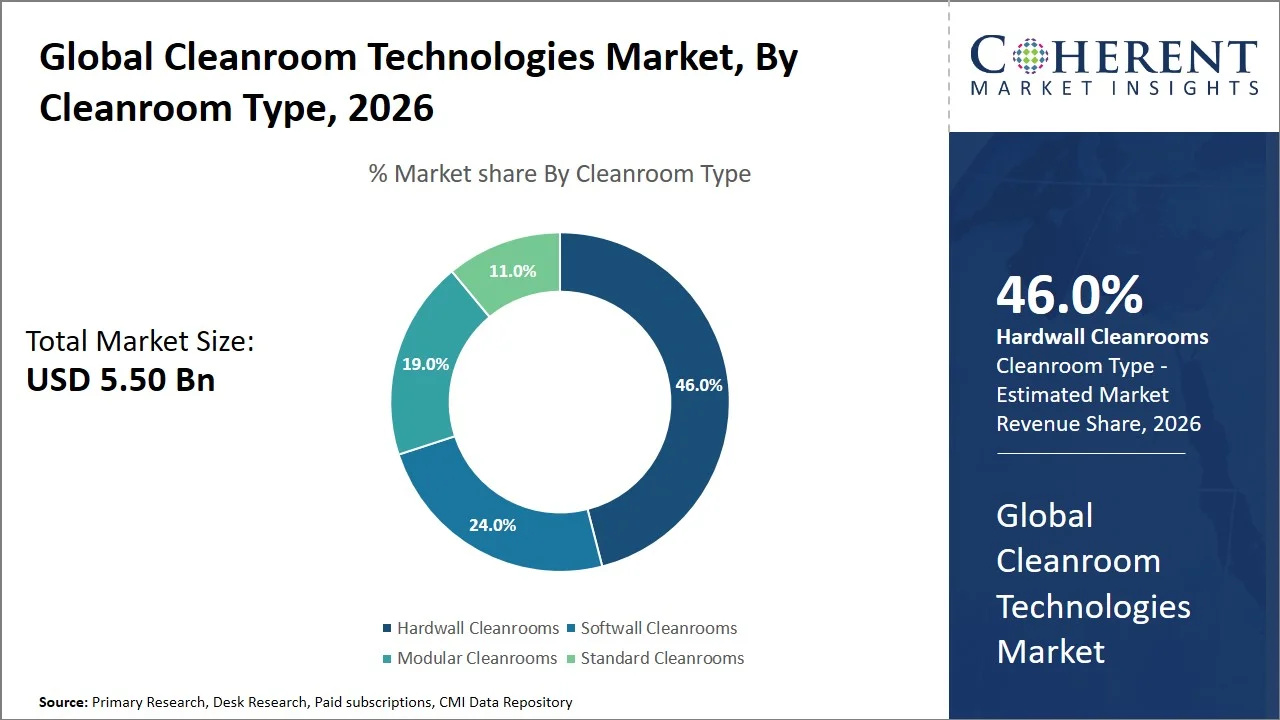
Why Do Hardwall Cleanrooms Dominate the Global Cleanroom Technologies Market?
The hardwall cleanrooms segment is expected to account for 46.0% of the global cleanroom technologies market share in 2026. Hardwall systems use stiff panels (such as acrylic, PVC or epoxy coated steel) that make a fully sealed structure with little air leakage, particle ingress and vibration as compared to softwall or modular curtain systems. This makes them highly applicable for industries with onerous regulatory standards, including semiconductors and pharmaceuticals, where even minute contamination can affect product quality and yield.
On May 26, 2026, SK hynix expanded its High Bandwidth Memory (HBM) production lines using fully enclosed hardwall modular cleanroom structures to support next-generation GPU memory demand. These rigid systems help maintain extremely tight particulate control required for AI server memory stacks.
- Current Industry Events of 2026
- Market Size Estimation
- Regional Breakdown
- Competitive Landscape
- Customer Intelligence
- Segmental Analysis
- Pricing Analysis
- Key Market Drivers, Challenges & Future Trends
- Customized Insights Section
Why are Installation Services the Most Preferred Service?
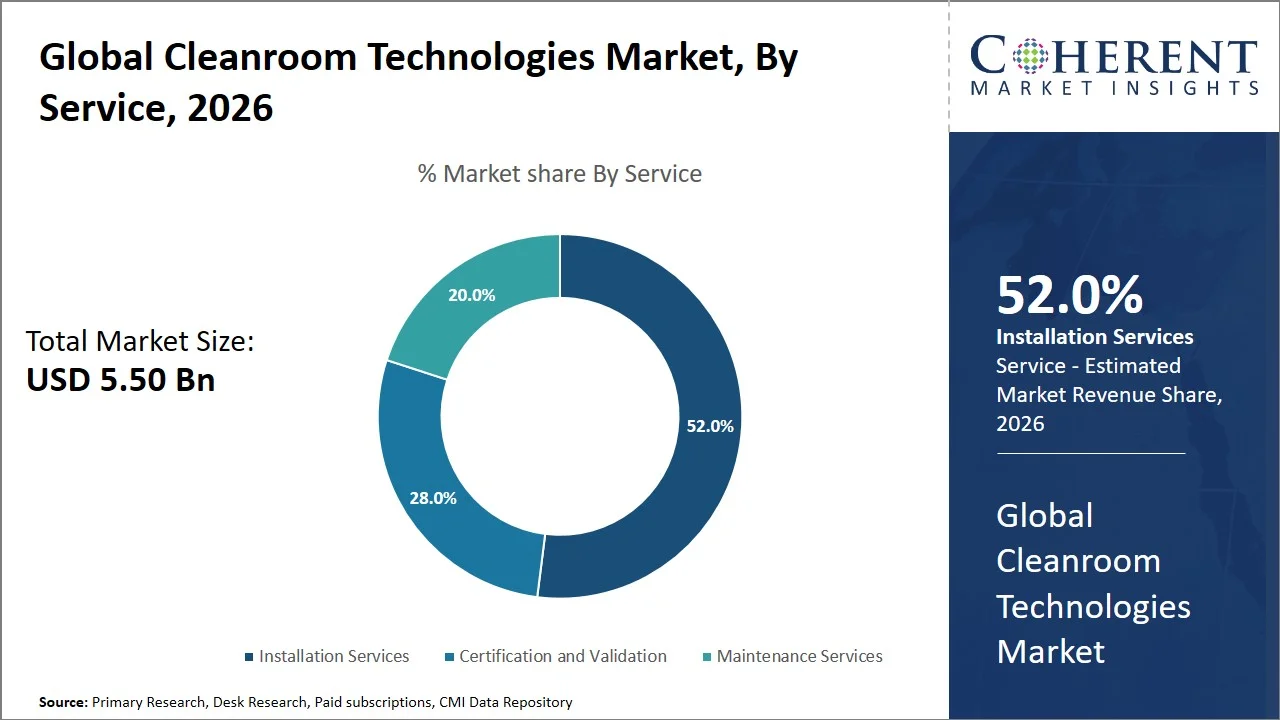
The installation services segment is expected to account for 52.0% of the global cleanroom technologies market share in 2026. Consumer industries including pharmaceuticals and biotechnology are increasingly selecting vendors that can provide a fully built and validated cleanroom with stringent regulatory criteria (for example, GMP or ISO classifications). This decreases the complexity of the project, reduces downtime and provides faster commissioning than working with many contractors independently.
On June 9, 2025, WuXi Biologics announced that it has kicked off construction of its new microbial manufacturing site for commercial production in the Wenjiang district of Chengdu, China, a renowned, vibrant hub for pharmaceutical development. (Source: WuXi Biologics)
Pharmaceuticals Dominate the Global Cleanroom Technologies Market
The pharmaceuticals segment is expected to account for 33.0% of the global cleanroom technologies market share in 2026. Strict criteria are imposed by the authorities such as the FDA and EMA for drug production – specifically sterile injectables, vaccines, biologics and gene therapies. The laws require very strict cleanroom conditions (temperature, humidity, particle count and microbiological limitations) and so cleanroom technologies are necessary in almost all pharmaceutical manufacturing operations. For instance, in 2024, Stricter EU GMP Annex 1 guidelines required over 850 sterile manufacturing facilities to upgrade their cleanrooms. The mandate phased in strict Grade A standards, emphasizing barrier technologies (isolators/RABS) over human operators to mitigate airborne contamination in pharmaceutical production. (Source: European Union)
Currents Events and their Impact
Current Events | Description and its Impact |
EU GMP Annex 1 (Manufacture of Sterile Medicinal Products) |
|
U.S. FDA Current Good Manufacturing Practice (cGMP) Updates (21 CFR Parts 210 & 211 modernization efforts) |
|
(Source: European Commission, U.S. Food & Drug Administration)
Cleanroom Technologies Market Dynamics
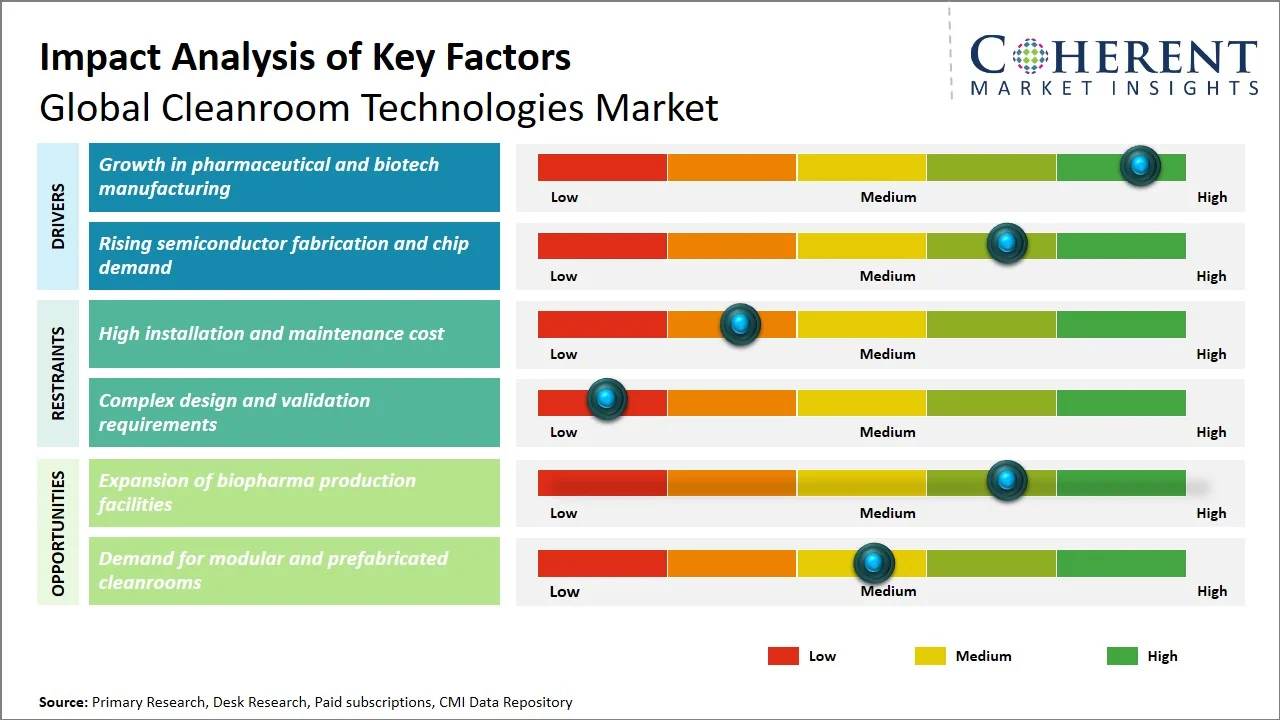
Market Drivers
Growth in pharmaceutical and biotech manufacturing
Growth in pharmaceutical and biotech manufacturing is a major driver of demand for cleanroom technology. These industries require highly controlled environments to assure product safety, sterility, and regulatory compliance. The tremendous growth in biologics, vaccines, gene treatments and personalized medicine has created a huge demand for sophisticated cleanroom facilities that can meet stringent air quality, particle control and microbial contamination requirements. Moreover, growing global healthcare requirements, reduced drug development timelines, and severe regulatory requirements by authorities such as FDA, EMA, and others are driving the manufacturers to expand and improve their cleanroom infrastructure, hence boosting the market growth.
On February 23, 2026, AbbVie announced a USD 380 million investment to build two new active pharmaceutical ingredient (API) manufacturing facilities in Illinois, U.S. focused on neuroscience and obesity medicines. The project strengthens domestic biologics and small-molecule production capacity and adds advanced AI-enabled manufacturing systems. (Source: AbbVie)
Rising semiconductor fabrication and chip demand
The growing demand for semiconductor fabrication and chips is a key driver of growth for cleanroom technologies, since modern chip manufacturing requires ultra-pure environments to prevent tiny contamination that could damage circuit performance and yield. The need for semiconductors driven by AI, 5G networks, electric vehicles, cloud computing and consumer electronics has caused a rise in the growth of fabrication plants around the world. The increase is driving firms to invest in high-grade ISO Class cleanrooms with modern airflow management, filtering systems and real-time monitoring to assure defect-free production and maintain exceptionally high precision standards.
On March 4, 2025, TSMC announced its intention to expand its investment in advanced semiconductor manufacturing in the U.S. by an additional USD 100 billion. Building on the company’s ongoing USD 65 billion investment in its advanced semiconductor manufacturing operations in Phoenix, Arizona, TSMC’s total investment in the U.S. is expected to reach USD 165 billion. (Source: TSMC)
Emerging Trends
- Strong demand from pharmaceutical and biotech sectors post-pandemic: Vaccine production, biologics, gene therapy and sterile medication manufacturing are increasing cleanroom investments. Regulatory pressure from authorities such as the Food & Drug Administration and European Medicines Agency is also driving enterprises towards higher-grade contamination control facilities, including advanced air filtration, monitoring systems and automated compliance tracking.
- Integration of smart monitoring and Industry 4.0 technologies: Increasingly, cleanrooms are being equipped with IoT sensors, artificial intelligence based contamination monitoring, real-time air quality tracking and predictive maintenance systems. Digital cleanrooms continuously optimize the temperature, humidity, ventilation and particle levels to help ensure compliance, eliminate human error and improve operating efficiency.
Regional Insights
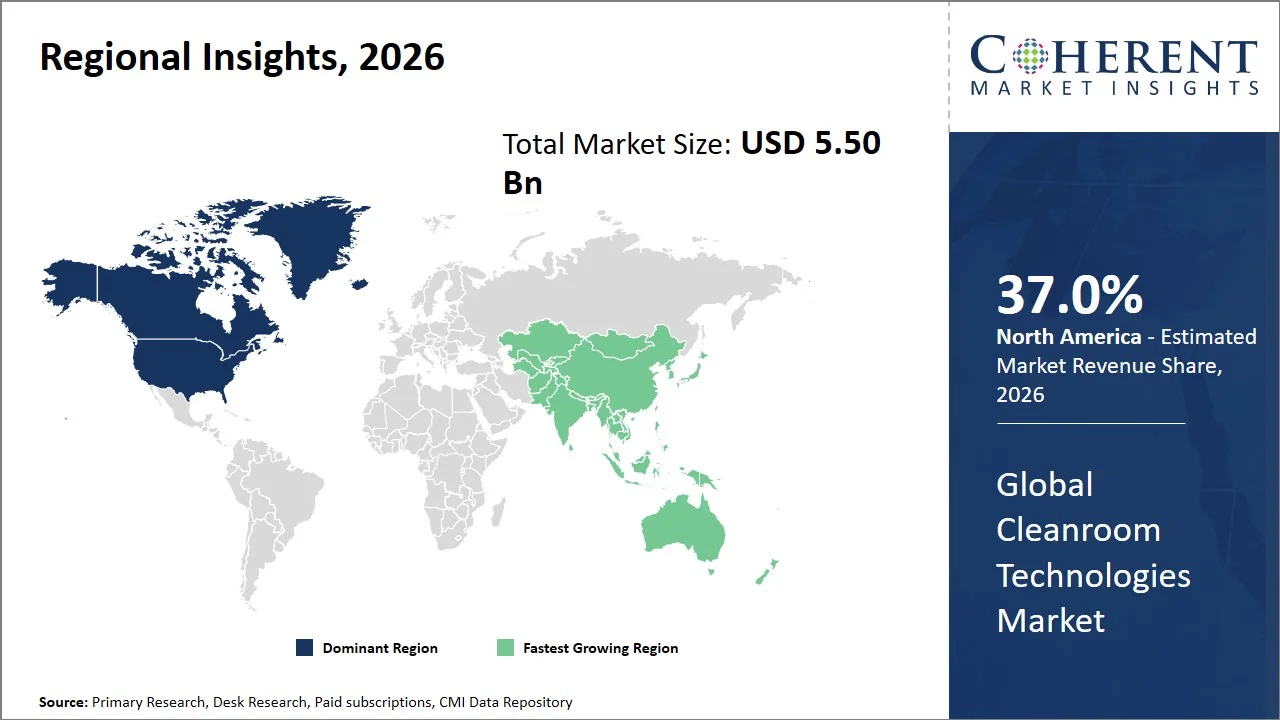
Why is North America a Strong Market for Cleanroom Technologies?
North America is expected to account for a market share of 37.0% in 2026. North America’s cleanroom technologies market is driven by large scale semiconductor expansion and sophisticated biologics manufacturing, especially in the U.S. and Canada. For example, Intel’s multi-billion dollar “mega fab” investments in Arizona and Ohio require EUV-compatible ultra-clean ISO Class 3-5 environments, and biotech hubs like Boston and San Diego are building out GMP cleanrooms for mRNA and cell therapy manufacturing. Smart cleanrooms combined with AI-based environmental monitoring systems are also widely adopted in the region. On October 6, 2025, Amkor began construction of a USD 7 billion cleanroom-heavy advanced semiconductor packaging campus in Arizona, U.S., designed to support Apple and Nvidia AI chip supply chains. The facility is part of the CHIPS Act ecosystem and will integrate high-precision cleanroom environments for 2.5D/3D chip packaging, highlighting rising demand for ultra-controlled fabrication spaces. (Source: Amkor)
Why Does the Asia Pacific Cleanroom Technologies Market Exhibit High Growth?
Asia Pacific is projected to account for 29.0% of the global cleanroom technologies market and is expected to register the fastest growth. The fastest growing cleanroom market is in Asia Pacific, driven by strong semiconductor and pharmaceutical capacity growth in nations such as Taiwan, South Korea, China and India. For example, TSMC in Taiwan and Samsung in South Korea run some of the world’s most advanced fabs needing severe particle control, while Singapore’s Biopolis hosts high-end biologics manufacturing on a modular cleanroom basis. Semiconductor self-sufficiency programs are being actively funded by global market players and governments that directly increase cleanroom building. On May 20, 2024, AstraZeneca announced plans to build a USD 1.5 billion manufacturing facility in Singapore for antibody drug conjugates (ADCs), enhancing global supply of its ADC portfolio. (Source: AstraZeneca)
Global Cleanroom Technologies Market Outlook for Key Countries
Why is the U.S. Emerging as a Major Hub in the Cleanroom Technologies Market?
Semiconductor reshoring pushed by the CHIPS Act and the advanced pharmaceuticals production significantly shape the U.S. cleanroom technologies market. Major projects like TSMC’s Arizona fabs and Intel’s Ohio expansion are driving demand for next generation cleanrooms with strict vibration and contamination control. Furthermore, the U.S. facilities of Moderna and Pfizer are also based on high-grade GMP cleanrooms for mRNA vaccine and biologics production which is further expanding the adoption of automated monitoring and isolator-based systems.
Is China the Next Growth Engine for the Cleanroom Technologies Market?
The market for cleanroom technologies in China is growing quickly, driven by the policies of local semiconductor self-reliance and huge pharmaceutical manufacturing capacity. Companies like SMIC and Yangtze Memory Technologies are constructing advanced fabrication facilities that require ultra-clean conditions, while vaccine producers like Sinovac have updated GMP cleanrooms for big scale biologics production. Government-backed schemes like as “Made in China 2025” are increasing investment in high-spec cleanroom infrastructure.
Germany Cleanroom Technologies Market Analysis and Trends
Precision engineering, pharmaceutical production and automotive electronics are propelling the cleanroom technology industry in Germany. Bayer and Merck run better GMP cleanrooms for the production of biologics and sterile drugs, while Infineon Technologies in Dresden provides the high-grade cleanrooms for the manufacture of semiconductors. The country’s strong regulatory environment under EU GMP Annex 1 is driving substantial renovations to contamination-controlled facilities.
The India cleanroom technologies market is set for growth with pharma export manufacturing and new semiconductor investments. For example, Sun Pharma and Dr. Reddy’s have big GMP-compliant cleanrooms for worldwide generic medication supply, and demand for additional high-grade cleanroom infrastructure is being driven by the Micron Technology semiconductor assembly project in Gujarat, India. Further, India Semiconductor Mission and other government efforts are propelling the growth of cleanroom construction in electronics and chip packing industry.
Global Cleanroom Technologies Market - Cleanroom Certification Failure and Contamination Incident Rates
Sector | Cleanroom Type (ISO / GMP) | Certification / Compliance Failure Rate | Environmental Monitoring Deviation Rate | Contamination Incident Rate (Batch/Production Level) |
Pharmaceutical Manufacturing | GMP Grade A/B (ISO 5–7 equivalent) | 20–35% facilities show at least 1 critical GMP/ISO deviation per audit cycle | 15–25% EM excursions (particle/microbial/pressure deviations) | ~1–3% batch contamination or rejection rate in sterile manufacturing |
Semiconductor Fabrication | ISO Class 3–5 fabs | ~25–40% fabs report at least one ISO parameter excursion annually | Continuous particle/pressure drift events in 10–20% of monitored cycles | ~0.5–2% wafer lot contamination or scrap events |
Biotechnology / Biologics | GMP Grade B/C cleanrooms | ~18–30% facilities show audit deviations (EM + aseptic control gaps) | 12–22% EM alert/action limit breaches in production cycles | ~1–2.5% contamination-linked production loss |
Medical Device Manufacturing | ISO Class 7–8 | ~15–25% certification non-conformance during audits | 10–18% environmental parameter excursions | <1–1.5% contamination events (lower sterility requirement than pharma) |
Semiconductor R&D / Pilot fabs | ISO Class 1–4 ultra-clean | ~30–50% initial qualification failure before stabilization | High drift sensitivity: frequent real-time corrections required | Highly variable; ~2–5% experimental batch loss in early ramps |
How is the Expansion of Biopharma Production Facilities Creating New Growth Opportunities in the Cleanroom Technologies Market?
The cleanroom technologies market growth opportunities are being driven by the expansion of biopharma production facilities, as it is significantly increasing the demand for highly controlled, contamination-free manufacturing environments required for biologics, vaccines, monoclonal antibodies, and cell and gene therapies. Companies like Pfizer, Moderna and other emerging biotechs are expanding their production capacity, investing in state-of-the-art GMP-compliant cleanrooms with isolators, HEPA/ULPA filtration and real-time environmental monitoring to satisfy stringent regulatory requirements and ensure product sterility. The expansion is further pushed by government-funded vaccine initiatives and the increasing worldwide demand for personalized medicine, which is driving greater adoption of modular and easily deployable cleanroom systems that can be rapidly deployed and verified for production.
On May 14, 2025, Sanofi announced its intention to invest at least USD 20 billion in the U.S. through 2030. The expected investment includes a significant increase in research and development spending and the allocation of billions of dollars to U.S. manufacturing. (Source: Sanofi)
Market Players, Key Development, and Competitive Intelligence
Key Developments
- On April 9, 2026, NY CREATES advanced its Albany NanoTech complex with a next-generation cleanroom designed for ASML High-NA EUV lithography research and chip prototyping. The High NA EUV Lithography Center is based at Creates’ Albany NanoTech Complex, North America’s largest and most advanced 300mm semiconductor R&D facility.
- On November 19, 2025, Novartis, a leading global innovative medicines company, announced plans to expand its operations in North Carolina, U.S., creating a new flagship manufacturing hub with end-to-end manufacturing capabilities. The strategic investment is a major step to ensure all key Novartis medicines for U.S. patients are manufactured in the U.S. and delivered to patients across the country at scale.
Competitive Landscape
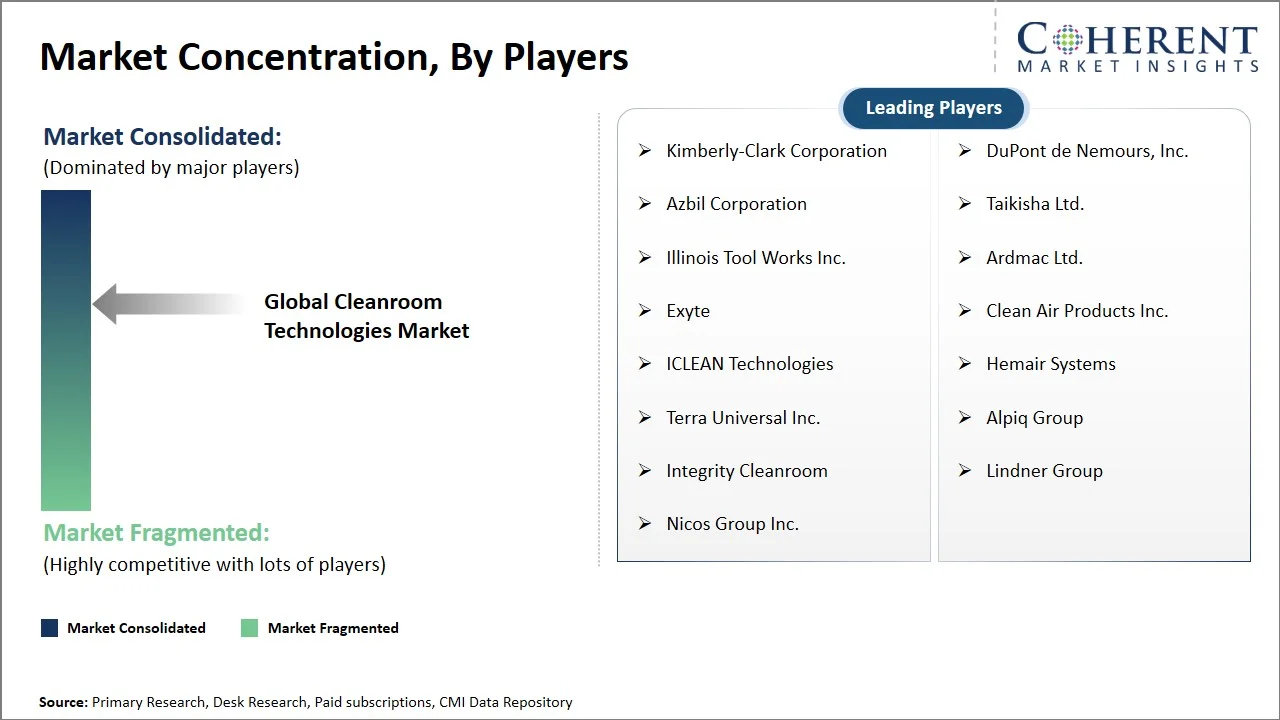
The global cleanroom technologies market is characterized by the existence of several established players and specialist engineering firms. Competition is driven by technological innovation, regulatory compliance capabilities and turnkey project delivery. Major players such as Terra Universal, Inc., Clean Air Products, Ardmac, ABN Cleanroom Technology and Taikisha Ltd. are focusing on modular cleanroom systems, energy-efficient HVAC solutions and integrated contamination control technologies.
Market Report Scope
Cleanroom Technologies Market Report Coverage
| Report Coverage | Details | ||
|---|---|---|---|
| Base Year: | 2025 | Market Size in 2026: | USD 5.50 Bn |
| Historical Data for: | 2020 To 2024 | Forecast Period: | 2026 To 2033 |
| Forecast Period 2026 to 2033 CAGR: | 4.8% | 2033 Value Projection: | USD 7.50 Bn |
| Geographies covered: |
| ||
| Segments covered: |
| ||
| Companies covered: | Kimberly-Clark Corporation, DuPont de Nemours, Inc., Azbil Corporation, Taikisha Ltd., Illinois Tool Works Inc., Ardmac Ltd., Exyte, Clean Air Products Inc., ICLEAN Technologies, Hemair Systems, Terra Universal Inc., Alpiq Group, Integrity Cleanroom, Lindner Group, and Nicos Group Inc. | ||
| Growth Drivers: |
| ||
| Restraints & Challenges: |
| ||
Analyst Opinion (Expert Opinion)
- With growing investments in biopharmaceutical production and semiconductor fabrication infrastructure, the market is deemed to be extremely growth-oriented. Growing emphasis on regulatory compliance, contamination control, and automation-based monitoring systems will transform cleanroom design and adoption trends. High-precision manufacturing sectors are seeing strong demand and continued increase is expected as companies move to advanced and digitally connected cleanroom environments.
- The cleanroom technologies market is predicted to grow strongly driven by rising demand for biologics, gene treatments and next generation semiconductors globally. Increased implementation of modular, prefabricated and intelligent cleanroom systems coupled with IoT and AI-based monitoring is expected to improve operating efficiency and scalability. Moreover, persistent investments in the semiconductor self-sufficiency projects and pharmaceutical manufacturing capacity in Asia Pacific and North America are likely to offer long-term growth possibilities for the cleanroom solution providers.
Speak to the analyst
Want personalized insights?
Take the findings above to one of our principal consultants, or have the report rebuilt around the segments, geographies and competitors you actually track.
Market Segmentation
- Cleanroom Type Insights (Revenue, USD Billion, 2021 - 2033)
- Hardwall Cleanrooms
- Softwall Cleanrooms
- Modular Cleanrooms
- Standard Cleanrooms
- Service Insights (Revenue, USD Billion, 2021 - 2033)
- Installation Services
- Certification and Validation
- Maintenance Services
- End User Insights (Revenue, USD Billion, 2021 - 2033)
- Pharmaceuticals
- Biotechnology
- Medical Devices
- Semiconductors and Electronics
- Hospitals and Laboratories
- Aerospace and Defense
- Regional Insights (Revenue, USD Billion, 2021 - 2033)
- North America
- U.S.
- Canada
- Latin America
- Brazil
- Argentina
- Mexico
- Rest of Latin America
- Europe
- Germany
- U.K.
- Spain
- France
- Italy
- Russia
- Rest of Europe
- Asia Pacific
- China
- India
- Japan
- Australia
- South Korea
- ASEAN
- Rest of Asia Pacific
- Middle East
- GCC Countries
- Israel
- Rest of Middle East
- Africa
- South Africa
- North Africa
- Central Africa
- North America
- Key Players Insights
- Kimberly-Clark Corporation
- DuPont de Nemours, Inc.
- Azbil Corporation
- Taikisha Ltd.
- Illinois Tool Works Inc.
- Ardmac Ltd.
- Exyte
- Clean Air Products Inc.
- ICLEAN Technologies
- Hemair Systems
- Terra Universal Inc.
- Alpiq Group
- Integrity Cleanroom
- Lindner Group
- Nicos Group Inc.
Sources
Primary Research Interviews
- Cleanroom equipment manufacturers and suppliers
- Pharmaceutical and biotechnology industry executives
- Healthcare facility managers and cleanroom operators
- Semiconductor industry professionals
Magazines
- Cleanroom Technology Magazine
- Pharmaceutical Manufacturing Magazine
- BioProcess International Magazine
- Controlled Environments Magazine
Journals
- Journal of Pharmaceutical Sciences
- International Journal of Pharmaceutics
- Pharmaceutical Engineering Magazine
Associations
- International Society for Pharmaceutical Engineering (ISPE)
- Institute of Environmental Sciences and Technology (IEST)
- Controlled Environment Testing Association (CETA)
- Pharmaceutical Research and Manufacturers of America (PhRMA)
Public Domain Sources
- U.S. Securities and Exchange Commission (SEC) filings
- Company annual reports and investor presentations
- Government regulatory publications
- Industry white papers and technical documents
Proprietary Elements
- CMI Data Analytics Tool
- Proprietary CMI Existing Repository of information for last 10 years
Get access to 250+ pages report
Every segment, forecast, competitor profile and data table behind the analysis above — available for instant download.
- ESOMAR Member
- ISO 9001:2015 Certified
- D-U-N-S Registered
- GDPR & CCPA Compliant
Missing comfort of reading report in your local language? Find your preferred language:
Transform your Strategy with Exclusive Trending Reports
Frequently Asked Questions
The global cleanroom technologies market is expected to stand at USD 5.50 Bn in 2026 and is expected to reach USD 7.50 Bn by 2033.
The CAGR of the global cleanroom technologies market is projected to be 4.8% from 2026 to 2033.
In terms of cleanroom type, the hardwall cleanrooms segment is estimated to dominate the market revenue share in 2026.
ISO cleanroom classification defines the maximum allowable particle concentration in the air for different cleanroom standards.
Cleanrooms maintain air purity using HEPA and ULPA filtration systems combined with controlled airflow patterns.
Growth in pharmaceutical and biotech manufacturing and rising semiconductor fabrication and chip demand are the major factors driving the growth of the global cleanroom technologies market.
High installation and maintenance cost and complex design and validation requirements are the major factors hampering the growth of the global cleanroom technologies market.