

Global Commerce Cloud Market and Forecast – 2026-2033
The global commerce cloud market is estimated to be valued at USD 28.34 Bn in 2026 and is expected to reach USD 122.07 Bn by 2033, exhibiting a compound annual growth rate (CAGR) of 23.2% from 2026 to 2033.
Key Takeaways of the Commerce Cloud Market
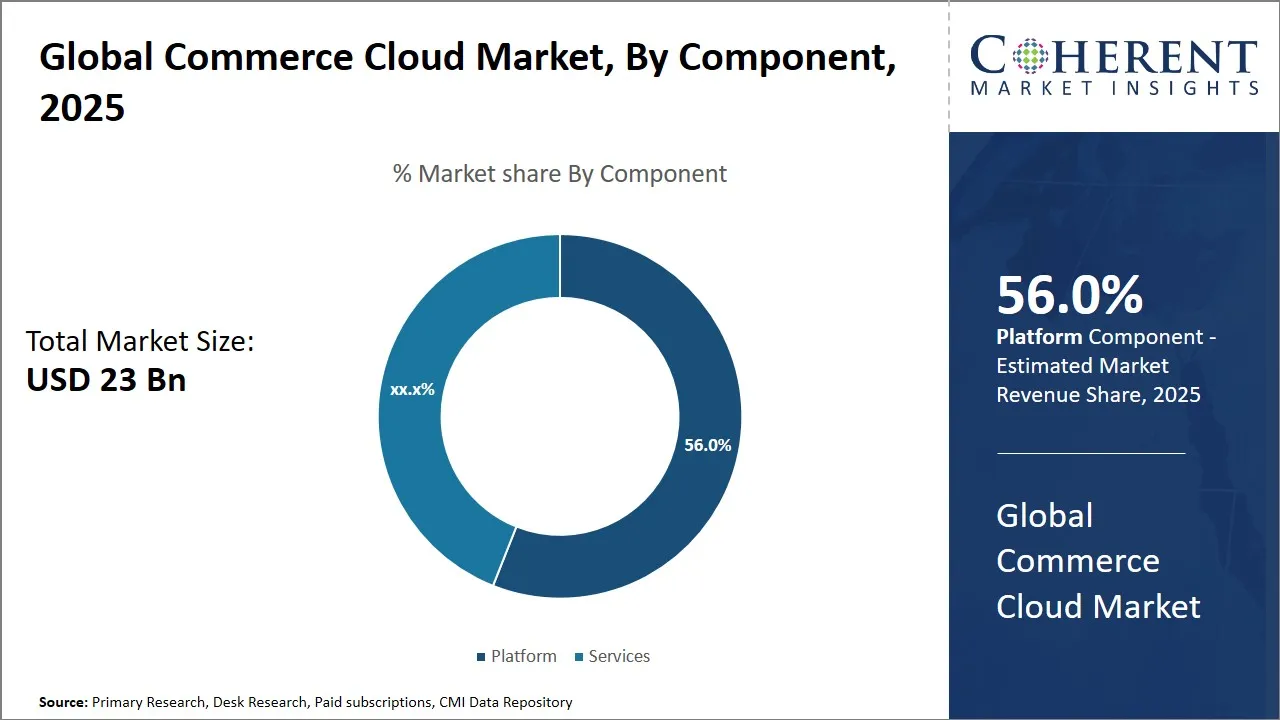
- The platform segment is expected to account for 57% of the commerce cloud market share in 2026.
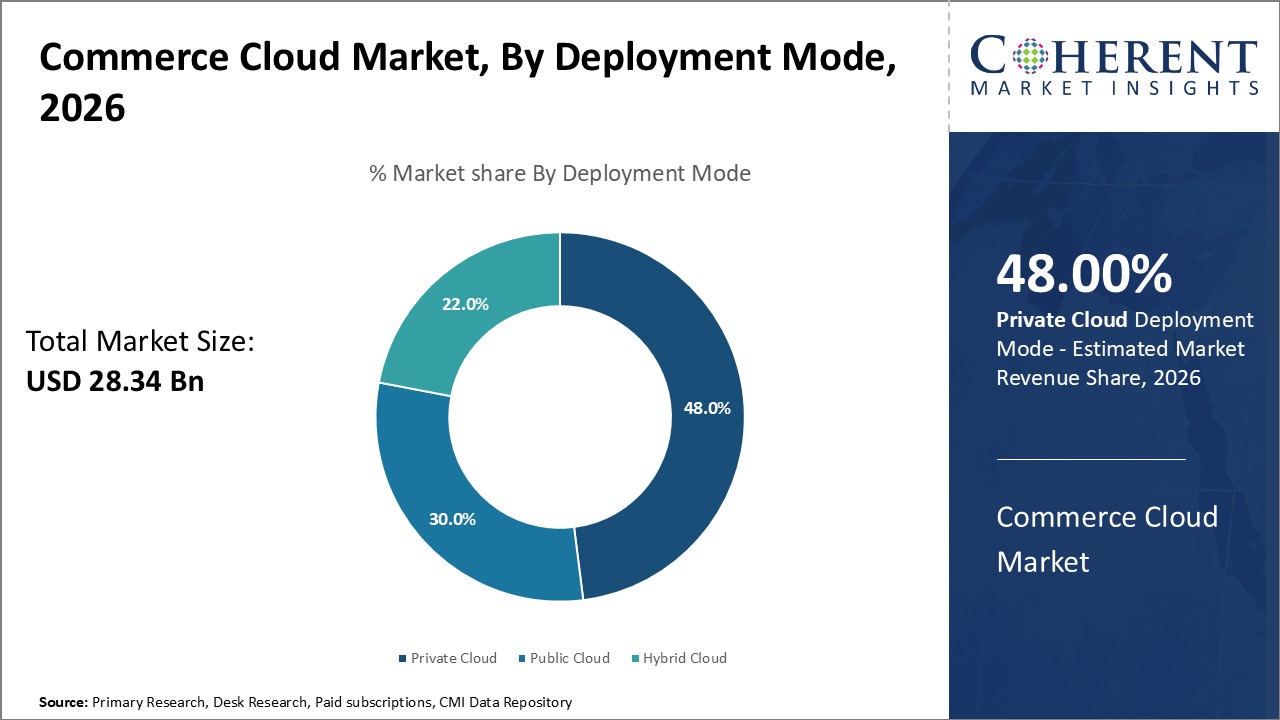
- The private cloud segment is projected to capture 48% of the market share in 2026.
- The grocery and pharmaceuticals segment is expected to command 35% share in 2026.
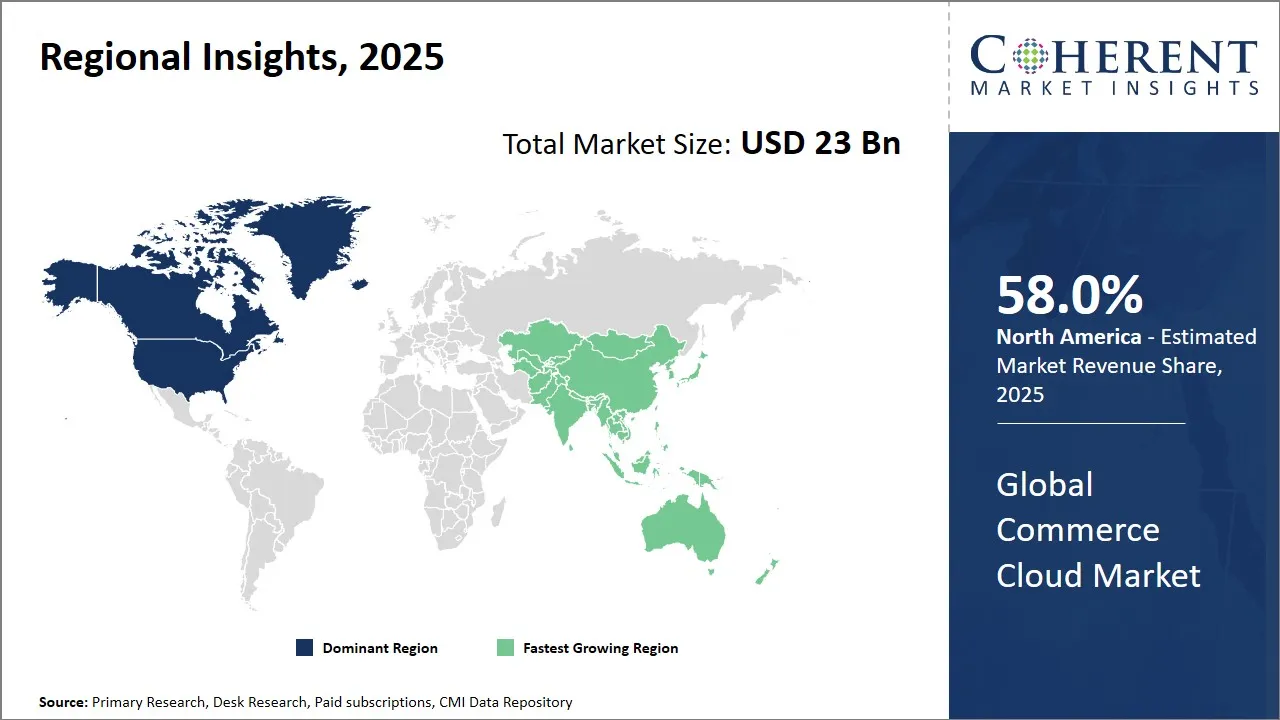
- North America will dominate the commerce cloud market in 2026 with an estimated 58% share.
- Asia Pacific will hold 21% share in 2026 and record the fastest growth.
Current Events and Its Impact
Current Events | Description and its Impact |
Salesforce and Open AI Partnership |
|
Segmental Insights
- Current Industry Events of 2026
- Market Size Estimation
- Regional Breakdown
- Competitive Landscape
- Customer Intelligence
- Segmental Analysis
- Pricing Analysis
- Key Market Drivers, Challenges & Future Trends
- Customized Insights Section
Why Does the Platform Segment Dominate the Global Commerce Cloud Market in 2026?
The platform segment is expected to hold 57% of the global commerce cloud market share in 2026. The expansion happens because it provides essential systems and tools to set up, launch, and run online stores effectively - while linking various digital channels like websites, apps, or social media through one cohesive structure. These platforms enable firms to deliver smooth, tailored interactions across different devices rather than relying on separate solutions. Because everything works together from start to finish, companies innovate faster since they adapt quickly when customer needs change, a key reason more enterprises choose such frameworks.
Cloud-based commerce systems support growth and adaptability, so businesses can handle high demand or enter new regions without big investments in hardware. Instead of physical setups, firms use digital tools like product catalogs, dynamic pricing, discounts, smart search, along with seamless payment links to stand out. Rather than generic solutions, providers now integrate AI and ML to improve suggestions, predict customer needs, detect suspicious activity - enhancing performance at every stage.
For instance, on November 12, 2025, Maropost, the leading unified commerce platform provider, announced the release of Maropost Commerce Cloud, a powerful addition to the brand’s suite of products for e-commerce and retail merchants, built as part of its Unified Commerce platform.
(Source: maropost.com)
Private Cloud Segment Dominates the Global Commerce Cloud Market
The private cloud segment is expected to hold 48% of the global commerce cloud market share in 2026. The expansion is driven by how well it meets strict enterprise needs around security, rules, and tailored setups. Organizations handling confidential information - or working under tight regulations - often choose private clouds due to isolated infrastructure. Because of this setup, they gain stronger oversight and confidentiality, unlike shared public options where systems are used by many different users.
Due to stricter rules on data handling, like GDPR or HIPAA, many favor private cloud because they keep sensitive information within protected, dedicated setups. Since these systems are separated from shared infrastructure, companies can adjust their digital operations to meet local and sector-based laws. This setup reduces both security incidents and possible fines by aligning technology use with compliance needs.
Why is Grocery and Pharmaceuticals the Most Essential End User in the Commerce Cloud Market?
The grocery and pharmaceuticals segment is expected to hold 35% of the global commerce cloud market share in 2026. The expansion comes mainly from the urgent demand to handle complicated logistics networks along with shifting customer demands. One sector depends on accurate, live tracking of stock plus order processing - so it can satisfy tough rules about access, security, and regulations.
In the grocery industry, how people shop has changed fast - more orders now happen online with deliveries to homes. Because of this shift, digital commerce platforms help stores link stock details from various locations, so they can offer flexible options like pickup at the curb or quick delivery on the same day. These systems also support recurring purchase plans by keeping track of supply levels.
Vertical Specific Customization Burden Index
Industry Vertical | Customization Burden Index (1 ‑ 10) | Primary Customization Drivers |
Pharmaceuticals & Health | 8.0 | Regulatory compliance, controlled SKU handling, integration with existing healthcare systems. |
Fashion & Apparel | 4.5 | Category/catalog variance, seasonal promotions, multi ‑ store inventories with moderate ERP integration needs. |
Electronics & Appliances | 6.0 | Complex product specs, warranty/returns logic, multiple fulfillment channels. |
Food & Grocery | 7.0 | SKU perishability, local price variations, compliance with food safety and regional delivery constraints. |
Regional Insights
North America Commerce Cloud Market Analysis and Trends
The North America region is projected to lead the market with a 58% share in 2026. The expansion comes from a solid technology environment, broad use of cloud services, while supportive government measures push digital change forward. Major companies like Salesforce, Oracle, or Adobe have made the area a center for new commerce cloud ideas. In addition, reliable networks and developed online shopping sectors, with fierce competition drive the need for advanced platforms. Trade patterns across the region combined with many tech-literate buyers help strengthen North America’s top role in this field.
Asia Pacific Commerce Cloud Market Analysis and Trends
Asia Pacific is expected to exhibit the fastest growth in the market, contributing 21% share in 2026. The surge comes from fast-moving digitization, wider web access, while more SMEs turn to cloud solutions. State-backed efforts to grow digital markets like China's "Digital Silk Road" or India’s "Digital India" have pushed ahead cloud systems alongside online trade.
A rising middle class combined with greater phone use drives active shopping online. Major firms including Alibaba Cloud, Tencent Cloud, along with SAP, have gained strong footholds here, sparking sharper rivalry plus fresh ideas. Better delivery networks paired with upgraded payment platforms also help boost the uptake of commerce-focused cloud services.
Global Commerce Cloud Market Outlook for Key Countries
Why is the U.S. Emerging as a Major Hub in the Commerce Cloud Market?
The U.S. commerce cloud market stays ahead because of strong IT systems alongside many cloud providers. Firms such as Salesforce or Oracle take key positions by delivering full-featured commerce platforms using AI with analytical tools to boost interactions and efficiency. A high number of emerging companies plus established firms adopting cloud tech creates an active, shifting marketplace. Also, favorable rules on data safety and personal information support trust in cloud-powered shopping services.
Is China the Next Growth Engine for the Commerce Cloud Market?
China's commerce cloud sector grows fast due to a massive e-commerce network, led by Alibaba Cloud and Tencent Cloud. Because of state-backed digital reforms, alongside heavy funding in tech infrastructure, growth accelerates. Platforms link closely with social shopping and phone-based payment systems and this mirrors distinct consumer habits. In addition, homegrown vendors provide tailored solutions and flexible scaling, serving everyone from big firms to small businesses, which helps widen adoption.
Germany Commerce Cloud Market Analysis and Trends
Germany's commerce cloud sector grows thanks to strong industrial output and global trade activity. Companies like SAP play a key role by offering advanced systems suited for intricate logistics networks. Support from national policies around Industry 4.0 helps speed up tech integration across businesses. In addition, strict adherence to EU data rules fosters trust in secure cloud services. This reliability appeals to both large firms and smaller enterprises operating in Europe.
India Commerce Cloud Market Analysis and Trends
India's commerce cloud market is growing fast, thanks to state efforts promoting digital transactions and cloud use. Through its Digital India drive, the government boosts cloud networks, opening access for millions of new users. Companies including Infosys and Wipro - alongside global names like SAP and Microsoft - are crafting custom tools for varied local retailers. E-commerce expansion, paired with more smartphone usage, drives market needs. At the same time, affordable plans and region-specific offerings help small firms shift toward cloud-based sales.
U.K. Commerce Cloud Market Analysis and Trends
The U.K.'s commerce cloud market thrives owing to an established retail industry along with rising demand for integrated shopping channels. Firms like Salesforce, Magento, and IBM are active here, delivering flexible and adaptable cloud-based tools. Government backing for technological advancements and secure data practices helps speed up acceptance across sectors. In addition, a vibrant fintech network enhances these platforms through smooth transaction support and targeted reward systems. Changes in trade patterns after Brexit have pushed firms toward quicker, more responsive digital sales solutions to stay relevant at home and abroad.
Market Players, Key Development, and Competitive Intelligence
Key Developments
- On December 10, 2025, Tata Consultancy Services (TCS) completed the acquisition of Coastal Cloud, a leading Salesforce Summit partner, that specializes in Salesforce Consulting for USD 700 Million.
- On November 17 2025, Salesforce announced Agentforce Commerce, a new commerce platform designed to embed agentic AI experiences across digital storefronts, POS, and order management. Agentforce Commerce is the first platform designed to give retailers full control over the entire agentic shopping journey, moving ahead of fragmented point solutions, to unify branded experiences and customer relationships across every touchpoint.
Top Strategies Followed by Global Commerce Cloud Market Players
Player Type | Strategic Focus | Example |
Established Market Leaders | Business Collaboration | On July 30, 2025, BigCommerce and Feedonomics, announced the extension of its partnership with Google Cloud to accelerate merchant performance using Google Cloud's next-generation AI tools. |
Mid-Level Players | Global Recognition | On December 17, 2025, E2open, a WiseTech Global Group company, was recognized as a Leader in the IDC MarketScape in the Worldwide Multi-Enterprise Supply Chain Commerce Networks (MESCCN) 2025 Vendor Assessment |
Small-Scale Players | TD Synnex Acquires Apptium | On July 1, 2025, TD Synnex acquired Apptium to accelerate innovation and expand cloud and Everything-as-a-Service offerings. |
Market Report Scope
Commerce Cloud Market Report Coverage
| Report Coverage | Details | ||
|---|---|---|---|
| Base Year: | 2025 | Market Size in 2026: | USD 28.34 Bn |
| Historical Data for: | 2020 To 2024 | Forecast Period: | 2026 To 2033 |
| Forecast Period 2026 to 2033 CAGR: | 23.2% | 2033 Value Projection: | USD 122.07 Bn |
| Geographies covered: |
| ||
| Segments covered: |
| ||
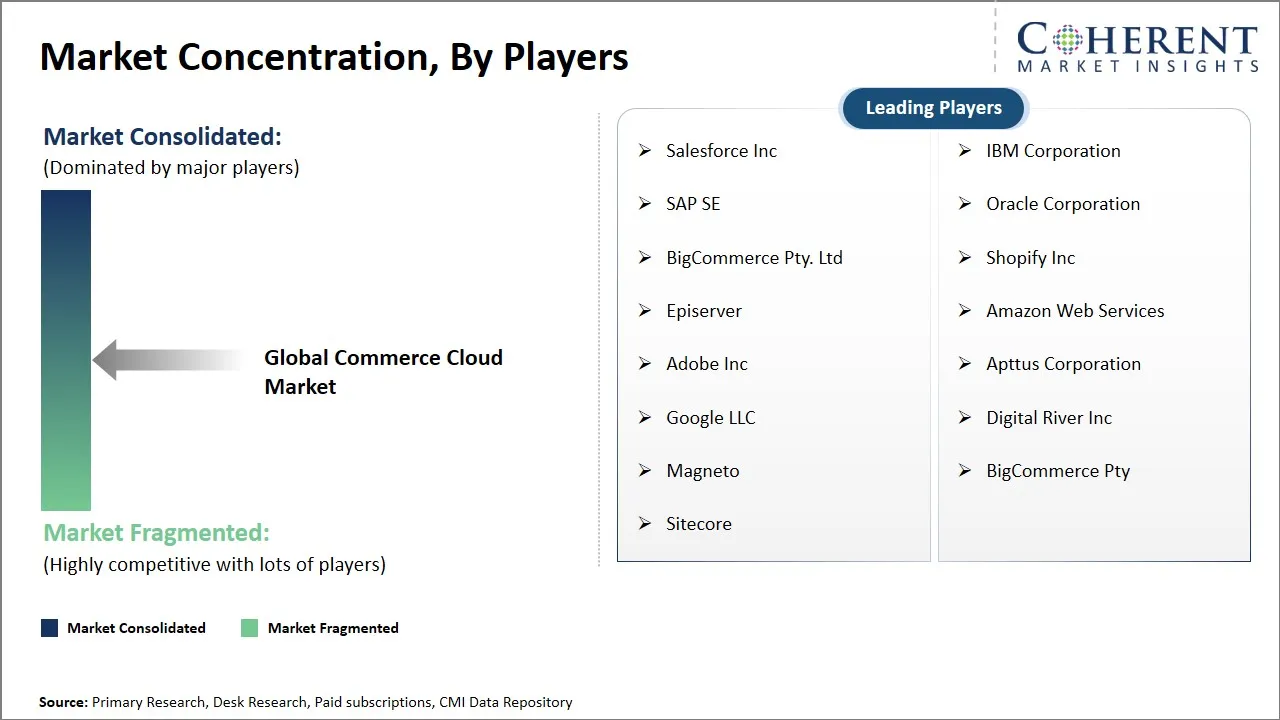
| Companies covered: | Salesforce Inc, IBM Corporation, SAP SE, Oracle Corporation, BigCommerce Pty. Ltd, Shopify Inc, Episerver, Amazon Web Services, Adobe Inc, Apttus Corporation, Google LLC, Digital River Inc, Magneto, BigCommerce Pty, and Sitecore | ||
| Growth Drivers: |
| ||
| Restraints & Challenges: |
| ||
Global Commerce Cloud Market Dynamics
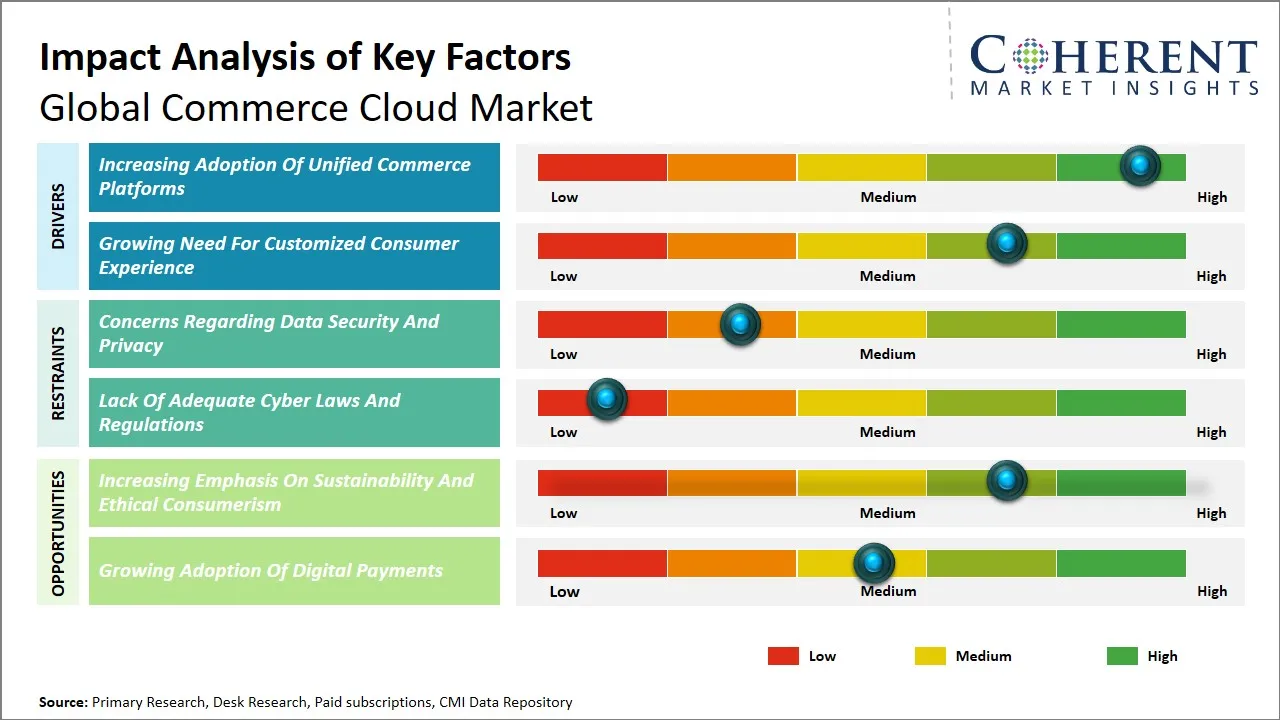
Global Commerce Cloud Market Driver - Increasing Adoption of Unified Commerce Platforms
The rise in use of integrated digital commerce platforms strongly boosts growth in the worldwide retail cloud sector. Because they want better engagement, stores now see value in smooth service across web, physical locations, or apps. These platforms link sales outlets, stock tracking, buyer details, and transaction tools, so updates happen instantly while operations run smoother. With this approach, companies can tailor purchases to individuals, speed up deliveries, also support cross-channel communication that strengthens customer trust.
Furthermore, growing numbers of tech-literate shoppers who value quick service and adaptable options push stores to use integrated retail systems. Because companies are shifting from isolated setups to connected networks, demand rises for cloud-based tools that enable seamless shopping experiences, like ordering online then collecting in person. This shift boosts uptake of unified platforms across various sectors and regions.
For instance, on June 25, 2025, OneView Commerce announced the completion of the first year of Australia Post's rollout of OneView's point of sale in more than 3,500 of its Post Offices in Australia. Australia Post's now modernized point of sale system, POST+, replaces a more than 30-year-old legacy system. As a unified commerce platform delivering native cloud technologies, OneView provides improved functionality and the ability to quickly and easily deliver system upgrades and improvements.
(Source: oneviewcommerce.com)
Global Commerce Cloud Market Opportunity - Increasing Emphasis on Sustainability and Ethical Consumerism
The rising focus on eco-friendly choices creates strong potential for the global commerce cloud market. As today’s buyers prefer companies that support green practices, firms must adapt. Platforms offering tools like emission monitoring systems or verified sourcing help sellers align with customer values. As a result, many now seek cloud systems with clear data dashboards showing ethical progress. These features let organizations highlight real actions instead of vague claims.
For instance, on March 26, 2025, SPS Commerce, Inc, a leader in retail supply chain cloud services, announced the release of its 2024 Environmental, Social, and Governance (ESG) Report, outlining the company’s ongoing commitment to sustainability, ethical business practices, and social responsibility.
(Source: investors.spscommerce.com)
Analyst Opinion (Expert Opinion)
- The global commerce cloud market is moving into a more advanced stage, where systems do more than support online shops, they are turning into core decision-making hubs for companies. Because of generative AI, combined data setups, or automated logistics networks, what buyers expect has changed: firms now want instant customization, smooth cross-channel coordination, therefore stronger reporting tools. As this shift continues, established names like Salesforce, Shopify, Adobe, alongside newer entrants such as integrated commerce experts or logistics software vendors are setting themselves apart using smart algorithms, flexible components, also network collaborations to cut setup time while lowering long-term expenses.
- Furthermore, eco-friendly practices are playing a bigger role in commerce platforms. Systems offering clear sourcing details, emissions tracking, or sustainable delivery options appeal more to mindful shoppers and labels alike. This trend will push firms to prioritize open data systems, values-driven tools, and responsible supplier networks when picking tech partners; slowly widening demand for offerings where sustainability is built-in functionality rather than optional reporting.
Speak to the analyst
Want personalized insights?
Take the findings above to one of our principal consultants, or have the report rebuilt around the segments, geographies and competitors you actually track.
Market Segmentation
- Component Insights (Revenue, USD Billion, 2021 - 2033)
- Platform
- Services
- Deployment Mode Insights (Revenue, USD Billion, 2021 - 2033)
- Private Cloud
- Public Cloud
- Hybrid Cloud
- End User Insights (Revenue, USD Billion, 2021 - 2033)
- Grocery and Pharmaceuticals
- Fashion and Apparel
- Electronics and Appliances
- Food and Beverages
- Others
- Regional Insights (Revenue, USD Billion, 2021 - 2033)
- North America
- U.S.
- Canada
- Latin America
- Brazil
- Argentina
- Mexico
- Rest of Latin America
- Europe
- Germany
- U.K.
- Spain
- France
- Italy
- Russia
- Rest of Europe
- Asia Pacific
- China
- India
- Japan
- Australia
- South Korea
- ASEAN
- Rest of Asia Pacific
- Middle East
- GCC Countries
- Israel
- Rest of Middle East
- Africa
- South Africa
- North Africa
- Central Africa
- North America
- Key Players Insights
- Salesforce Inc
- IBM Corporation
- SAP SE
- Oracle Corporation
- BigCommerce Pty. Ltd
- Shopify Inc
- Episerver
- Amazon Web Services
- Adobe Inc
- Apttus Corporation
- Google LLC
- Digital River Inc
- Magneto
- BigCommerce Pty
- Sitecore
Sources
Primary Research Interviews
- E-commerce Platform Vendors
- Cloud Service Providers
- Digital Commerce Solution Integrators
- Enterprise IT Decision Makers
Databases
- Salesforce Commerce Cloud Database
- Adobe Commerce Intelligence
- SAP Commerce Cloud Analytics
- Oracle Commerce Platform Data
Magazines
- E-commerce Times
- Digital Commerce 360
- Internet Retailer Magazine
- Cloud Computing Magazine
Journals
- Journal of Electronic Commerce Research
- International Journal of Cloud Computing
- Electronic Commerce Research and Applications
Newspapers
- The Wall Street Journal (Technology Section)
- Financial Times (Digital Business)
- TechCrunch
- Forbes (Cloud Technology)
Associations
- Digital Commerce Institute
- Cloud Security Alliance
- E-commerce Foundation
- International Association of Cloud & Mobile Computing
Public Domain Sources
- U.S. Census Bureau E-commerce Statistics
- European E-commerce Association Reports
- Government Cloud Computing Initiatives
- OECD Digital Economy Reports
Proprietary Elements
- CMI Data Analytics Tool
- Proprietary CMI Existing Repository of information for last 8 years
Get access to 250+ pages report
Every segment, forecast, competitor profile and data table behind the analysis above — available for instant download.
- ESOMAR Member
- ISO 9001:2015 Certified
- D-U-N-S Registered
- GDPR & CCPA Compliant
Missing comfort of reading report in your local language? Find your preferred language:
Transform your Strategy with Exclusive Trending Reports
Frequently Asked Questions
The global commerce cloud market is estimated to be valued at USD 28.34 Bn in 2026 and is expected to reach USD 122.07 Bn by 2033.
The CAGR of global commerce cloud market is projected to be 28.34% from 2026 to 2033.
Increasing adoption of unified commerce platforms and growing need for customized consumer experience are the major factors driving the growth of the global commerce cloud market.
Concerns regarding data security and privacy and lack of adequate cyber laws and regulations are the major factors hampering the growth of the global commerce cloud market.
In terms of component, platform is estimated to dominate the market revenue share in 2026.
Commerce cloud offers scalable, subscription-based, continuously updated solutions hosted in the cloud rather than on-premise, reducing infrastructure and maintenance costs.
AI enables personalization, predictive demand forecasting, dynamic pricing, fraud detection, and automated customer engagement.