

Global Contraceptive Pills Market Size and Forecast: 2026 to 2033
The Global Contraceptive Pills Market is estimated to be valued at USD 8.71 Bn in 2026 and is expected to reach USD 14.27 Bn by 2033, exhibiting a compound annual growth rate (CAGR) of 7.3% from 2026 to 2033. This growth reflects increasing awareness about family planning, rising healthcare accessibility, and greater acceptance of contraceptive methods worldwide. The expanding market is also driven by innovations in contraceptive formulations and distribution channels, enhancing user convenience and adherence.
Key Takeaways of the Global Contraceptive Pills Market
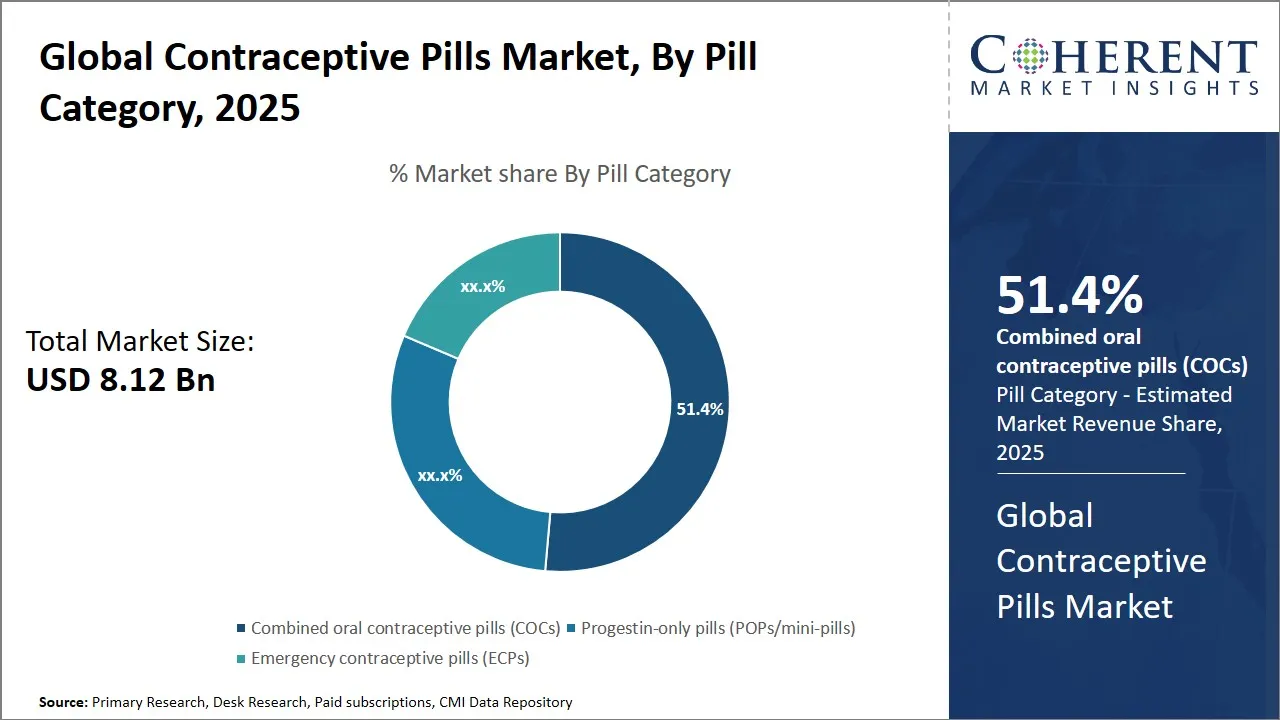
- Combined oral contraceptive pills (COCs) are expected to lead the global contraceptive pills market in 2026 with a 52.4% share.
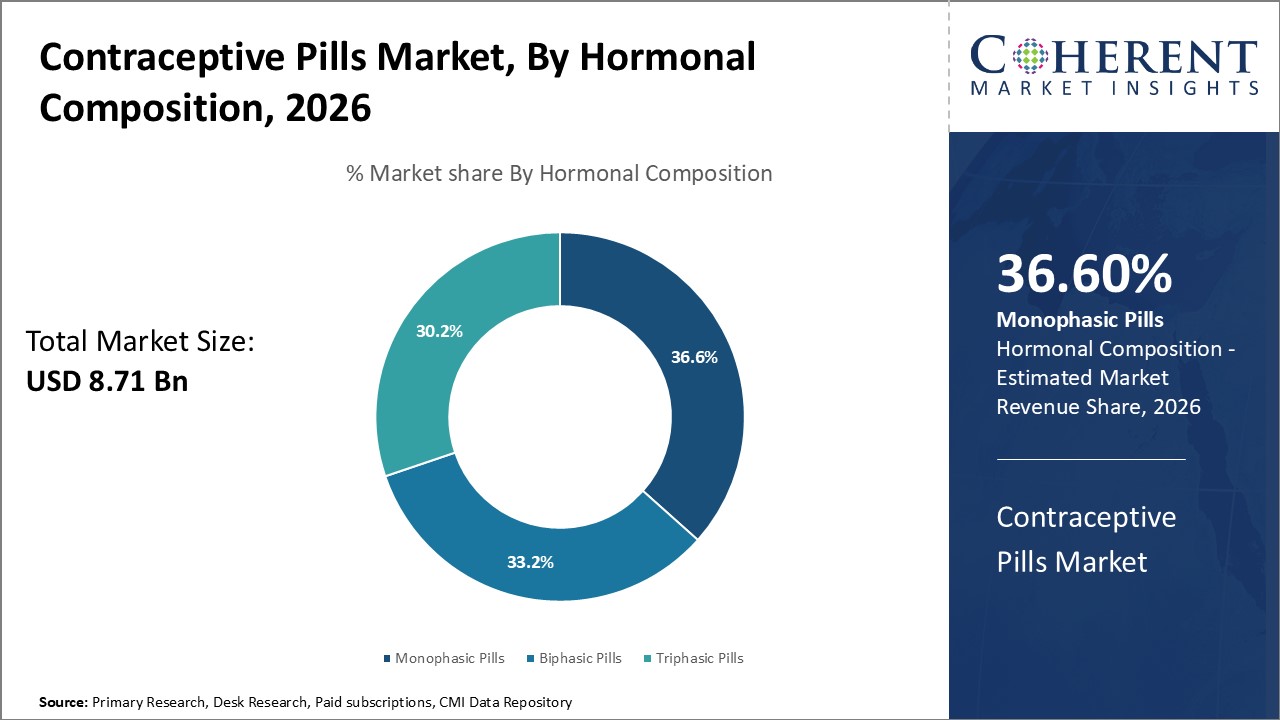
- Within hormonal composition, monophasic pills are projected to account for the largest portion at 36.6% in 2026.
- Based on dosage strength segmentation, low-dose pills dominate with an estimated 43.5% share in 2026.
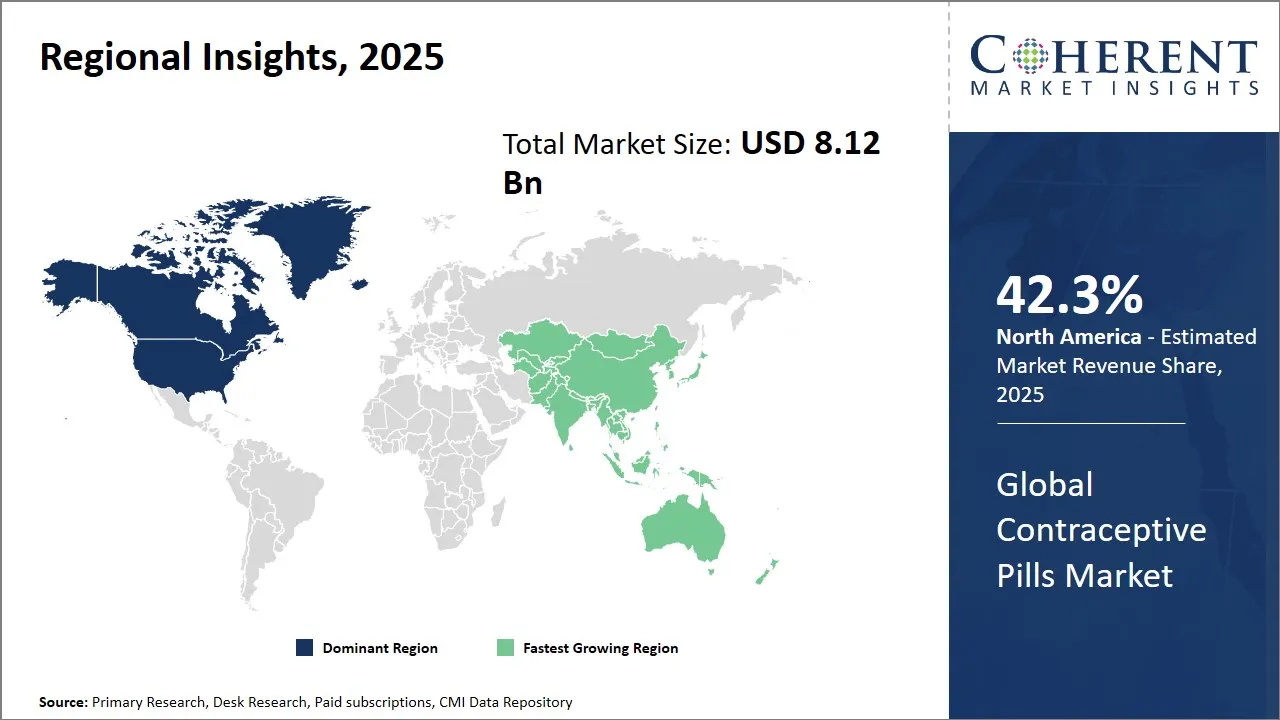
- North America is expected to lead the market, holding a share of 42.3% in 2026. Asia Pacific is anticipated to be the fastest-growing region, with an estimated market share of 24.5% in 2026.
Market Overview
A significant market trend is the growing demand for personalized and hormone-free contraceptive options, fueled by increased consumer preference for safer, side-effect-free alternatives. Additionally, digital health platforms and telemedicine services are improving accessibility and awareness, especially in developing regions. The integration of advanced technologies in product development and the rising emphasis on reproductive health education further contribute to this market’s dynamic evolution, positioning it for sustained growth over the coming years.
Currents Events and Its Impact
Current Events | Description and its Impact |
Asia Pacific Healthcare Expansion |
|
New Zealand funds desogestrel (Cerazette) as a new progestogen-only oral contraceptive option from |
|
Segmental Insights
- Current Industry Events of 2026
- Market Size Estimation
- Regional Breakdown
- Competitive Landscape
- Customer Intelligence
- Segmental Analysis
- Pricing Analysis
- Key Market Drivers, Challenges & Future Trends
- Customized Insights Section
Contraceptive Pills Market Insights, By Pill Category - Dominance of Combined Oral Contraceptive Pills (COCs) is Driven by Versatility and User Preference
Combined Oral Contraceptive Pills (COCs) lead the market with an estimated 52.4% share in 2026, driven by several strong demand-boosting factors that reinforce their widespread preference and adoption. COCs are a dependable and flexible way to prevent pregnancy that can attract a wide range of women in different countries around the world.
In November 2022, Wiley, a global scientific publisher, reported the U.K. launch of Drovelis, a new fifth-generation contraceptive pill developed with estetrol and drospirenone. Wiley notes that Drovelis, produced by Mithra Pharmaceuticals, a women’s health-focused biotech company, gained MHRA approval after strong phase 3 trial results showing reliable ovulation suppression and a favorable safety profile.
Contraceptive Pills Market Insights, By Hormonal Composition - Monophasic Pills Lead Due to Consistency and Simplified Regimen
In the hormonal composition segment of the global contraceptive pills market, monophasic pills are expected to hold the leading market share in 2026 of 36.6% due to the ease of use and the regular dose of hormones. Equipotent doses of estrogen and progestin are administered in monophasic pills in each active tablet as opposed to biphasic and triphasic pills, which contain different amounts of hormones in each cycle.
This uniformity allows monophasic pills to be more manageable to the user, avoiding confusion and chances of missed or wrongly administered doses, and this is important in ensuring the efficacy of contraceptive use. First-time users or individuals who require a simple birth control method tend to use monophasic pills.
Contraceptive Pills Market Insights, By Dosage Strength - Rising Preference for Low-Dose Pills Attributed to Safety and Tolerability
When it comes to dosage strength in the global market of contraceptive pills, low-dose pills will hold the largest portion of segment as they comprise 43.5% in 2026 because they will be in line with the growing trend of safer and more acceptable contraceptive methods.
These preparations include lower concentrations of estrogen and progestin than standard or high-dose preparations, which dramatically reduce the risk of side effects caused by hormones, including nausea, weight gain, and cardiovascular problems.
Side-Effect Incidence Benchmarking for Major Contraceptive Pill Categories
Side-Effect Category | Combined Oral Contraceptives (COCs) | Progestogen-Only Pills (POPs) | New-Generation Pills (E4-based, Low-Dose, DRSP) |
Weight Gain | Mild to moderate complaints; more common due to estrogen-related fluid retention | Lower incidence; minimal fluid retention | Lowest reported incidence; improved metabolic profile |
Mood Changes | Higher variability; older EE formulations show more mood swings and irritability | Fewer mood disturbances; more stable profile | Designed for mood stability; markedly fewer mood-related reports |
Venous Thromboembolism Risk. | Present; varies by progestin (highest with 3rd/4th gen) though absolute rates remain low | Negligible; no estrogen-driven clotting factor changes | Significantly reduced vs traditional COCs; E4 and low-dose EE show notably lower VTE odds |
Regional Insights
North America Contraceptive Pills Market Analysis and Trends
North America dominates the global contraceptive pills market with an estimated 42.3% share in 2026 due to its strong healthcare infrastructure and high awareness of contraceptive options. Government support for family planning and sexual health further reinforces the region’s leadership. Existence of major pharmaceutical corporations like Pfizer, Teva Pharmaceuticals, and Bayer Healthcare contribute a lot to innovation, availability and distribution of products in the entire region.
The trade policies are effective; the import and exportation strategies embrace open supply chains to ensure timely availability of products. Also, the high disposable income and the all-round insurance coverage promote the demand of diverse contraceptives, including the new hormonal formula pills.
Asia Pacific Contraceptive Pills Market Analysis and Trends
Increasing population awareness with an estimated share of 24.5% in 2026, better healthcare access and more urbanization are some of the factors that influence the contraceptive pills market in Asia Pacific, which shows the fast growth. Other governments such as India, China and Indonesia have been actively adopting the family planning programs, increasing access to reproductive health services and contraceptive education.
The area enjoys the fast-growing pharmaceutical sector that has both local sales (like Cipla in India and Otsuka in Japan) and multinational companies, entering the market through local strategies. Moreover, the increased participation of women in the workforce and changing the society are driving the demand to have effective contraceptives.
Global Contraceptive Pills Market Outlook for Key Countries
U.S. Contraceptive Pills Market Trends
The contraceptive pills market in the U.S. is also quite competitive and technologically developed with major R&D investments of the most influential companies such as Pfizer and Teva Pharmaceuticals. Market penetration increases with policy interventions to increase healthcare coverage and reproductive rights. The ubiquity of both brand and generic contraceptives provides a wide range of consumer selection and current development of low dose hormonal pills that address the safety and tolerability needs.
In July 2023, Perrigo Company plc, a global consumer self-care manufacturer, announced U.S. FDA approval for Opill, the first OTC progestin-only contraceptive pill in the country. The approval expands access to effective daily contraception for all ages and follows strong support from major U.S. medical associations.
India Contraceptive Pills Market Trends
The contraceptive pills market in India is a dynamic one that is evolving as a result of the government-supported family planning and health programs in rural areas that are raising the level of awareness and availability of contraceptive pills. The role of players like Cipla and Lupin would be critical, as it will provide options on affordable contraceptive pills depending on price sensitive segments. The increasing pharmaceutical production center and the rising urban middle class contribute to the demand even more.
In November 2024, the Contraception Action Network urged CDSCO to clarify the OTC status of Emergency Contraceptive Pills after confusion from an earlier CDSCO press note. The group welcomed confirmation that approved Schedule K strengths will stay non-prescription and pushed for final rule changes to eliminate regulatory contradictions and protect easy access to contraceptive pills across India.
Germany Contraceptive Pills Market Trends
The contraceptive pills market has remained very strong in Germany due to the strong regulatory standards set, the healthcare reimbursements schemes as well as consumer insistence on high-quality pharmaceutical products. The Bayer company, being one of the industry giants that headquarter in Germany, is an innovator with a spread of contraceptive pills that contain different hormone concoctions. The high-level healthcare and the high level of awareness campaigns in the country contributes to the continuing demand.
In June 2023, Germany-based, Bayer confirmed a temporary shortage of its contraceptive pill Yasmin in India, stating supplies would resume within days. Pharmacies reported limited availability since March and sales dropped sharply, though Bayer did not specify the cause.
China Contraceptive Pills Market Trends
China has a rapidly growing consumption of contraceptive pills as government policies of reproductive health and reproductive family planning reforms are advanced. The big pharmaceutical firms like Jiangsu Hengrui Medicine and multinationals are increasing in size with localized composed and extensive distribution systems. The aspects of urbanization, as well as the growing rate of women joining the workforce, are leading to the demand for convenient contraceptive means.
In December 2026, China ended its 30-year tax exemption on contraceptive pills and devices, introducing a 13% VAT from January to push pro-natal policies amid sharply declining birth rates. The move reverses decades of contraception-focused population control and pairs tax cuts for childcare and eldercare services to encourage parenthood.
Safety Profile and Efficacy of Contraceptive Pills
- Safety profiles for contraceptive pills remain strong due to decades of clinical data, standardized manufacturing, and regulated hormonal formulations. Modern pills use lower estrogen doses, reducing risks of thromboembolic events and cardiovascular complications compared with earlier generations.
- Most adverse effects nausea, breast tenderness, mild headaches are transient and dose-dependent. Progestin-only pills offer added safety for users with estrogen contraindications, including smokers above 35 and those with migraine with aura.
- Efficacy remains the core performance benchmark. Combined oral contraceptive pills achieve ~99.7% effectiveness with perfect use and ~91% with typical use, while progestin-only pills show ~99.5% perfect-use efficacy and ~93% typical-use efficacy when taken within the recommended time window.
- Failure rates stem primarily from inconsistent dosing, missed pills, and drug interactions that lower hormone levels. The market continues to shift toward formulations with improved adherence flexibility such as extended-cycle regimens and desogestrel-based POPs to narrow the gap between perfect and typical-use performance.
Market Players, Key Developments, and Competitive Intelligence
Key Developments
- In October 2025, ASKA Pharmaceutical, a Japanese drugmaker known for women’s health products, announced that Japan approved Norlevo as the country’s first over-the-counter emergency contraceptive pill. The approval allows women to buy the pill without age limits or parental consent, though it must be taken in front of a pharmacist. The health ministry signalled a shift toward wider reproductive access as Japan aligns with more than 90 countries already offering nonprescription emergency contraception.
- In March 2025, YourChoice Therapeutics, a U.S. biotech company developing next-generation contraceptives, reported a major milestone for YCT-529, the first hormone-free male contraceptive pill now advancing through clinical trials. The University of Minnesota College of Pharmacy, a long-standing research institution driving the drug’s early development, confirmed the pill safely blocked sperm production in animals with full fertility recovery after treatment stopped.
- In February 2025, Pharmac, New Zealand’s government medicine-funding agency, announced a proposal to fund Cerazette, a progestogen-only contraceptive pill made by Organon, a global women’s health company known for reproductive care products. Pharmac said the pill would give people a wider contraceptive choice, especially those avoiding oestrogen or breastfeeding users.
- In March 2024, ACOG, a leading U.S. obstetrics and gynecology organization, announced the nationwide availability of Opill, the first over-the-counter daily contraceptive pill approved for adolescents and adults. Perrigo, a global consumer health company that owns HRA Pharma, began distributing Opill as a non-prescription option offering easier access for users who prefer private, self-managed contraception.
Top Strategies Followed by Global Contraceptive Pills Market Players
- Established market leaders spend a lot of money in research and development in order to innovate high-performance, next-generation contraceptive remedies that align to the emerging consumer needs and acceptable regulatory standards. These firms use their strong financial base to come up with formulations with better efficacy, fewer side effects and other health-benefits like hormonal balance or skin enhancement.
- Examples of good leaders like Bayer, Pfizer and Organon are undoubtedly examples of leaders who have exercised this strategy. The further growth of drospirenone-based portfolio by Bayers, the efforts of Pfizer on better progestin-only preparations, and the organizing of the well-known brands of Organon shows that the most successful companies drive innovation with powerful research and development programs and regulatory interactions.
- Middle-level players in contraceptive pills market are taking a very narrowed down strategy to compete effectively. Because of the high price sensitivity of a large part of the consumers, these companies focus on providing affordable, but quality contraceptive methods which balance between price and quality. They can provide low-end markets with high product safety and efficacy, which is achieved through optimization of their production processes and use of cost-effective raw materials.
- Mid-level pharmaceutical companies, such as Ajanta Pharma, Cipla, and Plethico Pharmaceuticals, demonstrate that cost-efficient production and extensive distribution across geographic markets can be used to win low-end markets. These are firms that expand in India and other developing markets to sell cheap yet compliance contraceptive formulations such as levonorgestrel and desogestrel pills to serve competitive prices without quality sacrifices.
- Small market participants in the world market of contraceptive pills usually cut out their niches in order to enter the market with strong competition. They tend to work on new formulations or delivery systems which meet unmet medical conditions or target a certain demographic such as natural or herbal birth control, low-dose pills to use by sensitive people or specific hormonal combinations.
- Niche products like those provided by Hymn Organic, Lulu Natural Care, and Tara Pharmaceuticals can be seen to take off. These companies are testing plant-based hormonal support nutritional products, ultra-low dosage forms to serve a sensitive user segment, and alternative delivery ideas that target particular user segments.
Market Report Scope
Global Contraceptive Pills Market Report Coverage
| Report Coverage | Details | ||
|---|---|---|---|
| Base Year: | 2025 | Market Size in 2026: | USD 8.71 Bn |
| Historical Data for: | 2020 To 2024 | Forecast Period: | 2026 To 2033 |
| Forecast Period 2026 to 2033 CAGR: | 7.3% | 2033 Value Projection: | USD 14.27 Bn |
| Geographies covered: |
| ||
| Segments covered: |
| ||
| Companies covered: | Pfizer Inc, Bayer AG, Organon & Co, Teva Pharmaceutical Industries Ltd, Mylan NV (Viatris Inc), Johnson & Johnson, Gedeon Richter Plc, Lupin Limited, Cipla Limited, HLL Lifecare Limited, Piramal Enterprises Limited, Sun Pharmaceutical Industries Ltd, Allergan plc (AbbVie Inc), Cadila Healthcare Ltd (Zydus Lifesciences), and Torrent Pharmaceuticals Ltd | ||
| Growth Drivers: |
| ||
| Restraints & Challenges: |
| ||
Contraceptive Pills Market Dynamics
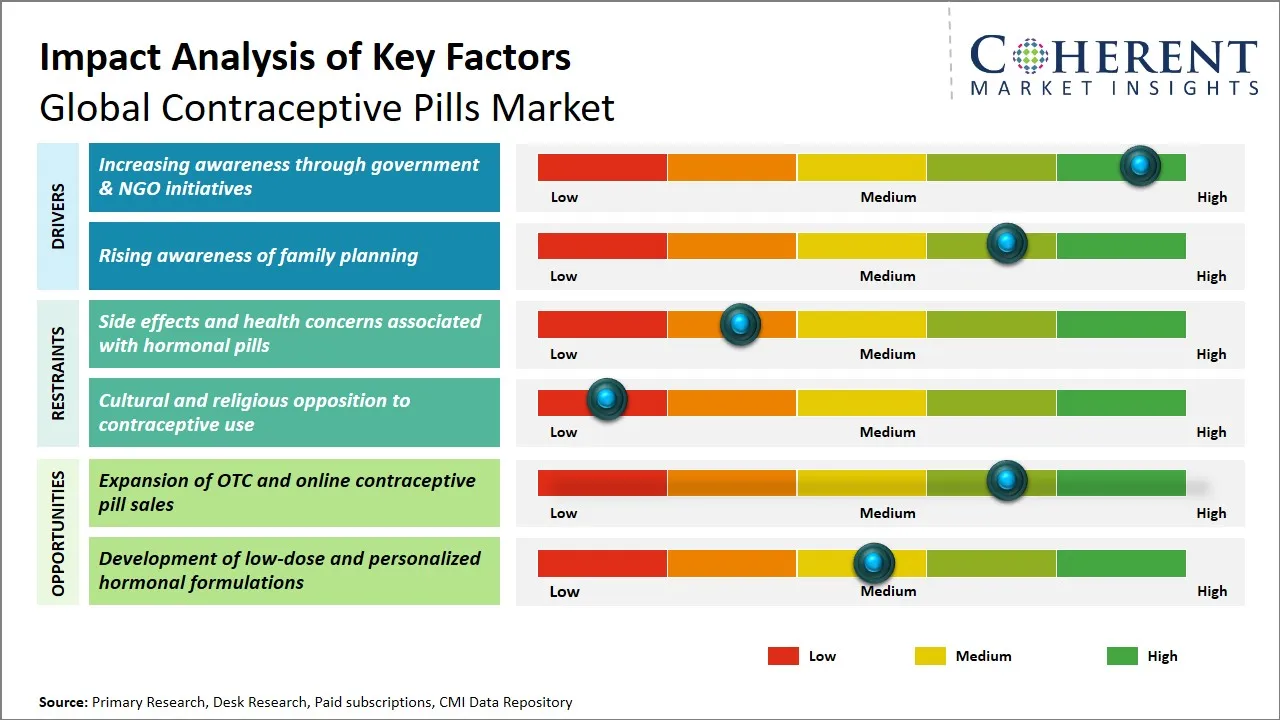
Contraceptive Pills Market Driver - Increasing Awareness Through Government & NGO Initiatives
In most parts, government agencies and non-governmental organizations (NGOs) are playing a crucial role in improving the availability and knowledge on the use of contraceptives pills, which is quite a motivator to market demand. These organizations have wide-ranging educational programs that are aimed at reproductive health, family planning, and the advantage of using contraceptives and effectively break the cultural taboo and myths about contraception. Through collaboration with local healthcare providers and community leaders, they make sure that the correct information is available even among remote and underserved groups. Public health programs also promote adoption (through subsidized distribution programs and free or low-cost contraceptive pills) which, in turn, are more widely accepted among low-income populations.
In December 2022, Mother Concern, a India-based NGO focused on women’s welfare, highlighted rising challenges in family planning as more women seek safer contraceptive pills and better reproductive choices. Mother Concern, an organization working on women’s health and empowerment, reported that low awareness, poverty, early marriage, and misconceptions about contraceptive pills continue to obstruct progress. Pfizer, a global pharmaceutical company producing women’s health medicines, was cited in awareness efforts supporting safer pill use. Bayer, a major healthcare company with a strong contraceptive pill portfolio, remained active in promoting informed reproductive decisions.
Contraceptive Pills Market Opportunity - Expansion of OTC and Online Contraceptive Pill Sales
The market of contraceptive pills is also experiencing an excellent growth potential due to the expansion of over-the-counter (OTC) availability and online sales options in the world market. As the consumer base broadens with more people willing to buy contraceptives with ease and in the comfort of their homes, OTC access gives consumers the opportunity to access contraceptives pills without the hurdles of a prescription thereby increasing the customer base. The ease of regulations and increasing awareness about reproductive health are increasing the demand of contraceptive pills, and e-commerce and telemedicine are now offering better access to it in a fast and discreet way in the markets where traditional retail products are still scarce.
In July 2023, the U.S. FDA approved Opill, the first non-prescription daily contraceptive pill in the United States, marking a major shift in access to reproductive care. Perrigo, a global consumer health company that owns HRA Pharma, the manufacturer of Opill, will handle its rollout across retail and online channels. The FDA said Opill offers a safe progestin-only option that consumers can use without visiting a clinician.
Analyst Opinion (Expert Opinion)
- Digital prescribing and the increasing awareness about the contraceptive pills market is growing and the regulators permit more people access to them with or without the OTC option. Safer, lower-dose preparations, and more robust partnerships between the government and business work to strengthen growth, but some issues, including side effects, supply, and disproportionate national policies, remain. The policy and innovation are still guided by key forums like the International Conference on Family Planning, Women Deliver, FIGO Congress, and the WHO reproductive health events.
- Momentum is evident in the recent developments. The availability is being extended by the approval of Opill as the first OTC daily pill by the FDA, the expansion of access to pharmacies by the U.K., and the pilots of UNFPA in Africa. Organon and Lupin companies are growing their output and reach, contributes to the adoption speed and the market direction in the nearest future.
Speak to the analyst
Want personalized insights?
Take the findings above to one of our principal consultants, or have the report rebuilt around the segments, geographies and competitors you actually track.
Market Segmentation
- Pill Category Insights (Revenue, USD Bn, 2021 - 2033)
- Combined oral contraceptive pills (COCs)
- Progestin-only pills (POPs/mini-pills)
- Emergency contraceptive pills (ECPs)
- Hormonal Composition Insights (Revenue, USD Bn, 2021 - 2033)
- Monophasic Pills
- Biphasic Pills
- Triphasic Pills
- Dosage Strength Insights (Revenue, USD Bn, 2021 - 2033)
- Low-Dose Pills
- Standard-Dose Pills
- High-Dose Pills
- Progestin Generation Insights (Revenue, USD Bn, 2021 - 2033)
- First-Generation Progestin Pills
- Second-Generation Progestin Pills
- Third-Generation Progestin Pills
- Fourth-Generation Progestin Pills
- User Age Group Insights (Revenue, USD Bn, 2021 - 2033)
- 15–19 years
- 20–29 years
- 30–39 years
- 40+ years
- Prescription Status Insights (Revenue, USD Bn, 2021 - 2033)
- Prescription-Based Pills
- Over-the-Counter Pills
- Brand Type Insights (Revenue, USD Bn, 2021 - 2033)
- Generic
- Branded
- Application Need Insights (Revenue, USD Bn, 2021 - 2033)
- Birth Control
- Hormonal Regulation
- Acne Management
- Menstrual Cycle Management
- Packaging Format Insights (Revenue, USD Bn, 2021 - 2033)
- 21-Day Pack
- 24-Day Pack
- 28-Day Pack
- 91-Day Pack
- Distribution Channel Insights (Revenue, USD Bn, 2021 - 2033)
- Hospital Pharmacies
- Retail Pharmacies
- Online Pharmacies
- Regional Insights (Revenue, USD Bn, 2021 - 2033)
- North America
- U.S.
- Canada
- Latin America
- Brazil
- Argentina
- Mexico
- Rest of Latin America
- Europe
- Germany
- U.K.
- Spain
- France
- Italy
- Russia
- Rest of Europe
- Asia Pacific
- China
- India
- Japan
- Australia
- South Korea
- ASEAN
- Rest of Asia Pacific
- Middle East
- GCC Countries
- Israel
- Rest of Middle East
- Africa
- South Africa
- North Africa
- Central Africa
- North America
- Key Players Insights
- Pfizer Inc
- Bayer AG
- Organon & Co
- Teva Pharmaceutical Industries Ltd
- Mylan NV (Viatris Inc)
- Johnson & Johnson
- Gedeon Richter Plc
- Lupin Limited
- Cipla Limited
- HLL Lifecare Limited
- Piramal Enterprises Limited
- Sun Pharmaceutical Industries Ltd
- Allergan plc (AbbVie Inc)
- Cadila Healthcare Ltd (Zydus Lifesciences)
- Torrent Pharmaceuticals Ltd
Sources
Primary Research Interviews
Industry Stakeholders
- Ministry of Health program directors
- Pharmaceutical company product managers
End Users
- Gynecologists and reproductive health specialists
- Family planning clinic practitioners
Government and International Databases
- World Health Organization (WHO)
- United Nations Population Division (UNPD)
- Centers for Disease Control and Prevention (CDC)
- National Family Health Survey (NFHS)
- Statistical Office of the European Union (Eurostat)
- World Bank Gender Data Portal (WB-GDP)
Trade Publications
- Pharmaceutical Executive (PharmExec)
- Drug Discovery & Development (DD&D)
- Fierce Pharma (FiercePharma)
- PharmaTimes (PT)
- The Pharma Letter (TPL)
- Healthcare Business News (HBN)
Academic Journals
- Contraception (Elsevier – Journal of Reproductive Health)
- The Lancet Public Health (Lancet PH)
- BMJ Sexual & Reproductive Health (BMJ SRH)
- Journal of Women’s Health (JWH)
- International Journal of Gynecology & Obstetrics (IJGO)
- American Journal of Obstetrics & Gynecology (AJOG)
Reputable Newspapers
- The New York Times (NYT)
- The Guardian (TG)
- The Washington Post (WP)
- Reuters Health (Reuters)
- The Hindu (TH)
- Financial Times (FT)
Industry Associations
- International Planned Parenthood Federation (IPPF)
- American College of Obstetricians and Gynecologists (ACOG)
- Federation of Obstetric and Gynecological Societies of India (FOGSI)
- International Federation of Gynecology and Obstetrics (FIGO)
- Population Council (PC)
- Guttmacher Institute (GI)
Public Domain Resources
- U.S. National Library of Medicine Public Access Database)
- ClinicalTrials.gov (U.S. NIH Clinical Trial Registry)
- United Nations International Children’s Emergency Fund Data (UNICEF Data)
- WHO Global Health Observatory (GHO)
- U.S. Food and Drug Administration Drug Database (FDA Drug DB)
- European Medicines Agency Public Assessment Reports (EMA PAR)
Proprietary Elements
- CMI Data Analytics Tool: Proprietary analytics tool to analyze real-time market trends, consumer behavior, and technology adoption in market
- Proprietary CMI Existing Repository of Information for Last 8 Years
Get access to 250+ pages report
Every segment, forecast, competitor profile and data table behind the analysis above — available for instant download.
- ESOMAR Member
- ISO 9001:2015 Certified
- D-U-N-S Registered
- GDPR & CCPA Compliant
Missing comfort of reading report in your local language? Find your preferred language:
Transform your Strategy with Exclusive Trending Reports
Frequently Asked Questions
The global contraceptive pills market is estimated to be valued at USD 8.71 Bn in 2026 and is expected to reach USD 14.27 Bn by 2033.
The CAGR of the global contraceptive pills market is projected to be 7.3% from 2026 to 2033.
Increasing awareness through government & NGO initiatives and rising awareness of family planning are the major factors driving the growth of the global contraceptive pills market.
Side effects and health concerns associated with hormonal pills and cultural and religious opposition to contraceptive use are the major factors hampering the growth of the global contraceptive pills market.
In terms of pill category, combined oral contraceptive pills (COCs) are estimated to dominate the market revenue share in 2026.
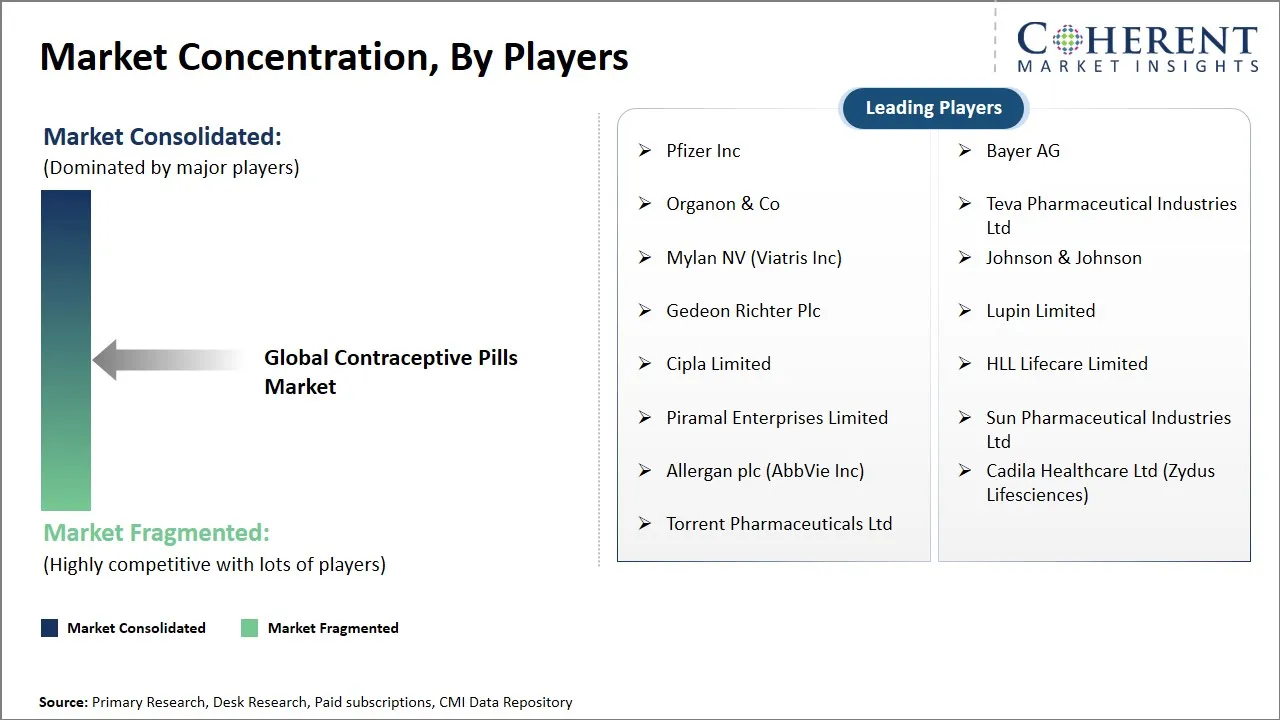
Pfizer Inc, Bayer AG, Organon & Co, Teva Pharmaceutical Industries Ltd, Mylan NV (Viatris Inc), Johnson & Johnson, Gedeon Richter Plc, Lupin Limited, Cipla Limited, HLL Lifecare Limited, Piramal Enterprises Limited, Sun Pharmaceutical Industries Ltd, Allergan plc (AbbVie Inc), Cadila Healthcare Ltd (Zydus Lifesciences), and Torrent Pharmaceuticals Ltd are the major players.
North America is expected to lead the global contraceptive pills market in 2026.