

Global Copolyester Market Size and Forecast – 2026 to 2033
According to Coherent Market Insights, the global copolyester market is estimated to be valued at USD 4.79 Bn in 2026 and is expected to reach USD 7.25 Bn by 2033, exhibiting a compound annual growth rate (CAGR) of 6.1% from 2026 to 2033.
Key Takeaways of the Copolyester Market
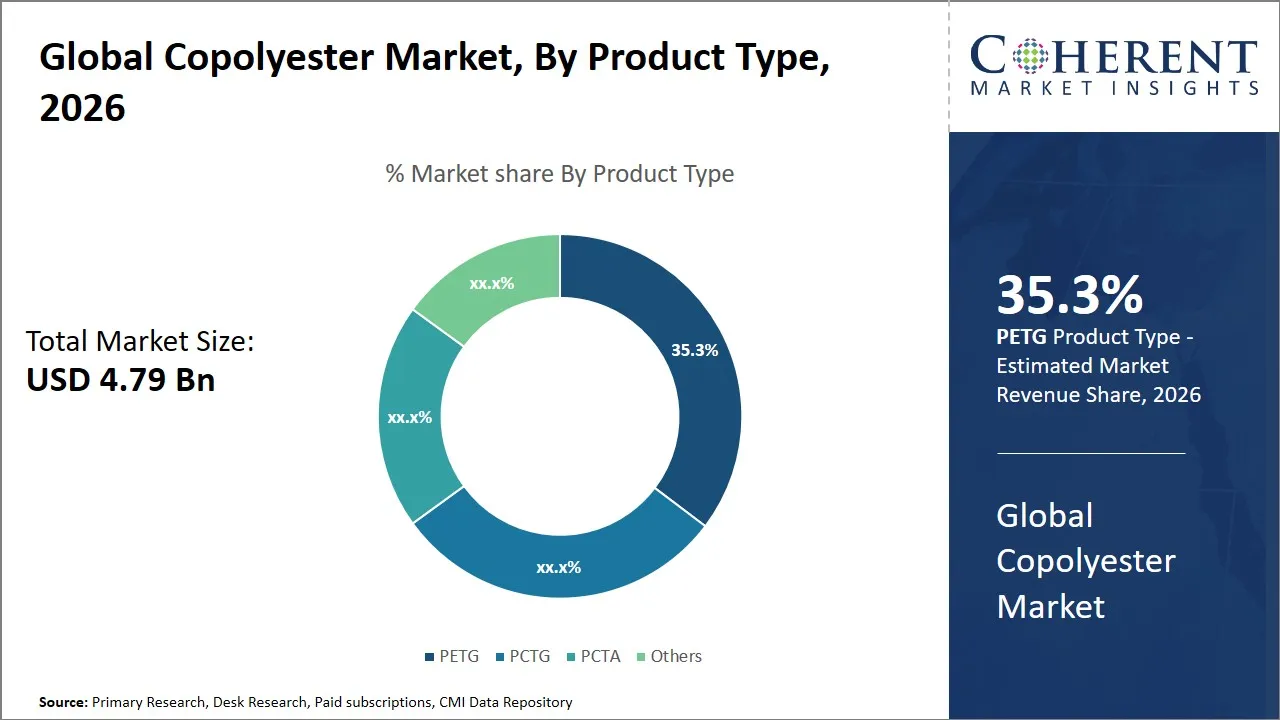
- The PETG segment is projected to account for 35. 3% of the global copolyester market share in 2026.
- The packaging is estimated to capture 34.6 % of the copolyester market share in 2026.
- Online retail is expected to dominate the global copolyester market with a 57.2 % share in 2026.
- The Asia Pacific region is expected to lead the market, capturing a 35.3 % share in 2026.
- The North America region is anticipated to experience the fastest growth, contributing a 16.3 % share in 2026.
Market Overview
- Market trends indicate a rising preference for recyclable and sustainable materials within the copolyester segment.
- Manufacturers are innovating to produce bio-based copolyesters to meet growing environmental regulations and consumer demand for eco-friendly products.
- Additionally, the integration of copolyester in high-performance applications is increasing due to its excellent physical properties and versatility.
- Digitalization and automation in production processes are further enabling cost efficiencies, positioning copolyester as a material of choice in emerging sectors like electronics and consumer goods.
Current Events and Its Impact
Current Events | Description and its Impact |
Circular and Sustainable Packaging Regulations (EU & India) |
|
Petrochemical Market Surplus & Feedstock Pressure |
|
Segmental Insights
- Current Industry Events of 2026
- Market Size Estimation
- Regional Breakdown
- Competitive Landscape
- Customer Intelligence
- Segmental Analysis
- Pricing Analysis
- Key Market Drivers, Challenges & Future Trends
- Customized Insights Section
Why Does PETG Dominate the Global Copolyester Market in 2026?
PETG segment is projected to hold 35.3% of the global copolyester market share in 2026, due to its unique combination of strength, clarity, and chemical resistance. It is a better substitute to other plastics particularly in areas where image and beauty matter such as food packaging and consumer products because of its high transparency. Its high impact resistance and toughness of materials place it in a good position relative to the conventional PET, which has a better standing in terms of durability without sacrificing its ease of processing. This has prompted manufacturing companies to use PETG in a setting that requires high performance and lightweight design.
For example, Amcor, a global packaging giant, incorporates PETG in its product range for food packaging to provide enhanced visibility of the contents, which is critical for consumer appeal in retail settings. The material's strength, coupled with its lightweight design, ensures product integrity and safety without compromising on visual presentation.
Why is Packaging the Largest Application for Copolyester Market?
The packaging segment is projected to represent 34.6% of the copolyester market share in 2026, due to their ability to meet stringent requirements for food safety, shelf-life extension, and product visibility. Copolyesters, in particular, PETG, provide outstanding barrier to moisture and gases that are significant in maintaining freshness and avoiding contamination. These characteristics ensure that, copolyesters are a good choice at food and beverage packaging (where product integrity is of utmost importance).
Moreover, the tendency to light and strong packaging materials increases the popularity of copolyesters. Their strength against impact and transparency enable manufacturers to create strong but aesthetically appealing packages that creates a better consumer experience as well as reduces transportation expenses and environmental impact due to light packaging designs.
Online Retail Dominates the Global Copolyester Market
Online retail is set to hold 57.2% of the copolyester market share in 2026, due to trends in e-commerce growth and the digitization of the procurement process. Online platforms are more desirable to businesses and end-users due to their convenience, larger choice and transparent pricing. This have made a revolution in the source of raw material like the copolyesters and helped access a variety of grades and formulations of the copolymer with minimum geographical limitations.
Retail online can make it easier to reach a wider market, and manufacturers and distributors can easily access smaller businesses, startups, and regional manufacturers who would not traditionally have a way to access copolyester materials. This democratization of supply chains promotes more frequent and flexible buying trends, which underpins just-in-time inventory designs and storage expenses, which achieve better management of cash flows.
Regional Insights
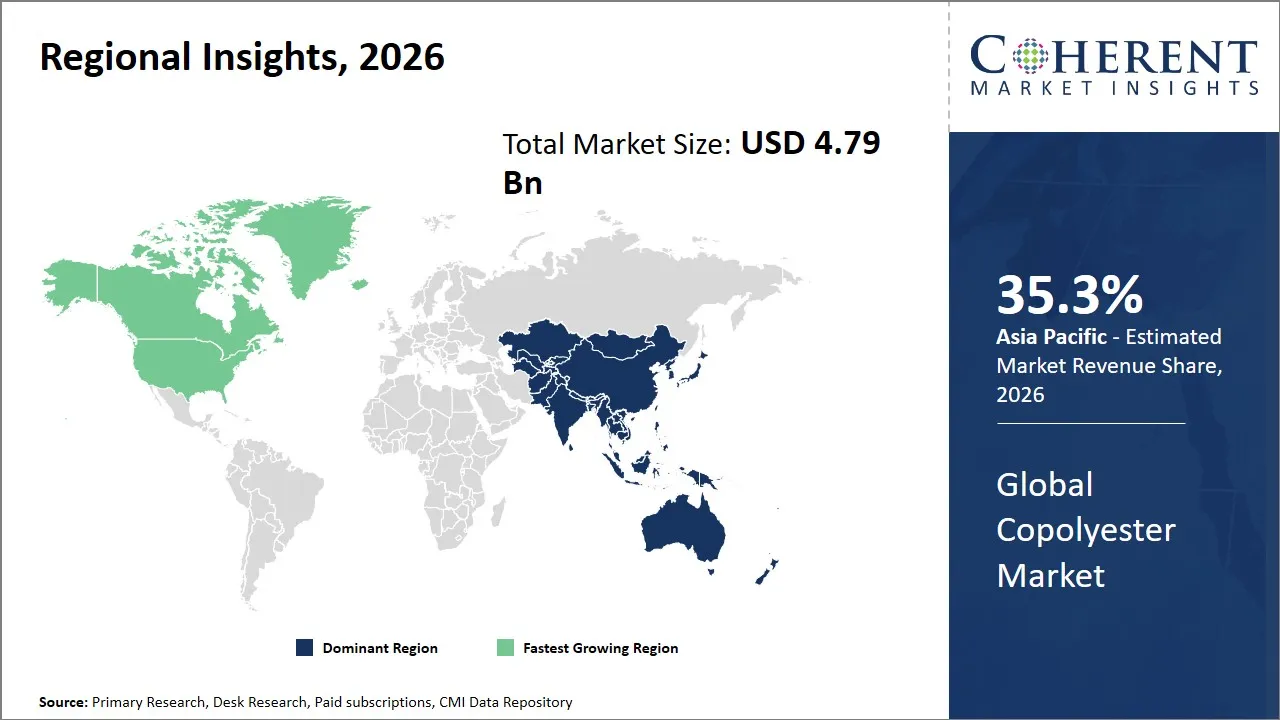
Asia Pacific Copolyester Market Analysis and Trends
The Asia Pacific region is projected to lead the market with a 35.3% share in 2026, driven by a robust manufacturing ecosystem that integrates raw material suppliers, polymer producers, and downstream industrial users such as automotive, packaging, and electronics sectors. China, Japan, South Korea, and India are countries with a high concentration of polymer manufacturing plants, which are backed by effective government policies to enhance industrial development and sustainable manufacturing. Policies that are investor friendly, combined with the presence of a cheap workforce and well-developed infrastructure, have seen this region emerge as a center of copolyester production and consumption.
Also, excellent export capacities and effective trade channels make the distribution easy in the international markets. Eastman Chemical Company (manufacturing and R&D operations in China), Mitsubishi Chemical Corporation (Japan), and Indorama ventures (Thailand) are known to be notable companies that drive product innovation and capacity growth, therefore, supporting the commanding role of Asia Pacific in the copolyester situation.
North America Copolyester Market Analysis and Trends
The North America region is expected to exhibit the fastest growth in the market contributing 16.3% share in 2026. The area enjoys well-developed industrial infrastructures, highly skilled manpower, as well as regulatory conditions that promote innovation and sustainability. The governments of North America both federal and state are actively encouraging circular economy and bioplastics, which boosts the demand of high advanced copolyesters.
The high number of major multinationals such as Eastman Chemical Company (based in the U.S.), SABIC and DuPont encourages the constant development of products to meet high standards in the industry, thus assisting in the seizure of the new markets. Also, the comparatively stable trade regime and availability of high value markets in Latin America and Europe also allow it to expand very fast.
Global Copolyester Market Outlook for Key Countries
China Copolyester Market Trends
China’s market for copolyester is manifested by a high level of integration of raw materials and downstream productions, with high government support of polymer industries under such initiatives like Made in China 2025. Large actors like Eastman and local manufacturers have engaged in capacity expansions and innovation centers. The auto and packaging industries are major end-users of the country as it is forcing the need to use high-performance copolyester materials with durability and recyclability. The ease of trade by having well established ports promotes the reputation of Chinas as a production center and a supplier of copolyesters.
Why are the U.S. Copolyester Market Thriving on Innovation and Sustainability?
The U.S. copolyester market thrives on innovation-driven demand, with a strong focus on specialty copolyesters used in medical devices, consumer electronics, and automotive lightweighting solutions. The country is the home of the Eastman Chemical Company, which is a global leader that has tremendous portfolio of copolyesters and it has dedicated to the sustainable material solutions, with high level of R&D infrastructure and high level of international standards, which facilitates improvement of the products. The U.S. is also one of the leading countries in applying the concepts of a circular economy to the manufacturing processes, which makes it an influential factor in advanced demand on eco-friendly variants of copolyester.
Germany Copolyester Market Trends
Germany remains the market leader in copolyester market in Europe with its position as an automotive engineering and precision manufacturing center. The major industry players such as BASF and Covestro also play a major role in partnerships and technology advancement of copolyester material used in automotive, electrical and packaging. The high export orientation of Germanys also gives it an advantage in the world copolyester value chain.
Why is India’s Copolyester Market Expanding with Automotive, Packaging, and Electronics Growth?
The copolyester market in India is a rapidly developing market because of the emerging automotive market, rising packaging markets and the rising electronic sectors. The government policies that are directed at increasing manufacturing competitiveness and the adoption of advanced materials are critical in driving demand. International companies such as Indorama Ventures and Reliance Industries have increased investments in polymer processing and capacity buildouts within the country, supported by local entrepreneurship and start-ups focused on sustainable plastics. Additionally, India’s youthful demographic and rising consumption are pivotal in driving the growth of end-use sectors for copolyesters.
Japan Copolyester Market Trends
Japanese has occupied a prominent status in the world copolyester market, owing to technology and the focus on quality and precision. Japan has a good reputation in the development of specialized copolyester grade that suits electronics, cars, and medical industries given that it is the home of such giants as Mitsubishi Chemical Corporation and Toray Industries.
A well-developed system of government support of the innovation and sustainability and great workforce level provide the constant improvement of the products and their commercialization. The robust export systems and networks of Japan also help it to be a key participant in the Asia Pacific copolyester ecosystem, and it combines the conventional strong performance in manufacturing with material innovations into the future.
Sustainability & Regulatory Impact
Factor | Description | Impact on Market |
Sustainability Regulations | Increased global regulatory pressure to use sustainable and recyclable materials in manufacturing. | Drives the shift towards sustainable copolyester products and innovations in recycling technologies. |
Circular Economy Initiatives | Encouraging closed-loop recycling, reducing waste, and improving resource efficiency. | Growth in demand for copolyesters with better recycling properties. |
Environmental Certifications | Pressure on companies to meet standards like ISO 14001 for environmental management. | Brands focusing on sustainability gain competitive advantage. |
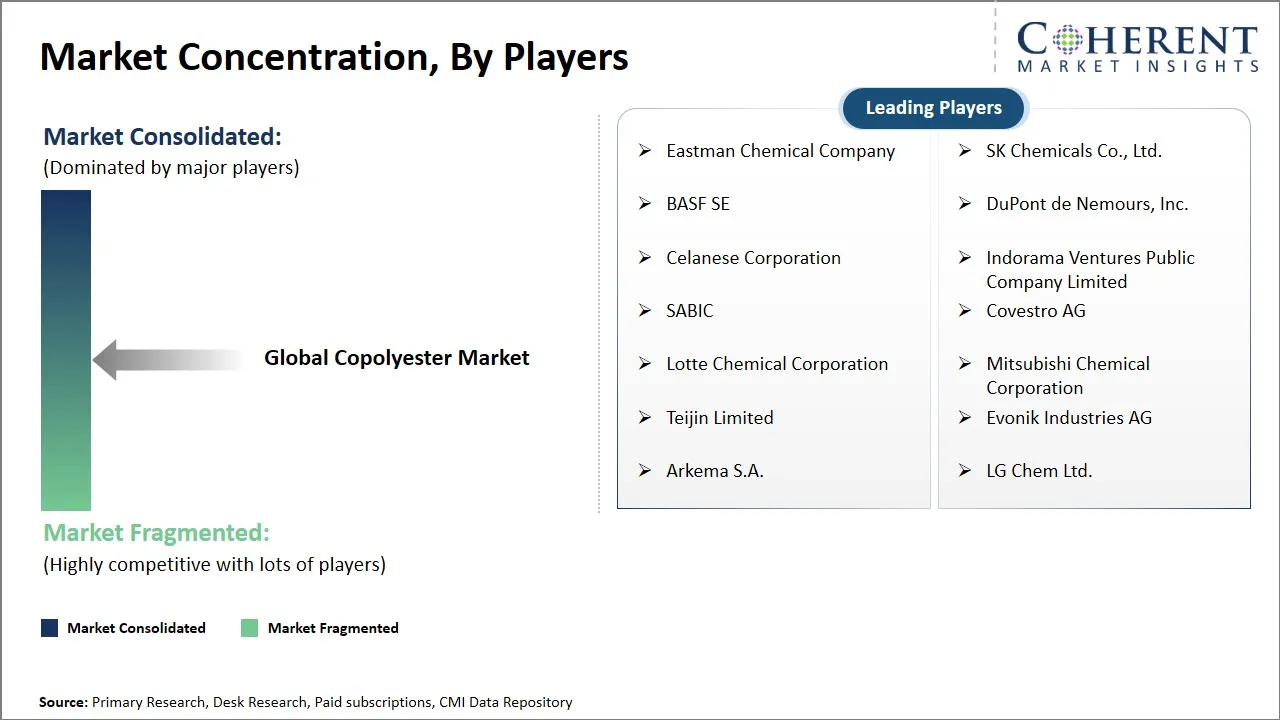
Market Players, Key Development, and Competitive Intelligence
Key Development
- In May 2025, Suqqu launched makeup compact with Eastman’s Cristal One recyclable resin. Kao’s prestige beauty brand Suqqu has unveiled a new setting powder housed in a compact crafted from Eastman’s Cristal One recyclable copolyester.
Top Strategies Followed by Global Copolyester Market Players
Player Type | Strategic Focus | Example |
Established Market Leaders | Heavy investment in R&D and innovation | For instance, Eastman Chemical Company have continued to exceed expectations by coming up with sustainable copolyester products that not only fulfill the requirements of high durability but also provide an added advantage of better recyclability. They produce Eastar copolyesters that are commonly used in the packaging industry where the longevity and sustainability of the product matter. |
Mid-Level Players | Balance cost and sustainability | Companies such as PolyOne Corporation (now Avient Corporation) have products based on competitive-priced copolyester to use in the automotive and packaging industries. Their Versaflex copolyester product range offers the required durability and flexibility and is affordable to smaller manufacturing companies. |
Small-Scale Players | Niche specialization & innovative variants | For instance, Green Dot Bioplastics, which specializes in the production of bio-based copolyester solutions to the growing demand of alternatives to traditional copolytic materials. Their Terratek COP line is created as a biodegradable substitute to conventional plastic copolyesters as the environmental impact issue becomes an increasing concern. |
Market Report Scope
Copolyester Market Report Coverage
| Report Coverage | Details | ||
|---|---|---|---|
| Base Year: | 2025 | Market Size in 2026: | USD 4.79 Bn |
| Historical Data for: | 2020 To 2024 | Forecast Period: | 2026 To 2033 |
| Forecast Period 2026 to 2033 CAGR: | 6.1% | 2033 Value Projection: | USD 7.25 Bn |
| Geographies covered: |
| ||
| Segments covered: |
| ||
| Companies covered: | Eastman Chemical Company, SK Chemicals Co., Ltd., BASF SE, DuPont de Nemours, Inc., Celanese Corporation, Indorama Ventures Public Company Limited, SABIC, Covestro AG, Lotte Chemical Corporation, Mitsubishi Chemical Corporation, Teijin Limited, Evonik Industries AG, Arkema S.A., and LG Chem Ltd. | ||
| Growth Drivers: |
| ||
| Restraints & Challenges: |
| ||
Copolyester Market Dynamics
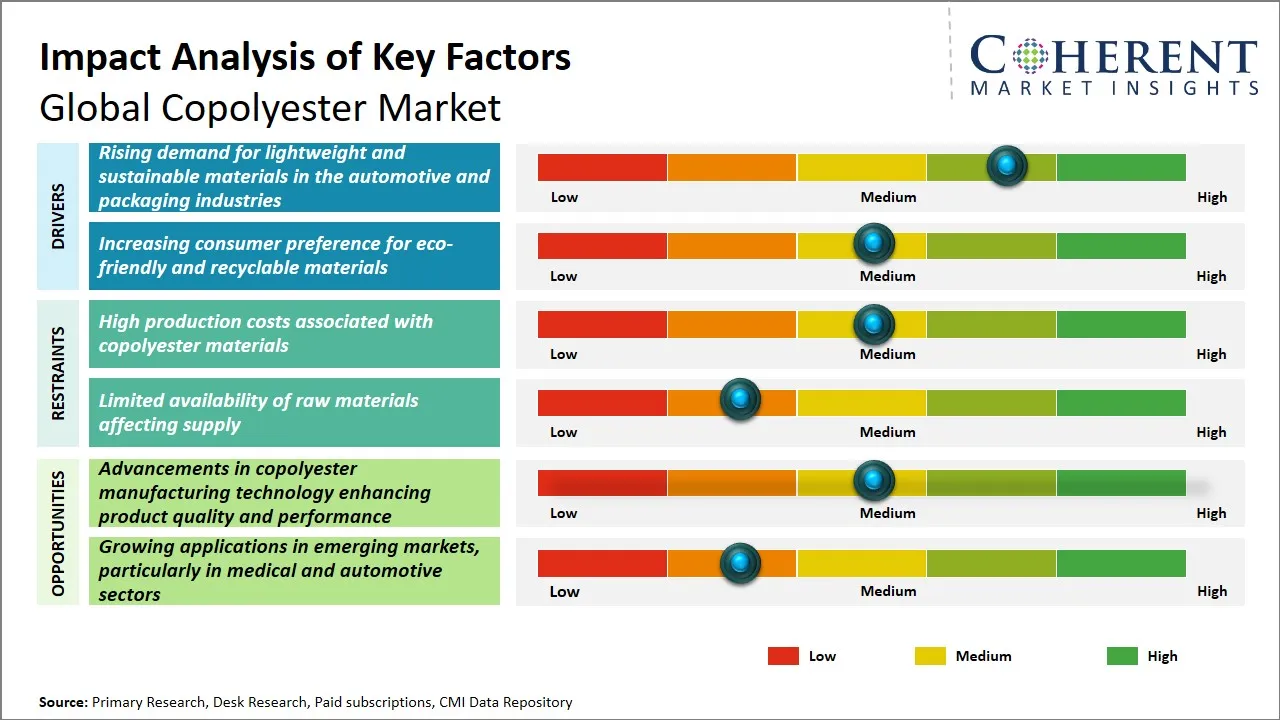
Copolyester Market Driver - Rising Demand for Lightweight and Sustainable Materials in the Automotive and Packaging Industries
The growing pressure in meeting carbon footprint and improving fuel efficiency has greatly boosted the need of lightweight materials in both automotive and packaging sectors, which is the main force behind the world copolymer market. There is an active effort among the automotive manufacturers to find materials that provide high mechanical strength and contribute to the overall reduction in the weight of the vehicles hence increase in fuel economy and also within strict emission standards. With their excellent usage through high durability, chemical and recycling ability, copolyester strives to be a perfect alternative to traditional plastics and heavy materials.
For instance, Ford has been incorporating copolyester in its vehicle components like interior parts, bumpers, and exterior panels, which are crucial for improving fuel efficiency while meeting stricter emissions regulations.
Copolyester Market Opportunity - Advancements in Copolyester Manufacturing Technology Enhancing Product Quality and Performance
The current developments in technology of copolyester production provide a good growth potential in the international copolyester market since it allows the manufacturing of quality and more performance-oriented products. The new innovations like better polymerization processes, the use of new catalysts and better blending have perfected the control and manipulation of molecular structure that directly influences the physical characteristics of the copolyesters which include impact resistance, clarity and thermal stability. These advancements enable manufacturers to customize the copolyester materials to match tough industry-specific requirements, specifically in industries such as packaging, automotive and electronics where durability and clarity of material is a major consideration.
For example, Eastman Chemical Company's investment in advanced polymerization processes that allow them to produce a new line of copolyester materials with enhanced clarity and impact resistance. These improvements have enabled them to offer copolyester materials that cater to industries such as food packaging and medical devices, where transparency and durability are crucial.
Analyst Opinion (Expert Opinion)
- The copolyester market is in an upward trend that has been influenced by increased needs of high-performance and multifunctional materials in many industries such as the automobile, textile, and consumer goods. The Global Plastics Conference (2023) and the International Polymer Science Symposium (2022) provided some insights into the major innovations in the field, and such companies as Eastman Chemical and BASF are leading the way to creating more advanced copolyester formulations to increase durability and sustainability.
- The new copolymer of bio-based material that Eastmans has recently introduced to be used in food packaging indicates that the industry is dedicated to environmental issues but at the same time effective. The need for more copolyesters that are more recyclable and less carbon footprint was cited in discussions, which meet the global sustainability objectives. Nevertheless, the problems associated with competition with alternative materials and changes in the prices of raw materials were often mentioned as the possible obstacles.
- Firms that have made innovation in material science a key priority and made investments in collaborations to develop new applications are likely to gain immense market share. Finally, the development of the copolyester market will be based on its capacity to constantly update and change in line with the dynamic consumer demands on the performance, sustainability, and affordability of material solutions.
Speak to the analyst
Want personalized insights?
Take the findings above to one of our principal consultants, or have the report rebuilt around the segments, geographies and competitors you actually track.
Market Segmentation
- Product Type Insights (Revenue, USD Bn, 2021 - 2033)
- PETG
- PCTG
- PCTA
- Others
- Application Insights (Revenue, USD Bn, 2021 - 2033)
- Packaging
- Automotive
- Consumer Goods
- Electronics
- Medical Devices
- Others (e.g., textiles, building materials)
- Distribution Channel Insights (Revenue, USD Bn, 2021 - 2033)
- Online Retail
- Offline Retail
- Distributors
- Direct Sales
- Supermarkets
- Others
- Regional Insights (Revenue, USD Bn, 2021 - 2033)
- North America
- U.S.
- Canada
- Latin America
- Brazil
- Argentina
- Mexico
- Rest of Latin America
- Europe
- Germany
- U.K.
- Spain
- France
- Italy
- Russia
- Rest of Europe
- Asia Pacific
- China
- India
- Japan
- Australia
- South Korea
- ASEAN
- Rest of Asia Pacific
- Middle East
- GCC Countries
- Israel
- Rest of Middle East
- Africa
- South Africa
- North Africa
- Central Africa
- North America
- Key Players Insights
- Eastman Chemical Company
- SK Chemicals Co., Ltd.
- BASF SE
- DuPont de Nemours, Inc.
- Celanese Corporation
- Indorama Ventures Public Company Limited
- SABIC
- Covestro AG
- Lotte Chemical Corporation
- Mitsubishi Chemical Corporation
- Teijin Limited
- Evonik Industries AG
- Arkema S.A.
- LG Chem Ltd.
Sources:
Primary Research Interviews
- CEO – Leading Copolyester Producer (e.g., Eastman Chemical or Celanese Corporation)
- Supply Chain Director – Major Thermoplastic Elastomer Distributor (e.g., Nexeo Plastics)
- Production Lead – Copolyester Elastomer Manufacturer (e.g., DuPont or SO.F.TER. GROUP)
- Sustainability Officer – Copolyester Certification Authority (e.g., focused on recyclable polymers)
Stakeholders
- Manufacturers
- End-use Sectors
- Packaging Industry (Food & Beverage, Cosmetics Containers)
- Automotive & Consumer Goods Producers
- Medical Devices & Electronics (High-performance applications)
- Regulatory & Certification Bodies (e.g., EPA for polymer emissions, REACH compliance in EU for copolyesters)
- E-commerce Platforms and Retailers (Alibaba, Industrial Suppliers, Sigma-Aldrich equivalents for specialty polymers)
- Technology Integration Players: Advanced packaging and elastomer producers using copolyester
Databases
- UN Comtrade Database (HS 39: Plastics and articles thereof)
- India Import Export (EXIM) Database
- USGS Mineral Commodity Summaries (related polymers where applicable)
- Eurostat Trade Statistics for Chemicals (Plastics & Polymers)
Magazines
- Plastics Recycling World – Trends in copolyester recycling
- Compounding World – Copolyester compounding developments
- Film and Sheet Extrusion – Copolyester in films
- Injection World – Molding innovations for copolyesters
Journals
- Polymer International – Advances in copolyester science
- High Performance Polymers – Copolyester properties and applications
- Journal of Applied Polymer Science (implied for durability studies)
Newspapers
- The Wall Street Journal – Global polymer demand including copolyesters
- Chemical Week – Supply chain disruptions in specialty elastomers
- Reuters – Price volatility in thermoplastic elastomers
- Business Standard (India) – Asia-Pacific copolyester market growth
Associations
- British Plastics Federation (BPF)
- Society of Chemical Industry (SCI) – Polymer sector
- European Polymer Dispersion and Latex Association (EPDLA, Cefic sector group)
- Association for Rubber Products Manufacturers (ARPM)
- British Rubber and Polyurethane Products Association (BRPPA)
Public Domain Sources
- EPA – Guidelines for polymer production and emissions
- European Commission – REACH regulations on copolyesters and monomers
- World Health Organization – Safety standards for polymer exposure
- OECD – Chemical trade and sustainability reports for polymers
Proprietary Elements
- CMI Data Analytics Tool, Proprietary CMI Existing Repository of information for last 8 years.
Get access to 250+ pages report
Every segment, forecast, competitor profile and data table behind the analysis above — available for instant download.
- ESOMAR Member
- ISO 9001:2015 Certified
- D-U-N-S Registered
- GDPR & CCPA Compliant
Missing comfort of reading report in your local language? Find your preferred language:
Transform your Strategy with Exclusive Trending Reports
Frequently Asked Questions
The global copolyester market is estimated to be valued at USD 4.79 Bn in 2026 and is expected to reach USD 7.25 Bn by 2033.
A polymer made from two or more monomers to enhance impact strength, clarity, and performance.
It offers better clarity, flexibility, and chemical resistance than PET, and higher clarity than PBT.
The CAGR of global copolyester market is projected to be 6.1% from 2026 to 2033.
Rising demand for lightweight and sustainable materials in the automotive and packaging industries and Increasing consumer preference for eco-friendly and recyclable materials are the major factors driving the growth of the global copolyester market.
High production costs associated with copolyester materials and limited availability of raw materials affecting supply are the major factors hampering the growth of the global copolyester market.
In terms of product type, PETG is estimated to dominate the market revenue share in 2026.