

Global Corrosion Test Chamber Market Size and Forecast – 2026 To 2033
The global corrosion test chamber market is expected to grow from USD 1.18 Bn in 2026 to USD 1.82 Bn by 2033, registering a compound annual growth rate (CAGR) of 6.4% from 2026 to 2033. The global market for corrosion test chamber is poised for significant expansion, fueled by growing investments in transportation and industrial infrastructure projects with strict demands on advanced materials' long-term durability and corrosion resistance.
According to NACE International IMPACT study, released in April 2026, the global cost of corrosion is estimated at USD 2.5 trillion per year, equivalent to about 3.4% of global GDP. With global GDP in 2025 exceeding USD 117 trillion, a similar ratio would place current direct global corrosion costs well above USD 3 trillion annually, and total costs over USD 6.5 trillion.
(Source: US Corrosion Services)
Key Takeaways of the Global Corrosion Test Chamber Market
- Salt spray test chambers are projected to hold 41.8 % of the global corrosion test chamber market share in 2026, making it the dominant product type segment, with considerable dominance in North America driven by stringent requirements in the automotive, aerospace, and defense industries for durability and coating validation. For instance, the U.S. Department of Transportation along with the industry manufacturers have increased the usage of ASTM B117 salt spray testing for coatings on steel, aluminum, and other industrial parts which are subject to harsher conditions and de-icing salts. With a heightened awareness for durability and corrosion control strategies throughout the region, installation of salt spray corrosion chambers is quickly spreading to many industrial laboratories and quality control departments. (Source: Advancing Standards Transforming Markets)
- Medium capacity chambers are projected to hold 46.3 % of the global corrosion test chamber market share in 2026, making it the dominant chamber capacity segment, with significant dominance in Europe, with increased importance in testing the new materials, life of equipment and environment simulation in machinery, precision engineering, automobile industry. The medium capacity chambers are widely used in France, Germany, Italy and others in lab scale corrosion simulation and standards testing reliability for products, and the European Commission is consistently promoting new, innovative, sustainable and material-centric activities which has further boost the application of controlled environment chamber in every lab and manufactured houses. (Source: European Commission)
- Metals and alloys are projected to hold 48.5 % of the global corrosion test chamber market share in 2026, making it the dominant material tested segment, with high dominance in North America driven by demanding product lifetime assessment and durability standards, especially in the transportation, infrastructure, aerospace, and general industrial manufacturing segments. Corrosion testing is frequently performed in the U.S. to assess coated steel products, aluminum alloys, and structural metals under corrosive, de-icing salt environments. For instance, long-term corrosion prevention and bridge durability programs supported by the U.S. Federal Highway Administration (FHWA) that address extending the service life of steel bridge infrastructure are stimulating the need for new corrosion simulation and environmental testing systems throughout North America. (Source: U.S. Department of Transportation)
- North America maintains dominance with an expected share of 36.8 % in 2026, primarily attributed to significant use in long-term corrosion prevention and performance testing programs in the U.S Aerospace, defense, transportation, and industrial manufacturing industry. The region maintains continued high demand for the use of corrosion test chambers to evaluate aircraft coatings, metal structures, and military hardware which are operated and maintained in severe operating and marine conditions. For instance, according to an audit report by the Department of Defense for the Aircraft Corrosion Prevention and Control Program of the Navy, "Corrosion prevention”, accelerated tests and maintenance of aircraft are paramount for enhancement of air-craft operational readiness and reduction of expensive maintenance costs. (Source: U.S. Department of War) Such initiatives will further fuel demand for the latest corrosion simulation and environmental testing systems in North America.
- Asia Pacific is expected to exhibit the fastest growth with a contribution of 29.4 % share in 2026, fueled by massive electronics production growth, booming automotive industry, and numerous industrial projects development in China, India, South Korea, and Southeast Asia regions, with an emphasis on the validation of durability and assessment of environmental reliability of industrial products to be exported or used for high-level manufacturing. For instance, the Indian Ministry of Heavy Industries promotes advanced manufacturing for automobiles and engineering sectors through Production Linked Incentive (PLI) schemes with more emphasis on durability, reliability of coatings, and corrosion testing of components at the industrial supply chain. (Source: Ministry of Heavy Industries)
- Increasing Corrosion Testing Requirements for Electric Vehicle Battery Systems: The widespread growth of electric vehicle production is generating a high requirement for corrosion test chambers to be used on EV enclosures, battery connectors, painted metal structures, thermal management structures (subjected to moist, salt and chemical conditions). Automotive manufacturers are employing the usage of cyclic corrosion and environmental simulation chambers to test the longevity of their EV battery system, enhance safety standards, and increase overall battery longevity performance. With increased regulations regarding the durability performance of vehicles, this testing equipment will become even more readily available in EV assembly plants.
- Growing Adoption of Automated and Smart Corrosion Testing Systems: The market is experiencing rapid growth with the integration of automated, IoT, and AI-powered monitoring technologies in the corrosion test chambers. Intelligent corrosion test platforms include features such as precise control over the test environment in real-time, automated data logging, condition monitoring with predictive maintenance capabilities, and remote data acquisition and monitoring services, which increases the accuracy of the test and operational efficiency. Increased demand for digital laboratory environment and industry 4.0 based quality control and quality assurance systems is predicted to boost the usage of smart corrosion simulation technologies in the aerospace, automobile and industrial manufacturing industries.
Segmental Insights
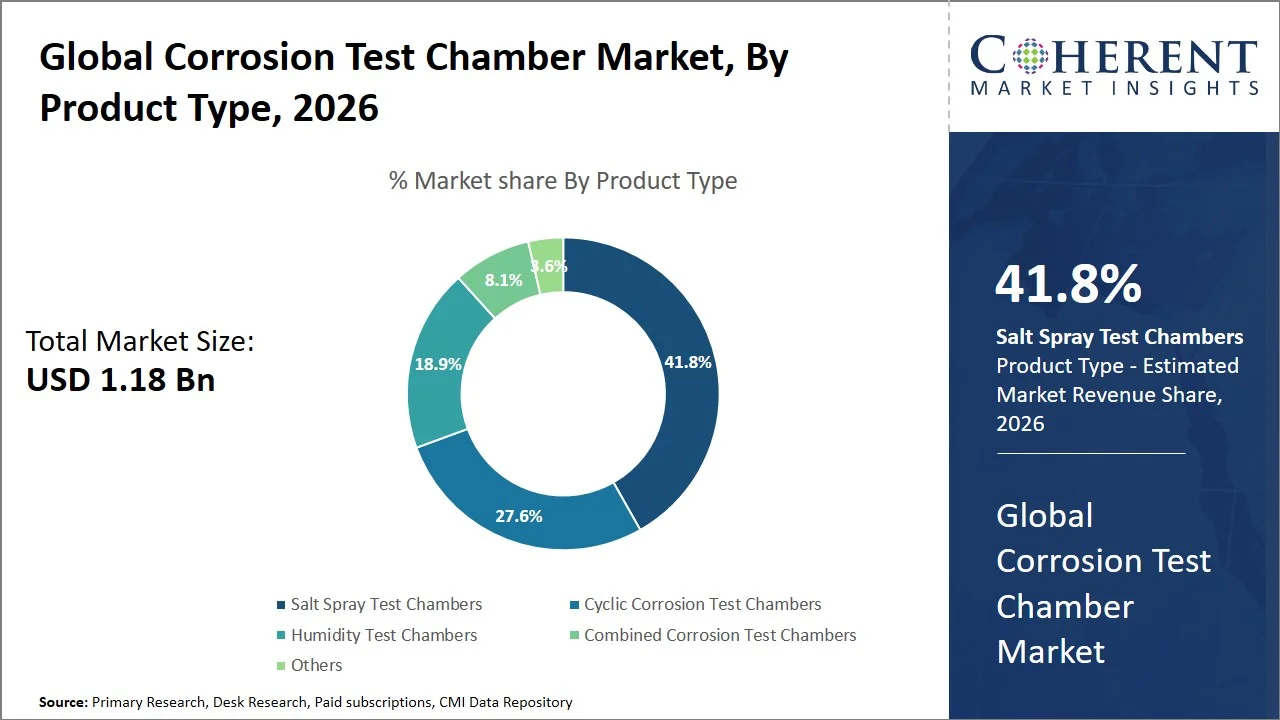
Why Does Salt Spray Test Chambers Segment Dominate the Global Corrosion Test Chamber Market?
Salt spray test chambers are projected to hold the market share of 41.8% in 2026, attributed to its cost effectiveness, accuracy and reliable corrosion resistance assessment system that provides the user with the necessary to tests metals, coatings, alloys and finished industrial articles under a specified set of conditions within the controlled confines of a laboratory environment. Their wide acceptance across industries including automotive, aerospace, electronics, marine and construction to conduct sped up and cost-effective tests for durable quality assurance under attack from harsh marine environments has made the chambers very popular. They are highly popular on the grounds of being economical and extremely effective on routine and compliant testing and also suitable for testing coatings or life time assessment.
In addition, more corrosion resistant materials, anti-corrosive coatings, lighter weight alloy-based metals, and industrial surface treatment technologies being developed worldwide are expected to increase demand for such systems at R&D and manufacturing level. For instance, ISO 9227 standard still prevails internationally, which is used for salt spray corrosion tests on metallic materials, on metallic and other organic materials, and metallic and plastic materials; evaluating resistance performance of metallic materials, and of metallic/plastic materials and organic coatings to corrosion under specified conditions (Source: International Organization for Standardization). These industry standard testing parameters maintain to encourage the widespread use of salt spray test chambers in industrial quality assurance and material testing applications globally.
- Current Industry Events of 2026
- Market Size Estimation
- Regional Breakdown
- Competitive Landscape
- Customer Intelligence
- Segmental Analysis
- Pricing Analysis
- Key Market Drivers, Challenges & Future Trends
- Customized Insights Section
Why Does Medium Capacity Chambers Represent the Largest Chamber Capacity Segment in the Global Corrosion Test Chamber Market?
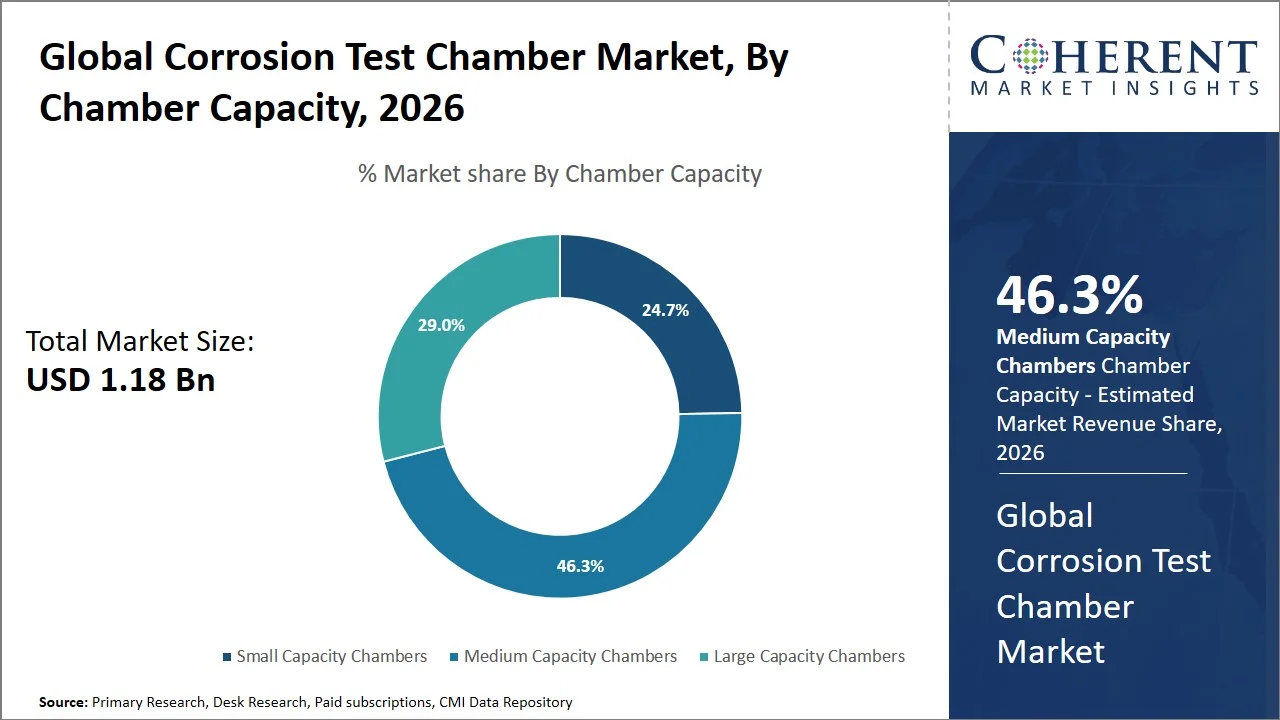
Medium capacity chambers are projected to hold a market share of 46.3% in 2026, because these offer the greatest efficiency for the purpose of balancing testing volume, laboratory versatility, and efficient use of lab space in manufacturing and quality assurance scenarios. Automotive, aerospace, industrial coating, electronics, and metal finishing businesses find medium capacity chambers to be a convenient option since they hold reasonably sized batch sizes and many various sizes of samples while still providing tight control over environmental and corrosion simulation variables. Routine qualification and testing of product coatings, and endurance tests can easily be implemented with the medium capacity systems since testing can occur without large operational expenses and demands as found with larger capacity chambers. Finally, increased reliance on in-house testing and quality control in manufacturing plants has also expanded the demand for medium capacity environmental simulation systems that support quick product development cycles. For instance, to perform comparative standardized evaluation on the corrosion resistance of metallic material and coating at controlled environment conditions, ISO 9227 salt spray testing standards still widely used by industrial lab and manufacture, which confirms the broad application of medium-capacity corrosion testing machines in industrial testing field. (Source: International Organization for Standardization)
Metals and Alloys Segment Dominates the Global Corrosion Test Chamber Market
The metals and alloys segment is projected to hold a market share of 48.5% in 2026. The metals and alloys are used widely within automotive, aerospace, marine, oil & gas, infrastructure, transportation, and industrial manufacturing where longevity of structure integrity and corrosion resistance are imperative operational necessity. Steels, aluminum, copper, titanium, and high-strength metals and alloys are continuously exposed to environments of humidity, salinity, chemicals and high temperatures, corrosion testing is thus an imperative factor in material selection and qualification, product testing and lifetime assessment. Corrosion chambers play an extensive role in testing environmental durability of the materials, coating resistance, and wear mechanisms under conditions of high humidity, saline solutions, and various chemical environments.
Increasing interest and development in high-strength light weight metal alloys, superior structural metal alloys and protective coatings also lead to the increasing need for accurate corrosion simulation in industrial R&D, as well as quality assessment; in conjunction to a number of other applications. Furthermore, increasing interest on infrastructure durability, assets operational life management, and preventive maintenance strategies reinforce the significance of metal and alloys in industrial corrosion testing and assessment. For instance, National Association of Corrosion Engineers (NACE/AMPP) has continued to promote corrosion evaluation and testing of material durability, especially industrial metals and alloys that find use in transportation, maritime, energy, and infrastructure industries in harsh environments. (Source: AMPP) This industry-level approach to preventing corrosion and increasing lifecycle reliability is increasingly leading to the adoption of corrosion chambers for testing metallic structures and alloys.
Currents Events and their Impact
Current Events | Description and its Impact |
Updated U.S. EPA Surface Coating and Industrial Emission Compliance Standards (January 2026) |
|
ISO 14001:2026 Expansion of Environmental Management Compliance Across Industrial Manufacturing |
|
(Source: United States Environmental Protection Agency, International Organization for Standardization)
Global Corrosion Test Chamber Market Dynamics
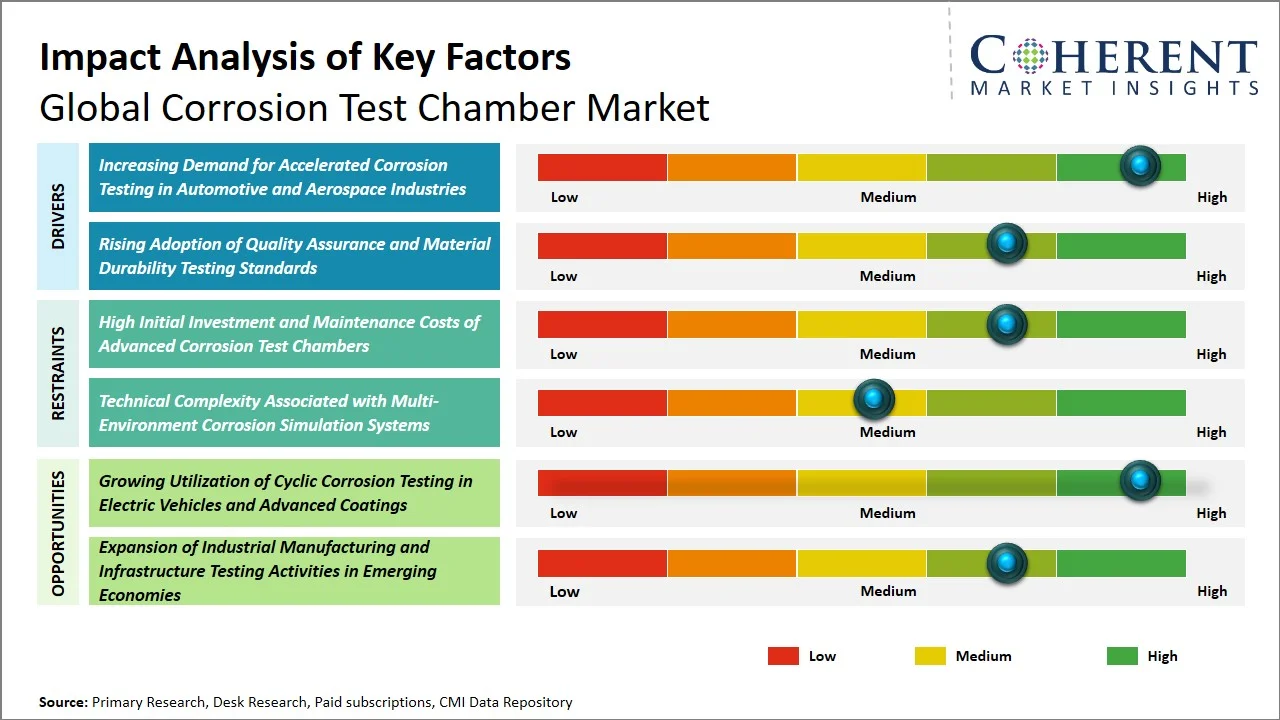
Market Drivers
- Increasing Demand for Accelerated Corrosion Testing in Automotive and Aerospace Industries: The automotive and aerospace industry's need for increased durability and reliability due to higher and higher performance demands is creating a stronger demand for materials with longer lifespan, and this also directly stimulates the demand for modern corrosion testing solution such as accelerated corrosion test chamber. The safety and regulatory standard of the industry require a thoroughly testing for all the material components, exposed to variety environmental stimuli such as salt spray, temperature variation, and humidity. The accelerated corrosion test permits manufacturers shorten time for product development, assure the quality while reproducing effects of long-time usage and aging within limited time duration. In addition to, lightweight material and new composites required for automotive and aircraft industry demand careful testing of the materials' corrosiveness, avoid failure within short period and financial loss caused by recall. While technological development and environment concern lead both industries for the greater progress and innovation, corrosion test chamber will be needed more. For instance, U.S. Federal Aviation Administration (FAA) places great emphasis on corrosion prevention and control of aircraft structures and aerospace materials when subjected to moisture, salty environments, and variations in temperature. This re-emphasizes the need for accelerated corrosion and environmental durability testing throughout the aerospace industry (Source: U.S. Department of Transportation). Increasing regulatory and operational needs are driving the implementation of high-tech corrosion test chambers in evaluating coating effectiveness, material integrity and long-term material performance in automotive and aerospace manufacturing processes.
- Rising Adoption of Quality Assurance and Material Durability Testing Standards: With growing use of quality assurance and material durability testing standards in the automotive, aerospace, electronics, marine and industrial manufacturing sectors, demand is rapidly increasing in many other sectors too for corrosion test chambers. Today more manufacturers are adopting standardized environmental simulation and corrosion resistance testing techniques as a means to ensure long term performance of components and equipment, compliance with regulatory standards and safety of operations, and above all to confirm and warranty performance of coated metals, industrial alloys, structural assemblies and electronic devices against a variety of exposures such as cyclic humidity, salt fog and cyclic temperature. A focus on life cycle evaluation and infrastructure longevity is prompting greater application of accelerated corrosion test techniques throughout industrial supply chains worldwide. For instance, ISO 9227 standards for salt spray corrosion testing, widely used in the world, are used to test metallic material or coatings performance in the face of corrosion under controllable laboratory conditions. (Source: International Organization for Standardization)
Emerging Trends
- Growing Adoption of Multi-Function Environmental Simulation Chambers: The manufacturers are implementing multi-function environmental simulation chambers that allow for the simultaneous or sequential introduction of the effects of corrosion, humidity, UV, temperature cycling and weathering within one chamber. This offers significantly greater testing efficiency and a more comprehensive simulation of the environmental conditions likely to be encountered by materials used in automotive, aerospace and industrial applications.
- Increasing Demand for Compact Laboratory Corrosion Testing Systems: In the present market, there is a demand for compact modular corrosion test chambers, especially in research labs, electronics producers and other smaller testing industrial companies. Compact designs are more cost effective, provide better flexibility and easier to install. It has application in standard salt spray tests and cyclic corrosion tests used for sophisticated materials and electronic components.
Regional Insights
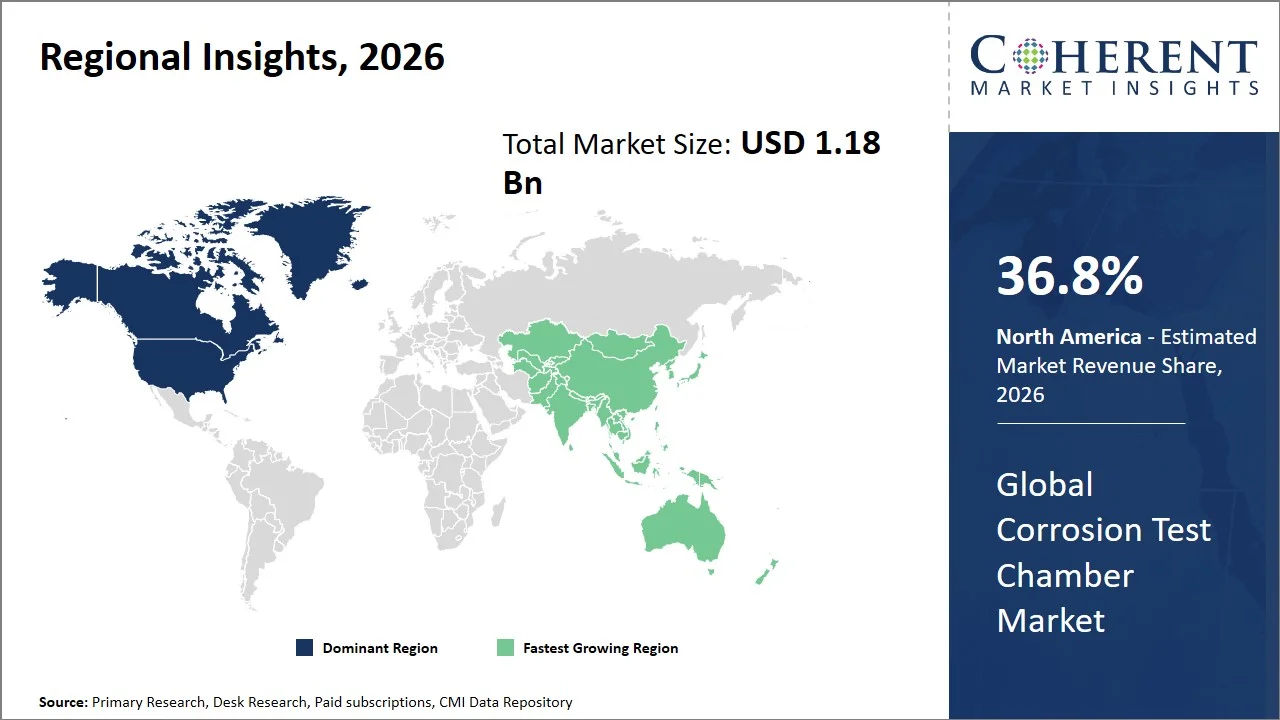
Why is North America a Strong Market for Corrosion Test Chamber?
North America leads the global corrosion test chamber market, accounting for an estimated 36.8% share in 2026, because environmental durability validation is heavily used in aerospace, transportation, energy and defense manufacturing industries. Increasingly, the use of accelerated corrosion simulation systems are gaining ground among industrial manufacturers and government institutions in the area for assessing structural metals, industrial coatings, pipeline material, transportation products when put into extreme climate and marine environments.
Additionally, the adoption of laboratory-based environmental testing to determine lifecycle of infrastructure materials and surface protective systems are also kept strong in this region. Apart from that, demand for programmable corrosion test systems in industrial labs is improving with ongoing upgrading of aged infrastructure and growth of EV and aerospace production capacities. For instance, the U.S. Department of Energy Office of Advanced Materials & Manufacturing Technology continues supporting research on advanced industrial materials and durability-oriented manufacturing technologies for extreme working conditions and high corrosiveness (Source: U.S. Department of Energy). These programs are building demand for corrosion simulation and environmental testing systems in North America.
Why Does Asia Pacific Corrosion Test Chamber Market Exhibit High Growth?
The Asia pacific corrosion test chamber market is expected to exhibit the fastest growth with an estimated contribution of 29.4% share to the market in 2026, propelled by quick scaling of automobile, shipbuilding, electronics and EV battery manufacturing sectors with the need to ascertain robust environmental resistance validation. Over the past years, manufacturers in China, South Korea, Japan and India are extensively utilizing cyclic corrosion and accelerated weathering systems in testing coated metals, structural alloys, connectors and battery enclosures exposed in corrosive and humid working conditions.
The region is actively improving its quality control systems in terms of export-grade compliance and industrial reliability testing of high-performance manufacturing industries. Growing use of offshore installations and marine engineering will also fuel the growth of advanced corrosion simulation techniques in Asia Pacific industrial labs. For instance, South Korea's shipbuilding continues growth into development of high value liquefied natural gas (LNG) carriers and offshore vessels that requires a great number of corrosion and marine durability tests for metals, which constitutes its structure, and coating applied. (Source: Organisation for Economic Co-operation and Development)
Global Corrosion Test Chamber Market Outlook for Key Countries
Why is the U.S. Leading Innovation and Adoption in the Corrosion Test Chamber Market?
U.S. dominates innovation and the market adoption for corrosion test chamber segment based on widespread implementation of military specification environment durability testing & modern material qualification process for aviation/aerospace, naval, automotive and transport industry. Industrial manufacturers and federal organizations utilize cyclic corrosion and accelerated weathering system widely for validating light weight alloys, coatings and for electric vehicle battery enclosures and heavy-duty materials under extreme applications and also strongly adopt American Society for Testing and Materials (ASTM), Society of Automotive Engineers (SAE) and Military Standards (MIL) specification standard tests for product certification and life testing purposes where robust controlled environment simulation is required. Furthe, increasing implementation of smart environmental simulation technologies with automated controls and programmable test cycles as well as AI integrated testing approach further enhances the U.S. corrosion test chamber market leadership in development & sales for modern corrosion test systems.
Is Japan a Favorable Market for Corrosion Test Chamber?
Japan’s strong focus on high-reliability manufacturing and long product lifespans across the automotive, electronics, rail, and marine sectors is driving demand for corrosion test chambers. The Japanese manufacturers extensively incorporate cyclic corrosion testing and environmental simulation in the testing of fine metal parts, coated surfaces, battery systems and electronic units intended for usage in humid and coastal environments. Additionally, Japan has firmly established practices in industrial quality and product lifetime testing and relies on carefully conducted corrosion testing as a component of product development and qualification phases. Coupled with its increasingly adopted usage of lightweight alloys, modern coatings and miniaturized electronics, Japan is demonstrating rapid growth in need for and application of precision programmable corrosion simulation chambers for its testing industries.
Is China Emerging as a Key Growth Hub for the Corrosion Test Chamber Market?
China is a key growth driver in the corrosion test chamber market, because of growth of the domestic production of electric vehicles, industrial coatings, and civil engineering infrastructure projects that demand highly efficient performance and reliability validation. Industries are beginning to incorporate corrosion simulation systems in the test and evaluation of coated steels, aluminum alloys, battery enclosure, railroad, and offshore components exposed to corrosive, saline and high humidity environments. They also began to enhance the adoption of integrated high-value industrial quality management system and environmentally reliable testing techniques for their automotive, ship building and heavy industrial applications. Increasing automation within production lines of materials manufactured at high performance and of export orientation will speed up the installation of Programmable cyclic corrosion and environment simulation chambers for various industries in China.
Why Does Germany Top the Europe Corrosion Test Chamber Market?
Germany is the leader in the Europe market for corrosion test chamber because of its concentrated number of industrial segments: automotive engineering, industrial machinery manufacturing, and new material processing industries, which require testing of environmental robustness. Cyclic corrosion and salt spray test of coated metal elements, lightweight alloys, fasteners, and precision-worked industrial parts are common applications in Germany and are usually required in automotive, rail, and heavy engineering industries. German industry has a very rigorous industrial qualification procedure and product life cycle evaluation standards that follow Deutsches Institut für Normung (DIN), International Organization for Standardization (ISO), and European standards for material reliability. Development of industrial coating systems that meet sustainable industry requirement and lightweight mobility concept is further driving demands for programmed multi-environment corrosion test chambers for Germany's industrial test labs.
Is Corrosion Test Chamber Market Developing in South Korea?
The corrosion test chamber market in South Korea is expanding rapidly attributed to its robust shipbuilding, automotive, semiconductor, and battery manufacturing industries, where environmental durability of the products needs to be effectively verified. The industrial sector more frequently adopts the cyclically accelerated corrosion tests and environmental simulation tests on the marine grade steel, painted metal building structure, and on the component parts of the EV battery and electronic assemblies, which should withstand highly humid and salt spraying environment when operated in use. Also, South Korea has been driving forward the digital manufacturing and smart industrial quality systems, where the accuracy of environment reliability tests is critical during the product qualification process. Meanwhile, rapid development of the shipbuilding and offshore engineering industries has increased the adoption demand for the advanced corrosion simulation technologies for marine machines and structural materials test.
Regulatory Landscape Governing the Global Corrosion Test Chamber Market
Region | Authority & Classification | Approval Pathway | Key Regulatory Insight |
North America | ASTM International, NACE/AMPP, U.S. Department of Defense (DoD), SAE International | Compliance with ASTM B117, ASTM G85, SAE J2334, and military corrosion testing standards for industrial and automotive applications | Strong implementation of standardized salt spray and cyclic corrosion testing protocols across aerospace, defense, automotive, and infrastructure sectors supports high adoption of advanced corrosion test chambers |
Europe | European Committee for Standardization (CEN), ISO, European Chemicals Agency (ECHA) | Compliance with ISO 9227, DIN corrosion testing standards, and EU industrial material durability frameworks | Strict industrial quality and environmental durability regulations across automotive, marine, and industrial manufacturing sectors increase utilization of corrosion simulation systems |
Asia Pacific | Japanese Industrial Standards (JIS), Bureau of Indian Standards (BIS), China National Standardization Administration | Regional compliance with JIS Z 2371, GB/T corrosion testing standards, and industrial quality certification systems | Rapid industrialization and export-oriented manufacturing are increasing emphasis on corrosion resistance validation and environmental simulation testing across automotive, electronics, and heavy industries |
Latin America | ABNT (Brazilian Association of Technical Standards), national industrial quality authorities | Adoption of ISO and ASTM-aligned corrosion testing procedures for industrial equipment and infrastructure materials | Expanding oil & gas, marine, and infrastructure sectors are increasing requirement for corrosion prevention and material reliability testing systems |
Middle East & Africa | GCC Standardization Organization (GSO), SASO, regional industrial compliance authorities | Implementation of ISO and ASTM-based environmental testing standards for oil & gas, marine, and infrastructure applications | Harsh climatic conditions, offshore projects, and industrial infrastructure expansion are accelerating demand for corrosion durability testing and environmental simulation technologies |
How is growing utilization of cyclic corrosion testing in electric vehicles and advanced coatings creating new growth opportunities in the global corrosion test chamber market?
The use of cyclic corrosion testing in EVs and coating industries are also expected to pose great growth opportunities for the corrosion test chamber market owing to the focus on long term durability of materials, coating integrity and battery reliability in demanding environments. Automotive players have been increasing use of cyclic corrosion simulation system for evaluation of EV battery enclosures, lightweight alloys, coated steel chassis, electrical connections, under the challenging atmospheric environments that include high humidity and deicing salts. Advanced coating makers are progressively using cyclic corrosion test for enhance performance and life of industrial coatings, in transportation, marine, and infrastructure. Increasing use of accelerated durability verification programs in EV and industrial sectors drives adoption of Programmable Multi-Environmental Corrosion Chambers, which simulate varied environmental exposures over time.
For instance, the SAE International SAE J2334 standard is increasingly the adopted method for cyclic corrosion testing of automotive body structures and coated metals under harshest environment for advanced corrosion simulation systems used for EVs manufacturing (Source: SAE International). Additionally, ASTM International states a rising demand in the application of cyclic corrosion and wear test standard for assessment of metals, coatings, and corrosion performance of material in adverse environments, driving the demand of advanced corrosion simulation chamber in both EV and industry. (Source: ASTM International)
Market Players, Key Development, and Competitive Intelligence
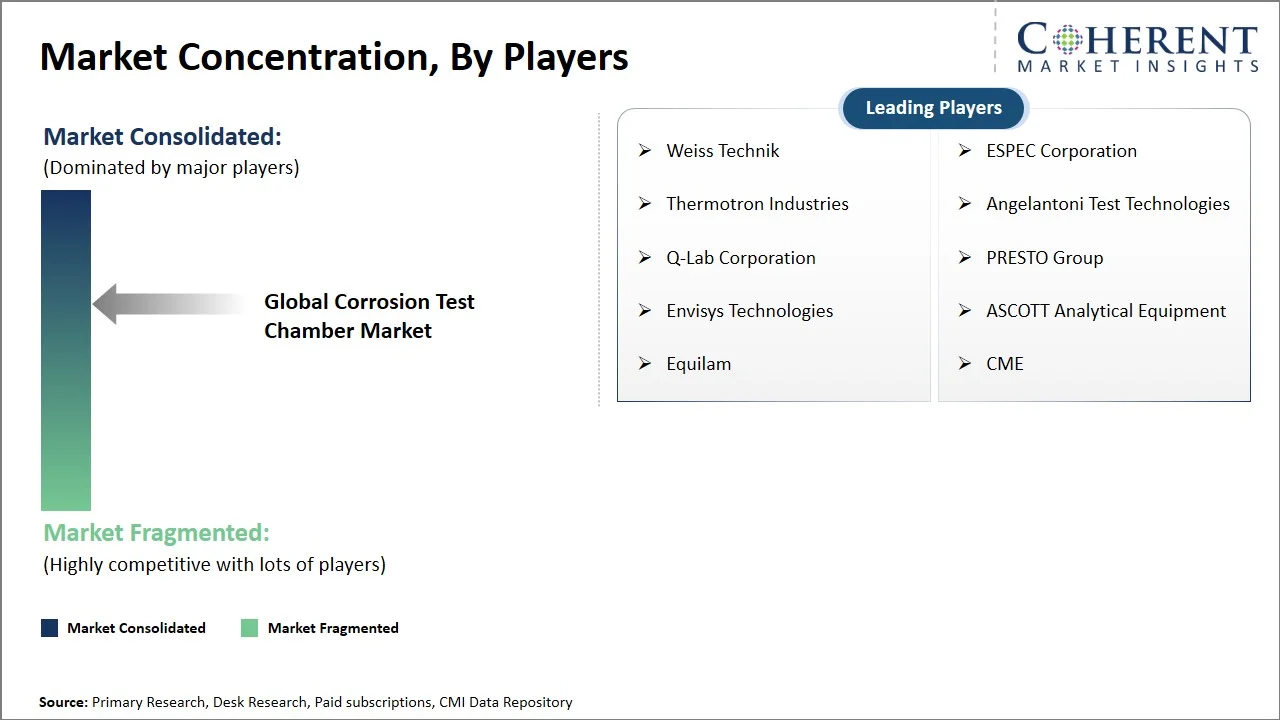
Key Developments
- In February 2026, LIB Industry announced the successful installation of their Salt Fog Corrosion Test Chamber for one of their manufacturing customers in Argentina for assessing the performance and durability of coatings and metals under extreme weather conditions. This development demonstrates the growing use of corrosion testing equipment in industrial manufacturing.
- In May 2025, the Department of Science and Technology purchased a corrosion testing machine that would be used by local furniture companies to determine the durability and corrosion-resistant performance of the materials they use. This move signifies increased efforts within institutions towards investing in corrosion testing equipment.
Competitive Landscape
The global corrosion test chamber market is moderately competitive, with competition mainly revolves around testing accuracy, environmental simulation feature, automation facility, chambers' durability, and adherence to international corrosion testing standards. Companies are focusing on developing modern cyclic corrosion chambers, programmable environmental simulation devices, and smart corrosion testing chambers aimed for material testing across the automotive, aerospace, marine, and industrial sectors. The manufacturers are looking to develop highly energy-efficient chambers, automated corrosion testing monitoring systems and IoT based testing chambers so that the tests are performed with greater efficiency and accuracy. Tie up with industrial testing laboratories, automotive OEMs, aerospace manufacturer and quality inspection bodies of infrastructure are aiding in the commercialization of new technology in the area. Key focus areas include:
- Development of advanced cyclic corrosion and multi-environment simulation chambers
- Expansion of automated and IoT-enabled corrosion testing systems
- Innovation in energy-efficient and precision-controlled environmental chambers
- Strategic collaborations with aerospace, automotive, and industrial testing laboratories
- Investments in accelerated durability testing technologies for EV batteries, industrial coatings, and structural metals
Market Report Scope
Corrosion Test Chamber Market Report Coverage
| Report Coverage | Details | ||
|---|---|---|---|
| Base Year: | 2025 | Market Size in 2026: | USD 1.18 Bn |
| Historical Data for: | 2020 To 2024 | Forecast Period: | 2026 To 2033 |
| Forecast Period 2026 to 2033 CAGR: | 6.4% | 2033 Value Projection: | USD 1.82 Bn |
| Geographies covered: |
| ||
| Segments covered: |
| ||
| Companies covered: | Weiss Technik, ESPEC Corporation, Thermotron Industries, Angelantoni Test Technologies, Q-Lab Corporation, PRESTO Group, Envisys Technologies, ASCOTT Analytical Equipment, Equilam, and CME | ||
| Growth Drivers: |
| ||
| Restraints & Challenges: |
| ||
Analyst Opinion (Expert Opinion)
- The future of global corrosion test chamber market is anticipated to be heavily driven by rising importance given to durability of infrastructure and reliability of advanced materials along with prediction-based quality assurance in the industrial manufacturing industry. There has been a progressive shift from traditional salt spray testing toward smart environmental simulation systems capable of simulating more complicated real-time conditions with respect to varied humidity, cycles of temperature variations, UV, and chemicals for the simulation of real time corrosion conditions. With increase in automation, IoT based testing process monitoring, along with AI supported testing data analysis, precision will grow significantly and time during the product testing process will shrink in a cost-effective way in the applications like automotive, aerospace, marine, electrical, energy etc. Growing trends in lightweight alloys, electric vehicle battery systems and various advanced industrial coatings is expected to continually foster the demand for the corrosion testing technologies at the global level.
- The maximum opportunities will probably exist in the next-generation cyclic corrosion test chambers and automated environment simulation systems for EV battery testing, aerospace coatings authentication and infrastructure testing and validation across the U.S., Germany, China and Japan. U.S will expect to be a major market due to the demand on aerospace, defense and transportation durability testing while the highest demand is likely to grow fastest in the industrial segment in China supported by fastest modernization of infrastructure and expansion of manufacturing industry. Growth prospects are expected to develop rapidly in corrosion testing solutions for renewable energy infrastructure, offshore equipment, marine engineering systems and new-age light-weight metal alloys in applications of the manufacturing processes for EVs and aerospace.
- In order to secure a competitive advantage, the key stakeholders need to invest in the development of intelligent and automated corrosion testing chambers that support the integration of IoT monitoring, programmed environmental simulations and AI-supported test analyses. Organizations should also extend their business to tailored testing solutions and automation services that support the development and evaluation of EVs, battery systems, aerospace alloys and industrial high-performance coatings designed for harsh environments. Close collaboration with automotive OEMs, aerospace manufacturers, infrastructure organizations and industrial testing facilities is becoming more crucial than ever to attain effective validation and sustained commercialization of the advanced corrosion testing technology. Vendors who have robust compliance with ever-updating ASTM, ISO, MIL-STD and environmental durability standards while enhance chamber energy efficiency and testing accuracy should maintain a stronger market competitiveness.
Speak to the analyst
Want personalized insights?
Take the findings above to one of our principal consultants, or have the report rebuilt around the segments, geographies and competitors you actually track.
Market Segmentation
- Product Type Insights (Revenue, USD Bn, 2021 - 2033)
- Salt Spray Test Chambers
- Cyclic Corrosion Test Chambers
- Humidity Test Chambers
- Combined Corrosion Test Chambers
- Others
- Chamber Capacity Insights (Revenue, USD Bn, 2021 - 2033)
- Small Capacity Chambers
- Medium Capacity Chambers
- Large Capacity Chambers
- Material Tested Insights (Revenue, USD Bn, 2021 - 2033)
- Metals and Alloys
- Coated Materials
- Plastics and Composites
- Electronic Components
- Others
- Application Insights (Revenue, USD Bn, 2021 - 2033)
- Coating and Paint Testing
- Material Durability Testing
- Quality Control and Inspection
- Product Development and R and D
- Compliance and Certification Testing
- End-Use Industry Insights (Revenue, USD Bn, 2021 - 2033)
- Automotive
- Aerospace and Defense
- Electronics and Semiconductors
- Industrial Manufacturing
- Marine
- Oil and Gas
- Construction and Infrastructure
- Others
- Regional Insights (Revenue, USD Bn, 2021 - 2033)
- North America
- U.S.
- Canada
- Latin America
- Brazil
- Argentina
- Mexico
- Rest of Latin America
- Europe
- Germany
- U.K.
- Spain
- France
- Italy
- Russia
- Rest of Europe
- Asia Pacific
- China
- India
- Japan
- Australia
- South Korea
- ASEAN
- Rest of Asia Pacific
- Middle East
- GCC Countries
- Israel
- Rest of Middle East
- Africa
- South Africa
- North Africa
- Central Africa
- North America
- Key Players Insights
- Weiss Technik
- ESPEC Corporation
- Thermotron Industries
- Angelantoni Test Technologies
- Q-Lab Corporation
- PRESTO Group
- Envisys Technologies
- ASCOTT Analytical Equipment
- Equilam
- CME
Sources
Primary Research Interviews
- Corrosion testing equipment manufacturers and environmental simulation system providers involved in accelerated corrosion and durability testing technologies
- Materials engineers and corrosion scientists specializing in metals, coatings, and industrial reliability assessment
- Automotive and aerospace quality assurance professionals utilizing salt spray and cyclic corrosion testing systems
- Industrial laboratory specialists involved in environmental simulation, coating validation, and material lifespan evaluation
- Academic researchers working on corrosion engineering, protective coatings, and advanced material durability studies
Stakeholders
- Corrosion test chamber manufacturers and environmental simulation technology providers, Industrial quality assurance and material testing laboratories, Automotive, aerospace, marine, and infrastructure durability testing agencies
- End-use Sectors
- Automotive and electric vehicle manufacturing companies
- Aerospace and defense industries
- Industrial manufacturing and metal processing facilities
- Marine, infrastructure, and construction engineering sectors
- Regulatory & Health Bodies: ASTM International – corrosion testing and salt spray testing standards, International Organization for Standardization (ISO) – environmental testing and material durability standards, National Association of Corrosion Engineers (NACE/AMPP) – corrosion engineering and prevention frameworks, U.S. Department of Transportation (DOT) – infrastructure material durability and corrosion prevention programs
Databases
- ASTM Standards Database – corrosion testing and salt spray testing protocols
- ISO Standards Database – environmental simulation and industrial testing standards
- NACE IMPACT Study Database – corrosion cost and industrial corrosion statistics
- OECD Industrial Statistics – manufacturing and industrial infrastructure indicators
- U.S. Federal Highway Administration (FHWA) Databases – bridge durability and corrosion prevention data
Magazines
- Materials Performance Magazine – corrosion engineering and industrial durability developments
- Quality Magazine – industrial testing and quality assurance technology trends
- Coatings World – protective coatings and corrosion prevention innovations
- Industrial Heating Magazine – environmental testing and materials engineering advancements
Journals
- Corrosion Science
- Materials and Corrosion
- Journal of Materials Engineering and Performance
- Surface and Coatings Technology
- Anti-Corrosion Methods and Materials
Newspapers
- Financial Times – industrial manufacturing and infrastructure investment developments
- The Wall Street Journal – automotive, aerospace, and industrial technology coverage
- The New York Times (Business Section) – infrastructure modernization and manufacturing trends
- The Guardian (Environment & Industry Section) – industrial sustainability and materials durability developments
Associations
- Association for Materials Protection and Performance (AMPP)
- ASTM International
- National Association of Testing Authorities (NATA)
- International Corrosion Council (ICC)
Public Domain Sources
- U.S. Department of Transportation (DOT) – infrastructure corrosion and material durability initiatives
- Federal Highway Administration (FHWA) – bridge preservation and corrosion mitigation programs
- National Institute of Standards and Technology (NIST) – materials engineering and industrial testing research
- European Commission – industrial sustainability and advanced materials innovation initiatives
Proprietary Elements
- CMI Data Analytics Tool, Proprietary CMI Existing Repository of information for last 10 years.
Get access to 250+ pages report
Every segment, forecast, competitor profile and data table behind the analysis above — available for instant download.
- ESOMAR Member
- ISO 9001:2015 Certified
- D-U-N-S Registered
- GDPR & CCPA Compliant
Missing comfort of reading report in your local language? Find your preferred language:
Transform your Strategy with Exclusive Trending Reports
Frequently Asked Questions
The global corrosion test chamber market is estimated to be valued at USD 1.18 Bn in 2026 and is expected to reach USD 1.82 Bn by 2033.
Salt spray test chambers dominate due to their widespread use in accelerated corrosion resistance testing for metals, coatings, automotive components, aerospace structures, and industrial materials under standardized salt fog environmental conditions.
A corrosion test chamber is an environmental simulation system used to evaluate the corrosion resistance and durability of materials, coatings, and components under controlled climatic and chemical conditions.
The CAGR of global corrosion test chamber market is projected to be 6.4% from 2026 to 2033.
Increasing demand for accelerated corrosion testing in automotive and aerospace industries and rising adoption of quality assurance and material durability testing standards are the major factors driving the growth of the global corrosion test chamber market.
High initial investment and maintenance costs of advanced corrosion test chambers and technical complexity associated with multi-environment corrosion simulation systems are the major factors hampering the growth of the global corrosion test chamber market.
In terms of application, coating and paint testing is estimated to dominate the market revenue share in 2026.