

Global Creative Software Market Size and Forecast – 2026-2033
The Global Creative Software Market is estimated to be valued at USD 10.58 Bn in 2026 and is expected to reach USD 15.49 Bn by 2033, exhibiting a compound annual growth rate (CAGR) of 5.6% from 2026 to 2033.
Key Takeaways of the Creative Software Market
- The image & video editing segment leads the market holding an estimated share of 43.2 % in 2026.
- North America is estimated to lead the market with a share of 39. 3% in 2026.
- Asia Pacific, holding a share of 24.3 % in 2026, is projected to be the fastest growing region.
Market Overview
The market is seeing a shift towards cloud-based creative software platforms, making possible real-time collaboration and improved accessibility for remote teams. Also, the integration of artificial intelligence and machine learning capabilities is helping users with automated design suggestions and improved workflow efficiencies. The rise in digital marketing and e-commerce activities adds to market demand, making creative software an essential tool for businesses seeking to engage modern audiences with visually compelling content.
Current Events and Its Impact
Current Events | Description and Impact |
Geopolitical and Trade Developments |
|
Economic and Infrastructure Trends |
|
Segmental Insights
- Current Industry Events of 2026
- Market Size Estimation
- Regional Breakdown
- Competitive Landscape
- Customer Intelligence
- Segmental Analysis
- Pricing Analysis
- Key Market Drivers, Challenges & Future Trends
- Customized Insights Section
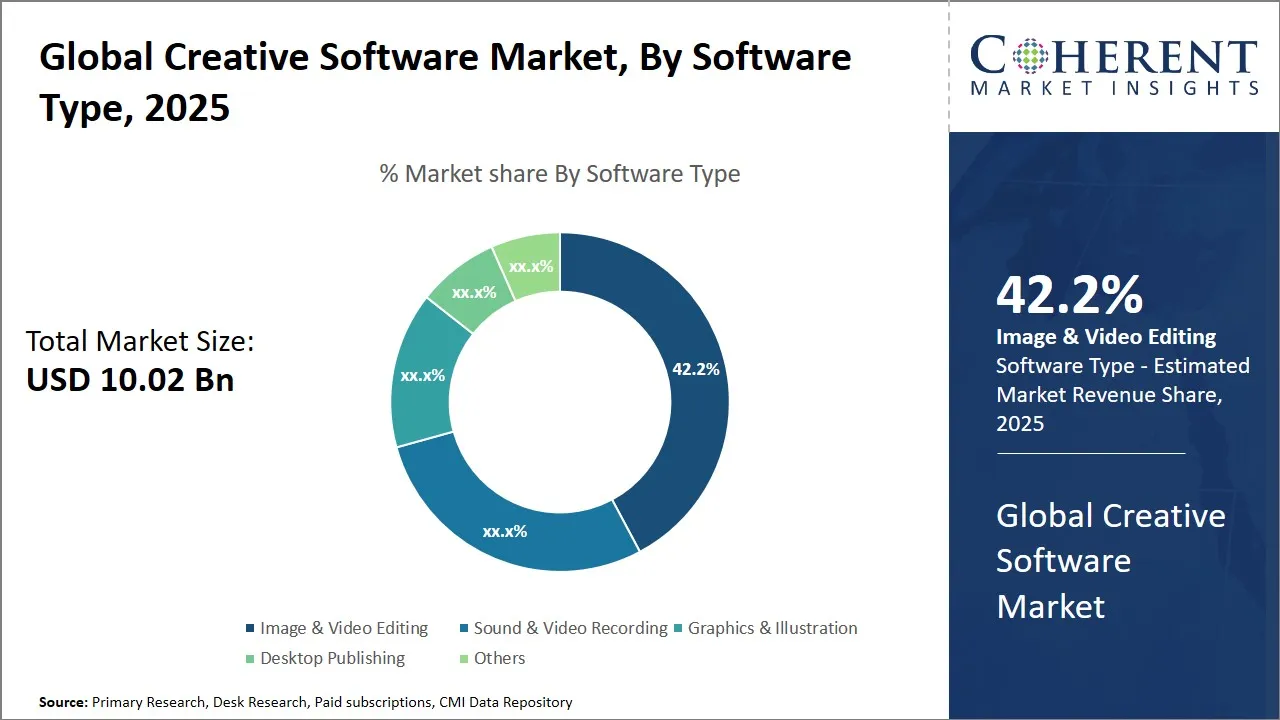
Global Creative Software Market Insights, by Software Type – Image & Video Editing’s Dominance is Driven by Increasing Demand for Visual Content Creation
Image & video editing is expected to contribute the highest share of 43.2% in the market in 2026. The growth in digital content consumption from social media platforms, entertainment, advertising, and corporate communications has greatly elevated the demand for tools that enable high-quality visual content creation and editing. Image and video editing software empower creators to produce polished, engaging content that can captivate audiences and enhance brand recognition. The popularity of smartphones with advanced cameras has made video and image capture a lot more common and accessible, creating the need for user-friendly editing software tailored for both amateurs and professionals.
Corporate sectors’ growing preference for video content in training, presentations, and marketing initiatives also adds to this segment's growth. Companies are increasingly spending on image and video editing solutions to make professional promotional materials and internal communications, thus enhancing workforce effectiveness and customer engagement.
Technological advancements such as AI-powered editing functionalities have further expanded the capabilities and efficiency of image and video editing software. Features like automated enhancements, background removal, and intelligent video trimming reduce manual effort, making high-quality editing accessible to users with different skill levels.
Impact of AI on the Creative Software Market
The impact of AI on the creative software market has been transformative, redefining both user experience and industry competitiveness. Major companies like Adobe have embedded AI into their core offerings—Adobe’s Firefly, launched in 2023, allows users to generate images, templates, and effects from text prompts, directly integrated within Photoshop and Illustrator. This has significantly reduced design time and lowered the barrier to entry for non-professionals, expanding the user base. Similarly, Figma has introduced AI-powered features like auto-layout suggestions and content generation to speed up UI/UX design workflows. These tools automate repetitive tasks, enhance precision, and allow creatives to focus more on ideation rather than manual execution.
In 2025, Canva acquired MagicBrief, an AI-based marketing tool that generates and analyzes ad creatives. This move reflects a growing trend where creative platforms are integrating AI not just for design, but also for content intelligence and marketing effectiveness.
Regional Insights
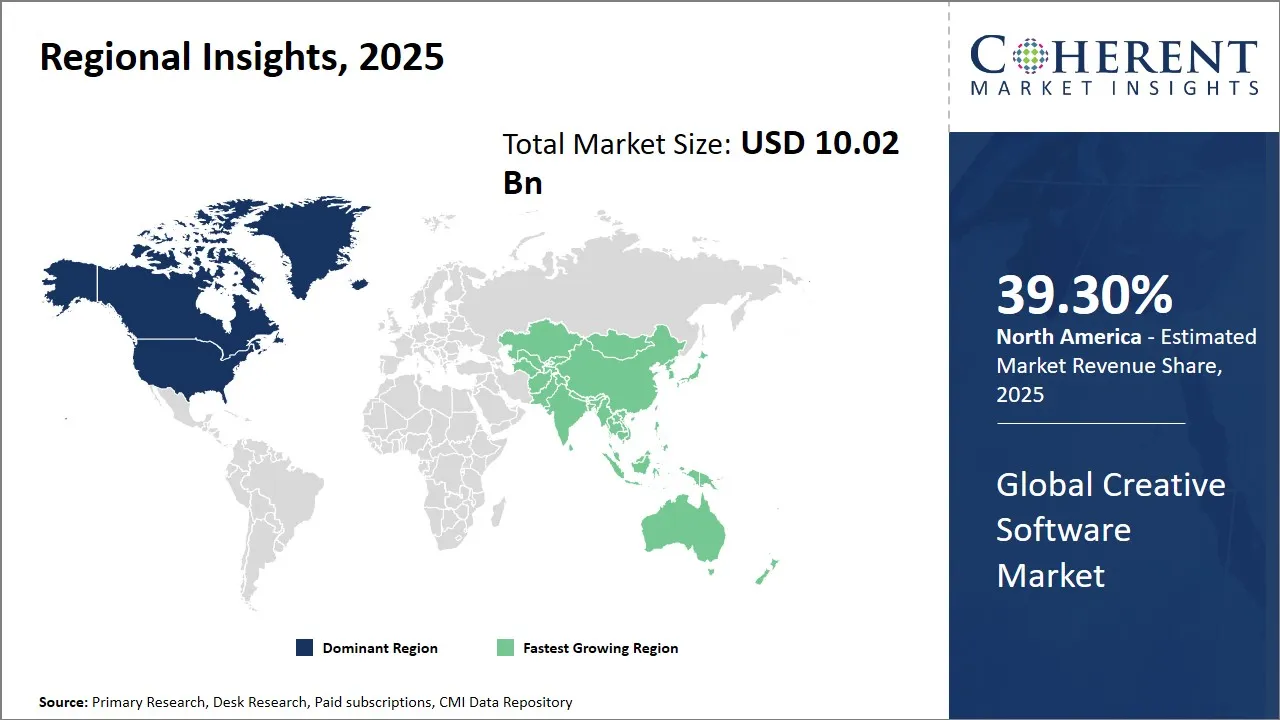
North America Creative Software Market Analysis and Trends
North America, holding a share of 39.3% in 2026, is expected to dominate the global creative software market, driven primarily by a well-established technology ecosystem, significant investment in innovation, and the presence of some of the largest and most influential creative software companies worldwide. The U.S. and Canada have long been hubs for software development, supported by strong intellectual property laws and a mature digital infrastructure. Government policies encouraging tech innovation and entrepreneurship further boost market growth.
In addition, the region houses industry giants such as Adobe Inc., Autodesk, and Corel Corporation, whose continued product innovations and extensive customer base reinforce North America’s market leadership. The robust creative industry across advertising, media, entertainment, and gaming sectors creates substantial demand for creative software tools, ranging from graphic design suites to 3D modeling and video editing solutions. Trade dynamics are characterized by well-established global partnerships and exports of software solutions, making North America both a consumption and innovation hub.
Asia Pacific Creative Software Market Analysis and Trends
The Asia Pacific region is expected to exhibit the fastest growth in the global creative software market, propelled by rapid digital transformation, increasing creative content consumption, and rising adoption of advanced software tools among businesses, freelancers, and educational institutions. Countries like China, India, Japan, South Korea, and Southeast Asia are investing heavily in creative industries, including video production, gaming, advertising, and digital media, creating expansive opportunities for software vendors. Government initiatives promoting digital literacy and software development ecosystems—such as China’s Made in China 2026 and India’s Digital India campaign—encourage local innovation and adoption.
Additionally, the growing number of tech startups and rising disposable incomes in the region fuel demand for affordable, locally tailored creative software solutions. Notable global and regional companies such as Adobe, Corel, Wacom, and newer entrants like CyberLink and Clip Studio Paint have capitalized on this trend, offering solutions that cater to creative professionals and enthusiasts alike. Trade relations and increasing cross-border collaborations also accelerate regional market expansion.
Creative Software Market Outlook for Key Countries
U.S. Creative Software Market Analysis and Trends
The U.S. remains a powerhouse owing to its position as home to the headquarters of leading creative software developers like Adobe and Autodesk. These companies drive innovation through continuous development of industry-standard solutions encompassing photo editing, video production, digital illustration, and 3D modeling. The U.S. benefits from a vibrant startup ecosystem that often integrates creative software into new digital content platforms. Moreover, strong intellectual property protection incentivizes R&D activities. High demand from Hollywood, advertising agencies, and digital media firms sustains robust market penetration, alongside growing interest in augmented reality (AR) and virtual reality (VR) content creation tools.
China Creative Software Market Analysis and Trends
China creative software market continues to expand rapidly, reflecting the country’s growing creative media consumption and rising domestic software development capabilities. Local firms are increasingly competing with global players by developing software tailored to local language and cultural preferences, while government support accelerates innovation hubs. The surge in online content creation, driven by social media platforms and streaming services, fuels demand for intuitive and versatile creative software.
Japan Creative Software Market Analysis and Trends
Japan continues to lead in the integration of creative software within its robust gaming and animation industries, catering to both domestic and global audiences. Established players such as Clip Studio Paint and Celsys are well-known for specialized software tools that support manga artists and animators worldwide. The government’s support for the digital creative economy, combined with strong intellectual property policies, sustains the country’s innovative edge.
India Creative Software Market Analysis and Trends
India reflects both an increasing user base and a burgeoning creative software development scene. The rise in digital content production, IT outsourcing, and e-learning sectors drives software adoption. Government initiatives promoting digital literacy and innovation centers contribute to the growth in demand and supply. Many global companies have established regional offices or development centers in India, benefiting from local engineering talent.
Germany Creative Software Market Analysis and Trends
Germany creative software market benefits from a well-developed industrial design and advertising sector, supported by its strong manufacturing base. The country hosts prominent European offices of global leaders like Adobe and Autodesk, which adapt their products to meet the high-quality and regulation-compliant standards prevalent in the market. Government policies promoting innovation and digitalization, such as Industrie 4.0, encourage integration of creative software in areas like product design and digital marketing. Germany’s trade-friendly environment also facilitates the export of software solutions to neighboring European countries, enhancing its role in the region.
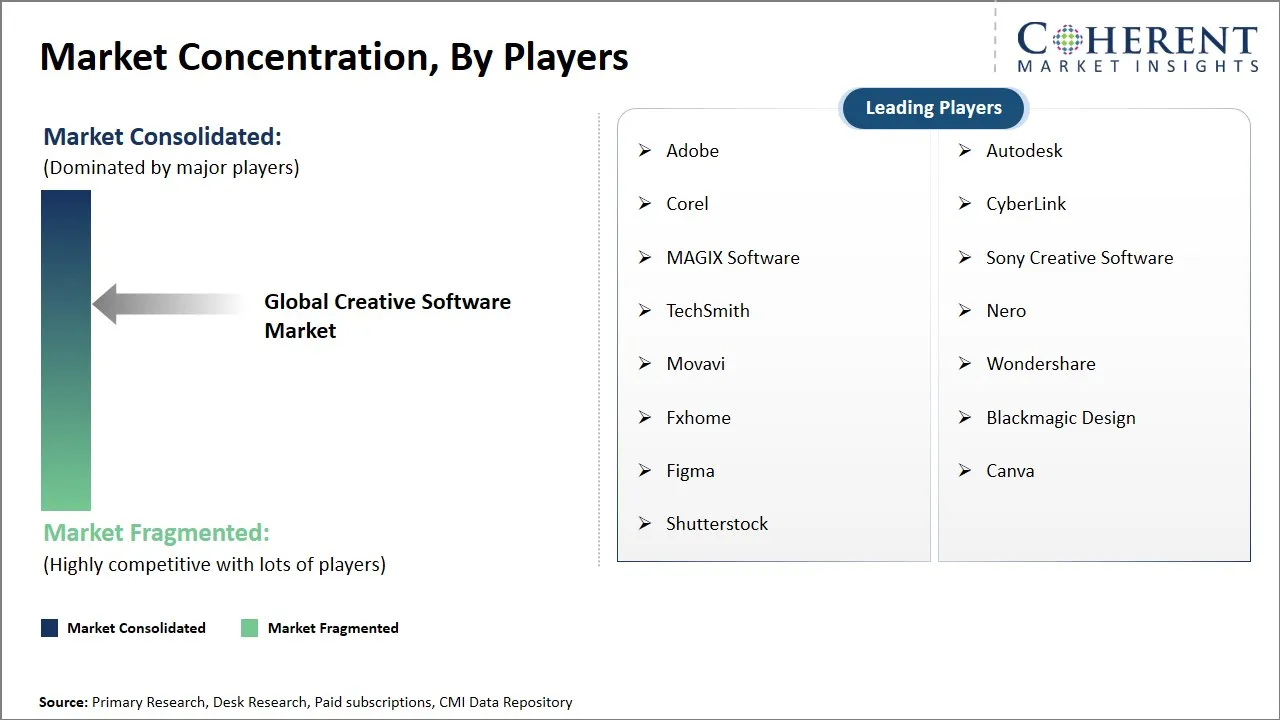
Market Players, Key Developments, and Competitive Intelligence
Key Developments
- On July 14, 2025, Cognition signed a definitive agreement to acquire Windsurf, the agentic IDE. The acquisition includes Windsurf’s IP, product, trademark and brand, and strong business.
- In June 2025, Canva announced its plan to acquire MagicBrief, an Australian creative intelligence startup. Together, the companies aim to fuel the entire marketing and content lifecycle – from ideation and creation to deployment, measurement, analysis, and optimization.
- In January 2025, Getty Images Holdings, Inc. and Shutterstock entered into a definitive merger agreement, creating a premier visual content company. The combined company is named Getty Images Holdings, Inc.
- In January 2024, Synopsys and Ansys entered into a definitive agreement under which Synopsys acquired Ansys. Bringing together Synopsys’ pioneering semiconductor electronic design automation (EDA) with Ansys’ broad simulation and analysis portfolio created a leader in silicon to systems design solutions.
Top Strategies Followed by Creative Software Market Players
- Established industry giants invest heavily in research and development (R&D) to drive innovation in high-performance creative tools. By allocating substantial resources towards enhancing software capabilities—such as advanced graphics rendering, AI-powered features, and cloud-based collaboration—they maintain a technological edge over competitors.
- Adobe allocated over USD 2 billion in R&D expenditure in 2024, much of it directed toward enhancing its Firefly generative AI platform, which was integrated across Photoshop, Illustrator, and Premiere Pro.
- Mid-level players in the creative software arena primarily differentiate themselves by offering cost-effective solutions that strike a balance between quality and affordability.
- Movavi, a mid-level creative software provider, released Movavi Video Editor 2024, a lightweight, one-time-purchase tool targeted at individual creators and educators. With simplified AI features and mobile compatibility, it offers an affordable alternative to Adobe’s subscription-heavy model.
- Small-scale creative software players carve out their niche by focusing on highly specialized features or innovative product offerings that address specific market gaps or emerging trends.
- FXhome (by Artlist) has focused on video effects software tailored to indie filmmakers and YouTube creators. Its tool HitFilm provides a free VFX and compositing suite with pro-grade features like motion tracking and 3D editing.
Market Report Scope
Creative Software Market Report Coverage
| Report Coverage | Details | ||
|---|---|---|---|
| Base Year: | 2025 | Market Size in 2026: | USD 10.58 Bn |
| Historical Data for: | 2020 To 2024 | Forecast Period: | 2026 To 2033 |
| Forecast Period 2026 to 2033 CAGR: | 5.6% | 2033 Value Projection: | USD 15.49 Bn |
| Geographies covered: |
| ||
| Segments covered: |
| ||
| Companies covered: | Adobe, Autodesk, Corel, CyberLink, MAGIX Software, Sony Creative Software, TechSmith, Nero, Movavi, Wondershare, Fxhome, Blackmagic Design, Figma, Canva, and Shutterstock | ||
| Growth Drivers: |
| ||
| Restraints & Challenges: |
| ||
Market Dynamics
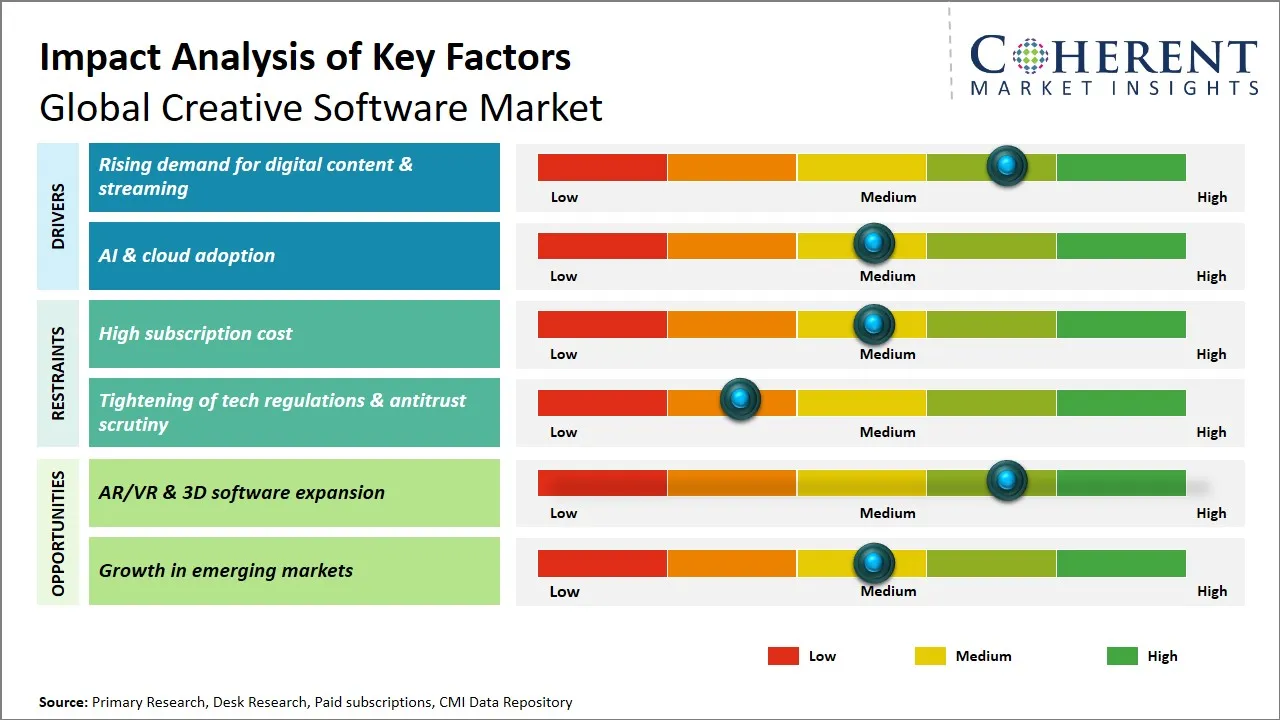
Global Creative Software Market Driver – Rising Demand for Digital Content & Streaming
With the surge in popularity of streaming services, online video platforms, and social media channels, content creators, influencers, and entertainment companies are increasingly reliant on advanced creative tools to produce high-quality visuals, animations, and multimedia presentations. This demand is further amplified by the growing preference for personalized and engaging content, which requires sophisticated editing, graphic design, and motion capture capabilities. Additionally, the ease of access to cloud-based creative solutions enables creators to collaborate seamlessly across geographies, fostering innovation and faster content turnaround.
In 2024, Blackmagic Design reported a 35% increase in global sales of its DaVinci Resolve Studio software, largely driven by the booming creator economy on YouTube, TikTok, and streaming platforms like Netflix and Twitch.
Global Creative Software Market Opportunity – Expansion of AR/VR and 3D Software in the Global Creative Software Market
The rapid advancement and increasing adoption of augmented reality (AR), virtual reality (VR), and 3D software present a significant growth opportunity within the global creative software market. These technologies are revolutionizing multiple industries, including entertainment, gaming, architecture, education, healthcare, and manufacturing, by enabling more immersive and interactive experiences. As consumer demand for AR/VR content rises along with the proliferation of compatible hardware such as AR glasses, VR headsets, and powerful mobile devices, creative software tailored for these platforms is becoming indispensable. Autodesk expanded its Maya and 3ds Max platforms in 2025 to include deeper integration with Unreal Engine and Unity, facilitating real-time 3D rendering and immersive content creation for AR/VR.
The ability to create realistic 3D models, simulations, and environments is driving innovation in content creation tools, pushing software developers to offer advanced features like real-time rendering, spatial audio integration, and intuitive design interfaces. Furthermore, the integration of AI and machine learning algorithms into AR/VR and 3D creative software enhances automation and personalization capabilities, lowering barriers for novice users and expanding the potential user base. Enterprises are also leveraging these tools for virtual prototyping, remote collaboration, and training applications, fueling demand for sophisticated yet user-friendly creative solutions.
Analyst Opinion (Expert Opinion)
- The film, streaming, and gaming industries are primary demand drivers, relying heavily on advanced video editing, VFX, and 3D modeling tools—fueling adoption of platforms like Adobe Premiere Pro, DaVinci Resolve, and Autodesk Maya.
- Growing use of creative software in schools, universities, and online education platforms is expanding user bases, with tools like Canva and Figma being adopted for curriculum design, student projects, and interactive learning materials.
- Brands and digital marketers across industries—from retail to real estate—are increasingly investing in creative software to generate high-impact visuals, short-form videos, and AR product previews, driving demand for cloud-based, AI-powered design tools.
Speak to the analyst
Want personalized insights?
Take the findings above to one of our principal consultants, or have the report rebuilt around the segments, geographies and competitors you actually track.
Market Segmentation
- Software Type Insights (Revenue, USD Bn, 2021 - 2033)
- Image & Video Editing
- Sound & Video Recording
- Graphics & Illustration
- Desktop Publishing
- Others
- Regional Insights (Revenue, USD Bn, 2021 - 2033)
- North America
- U.S.
- Canada
- Latin America
- Brazil
- Argentina
- Mexico
- Rest of Latin America
- Europe
- Germany
- U.K.
- Spain
- France
- Italy
- Russia
- Rest of Europe
- Asia Pacific
- China
- India
- Japan
- Australia
- South Korea
- ASEAN
- Rest of Asia Pacific
- Middle East
- GCC Countries
- Israel
- Rest of Middle East
- Africa
- South Africa
- North Africa
- Central Africa
- North America
- Key Players Insights
- Adobe
- Autodesk
- Corel
- CyberLink
- MAGIX Software
- Sony Creative Software
- TechSmith
- Nero
- Movavi
- Wondershare
- Fxhome
- Blackmagic Design
- Figma
- Canva
- Shutterstock
Sources
Primary Research Interviews
Stakeholders
- Independent Content Creators (e.g., YouTubers, streamers, freelance designers)
- Enterprise Marketing Teams (e.g., in retail, e-commerce, and education sectors)
- Media & Entertainment Professionals (e.g., video editors, animators, VFX supervisors)
- E-learning Content Developers and Educational Institutions
- AR/VR Content Developers and Immersive Media Startups
- UI/UX Designers and Web/Mobile App Developers
- Software Integrators and IT Procurement Teams in Design-Centric Enterprises
Databases
- UNESCO Institute for Statistics (UIS) – Digital education trends
- U.S. Bureau of Labor Statistics (Creative occupations growth)
- Asian Creative Economy Index
- North American Digital Content Survey (NADCS)
- Design Technology Innovation Tracker (DTIT)
- Global Content Creation Census (GCCC)
Magazines
- Creative Technology Weekly
- Digital Design Review
- Animation & VFX World
- User Interface Today
- Streaming Media Insights
- NextGen Creators Digest
Journals
- Journal of Creative Technology & Media Studies
- Digital Content & UX Journal
- AI in Design and Visual Communication Quarterly
- Journal of Interactive Media & Software Innovation
- Visual Computing and Immersive Design Review
Newspapers
- The Tech Chronicle (USA)
- Design Daily (UK)
- The Creator Times (Australia)
- Asia-Pacific Innovation Post
- The Economic Design Gazette (India)
Associations
- Global Association of Creative Software Developers (GACSD)
- International Federation of Digital Artists and Designers (IFDAD)
- Asia-Pacific UI/UX Professionals Network (APUXN)
- North American Content Creation Alliance (NACCA)
- Association for AI in Creative Industries (AAICI)
Public Domain Sources
- U.S. Census Bureau
- EUROSTAT
- United Nations Educational, Scientific and Cultural Organization (UNESCO)
- World Bank
- ResearchGate
Proprietary Elements
- CMI Data Analytics Tool, Proprietary CMI Existing Repository of information for last 8 years
Get access to 250+ pages report
Every segment, forecast, competitor profile and data table behind the analysis above — available for instant download.
- ESOMAR Member
- ISO 9001:2015 Certified
- D-U-N-S Registered
- GDPR & CCPA Compliant
Missing comfort of reading report in your local language? Find your preferred language:
Transform your Strategy with Exclusive Trending Reports
Frequently Asked Questions
The global creative software market is estimated to be valued at USD 10.58 billion in 2026 and is expected to reach USD 15.49 billion by 2033, growing at a compound annual growth rate (CAGR) of 5.6% from 2026 to 2033.
The CAGR of global creative software market is projected to be 5.6% from 2026 to 2033.
Rising demand for digital content & streaming and AI & cloud adoption are the major factor driving the growth of global creative software market.
High subscription cost and Tightening of tech regulations & antitrust scrutiny are the major factor hampering the growth of global creative software market.
In terms of Software Type, Image & Video Editing is estimated to dominate the market revenue share in 2026.
Creative software is most widely used in industries like media & entertainment, advertising, marketing, graphic design, publishing, architecture, and product design—where visual content creation, editing, and rendering are essential.
Yes, there are several free alternatives such as GIMP (for Photoshop), Blender (for 3D design), DaVinci Resolve (for video editing), and Inkscape (for vector graphics), offering robust features at no cost.