

Global Custom Printed Products Market Size and Forecast – 2026-2033
The Global Custom Printed Products Market is estimated to be valued at USD 8.89 Bn in 2026 and is expected to reach USD 12.84 Bn by 2033, exhibiting a compound annual growth rate (CAGR) of 5.4% from 2026 to 2033.
Key Takeaways of the Custom Printed Products Market
- The custom printed apparel segment is expected to account for 36.6 % of the global custom printed products market in 2026.
- The retail segment is projected to capture 33.5 % of the market in 2026.
- The online segment dominates the market with an estimated 37.7 % share in 2026.
- Asia Pacific is set to lead the global custom printed products market in 2026 with a 32.2 % share. North America, with a 23.5% share, will be the fastest-growing region.
Market Overview
A major trend in the custom printed products market is advanced digital printing technologies used nowadays that provide better turnaround times and much more flexibility in designs. Another area concerning consumer preferences is the demand for green and sustainable materials where manufacturers are now looking to innovate with biodegradable inks and recyclable substrates. Also, e-commerce platforms offering customized products have been increasing market accessibility worldwide and will further drive demand and open up new opportunities for market players.
Current Events and Its Impact
Current Events | Description and its impact |
Increasing Consumer Demand for Personalization |
|
Advancements in Printing Technology |
|
Segmental Insights

- Current Industry Events of 2026
- Market Size Estimation
- Regional Breakdown
- Competitive Landscape
- Customer Intelligence
- Segmental Analysis
- Pricing Analysis
- Key Market Drivers, Challenges & Future Trends
- Customized Insights Section
Custom Printed Products Market Insights, By Product Type - Custom Printed Apparel Segment Dominates the Market Through Personalization and Fashion Trends
The Custom Printed Apparel segment is expected to hold 36.6% share of the global custom printed products market in 2026, primarily due to the increasing consumer demand for personalized and unique clothing options. Custom printed apparel offers customers the ability to express individuality through designs, logos, and messages tailored specifically to their preferences. This personalization trend has gained significant traction, especially among millennials and Gen Z consumers who value self-expression and uniqueness in their fashion choices.
Growth in the popularity of trends emphasizing customization, including limited editions and collaborative collections, further accelerates the demand for custom printed apparel. Retailers and brands capitalize on these trends by providing customization as an added value, allowing consumers to co-create their clothing instead of choosing from pre-existing inventory. This has transitioned beyond casual wear to sportswear, business uniforms, and even high-end clothing, broadening the product appeal across various demographics.
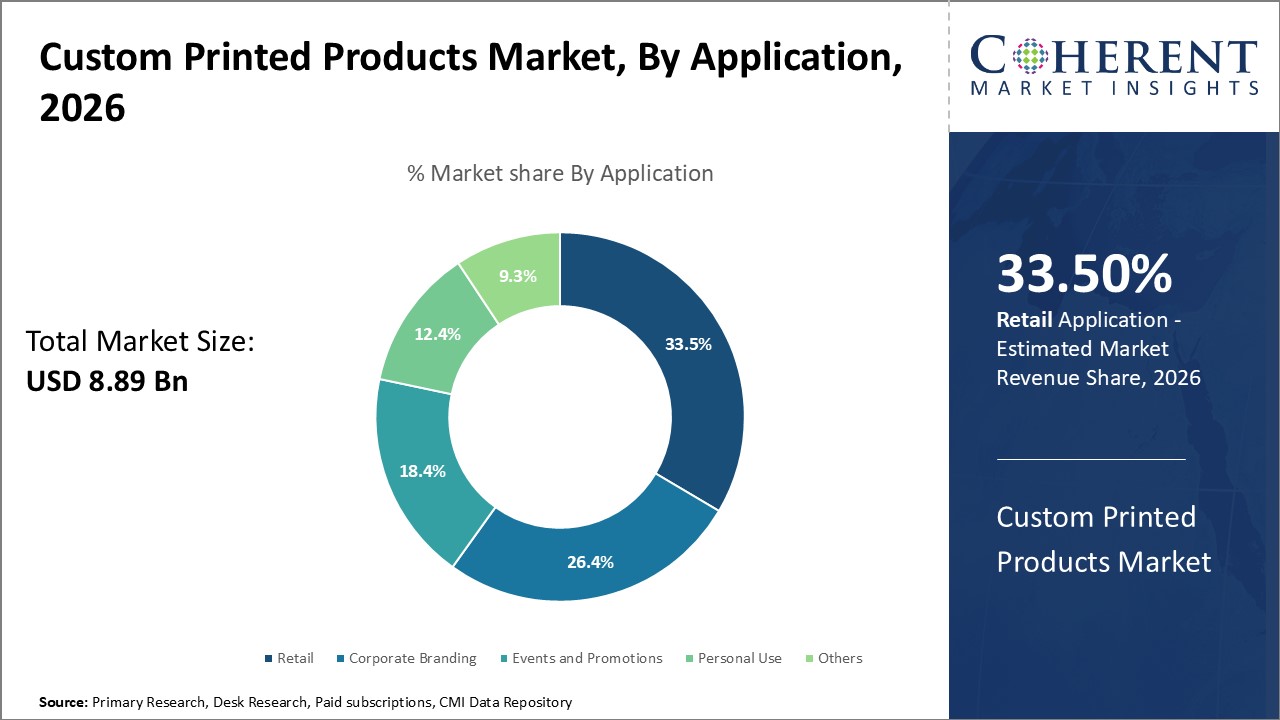
Custom Printed Products Market Insights, By Application - Retail Segment Dominates the Market Due to Its Consumer Engagement and Experience
The Retail segment is projected to hold 33.5% share of the market in 2026, due to the strong demand for tailored shopping experiences and new product offerings. Retailers have come to realize that customization creates greater customer engagement, results in greater customer satisfaction, and consequently drives brand loyalty and sales.
An important driver is greater consumer demand for exclusivity and personalization in store environments. Buying custom-printed products from retail stores or via online retailers provides customers with easy access to a broad range of customizable products from clothing to packaging and home furnishings. Retailers are increasingly introducing interactive channels such as in-store kiosks and online configurators where customers can design products in real-time, adding an entertainment, creative element to the purchase experience.
Custom Printed Products Market Insights, By Distribution Channels – Online Segment Dominates the Market Through Convenience and Customization
Online segment is set to account for 37.7% share of the market in 2026, driven by the ease of digital platforms and the broad accessibility it provides customers worldwide. Distribution channels in the online space have transformed how custom printed products are marketed, sold, and delivered, establishing themselves as the preferred channel for both customers and companies.
One of the major enablers of the online space is the capability to provide highly customizable and interactive design tools right on e-commerce sites. These tools enable customers to customize their products easily, viewing designs in real-time and making changes instantly. Ease of use through friendly interfaces lowers the hurdles to purchase and boosts consumer confidence, resulting in greater conversion rates.
Regional Insights
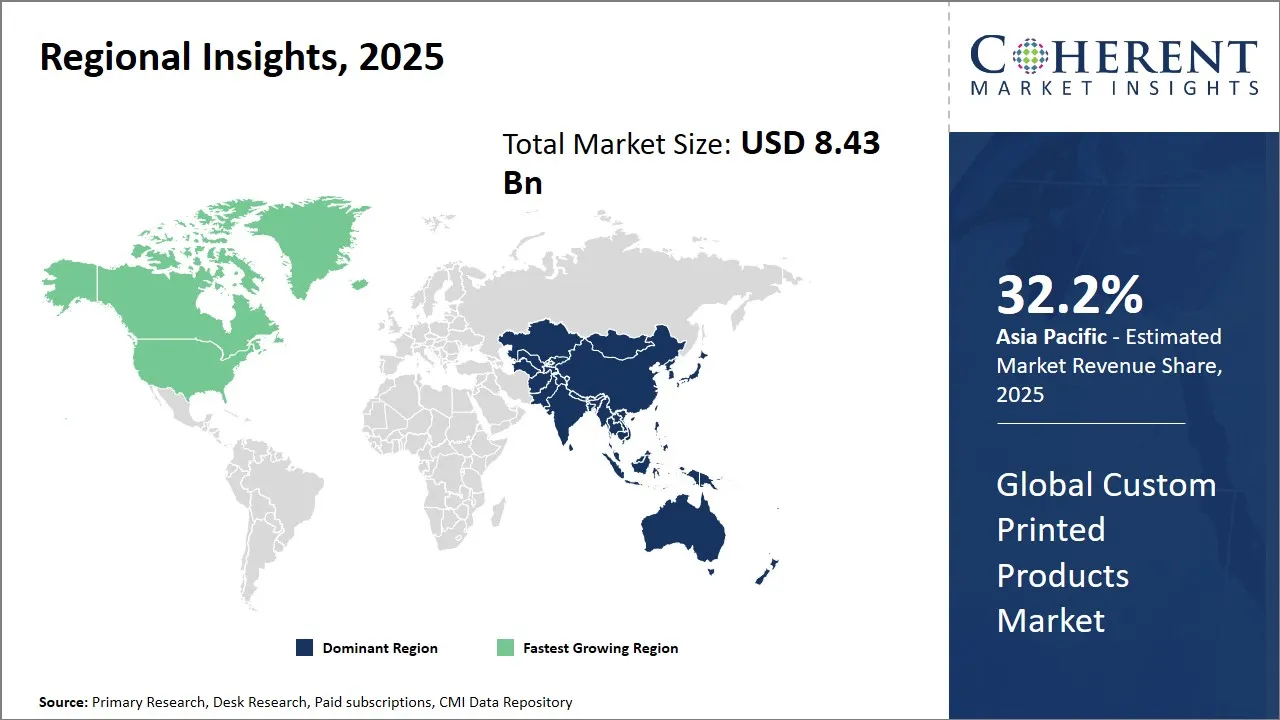
Asia Pacific Custom Printed Products Market Analysis and Trends
The Asia Pacific region is projected to lead the market with a 32.2% share in 2026, on account of its high levels of industrialization, growing e-commerce penetration, and increasing disposable incomes, especially in emerging markets such as India, China, and Southeast Asia. Government policies aimed at digital transformation and "Make in India" type manufacturing incentives have driven the uptake of custom printed products.
Also, having a huge skilled workforce and the option of low-cost production makes domestic as well as foreign companies invest heavily in the region. Well-known players like Shenzen Print Century, Alibaba Group (through custom printing websites), and Indian startups that deal in customized merchandise add significantly to the growth.
North America Custom Printed Products Market Analysis and Trends
The North America region is expected to exhibit the fastest growth in the market, contributing an estimated 23.5% share in 2026, due to a well-developed market ecosystem featuring innovative printing technologies and an established network of suppliers. The availability of prominent industry players such as VistaPrint, FedEx Office, and 3M has hastened innovation in customization services and products. In addition, favorable government policies that provide ease of business, robust e-commerce infrastructure, and growing consumer demand for customized products help increase market penetration.
Global Custom Printed Products Market Outlook for Key Countries
U.S. Custom Printed Products Market Trends
The U.S. continues to lead the North American market due to its established printing capacity, strong consumer demand for customized products, and existing base of key players including VistaPrint and FedEx Office. The nation's diversified economy caters to a wide range of industries from retail to corporate gift giving—leveraging custom printed products heavily. Small business empowerment and digitization by the government further enhance market activities, with sophisticated technologies like 3D printing and on-demand production keeping the market competitive.
Germany Custom Printed Products Market Trends
Germany's market for custom printed product relies on its strong industrial base and competency with precision engineering as part of producing custom printed products of high quality. Players like Cimpress and domestic printing technology companies lead research in eco-friendly printing technologies, supporting tight EU regulation on environmental standards. Germany is supported by an advanced logistical infrastructure and a corporate culture that focuses on product customization, particularly in the automotive and promotion industries.
China Custom Printed Products Market Trends
China's market for custom printed products is dominated by its large base of manufacturers and their fast-expanding e-commerce industry, driving custom printed product demand from packaging to clothing. Domestic industry leaders such as Shenzen Print Century and foreign partnerships improve manufacturing capabilities and cost-effectiveness. Industrial modernization and development of the digital economy-oriented government policies offer robust support.
India Custom Printed Products Market Trends
India is becoming a key player in the Asia Pacific market, fueled by increasing consumer consciousness and a booming middle class willing to pay for customized products. Local startups focused on customized products, as well as mainstream companies entering digital printing, create robust market dynamics. The government's "Make in India" program and initiatives to enhance infrastructure support manufacturing scalability, while increasing internet penetration supports online selling channels.
Brazil Custom Printed Products Market Trends
Brazil's increasing interest in customized products, supported by growing urbanization and an emerging retail market, is shaping the landscape of the Latin American custom printed products marketplace. The country’s manufacturing sector, which is encumbered by logistical and economic factors, benefits from localized customization firms, such as Printi and Localprint, who lead in innovation through regional tastes and preferences and who play an important role in creating jobs.
Macro and Micro Economic Factors Impacting Custom Printed Products Market Growth
Macroeconomic Factors
- Economic growth and rising disposable incomes, especially the growth of the middle class in emerging markets are leading increased consumer spending on personal and customized products. Urbanization and demographic trends also support expansion within the marketplace.
- Technological innovation, such as digital printing, direct-to-garment, and 3D printing allows for increased quality, speed of production, and levels of customization, which offers new avenues of growth globally.
- The expansion of e-commerce and improved internet access have enhanced the geographic reach of the marketplace, affording wider access for consumers of custom printed product through online channels.
Microeconomic Factors
- Consumer preferences for customized, personalized items for the special occasions of life, events, and corporate branding are fueling demand in the market.
- The costs of raw materials including inks, papers, and the technologies relating to printing impact both the production costs and the supply chain elements.
- Midsized businesses and individual consumers drive demand for customization for apparel, drinkware, and promotional products in particular.
Market Players, Key Development, and Competitive Intelligence
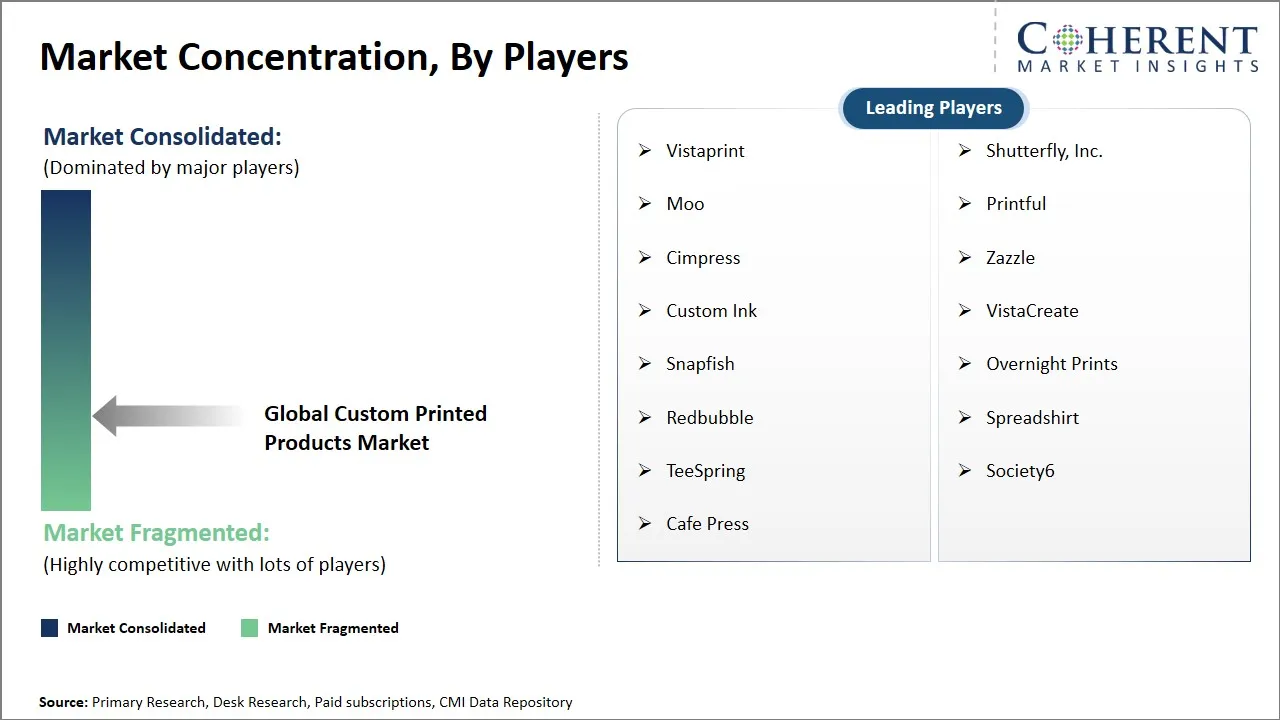
Key Developments
- In October 2025, Underground Printing (UGP), a national leader in custom printed apparel, promotional products, and licensed collegiate merchandise, announced the opening of its newest retail location at 1350 College Ave, Boulder, CO, U.S. This marks the company's 30th location and its first in Colorado, conveniently situated on campus at the University of Colorado Boulder.
Top Strategies Followed by Global Custom Printed Products Market Players
- Established market leaders continue to dominate through heavy research and development (R&D) spending, which gives them the capacity to innovate high-quality customizable products that keep pace with the shifting demands of consumers. Their R&D initiatives center on enhancing print quality, performance, durability, and environmental sustainability, all of which remain key differentiators in an often-crowded market with more manufacturers and suppliers than consumer choices.
- An example of a market leader is Custom Ink, whose success is based on offering quality custom printing services at reasonable rates for consumers and businesses ordering small quantities. Mid-sized market players are taking more of an operational approach, generating savings in their production processes. This could include exploring new technology in digital printing, which reduces setup costs, and part of the savings is transferred to the customers.
- Mid-level stakeholders in the custom printed products market have an entirely different approach, but complementary to the market leaders, offering companies with cash pricing solutions that consider both quality and cost. Their target market includes price-sensitive customers like small- to medium-sized businesses (SMEs) and value-sensitive retailers, which are often times subjected to offer custom printed products that don't sacrifice reliability for cost savings.
- For example, Printful, a print-on-demand company, underscores its commitment to using organic and sustainable fabrics to appeal to eco-friendly consumers. They also employ the latest technologies in printing, including 3D and digital textile printing, to deliver products that are highly personalized in terms of their applicability to small batches of products.
- Small-scale businesses to develop specialties in offering specific features or unique products, which larger businesses may not address. These items may range from sustainable materials to limited-edition products or employing the latest technologies in printing, like 3D printing or digital textile printing (usually stipulated by technology). Small-scale companies see a production advantage or competitiveness through time and innovation, despite large-scale companies having more resources and production volumes.
Market Report Scope
Custom Printed Products Market Report Coverage
| Report Coverage | Details | ||
|---|---|---|---|
| Base Year: | 2025 | Market Size in 2026: | USD 8.89 Bn |
| Historical Data for: | 2020 To 2024 | Forecast Period: | 2026 To 2033 |
| Forecast Period 2026 to 2033 CAGR: | 5.4% | 2033 Value Projection: | USD 12.84 Bn |
| Geographies covered: |
| ||
| Segments covered: |
| ||
| Companies covered: | Vistaprint, Shutterfly, Inc., Moo, Printful, Cimpress, Zazzle, Custom Ink, VistaCreate, Snapfish, Overnight Prints, Redbubble, Spreadshirt, TeeSpring, Society6, and Cafe Press | ||
| Growth Drivers: |
| ||
| Restraints & Challenges: |
| ||
Custom Printed Products Market Dynamics
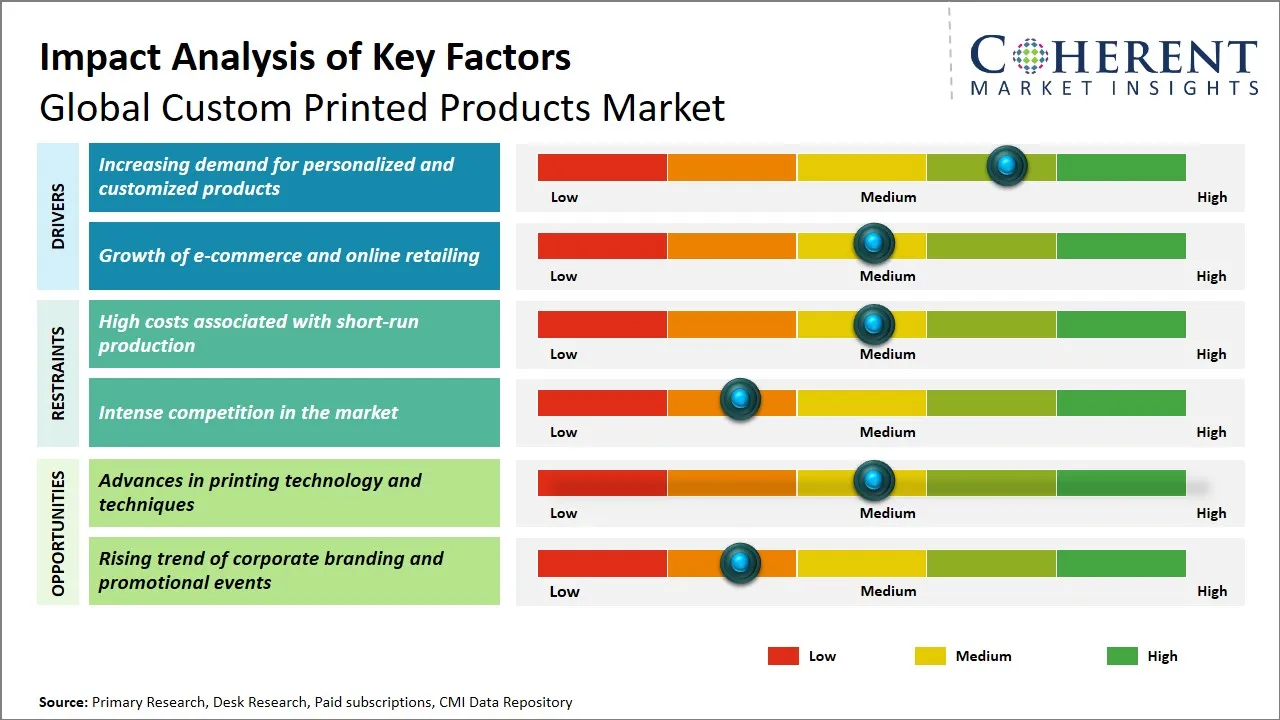
Custom Printed Products Market Driver - Increasing Demand for Personalized and Customized Products
An increasingly large consumer base is driving demand for products that allow customization and personalization. As individuals seek to express their identity or distinctiveness in societal or business norms, the desire for products that reflect personal tastes, preferences, and distinctions increases. This product personalization opportunity is present in many segments including fashion, home decorative items, promotional items, and corporate gifts, as it produces greater emotional engagement and value to consumers.
For instance, Vistaprint is a great example that offers a plethora of custom products that could consist of complete variations which could range from mugs, t-shirts, stationary long pens, etc. These products customize to a company brand which may include a logo, tagline, or any other branding to create a better emotional connection with customers or the company's employees, thus creating a companionship with a valued feeling.
Custom Printed Products Market Opportunity - Advances in Printing Technology and Techniques
The global custom printed products market is expected to grow significantly as the capability of printing technology and processes continue to advance. Developments in methods of printing such as digital printing, 3D printing, and UV printing have changed the way companies create custom printed products by offering shorter turnaround times, improved accuracy and personalization. Digital printing, in particular, is enabling shorter runs in a cost-effective way so companies can create personalized products without spending significantly more money, which increases their need for personalized products, for instance in fashion, packaging, advertising, consumer electronics, etc.
In fashion, for example, Threadless and Custom Ink are utilizing digital printing technology to offer custom on-demand apparel with low set up costs. Printing allows this process to run very smoothly, even for complex graphics. Imagine a t-shirt printed not only with a design but also an image in colors such that no traditional printing method could reproduce, even in a small run.
Analyst Opinion (Expert Opinion)
- The custom printed products market is undergoing substantial growth as demand for personalized branding & experience with individualized consumer & customer experience continues to rise. Insights from the Promotional Products Association International Expo (2023) & Custom Printing Conference (2022) revealed critical innovations, with companies including Vistaprint & Printful taking the lead to offer products and services with advanced custom elements.
- Vistaprint's recent launch of an AI-powered design tool illustrates how technology continues to enhance user engagement, while allowing small business to completely avoid original design. Conversations revealed that sustainability is very important, as brands have already started adopting sustainable Eco-responsible materials for usage in the products they have to offer.
- Brands that provide experienced forethought and conceiving value with a purposeful e-commerce platform, quality products, as well as product customization will see an increase in market share. Local artisans can help brands add needed uniqueness, while engaging the local community outside of product experience. Overall, the growth of the custom printed products market will rely on the unification of sustainability and innovation to accommodate both of small businesses and consumers.
Speak to the analyst
Want personalized insights?
Take the findings above to one of our principal consultants, or have the report rebuilt around the segments, geographies and competitors you actually track.
Market Segmentation
- Product Type Insights (Revenue, USD Bn, 2021 - 2033)
- Custom Printed Apparel
- Custom Printed Packaging
- Custom Printed Promotional Products
- Custom Printed Home Décor
- Others
- Application Insights (Revenue, USD Bn, 2021 - 2033)
- Retail
- Corporate Branding
- Events and Promotions
- Personal Use
- Others
- Distribution Channel Insights (Revenue, USD Bn, 2021 - 2033)
- Online
- Offline (Retail Stores)
- Distributors
- Others
- Regional Insights (Revenue, USD Bn, 2021 - 2033)
- North America
- U.S.
- Canada
- Latin America
- Brazil
- Argentina
- Mexico
- Rest of Latin America
- Europe
- Germany
- U.K.
- Spain
- France
- Italy
- Russia
- Rest of Europe
- Asia Pacific
- China
- India
- Japan
- Australia
- South Korea
- ASEAN
- Rest of Asia Pacific
- Middle East
- GCC Countries
- Israel
- Rest of Middle East
- Africa
- South Africa
- North Africa
- Central Africa
- North America
- Key Players Insights
- Vistaprint
- Shutterfly, Inc.
- Moo
- Printful
- Cimpress
- Zazzle
- Custom Ink
- VistaCreate
- Snapfish
- Overnight Prints
- Redbubble
- Spreadshirt
- TeeSpring
- Society6
- Cafe Press
Sources
Primary Research Interviews
- R&D Director – Leading Custom Printed Products Manufacturer
- Procurement Manager – Major Packaging Retailer
- Product Development Head – Well-Known Branding & Printing Company
- Sustainability Manager – Packaging Certification Body
Stakeholders
- Manufacturers of custom printed packaging and products
- End-use Sectors:
- Food & Beverage Packaging
- Cosmetics & Personal Care Packaging
- Pharmaceutical & Healthcare Packaging
- Retail & Promotional Products
- Regulatory & Certification Bodies
- E-commerce Platforms and Retailers
- Technology Integration Players: AI-based design and printing personalization providers
Databases
- UN Comtrade Database (custom printed products trade data)
- India Import Export (EXIM) Database (printing and packaging export/import statistics)
Magazines
- Packaging World – Trends in custom printed packaging and labeling
- PrintWeek – Innovations in printing technology and custom solutions
- Brand Packaging Magazine – Market updates on branding and printing innovations
- Specialty Graphic Imaging Association (SGIA) Journal – Industry news and printing advancements
Journals
- Journal of Imaging Science and Technology – Advances in printing materials and technology
- Packaging Technology and Science – Research on printed packaging materials and sustainability
- Journal of Graphic Engineering and Design – Trends in graphic printing and product customization
- International Journal of Industrial Ergonomics – Consumer interaction with custom printed products
Newspapers
- The Financial Times – Market growth and mergers in custom printed products sector
- The Guardian – Sustainability trends in packaging and printing
- Asia Packaging News – Growth drivers for custom printed packaging in Asia-Pacific
- European Packaging News – Regulatory updates and innovations in printed products
Associations
- Specialty Graphic Imaging Association (SGIA)
- International Label Association (ILA)
- Printing Industries of America (PIA)
- European Federation of Printing and Digital Communication (Intergraf)
- Sustainable Packaging Coalition
Public Domain Sources
- FDA – Guidelines for packaging materials and labeling requirements
- European Commission – Regulations on packaging and printed products
- World Health Organization – Safety standards for packaging in healthcare sector
- OECD – Environmental and safety assessments for printed product materials
Proprietary Elements
- CMI Data Analytics Tool, Proprietary CMI Existing Repository of information for last 8 years.
Get access to 250+ pages report
Every segment, forecast, competitor profile and data table behind the analysis above — available for instant download.
- ESOMAR Member
- ISO 9001:2015 Certified
- D-U-N-S Registered
- GDPR & CCPA Compliant
Missing comfort of reading report in your local language? Find your preferred language:
Transform your Strategy with Exclusive Trending Reports
Frequently Asked Questions
The global custom printed products market is estimated to be valued at USD 8.89 Bn in 2026 and is expected to reach USD 12.84 Bn by 2033.
The CAGR of global custom printed products market is projected to be 5.4% from 2026 to 2033.
Increasing demand for personalized and customized products and growth of e-commerce and online retailing are the major factors driving the growth of global custom printed products market.
High costs associated with short-run production and intense competition in the market are the major factors hampering the growth of global custom printed products market.
In terms of Product Type, Custom Printed Apparel segment is estimated to dominate the market revenue share in 2026.
Vistaprint, Shutterfly, Inc., Moo, Printful, Cimpress, Zazzle, Custom Ink, VistaCreate, Snapfish, Overnight Prints, Redbubble, Spreadshirt, TeeSpring, Society6, and Cafe Press are the major players.
Asia Pacific is expected to lead the global custom printed products market in 2026.