

Global Dairy Processing Equipment Market Size and Forecast – 2026 To 2033
The Global Dairy Processing Equipment Market is estimated to be valued at USD 12.42 Bn in 2026 and is expected to reach USD 19.68 Bn by 2033, exhibiting a compound annual growth rate (CAGR) of 6.8% from 2026 to 2033. Market growth is supported by increasing consumption of processed and value-added dairy products, modernization of production facilities, and expansion of milk-processing capacity across developed and emerging economies.
Processors are investing in advanced milk reception, pasteurization, separation, cheese production, automation, and hygienic handling systems to improve throughput and product consistency. In April 2026, Lactalis Canada opened a USD 16.4 million milk-receiving facility at its Winchester cheese plant, increasing milk-receiving capacity by approximately 25% to two million liters per day and supporting higher processing output.
Key Takeaways of the Global Dairy Processing Equipment Market
- Pasteurizers are expected to account for the largest share of 21.8 % in 2026, as they remain essential for microbial control, shelf-life extension, and regulatory compliance across milk, cream, yogurt, and cheese lines. In January 2025, Alfa Laval introduced Extend, an add-on designed to reduce bacterial build-up in heat exchangers and extend pasteurizer operating time between cleaning cycles.
- Automatic equipment is projected to command 57.6 % of the market share in 2026 because large dairy plants require repeatable product quality, continuous throughput, automated clean-in-place cycles, traceability, and reduced manual intervention. In August 2025, Rockwell Automation detailed an integrated automation and control architecture implemented for a greenfield bulk cheese and whey facility, supporting coordinated process and power operations.
- Processed milk is expected to account for the largest share of 30.8 % in 2026, reflecting its high production volumes and requirement for integrated separation, standardization, homogenization, pasteurization, cooling, and packaging lines. In December 2025, Walmart opened a USD 350 million milk processing facility in Georgia to strengthen its supply chain for affordable private-label milk.
- Asia Pacific is expected to dominate with a 35.8 % of the market share in 2026, supported by expanding packaged-dairy consumption, large milk pools, cooperative modernization, and investment in chilling and processing infrastructure. In April 2026, India’s Ministry of Cooperation announced milk processing units, cooling systems, mobile testing facilities, and an automated milk collection system for Ladakh, illustrating continuing regional infrastructure upgrades.
- Europe is expected to be the fastest-growing region and hold a 28.4 % share in 2026, as processors replace aging assets, improve energy efficiency, and expand capacity for shelf-stable and value-added dairy products. In February 2025, Arla proposed investing USD 123.0 million in a UHT Centre of Excellence at Lockerbie, Scotland, strengthening advanced long-life milk processing capacity.
- Digital and Predictive Processing: Dairy processors are moving from isolated machine automation toward connected production environments integrating sensors, manufacturing execution systems, predictive maintenance, and real-time quality control. This transition improves line availability, reduces unplanned stoppages, strengthens batch traceability, and enables faster product changeovers. Equipment suppliers offering interoperable software, remote diagnostics, and lifecycle services will gain stronger recurring-revenue opportunities.
- Resource-Efficient Thermal Processing: Energy-intensive pasteurization, evaporation, drying, and clean-in-place operations are becoming central targets for cost and emissions reduction. Heat recovery, electrified heating, optimized water circulation, and low-loss hygienic design are increasingly influencing equipment purchasing decisions. Suppliers that demonstrate measurable utility savings without compromising food safety can secure premium positioning and accelerate replacement demand across mature dairy plants.
Segmental Insights
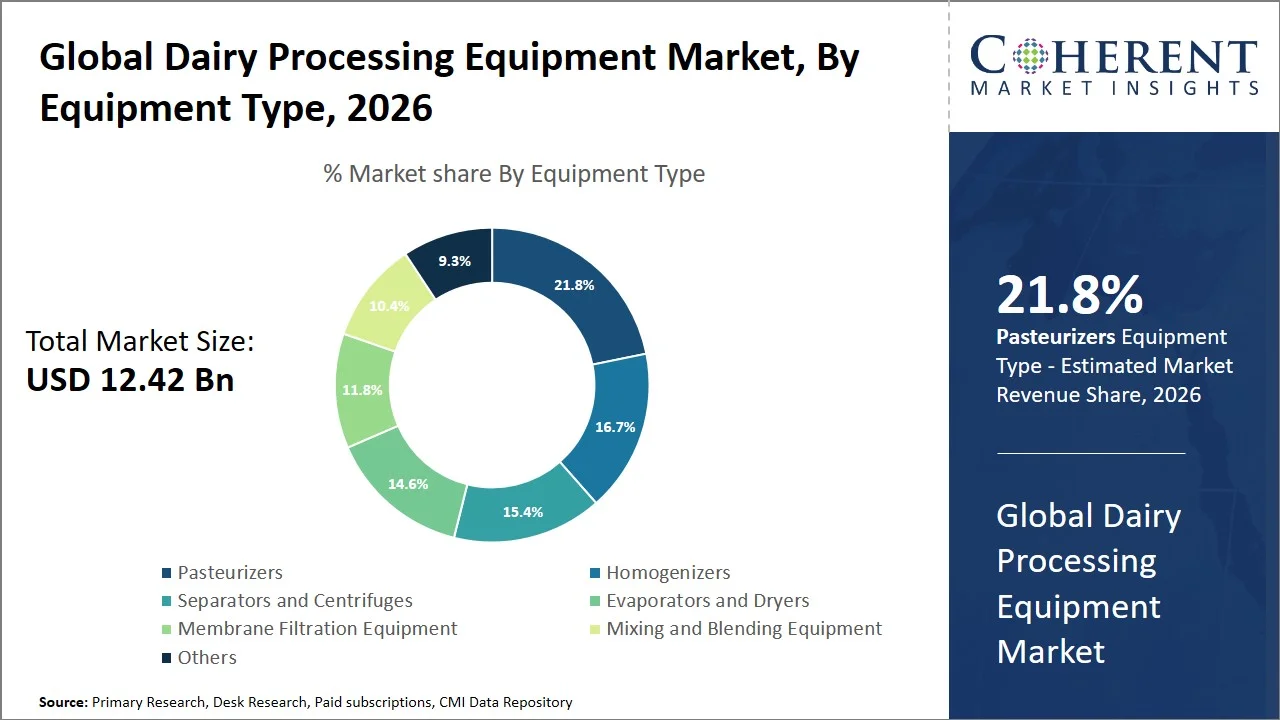
Why Do Pasteurizers Dominate the Global Dairy Processing Equipment Market?
Pasteurizers are expected to account for 21.8% of the global dairy processing equipment market in 2026. Their leadership reflects their position as a critical thermal-control stage across fluid milk, cream, cultured-product bases, cheese milk, and extended-shelf-life processing lines. Demand is supported by processors seeking reliable microbial control, longer distribution windows, and consistent sensory characteristics across high-throughput operations. Unlike equipment dedicated to a single dairy category, pasteurizers can support multiple product formats, improving asset utilization and strengthening replacement demand. Modern systems incorporate regenerative heat exchange, automated holding-temperature control, clean-in-place compatibility, and energy-recovery technologies. In November 2025, Tetra Pak launched an integrated heat-pump system for pasteurizers that recovers waste heat and supplies simultaneous heating and cooling for chilled milk, cheese, and ambient-milk pre-treatment applications.
- Current Industry Events of 2026
- Market Size Estimation
- Regional Breakdown
- Competitive Landscape
- Customer Intelligence
- Segmental Analysis
- Pricing Analysis
- Key Market Drivers, Challenges & Future Trends
- Customized Insights Section
Why Does Automatic Equipment Represent the Largest Automation Level Segment in the Global Dairy Processing Equipment Market?
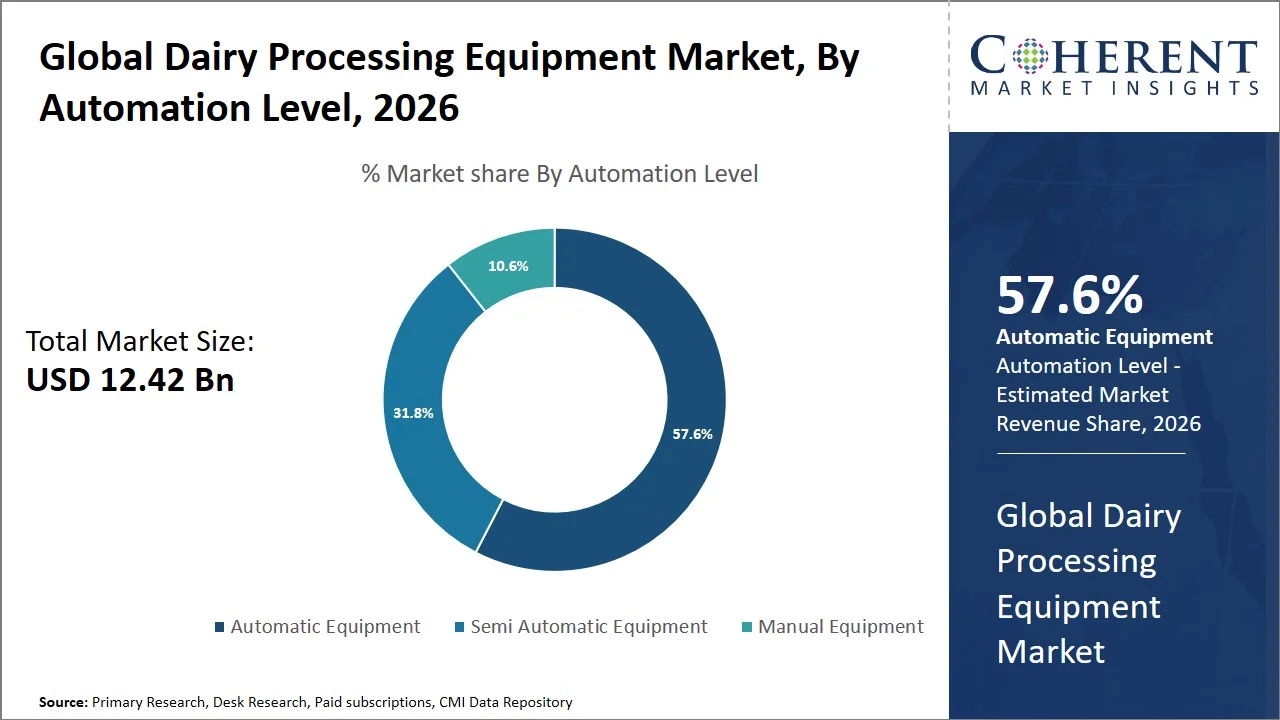
Automatic equipment is projected to represent 57.6% of the market share in 2026 because dairy plants require seamless coordination of continuous, hygiene-sensitive processes, including milk reception, separation, standardization, processing, cleaning, and filling. Large processors require recipe control, synchronized valves and pumps, automated clean-in-place sequencing, and digital production records to reduce operator-dependent variation. Demand is particularly strong in multi-product facilities where rapid changeovers and precise control of temperature, pressure, flow, and formulation protect yield and brand consistency. Supply-side adoption is advancing through AI-based condition monitoring, integrated maintenance platforms, and connected controls that improve asset availability without proportionate labor growth. In June 2025, Siemens announced the deployment of Senseye Predictive Maintenance at Sachsenmilch’s highly automated milk-processing facility, using AI algorithms to anticipate equipment issues and support continuous production of milk, butter, yogurt, cheese, and dairy derivatives.
Why Does Processed Milk Dominate the Global Dairy Processing Equipment Market?
Processed milk is expected to hold the largest application share of 30.8% in 2026 because it is produced and consumed more frequently than most value-added dairy categories. The demand for pasteurized, lactose-free, fortified, flavored, and ultra-filtered milk creates recurring equipment requirements across clarification, fat standardization, homogenization, filtration, thermal treatment, cooling, and hygienic storage. Processors also require flexible lines capable of handling multiple fat levels and functional formulations while maintaining consistent taste and shelf stability. This broad product base supports both greenfield investment in developing dairy economies and modernization of established plants serving retail and foodservice channels. In April 2025, The Coca-Cola Company reported continued strong volume growth for fairlife, whose portfolio includes lactose-free ultra-filtered milk and high-protein dairy beverages, illustrating how premium processed-milk formats are supporting the demand for advanced filtration, blending, heat-treatment, and filling capabilities.
Global Dairy Processing Equipment Market Dynamics
Key Market Drivers
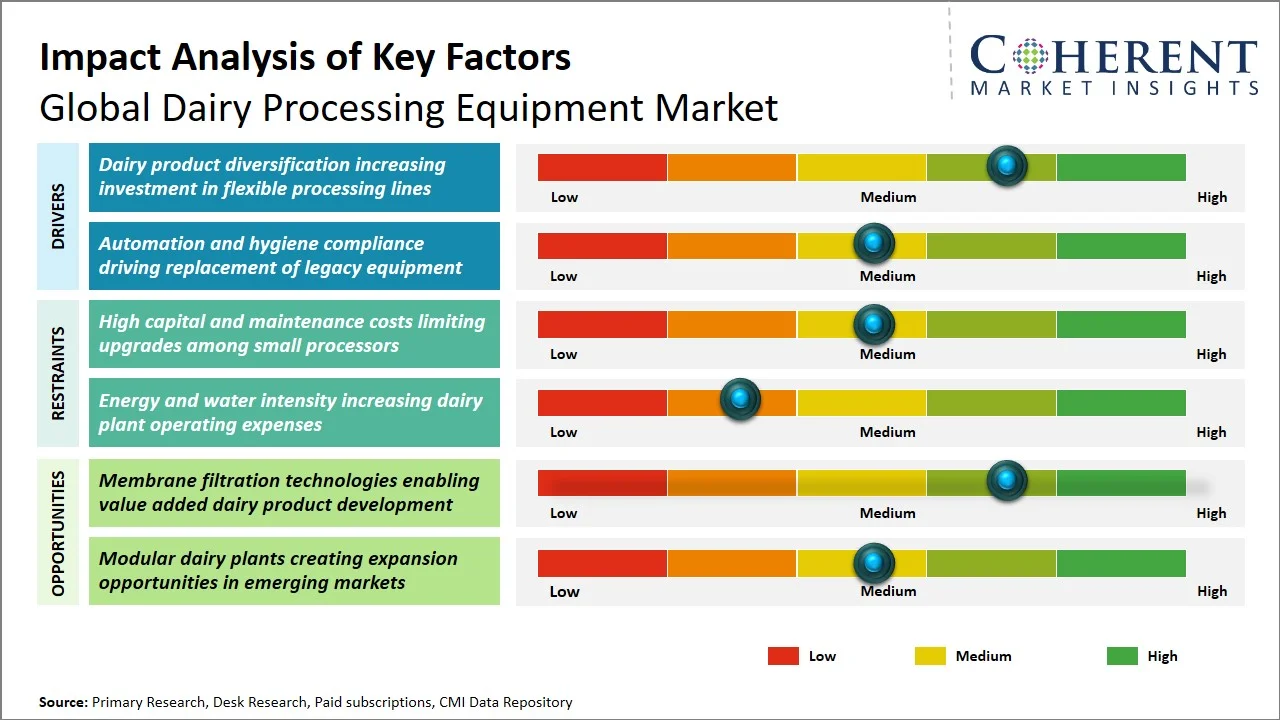
- Dairy Product Diversification Increasing Investment in Flexible Processing Lines: Dairy processors are expanding beyond standard fluid milk into high-protein beverages, functional yogurt, lactose-free products, specialty cream, cultured products, and premium butter. This diversification increases the demand for modular lines that can manage frequent recipe changes, varying viscosities, multiple heat-treatment profiles, and short production campaigns without excessive product loss. Flexible equipment also allows processors to test new formulations and scale successful products while using common utilities, clean-in-place systems, and automation platforms. This improves capital utilization and reduces the risk associated with product-specific plants. In September 2024, Meiji announced a new Kanagawa smart factory designed with production lines compatible with high-mix manufacturing, new product forms, automated material feeding, remote monitoring, and lower water use. The project illustrates how changing consumer requirements are influencing dairy processors to consolidate varied products within advanced, adaptable facilities.
- Automation and Hygiene Compliance Driving Replacement of Legacy Equipment: Legacy dairy plants face increasing pressure to deliver consistent microbial control, documented cleaning performance, reliable traceability, and uninterrupted output with fewer skilled operators. Replacement spending is therefore shifting toward sensor-equipped equipment, automated clean-in-place sequencing, predictive maintenance, and centrally controlled valves, pumps, evaporators, and dryers. These upgrades reduce operator-dependent variation, identify deterioration before shutdowns, and create electronic records that support customer audits and regulatory inspections. They also extend useful asset life through condition-based interventions rather than emergency repair. In September 2025, GEA launched InsightPartner EvoHDry for dairy and beverage plants, providing real-time monitoring of temperature, pressure, vibration, and flow across evaporators, spray dryers, pumps, rotating equipment, and clean-in-place systems. The solution demonstrates how equipment manufacturers are converting maintenance, hygiene, and reliability requirements into digital-service and plant-modernization opportunities.
Emerging Market Trends
- Modular and Reconfigurable Multiproduct Processing Lines: Dairy processors are moving toward skid-mounted, modular process blocks that can be added, reconfigured, or bypassed as product portfolios change. Standardized interfaces between separation, filtration, blending, homogenization, heat treatment, fermentation, and cleaning systems reduce engineering time and simplify future expansion. This is particularly relevant for processors serving fragmented consumer demand across protein-enriched drinks, lactose-free milk, cultured products, specialty cheese, and foodservice ingredients. Modular plants also permit phased investment, enabling operators to install essential capacity first and add higher-value processing steps once demand is validated. Equipment suppliers will increasingly compete through pre-engineered modules, recipe libraries, rapid commissioning, and compatibility with third-party controls. The trend supports smaller batch sizes and faster innovation while preserving industrial hygiene, making operational flexibility an important purchasing criterion alongside throughput, energy consumption, and initial capital cost.
- Electrified Thermal Processing and Water-Smart Plant Operations: Thermal processing and cleaning account for a substantial portion of dairy-plant utility consumption, placing electrification, heat recovery, and water reuse at the center of equipment redesign. Heat pumps, mechanical vapor recompression, regenerative pasteurization, optimized spray drying, and endpoint-controlled cleaning can lower exposure to fuel, water, and wastewater costs. The commercial focus is shifting from standalone machine efficiency toward site-wide utility integration, where heating and cooling requirements are balanced across pasteurizers, evaporators, fermentation tanks, cold stores, and clean-in-place circuits. This favors suppliers capable of combining process engineering with refrigeration, automation, and energy-management expertise. Adoption will be strongest where processors can retrofit resource-saving technologies without disrupting validated product conditions. Over time, verified reductions in utilities and emissions will become more influential in equipment procurement, financing, retailer negotiations, and export-oriented sustainability reporting.
Current Events and their Impact
Current Events | Description and its Impact |
July 2026 – U.S. FDA traceability enforcement deferred until July 2028 |
|
February 2025 – EU Packaging and Packaging Waste Regulation entered into force |
|
January 2025 – EU restrictions tightened for high-GWP industrial refrigeration equipment |
|
Regional Insights
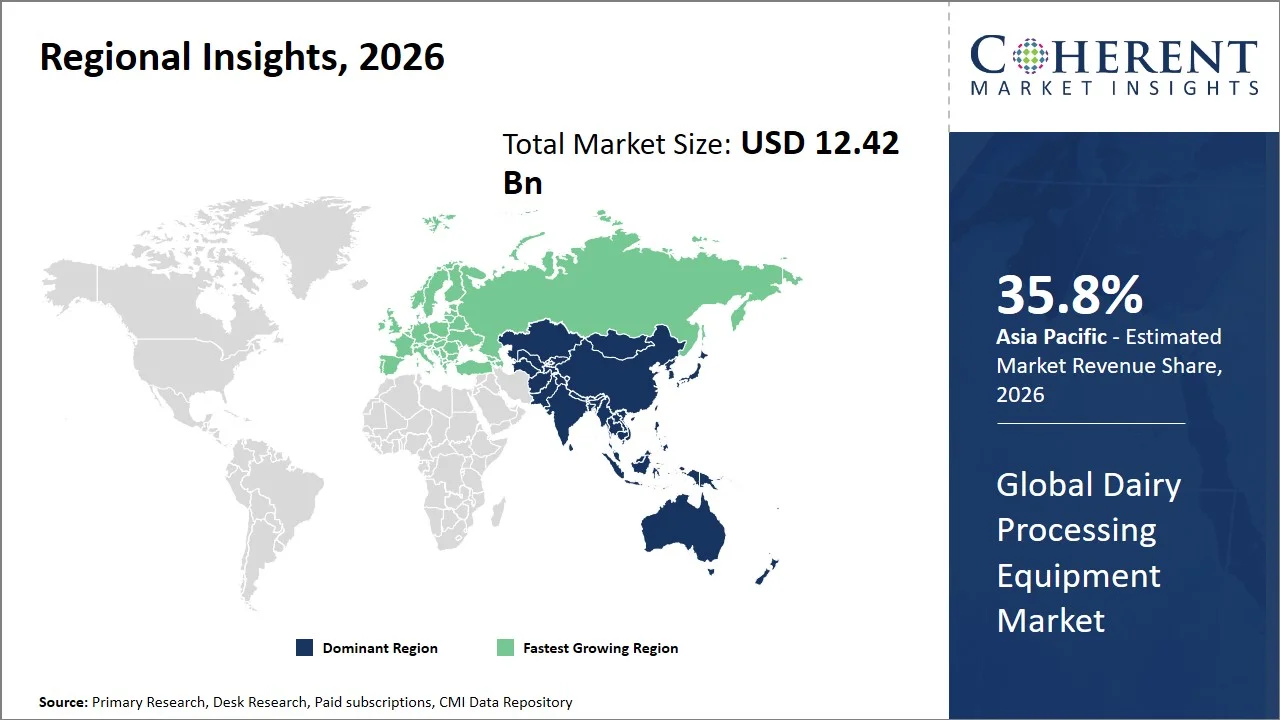
Why Does Asia Pacific Dominate the Global Dairy Processing Equipment Market?
Asia Pacific is expected to dominate the global dairy processing equipment market with a 35.8% share in 2026. Regional leadership is supported by large milk pools, expanding organized dairy procurement, rising consumption of packaged milk and cultured products, and continuous investment in high-capacity plants. China and India provide substantial processing scale, while Japan, Australia, and New Zealand contribute advanced engineering, export-oriented quality systems, and specialized ingredient production. Equipment demand spans pasteurization, separation, homogenization, membrane filtration, evaporation, drying, and automated clean-in-place systems. The region also benefits from expanding domestic equipment manufacturing and local technical-service networks. In August 2025, Mengniu reported that its Wuhan plant used full-process traceability, intelligent management, and high-speed warehousing to support large-scale dairy output, illustrating Asia Pacific’s transition toward digitally integrated processing infrastructure.
Why is Europe Emerging as the Fastest-Growing Region in the Global Dairy Processing Equipment Market?
Europe is expected to be the fastest-growing region and account for 28.4% of the global dairy processing equipment market in 2026. Growth is being shaped by the replacement of aging assets, stringent hygienic-design expectations, low-carbon production targets, and demand for premium cheese, cultured products, dairy proteins, and extended-shelf-life milk. Processors are prioritizing automation, heat recovery, low-GWP refrigeration, water-efficient cleaning, and flexible lines that accommodate smaller product runs. The region’s mature dairy base creates recurring retrofit opportunities rather than relying only on greenfield plants. In May 2025, Valio announced a USD 34.26 million investment in a new automated cheese maturation warehouse at its Joensuu plant, alongside the relocation of slicing, grating, and processed-cheese operations. The project demonstrates how European processors are consolidating production and modernizing downstream handling to improve efficiency and product flexibility.
Global Dairy Processing Equipment Market Outlook for Key Countries
Why is the U.S. a Key Market for the Dairy Processing Equipment Market?
The U.S. is a key market for dairy processing equipment because it combines large-scale milk production with strong demand for yogurt, cheese, high-protein beverages, lactose-free milk, whey ingredients, and private-label dairy products. Processors require high-throughput systems capable of meeting strict food-safety, traceability, labor-efficiency, and cold-chain requirements across geographically dispersed supply networks. Investment is increasingly concentrated in ultrafiltration, aseptic filling, cultured-product lines, automated warehousing, and advanced cleaning systems. The country also supports equipment demand through state incentives and an established engineering and maintenance ecosystem. In April 2025, New York State announced that Chobani would build a USD 1.2 billion, 1.4 million-square-foot facility in Rome, New York, designed to produce more than one billion pounds of dairy products annually. The project highlights continuing demand for integrated, high-capacity processing, filling, packaging, and warehouse infrastructure.
Why is India Important in the Global Dairy Processing Equipment Market?
India is important in the global dairy processing equipment market because its milk supply is highly fragmented while demand for packaged, safe, and value-added dairy products continues to expand. This creates substantial need for collection, chilling, testing, pasteurization, fermentation, powder production, and hygienic packaging systems connecting village-level procurement with regional processing hubs. Cooperatives and private dairies are investing in curd, paneer, milk powder, flavored milk, and whey products to improve realization from seasonal milk surpluses. Domestic equipment manufacturing supports cost-sensitive projects, while imported technologies remain relevant for advanced filtration, drying, and automation. In June 2025, the National Dairy Development Board reported the foundation-stone laying of a state-of-the-art milk powder plant at Medha Dairy in Ranchi. The project demonstrates how regional capacity additions are expanding demand for evaporation, spray drying, powder handling, automated cleaning, and quality-control equipment.
Why Does China Support Growth in the Global Dairy Processing Equipment Market?
China supports growth in the global dairy processing equipment market through its large consumer base, extensive food-manufacturing infrastructure, and rapid adoption of digital production systems. Demand is shifting from standard liquid milk toward chilled yogurt, functional beverages, infant nutrition, cheese, ice cream, and specialized dairy ingredients, requiring processors to install flexible and highly automated lines. Domestic manufacturers benefit from industrial clusters covering stainless-steel fabrication, robotics, sensors, packaging, and process controls, while leading dairy groups continue to benchmark international hygiene and quality standards. In July 2025, Yili highlighted its work across advanced dairy processing, maternal and infant nutrition, and sustainable manufacturing at the Global Dairy Congress. The company also reported an international network of innovation centers, demonstrating how Chinese processors are linking research with commercial-scale production. This model supports investment in precision formulation, separation, thermal processing, and digitally controlled equipment.
Why is Germany a Strategic Country in the Dairy Processing Equipment Market?
Germany is a strategic country in the global dairy processing equipment market because it combines a large dairy industry with advanced mechanical engineering, automation, hygienic design, and export-oriented food processing. German processors operate across cheese, milk powders, infant nutrition, whey proteins, ice cream, and specialized ingredients, creating demand for equipment that delivers narrow process tolerances and documented quality consistency. Sustainability requirements and high energy costs are also accelerating adoption of heat recovery, efficient evaporation, low-loss cleaning, and predictive maintenance. In May 2026, DMK Group commissioned a USD 28.55 million lactoferrin production plant at Altentreptow. The facility requires advanced protein separation, strict traceability, reproducible product specifications, and high product-safety controls. This development illustrates Germany’s growing focus on high-value dairy ingredients and creates opportunities for specialized filtration, purification, drying, hygienic handling, and process-control technologies.
Why is New Zealand an Important Growth Market for the Dairy Processing Equipment Market?
New Zealand is an important growth market for dairy processing equipment because its dairy sector is highly export-oriented and depends on converting large seasonal milk volumes into milk powder, butter, cheese, cream, proteins, and specialty ingredients. Processing plants therefore require reliable evaporation, spray drying, separation, membrane filtration, automated cleaning, and bulk-material handling systems capable of operating at high utilization during peak milk periods. Export-market access also places strong emphasis on traceability, hygiene validation, energy efficiency, and consistent product specifications. In June 2026, New Zealand’s Ministry for Primary Industries forecast dairy export revenue at a record level for the year ending June 2026, supported by strong international prices. This export dependence encourages processors to maintain modern, high-capacity facilities and invest in equipment that improves product recovery, manufacturing flexibility, resource efficiency, and compliance with multiple destination-market standards.
Technology Adoption Landscape in the Global Dairy Processing Equipment Market
Technology | Adoption Level | Key Application Area | Business Impact |
PLC, SCADA, and MES-Based Process Automation | High | Milk reception, standardization, pasteurization, fermentation, drying, and filling | Coordinates recipes and equipment sequences, improves batch consistency, strengthens traceability, and reduces operator-dependent errors. |
Automated CIP and SIP Systems | High | Pasteurizers, tanks, pipelines, membrane systems, evaporators, and fillers | Controls cleaning time, temperature, chemical concentration, and rinse endpoints while supporting documented hygiene compliance. |
Ultrafiltration, Nanofiltration, and Reverse Osmosis | High | Whey concentration, protein standardization, lactose reduction, and water removal | Enables higher-value ingredient recovery, reduces thermal load, improves yield, and creates differentiated dairy formulations. |
Inline Optical and Compositional Sensors | Medium | Fat, protein, solids, moisture, color, and fermentation monitoring | Provides real-time quality control, reduces laboratory delays, supports automatic process correction, and limits off-specification production. |
Industrial Heat Pumps and Mechanical Vapor Recompression | Medium | Pasteurization, evaporation, drying, hot-water generation, and refrigeration | Reuses low-grade process heat, reduces fossil-fuel dependence, and lowers energy exposure across thermal operations. |
AI-Enabled Predictive Maintenance and Digital Twins | Medium | Separators, homogenizers, pumps, evaporators, dryers, and refrigeration systems | Anticipates component failure, improves maintenance scheduling, supports virtual process optimization, and reduces unplanned downtime. |
How are Modular Processing and Resource-Efficient Retrofits Creating New Growth Opportunities in the Global Dairy Processing Equipment Market?
The strongest growth opportunity lies in modular, resource-efficient lines for value-added dairy products and modernization of mid-sized processing plants. Demand is expanding for lactose-free milk, high-protein beverages, cultured products, specialty cheese, whey ingredients, and extended-shelf-life formats, yet many processors lack equipment capable of handling short runs, complex formulations, and strict cleaning transitions economically. Suppliers can address this gap through pre-engineered skids combining filtration, blending, homogenization, thermal treatment, fermentation, and automated cleaning. Such systems reduce project risk, shorten commissioning, and allow capacity to be added in stages. Retrofit packages for heat recovery, predictive maintenance, inline quality measurement, low-water cleaning, and low-GWP refrigeration create an additional service-led opportunity within existing facilities. Commercially, this shifts the market from one-time machinery sales toward lifecycle partnerships covering process design, software, optimization, validation, spare parts, and performance guarantees. Vendors that make advanced processing accessible to regional dairies can expand customer reach while helping processors enter premium domestic and export categories.
Market Players, Key Development, and Competitive Landscape
Key Developments
- In October 2025, Fonterra announced an investment in a new butter production line at its Clandeboye facility. The line will manufacture multiple butter formats for ingredients customers and professional kitchens while supporting Halal and Kosher requirements. This is important for the dairy processing equipment market because it demonstrates continuing investment in specialized, export-oriented equipment capable of serving diversified customer specifications.
- In September 2025, INOXPA introduced the UltiLobe hygienic rotary lobe pump for dairy and other sanitary-processing applications. The product supports clean-in-place and sterilization-in-place operations, self-draining configurations, multiple rotor options, and higher-capacity fluid handling. This is important because pumps designed for varied viscosity and strict hygiene conditions improve flexibility across milk, cream, yogurt, cheese, and concentrated dairy-product lines.
- In March 2025, SPX FLOW expanded its Enhanced Classic Line with Quick Connect and Side Entry portable mixers for hygiene-sensitive processing. The systems offer retrofit compatibility, polished finishes, hygienic seals, faster installation, and simplified maintenance. This is important for the dairy processing equipment market because it supports flexible upgrades to existing blending and formulation operations without requiring complete line replacement.
Competitive Landscape
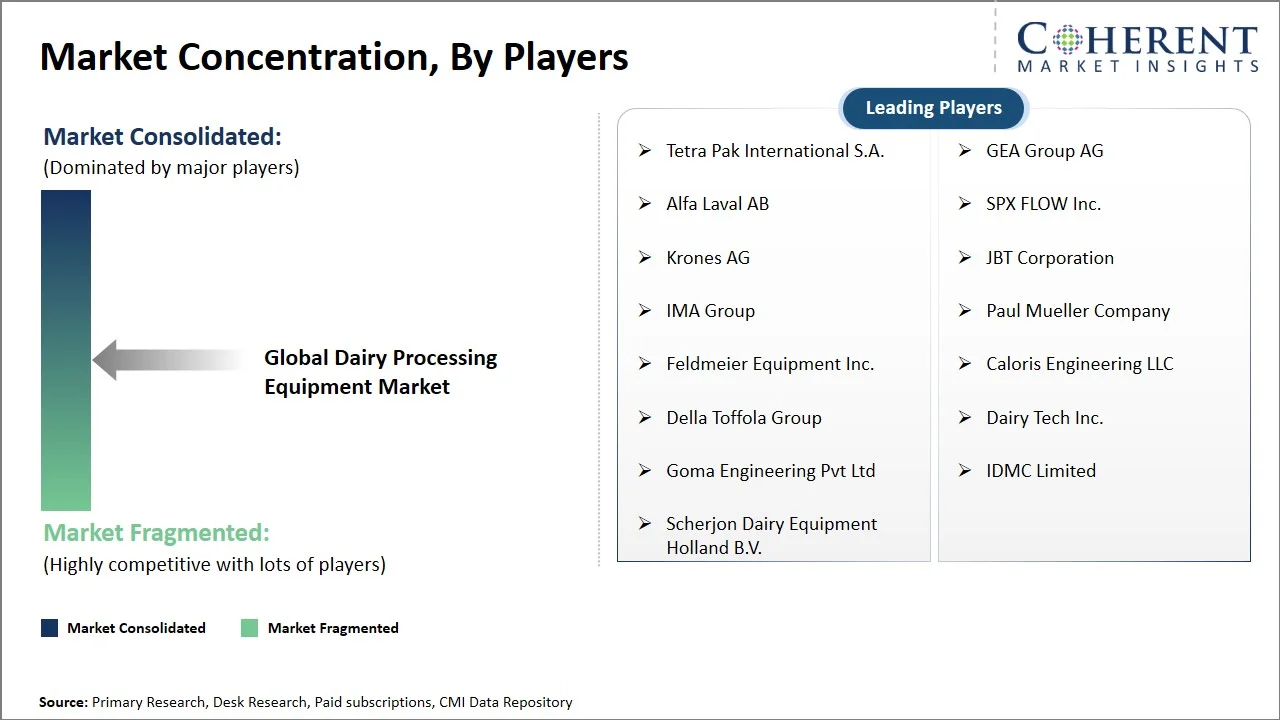
The global dairy processing equipment market is moderately consolidated among full-line engineering and automation suppliers, while individual equipment categories, components, and regional integration services remain fragmented. Competition is shaped by processors’ preference for hygienically designed, scalable systems supported by strong commissioning, validation, maintenance, and spare-parts capabilities.
Key focus areas include
- Product quality and differentiation: Suppliers compete through processing accuracy, hygienic design, product recovery, gentle handling, cleanability, and consistent output quality.
- Automation and process integration: Integrated controls connecting milk intake, processing, utilities, cleaning, and filling are becoming important differentiators.
- Energy and water efficiency: Equipment performance is increasingly evaluated through heat recovery, electricity consumption, water use, chemical consumption, and wastewater generation.
- Pricing and lifecycle economics: Purchase price remains important, but processors increasingly assess uptime, maintenance cost, yield loss, cleaning time, and equipment lifespan.
- Capacity and configuration flexibility: Vendors offer equipment across batch, continuous, modular, and high-capacity configurations to serve regional dairies and multinational processors.
- Certifications and hygienic compliance: Food-contact materials, weld quality, surface finish, sanitary design, pressure certification, and clean-in-place validation influence supplier approval.
- Service network and spare-parts availability: Local technical support, remote diagnostics, operator training, and rapid access to critical components strengthen customer retention.
- Engineering partnerships: Turnkey design, utility integration, process guarantees, contract manufacturing support, and long-term service agreements are becoming central to competitive positioning.
Market Report Scope
Dairy Processing Equipment Market Report Coverage
| Report Coverage | Details | ||
|---|---|---|---|
| Base Year: | 2025 | Market Size in 2026: | USD 12.42 Bn |
| Historical Data for: | 2020 To 2024 | Forecast Period: | 2026 To 2033 |
| Forecast Period 2026 to 2033 CAGR: | 6.8% | 2033 Value Projection: | USD 19.68 Bn |
| Geographies covered: |
| ||
| Segments covered: |
| ||
| Companies covered: | Tetra Pak International S.A., GEA Group AG, Alfa Laval AB, SPX FLOW Inc., Krones AG, JBT Corporation, IMA Group, Paul Mueller Company, Feldmeier Equipment Inc., Caloris Engineering LLC, Della Toffola Group, Dairy Tech Inc., Goma Engineering Pvt Ltd, IDMC Limited, and Scherjon Dairy Equipment Holland B.V. | ||
| Growth Drivers: |
| ||
| Restraints & Challenges: |
| ||
Analyst Opinion (Expert Opinion)
- Future leadership in the dairy processing equipment market will increasingly depend on guaranteed processing outcomes rather than equipment specifications alone. Processors are likely to favor suppliers that deliver measurable gains in yield, uptime, product consistency, cleaning performance, and utility efficiency. This will shift competition toward lifecycle contracts, remote optimization, predictive service, and integrated responsibility across entire processing sections.
- The convergence of electrified thermal processing, membrane separation, automated cleaning, and real-time quality control can significantly improve dairy plant economics. Integrated systems help reduce thermal damage, recover higher-value milk components, shorten quality-release cycles, and support multiple product formats on shared infrastructure. Manufacturers should therefore prioritize connected processing platforms over standalone machines, especially for value-added milk, cultured products, cheese, and dairy proteins.
- Asia Pacific will remain a key region for new processing capacity, while Europe will see strong replacement demand driven by energy efficiency, water conservation, refrigeration compliance, and digital traceability. Major challenges include high capital costs, long payback periods, skilled labor shortages, fragmented control systems, and retrofit disruptions. Suppliers offering modular installation, open automation, financing support, cybersecurity, and measurable performance guarantees will be best positioned for long-term advantage.
Speak to the analyst
Want personalized insights?
Take the findings above to one of our principal consultants, or have the report rebuilt around the segments, geographies and competitors you actually track.
Market Segmentation
- Equipment Type Insights (Revenue, USD Bn, 2021 - 2033)
- Pasteurizers
- Homogenizers
- Separators and Centrifuges
- Evaporators and Dryers
- Membrane Filtration Equipment
- Mixing and Blending Equipment
- Others
- Automation Level Insights (Revenue, USD Bn, 2021 - 2033)
- Automatic Equipment
- Semi Automatic Equipment
- Manual Equipment
- Application Insights (Revenue, USD Bn, 2021 - 2033)
- Processed Milk
- Cheese
- Yogurt and Fermented Products
- Milk Powder
- Butter and Cream
- Ice Cream and Frozen Dairy
- Others
- Processing Capacity Insights (Revenue, USD Bn, 2021 - 2033)
- Below 10,000 Liters per Day
- 10,000 to 100,000 Liters per Day
- 100,000 to 500,000 Liters per Day
- Above 500,000 Liters per Day
- Regional Insights (Revenue, USD Bn, 2021 - 2033)
- North America
- U.S.
- Canada
- Latin America
- Brazil
- Argentina
- Mexico
- Rest of Latin America
- Europe
- Germany
- U.K.
- Spain
- France
- Italy
- Russia
- Rest of Europe
- Asia Pacific
- China
- India
- Japan
- Australia
- South Korea
- ASEAN
- Rest of Asia Pacific
- Middle East
- GCC Countries
- Israel
- Rest of Middle East
- Africa
- South Africa
- North Africa
- Central Africa
- North America
- Key Players Insights
- Tetra Pak International S.A.
- GEA Group AG
- Alfa Laval AB
- SPX FLOW Inc.
- Krones AG
- JBT Corporation
- IMA Group
- Paul Mueller Company
- Feldmeier Equipment Inc.
- Caloris Engineering LLC
- Della Toffola Group
- Dairy Tech Inc.
- Goma Engineering Pvt Ltd
- IDMC Limited
- Scherjon Dairy Equipment Holland B.V.
Source
Primary Research Interviews
- Dairy processing equipment manufacturers covering pasteurizers, homogenizers, separators, evaporators, dryers, filtration systems, mixers, tanks, pumps, and clean-in-place systems
- Turnkey dairy plant engineering, automation, refrigeration, heat-recovery, and predictive-maintenance solution providers
- Dairy processors producing milk, cheese, yogurt, milk powder, butter, cream, ice cream, whey proteins, and value-added dairy products
- Milk cooperatives, ingredient producers, distributors, system integrators, engineering consultants, and maintenance providers
- Suppliers of stainless steel, sanitary valves, pumps, membranes, heat exchangers, sensors, and packaging interfaces
- Food safety, hygienic design, sustainability, energy efficiency, and regulatory compliance experts
Stakeholders
- Equipment manufacturers: Tetra Pak, GEA Group, Alfa Laval, SPX FLOW, JBT Marel, Krones, IMA Group, Paul Mueller, Feldmeier Equipment, Caloris Engineering
- Specialized suppliers: Della Toffola Group, Scherjon Dairy Equipment, Goma Engineering, IDMC, INOXPA, SiccaDania
- Automation providers: Siemens, Rockwell Automation, Schneider Electric, ABB, Emerson, Endress+Hauser, Honeywell
- Dairy processors: Lactalis, Nestlé, Danone, Fonterra, Arla Foods, FrieslandCampina, Yili, Mengniu, Amul, DMK Group, Saputo
- End users: dairy cooperatives, cheese and yogurt producers, milk powder processors, ingredient manufacturers, contract processors, and foodservice suppliers
Databases
- FAOSTAT, USDA, OECD-FAO, Eurostat, and national dairy boards
- UN Comtrade, ITC Trade Map, USITC DataWeb, and Eurostat Comext
- U.S. Census Bureau, EU PRODCOM, India Ministry of Food Processing Industries, China NBS, and Japan METI
- BLS, FRED, IEA, World Bank, IFC, and Asian Development Bank
- Company annual reports, investor presentations, technical documents, patents, and press releases
- Industry Publications and Journals
- Dairy Industries International, Dairy Foods, Dairy Reporter, Dairy Global, Food Engineering, and Food Processing
- Journal of Dairy Science, International Dairy Journal, Journal of Food Engineering, Food Control, Drying Technology, and Membrane Technology
- Applied Thermal Engineering, International Journal of Refrigeration, and Journal of Cleaner Production
Associations
- International Dairy Federation, Global Dairy Platform, European Dairy Association, and International Dairy Foods Association
- European Hygienic Engineering & Design Group, 3-A Sanitary Standards, ISO, ASTM International, and Codex Alimentarius
- Indian Dairy Association, National Dairy Development Board, U.S. Dairy Export Council, and Dairy Companies Association of New Zealand
Public Domain Sources
- U.S. FDA, USDA, EPA, Department of Energy, and Census Bureau
- European Commission, Eurostat, EFSA, and European Environment Agency
- FSSAI, India Ministry of Food Processing Industries, and National Dairy Development Board
- China SAMR, Ministry of Agriculture and Rural Affairs, and National Bureau of Statistics
- New Zealand Ministry for Primary Industries and DairyNZ
- Germany Federal Ministry of Food and Agriculture and Federal Statistical Office
Proprietary Elements
- CMI Data Analytics Tool, Proprietary CMI Existing Repository of information for last 10 years.
Get access to 250+ pages report
Every segment, forecast, competitor profile and data table behind the analysis above — available for instant download.
- ESOMAR Member
- ISO 9001:2015 Certified
- D-U-N-S Registered
- GDPR & CCPA Compliant
Missing comfort of reading report in your local language? Find your preferred language:
Transform your Strategy with Exclusive Trending Reports
Frequently Asked Questions
The CAGR of the global dairy processing equipment market is projected to be 6.8% from 2026 to 2033.
The global dairy processing equipment market is estimated to be valued at USD 12.42 billion in 2026 and is expected to reach USD 19.68 billion by 2033.
Dairy processing equipment is widely used for processed milk, cheese, yogurt, milk powder, butter, cream, ice cream, and other value-added dairy products.
Automation improves product consistency, hygiene control, traceability, production efficiency, and clean-in-place operations while reducing manual intervention and processing losses.
Key trends include modular processing lines, energy-efficient thermal systems, membrane filtration, predictive maintenance, real-time quality monitoring, and water-saving cleaning technologies.
Dairy product diversification increasing investment in flexible processing lines and automation and hygiene compliance driving replacement of legacy equipment are the major factors driving the growth of the global dairy processing equipment market.
High capital and maintenance costs limiting upgrades among small processors and energy and water intensity increasing dairy plant operating expenses are the major factors hampering the growth of the global dairy processing equipment market.