

Global Data Quality Tools Market Size and Forecast – 2026 To 2033
The global data quality tools market is expected to grow from USD 3.50 Bn in 2026 to USD 10.80 Bn by 2033, registering a compound annual growth rate (CAGR) of 17% from 2026 to 2033. The global data quality tools market is driven by the steady expansion of cloud-based data platforms and data lakes. On May 27, 2026, Snowflake announced that it has signed a multi-year strategic collaboration agreement with Amazon Web Services. Snowflake is making a USD 6 billion multi-year infrastructure commitment to AWS, its largest to date, reflecting the accelerating enterprise demand for AI and data workloads running on AWS. (Source: Snowflake)
Key Takeaways of the Global Data Quality Tools Market
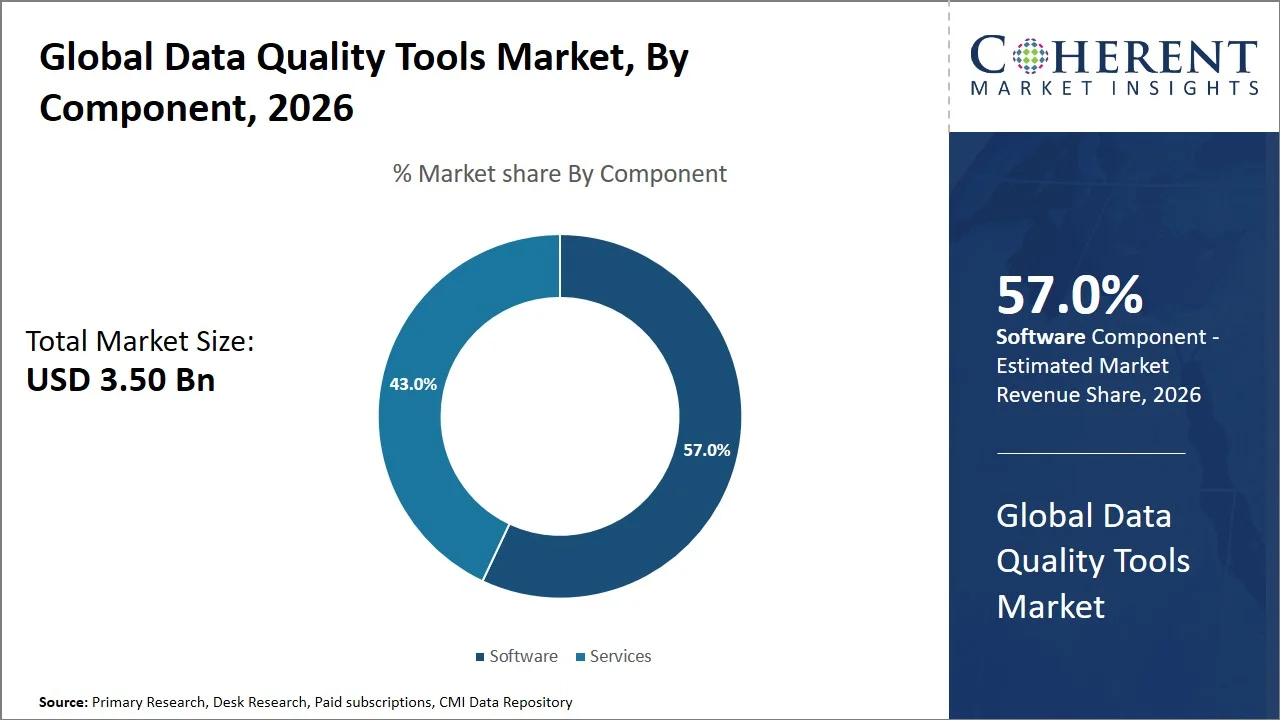
- The software segment is expected to account for 57.0 % of the global data quality tools market share in 2026. Need for accurate customer and master data management is driving the growth of the software segment. For example, Databricks strengthened its lakehouse platform through deeper AI integration, enabling enterprises to run AI models directly on governed, unified datasets. (Source: Databricks)
- The cloud-based segment is estimated to capture 66.0 % of the market share in 2026. Increasing use of real-time data quality solutions is a major driver for the segmental growth. For instance, Acceldata reported increasing enterprise adoption of real-time data observability platforms that continuously monitor freshness, schema changes, and pipeline anomalies. (Source: Acceldata)
- The BFSI segment is estimated to capture 26.0 % of the market share in 2026. Need for accurate customer and master data management is a crucial growth factor for the BFSI segment. On November 1, 2025, Salesforce announced that it has completed its acquisition of Informatica, a leader in enterprise AI-powered cloud data management. (Source: Salesforce)
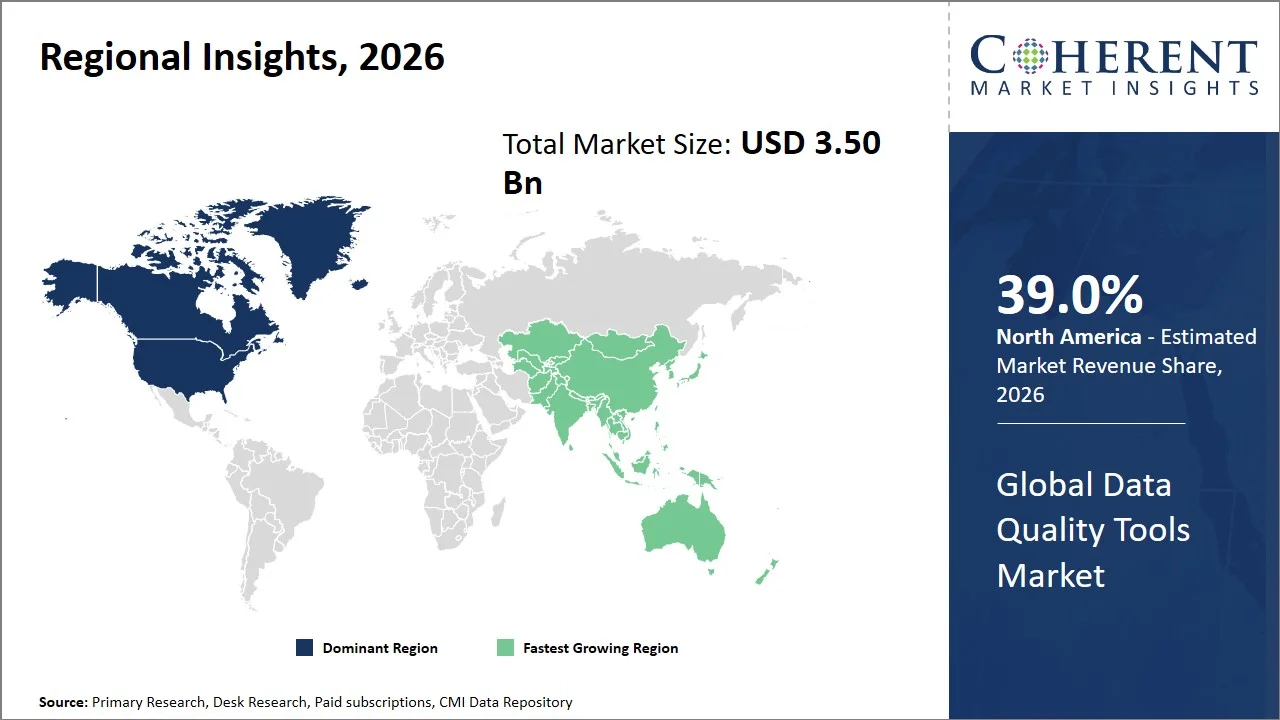
- North America is expected to dominate the data quality tools market in 2026 with a market share of 39.0 %. Expansion of AI-driven automated data quality monitoring in North America is a major driver for the regional market. On April 21, 2026, Snowflake expanded its AI data cloud with Cortex AI and Snowflake Intelligence, enabling automated monitoring and validation of enterprise data in real time. (Source: Snowflake)
- Asia Pacific is expected to account for 23.0 % share in 2026 and is projected to record the fastest growth over the forecast period. Increasing integration of data quality with governance and metadata management is driving the growth of the data quality tools market in Asia Pacific. For example, Informatica enhanced its Intelligent Data Management Cloud (IDMC) adoption across Asia Pacific enterprises, including India and Japan, with deeper integration of data quality, metadata management, data cataloging, and governance workflows in a single AI-driven platform. (Source: Informatica)
- AI-Powered Data Quality Automation: Data quality platforms are increasingly leveraging artificial intelligence and machine learning capabilities to automatically identify anomalies, locate duplicate records, suggest fixes, and predict data quality issues before they impact business operations.
- Growing Demand for Cloud-Native and SaaS-Based Solutions: Organizations are accelerating their cloud migration initiatives, resulting in a growing demand for cloud-native data quality tools that can handle hybrid and multi-cloud environments. These technologies allow for scaling, faster deployment, lower infrastructure costs and easy interfacing with new cloud data platforms.
Segmental Insights
Why Does Software Dominate the Global Data Quality Tools Market?
The software segment is expected to account for 57.0% of the global data quality tools market share in 2026. Software is dominating the global data quality tools market, offering automated data cleansing, validation, profiling and monitoring tools that help organizations to handle large and complex data sets efficiently, minimizing manual effort and increasing the accuracy and consistency of data across business processes.
On February 18, 2026, Datadog released its 2026 cloud observability update with over 400 new AI-powered features, expanding automated monitoring of cloud data pipelines, logs, and telemetry streams. The update focuses on real-time anomaly detection and automated root-cause analysis across distributed systems, reducing the need for manual data checks and improving data reliability at scale. (Source: Datalog)
- Current Industry Events of 2026
- Market Size Estimation
- Regional Breakdown
- Competitive Landscape
- Customer Intelligence
- Segmental Analysis
- Pricing Analysis
- Key Market Drivers, Challenges & Future Trends
- Customized Insights Section
Why is Cloud-Based the Most Preferred Deployment?
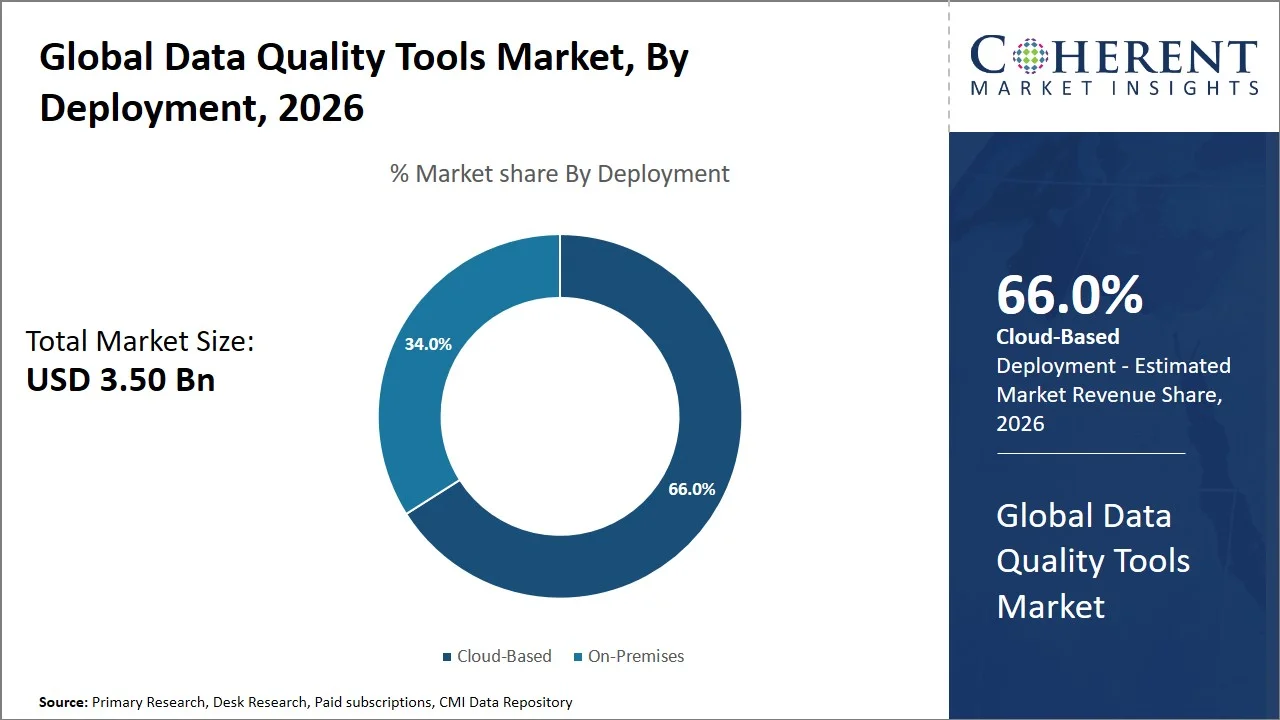
The cloud-based segment is expected to account for 66.0% of the global data quality tools market share in 2026. The most preferred strategy is cloud-based deployment, as it allows scalable and cost-effective data quality control. It gives enterprises the ability to manage ever-increasing data volumes without large upfront infrastructure costs. It also enables faster deployment and simpler access in distributed contexts.
On April 22, 2026, ClickHouse, at Google Next 26, announced a significant expansion of its strategic collaboration with Google Cloud. The announcement encompasses four major milestones: native integration with Google Cloud Lakehouse, the availability of ClickHouse's Bring Your Own Cloud (BYOC), the migration of ClickHouse Cloud on Google Cloud to Google's custom Arm-based Axion processors, and a new integration between the ClickHouse MCP server and Google Antigravity. (Source: ClickHouse)
BFSI Dominates the Global Data Quality Tools Market
The BFSI segment is expected to account for 26.0% of the global data quality tools market share in 2026. Data quality is a critical business need for financial institutions, which depend on highly accurate, compliant data for risk management, fraud detection, regulatory reporting, and consumer analytics. This propels BFSI to dominate the worldwide data quality tools market. For instance, IBM emphasized in its banking industry outlook that financial institutions must strengthen AI governance, risk management, and data controls as they scale AI systems. The report shows banks are increasingly dependent on high-quality, governed data for compliance, fraud prevention, and risk modeling, reinforcing BFSI’s heavy reliance on data quality tools. (Source: IBM)
Currents Events and their Impact
Current Events | Description and its Impact |
EU AI Act (European Union) |
|
Digital Personal Data Protection Act, 2023 (DPDP) & DPDP Rules 2025 (India) |
|
(Source: EU AI ACT, Press Information Bureau)
Data Quality Tools Market Dynamics
Market Drivers
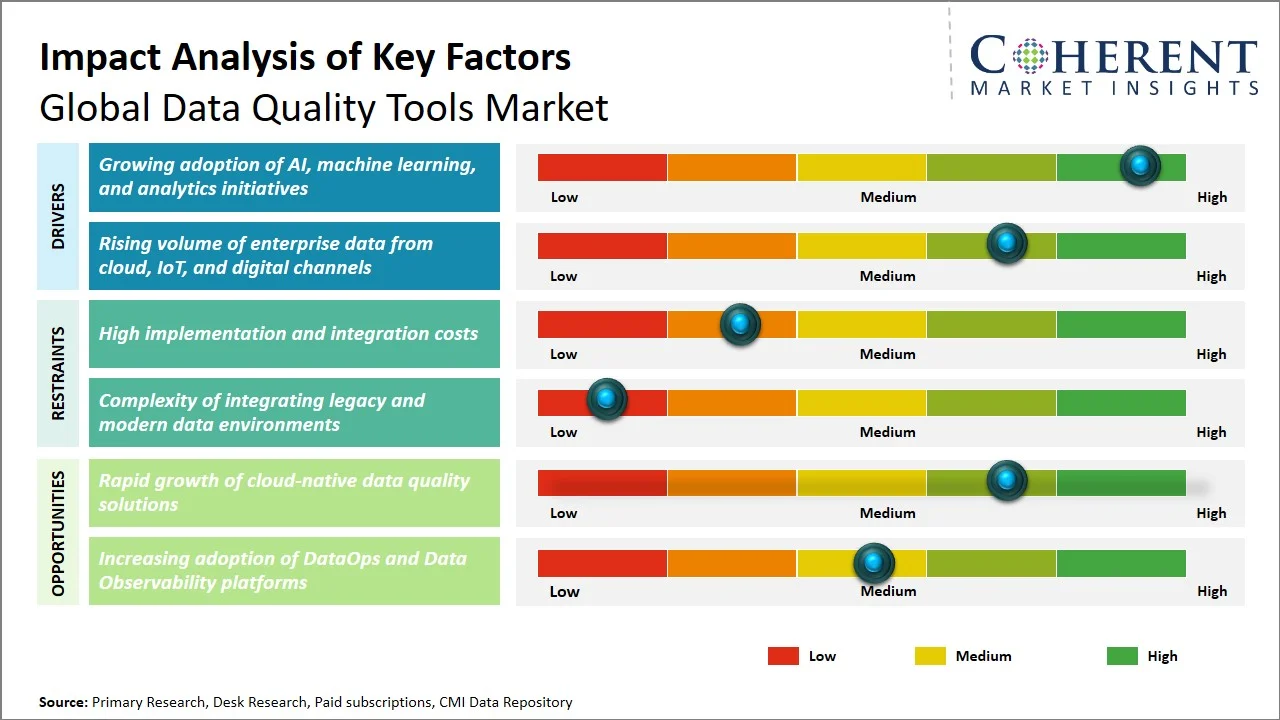
- Growing adoption of AI, machine learning, and analytics initiatives: The increasing usage of AI, ML, and advanced analytics is driving the need for high-quality, accurate and consistent data. Companies are investing in data quality technologies to ensure AI models and analytics platforms are running on reliable datasets for better decision-making, stronger model performance and more trustworthy business insights, to that end. On May 28, 2026, Wipro strengthened its AI strategy by integrating agentic AI workflows into core enterprise functions such as IT, HR, procurement, and cybersecurity through its ServiceNow partnership. This reflects increased adoption of machine learning–driven automation and analytics in enterprise operations. (Source: Wipro)
- Rising volume of enterprise data from cloud, IoT, and digital channels: The growing volume of enterprise data from cloud platforms, IoT devices, mobile apps, social media and other digital channels presents significant data management challenges. The goal is to ensure data accuracy and usability for business operations and analytics as organizations adopt data quality solutions to cleanse, validate and standardize large and complex datasets. On December 1, 2025, Amazon and Google introduced a jointly developed multicloud networking service to meet growing demand for reliable connectivity, at a time when even brief internet disruptions can cause major outages. The initiative will enable customers to establish private, high-speed links between the two companies’ computing platforms in minutes. (Source: The Hindu)
Emerging Trends
- Integration of Data Quality with Data Governance and Data Observability: Enterprises are shifting from stand-alone data quality solutions to integrated platforms that incorporate data quality, data governance, metadata management, lineage tracking and data observability. This gives end-to-end visibility and control of enterprise data assets.
- Data Quality as a Foundation for Generative AI and Advanced Analytics: Generative AI, large language models (LLMs) and advanced analytics are being adopted rapidly, which in turn creates the need for high quality, trusted and well managed data. Organizations are spending heavily on data quality technologies to ensure that AI models are trained and run on accurate, comprehensive and consistent data sets, resulting in better AI results and fewer risks.
Regional Insights
Why is North America a Strong Market for Data Quality Tools?
North America is expected to account for a market share of 39.0% in 2026. North America is the dominant region in the global data quality tools market followed by Asia Pacific. The increasing adoption of data quality tools in the BFSI, healthcare and IT sector in the enterprises in the region is a major factor driving the growth of the market.
The region spends extensively on AI-enabled data governance tools. Strict compliance laws such as HIPAA and CCPA are also common in the region encouraging organizations to move towards sophisticated data validation and monitoring solutions at scale. On May 29, 2026, Informatica launched Agentic AI-powered MDM and data quality integrations with Snowflake Cortex, enabling enterprises to run automated cleansing, validation, and governance directly inside AI workflows. This reflects tighter embedding of data quality tools into enterprise AI platforms rather than standalone systems. (Source: Salesforce)
Why Does the Asia Pacific Data Quality Tools Market Exhibit High Growth?
Asia Pacific is projected to account for 23.0% of the global data quality tools market and is expected to register the fastest growth. Asia Pacific is the fastest developing region, driven by rapid digital transformation, growing cloud use and increasing data creation from mobile first economies. Demand for scalable, cloud-based data quality solutions is being driven by strong investment in modernizing data infrastructure in countries such as India, China and Southeast Asia. On May 25, 2026, Google Cloud announced expanded collaborations with Enterprise Singapore (EnterpriseSG), Indonesia’s Ministry of Communication and Digital Affairs (Komdigi), the Vietnam National Innovation Center (NIC), and the Startup and Innovation Hub of Ho Chi Minh City (SIHUB), establishing an AI startup innovation corridor in Southeast Asia (Source: Google)
Global Data Quality Tools Market Outlook for Key Countries
Why is the U.S. Emerging as a Major Hub in the Data Quality Tools Market?
The market in the U.S. is very mature, with major deployments in financial services, software giants and cloud-native companies. Strong regulatory pressure (Sarbanes–Oxley Act and Dodd-Frank Act) and increasing adoption of GenAI are driving heavy investment in automated data quality and real-time data observability platforms. On June 3, 2026, Alphabet announced an USD 84.75 billion equity offering to fund aggressive GenAI and AI data center expansion.
Is China the Next Growth Engine for the Data Quality Tools Market?
E-commerce, finance, and industrial IoT platforms are driving a huge digital ecosystem in China and its market is growing rapidly. Government-led data governance initiatives and national data security legislation are forcing organizations to implement localized data quality and compliance solutions. In October 2025, China’s top legislature approved major amendments to the Cybersecurity Law of the People’s Republic of China, which came into force on January 1, 2026. The revised law strengthens penalties, expands extraterritorial enforcement, and formally embeds AI governance requirements into cybersecurity obligations, reflecting the government’s push to regulate both data and AI systems under a unified framework. (Source: Center for Security and Emerging Technology)
Germany Data Quality Tools Market Analysis and Trends
Industrial manufacturing, automotive and engineering heavily shape the market in Germany and hence require highly structured and standardized data environments. The need for enterprise-grade data quality frameworks is increasing with compliance to EU GDPR and Industry 4.0 projects.
Rapid use of cloud-based data quality tools in India is spurred by growth of IT services, fintech and digital public infrastructure activities. The DPDP Act is raising the regulatory focus, and the massive scale outsourcing of data operations is driving enterprises to invest in scalable data governance systems.
Data Quality Tools Market - Master Data Management (MDM) and Data Governance Adoption Rate
Category | Adoption Rate |
MDM (AI-driven data validation usage) | ~62% enterprises using AI-driven validation tools |
Cloud-based MDM adoption (large enterprises) | ~58% |
Data Governance framework adoption | ~67% enterprises have structured governance frameworks |
MDM / data governance in large enterprises (broad deployment) | ~58%+ large organization usage |
Data Quality Monitoring / Scoring systems usage (BFSI-heavy) | ~42.8% market share in monitoring segment |
How is the Rapid Growth of Cloud-Native Data Quality Solutions Creating New Growth Opportunities in the Data Quality Tools Market?
The fast growth of cloud-native data quality solutions is opening up new opportunities in the data quality tools market, by enabling organizations to deploy scalable, flexible and subscription-based platforms that can handle huge and growing data volumes across hybrid and multi-cloud environments. The trend is prompting suppliers to innovate with real-time data validation, automated monitoring and API-driven integration capabilities, making data quality more accessible to major companies and mid-sized organizations. On January 8, 2026, Snowflake announced that it has signed a definitive agreement to acquire Observe, a leader in AI-powered observability. With this acquisition, Snowflake will deliver next generation of AI-powered observability, built on open standards and designed for the scale, complexity, and economics required by modern AI-driven enterprises. (Source: Snowflake)
Market Players, Key Development, and Competitive Intelligence
Key Developments
- On April 8, 2026, Dynatrace announced that it has entered into an agreement to acquire Bindplane, a modern telemetry pipeline built on open standards that acts as a control plane for data from disparate sources. Together, Dynatrace and Bindplane will extend data collection from the edge through analytics, combining open-standards-based telemetry pipeline capabilities with AI-powered observability to give customers greater access, flexibility, and control of their logs, metrics, and application data.
- On November 19, 2025, Palo Alto Networks announced it has entered into a definitive agreement to acquire Chronosphere, a next-generation observability platform built to scale for the AI era. This acquisition will strengthen Palo Alto Networks' ability to help organizations navigate a world where modern applications and AI workloads demand a unified data and security foundation.
Competitive Landscape
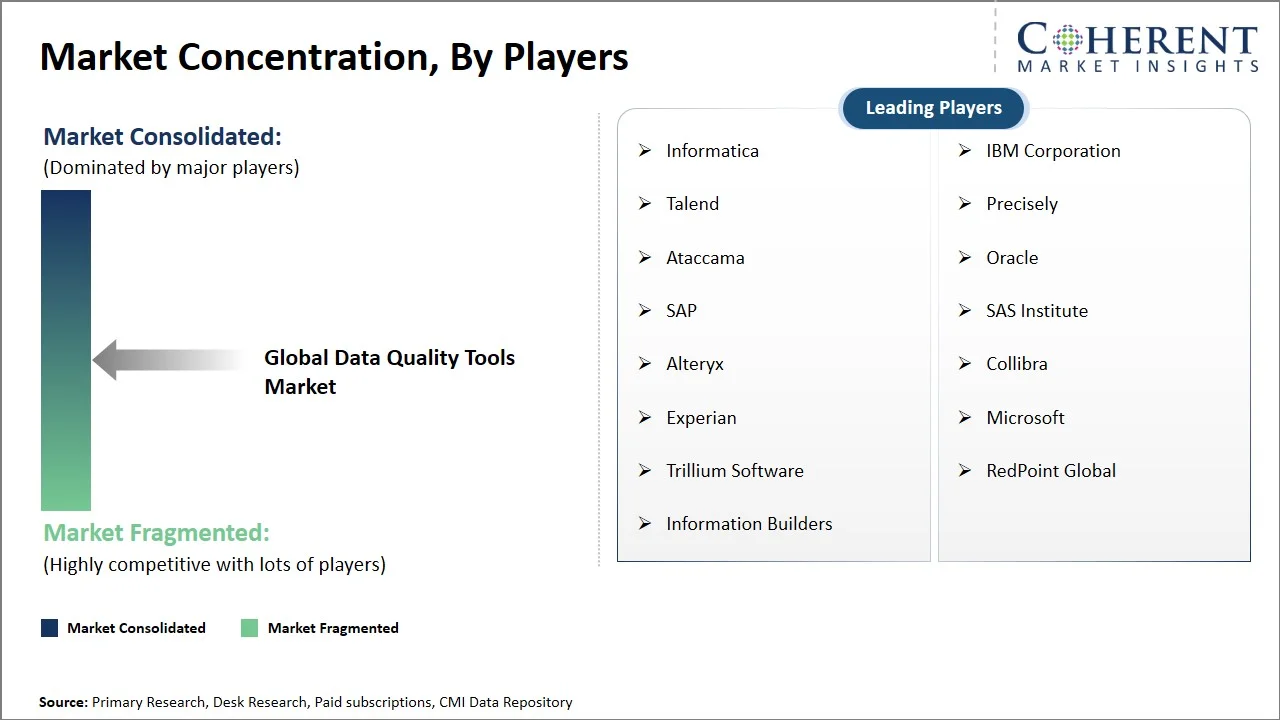
The data quality tools market is a mix of established enterprise software manufacturers and rising cloud-native players. Informatica, IBM, Oracle, SAP, and SAS Institute are among the vendors having significant offers of enterprise data governance, integration, and quality management. There is also competition heating up with cloud-centric businesses like Microsoft, Talend (Qlik), Ataccama and Collibra extending their platforms to provide end-to-end data quality and observability features.
Market Report Scope
Data Quality Tools Market Report Coverage
| Report Coverage | Details | ||
|---|---|---|---|
| Base Year: | 2025 | Market Size in 2026: | USD 3.50 Bn |
| Historical Data for: | 2020 To 2024 | Forecast Period: | 2026 To 2033 |
| Forecast Period 2026 to 2033 CAGR: | 17% | 2033 Value Projection: | USD 10.80 Bn |
| Geographies covered: |
| ||
| Segments covered: |
| ||
| Companies covered: | Informatica, IBM Corporation, Talend, Precisely, Ataccama, Oracle, SAP, SAS Institute, Alteryx, Collibra, Experian, Microsoft, Trillium Software, RedPoint Global, and Information Builders | ||
| Growth Drivers: |
| ||
| Restraints & Challenges: |
| ||
Analyst Opinion (Expert Opinion)
- There is broad evidence that the data quality tools industry is being propelled by the increasing importance of trusted data in AI, analytics and regulatory compliance frameworks. The drive toward cloud-native architecture and automated data governance platforms is strong, and it looks like the old manual data quality processes are gradually being phased out.
- With growing regulatory pressures and the proliferation of data-intensive technologies, data quality is likely to become a key organizational focus, rather than a supporting function. Continuous innovation in AI-powered data validation and real-time observability will transform how enterprises approach data reliability and trust.
- The future of the data quality tools market is anticipated to be substantially affected by the integration of artificial intelligence, machine learning, and generative AI systems. We expect to see the arrival of completely automated, self-healing data quality solutions that will enable continuous, real-time monitoring and rectification of data problems across remote contexts.
- Also in emerging markets, demand is likely to increase substantially with rising data volumes and accelerated digital transformation. Data quality is also expected to merge into governance, security and observability platforms, creating unified data intelligence ecosystems and making data quality a basic component for the enterprise’s digital strategy.
Speak to the analyst
Want personalized insights?
Take the findings above to one of our principal consultants, or have the report rebuilt around the segments, geographies and competitors you actually track.
Market Segmentation
- Component Insights (Revenue, USD Billion, 2021 - 2033)
- Software
- Services
- Deployment Insights (Revenue, USD Billion, 2021 - 2033)
- Cloud-Based
- On-Premises
- End User Insights (Revenue, USD Billion, 2021 - 2033)
- BFSI
- Healthcare and Life Sciences
- Retail and E-commerce
- IT and Telecommunications
- Manufacturing
- Transportation and Logistics
- Government and Public Sector
- Regional Insights (Revenue, USD Billion, 2021 - 2033)
- North America
- U.S.
- Canada
- Latin America
- Brazil
- Argentina
- Mexico
- Rest of Latin America
- Europe
- Germany
- U.K.
- Spain
- France
- Italy
- Russia
- Rest of Europe
- Asia Pacific
- China
- India
- Japan
- Australia
- South Korea
- ASEAN
- Rest of Asia Pacific
- Middle East
- GCC Countries
- Israel
- Rest of Middle East
- Africa
- South Africa
- North Africa
- Central Africa
- North America
- Key Players Insights
- Informatica
- IBM Corporation
- Talend
- Precisely
- Ataccama
- Oracle
- SAP
- SAS Institute
- Alteryx
- Collibra
- Experian
- Microsoft
- Trillium Software
- RedPoint Global
- Information Builders
Sources
Primary Research Interviews
- Data Quality Software Vendors and Solution Providers
- IT Directors and Data Management Professionals
- Database Administrators and Data Scientists
- Chief Data Officers and Analytics Managers
Magazines
- Data Management Review Magazine
- Information Management Magazine
- CIO Magazine
- Database Trends and Applications Magazine
Journals
- Journal of Data and Information Management
- International Journal of Information Management
- Data Science Journal
Associations
- Data Management Association International (DAMA)
- International Association for Information and Data Quality (IAIDQ)
- Association for Computing Machinery (ACM)
- IEEE Computer Society
Public Domain Sources
- U.S. Securities and Exchange Commission (SEC) Filings
- Company Annual Reports and Investor Relations
- Government Technology Procurement Reports
Proprietary Elements
- CMI Data Analytics Tool
- Proprietary CMI Existing Repository of information for last 10 years
Get access to 250+ pages report
Every segment, forecast, competitor profile and data table behind the analysis above — available for instant download.
- ESOMAR Member
- ISO 9001:2015 Certified
- D-U-N-S Registered
- GDPR & CCPA Compliant
Missing comfort of reading report in your local language? Find your preferred language:
Transform your Strategy with Exclusive Trending Reports
Frequently Asked Questions
The global data quality tools market is expected to stand at USD 3.50 Bn in 2026 and is expected to reach USD 10.80 Bn by 2033.
The CAGR of the global data quality tools market is projected to be 17% from 2026 to 2033.
In terms of component, the software segment is estimated to dominate the market revenue share in 2026.
It is the management of data availability, usability, integrity, and security across an organization.
It reduces model accuracy and leads to unreliable predictions and insights.
Growing adoption of AI, machine learning, and analytics initiatives and rising volume of enterprise data from cloud, IoT, and digital channels are the major factors driving the growth of the global data quality tools market.
High implementation and integration costs and complexity of integrating legacy and modern data environments are the major factors hampering the growth of the global data quality tools market.