

Global Direct to Satellite Market Size and Forecast – 2026 to 2033
The global direct to satellite market is estimated to be valued at USD 4.15 Bn in 2026 and is expected to reach USD 10.84 Bn by 2033, exhibiting a compound annual growth rate (CAGR) of 14.7% from 2026 to 2033.
Key Takeaways of the Global Direct to Satellite Market
- The direct-to-device segment is expected to lead the market holding a share of 37.2% in 2026.
- North America, holding an estimated share of 39.8% in 2026, and projected to dominate the market.
- Asia Pacific, holding an expected share of 26.5% in 2026, and shows the fastest growth in the market.
Market Overview
The market is seeing a big move towards Low Earth Orbit (LEO) satellite constellations, which offer lower latency and improved service quality compared to traditional geostationary satellites. Also, growing adoption of internet of things (IoT) applications and increased demand for broadband connectivity in remote and underserved regions are adding to the market growth. The use of AI and big data analytics in satellite operations is also increasing the efficiency, reliability, and scalability of direct-to-satellite services, setting a robust foundation for the future expansion.
Current Events and its Impact
Current Events | Description and its Impact |
Geopolitical and Trade Developments |
|
Economic and Infrastructure Trends |
|
Segmental Insights
- Current Industry Events of 2026
- Market Size Estimation
- Regional Breakdown
- Competitive Landscape
- Customer Intelligence
- Segmental Analysis
- Pricing Analysis
- Key Market Drivers, Challenges & Future Trends
- Customized Insights Section
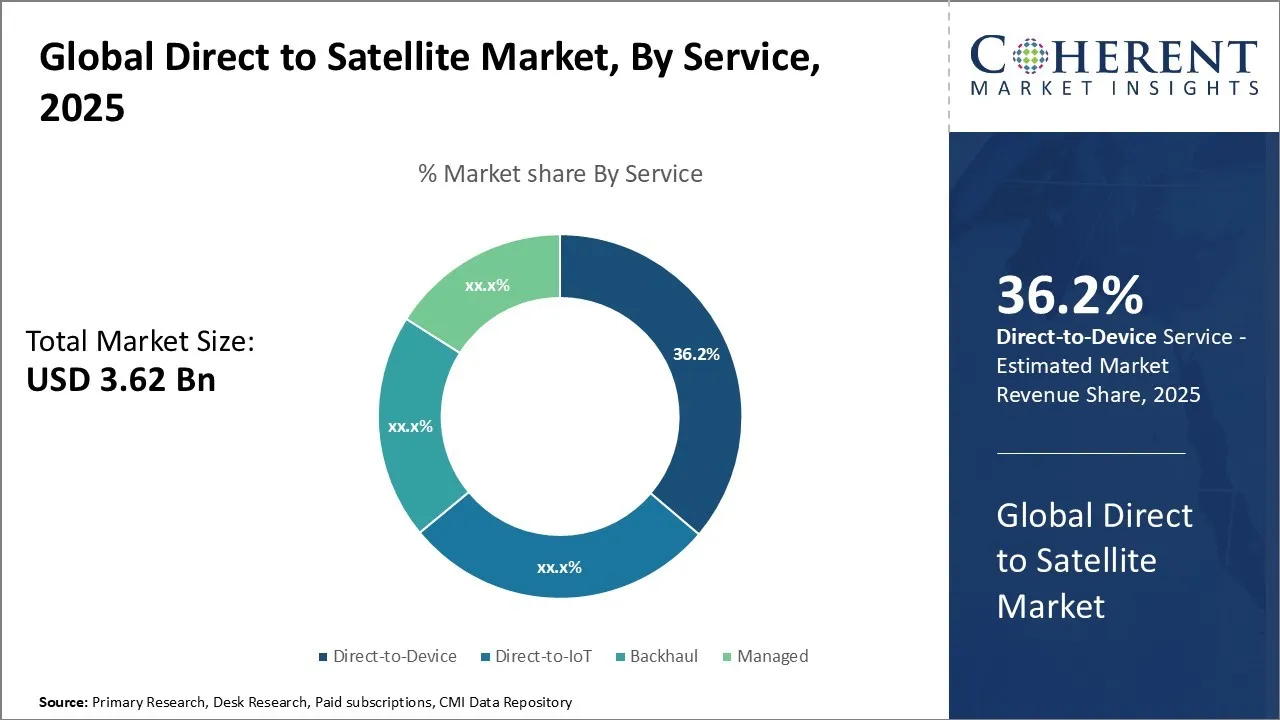
Global Direct to Satellite Market Insights, By Service – Rising Demand for Seamless Connectivity Drives Direct-to-Device Segment Growth
The direct-to-device segment is projected to hold the largest share of 37.2% in 2026, because of rising demand for seamless, ubiquitous connectivity, especially in remote and underserved locations. By allowing satellites to connect directly with smartphones, tablets, and other devices without relying on terrestrial networks, direct-to-device (D2D) offers reliable communication where traditional infrastructure is limited or unavailable.
Fast global growth in smartphone adoption further supports the segment, as users increasingly expect uninterrupted voice, data, and multimedia services. Advances in miniaturized satellite communication chipsets have also made it possible to integrate D2D functionality into commercial devices, improving accessibility and user experience.
In 2025, Starlink successfully demonstrated direct-to-cell satellite connectivity with major operator VEON, enabling standard smartphones to send and receive messages without terrestrial network access, an important milestone highlighting accelerating commercial adoption of D2D services.
Pricing Analysis of the Direct to Satellite Market
Service/Use-Case | Pricing (USD) |
T-Mobile/Starlink “T-Satellite” (direct-to-cell for standard phones) | USD 10/month → USD 15/month after initial period |
Starlink Mobile Priority (high-priority two-way data, LEO) | 50 GB plan: USD 374/month |
Starlink Global/Maritime Priority (via reseller/third-party) | 50 GB: USD 250/month |
Starlink Premium (historical tier) | ~USD 500/month (this was an older premium tier with higher-end hardware) |
Starlink Residential/Standard Internet | ~USD 120/month in the U.S. |
Constellation-by-Constellation Comparison
Constellation (Operator) | Capability (role/size/use) | Spectral capacity/known spectrum (GBps/MHz) | Latency (typical) | Frequency band utilization | Coverage gaps/limitations |
Starlink (SpaceX) | Massive LEO broadband constellation (thousands launched; global consumer & prioritized mobile tiers). Primary D2S player via roaming/partnerships and Starlink Mobile offerings. | Aggregate capacity: multi-Tbps across constellation (public). Per-satellite throughput: public estimates vary; SpaceX advertises up to ~1 Gbps user speeds; total capacity per satellite ~tens of Gbps (industry estimate). | ~25–35 ms (LEO). | Primarily Ka/Ku-like spectrum for user downlink/up (SpaceX uses V-, Ku/Ka-band payloads and phased arrays); Starlink also uses inter-satellite laser links. | Gaps: D2D (direct-to-cell) coverage depends on regulatory approvals, operator partnerships and device compatibility — not globally available for native smartphones without operator tie-ups. Also GEO fallback in some remote cases not integrated. |
OneWeb (Eutelsat OneWeb) | LEO constellation focused on fixed, mobility and enterprise broadband; ~600+ satellites planned/operational for global coverage (higher altitudes ~1,200 km). | Per-satellite: SES/OneWeb cite multi-Gbps per satellite with many spot beams; aggregate multi-Tbps across constellation (public statement, detailed numbers proprietary). | ~50–120 ms (higher LEO altitude ~1,200 km) — higher than very-low LEO but still far below GEO. | Ka-band/Ku-band for user links (broadband), interoperable with MNO NTN standards in trials. | Gaps: Lower coverage density in extreme polar regions until full deployment; D2D (direct-to-cell) adoption limited vs dedicated D2D players. |
Project Kuiper (Amazon) | Large planned LEO broadband constellation (~3,236 satellites planned). Target: consumer broadband, enterprise, AWS integration; deployments ramping since 2025. | Spectrum: Kuiper intends to use ~18 GHz downlink (per regulatory filings) and other Ka/Ku allocations; aggregate capacity expected in multi-Tbps (estimate based on constellation size). | ~25–40 ms (typical for LEO at ~590–630 km orbit). | Ka/Ku and planned use of 18 GHz per filings; phased array user terminals. | Gaps: Rollout & regulatory approvals still in progress; commercial coverage initially limited to regions after launches and gateway build-out. |
O3b mPOWER (SES) — MEO | MEO high-capacity system (medium Earth orbit) aimed at enterprise, telco backhaul, mobile backhaul, maritime/air; multi-Tbps class system with steerable spot beams. | Per-satellite: SES claims hundreds of Gbps per satellite (with frequency reuse and thousands of spot beams); aggregate multi-Tbps across fleet. | ~120–150 ms (MEO one-hop predictability). | Predominantly Ka-band (full Ka usage for high throughput) with advanced digital payloads and dynamic beamforming. | Gaps: Not optimized for consumer D2D to handsets (requires terminals/gateways); coverage can be spot-beam based — rural/very remote last-mile still needs terminals. |
Telesat Lightspeed (Telesat) | Planned LEO constellation focused on enterprise, government & telco wholesale (original design ~298 LEO satellites). Program status has evolved; tech aims for in-space digital routing and high capacity. | Target capacity: up to tens of Tbps across constellation (public target); per-satellite multi-tens of Gbps (design goal; some program changes publicly reported). | ~25–50 ms (LEO MUX design target). | Ka/Ku bands with advanced digital payloads. | Gaps: Commercial availability depends on final deployment; some program timing and partnership shifts reported — limits immediate D2D applicability. |
AST SpaceMobile (AST) | Purpose-built direct-to-cell (D2D) LEO network that aims to connect standard mobile phones directly (huge phased arrays per satellite). Focused on lower-mid mobile spectrum access. | Spectrum: AST has negotiated access/term sheets for tens of MHz (~up to 45 MHz reported in North America in 2025) of lower/mid band spectrum for D2D. They report per-cell peak data speeds (vendor claim e.g., 120 Mbps per cell with 40 MHz). | ~25–50 ms (LEO D2D design). | Uses lower-mid mobile bands (to be compatible with GSM/4G/5G bands) — their large phased arrays beam to phones/cells. | Gaps: Coverage limited until constellation scales; regulatory spectrum approvals and MNO partnerships are required per market. Hardware & interference management are challenges. |
Lynk Global (incl. Omnispace merger plans) | LEO smallsat D2D specialist — focuses on delivering SMS/IoT and basic voice/messaging directly to legacy phones (backward compatible). | Spectrum: Uses narrowband mobile-compatible allocations (exact MHz small; Lynk focuses on signaling/short messages). Capacity: optimized for low-rate messaging (low aggregate GBps but wide reach). | ~30–80 ms (LEO, depends on orbit & satellite hardware). | Lower-mid mobile bands/narrowband allocations for D2D messaging and control channels. | Gaps: Not built for high-throughput broadband to phones; best suited for messaging/IoT; coverage scales with satellite count and operator reach. Regulatory approvals & MNO cooperation required per country. |
Viasat/Inmarsat (now combined) | Multi-orbit operator: GEO legacy fleet (Inmarsat), Ka/Ku GEO HTS and newer LEO/MEO integrations (Viasat expanding multi-orbit). Focus: enterprise, mobility (aero/maritime), gov. | Capacity: GEO HTS and added LEO/MEO capacity; Viasat advertises multi-Gbps per satellite in HTS GEO payloads and multi-Tbps across fleet when combined. Viasat’s HaloNet & multi-orbit approach aims to add near-earth capacity. | GEO: ~600–800 ms; MEO/LEO tiers (when used) lower ~50–200 ms — multi-orbit mix. | GEO Ka/Ku/L-band legacy; Viasat expanding into LEO/MEO and Ka/Ku overlays. | Gaps: GEO is unsuitable for low-latency D2D to handsets; LEO/MEO integration improves latency but D2D to standard handsets still depends on device chipset & MNO deals. |
Technology Landscape — Direct to Satellite Market
Topic | Key points | Example | Implication for D2S |
Power-budget requirements (terminal side) | Power budget expressed as EIRP (dBm) from transmitter and receiver sensitivity (dBm). Handset D2D requires higher PA EIRP than BLE/LoRa IoT; IoT modules target low average power using narrowband bursts. | Handset D2D (smartphone class): required EIRP ≈ +5 to +20 dBm (PA + antenna gain combined) depending on band and link margin. IoT narrowband module: avg transmit power ≈ +14 dBm (peak) but duty-cycled; battery operation typical. VSAT/terminals: EIRP much higher (tens of dBm to >+50 dBm depending on dish and PA). (ranges are operator/design dependent.) | Handsets must trade peak PA power vs battery life; realistic D2D on phones requires either spectrum in lower mobile bands or satellites with focused beams / higher receive sensitivity on satellite to keep phone EIRP modest. IoT focuses on ultra-narrowband, long sleep cycles. |
Link-budget modeling (core equations & margins) | Basic link budget: Received Power (dBm) = EIRP (dBm) + Grx (dBi) − FSPL (dB) − Other losses (dB) + Rx NF margin (dB). Include fade margin, implementation loss, and required SNR for selected modulation/Coding. | FSPL formula: FSPL(dB) = 20·log10(d_km) + 20·log10(f_MHz) + 32.44. | Shows why lower frequency (L/S) eases path loss but trades off bandwidth. To close a handset link you need higher satellite receive gain/low NF and/or narrowband waveforms and sufficient fade margin. Designers must budget for rain fade (Ku/Ka), Doppler, and dynamic link adaptation. |
Antenna design evolution (user devices & satellites) | Evolution: omnidirectional/wide-beam antennas → patch & phased arrays → electronically steered flat-panel arrays (E-SAs) for LEO. For handsets, trend to highly integrated multi-band small arrays or use of network-assisted relay. | Handset class: tiny phased-array elements or multi-mode patch arrays integrated into bezel/frame; Flat-panel terminals: 10s–100s of elements, electronic steering. Maritime/vehicular: larger phased arrays or dishes (30–100 cm). | Electronically steered arrays enable tracking LEO beams with no mechanical pointing. For D2D, low-profile, conformal arrays or leveraging existing handset antennas (in-band solutions) are critical. Complexity & cost scale with element count and beamforming DSP. |
L-band performance (≈1–2 GHz) | Low path loss, good penetration through foliage/buildings, robust to rain. Narrow bandwidths available compared with Ku/Ka. Widely used for GNSS, legacy satellite IoT and messaging. | Bandwidth: typically tens of kHz up to a few MHz per allocation; Rain fade: minimal; Typical use: messaging, IoT, emergency comms. | Excellent for narrowband D2D messaging and IoT where robustness > throughput. Limited spectrum constrains high-bitrate services; good candidate for first-generation D2D fallback messaging. |
S-band performance (≈2–4 GHz) | Compromise between capacity and propagation. Growing interest for NTN / direct-to-cell because S-band maps closer to cellular bands (ease of handset compatibility). Moderate rain sensitivity. | Bandwidth: low to moderate (several MHz to tens of MHz); Propagation: better than Ku/Ka but worse than L. | Attractive for D2D because device RF front-end adaptation is easier than with Ku/Ka. Regulators often allocate S-band for mobile satellite services — useful for two-way D2D. |
Ku-band performance (≈12–18 GHz) | High available bandwidth, good throughput, widely used for HTS. Medium to high rain attenuation. Requires tighter antenna pointing and higher EIRP. | Bandwidth: hundreds of MHz per operator in some regions; Rain fade: significant at heavy rain; Typical use: consumer/maritime broadband. | Strong for broadband/high-throughput services (terminals/dishes). Less ideal for direct native handset connections due to higher path loss and handset antenna constraints. |
Ka-band performance (≈26–40 GHz) | Very high capacity (large contiguous bandwidth) but high rain and atmospheric attenuation. Best for spot-beam HTS and gateways; enables multi-Gbps links. | Bandwidth: GHz scale allocations possible; Rain fade: high — substantial fade margins required. | Excellent for backbone & feeder links; poor for direct handset D2D without large antenna/EIRP or advanced mitigation (adaptive coding, power control). |
Device chipset compatibility (smartphones & IoT) | Two approaches: (a) native NTN support integrated in baseband/RF chipsets (multi-band, NTN-aware MAC/PHY), (b) external companion modem / module + eSIM profile. Chipsets must support NTN waveforms, timing, PRACH, power control, and Doppler handling. | Smartphone trend: modern SoCs/5G modems (vendor examples: major SoC vendors adding satellite-capable modes) — chipset features: extended PRACH windows, enhanced timing advance, NTN positioning. IoT modules: narrowband chipsets with extreme low power (mW sleep currents). | Native chipset support enables mass market D2D (no external puck). Without chipset support, D2D is constrained to external accessories or specialized devices. Chipset integration timeline governs adoption speed. |
3GPP NTN Release 17 impact | R17 introduced initial study/spec work for Non-Terrestrial Networks (NTN) — adaptations for random access, HARQ, timing, and control channel changes to support satellite links (mostly GEO/LEO studies). | Key R17 features: NTN channel models; extended timing advances; initial link and random access enhancements for NTN. | Provided the first standard framework enabling interoperability between MNOs and satellite systems — lowered integration friction for D2D trials and initial deployments. |
3GPP NTN Release 18 impact | R18 focuses on performance enhancements and deeper radio-layer support, including improved mobility, power saving, enhanced positioning, and further work to support D2D/Direct-to-phone scenarios. Enables more mature commercial services. | Key R18 priorities: improved NR-NTN procedures, UE power saving optimizations, better PRACH/RA for high Doppler, multicast/broadcast for emergency messaging (implementation varied by vendor). | R18 lowers device and network complexity barriers, improves battery life for NTN modes, and increases feasibility of large-scale commercial D2D deployments — critical to mass market roll-out. |
Regional Insights
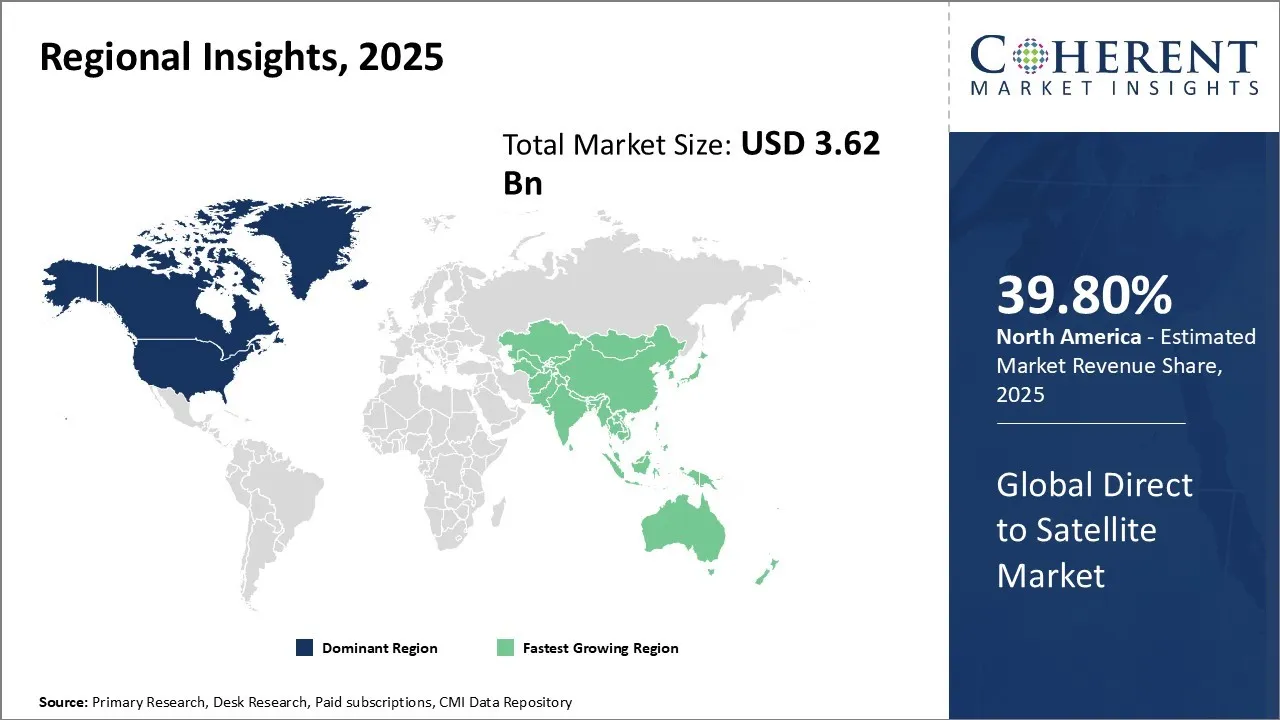
North America Direct to Satellite Market Analysis and Trends
North America, holding an estimated share of 39.8% in 2026, dominates the global direct to satellite market stems from a mature telecommunications infrastructure, a strong presence of leading satellite service providers, and supportive government policies. The U.S. Federal Communications Commission (FCC) has put in place favorable regulatory frameworks, including spectrum allocation and funding for rural satellite internet services, bolstering the market expansion.
Also, North America hosts big industry players like Hughes Network Systems, Viasat, and DISH Network, which drive innovation through advancements in satellite technology, such as high-throughput satellites and low-latency broadband solutions. The region sees a strong ecosystem comprising satellite manufacturers, launch service providers, and a large consumer base needing high-speed satellite internet services. Also, strategic partnerships with defense and aerospace sectors further add to North America’s leadership in the direct to satellite market.
Asia Pacific Direct to Satellite Market Analysis and Trends
The Asia Pacific region, holding an expected share of 26.5% in 2026, shows the fastest growth in the direct to satellite market, because of increasing internet penetration in remote areas, government initiatives promoting digital inclusion, and rapid urbanization creating demand for reliable broadband alternatives. Countries like India, China, and Australia are investing a lot in satellite infrastructure to bridge the digital divide and support smart city projects.
The region sees a dynamic ecosystem of emerging satellite operators and tech startups focusing on nano- and microsatellite deployments, which reduce costs and add to scalability. Trade liberalization and international collaborations have increased access to advanced satellite technology. Supportive policies in countries like India’s Department of Telecommunications allow spectrum allocation and incentivize satellite communication providers. Companies such as OneWeb (with planned expansions), Chinese satellite entities like China Satellite Communications, and Australian players like NBN Co contribute strongly to the market’s rapid evolution in Asia Pacific.
Direct to Satellite Market Outlook for Key Countries
U.S. Direct to Satellite Market Analysis and Trends
The U.S. direct to satellite market is very competitive with established entities such as Hughes Network Systems and Viasat leading the delivery of satellite internet and broadcast services. The country’s advanced infrastructure, added with ongoing innovations in satellite technology like next-gen geostationary and low-earth orbit (LEO) constellations, supports diverse applications including rural broadband, military communications, and direct-to-home (DTH) entertainment. U.S. government agencies actively facilitate satellite communications through grants and regulatory amendments, pushing fast deployment and adoption of DTS solutions nationwide.
India Direct to Satellite Market Analysis and Trends
India direct to satellite market is growing fast, because of government programs like Digital India, aiming to enhance connectivity across rural and remote regions. The Indian Space Research Organization (ISRO) plays a pivotal role by launching communication satellites that enable affordable satellite broadband. Private sector players such as Bharti Airtel and emerging start-ups are collaborating to blend satellite and terrestrial networks, accelerating access to direct satellite services. Supportive policy reforms for spectrum allocation and a big consumer base eager for high-speed internet show India’s high market potential.
China Direct to Satellite Market Analysis and Trends
China continues to lead the Asia Pacific direct to satellite market through substantial state investments in satellite infrastructure and technology development. State-owned giants such as China Satcom and China Aerospace Science and Technology Corporation dominate the market, providing extensive government-backed DTH and satellite broadband services. Continued focus on indigenous satellite manufacturing capabilities and strategic partnerships under the “Made in China 2026” initiative add to self-reliance and technological advancements. The Chinese government’s strong regulatory environment ensures market stability while fostering innovation in satellite constellations and ground equipment.
Brazil Direct to Satellite Market Analysis and Trends
Brazil direct to satellite market benefits from increasing satellite adoption in both the communications and media sectors, because of geographic challenges in connecting remote Amazonian and rural regions. The country’s regulatory body, Anatel, supports satellite operators by streamlining licensing and spectrum management, making market entry easier for large players like Embratel and Sky Brasil. These companies add to the growing direct satellite TV and internet coverage, addressing the demand from a growing middle-class population. Brazil’s participation in regional satellite initiatives further adds to its role within the Latin American DTS ecosystem.
Australia Direct to Satellite Market Analysis and Trends
Australia direct to satellite market is growing fast, leveraging government programs aimed at rural broadband connectivity, such as the National Broadband Network (NBN). Satellite operators like NBN Co collaborate with international technology providers to expand satellite internet access in remote and indigenous communities. The country’s open trade policies enable the import of cutting-edge satellite hardware and services, adding to the local industry growth. Increased demand for direct-to-home entertainment and efficient communications in less populated regions shows Australia’s focus on improving DTS capabilities.
Market Players, Key Development, and Competitive Intelligence
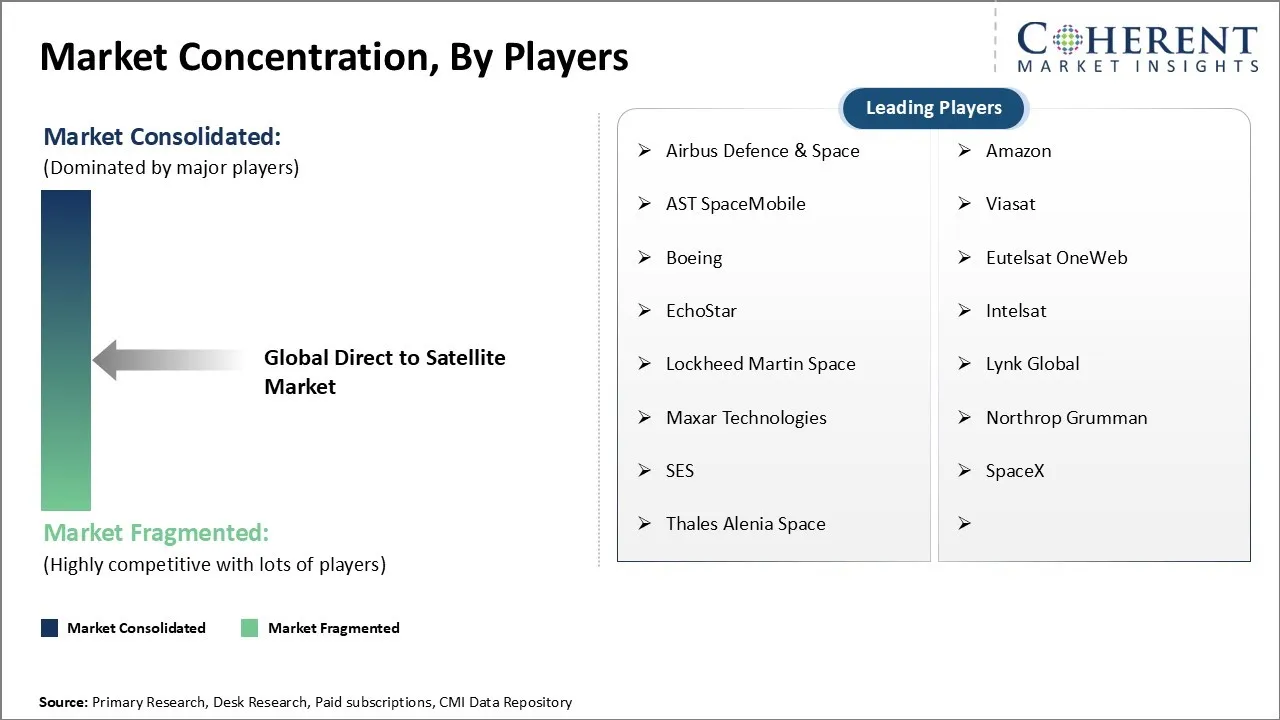
Key Developments
- On November 6, 2025, Starlink, a subsidiary of SpaceX, secured its largest direct-to-cell deal yet with telecoms group Veon, granting access to over 150 million potential customers.
- In August 2025, Ukraine's largest mobile operator, Kyivstar, successfully conducted the first field test of Starlink direct-to-cell satellite technology in Eastern Europe.
- In June 2025, Vodafone Group and AST SpaceMobile Inc., announced that their new joint venture satellite company, SatCo, will be headquartered in Luxembourg, creating a European sovereign integrated satellite service.
- In March 2025, SES and Lynk Global announced a strategic partnership to address the high-growth direct-to-device (D2D) segment. As part of the agreement, SES will provide Series B funding for Lynk Global’s D2D constellation and provide a suite of integrated services that will enhance Lynk Global’s capabilities.
Top Strategies Followed by Direct To Satellite Market Players
- Established market leaders invest a lot in research and development (R&D) to drive innovation and create high-performance products that meet increasingly sophisticated consumer and industry needs.
- Starlink increased R&D spending to expand Direct-to-Cell capabilities by launching specialized satellites with LTE payloads (2024–2025).
- Mid-level companies in the direct to satellite market adopt a more cost-conscious yet quality-focused approach to secure their foothold.
- Lynk Global offers commercial D2D SMS services via telecom operators like Vodafone Ghana (2023–2024) and at significantly lower cost structures by using smaller satellites and simplified waveforms.
- Small-scale players find a distinctive niche in the global direct to satellite market by specializing in unique features or highly innovative products that larger companies may overlook.
- Skylo Technologies focuses specifically on NTN IoT connectivity using L-band satellite networks (Inmarsat/others). Instead of competing with Starlink on broadband, Skylo targets asset tracking, agriculture, logistics, and industrial IoT, differentiating through ultra-low-power IoT modems and narrowband NTN services.
Market Report Scope
Global Direct to Satellite Market Report Coverage
| Report Coverage | Details | ||
|---|---|---|---|
| Base Year: | 2025 | Market Size in 2026: | USD 4.15 Bn |
| Historical Data for: | 2020 To 2024 | Forecast Period: | 2026 To 2033 |
| Forecast Period 2026 to 2033 CAGR: | 14.7% | 2033 Value Projection: | USD 10.84 Bn |
| Geographies covered: |
| ||
| Segments covered: |
| ||
| Companies covered: | Airbus Defence & Space, Amazon, AST SpaceMobile, Viasat, Boeing, Eutelsat OneWeb, EchoStar, Intelsat, Lockheed Martin Space, Lynk Global, Maxar Technologies, Northrop Grumman, SES, SpaceX, and Thales Alenia Space | ||
| Growth Drivers: |
| ||
| Restraints & Challenges: |
| ||
Market Dynamics
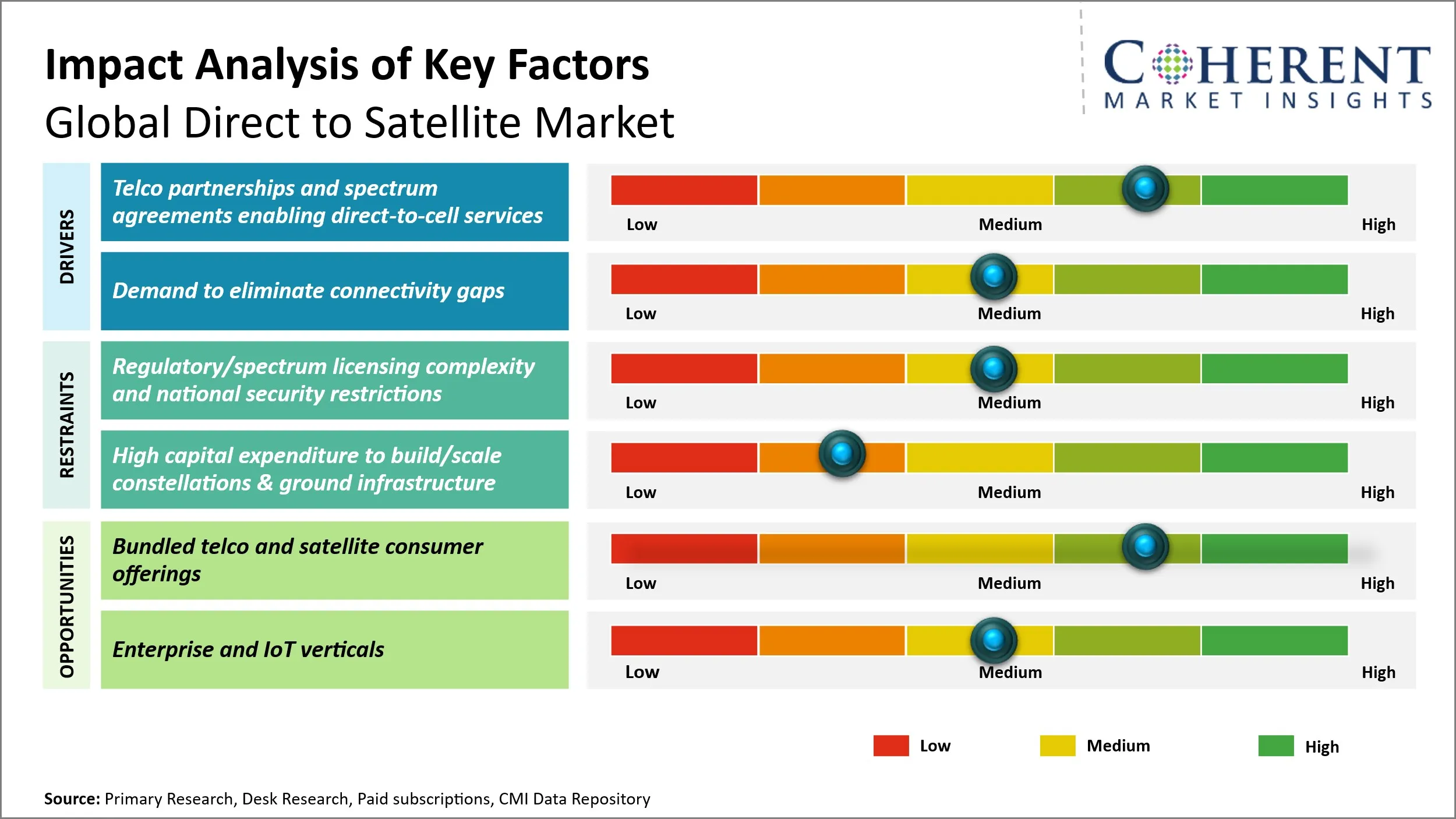
Global Direct to Satellite Market Driver – Telco Partnerships & Spectrum Agreements Enabling Direct-to-Cell Services
Strategic partnerships between satellite operators and telecom companies, supported by licensed spectrum agreements, are accelerating the deployment of direct-to-cell (D2C) services. These collaborations allow satellite signals to operate on telcos’ licensed bands, making possible connectivity directly to standard mobile phones without extra hardware. By adding satellite reach to telco customer bases and infrastructure, operators get faster rollout, broader coverage, and improved service reliability in underserved regions.
T-Mobile and SpaceX (Starlink) partnership (2022–2025) uses T-Mobile’s PCS spectrum to enable Starlink’s Direct-to-Cell service on regular K, now in live beta for messaging and expanding toward voice and data services.
Global Direct to Satellite Market Opportunity – Bundled Telco and Satellite Consumer Offerings
Bundled telco–satellite plans present major growth potential by combining mobile, broadband, and satellite connectivity under unified subscriptions. These offerings fill coverage gaps, improve reliability for rural users, and provide seamless service continuity across terrestrial and satellite networks. They add to convenience, boost ARPU for telcos, and expand satellite operator access to mass-market consumers.
AT&T and AST SpaceMobile partnership (2024–2025) is preparing satellite-enhanced mobile plans adding AST’s space-based coverage to AT&T’s consumer packages, enabling direct satellite-to-phone services for customers in remote areas.
Analyst Opinion (Expert Opinion)
- Despite aggressive marketing, true broadband-to-phone connectivity remains technically constrained by handset power limits, Doppler management, and beamforming complexity. Many announced services are closer to “enhanced messaging” than full mobile-grade performance, and this technological gap will continue to frustrate early adopters.
- Regulators are moving cautiously, and telcos are not universally willing to share licensed spectrum with satellite operators. With several nations yet to formalize NTN frameworks, market expansion risks becoming fragmented and painfully slow, especially where incumbents resist spectrum harmonization.
- LEO constellation buildouts need huge ongoing capital, and monetizing D2D at consumer-friendly price points is far from guaranteed. Without high ARPU enterprise use-cases or large-scale telco bundling, some operators may struggle to justify long-term financial sustainability, potentially leading to consolidation or stalled growth.
Speak to the analyst
Want personalized insights?
Take the findings above to one of our principal consultants, or have the report rebuilt around the segments, geographies and competitors you actually track.
Market Segmentation
- Service Insights (Revenue, USD Bn, 2021 - 2033)
- Direct-to-Device
- Direct-to-IoT
- Backhaul
- Managed
- Regional Insights (Revenue, USD Bn, 2021 - 2033)
- North America
- U.S.
- Canada
- Latin America
- Brazil
- Argentina
- Mexico
- Rest of Latin America
- Europe
- Germany
- U.K.
- Spain
- France
- Italy
- Russia
- Rest of Europe
- Asia Pacific
- China
- India
- Japan
- Australia
- South Korea
- ASEAN
- Rest of Asia Pacific
- Middle East
- GCC Countries
- Israel
- Rest of Middle East
- Africa
- South Africa
- North Africa
- Central Africa
- North America
- Key Players Insights
- Airbus Defence & Space
- Amazon
- AST SpaceMobile
- Viasat
- Boeing
- Eutelsat OneWeb
- EchoStar
- Intelsat
- Lockheed Martin Space
- Lynk Global
- Maxar Technologies
- Northrop Grumman
- SES
- SpaceX
- Thales Alenia Space
Sources
Primary Research Interviews
Stakeholders
- Satellite Network Operators
- Mobile Network Operators & Telecom Providers
- Satellite Terminal & Antenna Manufacturers
- IoT Device Manufacturers & Module Suppliers
- Aerospace System Integrators
- Spectrum Regulators & National Frequency Authorities
- Emergency Communication Agencies & Disaster Response Coordinators
- Maritime & Aviation Connectivity Providers
- Space Technology Start-ups focusing on Direct-to-Device (D2D) solutions
- NTN (Non-Terrestrial Network) 3GPP Standards Contributors
- Semiconductor & Chipset Manufacturers (RF Front-End / NTN chip designers)
- Satellite Launch Service Providers (Mission Planners, Deployment Engineers)
Databases
- European Space Agency (ESA) DataHub
- FCC International Bureau Filing Database
- ITU Radiocommunication Bureau Spectrum Statistics
- NASA SmallSat & Mission Database
- OECD Digital Connectivity Dataset
- U.S. Census (Population Coverage & Connectivity Indicators)
- Eurostat (Telecom & Digital Access Statistics)
Magazines
- Satellite Today
- Via Satellite Magazine
- SpaceNews Connectivity Edition
- Communications Technology Review
- Mobile World Live Magazine
- Aerospace & RF Engineering Monthly
Journals
- International Journal of Satellite Communications and Networking
- IEEE Transactions on Antennas and Propagation
- Journal of Spacecraft and Rockets
- IEEE Access – NTN & 5G/6G Sections
- Journal of Wireless Communications & Mobile Computing
- Remote Sensing and Space Systems Journal
Newspapers
- SpaceTech Daily
- The Guardian (U.K.) – Technology Section
- The Economic Times (India) – Telecom & Technology
- The New York Times – Science & Space
- The Wall Street Journal – Telecom & Mobility
- Nikkei Asia – Satellite & Connectivity Updates
Associations
- Global Satellite Operators Association (GSOA)
- 3GPP Standards Association (NTN Working Group)
- Mobile Satellite Services Association (MSSA)
- Satellite Industry Association (SIA – USA)
- European Telecommunications Standards Institute (ETSI)
- International Telecommunication Union (ITU) Space Division
- Association of Space Explorers (ASE)
Public Domain Sources
- NASA Open Data Portal
- U.S. Census Bureau
- EUROSTAT
- World Bank – Digital Development & Connectivity
- United Nations Economic Commission for Europe (UNECE)
- ESA Earth Observation Open Access Hub
- ResearchGate
- ITU Publications – Open Technical Reports
Proprietary Elements
- CMI Data Analytics Tool
- Proprietary CMI Existing Repository of Information for Last 8 Years
Get access to 250+ pages report
Every segment, forecast, competitor profile and data table behind the analysis above — available for instant download.
- ESOMAR Member
- ISO 9001:2015 Certified
- D-U-N-S Registered
- GDPR & CCPA Compliant
Missing comfort of reading report in your local language? Find your preferred language:
Transform your Strategy with Exclusive Trending Reports
Frequently Asked Questions
The global direct to satellite market is estimated to be valued at USD 4.15 Bn in 2026 and is expected to reach USD 10.84 Bn by 2033.
The CAGR of the global direct to satellite market is projected to be 14.7% from 2026 to 2033.
Telco partnerships & spectrum agreements enabling direct-to-cell services and demand to eliminate connectivity gaps are the major factors driving the growth of the global direct to satellite market.
Regulatory/spectrum licensing complexity & national security restrictions and high capital expenditure to build/scale constellations & ground infrastructure are the major factors hampering the growth of the global direct to satellite market.
In terms of service, the direct-to-device is estimated to dominate the market revenue share in 2026.
Airbus Defence & Space, Amazon, AST SpaceMobile, Viasat, Boeing, Eutelsat OneWeb, EchoStar, Intelsat, Lockheed Martin Space, Lynk Global, Maxar Technologies, Northrop Grumman, SES, SpaceX, and Thales Alenia Space are the major players.
North America is expected to lead the global direct to satellite market in 2026.