

Global Electric Vehicle Sensor Market and Forecast – 2026-2033
Coherent Market Insights estimates that the global electric vehicle sensor market is expected to reach USD 18 Bn in 2026 and will expand to USD 60 Bn by 2033, registering a CAGR of 14% between 2026 and 2033.
Key Takeaways of the Electric Vehicle Sensor Market
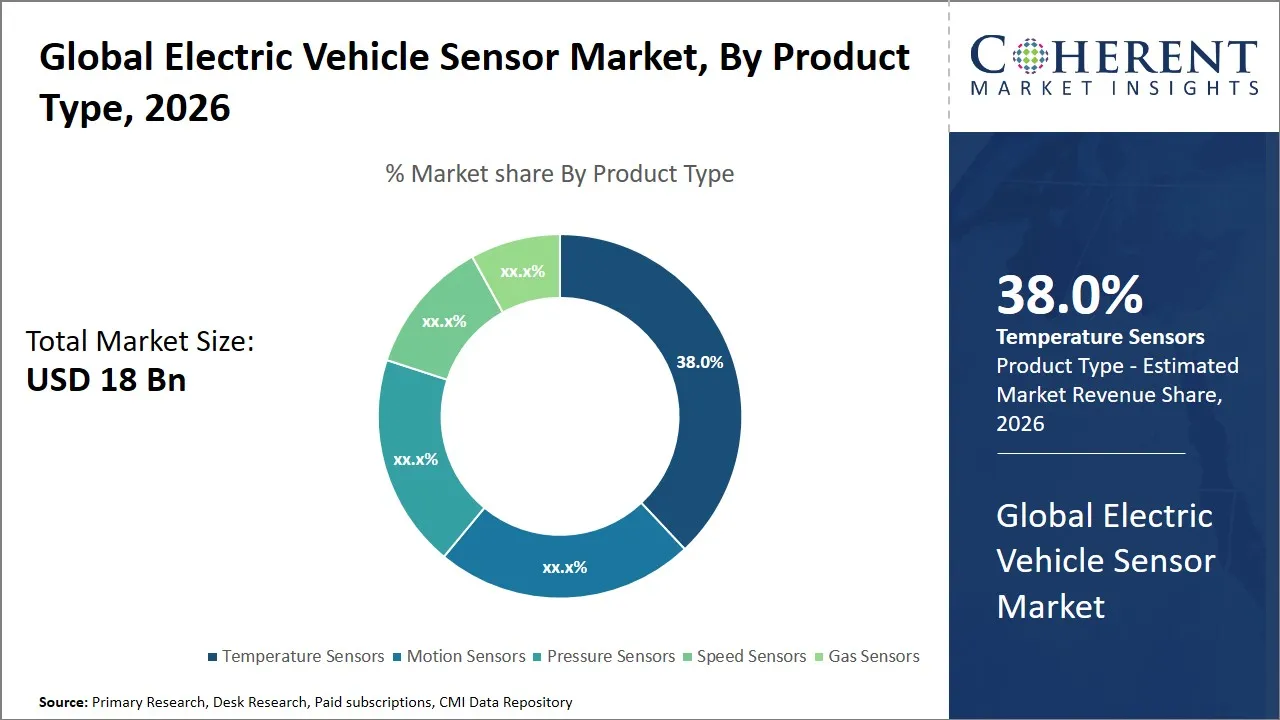
- The temperature sensors segment is expected to account for 38% of the electric vehicle sensor market share in 2026.
- The hybrid electric vehicle segment is projected to hold 34% of the market share in 2026.
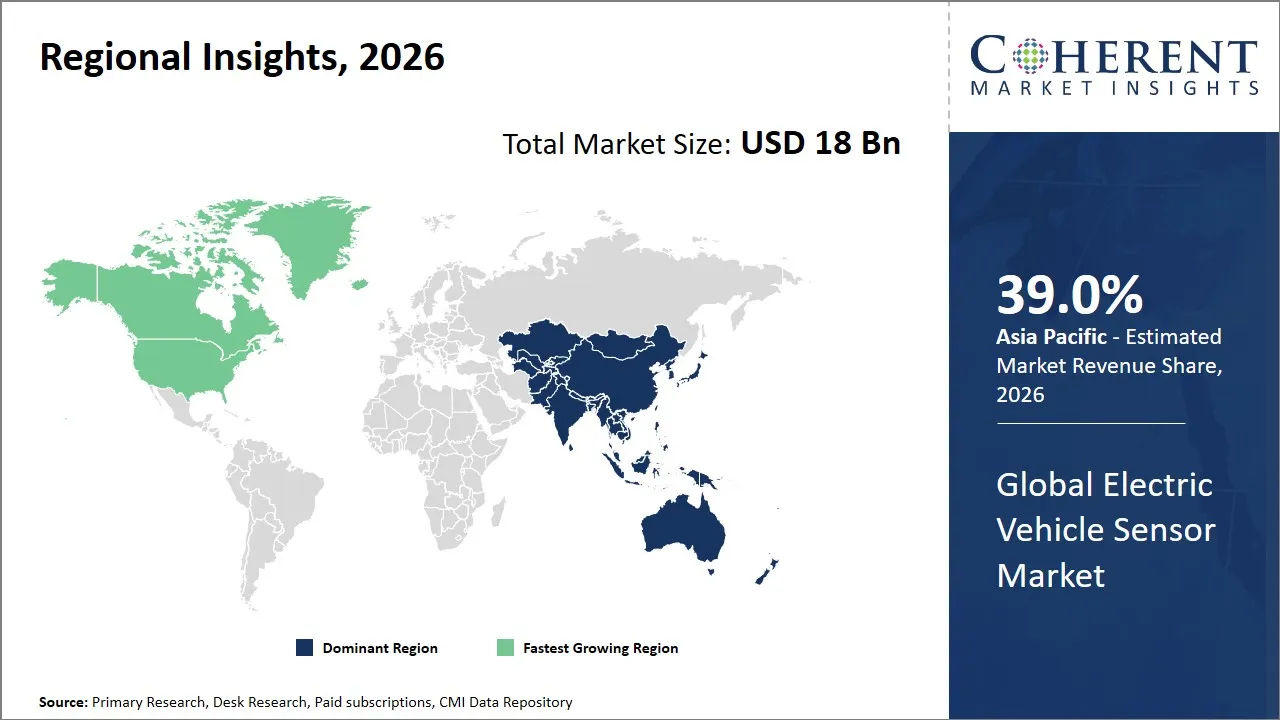
- Asia Pacific will dominate the electric vehicle sensor market in 2026 with a 39% market share.
- North America will hold 22% share in 2026 and is expected to record the fastest growth over the forecast period.
Current Events and Its Impact
Current Events | Description and its Impact |
Hesai Expansion Plans |
|
Segmental Insights
- Current Industry Events of 2026
- Market Size Estimation
- Regional Breakdown
- Competitive Landscape
- Customer Intelligence
- Segmental Analysis
- Pricing Analysis
- Key Market Drivers, Challenges & Future Trends
- Customized Insights Section
Why Does Temperature Sensors Segment Dominate the Global Electric Vehicle Sensor Market in 2026?
The temperature sensors segment is expected to account for 38.0% of the global electric vehicle sensor market share in 2026. Driven by their essential role, these devices monitor and control heat across key parts of electric vehicles. A major focus within such vehicles lies in handling battery heat levels, given how reactive lithium-ion units are to shifting temperatures. Stable operating warmth supports longer battery life, avoids excessive heat buildup, reduces dangers. Live feedback from sensors allows the BMS to adjust cooling or warming actions promptly, curbing chances of uncontrolled reactions.
For instance, on June 3, 2025, Continental announced the development of a new sensor technology that measures the temperature inside permanently excited synchronous motors in electric vehicles (EVs) directly on the rotor for the first time. The e-Motor Rotor Temperature Sensor (eRTS) delivers significantly more precise measurement results than the current software-based temperature simulation – with a tolerance range reduced from 15°C to just 3°C.
(Source: continental.com)
Hybrid Electric Vehicle Segment Dominates the Global Electric Vehicle Sensor Market
The hybrid electric vehicle segment is expected to account for 34.0% of the global electric vehicle sensor market share in 2026. Primarily, expansion stems from their solid market position - serving as a functional link between traditional gasoline cars and fully electric versions. What sets HEVs apart is the integration of a gas-powered engine alongside an electric drive setup. This blend leads to better mileage while lowering exhaust output. Unlike battery-only models, these vehicles avoid concerns about limited travel distance on a single charge.
Supply Chain Localization & OEM Sourcing Shifts
Aspect | Data / Trend |
OEM Sourcing Share | ~93% of total market revenue |
OEM vs Aftermarket | OEM dominates (~93%), Aftermarket Growing |
China Sensor Production Scale | >40 million current sensors produced annually |
Localized Sensor Pricing Advantage | Localized suppliers can offer sensors ~10–18% lower |
Production Base (Asia Pacific) | >120 sensor manufacturing facilities |
Regional Insights
Asia Pacific Electric Vehicle Sensor Market Analysis and Trends
The Asia Pacific region is projected to lead the market with a 39% share in 2026. Primarily, expansion stems from large-scale production capacity paired with widespread acceptance of electric vehicles. Government efforts emphasizing cleaner energy solutions further shape this trend. Leading nations including China, Japan, and South Korea maintain active networks where automakers, sensor developers, and parts providers operate closely. Industrial strength here benefits greatly from consistent funding toward advancements in batteries and electric transport systems. Policy measures - ranging from financial support to tight emissions rules - push firms to refine sensing components for better operation under real-world demands. Performance gains in power usage, driver aid functions, and onboard monitoring emerge through work conducted by key players such as Panasonic, Denso, and Bosch across these markets.
For instance, on May 28, 2025, Ather Energy, a leading electric two-wheeler manufacturer in India and Infineon Technologies Asia Pacific Pte Ltd, a global leader in semiconductor solutions, signed a Memorandum of Understanding (MoU) in Seoul, South Korea, to jointly drive innovation in the electric vehicle (EV) industry in India. The collaboration focuses on advancing semiconductor technologies to support light electric vehicles (LEVs), charging infrastructure, and safety, with a shared vision to contribute to India’s growing EV ecosystem.
(Source: infineon.com)
North America Electric Vehicle Sensor Market Analysis and Trends
The North America region is expected to exhibit the fastest growth in the market contributing 22% share in 2026. With electric vehicles gaining ground, demand grows across North America for sensors tied to vehicle systems. Rising regulatory focus on emissions plays a role in shaping development paths. Now appearing more central are features tied to protection, reaction speed, together with networked interfaces inside automobiles. This shift places greater weight on detection systems during development phases. Equipment makers increasingly depend on signals from detectors to monitor power storage condition, control temperature, adjust propulsion efficiency, at the same time tracking active performance metrics. Sensors that capture warmth, pressure, current, positional orientation, plus optical input show rising installation frequency. With transportation tools transforming into code-driven environments, uninterrupted flows of information become essential for adjusting actions or anticipating maintenance demands. The rise of advanced driver assistance systems and progress toward higher levels of vehicle automation are further expanding sensor content per vehicle while over the air updates and vehicle to everything communication are shaping requirements for higher accuracy, reliability, and cybersecurity.
Global Electric Vehicle Sensor Market Outlook for Key Countries
Why is China Emerging as a Major Hub in the Electric Vehicle Sensor Market?
Driven by consistent policy backing, China's electric vehicle sector grows steadily. Support comes through financial incentives, national sales goals, and city-level limits on fossil-fuel cars. Firms including Nanjing Shihua Sensor alongside global names like Bosch tap into deep manufacturing networks across the country. These partnerships enable progress in sensing technology for batteries, heat regulation, and aid during driving. Widespread deployment of electric vehicles creates need - sensors must endure varied climates while maintaining reliability. Scale shapes innovation; volume demands durability.
Is U.S. the Next Growth Engine for the Electric Vehicle Sensor Market?
Across the U.S., trade moves through a web of long-standing automotive enterprises, each tied to hubs where new sensing technologies take shape - shaping how driverless and battery-powered vehicles perceive their surroundings. Rather than depend on standard components, companies like Texas Instruments, Analog Devices, and STMicroelectronics focus on precision instruments that manage energy reserves, monitor external environments, or assist drivers during operation. Though often unseen, these systems form the quiet backbone of modern mobility. While many chase trends, these organizations emphasize reliability through consistent engineering advances. Federal policies, along with state-level incentives in California and other progressive states, enhance EV infrastructure development, thereby increasing sensor adoption. Collaboration between automotive giants such as Tesla and sensor manufacturers accelerates market evolution.
Germany Electric Vehicle Sensor Market Analysis and Trends
Despite shifting industry dynamics, Germany holds a central position in Europe's electric vehicle sensor sector due to long-standing expertise in automobile engineering. Siemens, Infineon Technologies, and Continental AG stand out through development of smart sensors for monitoring batteries, enhancing movement efficiency, or enabling autonomous operation. Because Europe enforces tight emissions standards, demand grows for precise sensing technology, supported further by national programs favoring energy-efficient vehicles. Working together, parts creators and vehicle builders - Volkswagen included - introduce innovations rapidly, adjusting current models with real-world feedback shaping progress.
Japan Electric Vehicle Sensor Market Analysis and Trends
Growth appears in Japan's electric vehicle sensor field. Companies like Denso, Panasonic, yet Toyota push new methods in sensing technology. Rather than wide statements, results emerge where it counts: safeguarding batteries, monitoring motors, also interpreting environments using refined tools. These efforts support dependability and function of transport units. Support from national policies encouraging cleaner energy boosts need for sensing components. Alongside full-electric models, focus on hybrid and hydrogen-powered cars introduces varied uses. As a result, the range of applications extends past standard electric automobiles.
France Electric Vehicle Sensor Market Analysis and Trends
A pattern of consistent growth marks the path of France’s automotive sector, shaped by persistent state efforts to promote electric transport via policies aimed at lowering emissions while encouraging sustainable travel methods. Rather than isolated progress, joint work among car manufacturers - Renault and what was once PSA Group - and semiconductor firms such as STMicroelectronics highlights deeper links in embedding advanced sensors that track energy flow, detect failures, and assist limited autonomous functions. With city-based digital projects growing alongside wider access to recharging stations, demand rises for inventive sensor uses, positioning France visibly amid broader European shifts in electrified vehicle technology.
Market Players, Key Development, and Competitive Intelligence
Key Developments
- On April 23, 2025, Robert Bosch GmbH unveiled its extensive portfolio of solutions for assisted and automated driving and parking. It includes software features and hardware components that the technology group is aligning with the expectations of local drivers and can be easily customized for different customer needs.
- On March 26, 2025, TDK Corporation launched B58101A0851A000, the first in a new line of immersion temperature sensors (ITS), designed specifically for EV powertrain cooling applications. This highly responsive, fully sealed NTC thermistor is engineered to provide fast and precise temperature control.
Top Strategies Followed by Global Electric Vehicle Sensor Market Players
Player Type | Strategic Focus | Example |
Established Market Leaders | Robert Bosch GmbH CES 2026 Line-Up Announcement | On December 18, 2025, Robert Bosch GmbH announced it will unveil its new AI extension platform, an AI-enabled high performance computing unit for realizing an AI-powered cockpit, at CES 2026.
|
Mid-Level Players | Business Collaboration | On November 13, 2024, NOVOSENSE Microelectronics and Continental AG announced a collaboration on the development of automotive-grade sensors to advance safety in vehicle systems. |
Small-Scale Players | Business Collaboration | On January 6, 2025 Arbe Robotics Ltd. announced that in collaboration with NVIDIA, Arbe is enhancing free space mapping and AI-driven capabilities to further advance the automotive industry. Arbe showcased its groundbreaking ultra-high-definition radar that is revolutionizing vehicle safety and autonomy at CES 2025. |
Market Report Scope
Electric Vehicle Sensor Market Report Coverage
| Report Coverage | Details | ||
|---|---|---|---|
| Base Year: | 2025 | Market Size in 2026: | USD 18 Bn |
| Historical Data for: | 2020 To 2024 | Forecast Period: | 2026 To 2033 |
| Forecast Period 2026 to 2033 CAGR: | 14% | 2033 Value Projection: | USD 60 Bn |
| Geographies covered: |
| ||
| Segments covered: |
| ||
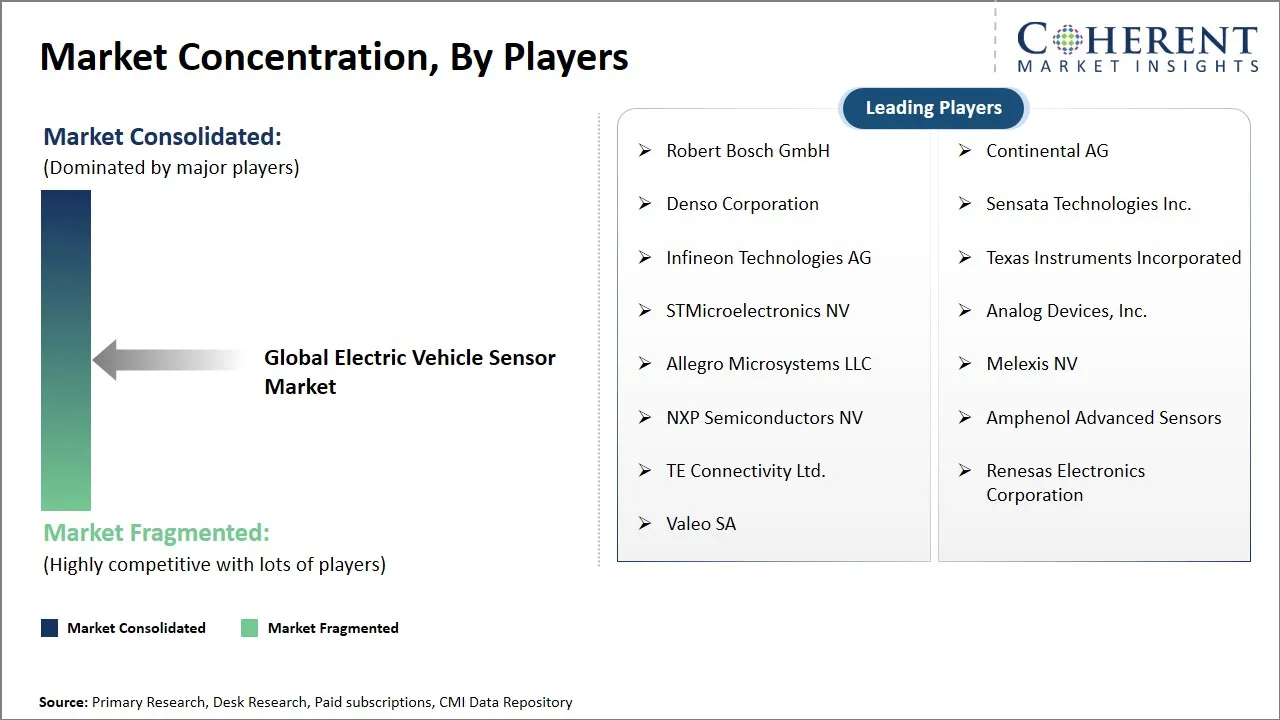
| Companies covered: | Robert Bosch GmbH, Continental AG, Denso Corporation, Sensata Technologies Inc., Infineon Technologies AG, Texas Instruments Incorporated, STMicroelectronics NV, Analog Devices, Inc., Allegro Microsystems LLC, Melexis NV, NXP Semiconductors NV, Amphenol Advanced Sensors, TE Connectivity Ltd., Renesas Electronics Corporation, and Valeo SA | ||
| Growth Drivers: |
| ||
| Restraints & Challenges: |
| ||
Global Electric Vehicle Sensor Market Dynamics
Global Electric Vehicle Sensor Market Driver - Rapid Adoption of Electric Vehicles
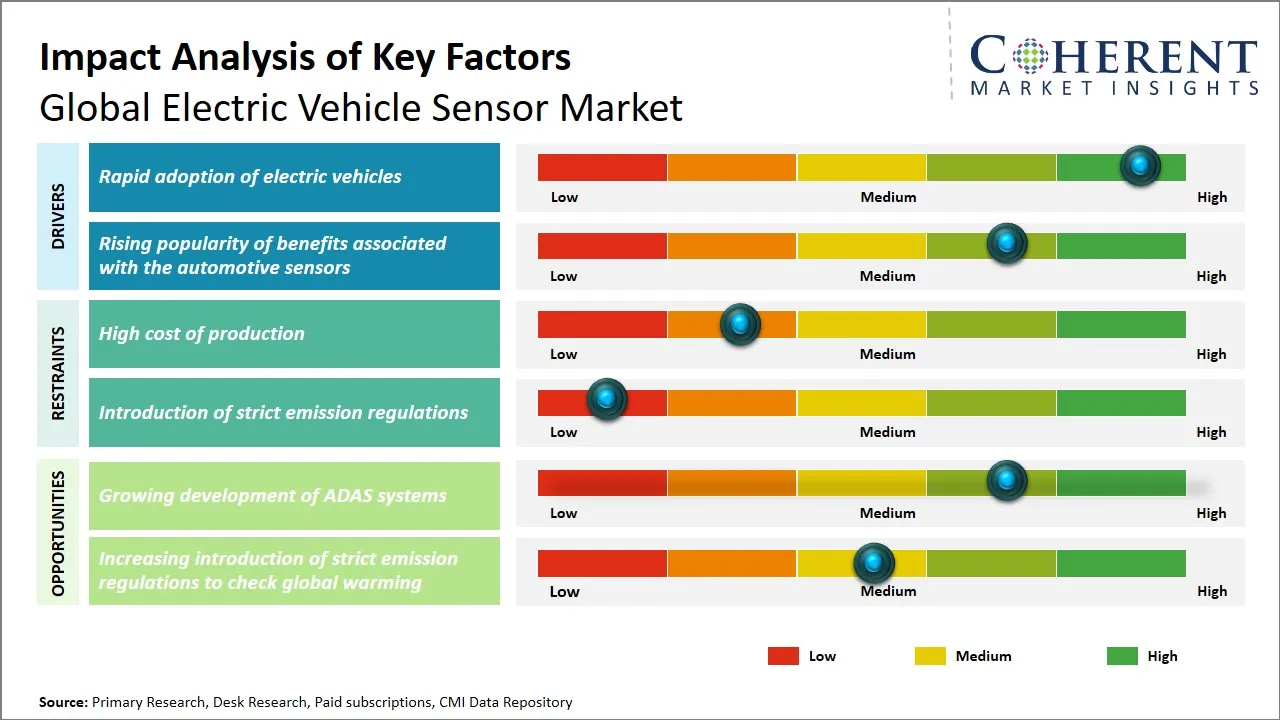
The swift and widespread adoption of electric vehicles (EVs) is a pivotal factor driving the expansion of the electric vehicle sensor market. As automakers aggressively pivot towards electrification to meet stringent emission regulations and evolving consumer preferences, the integration of advanced sensor technologies becomes indispensable. Sensors play a critical role in managing battery performance, monitoring motor operations, ensuring safety systems, and enabling autonomous features within electric vehicles. The complexity of electric drivetrains and energy management systems requires precise and reliable sensor inputs to optimize vehicle efficiency, extend battery life, and enhance overall performance.
For instance, on January 6, 2026, Hyundai Motor Company unveiled the STARIA Electric at the Brussels Motor Show, marking a bold step forward in multi-purpose vehicle (MPV) innovation. Combining zero-emission mobility with a people-centered design, STARIA Electric sets a new standard for modern lifestyles.
(Source: hyundainews.com)
Global Electric Vehicle Sensor Market Opportunity - Growing Development of ADAS Systems
The expanding integration of Advanced Driver Assistance Systems (ADAS) in Electric Vehicles (EVs) presents a significant growth opportunity for the global electric vehicle sensor market. Safety tools like adaptive cruise control, alerts for drifting lanes, sudden brake support, and help during parking depend mainly on different detectors - laser scanning, radio waves, sound pulses, visual capture - to improve how vehicles protect occupants plus operate smoothly. With standards growing stricter worldwide and customers leaning more toward intelligent features, producers of battery-powered cars focus increasingly on building high-level assistance functions directly into upcoming versions.
For instance, on November 17, 2025, Nexteer Automotive broke ground on its APAC Smart Manufacturing Project in Suzhou Industrial Park, China, an initiative designed to advance the company's smart manufacturing capabilities and long-term operational agility.
(Source: nexteer.com)
Analyst Opinion (Expert Opinion)
- Among emerging automotive trends, electric vehicle sensors stand out due to their role in enabling smarter transport solutions. Instead of simple monitoring tasks, modern sensing devices now support critical functions like energy control and environmental awareness. As vehicle architectures evolve, featuring intricate battery setups alongside adaptive driving aids, reliance on accurate data from sensors increases noticeably. Rather than being passive components, these elements actively shape how efficiently a car operates. With automation gaining ground, precision and consistency in sensor output matter more than before. They see a particularly strong uptick in adoption of multifunctional sensors, sensor fusion platforms, and intelligent sensing systems that combine hardware with embedded software to deliver predictive diagnostics and real-time control. This trend is expected to drive deeper collaboration between semiconductor firms, tier-1 suppliers, and OEMs, pushing innovation cycles faster while also raising the importance of localized supply chains and resilient component sourcing.
- Still, multiple significant hurdles remain which may slow expansion. Among them, limited availability of semiconductors, increasing prices for base materials, along with pressure from competing sensing methods like LiDAR, radar, or cameras are a few. As the network develops, specialists emphasize that compatibility and uniform protocols matter greatly, especially concerning driver support features and self-operating capabilities. Regional factors play a role too; regulations in areas such as China, Europe, and North America differ, while electric vehicle uptake varies by market, affecting deployment speed across car types. In the end, despite complexities, expert projections stay positive over time: sensors in electric vehicles are seen less as mere parts, more as pivotal elements guiding how transport advances.
Speak to the analyst
Want personalized insights?
Take the findings above to one of our principal consultants, or have the report rebuilt around the segments, geographies and competitors you actually track.
Market Segmentation
- Product Type Insights (Revenue, USD Billion, 2021 - 2033)
- Temperature Sensors
- Motion Sensors
- Pressure Sensors
- Speed Sensors
- Gas Sensors
- Propulsion Type Insights (Revenue, USD Billion, 2021 - 2033)
- Hybrid electric Vehicle
- Plug-in Hybrid Electric Vehicle
- Battery Electric Vehicle
- Regional Insights (Revenue, USD Billion, 2021 - 2033)
- North America
- U.S.
- Canada
- Latin America
- Brazil
- Argentina
- Mexico
- Rest of Latin America
- Europe
- Germany
- U.K.
- Spain
- France
- Italy
- Russia
- Rest of Europe
- Asia Pacific
- China
- India
- Japan
- Australia
- South Korea
- ASEAN
- Rest of Asia Pacific
- Middle East
- GCC Countries
- Israel
- Rest of Middle East
- Africa
- South Africa
- North Africa
- Central Africa
- North America
- Key Players Insights
- Robert Bosch GmbH
- Continental AG
- Denso Corporation
- Sensata Technologies Inc.
- Infineon Technologies AG
- Texas Instruments Incorporated
- STMicroelectronics NV
- Analog Devices, Inc.
- Allegro Microsystems LLC
- Melexis NV
- NXP Semiconductors NV
- Amphenol Advanced Sensors
- TE Connectivity Ltd.
- Renesas Electronics Corporation
- Valeo SA
Sources
Primary Research Interviews
- Electric Vehicle Sensor Manufacturers
- Automotive OEMs and Tier-1 Suppliers
- Electric Vehicle Technology Experts
Databases
- Bloomberg Terminal
- S&P Capital IQ
- Automotive Industry Database
- GlobalData Automotive Intelligence
Magazines
- Automotive News
- Electric Vehicle Magazine
- Sensors & Transducers Magazine
- Auto Tech Review
Journals
- IEEE Transactions on Vehicular Technology
- Journal of Automotive Engineering
- Sensors and Actuators Journal
Newspapers
- Financial Times
- The Wall Street Journal
- Automotive News Europe
- Reuters Business News
Associations
- Society of Automotive Engineers (SAE)
- Electric Vehicle Association (EVA)
- International Association of Automotive Sensor Manufacturers
- Alliance for Automotive Innovation
Public Domain Sources
- International Energy Agency (IEA) Reports
- Government Electric Vehicle Policy Documents
- Patent Databases (USPTO, EPO)
Proprietary Elements
- CMI Data Analytics Tool
- Proprietary CMI Existing Repository of information for last 8 years
Get access to 250+ pages report
Every segment, forecast, competitor profile and data table behind the analysis above — available for instant download.
- ESOMAR Member
- ISO 9001:2015 Certified
- D-U-N-S Registered
- GDPR & CCPA Compliant
Missing comfort of reading report in your local language? Find your preferred language:
Transform your Strategy with Exclusive Trending Reports
Frequently Asked Questions
The global electric vehicle sensor market stood at USD 18 Bn in 2026 and is expected to reach USD 60 Bn by 2033.
The CAGR of global electric vehicle sensor market is projected to be 14% from 2026 to 2033.
Rapid adoption of electric vehicles and rising popularity of benefits associated with the automotive sensors are the major factors driving the growth of the global electric vehicle sensor market.
High cost of production and introduction of strict emission regulations are the major factors hampering the growth of the global electric vehicle sensor market.
In terms of product type, temperature sensors are estimated to dominate the market revenue share in 2026.
Sensors enable precise control of batteries, motors, thermal systems, and safety features, which are essential for reliable EV operation.
Battery management systems rely heavily on sensors to monitor temperature, voltage, and current to ensure safety and extend battery life.