

Global Embroidery Machine Market Size and Forecast – 2026 to 2033
The global embroidery machine market is estimated to be valued at USD 1.33 Bn in 2026 and is expected to reach USD 2.01 Bn by 2033, exhibiting a compound annual growth rate (CAGR) of 6.1% from 2026 to 2033.
Key Takeaways of the Global Embroidery Machine Market
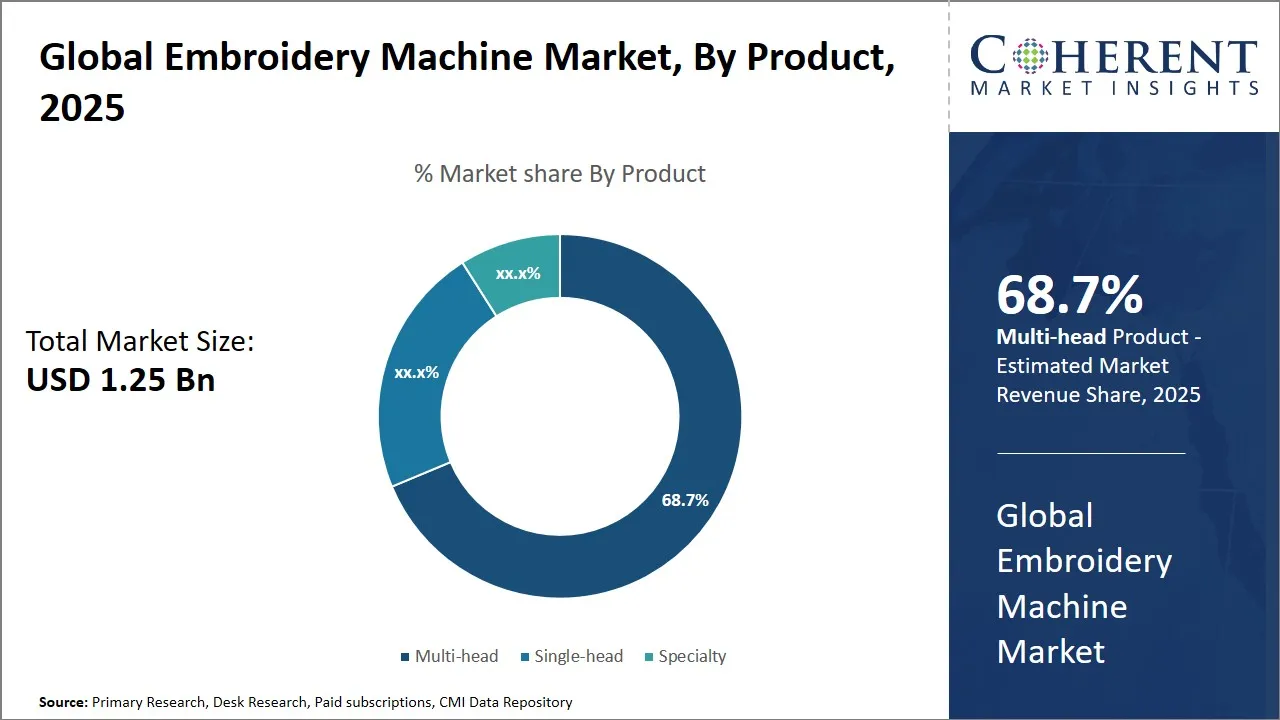
- The multi-head segment is expected to lead the market holding a share of 69.7% in 2026.
- The computerized segment is projected to dominate with a share of 66.6% in 2026.
- Asia Pacific, expected to hold a share of 41.1% in 2026, dominates the market.
- North America, projected to hold a share of 20.3% in 2026, shows the fastest growth in the market.
Market Overview
Market trends show a move towards automation and smart embroidery machines with advanced software, enhancing precision and efficiency. The use of IoT and AI technologies is enabling real-time monitoring and predictive maintenance, reducing downtime. Also, there is growing adoption in emerging markets because of growing fashion industries and increasing awareness about sustainable and bespoke clothing, further propelling the market’s expansion globally.
Current Events and Its Impacts
Current Events | Description and its Impact |
Geopolitical and Trade Developments |
|
Economic and Manufacturing Trends |
|
Segmental Insights
- Current Industry Events of 2026
- Market Size Estimation
- Regional Breakdown
- Competitive Landscape
- Customer Intelligence
- Segmental Analysis
- Pricing Analysis
- Key Market Drivers, Challenges & Future Trends
- Customized Insights Section
Global Embroidery Machine Market Insights, By Product – Multi-head Segment Leads Because of Enhanced Productivity and Efficiency Needs
The multi-head segment, expected to capture 69.7% share in 2026, dominates the market because of its ability to deliver high productivity, consistent quality, and large-volume output. These machines make possible simultaneous stitching across multiple heads, making them ideal for mass production in apparel, sportswear, and home décor.
The segment's growth is reinforced by growing demand for mass customization, increasing labor costs, and the need for automation-driven efficiency. Modern multi-head systems come with features like automatic thread trimming, color change, and computerized controls, significantly reducing labor and minimizing errors. Their ability to handle different fabrics and complex patterns further adds to their appeal in fast growing textile markets.
Tajima’s TFMX-II multi-head series is used a lot by large apparel manufacturers for high-speed bulk embroidery, helping them boost output while lowering per-unit cost.
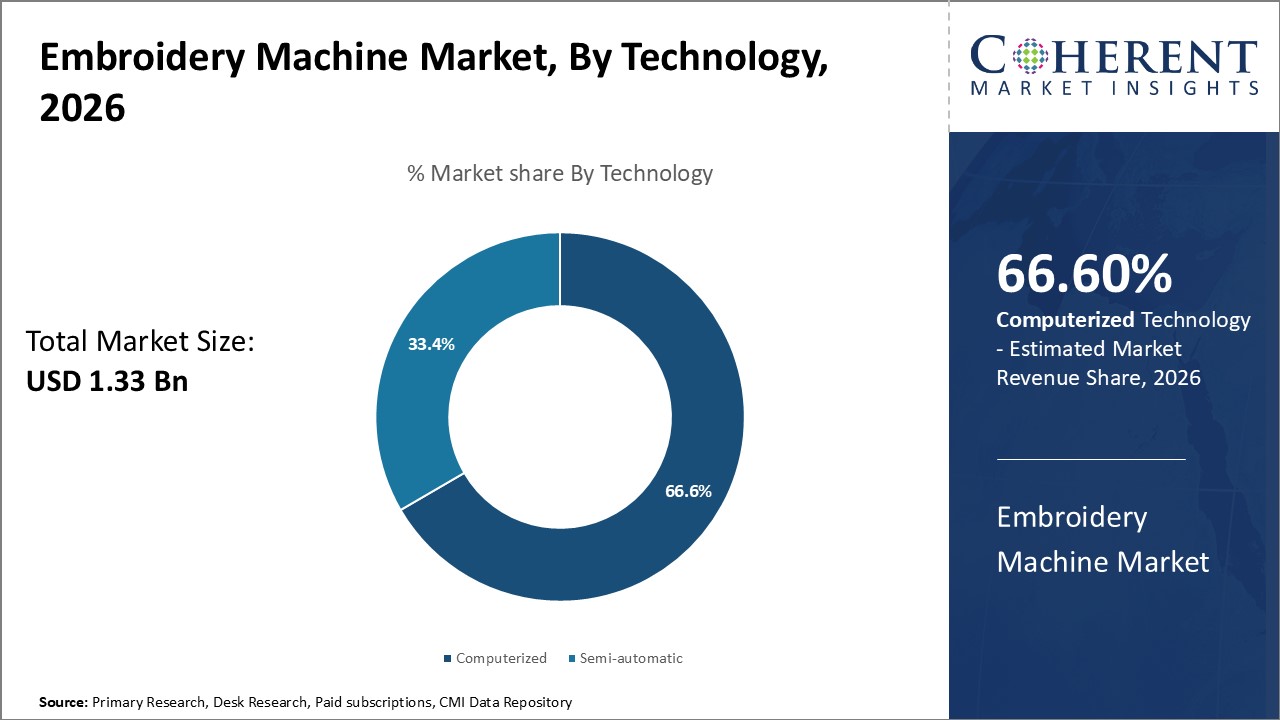
Global Embroidery Machine Market Insights, By Technology – Computerized Segment Leads Because of Precision and Automation Integration
The computerized segment, projected to hold 66.6% share in 2026, leads because of its superior precision, automation, and design flexibility. Computerized systems convert digital designs into accurate stitching patterns, enabling flawless replication of intricate and multi-color designs at scale. This makes them particularly especially useful attractive for fashion labels, corporate branding, and promotional merchandise.
Automation features, including auto-trimming, color sequencing, error detection, and Computer-Aided Design (CAD) integration, reduce manual effort, minimize defects, and improve throughput. Their user-friendly interfaces also make them suitable for both industrial manufacturers and small businesses. With growing digitalization and sustainability demands, computerized machines offer reduced wastage and compatibility with IoT-enabled production lines.
Barudan’s BEKT-S1512C computerized multi-head machine is used by global sportswear and logo manufacturers to get high-accuracy stitching with reduced setup time.
Pricing Analysis of the Embroidery Machine Market
Machine Type/Use-case | Typical Price Range (USD) |
Entry-level/Hobby/Home/Basic single-needle machine | USD 300 – USD 2,500 |
Prosumer/Semi-commercial/Multi-needle small-business machines | USD 2,500 – USD 8,000 |
Commercial single-head or smaller multi-needle machines (for small/medium business) | USD 8,000 – USD 25,000 |
Entry-level multi-head/lower-end industrial embroidery machines (basic multi-head 4–6 heads) | USD 25,000 – USD 40,000 |
Mid- to high-end industrial/commercial multi-head embroidery machines | USD 40,000 – USD 80,000 |
Premium industrial multi-head machines/large-capacity production systems/top-tier OEM machines | USD 80,000 – USD 250,000+ |
Capital Expenditure (CapEx) Comparison
Machine Type | Typical Price Range (USD) |
Manual/Semi-automatic Single-Needle | USD 1,200 – USD 5,000 |
Computerized Single-Head | USD 6,000 – USD 18,000 |
Computerized Multi-Head (4–12 heads) | USD 20,000 – USD 65,000 |
High-End Multi-Head (15–30 heads, advanced digital control) | USD 75,000 – USD 150,000+ |
Scrap Reduction & Precision Accuracy Metrics
Metric | Manual Machinery | Computerized Machinery | Benefit |
Error Rate | 8–12% | 1.5–3% | Up to 80% scrap reduction |
Stitch Accuracy Deviation | ± 1.5–2 mm | ± 0.3–0.6 mm | High precision |
Design Consistency | Low | Very High | Uniform quality across large runs |
Thread Waste | 8–12% | 3–5% | 40–60% less waste |
Total Cost of Ownership (TCO) Breakdown (5-Year Horizon)
Cost Element (5 Years) | Estimated Cost (USD) |
Initial Purchase (CapEx) | USD 50,000 |
Maintenance, Parts & Service | USD 3,500 – USD 8,000 |
Software Licenses & Upgrades | USD 1,200 – USD 3,000 |
Operator Labor Cost | USD 18,000 – USD 40,000 |
Electricity Consumption | USD 3,000 – USD 6,000 |
Thread & Consumables | USD 8,000 – USD 15,000 |
Total 5-Year TCO | USD 83,700 – USD 122,000 |
Regional Insights
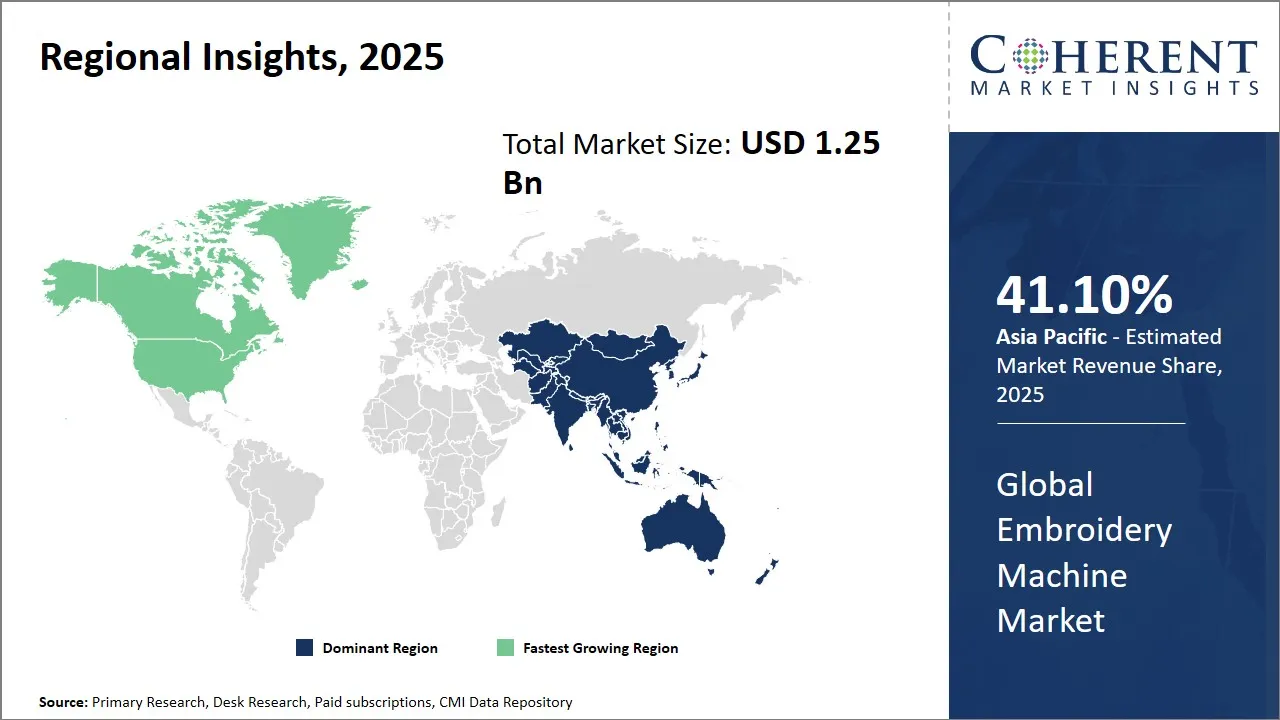
Asia Pacific Embroidery Machine Market Analysis and Trends
Asia Pacific, expected to hold a share of 41.1% in 2026, dominates the global embroidery machine market, because of robust textile and garment manufacturing ecosystem that supports extensive demand for embroidery equipment. Countries such as China, India, and Japan host a significant number of textile and apparel manufacturers, ranging from small and medium enterprises to large factories, creating a concentrated user base for embroidery machines. Government initiatives for promoting exports, textile sector modernization, and skill development add to industry growth.
Also, lower manufacturing and labor costs in this region add to investments in automation and advanced machinery, including embroidery machines. Key players like Tajima, ZSK, and Happy Japan have made strong footprints here, supplying high-precision and technologically advanced embroidery machines made for mass production and intricate designs. Trade policies encouraging textile exports further add to Asia Pacific’s market leadership.
North America Embroidery Machine Market Analysis and Trends
The North America region, projected to hold a share of 20.3% in 2026, maintains a strong growth trajectory, because of its advanced textile decoration ecosystem, high demand for customized apparel, and early adoption of automation technologies. The U.S. and Canada continue to invest a lot in digital embroidery, promotional merchandise production, and on-demand apparel manufacturing, supported by a mature retail environment and a thriving small-business embroidery community.
Leading companies such as Tajima, Barudan, ZSK, and Brother have strengthened their North American distribution networks, offering advanced machines, technical training, and software solutions tailored for both commercial decorators and emerging customized apparel startups. Also, the strong presence of promotional product companies and e-commerce-driven brands makes consistent demand for efficient, high-precision embroidery machinery across the region.
Global Embroidery Machine Market Outlook for Key Countries
China Embroidery Machine Market Analysis and Trends
China embroidery machine market has a huge textile manufacturing base, which incorporates both traditional and high-tech embroidery solutions. The country benefits from extensive government support in modernizing textile equipment. Major domestic manufacturers, along with global companies like Tajima and SWF, compete actively here, providing different product ranges from single-head machines to multi-head automated systems. China serves as both a significant production hub and export base for embroidery machinery, leveraging its comprehensive supply chain and evolving infrastructure.
India Embroidery Machine Market Analysis and Trends
India continues to lead because of a strong presence of textile artisans and large-scale manufacturers requiring varied embroidery technology. Government initiatives such as “Make in India” and support for micro, small, and medium enterprises (MSMEs) add to machinery adoption. Companies like ZSK and Happy have made localized support centers to cater to the demand for both manual and computerized embroidery machines. The country’s traditional embroidery crafts combined with industrial usage make a unique market dynamic emphasizing customization and automation.
U.S. Embroidery Machine Market Analysis and Trends
The U.S. embroidery machine market grows because of advanced technological integration and growing customization trends in fashion and promotional merchandise sectors. The availability of high-precision machines from manufacturers such as Brother, Barudan, and Tajima caters to diverse end users ranging from small businesses to large apparel firms. Strong IP protection and a well-established distribution network ensure quality and innovation. Also, sustainability trends add to the adoption of energy-efficient embroidery machines, adding momentum to advanced product offerings.
Brazil Embroidery Machine Market Analysis and Trends
Brazil embroidery machine market showcases rapid industrial adoption prompted by growing domestic textile manufacturing and expanding fashion industries. Local companies and global brands like Barudan and SWF have capitalized on improving trade policies and infrastructure developments to grow their reach. Government support for industrial modernization, alongside growing consumer interest in embroidered fashion products, adds to market expansion. The growing MSME segment plays a pivotal role in mechanization and technology upgrades.
Market Players, Key Development, and Competitive Intelligence
Key Developments
- In April 2025, Melco's SUMMIT was recognized as the Best New Embroidery Technology of 2024 by Impressions Magazine.
- In March 2025, Brother Industries Ltd. launched the Brother PR1X Commercial Embroidery Machine, designed to meet the advanced technical and upgrade requirements of home enthusiasts while also serving as a powerful tool for retail businesses specializing in clothing, sports goods, baby products, and gifts.
- In September 2024, Melco International, a global leader in commercial embroidery technology, announced the launch of the Melco SUMMIT, an advanced and easy-to-use commercial embroidery machine on the market.
- In August 2024, Brother International Corporation introduced the Aveneer EV1, a state-of-the-art sewing, embroidery, and quilting machine offering powerful, dynamic luxury, and industry-leading features.
Top Strategies Followed by Embroidery Machine Market Players
- Established companies dominate the market by using their substantial financial and technological resources to maintain a competitive edge.
- ZSK has expanded into technical embroidery (e-textiles, conductive fiber embroidery, composite materials) via its “Technical Embroidery Systems” platform. This shows R&D targeting advanced materials and new high-value applications beyond traditional garment use.
- Mid-level players in the embroidery machine market use cost-effective strategies to differentiate themselves from both dominant corporations and smaller niche manufacturers.
- Ricoma offers competitively priced multi-head models like CHT2 series, balancing good speed, touchscreen control, and multi-needle capacity at lower price points than Tajima/ZSK.
- Small-scale players operate in a highly competitive environment by adopting niche-focused strategies that allow them to carve out unique market positions.
- Aemco manufactures embroidery machines customized for local Indian textile clusters, including sari, lehenga, and boutique embellishment applications.
Market Report Scope
Embroidery Machine Market Report Coverage
| Report Coverage | Details | ||
|---|---|---|---|
| Base Year: | 2025 | Market Size in 2026: | USD 1.33 Bn |
| Historical Data for: | 2020 To 2024 | Forecast Period: | 2026 To 2033 |
| Forecast Period 2026 to 2033 CAGR: | 6.1% | 2033 Value Projection: | USD 2.01 Bn |
| Geographies covered: |
| ||
| Segments covered: |
| ||
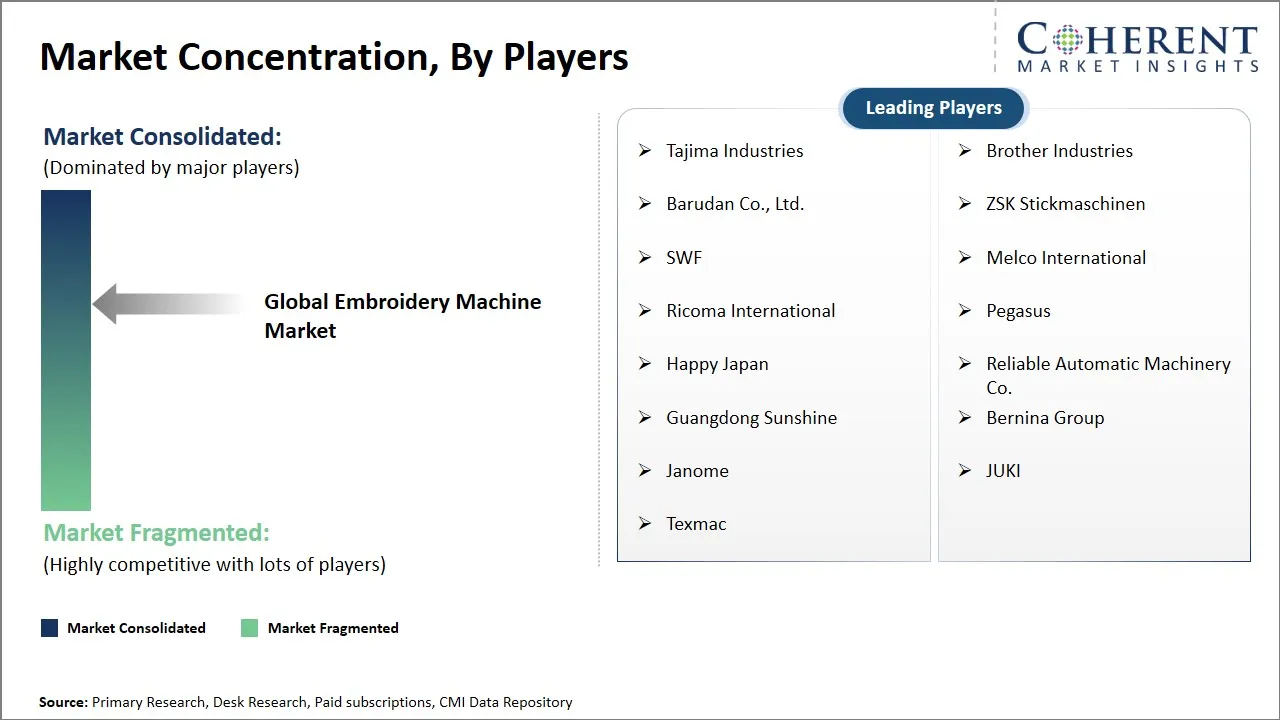
| Companies covered: | Tajima Industries, Brother Industries, Barudan Co., Ltd., ZSK Stickmaschinen, SWF, Melco International, Ricoma International, Pegasus, Happy Japan, Reliable Automatic Machinery Co., Guangdong Sunshine, Bernina Group, Janome, JUKI, and Texmac | ||
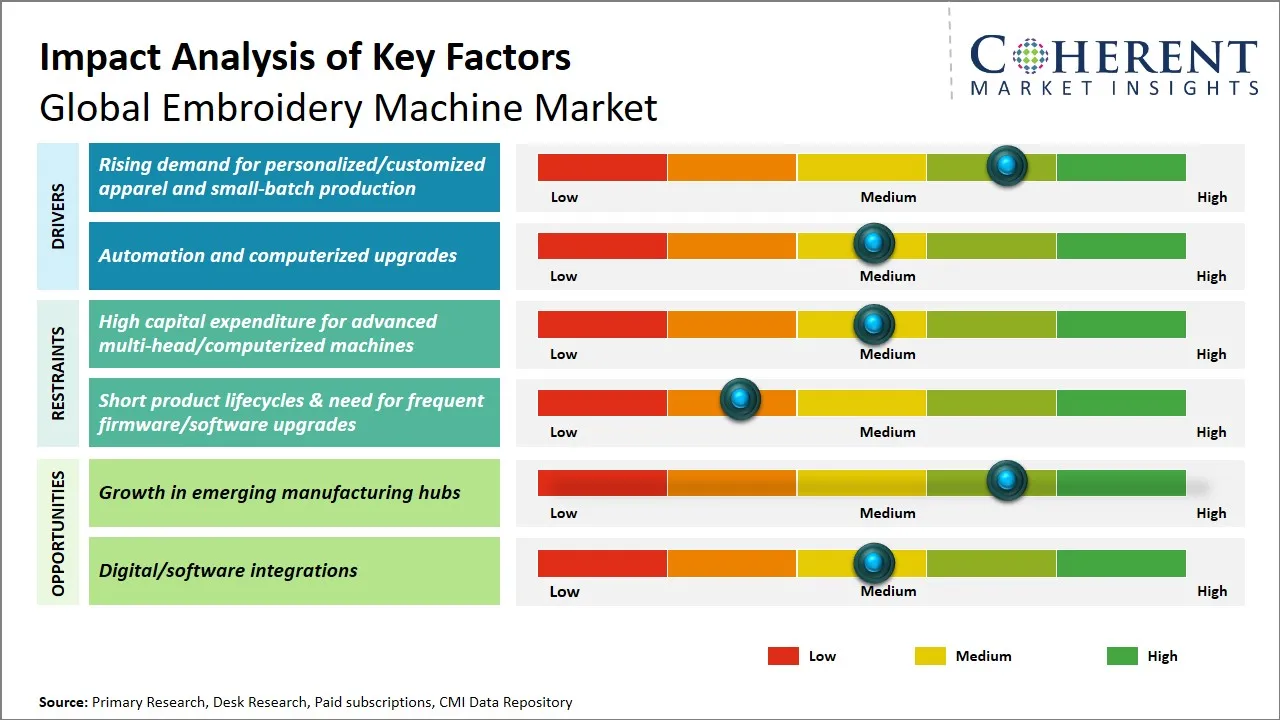
| Growth Drivers: | Rising demand for personalized/customized apparel and small-batch production Automation and computerized upgrades | ||
| Restraints & Challenges: |
| ||
Market Dynamics
Global Embroidery Machine Market Driver – Rising Demand for Personalized/Customized Apparel and Small-Batch Production
The growing preference for personalized and custom-designed apparel is adding to the global adoption of embroidery machines. Consumers increasingly want unique, style-specific products, pushing brands toward small-batch, flexible production models instead of traditional mass manufacturing. Modern embroidery machines offer the precision, speed, and design versatility needed for high-quality custom work, making them essential for boutique labels, print-on-demand platforms, and online fashion retailers. Technological advances—such as faster stitching speeds, easy digital pattern uploads, and automated adjustments—have also reduced turnaround time and costs, allowing businesses of all sizes to serve the customization trend efficiently.
Etsy-based apparel sellers in the U.S. widely use Brother PR-series single-head computerized machines to offer personalized monograms, custom patches, and name embroidery, supporting fast custom-order fulfillment.
Global Embroidery Machine Market Opportunity – Growth in Emerging Manufacturing Hubs
Emerging manufacturing hubs across Southeast Asia, Latin America, and Eastern Europe present big growth opportunities as textile and garment production expands rapidly. These regions benefit from competitive labor costs, rising investments in apparel manufacturing, and government incentives encouraging modernization. Growing domestic demand for fashion and increasing export activity are driving manufacturers to adopt automated, IoT-enabled, and high-output embroidery machines to meet global quality and volume requirements.
Vietnam’s textile clusters have adopted Tajima TMAR-KC multi-head machines to enhance export competitiveness, improving production speed and consistency for global sportswear and fashion brands.
Analyst Opinion (Expert Opinion)
- Despite rapid advances in digital embroidery and multi-needle automation, many manufacturers—especially in Asia Pacific are still operating with outdated production lines. This technological gap slows down machine precision improvements, increases defect rates, and limits the ability of suppliers to meet the expectations of global apparel and home-textile exporters who now demand fully networked, IoT-enabled machines.
- The market has entered a phase where mid-tier players from China and emerging Asian economies are undercutting pricing to gain global share. While this boosts short-term accessibility, it erodes margins across the ecosystem and puts pressure on established brands to reduce prices at the cost of innovation. This “race to the bottom” in pricing risks stalling R&D investments in high-precision and smart embroidery technologies.
- The embroidery machine ecosystem is tightly linked to the cyclical nature of fashion and home décor markets. Unpredictable shifts—driven by fast fashion slowdowns, inventory pile-ups, and geopolitical sourcing shifts—make it increasingly difficult for manufacturers to forecast orders. This inconsistency strains supply chain planning, increases inventory risks, and forces companies to operate with reduced operational visibility.
Speak to the analyst
Want personalized insights?
Take the findings above to one of our principal consultants, or have the report rebuilt around the segments, geographies and competitors you actually track.
Market Segmentation
- Product Insights (Revenue, USD Bn, 2021 - 2033)
- Multi-head
- Single-head
- Specialty
- Technology Insights (Revenue, USD Bn, 2021 - 2033)
- Computerized
- Semi-automatic
- Regional Insights (Revenue, USD Bn, 2021 - 2033)
- North America
- U.S.
- Canada
- Latin America
- Brazil
- Argentina
- Mexico
- Rest of Latin America
- Europe
- Germany
- U.K.
- Spain
- France
- Italy
- Russia
- Rest of Europe
- Asia Pacific
- China
- India
- Japan
- Australia
- South Korea
- ASEAN
- Rest of Asia Pacific
- Middle East
- GCC Countries
- Israel
- Rest of Middle East
- Africa
- South Africa
- North Africa
- Central Africa
- North America
- Key Players Insights
- Tajima Industries
- Brother Industries
- Barudan Co., Ltd.
- ZSK Stickmaschinen
- SWF
- Melco International
- Ricoma International
- Pegasus
- Happy Japan
- Reliable Automatic Machinery Co.
- Guangdong Sunshine
- Bernina Group
- Janome
- JUKI
- Texmac
Sources
Primary Research Interviews
Stakeholders
- Textile & Apparel Manufacturers
- Embroidery Machine Manufacturers & Suppliers
- Garment Export Houses across Asia Pacific
- Fashion Designers & Custom Apparel Brands
- Technical Textile Producers
- Embroidery Service Providers (Commercial Shops & Contract Embroiderers)
- Automation & Digitalization Consultants specializing in textile machinery
- Sustainability & Circular Textile Experts (for eco-friendly machine trends)
Databases
- Eurostat
- U.S. Census Bureau
- TextileWorld Data Hub
- OECD
- International Textile Machinery Shipment Statistics (ITMSS Database)
- Asia Pacific Apparel Production Index (APAPI Database)
Magazines
- Textile Today
- Apparel Insider
- Embroidery & Design Magazine
- StitchWorld International
- Impressions Magazine (Decorated Apparel Industry)
Journals
- Journal of Textile Engineering & Fashion Technology
- Textile Research Journal
- International Journal of Clothing Science and Technology
- Automation in Textile Machinery Journal
- Journal of Industrial Textiles
Newspapers
- The Business of Fashion (BoF) – News Section
- Textile Excellence (India)
- Nikkei Asia – Manufacturing & Machinery
- The Guardian – Global Trade Section
- South China Morning Post – Manufacturing Updates
Associations
- International Textile Manufacturers Federation (ITMF)
- American Apparel & Footwear Association (AAFA)
- Japan Sewing Machinery Manufacturers Association (JASMA)
- China National Textile & Apparel Council (CNTAC)
- European Apparel and Textile Confederation (EURATEX)
- Embroidery Trade Association (ETA – U.K.)
Public Domain Sources
- U.S. Census Bureau
- EUROSTAT
- United Nations Industrial Development Organization (UNIDO)
- World Bank – Textile Manufacturing Indicators
- WTO – Global Trade Statistics for Textile Machinery
- ResearchGate (for technical papers on embroidery automation)
Proprietary Elements
- CMI Data Analytics Tool
- Proprietary CMI existing repository of information for last 8 years
Get access to 250+ pages report
Every segment, forecast, competitor profile and data table behind the analysis above — available for instant download.
- ESOMAR Member
- ISO 9001:2015 Certified
- D-U-N-S Registered
- GDPR & CCPA Compliant
Missing comfort of reading report in your local language? Find your preferred language:
Transform your Strategy with Exclusive Trending Reports
Frequently Asked Questions
The global embroidery machine market is estimated to be valued at USD 1.33 Bn in 2026 and is expected to reach USD 2.01 Bn by 2033.
The CAGR of the global embroidery machine market is projected to be 6.1% from 2026 to 2033
Rising demand for personalized/customized apparel and small-batch production and automation and computerized upgrades are the major factor driving the growth of the global embroidery machine market.
High capital expenditure for advanced multi-head/computerized machines and short product lifecycles & need for frequent firmware/software upgrades are the major factor hampering the growth of the global embroidery machine market.
In terms of product, the multi-head segment is estimated to dominate the market revenue share in 2026.
Tajima Industries, Brother Industries, Barudan Co., Ltd., ZSK Stickmaschinen, SWF, Melco International, Ricoma International, Pegasus, Happy Japan, Reliable Automatic Machinery Co., Guangdong Sunshine, Bernina Group, Janome, JUKI, and Texmac are the major players.
Asia Pacific is expected to lead the global embroidery machine market in 2026