

Europe Animal Disinfectant Market Size and Forecast – 2026 To 2033
The Europe animal disinfectant market is estimated to be valued at USD 1,211.7 Mn in 2026 and is expected to reach USD 1,856.2 Mn by 2033, exhibiting a compound annual growth rate (CAGR) of 7.3% from 2026 to 2033. This growth is driven by increasing awareness about animal health and biosecurity measures across livestock farms, along with stringent regulations to prevent the spread of infectious diseases among animals. Investments in advanced disinfectant formulations and rising demand from the veterinary sector further bolster market expansion.
Key Takeaways of the Europe Animal Disinfectant Market
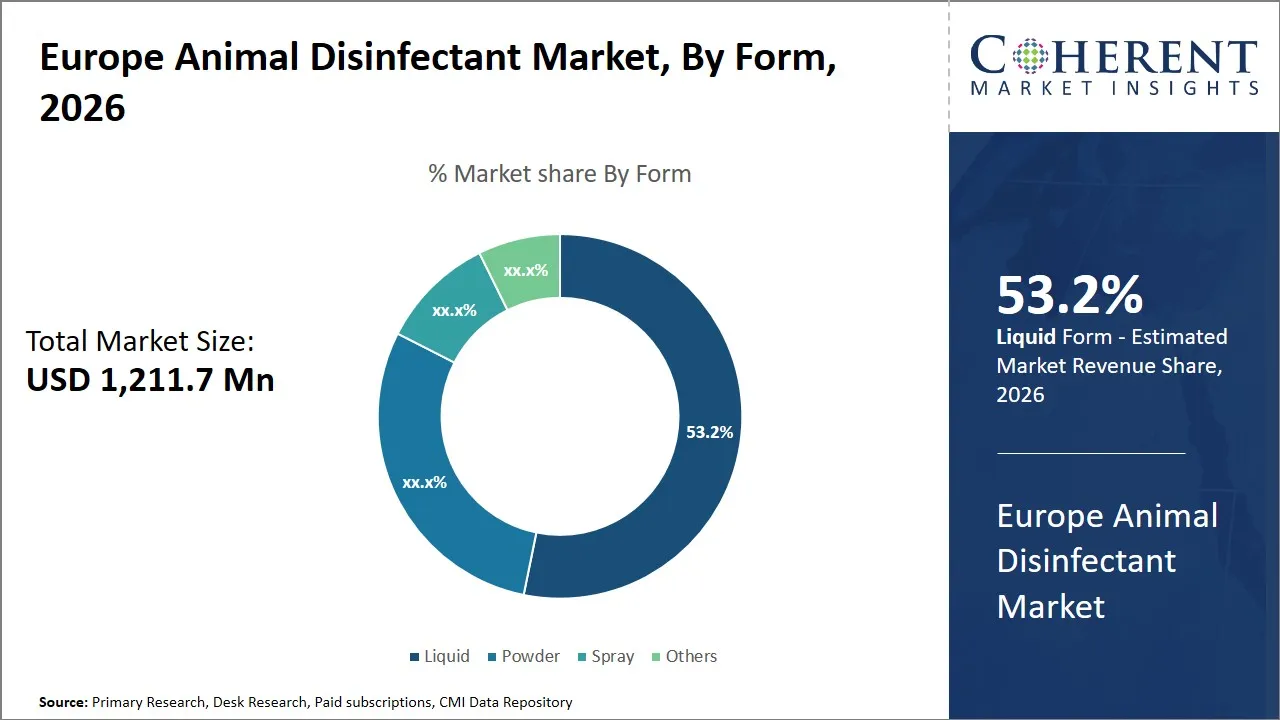
- Liquid segment is expected to lead the Europe animal disinfectant market, capturing 53.2% share in 2026.
- Chlorine-based disinfectants segment is estimated to represent 24.7% of the Europe animal disinfectant market share in 2026.
- Livestock farms segment is projected to dominate with 44.1% of the Europe animal disinfectant market share in 2026.
Market Overview
- Europe remains a regulation-driven market where animal disinfectants are shaped heavily by the EU Biocidal Products Regulation, especially under veterinary hygiene product type classifications.
- Demand is being supported by recurring avian influenza pressure across Europe, which keeps farm hygiene, surface disinfection, and strict biosecurity high on the agenda for poultry producers.
- Poultry and dairy are the key demand centers, as intensive farming systems require routine disinfection of housing, equipment, transport vehicles, and contact surfaces to reduce infection risk.
- The market is moving beyond basic disinfectant use toward broader biosecurity programs, with more focus on validated efficacy, correct application protocols, and farm-level disease prevention.
Currents Events and their Impact
Current Events | Description and its Impact |
Avian influenza outbreaks are keeping farm biosecurity at the top of spending priorities |
|
The market is moving toward automation-compatible dairy disinfection solutions |
|
Segmental Insights
- Current Industry Events of 2026
- Market Size Estimation
- Regional Breakdown
- Competitive Landscape
- Customer Intelligence
- Segmental Analysis
- Pricing Analysis
- Key Market Drivers, Challenges & Future Trends
- Customized Insights Section
Why Does the Liquid Segment Dominate the Europe Animal Disinfectant Market in 2026?
The liquid segment is expected to hold the largest market share of 53.2% in 2026, due to several pivotal factors. Liquids offer superior ease of application, allowing thorough coverage of animal housing, equipment, and surfaces prone to contamination. This is because they can be diluted into different concentrations and hence be used to accommodate the different biosecurity requirements, both the high-level sterilization requirements and the regular cleaning requirements. The liquid nature allows it to penetrate cracks and other irregular surfaces effectively eliminating pathogen and this is vital in animal habitat where microbial proliferation is extreme.
In addition, liquid disinfectants are known to have a quick antimicrobial effect, which is a necessary characteristic in livestock business in which time-dependent response of batches of livestock or cleaning cycles can affect productivity and animal welfare. This is because of the wide range of formulations that are available in a liquid state and they usually combine various active ingredients that allow a specific response to a wide range of pathogens such as bacteria, viruses, fungi and spores. This is particularly critical in the diverse climatic conditions in Europe that may have a different impact on the microbial growth in different places.
For instance, in April 2024, Neogen Corporation announced the launch of its Farm Fluid MAX disinfectant in the U.K., a liquid-based disinfectant designed for use across poultry and livestock environments. The product was developed to deliver broad-spectrum efficacy with improved penetration and coverage, aligning with the growing preference for liquid disinfectants in farm applications.
(Source: Neogen)
Why Does the Chlorine-based Disinfectants Segment Dominate the Europe Animal Disinfectant Market in 2026?
The chlorine-based disinfectants segment is expected to hold 24.7% of the market share in 2026, largely because of their unmatched broad-spectrum antimicrobial capacity and economic advantages. The strong oxidizing ability of chlorine compounds including sodium hypochlorite is also well known in destroying a large variety of pathogens such as bacteria, viruses, algae, and fungi, among others. This inclusive measure is essential in the agricultural setting where complex microbial risks are constantly putting the health of livestock and biosecurity at risk.
Chlorine-based disinfectants are very affordable and this attribute is very appealing to large-scale farming operations and also to small farms. Their cheap cost of production and the opportunity to be used in concentrated forms enable users to ensure high levels of disinfection schedules without straining operational budgets. This affordability makes its use in large-scale application across the diverse agricultural environment in Europe, which covers both intensive pig and poultry farms on one end to larger cattle and sheep rearing enterprises on the other.
For instance, in April 2025, Lanxess announced the expansion of its chlorine-based disinfection solutions portfolio for agricultural and veterinary applications in Europe, introducing enhanced formulations based on sodium hypochlorite chemistry for farm hygiene and water system sanitation. The new products are designed to deliver rapid antimicrobial action along with improved stability under farm operating conditions.
(Source: Lanxess)
The Livestock Farms Segment Dominates the Europe Animal Disinfectant Market
The livestock farms segment is expected to hold the largest market share of 44.1% in 2026, driven primarily by the increased emphasis on biosecurity in intensive farming systems. The high density of animals in comparatively small areas increases the chances of an outbreak of contagious diseases and appropriate disinfection measures are therefore necessary to ensure health and output of the herds. Farms with livestock, including cattle, swine, and mixed-species farms, need strong and effective hygiene practices in order to reduce the transmission of the pathogenic organisms that have the potential to severely affect the yield and economic sustainability.
Tight regulatory requirements and increasing consumer consciousness on food safety and animal welfare in Europe subject farmers of livestock to extra pressure to adopt strict sanitation practices. The essential part of these measures is disinfectants, which is aimed at providing the absence of infectious agents in housing facilities, feeding equipment, and vehicles during transportation. Preventive disinfection is a luxury and not a luxury because of the economic losses associated with outbreaks of such diseases as foot-and-mouth disease, avian influenza, or swine fever.
Regulatory Compliance as a Key Market-Shaping Force in the Europe Animal Disinfectant Market
- Regulatory Compliance as a Key Market Driver- Regulatory compliance is also a dominant market force as the animal disinfectant market in Europe is defined by the strictness of the regional regulations on chemical safety, biocidal efficacy, labeling, and environmental impact of the products. In Europe, consumers are no longer seeking effective disinfectants, but also products that have been approved to be used in livestock farms, hatcheries and veterinary environments and facilities that house animals. This renders compliance as an essential element in product development, registration and access to the market.
- Impact on Competition and Product Strategy- These policy requirements are forcing the firms to invest more in upgrading their formulation, documentation, testing and approval procedures before launching or expanding products in the region. Consequently, the market is increasingly quality driven and organized and compliant players are finding it easier to develop trust amongst the distributors, veterinarians and farm operators. Meanwhile, more stringent regulations will help reduce the entry rates of smaller manufacturers, so regulatory preparedness is a valuable competitive advantage in the European market.
Market Players, Key Developments, and Competitive Intelligence
Key Developments
- In September 2025, Kersia announced an exclusive agreement to acquire Neogen’s cleaners and disinfectants business, describing it as a major animal biosecurity acquisition. Kersia said the deal would add about USD 55 million in turnover and strengthen its position in pork and poultry hygiene, helping propel it into the top 3 global players in hygiene and disinfection for the agricultural world.
- In April 2025, Kersia announced that it acquired a majority stake in Ikochimiki, a Greek company focused on biosecurity solutions. Kersia said the acquisition strengthens its position in Greece and the Balkans and supports its strategy to consolidate activities across the food chain. For the Europe animal disinfectant market, this is a clear regional expansion move that improves Kersia’s footprint in Southern and Southeastern Europe.
- In October 2024, DeLaval announced the launch of Titan, a new barrier teat disinfectant developed for automated spray systems. The company said Titan combines the convenience of spray application with film-forming protection, making it DeLaval’s first teat spray to use this technology and one of the first products of its kind on the market.
Industry Consolidation Driving Integrated Biosecurity Solutions in the Europe Animal Disinfectant Market
- Industry Consolidation- The consolidation in the industry is assisting the companies in the Europe animal disinfectant market to solidify their positions by consolidating through acquisitions, alliances and expanding their product base. This is enabling the players to go beyond the sales of individual products and establish a better regional presence in livestock and veterinary hygiene markets.
- Integrated Biosecurity Portfolios- Due to this, the companies are now investing in integrated biosecurity portfolios, a case where disinfectants are packaged with broader hygiene and infection prevention offerings. This strategy is contributing to customer retention, aiding in the requirements of stricter sanitation of farms, and rendering suppliers more useful to end users seeking full biosecurity services.
Top Strategies Followed by Europe Animal Disinfectant Market Players
Player Type | Strategic Focus | Examples |
Established Market Leaders | Established players in the Europe animal disinfectant market focus heavily on R&D, regulatory compliance, and product innovation to maintain a competitive edge. They strengthen their position through strategic partnerships, OEM collaborations, and expanded distribution networks, allowing them to serve a wide range of applications across livestock, veterinary, and companion animal care while tapping into growth in emerging European markets. | Neogen Corporation has expanded its animal safety and biosecurity portfolio through acquisitions and partnerships, reinforcing its presence across Europe with a broader range of disinfectant and hygiene solutions. |
Mid-Level Players | Mid-level companies in the Europe animal disinfectant market compete by offering cost-effective products that balance performance and affordability, making them suitable for small farms and local veterinary providers. They typically grow through partnerships, joint ventures, and operational improvements that help expand production capacity, improve supply chains, and strengthen regional presence without the scale of larger players. | CID LINES (a part of Ecolab) has built a strong position in livestock hygiene across Europe by offering competitively priced disinfectant solutions while leveraging partnerships and distribution networks to expand its reach. |
Small-Scale Players | Small-scale and emerging players in the Europe animal disinfectant market compete by focusing on niche segments, such as eco-friendly or specialized disinfectant formulations, and tailoring products to local needs. They rely on innovation, flexibility, and local partnerships to build visibility and adapt quickly to regional regulations and customer preferences. | Anpario plc develops natural and bio-based hygiene and feed additive solutions, positioning itself in niche segments by offering sustainable alternatives aligned with evolving regulatory and environmental expectations in Europe. |
Market Report Scope
Europe Animal Disinfectant Market Report Coverage
| Report Coverage | Details | ||
|---|---|---|---|
| Base Year: | 2025 | Market Size in 2026: | USD 1,211.7 Mn |
| Historical Data for: | 2020 To 2024 | Forecast Period: | 2026 To 2033 |
| Forecast Period 2026 to 2033 CAGR: | 7.3% | 2033 Value Projection: | USD 1,856.2 Mn |
| Segments covered: |
| ||
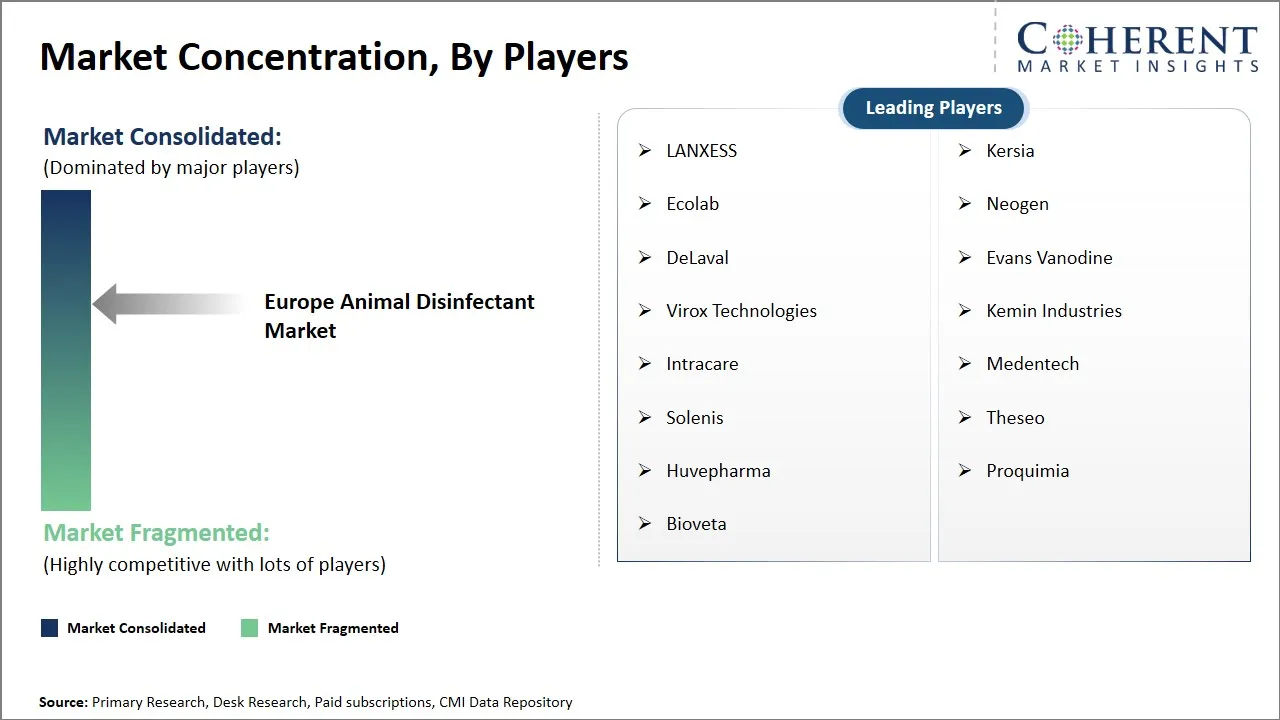
| Companies covered: | LANXESS, Kersia, Ecolab, Neogen, DeLaval, Evans Vanodine, Virox Technologies, Kemin Industries, Intracare, Medentech, Solenis, Theseo, Huvepharma, Proquimia, and Bioveta | ||
| Growth Drivers: |
| ||
| Restraints & Challenges: |
| ||
Europe Animal Disinfectant Market Dynamics
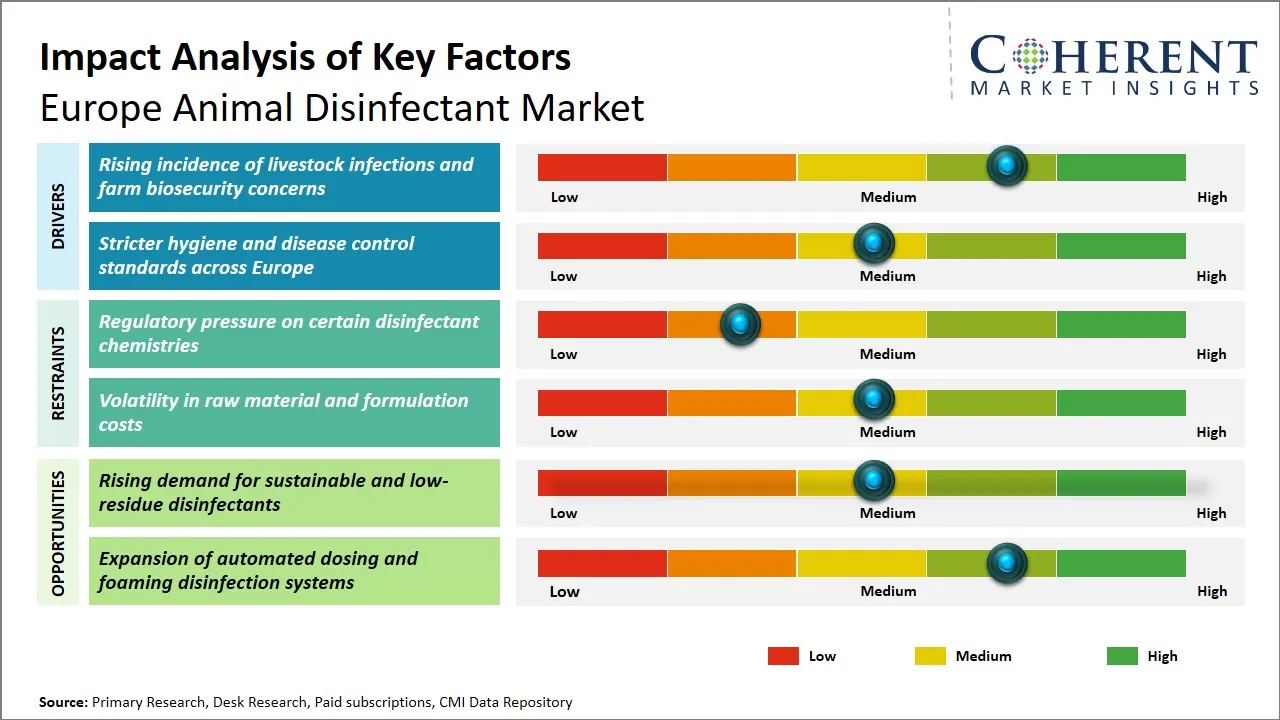
Europe Animal Disinfectant Market Driver - Rising Incidence of Livestock Infections and Farm Biosecurity Concerns
Increasing rate of infectious diseases on livestock in Europe has been a major issue among farmers and agricultural stakeholders and has been largely contributing to the demand of animal disinfectants. Diseases such as avian influenza, foot-and-mouth disease, porcine reproductive and respiratory syndrome are some of the diseases that have increased the imperative of adopting a high level of biosecurity in farms. Animal disinfectant helps in the prevention of cross-contamination as it is crucial in the disinfection of equipment, housing facilities, and transportation vehicles, thereby breaking the cycle of the transmission pathogen.
Moreover, the increased understanding of farmers regarding the need to keep the health of animals and guarantee the safety of food has resulted in the implementation of extensive hygienic standards. Another measure underway by governments and regulation agencies is to enforce tightening of the biosecurity standards to reduce economic losses resulting due to livestock diseases.
For instance, in May 2025, Merck Animal Health launched a long‑lasting antimicrobial biosecurity solution designed to bolster on‑farm disease prevention and pathogen control. The EPA‑registered antimicrobial product creates a durable protective barrier on treated surfaces, offering up to 90 days of protection and enhancing existing farm sanitation protocols when used with standard cleaning and disinfection practices.
(Source - Merck Animal Health)
Europe Animal Disinfectant Market Opportunity - Rising Demand for Sustainable and Low-Residue Disinfectants
In Europe, the animal disinfectant is a major opportunity due to the increasing sustainable and low-residue disinfectants demands. The growing consumer consciousness surrounding environmental issues and food safety has driven the livestock farmers and animal husbandry businesses to take disinfectant solutions that are more effective and at the same time safe and environmentally friendly among the animals as well as human beings.
The regulatory authorities in Europe are also implementing strict measures to reduce the amount of chemical residues in meat, dairy, and other animal foods, which has increased pressure on disinfectants, which must meet the specifications. Environmentally-friendly disinfectants, frequently made using natural or biodegradable material, minimize the threat of accumulation and pollution of the environment, which is a trend in a wider context of green agriculture and sustainable farming.
Analyst Opinion (Expert Opinion)
- The Europe animal disinfectant market is expected to grow due to an increasing demand of farms to prevent disease outbreak, maintain a higher level of hygiene and more vigorous biosecurity measures. There is also a growing demand in automated and more powerful disinfectant solutions that are costly in large intensive dairy and poultry plants. Sustainable formulations and system-compatible products are the real opportunity and tight regulation, cost pressure, and proven efficacy in field use remain the main challenge.
- Events like the EuroTier 2024 and VIV Europe 2026 are also raising the industry visibility, with the theme of animal health, farm hygiene, and biosecurity continuing to be central. The changing trends such as the recent transaction of Kersia to purchase the cleaners and disinfectants business of Neogen in April 2025 reveal the fact that the market is being narrowed into hygiene portfolios and regional capabilities. That indicates the direction of a market that is increasingly structured, increasingly technology-driven, and compliance-driven.
Speak to the analyst
Want personalized insights?
Take the findings above to one of our principal consultants, or have the report rebuilt around the segments, geographies and competitors you actually track.
Market Segmentation
- Form Insights (Revenue, USD Mn, 2021 - 2033)
- Liquid
- Powder
- Spray
- Others
- Type Insights (Revenue, USD Mn, 2021 - 2033)
- Chlorine-based Disinfectants
- Iodine-based Disinfectants
- Quaternary Ammonium Compounds (Quats)
- Phenolic Disinfectants
- Hydrogen Peroxide-based Disinfectants
- Others (Glycolic acid Disinfectants, etc.)
- Application Insights (Revenue, USD Mn, 2021 - 2033)
- Livestock Farms
- Cattle Farming
- Poultry Farming
- Pig Farming (Swine)
- Others (sheep farms, etc.)
- Veterinary Clinics and Pet Care
- Aquaculture (Fish Farms)
- Zoos and Wildlife Parks
- Distribution Channel Insights (Revenue, USD Mn, 2021 - 2033)
- Online
- Offline
- Key Players Insights
- LANXESS
- Kersia
- Ecolab
- Neogen
- DeLaval
- Evans Vanodine
- Virox Technologies
- Kemin Industries
- Intracare
- Medentech
- Solenis
- Theseo
- Huvepharma
- Proquimia
- Bioveta
Sources
Primary Research Interviews
Industry Stakeholders
- Veterinary disinfectant formulators
- Animal health regulatory consultants
- Livestock biosecurity specialists
- Veterinary hygiene product development managers
- Farm sanitation and infection control advisors
- Disinfection protocol validation experts
End-Users list
- Commercial poultry farm managers
- Dairy farm operators
- Swine farm biosecurity managers
- Veterinarians in food-producing animal practice
- Hatchery hygiene supervisors
- Livestock cooperative procurement heads
Government and International Databases
- European Commission Biocides Regulation and Biocidal Products pages
- European Chemicals Agency biocidal products database
- European Food Safety Authority animal health resources
- World Organisation for Animal Health WAHIS
- EU Animal Disease Information System ADIS
- European Medicines Agency veterinary medicines resources
Trade Publications
- Pig Progress
- Poultry World
- Dairy Global
- The Poultry Site
- The Pig Site
- All About Feed
Academic Journals
- Preventive Veterinary Medicine
- Transboundary and Emerging Diseases
- Veterinary Microbiology
- Poultry Science
- Journal of Veterinary Science
- Frontiers in Veterinary Science
Reputable Newspapers
- Financial Times
- The Guardian
- Le Monde
Industry Associations
- AnimalhealthEurope
- World Organisation for Animal Health
- European Federation of Animal Science
- European Veterinary Public Health Association
- British Veterinary Association
- Federation of Veterinarians of Europe
Public Domain Resources
- EUR-Lex
- EU Open Data Portal
- FAOSTAT
- Eurostat
Proprietary Elements
- CMI Data Analytics Tool: Proprietary analytics tool to analyze real-time market trends, consumer behavior, and technology adoption in market
- Proprietary CMI Existing Repository of Information for Last 10 Years
Get access to 250+ pages report
Every segment, forecast, competitor profile and data table behind the analysis above — available for instant download.
- ESOMAR Member
- ISO 9001:2015 Certified
- D-U-N-S Registered
- GDPR & CCPA Compliant
Missing comfort of reading report in your local language? Find your preferred language:
Transform your Strategy with Exclusive Trending Reports
Frequently Asked Questions
The Europe animal disinfectant market is estimated to be valued at USD 1,211.7 million in 2026 and is expected to reach USD 1,856.2 million by 2033.
The CAGR of Europe animal disinfectant market is projected to be 7.3% from 2026 to 2033.
Rising incidence of livestock infections and farm biosecurity concerns and stricter hygiene and disease control standards across Europe are the major factors driving the growth of the Europe animal disinfectant market.
Regulatory pressure on certain disinfectant chemistries and volatility in raw material and formulation costs is the major factors hampering the growth of the Europe animal disinfectant market.
The biggest trend is the move from basic disinfection toward broader biosecurity systems that combine efficacy, compliance, and farm-specific application.
Regulation is a major market driver because biocidal products in the EU are tightly governed under the biocide’s framework, and 2025 Member State reporting shows continued official controls over product authorization, labeling, market placement, and use. That means compliance is not optional and directly affects product approval and commercial access.
In terms of form, the liquid segment is estimated to dominate the market revenue share in 2026.