

Myopia And Presbyopia Eye Drops Market Size and Share Analysis - 2026 To 2033
The Myopia and Presbyopia Eye Drops market is anticipated to grow at a CAGR of 7.5% with USD 1.64 Bn in 2026 and is expected to reach USD 2.63 Bn in 2033. The increasing prevalence of myopia (Approximately 2.6 Bn people globally are affected by myopia as of 2024, a number projected to reach 4.76 Bn by 2050) is expected to drive growth of the global myopia & presbyopia eye drops market. The increasing number of research and development activities by market key players is further expected to drive growth of the global myopia & presbyopia eye drops market.
Key Takeaways
- Atropine drops are expected to account the largest share of 80% in 2026, it is the most clinically proven, widely used, and commercially established treatment for slowing myopia progression. Low concentration atropine (0.01%) eye drops significantly reduced progression of myopia and were well tolerated compared with placebo in children in the UK.
- Presbyopia will dominate with 55% in 2026, it affects almost everyone above 40, creating a much larger and continuously growing patient pool compared to myopia. The global prevalence of myopia has surged from 22.9% in 2000 to an estimated 34% in 2020 and is expected to reach 50% by 2050.
- Hospitals will dominate with 35% in 2026, they control the highest-value ophthalmic treatments, especially surgeries and prescription initiation, which drive long-term eye-drop usage. 2026, the IRIS Registry has aggregated, deidentified data on over 887 million patient visits and 87 million unique patients.
- North America is expected to acquire the dominant share of 45% in 2026, advanced healthcare systems, early drug adoption, high spending power, and strong pharmaceutical innovation ecosystem. Between 2015 and 2024, the number of drug development programs nearly doubled, from approximately 10 400 to roughly 19 000.
Segmental Insights
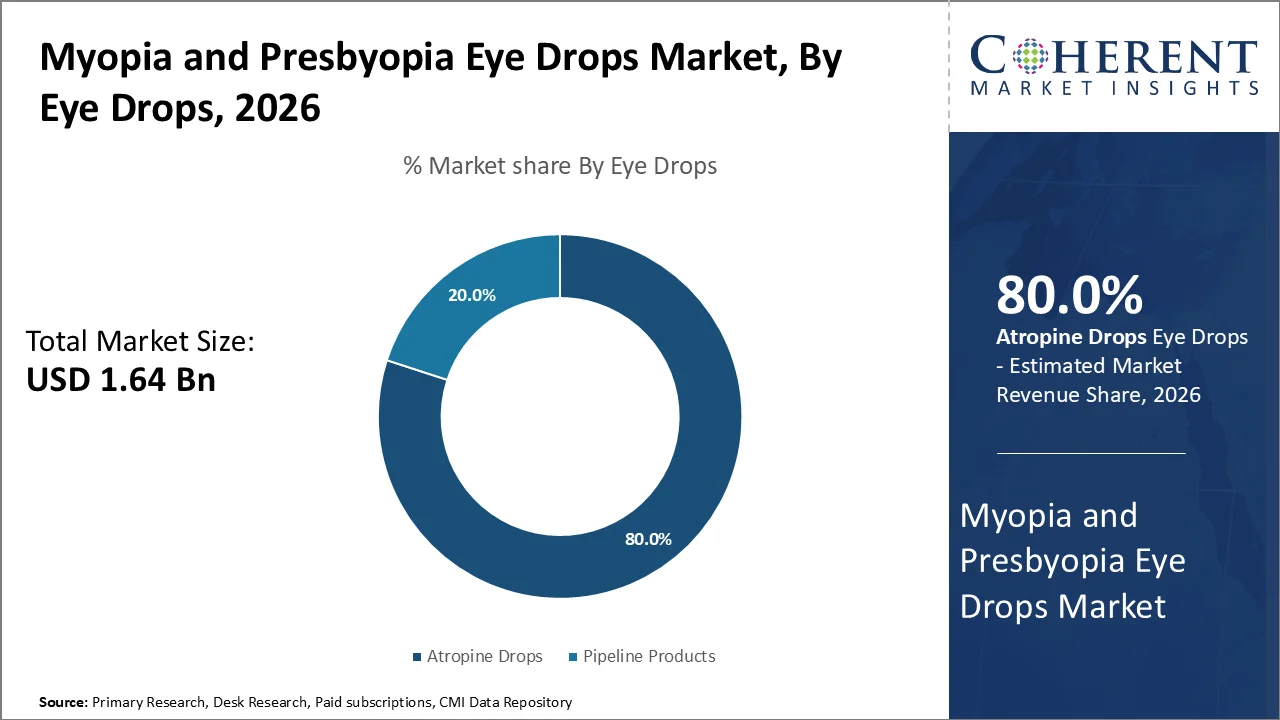
Why is Atropine Drops Acquiring the Largest Market Share?
Atropine drops is projected to account for the largest share of eye drops in 2026, representing approximately 80% of the total volume. Attributed to an extensive body of clinical research and endorsement from globally recognized health institutions. Recent landmark studies, including the Atropine for the Treatment of Myopia (ATOM) and Low-Concentration Atropine for Myopia Progression (LAMP) trials, demonstrated that lower concentrations of atropine (0.01%, 0.03%, and 0.05%) can effectively reduce myopia progression with fewer side effects.
The World Health Organization (WHO), under its World Report on Vision published by the International Agency for the Prevention of Blindness (IAPB), has repeatedly showed the rising burden of uncorrected as well as progressive myopia as a major global public health concern, with estimates suggesting that nearly half of the world's population could be affected by myopia by 2050 if current trends continue.
This alarming projection has directly intensified clinical demand for effective pharmacological myopia-control interventions, with low-dose atropine drops being positioned at the forefront of such interventions.
- Current Industry Events of 2026
- Market Size Estimation
- Regional Breakdown
- Competitive Landscape
- Customer Intelligence
- Segmental Analysis
- Pricing Analysis
- Key Market Drivers, Challenges & Future Trends
- Customized Insights Section
Presbyopia holds the Largest Market Share
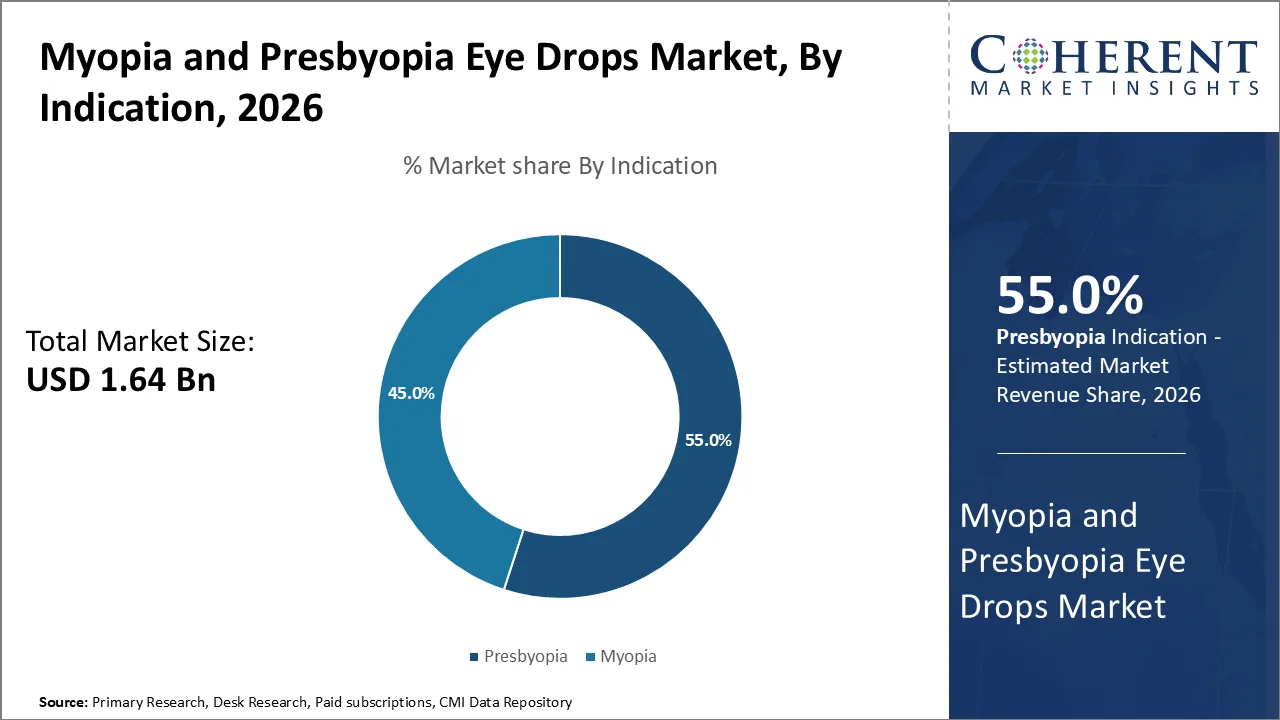
Based on indication, presbyopia dominates the market, accounting for a significant 55% share in 2026. Presbyopia contributes the highest share in the market, owing to its significantly higher prevalence across the global adult population, particularly among individuals aged 40 years and above. As of 2026, presbyopia affects a very large portion of the world’s population. Estimates suggest that around 1.8 billion people globally are presbyopic. That is about 25% of the global population! And this number is only expected to go up in future because of demographic change, particularly the high proportion of older adults.
Presbyopia, an age-related condition known by the progressive loss of the eye's ability to focus on near objects, has become one of the most prominent refractive errors globally.
According to the World Health Organization (WHO), presbyopia affects an estimated 1.8 billion people globally, making it one of the most commonly encountered vision impairments across all age groups as well as geographic regions. This high prevalence directly translates into a robust as well as sustained demand for therapeutic eye drop solutions designed to manage or correct the condition without the need for reading glasses or surgical interventions.
Hospitals holds the Largest Market Share
Based on end user, hospital dominate the market, accounting for a significant 35% share in 2026, owing to their broad patient base, advanced diagnostic facilities, and the capacity to manage a wide spectrum of refractive error cases, ranging from mild myopia in pediatric populations to progressive presbyopia in aging adults. Refractive error requiring correction prevalence was 55.9%, with older age, female sex, hyperopia, myopia, astigmatism and anisometropia being associated factors.
Hospitals are equipped with sophisticated ophthalmic departments staffed by board-certified ophthalmologists, trained optometrists, as well as clinical pharmacists who are well-positioned to prescribe, dispense, and monitor therapeutic eye drop regimens with precision and consistency.
The World Health Organization (WHO) has consistently shown that hospitals remain the backbone of ophthalmic care delivery, particularly in low- and middle-income countries where standalone eye clinics are sparse and patients often rely on government-funded or tertiary hospital systems to access vision care.
Muscarinic Receptor Antagonist Technology is transforming the Myopia and Presbyopia Eye Drops Industry
Muscarinic receptor antagonists are eye drops used to slow myopia (near-sightedness) in children. They work by blocking signals in the eye that cause the eyeball to grow too long, which aid lower worsening vision over time.
The most important treatment in this group is low-dose atropine eye drops (0.01%–0.05%). Clinical studies show they can lower myopia progression by about 30% to 60%, with some studies reporting up to approximately 50% improvement in eye growth control compared to no treatment. Higher concentrations work better, but lower doses are used as they cause fewer side effects like light sensitivity as well as near-vision blur.
Cholinergic Agonist Technology (Presbyopia): A major breakthrough in Myopia and Presbyopia Eye Drops
Cholinergic agonist eye drops are used to treat presbyopia (age-related near vision loss). They work by activating certain eye receptors, which makes the pupil smaller. This “pinhole effect” helps the eye focus better on nearby objects and improves reading vision. The most common medicine in this group is pilocarpine, used in products like Vuity. It is the first FDA-approved eye drop for presbyopia and works within about 15 minutes, with effects lasting around 4–6 hours per dose
Clinical studies show that pilocarpine-based drops can improve near vision by about 3 lines on a reading chart and help a significant number of patients achieve better reading ability compared to placebo. For example, in trials, around 30% of patients showed strong near-vision improvement at 3–6 hours after use, while maintaining distance vision in most cases. Newer formulations and combinations are being developed to reduce side effects like headache and eye redness while improving duration and comfort.
Current Events and Their Impact on the Myopia and Presbyopia Eye Drops Market
Current Event | Description and its Impact |
FDA approval of new presbyopia eye drops (e.g., LENZ Therapeutics VIZZ, 2025–2026) |
|
Rapid expansion of low-dose atropine approvals and guideline adoption for pediatric myopia control (2025–2026) |
|
Myopia And Presbyopia Eye Drops Market Trends
- The most transformative trend building this market is the high shift from mechanical correction (spectacles, contact lenses) toward pharmacological management of refractive errors. The landmark FDA approval of VUITY (pilocarpine HCl ophthalmic solution 1.25%) by AbbVie marked a watershed moment for presbyopia eye drops, validating the category as well as unlocking significant commercial and R&D investment.
- The global myopia epidemic continues to fuel at an alarming rate, with epidemiological projections estimating that approximately 5 billion people (50% of the global population) will be affected by myopia by 2050, up from approximately 2.6 billion currently. The disproportionate burden is concentrated in East and Southeast Asian populations, where myopia prevalence among school-age children reaches upwards of 80–90% in urban centers such as Singapore, Hong Kong, and metropolitan China.
- Presbyopia the age-related loss of near-vision accommodation affecting virtually all individuals beyond age 40 is experiencing explosive demand growth as the global population ages at an unprecedented rate. The global presbyopic population is estimated to exceed 1.8 billion individuals.
- Advanced formulation technologies are significantly elevating product differentiation within the market. Innovations including nanoemulsion carriers, mucoadhesive polymer systems, sustained-release ophthalmic inserts, liposomal encapsulation, and smart drug delivery platforms are addressing the historically challenging barriers of ocular bioavailability, patient compliance, and duration of action.
Regional Insights
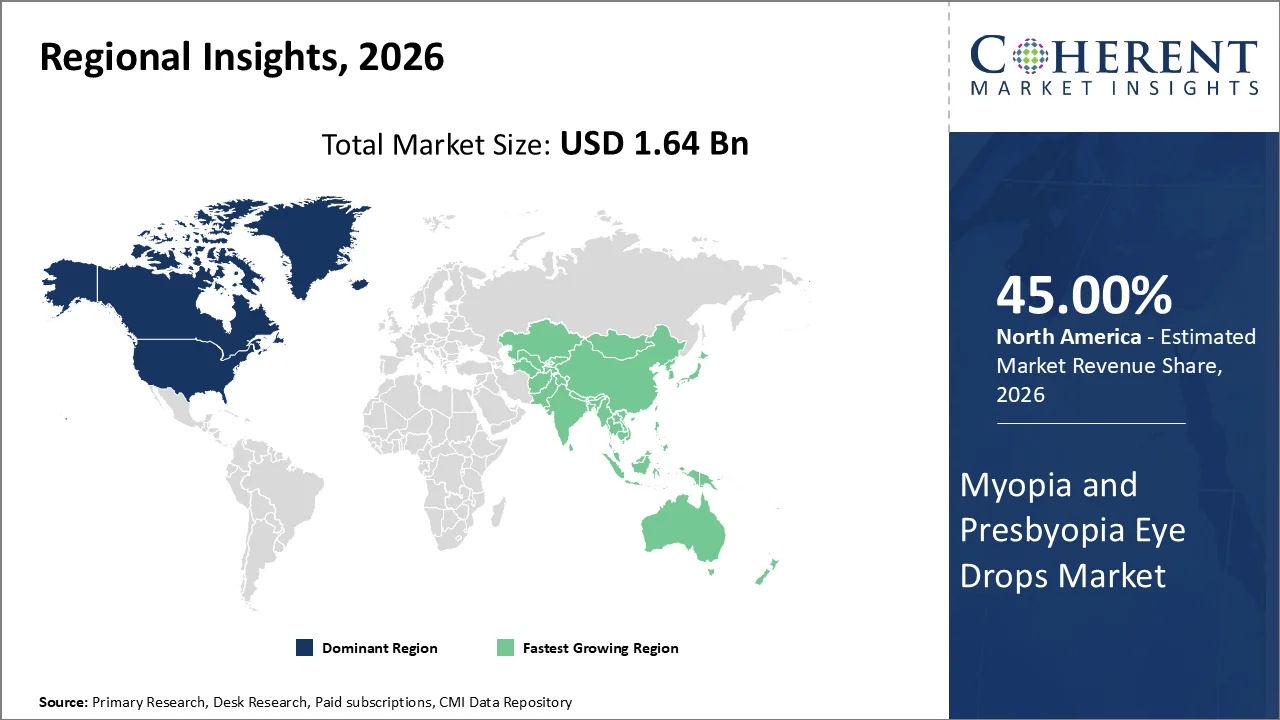
North America dominates owing to its exceptionally well-developed ophthalmic healthcare infrastructure
North America account 45% market share in 2026, owing to its exceptionally well-developed ophthalmic healthcare infrastructure, high prevalence of refractive errors among the population, and strong regulatory frameworks that accelerate the adoption of novel therapeutic eye drops. Refractive errors are the most common type of vision problem. More than 150 million Americans have a refractive error.
The United States, in particular, has experienced a major surge in myopia diagnoses, with the American Academy of Ophthalmology reporting that myopia currently affects nearly 42% of Americans, a figure that has dramatically raised from approximately 25% recorded in the 1970s.
This high rise in prevalence of myopia has directly translated into heightened demand for pharmacological interventions, including low-concentration atropine eye drops, which have gained substantial clinical traction following multiple peer-reviewed endorsements from American ophthalmological bodies. The U.S. Food and Drug Administration's proactive regulatory pathway for ophthalmic drug approvals has further stimulated the dominance of the region, allowing pharmaceutical companies headquartered in North America to fast-track clinical trials and commercialization of presbyopia-correcting eye drops.
Asia Pacific Myopia and Presbyopia Eye Drops Market Trends
The Asia Pacific region is poised to be the fastest-growing region through 2026-2033, expanding at a CAGR of approximately 8.2%. An extraordinarily high and escalating burden of myopia, increasing urbanization, prolonged near-work activities among younger populations, as well as a rapidly improving healthcare access landscape are the growth inducing factors. Research indicates that 80% to 90% of adolescents in China, Singapore, and South Korea have myopia, with up to 20% developing high myopia before graduation.
The prevalence of myopia across East and Southeast Asian countries has reached near-epidemic proportions, with the World Health Organization estimating that nearly 80 to 90 percent of school leavers in countries including Singapore, South Korea, Taiwan, China, etc., are affected by myopia, making an urgent as well as expanding clinical need for pharmacological interventions including atropine-based eye drops.
Singapore's Health Sciences Authority has been a pioneer in facilitating clinical use of low-concentration atropine eye drops for myopia control in children, with institutions including the Singapore Eye Research Institute conducting landmark clinical trials including the ATOM1 and ATOM2 studies that demonstrated the efficacy of 0.01% atropine in slowing myopic progression.
Its Significantly Large and Aging Population Base is Accelerating the Myopia and Presbyopia Eye Drops Market Demand in United States
The U.S. contributes the highest share in the myopia and presbyopia eye drops market in North America, owing to its significantly large and aging population base combined with an exceptionally high prevalence of refractive error conditions across multiple demographic groups. According to the National Eye Institute (NEI), part of the U.S. National Institutes of Health, myopia affects approximately 41.6% of Americans, a figure that has nearly doubled over the past three decades, creating an enormous patient pool actively seeking pharmacological management options beyond traditional corrective lenses.
The U.S. Food and Drug Administration (FDA) has played a central role in accelerating market development by approving pioneering ophthalmic pharmaceutical solutions, most notably the approval of low-dose atropine-based formulations and Vuity (pilocarpine hydrochloride ophthalmic solution 1.25%) by AbbVie, which became the first FDA-approved eye drop specifically designed to treat presbyopia in adults in October 2021.
China Myopia and Presbyopia Eye Drops Market Trends
China contributes the highest share in the myopia and presbyopia eye drops market in APAC, owing to its extraordinarily high prevalence of myopia across its population, particularly among school-aged children and young adults.
According to the National Eye Institute and the World Health Organization, China has one of the highest myopia prevalence rates globally, with studies indicating that approximately 80–90% of urban Chinese teenagers are affected by myopia, a statistic that has been alarming public health officials for decades.
The Chinese government has taken unprecedented policy-level intervention, with the National Health Commission of China launching dedicated national vision care programs targeting myopia prevention and control in school-aged children.
Who are the Major Companies in Myopia and Presbyopia Eye Drops Industry
Some of the major key players in Myopia and Presbyopia Eye Drops market include, Orasis Pharmaceuticals, AbbVie Inc. (Allergan), Novartis AG, OSRX Pharmaceuticals, LENZ Therapeutics, Visus Therapeutics, Ocuphire Pharma Inc., Eyenovia, Inc., Vyluma Inc., and Jawa Pharmaceuticals (India) Pvt. Ltd.
Key News
- In January 2026, LENZ Therapeutics announced the launch of “Make It VIZZable,” a new consumer campaign for its recently launched presbyopia drop Vizz (aceclidine ophthalmic solution) 1.44%, featuring award-winning actor, producer and publisher Sarah Jessica Parker as a brand ambassador.
- In March 2026, ROHTO Pharmaceutical Co., Ltd. will launch "Rohto Eye Vision," a children's eye drop that focuses on "eye strain caused by digital stress *2" in children due to the use of digital devices such as smartphones and tablets, on Thursday, March 26, 2026.
Market Report Scope
Myopia And Presbyopia Eye Drops Market Report Coverage
| Report Coverage | Details | ||
|---|---|---|---|
| Base Year: | 2025 | Market Size in 2026: | USD 1.64 Bn |
| Historical Data for: | 2020 To 2024 | Forecast Period: | 2026 To 2033 |
| Forecast Period 2026 to 2033 CAGR: | 7.5% | 2033 Value Projection: | USD 2.63 Bn |
| Geographies covered: |
| ||
| Segments covered: |
| ||
| Companies covered: | Orasis Pharmaceuticals, AbbVie Inc. (Allergan), Novartis AG, OSRX Pharmaceuticals, LENZ Therapeutics, Visus Therapeutics, Ocuphire Pharma Inc., Eyenovia, Inc., Vyluma Inc., and Jawa Pharmaceuticals (India) Pvt. Ltd. | ||
| Growth Drivers: |
| ||
| Restraints & Challenges: |
| ||
Analyst Opinion
- The myopia and presbyopia eye drops market is experiencing a significant transformation, driven by rising global prevalence of refractive errors across diverse age groups. Globally, it is estimated that 2 out of 3 people in low-income countries with a distance vision impairment due to refractive error.
- Increasing screen time, sedentary lifestyles, and prolonged near-work activities are accelerating myopia progression, particularly among younger populations, creating substantial demand for pharmacological intervention. Approximately 2.6 billion people globally are affected by myopia as of 2024, a number projected to reach 4.76 billion by 2050.
- The approval of atropine-based eye drops and emerging presbyopia-correcting formulations has fundamentally shifted treatment paradigms away from traditional corrective lenses and surgical procedures.
- Growing patient preference for non-invasive, convenient treatment alternatives continues to strengthen market momentum considerably.
- However, concerns regarding long-term safety profiles, potential side effects including photosensitivity and blurred near vision, and stringent regulatory requirements pose notable restraints to widespread adoption.
Speak to the analyst
Want personalized insights?
Take the findings above to one of our principal consultants, or have the report rebuilt around the segments, geographies and competitors you actually track.
Market Segmentation
- By Eye Drops (Revenue, USD Bn, 2021-2033)
- Atropine Drops
- Pipeline Products
- CSF-1
- AGN – 190584
- Nyxol
- UNR844-Cl
- PRX-100
- MicroLine
- Others
- By Indication (Revenue, USD Bn, 2021-2033)
- Myopia
- Presbyopia
- By End User (Revenue, USD Bn, 2021-2033)
- Hospitals
- Ophthalmic Clinics
- Others
- By Region (Revenue, USD Bn, 2021-2033)
- North America
- U.S.
- Canada
- Latin America
- Brazil
- Mexico
- Argentina
- Rest of Latin America
- Europe
- Germany
- U.K.
- France
- Italy
- Spain
- Russia
- Rest of Europe
- Asia Pacific
- China
- India
- Japan
- Australia
- South Korea
- ASEAN
- Rest of Asia Pacific
- Middle East
- GCC
- Israel
- Rest of Middle East
- Africa
- South Africa
- Central Africa
- North Africa
- North America
Sources
Primary Research Interviews
- Ophthalmologists & Eye Care Specialists
- Pharmaceutical & Ophthalmic Drug Manufacturers
- Hospital Procurement & Healthcare Administrators
- Retail & Online Pharmacy Chain Representatives
- Others
Databases
- IQVIA Healthcare Database
- Pharma Intelligence (Citeline) Database
- Others
Magazines
- Ophthalmology Times
- Review of Ophthalmology
- EyeWorld Magazine
- Optometry & Vision Science Magazine
- Others
Journals
- Investigative Ophthalmology & Visual Science (IOVS)
- British Journal of Ophthalmology
- Journal of Cataract & Refractive Surgery
- American Journal of Ophthalmology
- Others
Newspapers
- The Wall Street Journal (Healthcare Section)
- Financial Times (Pharma & Life Sciences)
- Reuters Health News
- The Economic Times (Pharma)
- Others
Associations
- American Academy of Ophthalmology (AAO)
- International Myopia Institute (IMI)
- World Council of Optometry (WCO)
- European Society of Ophthalmology (SOE)
- Others
Public Domain Sources
- U.S. Food & Drug Administration (FDA) Drug Approvals & Database,
- World Health Organization (WHO) – Vision Impairment Reports
- U.S. National Institutes of Health (NIH) – National Eye Institute
- European Medicines Agency (EMA) – Ophthalmic Drug Approvals
- Others
Proprietary Elements
- CMI Data Analytics Tool
- Proprietary CMI Existing Repository of information for last 10 years
Get access to 250+ pages report
Every segment, forecast, competitor profile and data table behind the analysis above — available for instant download.
- ESOMAR Member
- ISO 9001:2015 Certified
- D-U-N-S Registered
- GDPR & CCPA Compliant
Missing comfort of reading report in your local language? Find your preferred language:
Transform your Strategy with Exclusive Trending Reports
Frequently Asked Questions
The Myopia and Presbyopia eye drops market is expected to reach USD 2.63 Bn in 2033.
Major players operating in the global Myopia and Presbyopia eye drops market include Orasis Pharmaceuticals, AbbVie Inc. (Allergan), Novartis AG, OSRX Pharmaceuticals, LENZ Therapeutics, Visus Therapeutics, Ocuphire Pharma Inc., Eyenovia, Inc., Vyluma Inc., and Jawa Pharmaceuticals (India) Pvt. Ltd.
Availability of alternative treatments for ophthalmic conditions such as myopia and presbyopia is expected to restrain the Myopia and Presbyopia eye drops market growth over the forecast period.
Increasing research and development activities for treatment of myopia and presbyopia are driving growth of the global Myopia and Presbyopia eye drops market.
The Myopia and Presbyopia eye drops market is anticipated to grow at a CAGR of 7.5% between 2026 and 2033.
Among regions, North America is expected to account for a largest market share in the global Myopia and Presbyopia eye drops market over the forecast period.
Presbyopia, or age-related vision changes, is a common eye condition. It can make objects and small details harder to see up close as you get older. Vuity and Qlosi are FDA-approved eye drops for presbyopia. They contain the same active ingredient: pilocarpine.