

Glycine Market Size and Forecast — 2026-2033
The Global Glycine Market size is estimated to be valued at USD 459.0 million in 2026 and is expected to reach USD 735 million by 2033, exhibiting a compound annual growth rate (CAGR) of 8.0% from 2026 to 2033.
Overview
Glycine is the simplest amino acid, appearing as a white crystalline solid that is highly soluble in water. It serves as a building block in pharmaceuticals, animal feed, food additives, and agrochemicals. In the food industry, glycine functions as a flavor enhancer, buffering agent, and nutritional supplement, while in pharmaceuticals, it is used in formulations for neuroprotective, anti-inflammatory, and cytoprotective effects. Industrially, glycine also contributes to herbicides, chelating agents, and metal treatment chemicals. Its biocompatibility, low toxicity, and multifunctional properties make it a widely utilized chemical across diverse sectors.
Key Takeaways
The Pharmaceuticals segment dominates the market share as it accounts for over 40% of the total revenue, driven by therapeutic applications and increasing healthcare expenditure globally.
The Powder form leads among product types with a 57% share, favored for its ease of handling and storage in industrial and pharmaceutical processes.
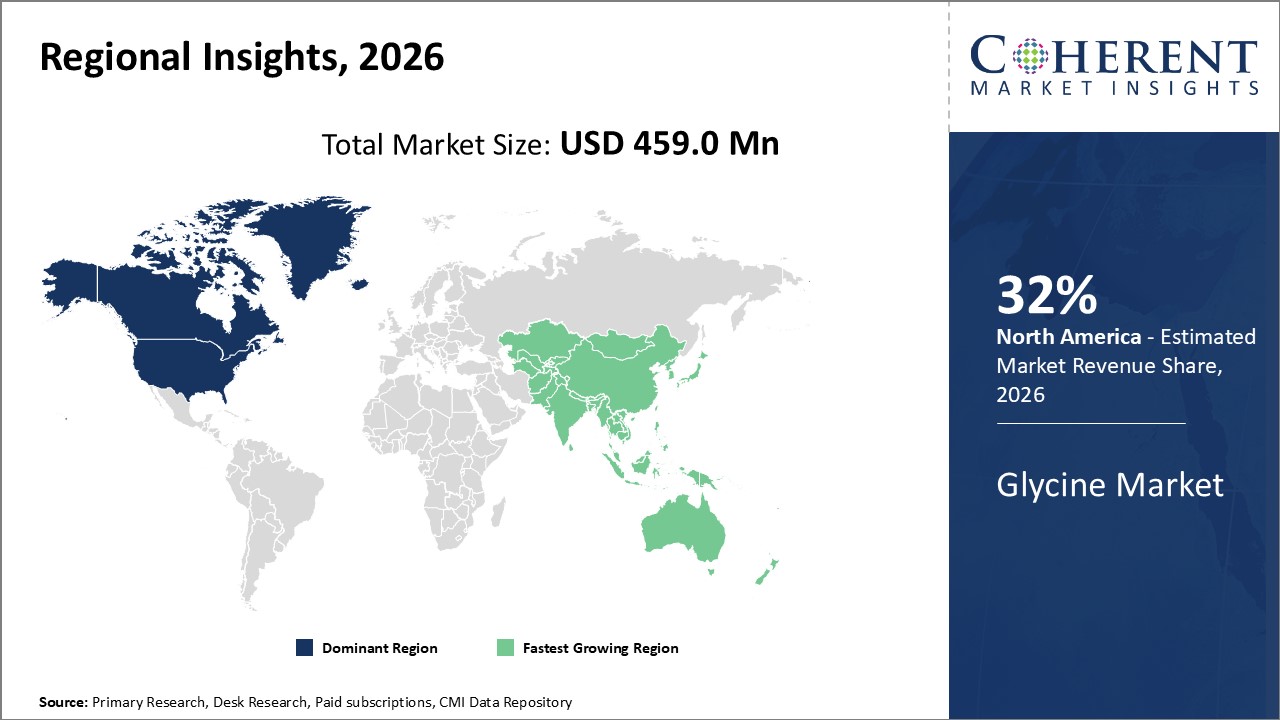
Regionally, North America holds the largest industry share with approximately 32% of market revenue, attributed to strong R&D infrastructure and stringent quality standards.
Meanwhile, Asia Pacific represents the fastest-growing region with a CAGR exceeding 9%, propelled by industrial expansion, government initiatives supporting bio-based chemicals, and rising demand in end-user industries such as food and cosmetics.
Glycine Market Segmentation Analysis
Glycine Market Insights, By Product Type
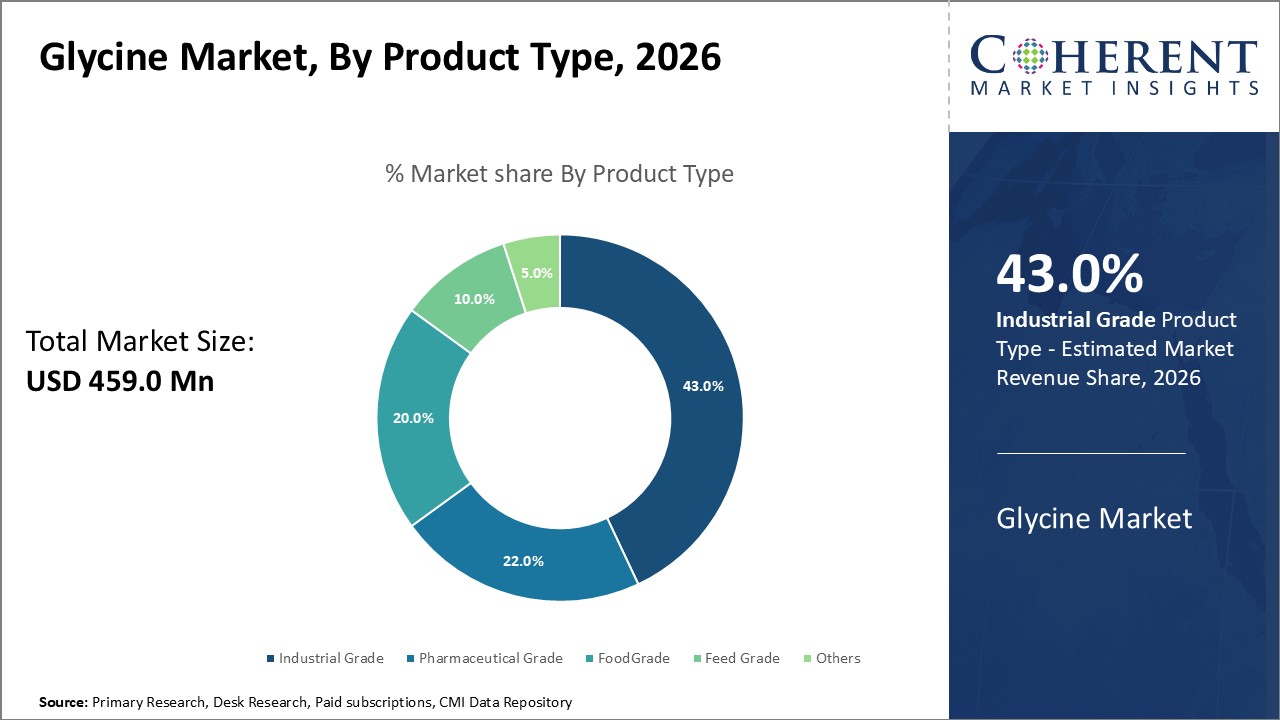
Industrial Grade dominates the market share with 43%. Industrial-grade glycine remains the cornerstone of the market due to its vast applications across sectors such as detergents and textiles. Pharmaceutical-grade glycine is the fastest-growing subsegment, fueled by increasing drug manufacturing activities and stringent purity requirements, leading to robust growth in regions with advanced healthcare infrastructure. Food-grade glycine finds usage in flavor enhancement and preservation, but maintains moderate growth due to regulatory oversight. Feed-grade glycine supports animal nutrition and enjoys steady demand, especially in emerging economies.
Glycine Market Insights, By Application
Pharmaceuticals dominate the market share, contributing over 40%. Pharmaceutical applications leverage glycine's versatility as a building block for drugs and protective compounds, bolstered by rising chronic disease management. The fastest growing application is Cosmetics & Personal Care, which witnessed increased incorporation of glycine-based surfactants and moisturizers to meet consumer demand for natural ingredients. Food & Beverages applications are stable, focused on flavoring and preservation roles, while Animal Feed usage grows significantly in livestock-intensive regions. The Others segment includes industrial solvents and agricultural chemicals.
Glycine Market Insights, By Form
Powder dominates the market share, accounting for 56%. Powder form glycine is popular due to ease of storage, transport, and handling, especially in the pharmaceutical and food industries. Liquid glycine is the fastest-growing form, increasingly adopted in specialized pharmaceutical formulations and cosmetic serums because of its solubility and application convenience. Crystals maintain niche use in food and specialty segments. The Others category includes customized blends and granules tailored for specific industrial processes.
Glycine Market Trends
The market currently witnesses a strong trend toward bio fermentation-derived glycine, especially in Europe, where environmental regulations encourage sustainable production.
For example, in 2025, bio-based glycine production rose by 26% in Germany following favorable government incentives.
Additionally, personal care product manufacturers increasingly adopt glycine-based surfactants, expanding their footprint in North America by 20% in 2026.
Another crucial trend is the rising use of glycine in animal feed additives across Latin America, where increased livestock farming drives demand.
Glycine Market Insights, By Geography
North America Glycine Market Analysis and Trends
In North America, the dominance in the market is supported by robust pharmaceutical industries, stringent quality standards, and advanced R&D infrastructure. The region accounts for approximately 32% of the industry share as major players like Ajinomoto and CJ CheilJedang enhance local production capabilities. The U.S. government's increasing investment in biotech and green chemistry continues to foster growth here, with exports growing 8% annually.
Asia Pacific Glycine Market Analysis and Trends
Meanwhile, the Asia Pacific exhibits the fastest growth with a CAGR over 9%, driven by expanding chemical manufacturing bases in China and India. Government focus on bio-based chemical production, growing food and beverage industries, and rising consumer expenditure on healthcare propel market dynamics. Companies like Fufeng Group and Henan Tianguan Group drive competitive growth through capacity expansions and cost leadership.
Glycine Market Outlook for Key Countries
USA Glycine Market Analysis and Trends
The U.S. market is propelled by a combination of strong pharmaceutical demand and innovation in biotech production processes. In 2025, pharmaceutical industry growth led to a 10% increase in high-purity glycine consumption, supported by the country's regulatory environment favoring green chemistry and biocompatible materials. Major players such as CJ CheilJedang have localized manufacturing to optimize supply chains, contributing to enhanced market revenues and an expanding domestic market share.
China Glycine Market Analysis and Trends
China’s glycine market benefits from its integrated supply chain and increasing application diversification, particularly in animal feed and cosmetics. The country’s production capacity increased by 15% in 2026, meeting both domestic needs and export demands. Companies like Fufeng Group have invested heavily in fermentation technology, improving cost-efficiency and driving regional growth. Government incentives for sustainable chemical production further enhance market prospects here.
Analyst Opinion
The expanding pharmaceutical industry's reliance on glycine for its detoxifying and protective effects is driving significant demand. In 2025, pharmaceutical-grade glycine consumption increased by 10%, supported by rising production of nephro-protective drugs in countries like Germany and the USA, where R&D expenditures grew by over 6%.
Industrial synthesis capacity has outstripped demand in certain regions, particularly Asia Pacific, where glycine production capacity surged by 15% in 2026. This oversupply has led to competitive pricing strategies, with export volumes increasing by 12% year-on-year from India and China, contributing directly to market share growth.
Application diversification is fueling novel use cases; for example, glycine-based surfactants gained 18% traction in personal care products in 2025 owing to their mildness and biodegradability. Consequently, imports for cosmetic-grade glycine into North America and Europe rose by 20% from last year, reflecting shifting consumer preferences.
Demand-side factors such as increased adoption in animal nutrition are becoming critical growth levers. Between 2023 and 2026, the feed additive segment accounted for over 26% of market revenue, particularly in countries with large livestock industries like Brazil and the United States, where protein feed supplementation demand soared by 11%.
- Current Industry Events of 2026
- Market Size Estimation
- Regional Breakdown
- Competitive Landscape
- Customer Intelligence
- Segmental Analysis
- Pricing Analysis
- Key Market Drivers, Challenges & Future Trends
- Customized Insights Section
Market Scope
| Report Coverage | Details | ||
|---|---|---|---|
| Base Year: | 2025 | Market Size in 2026: | USD 459.0 million |
| Historical Data for: | 2020 To 2024 | Forecast Period: | 2026 To 2033 |
| Forecast Period 2026 to 2033 CAGR: | 8.0% | 2033 Value Projection: | USD 735 million |
| Geographies covered: |
| ||
| Segments covered: |
| ||
| Companies covered: | Daesang Corporation; Weifang Ensign Industry Co., Ltd.; Wamin Group; Patriarch Partners LLC; ADM (Archer Daniels Midland); Domo Chemicals GmbH; Hebei Welson Biochem Co., Ltd.; Truechem Co., Ltd.; Hebei Yuxin Amino Acid Co., Ltd.; Wuhan Huakang Amino Acids Co., Ltd. | ||
| Growth Drivers: |
| ||
Glycine Market Growth Factors
Rapid growth in the pharmaceutical sector due to rising chronic diseases is propelling glycine demand, as its role in drug formulations becomes increasingly vital. Regulatory approvals for glycine-based therapeutics surged by 8% globally in 2025, particularly in the U.S. and Europe. The expansion of animal feed production in emerging economies like India and Brazil, driven by increasing meat consumption, supports glycine’s application as a growth promoter, reflecting 13% annual growth in feed-related glycine demand. Sustainability trends are influencing the personal care segment, where glycine's biodegradable profile fulfills consumer demand, leading to a 16% increase in cosmetic applications between 2023 and 2026. Furthermore, advancements in fermentation technologies have improved cost efficiencies, reducing manufacturing time by 21%, which positively impacts market revenue globally.
Glycine Market Development
In September 2019, Arsenal Capital Partners acquired Geo Specialty Chemicals, a major producer of specialty chemicals, including glycine, expanding its footprint across 19 manufacturing sites in the United States and Europe. The acquisition strengthened Arsenal’s position in high-value chemical segments and enabled greater investment in production efficiency, product innovation, and global customer reach, particularly within the amino acid and specialty intermediates markets.
In May 2019, Evonik Nutrition & Care GmbH announced a 13% price increase for its glycine products, effective from July 1, 2019, attributing the adjustment to significantly rising raw material and production costs over the previous year. The increase was implemented to ensure supply reliability and maintain product quality standards, reflecting cost pressures across the broader specialty amino acids value chain.
Key Players
Leading Companies of the Market
Daesang Corporation,
Weifang Ensign Industry Co., Ltd.,
Wamin Group,
Patriarch Partners LLC,
ADM (Archer Daniels Midland),
Domo Chemicals GmbH,
Hebei Welson Biochem Co., Ltd.,
Truechem Co., Ltd.,
Hebei Yuxin Amino Acid Co., Ltd.,
Wuhan Huakang Amino Acids Co., Ltd.
Leading companies are leveraging vertical integration and strategic capacity expansion to strengthen their glycine market share. For instance, Ajinomoto’s acquisition of feed-grade glycine producers in 2025 enhanced its production footprint, resulting in a 11% increase in market penetration in Asia Pacific within six months. Similarly, CJ CheilJedang’s ongoing investments in biotech-driven glycine fermentation technology have successfully decreased production costs by 9%, boosting their competitiveness in North America.
Glycine Market Future Outlook
The glycine market is expected to grow as demand for functional foods, nutraceuticals, and sustainable agricultural solutions increases. Pharmaceutical applications, particularly in neurological and metabolic health, are anticipated to expand. Emerging economies with growing food and healthcare sectors will contribute to consumption. Industrial innovations, including green synthesis methods and high-purity derivatives, may enhance product efficiency and safety.
Glycine Market Historical Analysis
Glycine, the simplest amino acid, has historically been used in food, pharmaceuticals, animal feed, and agrochemicals. Its applications in flavor enhancement, pH buffering, and nutritional supplementation drove steady adoption in processed foods and beverages. In pharmaceuticals, glycine has been applied for neuroprotection, anti-inflammatory therapies, and as an intermediate in drug synthesis. Industrial uses, such as herbicides and chelating agents, further diversified consumption.
Sources
Primary Research Interviews:
Pharmaceutical Manufacturers
Food & Beverage Technologists
Agrochemical Specialists
Databases:
GlobalData Chemicals & Pharmaceuticals Reports
Statista Amino Acid Data
UN Comtrade Chemical Statistics
Magazines:
Nutraceuticals World
Food Processing Magazine
PharmaTimes
Journals:
Journal of Agricultural and Food Chemistry
Amino Acids
Journal of Functional Foods
Newspapers:
The Wall Street Journal (Health & Food)
Financial Times (Pharma)
The Economic Times (Agriculture & Food)
Associations:
International Food Additives Council (IFAC)
American Chemical Society (ACS)
Food Chemicals Codex (FCC)
Get access to 250+ pages report
Every segment, forecast, competitor profile and data table behind the analysis above — available for instant download.
- ESOMAR Member
- ISO 9001:2015 Certified
- D-U-N-S Registered
- GDPR & CCPA Compliant
Missing comfort of reading report in your local language? Find your preferred language:
Transform your Strategy with Exclusive Trending Reports
Frequently Asked Questions
The market is led by companies such as Ajinomoto Co. Inc., CJ CheilJedang Corporation, and Fufeng Group, which collectively command significant market share due to their production capacity and extensive distribution networks.
The Glycine market is expected to grow from USD 459.0 million in 2026 to USD 735 million by 2033, at a CAGR of 8.0%, fueled by rising pharmaceutical demand and expanding applications in food and animal feed.
Pharmaceutical applications hold the largest growth potential, accounting for over 40% of the market revenue, driven by increasing demand for glycine's therapeutic properties and drug formulation uses.
Bio-based production methods, expansion in personal care applications, and growing feed additive consumption in emerging economies will redefine industry trends with greater sustainability and efficiency focus.
The landscape is competitive, marked by capacity expansions, cost-optimization strategies, and technology adoption. Challenges include fluctuating raw material prices and regulatory controls impacting production costs.
Strategies include vertical integration, mergers and acquisitions, costs reduction via fermentation process innovation, and geographic expansion to emerging markets.