

Global Friction Stir Welding Market Size and Forecast – 2026-2033
The global friction stir welding market is estimated to be valued at USD 295.2 Mn in 2026 and is expected to reach USD 449.8 Mn by 2033, reflecting a compound annual growth rate (CAGR) of 6.2% from 2026 to 2033.
Key Takeaways of the Friction Stir Welding Market
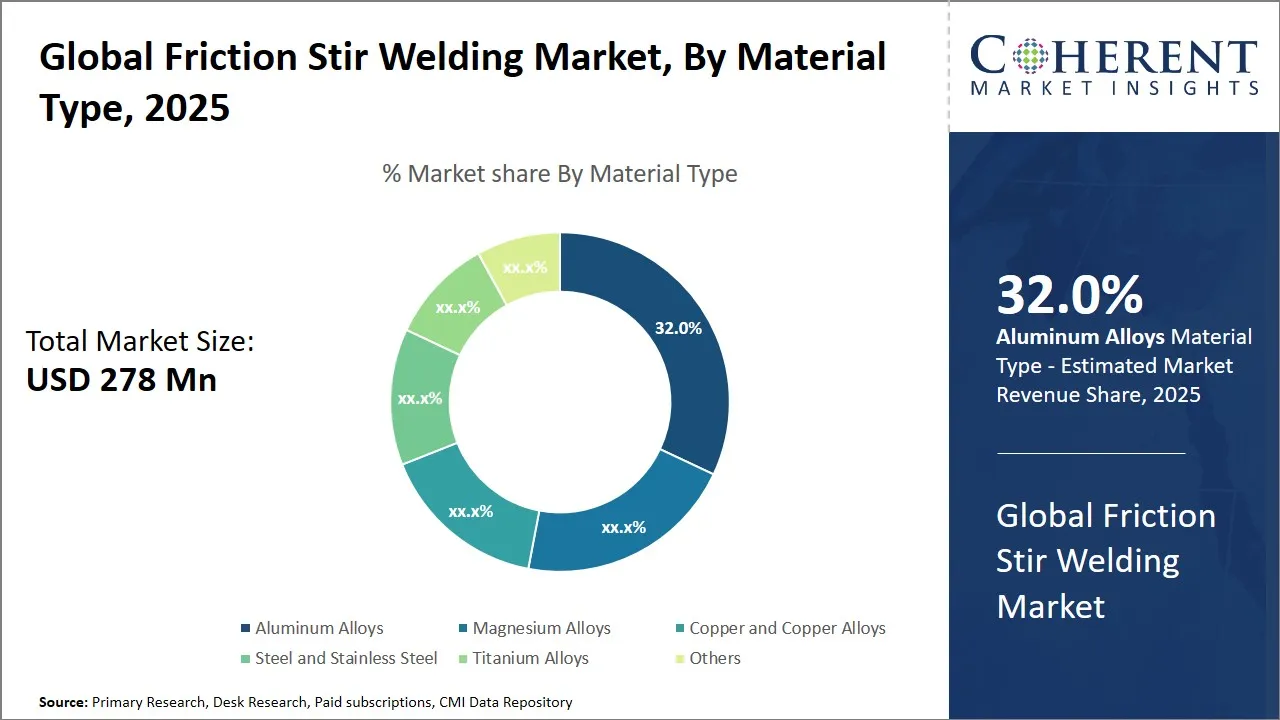
- The aluminum alloys segment is expected to account for 33% of the friction stir welding market share in 2026.
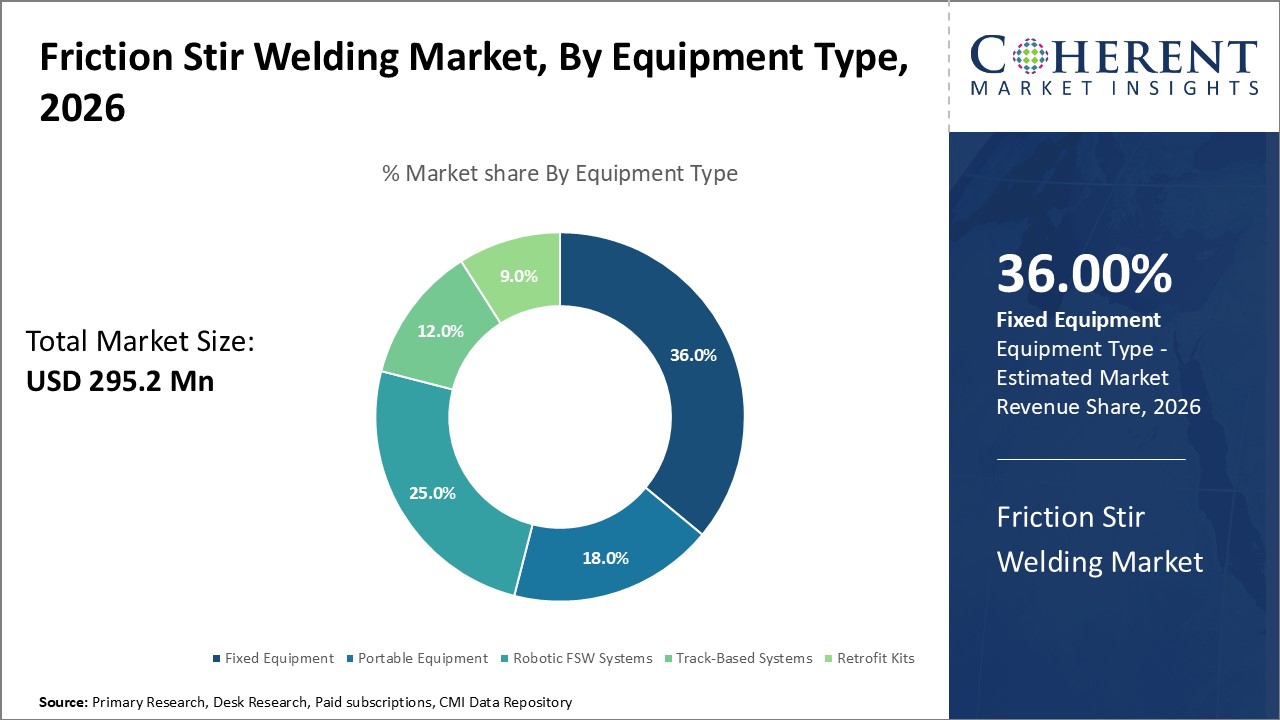
- The fixed equipment segment is projected to capture 36% of the market share in 2026.
- The conventional FSW tools segment is expected to command 37% share in 2026.
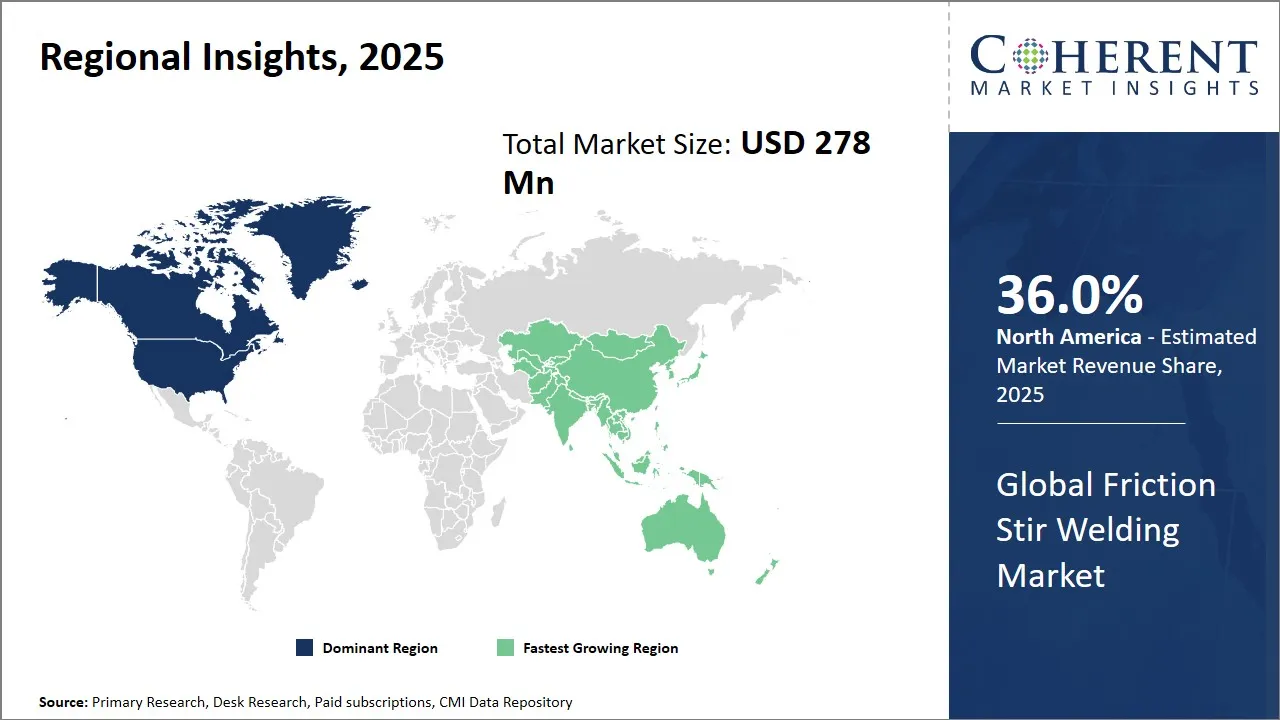
- North America will dominate the friction stir welding market in 2026 with an estimated 36% share.
- Asia Pacific will hold 28% share in 2026 and record the fastest growth.
Current Events and Its Impact
Current Events | Description and its Impact |
KUKA Order Confirmation |
|
Segmental Insights
- Current Industry Events of 2026
- Market Size Estimation
- Regional Breakdown
- Competitive Landscape
- Customer Intelligence
- Segmental Analysis
- Pricing Analysis
- Key Market Drivers, Challenges & Future Trends
- Customized Insights Section
Why Does the Aluminum Alloys Segment Dominate the Global Friction Stir Welding Market in 2026?
The aluminum alloys segment is expected to hold 33.0% of the global friction stir welding market share in 2026. The increase stems mainly from their suitable metal traits, which match well with FSW’s strengths. Although aluminum is known to be tough to weld through standard fusion ways - due to rapid heat spread and risks such as voids or cracks - the method avoids this by bonding materials without melting them. This solid-state approach reduces flaws, producing stronger joints compared to typical welding processes.
The aerospace, auto, and ship sectors depend on aluminum alloys, owing to lightness paired with durability, for better fuel economy alongside stronger builds. Such broad use across vital fields drives need for FSW methods fine-tuned to these metals. Also, rising demand for lighter materials in vehicle production supports ongoing application of friction stir welding, delivering solid yet slim connections crucial under tight emissions and safety rules.
Fixed Equipment Segment Dominates the Global Friction Stir Welding Market
The fixed equipment segment is expected to hold 36.0% of the friction stir welding market share in 2026. Fixed equipment form the base of friction stir welding, particularly in factories where accuracy must stay uniform. Despite this, such static systems are built to offer solid clamping plus steady tool positioning - elements vital for ensuring strong joints while hitting narrow margins needed across aviation, car production, or large-scale mechanical fabrication.
Automation in factories is pushing the demand for fixed friction stir welding tools. Because these setups work alongside CNC machinery, operations run smoother without constant manual input. As a result, output becomes more reliable while errors drop significantly - making them attractive under tight budgets and high-volume goals.
For instance, in January 2024, KUKA launched the KR FORTEC. The new KR FORTEC comes with a longer arm which is able to carry 240 kg up to 3,700 mm. In performance, this powerful robot sits just above the KR QUANTEC but below the KR FORTEC ultra.
(Source: kuka.com)
Why are Conventional FSW Tools the Most Widespread Technology in the Friction Stir Welding Market?
The conventional FSW tools segment is expected to hold 37.0% of the global friction stir welding market share in 2026. Conventional friction stir welding tools still dominate the market due to consistent results in various uses. Although simple in design, they include a shoulder paired with a pin crafted from tough substances like tool steel or strong alloys. Because these materials withstand stress, they create enough heat through motion to soften metals along the seam without melting them. This process allows joining parts in a solid state, avoiding common flaws linked to fusion methods.
The broad application of traditional FSW tools comes from their reliable performance in producing uniform welds using simple settings. As they have been proven effective across many manufacturing fields, industries trust them for bonding different metals, especially aluminum alloys. Their known behavior reduces resistance to implementation while speeding up adaptation within current workflows.
Qualification Standards & Certification
Certification | Key Requirement | Applicability |
ISO 25239-1:2020 | 100+ key FSW terms | Base requirement for any FSW documentation and compliance globally. |
ISO 25239-2:2020 | 10+ design criteria | Required for joint preparation and design validation. |
ISO 25239-3:2020 | Operator qualification requires passing standard welding test (min 1 welded test coupon) | Certification must be per standard tests; valid for aluminum welds only. |
ISO 25239-4:2020 | 22+ procedural qualification requirements | Governs welding procedure specification (WPS) and part qualification test criteria. |
ISO 25239-5:2020 | Multiple nondestructive & destructive tests | Key acceptance criteria for weld integrity and inspections. |
Regional Insights
North America Friction Stir Welding Market Trends
The North America region is projected to lead the market with a 36% share in 2026. The regional expansion comes from growing aerospace and defense operations, also boosted by stronger R&D in lightweight material joining methods. Support from the U.S. government drives innovation, using funds from agencies like the Department of Energy and Defense to speed up use of friction stir welding across military planes, space systems, and electric cars.
Advanced production hubs exist in the U.S. and Canada; these work alongside known industry groups targeting fusing techniques and modern weld processes, helping markets stay active. Key players including Arconic Corporation, The Lincoln Electric Company, and NASA labs play major roles shaping new FSW machinery and refining workflows. On top of that, the shift from NAFTA to USMCA improves trading conditions, giving North American producers an upper hand in linking supply networks.
Asia Pacific Friction Stir Welding Market Trends
Asia Pacific is expected to exhibit the fastest growth in the market contributing 28% share in 2026. The rise comes mainly from fast industrial growth plus expanding factories in nations including China, Japan, South Korea, or India. This area gains strength from strong car, plane, ship, and electronics industries - sectors that widely apply FSW because it works well with light metals such as aluminum or magnesium.
Policies pushing high-tech production methods, like “Made in China 2026” along with Japan's Society 5.0, help drive funding into new types of welding tech. Big firms, for instance Mitsubishi Heavy Industries and China Aerospace Science and Technology Corporation play key roles by using friction stir welding when building transport systems or energy equipment, helping the Asia Pacific stay ahead. On top of this, economic networks like ASEAN together with RCEP support international teamwork plus sharing know-how, improving overall market conditions.
Global Friction Stir Welding Market Outlook for Key Countries
Is China the Next Growth Engine for the Friction Stir Welding Market?
The market in China benefits from strong state backing in technology manufacturing and large-scale projects needing modern welding methods. In sectors such as aviation, cars, or maritime construction, the need for friction stir welding grows as firms like CSSC and AVIC are investing heavily. By prioritizing homegrown solutions while boosting local output, progress stays steady; growth follows naturally.
Why is U.S. Emerging as a Major Hub in the Friction Stir Welding Market?
The U.S. stays ahead in research and innovation around friction stir welding. While companies like Boeing apply the technique, others such as Lockheed Martin use it to build lighter, stronger planes. Equipment makers including The Lincoln Electric Company help expand adoption. As partnerships with labs grow, so does momentum in this sector.
Japan Friction Stir Welding Market Trends
Japan's economy relies heavily on precise production methods - especially in cars and electronic devices. Firms such as Toyota and Mitsubishi Heavy Industries lead the way, using friction stir welding to boost efficiency while enhancing durability. Instead of traditional techniques, this method reduces energy use and strengthens materials. Public initiatives that encourage automated systems or intelligent factories further accelerate industry expansion.
Germany Friction Stir Welding Market Trends
Germany excels in car-making and machine production, supporting wider use of friction stir welding. Companies like Volkswagen and Siemens apply this technique to build lighter vehicles while boosting power savings. Thanks to Industry 4.0 priorities, digital systems now work closely with modern welding methods.
India Friction Stir Welding Market Trends
India’s expanding car and aircraft industries, alongside programs such as Make in India, are boosting the need for modern welding methods. Firms like HAL and Tata Motors use friction stir welding to improve manufacturing standards. Rising overseas investments, together with collaborations involving international firms, expand market potential.
Market Players, Key Development, and Competitive Intelligence
Key Developments
- On April 7, 2025, Bodor officially launched its ECO Series handheld laser welding machine, offering full-rated power and higher welding speeds. The system is designed to reduce labor costs by up to 50%, while delivering smart, automation-ready performance for next-generation manufacturing environments.
- In October 2024, TWI Ltd and Stirweld announced a collaborative event to showcase advanced tank welding capabilities using Stirweld's retractable pin Friction Stir Welding (FSW) head technology.
Top Strategies Followed by Global Friction Stir Welding Market Players
Player Type | Strategic Focus | Example |
Established Market Leaders | Product Showcase | On October 6, 2025, Mazak MegaStir was showcased during Mazak’s biennial Discover 2025 event at the Mazak North American headquarters in Florence, Kentucky. |
Mid-Level Players | Business Collaboration | In March 2025, MTI and STIRTEC announced they have entered into a strategic global partnership to expand Friction Stir Welding machine-build capacity with regional production for customers in the Americas, India, Australia, and New Zealand. |
Small-Scale Players | Product Launch | In August 2023, Bond Technologies, Inc. announced the launch of its innovative PM2 Friction Stir Welding machine. |
Market Report Scope
Friction Stir Welding Market Report Coverage
| Report Coverage | Details | ||
|---|---|---|---|
| Base Year: | 2025 | Market Size in 2026: | USD 295.2 Mn |
| Historical Data for: | 2020 To 2024 | Forecast Period: | 2026 To 2033 |
| Forecast Period 2026 to 2033 CAGR: | 6.2% | 2033 Value Projection: | USD 449.8 Mn |
| Geographies covered: |
| ||
| Segments covered: |
| ||
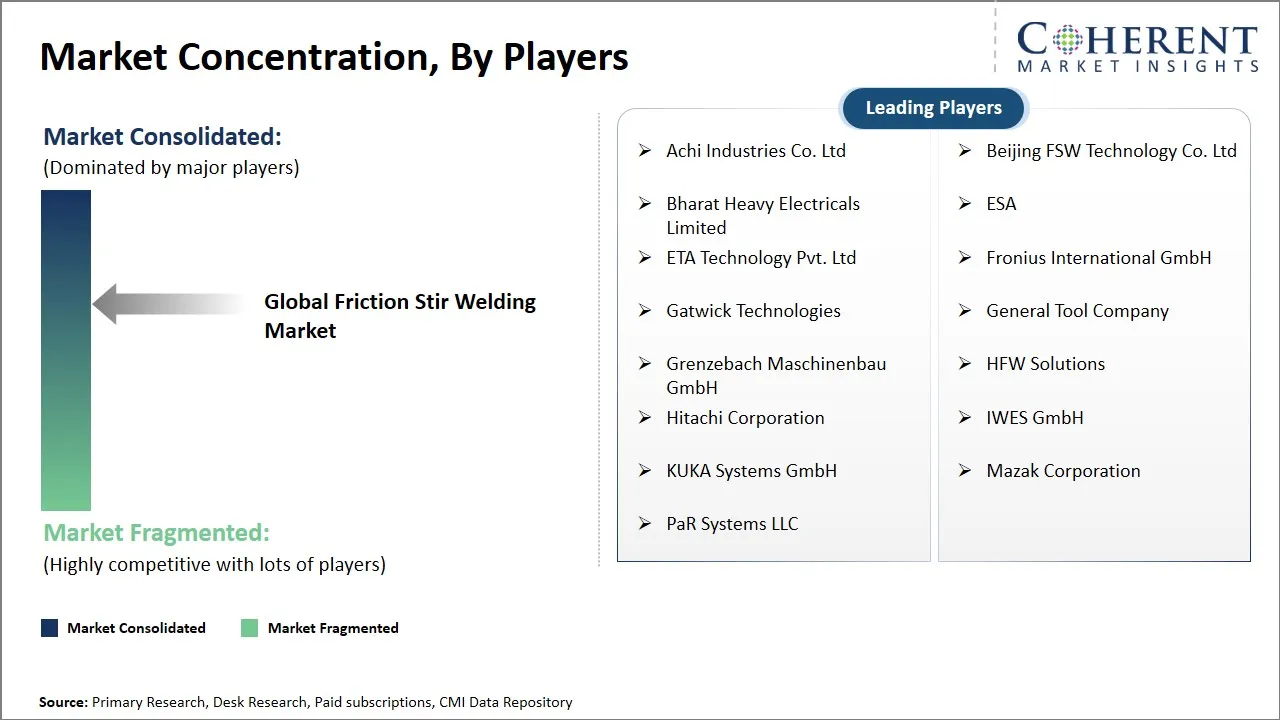
| Companies covered: | Achi Industries Co. Ltd, Beijing FSW Technology Co. Ltd, Bharat Heavy Electricals Limited, ESA, ETA Technology Pvt. Ltd, Fronius International GmbH, Gatwick Technologies, General Tool Company, Grenzebach Maschinenbau GmbH, HFW Solutions, Hitachi Corporation, IWES GmbH, KUKA Systems GmbH, Mazak Corporation, and PaR Systems LLC | ||
| Growth Drivers: |
| ||
| Restraints & Challenges: |
| ||
Global Friction Stir Welding Market Dynamics
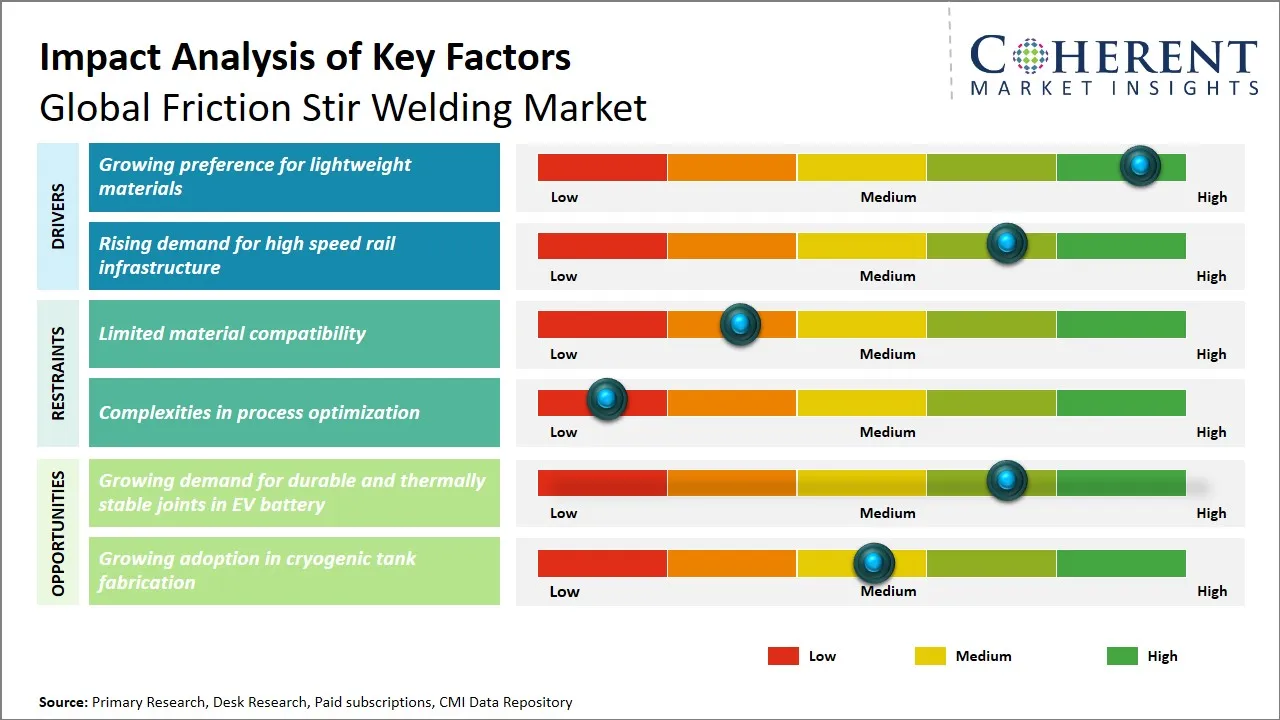
Global Friction Stir Welding Market Driver - Growing Preference for Lightweight Materials
The rising need for lighter materials in many industries is pushing growth in friction stir welding use. Because of this, companies in aerospace, cars, and transport focus on cutting weight to boost efficiency while lowering emissions alongside better results. Instead of older techniques, which can weaken light metals such as aluminum or magnesium during joining, FSW keeps core material strength intact through a solid-state method.
Unlike conventional processes, it creates strong, clean bonds without damaging original traits. As a result, mixing different lightweight types becomes easier, supporting smarter designs plus improved parts. The move toward electric cars and new aircraft types increases demand for better joining methods that work with light materials. Because sectors now focus more on eco-friendly solutions along with improved material strength, there’s stronger interest in lighter components, helping position friction stir welding as key in today’s production systems.
Global Friction Stir Welding Market Opportunity - Growing Demand for Durable and Thermally Stable Joints in EV Battery
The fast growth of the electric vehicle sector opens strong potential for the worldwide friction stir welding market. The demand comes mainly from higher needs for tough, heat-stable connections in making EV batteries. As these batteries depend on solid, light, and heat-tolerant parts to stay safe, work well, and last longer, it links different materials without warping them while delivering better strength. Unlike older welding ways, which struggle with weakened metal or poor joins when heated repeatedly, friction stir welding gives clean results every time, improving how dependable battery units are.
Furthermore, as carmakers move to lighter metals such as aluminum and magnesium alloys, which dominate EV battery enclosures, the push grows stronger for modern joining methods; here, FSW performs especially well handling those specific materials. The push to extend battery lifespan while boosting efficiency boosts need for weld methods that reduce thermal damage while preserving strength, placing FSW at the core of electric vehicle battery manufacturing. As a result, companies are allocating significant resources into automating and embedding friction stir welding into cell production processes, turning this use case into one of the fastest-expanding areas across the broader FSW sector.
Analyst Opinion (Expert Opinion)
- The friction stir welding market is moving into steady expansion, fueled by lasting trends in lighter materials, electric systems, and eco-friendly production. While automotive makers - especially those building EVs - are adopting FSW faster for parts like battery housings and aluminum frames; this comes from benefits such as stronger seams, less warping, along with lower power use when contrasted with traditional welding. Meanwhile industries including aviation, railways, or marine construction keep depending on FSW to join big components tightly, confirming its role as essential method instead of limited alternative.
- From a competition angle, the market is splitting into two clear paths. While major automation firms boost output using robots and set FSW systems for mass production, smaller or mid-sized experts focus on accessible solutions - modular units, CNC-compatible FSW tools, plus intelligent equipment with live performance tracking. As both tracks advance separately, more customers become reachable, not just top-tier OEMs but also medium workshops and service providers. In coming years, suppliers that adopt digital interfaces, connect to smart factory networks, or master mixed-material joining will gain edge, influencing who leads and lasts in this space.
Speak to the analyst
Want personalized insights?
Take the findings above to one of our principal consultants, or have the report rebuilt around the segments, geographies and competitors you actually track.
Market Segmentation
- Material Type Insights (Revenue, USD Million, 2021 - 2033)
- Aluminum Alloys
- Magnesium Alloys
- Copper and Copper Alloys
- Steel and Stainless Steel
- Titanium Alloys
- Others
- Equipment Type Insights (Revenue, USD Million, 2021 - 2033)
- Fixed Equipment
- Portable Equipment
- Robotic FSW Systems
- Track-Based Systems
- Retrofit Kits
- Technology Insights (Revenue, USD Million, 2021 - 2033)
- Conventional FSW Tools
- Advanced Tool Materials
- Self-reacting and Dual-rotational Tools
- Adjustable Pin Tools for Complex Joints
- End User Insights (Revenue, USD Million, 2021 - 2033)
- Automotive & Transportation
- Aerospace & Defense
- Railway
- Construction & Infrastructure
- Others
- Regional Insights (Revenue, USD Million, 2021 - 2033)
- North America
- U.S.
- Canada
- Latin America
- Brazil
- Argentina
- Mexico
- Rest of Latin America
- Europe
- Germany
- U.K.
- Spain
- France
- Italy
- Russia
- Rest of Europe
- Asia Pacific
- China
- India
- Japan
- Australia
- South Korea
- ASEAN
- Rest of Asia Pacific
- Middle East
- GCC Countries
- Israel
- Rest of Middle East
- Africa
- South Africa
- North Africa
- Central Africa
- North America
- Key Players Insights
- Achi Industries Co. Ltd
- Beijing FSW Technology Co. Ltd
- Bharat Heavy Electricals Limited
- ESA
- ETA Technology Pvt. Ltd
- Fronius International GmbH
- Gatwick Technologies
- General Tool Company
- Grenzebach Maschinenbau GmbH
- HFW Solutions
- Hitachi Corporation
- IWES GmbH
- KUKA Systems GmbH
- Mazak Corporation
- PaR Systems LLC
Sources
Primary Research Interviews
- Friction stir welding equipment manufacturers and suppliers
- Aerospace and automotive industry welding specialists
- Metal fabrication and construction industry professionals
- Research and development engineers in advanced welding technologies
Databases
- Global Trade Atlas
- Bloomberg Terminal
- Euromonitor International
Magazines
- Welding Journal
- The Fabricator Magazine
- Industrial Heating Magazine
- Manufacturing Engineering Magazine
- Metal Working World Magazine
Journals
- Journal of Materials Processing Technology
- Materials & Design Journal
- International Journal of Advanced Manufacturing Technology
Newspapers
- Financial Times
- The Wall Street Journal
- Industrial News
- Manufacturing News
- Metal Bulletin Daily
Associations
- American Welding Society (AWS)
- International Institute of Welding (IIW)
- Friction Stir Welding Institute
- European Welding Federation (EWF)
Public Domain Sources
- U.S. Patent and Trademark Office (USPTO)
- European Patent Office (EPO)
- World Trade Organization (WTO) reports
- Government industrial statistics databases
- International standards organizations (ISO, ASTM)
Proprietary Elements
- CMI Data Analytics Tool
- Proprietary CMI Existing Repository of information for last 8 years
Get access to 250+ pages report
Every segment, forecast, competitor profile and data table behind the analysis above — available for instant download.
- ESOMAR Member
- ISO 9001:2015 Certified
- D-U-N-S Registered
- GDPR & CCPA Compliant
Missing comfort of reading report in your local language? Find your preferred language:
Transform your Strategy with Exclusive Trending Reports
Frequently Asked Questions
The global friction stir welding market is estimated to be valued at USD 295.2 Mn in 2026 and is expected to reach USD 449.8 Mn by 2033.
The CAGR of global friction stir welding market is projected to be 6.2% from 2026 to 2033.
Growing preference for lightweight materials and rising demand for high-speed rail infrastructure are the major factors driving the growth of the global friction stir welding market.
Limited material compatibility and complexities in process optimization are the major factors hampering the growth of the global friction stir welding market.
In terms of material type, aluminum alloys are estimated to dominate the market revenue share in 2026.
Electric vehicle growth directly boosts FSW demand for battery trays, cooling plates, and structural enclosures.
Automation is expanding FSW adoption through robotic cells, real-time monitoring, and Industry 4.0 integration.