

GCC Aquaculture Market Size and Forecast – 2026-2033
The GCC Aquaculture Market is estimated to be valued at USD 2.36 Bn in 2026 and is expected to reach USD 3.78 Bn by 2033, exhibiting a compound annual growth rate (CAGR) of 6.9% from 2026 to 2033.
Key Takeaways of the GCC Aquaculture Market
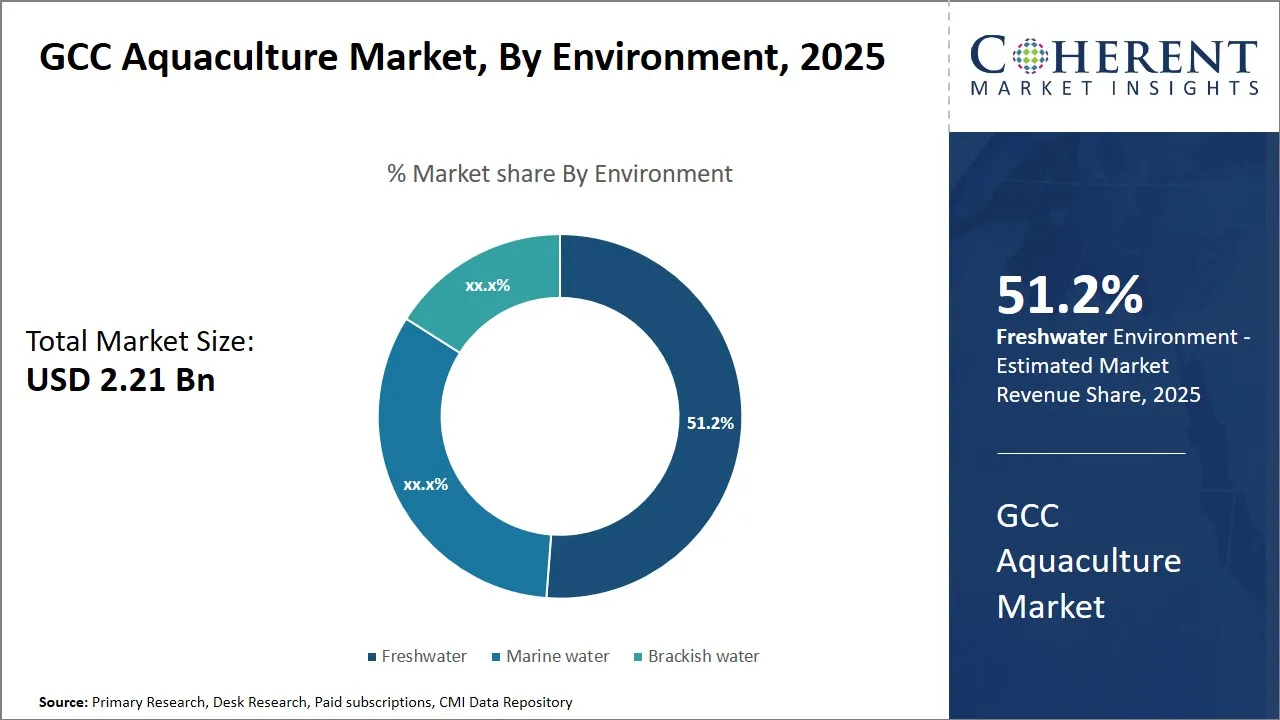
- The freshwater segment is expected to hold a 52.2% share of the GCC aquaculture market in 2026, driven by factors that foster the continued growth of freshwater aquaculture.
- The carps, barbels, and other cyprinids segment is projected to hold a 20.7% share of the GCC aquaculture market in 2026, driven by their biological traits and market acceptance.
Market Overview
A key market trend is the increasing adoption of advanced aquaculture technologies, such as recirculating aquaculture systems (RAS) and integrated multi-trophic aquaculture (IMTA), which enhance yield while minimizing environmental impact. Additionally, government initiatives promoting food security and private sector participation are accelerating market expansion. Consumers' preference for fresh and organic seafood products further fuels innovation and diversification in aquaculture practices across the GCC region.
Currents Events and their Impact
Current Events | Description and its impact |
Launch of Precision Aquaculture Platforms |
|
Development of Super-Intensive Shrimp Farming Systems |
|
Segmental Insights
- Current Industry Events of 2026
- Market Size Estimation
- Regional Breakdown
- Competitive Landscape
- Customer Intelligence
- Segmental Analysis
- Pricing Analysis
- Key Market Drivers, Challenges & Future Trends
- Customized Insights Section
GCC Aquaculture Market Insights, By Environment – Freshwater Segment Dominates the Market due to Favorable Conditions and Widespread Adaptability
The freshwater segment is expected to hold 52.2% share of the GCC aquaculture market in 2026, can be attributed to multiple interacting factors that create an ideal setting for the sustained growth of freshwater aquaculture activities. Firstly, access to freshwater, which is mainly through inland rivers, reservoirs, and controlled water bodies, makes it easy to develop large-scale freshwater farms at relatively cheaper operation costs than the marine or brackish water systems. Fresh water farming uses less specialized equipment and less infrastructure compared to the salt water farming, thus available to a wider pool of producers including the small to medium-sized enterprises.
The other significant motivation is the biological flexibility and rapid multiplication cycles of popular freshwater species that are grown in the area. Freshwater fish such as carps and tilapias fare well in regulated freshwater conditions, and have a high feed to output ratio and adaptability to different climatic conditions. This flexibility lowers the mortality levels and enhances delivery, which is why producers are encouraged to target freshwater systems. Moreover, freshwater environment enables the management of water quality parameters of temperature, pH, and dissolved oxygen that are important in ensuring optimal fish health and productivity.
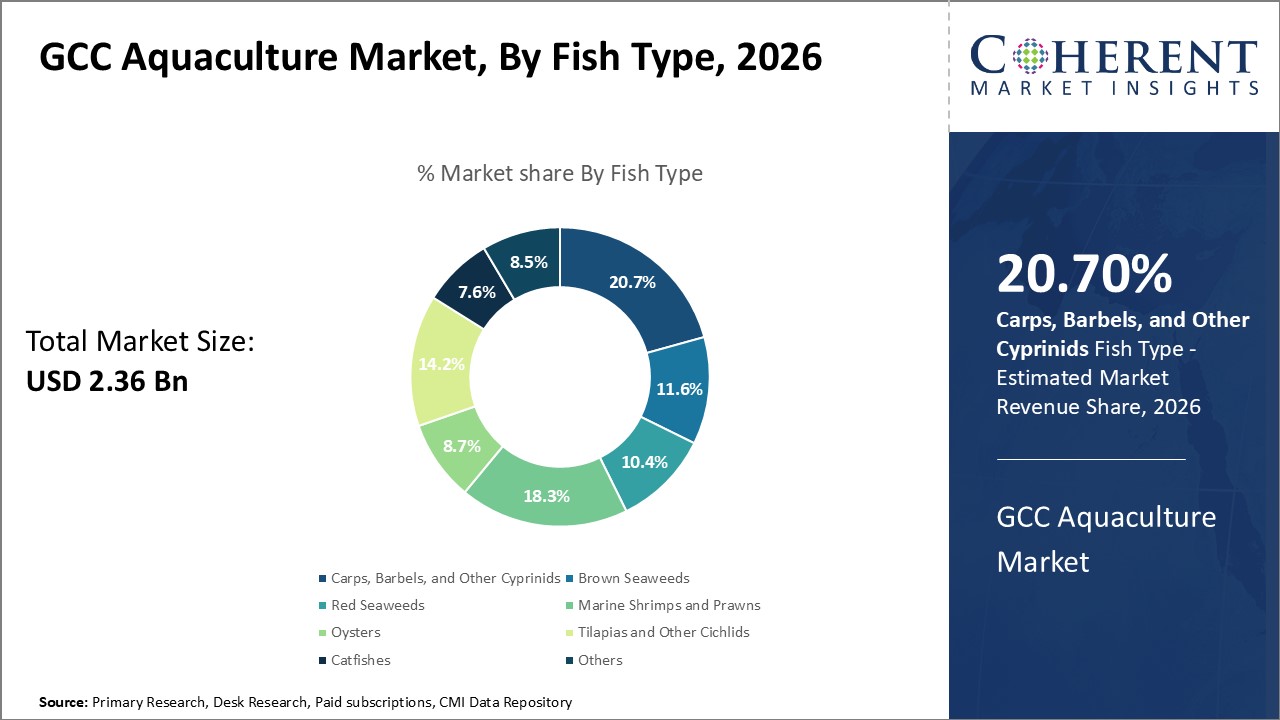
GCC Aquaculture Market Insights, By Fish Type - Carps, Barbels, and Other Cyprinids lead the GCC Aquaculture Market Driven by their Adaptability and Nutritional Value
The carps, barbels, and other cyprinids segment is projected to hold 20.7% share of the GCC aquaculture market in 2026, primarily due to the biological characteristics and market acceptance of these species. These cyprinids are hardy freshwater fish with high tolerability of various water conditions such as temperature changes and oxygen that are usually found in GCC aquaculture environments. This biological stability is translated to reduce mortality rate and farm production stability which is very attractive to producers who want assurance and predictability of yield.
Macro and Micro Economic Factors Impacting on GCC Aquaculture Market Growth
Macro-Economic Factors
- Government Investment and Food Security Programs: GCC governments have invested a lot of money in the infrastructure of aquaculture as part of strategic food security measures in order to mitigate the reliance on imports and to guarantee the sustainability of local seafood production. The notable examples are the Vision 2030 in Saudi Arabia and the climate/environmental initiatives in the U.A.E where billions of dollars are invested and increases in production have been cited in notable amounts.
- Increased Seafood Demand: The high population growth (more than 2 per cent per annum) and the rising per capita consumption of seafood have contributed to the demand in the GCC region. As an example, the consumption of seafood in the U.A.E increased to more than 37 kg per person in 2022, which is much higher than in the rest of the world, which is approximately 33 kg per person.
- Technological Improvements and Sustainable Operations: Advanced aquaculture technologies (Recirculating aquaculture systems (RAS), artificial intelligence, internet of things (IoT) to control feed and water quality, and precision aquaculture) have been adopted to enhance productivity, efficiency, and sustainability. The innovations are also appealing to the investment by the private sector.
Micro Economic Factors
- Operational Costs and Investment Requirements: High initial capital investment for modern aquaculture systems and ongoing operational costs (energy, maintenance) influence decisions of smaller farmers and enterprises, potentially limiting sector participation.
- Disease Management and Biosecurity: Micro-level challenges such as disease outbreaks and the need for strong biosecurity measures impact production stability and cost structure.
Market Players, Key Development, and Competitive Intelligence
Key Developments
- In September 2024, the Oman Investment Authority (OIA) facilitated the merger of Fisheries Development Oman (FDO) with Oman Food Investment Holding Company (NITAJ). The purpose of this strategic move is to streamline the efficient operations and save both entities’ expenditures. Moreover, the merger will strengthen the food security of Omans, improve the quality of products, and foster cost-effectiveness, all of which are in line with Oman Vision 2040.
- In July 2024, the National Centre of Fisheries, Saudi Arabia granted 18 licenses for aquaculture projects in the Mecca region, encompassing roughly one-third of Saudi Arabia's Red Sea coastline.
- In December 2023, Aqua Bridge Group, a company focused on aquaculture development, and Enertech, the Kuwait-based innovator, investor, and developer of end-to-end sustainable solutions, announced the launch of Aqua Bridge Kuwait on the side-lines of COP28 in Dubai, U.A.E. The joint venture aims to build a sustainable agri-food system that is equipped to cope with global economic shocks and disruptions.
Top Strategies Followed by GCC Aquaculture Market Players
- Established players are the players who dominate the industry through huge investments in research and development (R&D) to develop high-performance products and sustainable solutions that respond to the changing consumer and regulatory requirements. The companies are oriented at developing their technological possibilities to achieve better yield, efficiency, environment compliance and helps them to embrace the synergized expertise and resources and allows them to penetrate the market and be able to serve a broader range of clients. Moreover, internationalization is one of the fundamental growth drivers and most developed companies continue to expand their distribution systems across the world to tap emerging markets outside the GCC region.
- As an example, companies such as Saudi Arabian Fisheries, one of the leaders in the sector, invests much in innovative aquaculture methods, such as a recirculating aquaculture system (RAS), to maximize the use of water and reduce the negative impact on the environment.
- A different strategic focus is that of the mid-level players of the established GCC aquaculture market who focus on the delivery of cost-effective solutions that balance quality with affordability. Being aware of the fact that a large proportion of the consumer market is price sensitive, these companies design products and services to suit the basic needs without compromising on quality. They are based on maximization of operational efficiencies and use of innovative but cost-effective technologies to ensure that costs are competitive.
- An example is Oman Fisheries Co.S.A.O.G that embraces low cost but effective feed technologies to enable it keep the price of products competitive without compromising on quality. Cost-effective production methods, including modular farming systems are also highlighted by these players which can be easily scaled and require less initial capital investment, are attractive to small scale operators.
- The small-scale players cut their niche market within the GCC aquaculture by focusing on specialization and regional or consumer-focused innovation. Frequently, these firms emphasize the use of differentiated product features or novel approaches to aquaculture, using the latest technologies like smart monitoring systems or automated feeding devices, eco-friendly farming methods, etc., to keep up with the existing competition on the market. Their agility enables them to quickly react to new trends and regulatory changes, and this is important in a dynamic business such as aquaculture.
- For example, Sea Green Aquaculture is a small player in the U.A.E and specializes in the production of high quality and environment-friendly farmed shrimp. It applies sustainable farming methods, such as biofloc systems, that save on water usage and enhance sustainability.
Market Report Scope
GCC Aquaculture Market Report Coverage
| Report Coverage | Details | ||
|---|---|---|---|
| Base Year: | 2025 | Market Size in 2026: | USD 2.36 Bn |
| Historical Data for: | 2020 To 2024 | Forecast Period: | 2026 To 2033 |
| Forecast Period 2026 to 2033 CAGR: | 6.9% | 2033 Value Projection: | USD 3.78 Bn |
| Segments covered: |
| ||
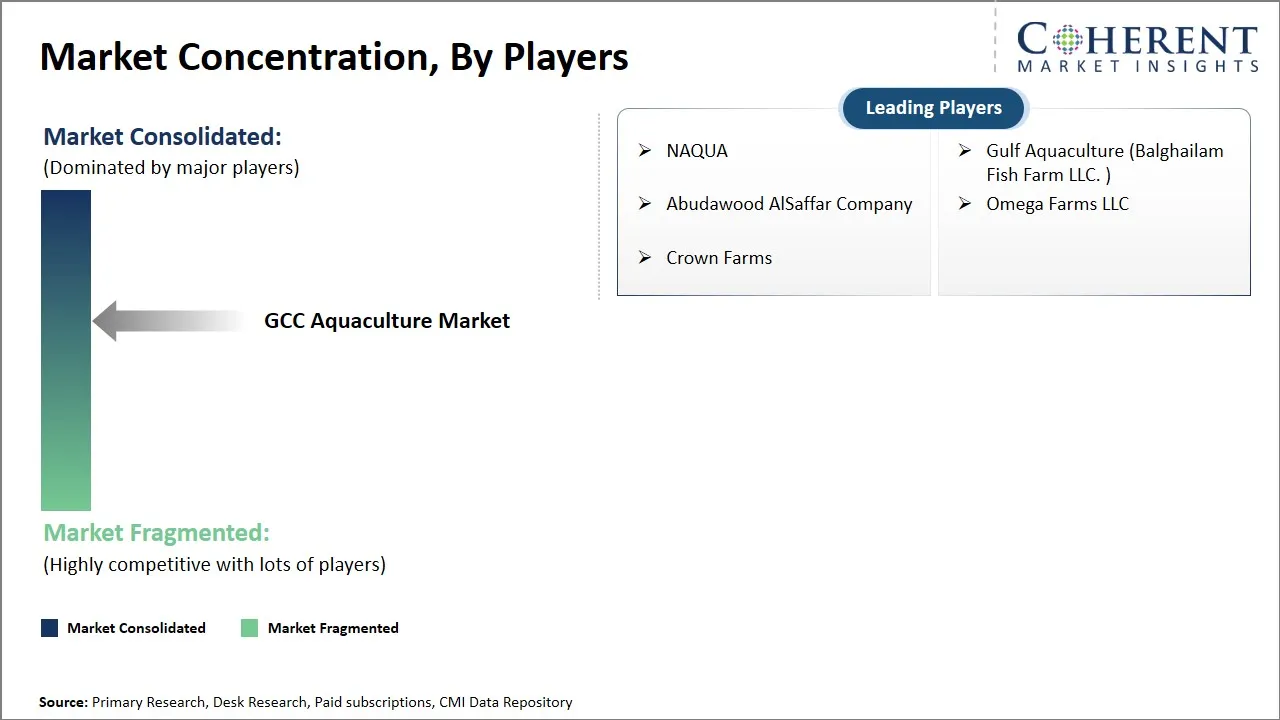
| Companies covered: | NAQUA, Gulf Aquaculture (Balghailam Fish Farm LLC. ), Abudawood AlSaffar Company, Omega Farms LLC, and Crown Farms | ||
| Growth Drivers: |
| ||
| Restraints & Challenges: |
| ||
GCC Aquaculture Market Dynamics
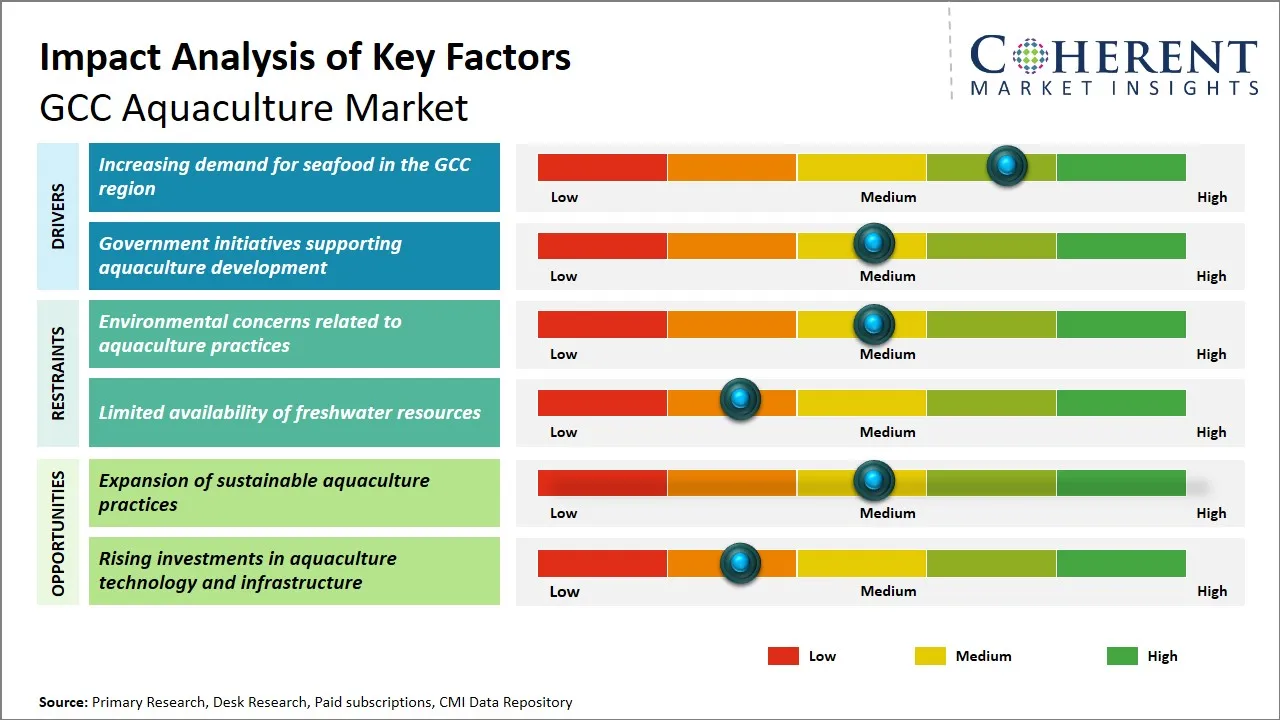
GCC Aquaculture Market Driver - Increasing Demand for Seafood in the GCC Region
The growing demand of seafood in the GCC region is one of the main factors that influence the development of the aquaculture market. Due to the changing tastes and preferences of the consumers towards healthy and protein rich food, seafood is gaining popularity among the people. This trend is also reinforced by increasing awareness of the nutritional advantages of fish and other aquatic food products, i.e., omega-3 products, fatty acids. Other contributing factors also include increased consumption of sea foods either at home or in the hospitality industry due to rapid urbanization and increasing number of people in the middle-class segment of the population in nations such as Saudi Arabia, the U.A.E and even Kuwait.
As an example, in 2023, the Saudi Fisheries Group has also started to enter the larger-scale fish farming sector, with the yearly capacity of over 20,000 tons of fish to serve local markets and restaurants.
GCC Aquaculture Market Opportunity - Expansion of Sustainable Aquaculture Practices
GCC aquaculture market in aquaculture holds great growth opportunities due to the development of sustainable aquaculture, which is propelled by the rising awareness about the environment, government policies, and advancement in technology. As the regions increase in population and the demand of the sustainable seafood increases, the conventional raw fisheries are constrained by overfishing and environmental degradation, making aquaculture an appealing source of sustaining the consumer needs. Aquaculture, which emphasizes efficient resource use, minimized environmental impact, and improved fish health, aligns well with the GCC countries strategic goals of food security and economic diversification.
In 2022, Qatar established the Qatar Fisheries Development Company aimed at popularizing environment-friendly fish farming methods including offshore fish farming on innovative and low-impact systems. Such systems save on water consumption and minimize environmental impact and produce high-quality seafood.
Analyst Opinion (Expert Opinion)
- GCC aquaculture market is at the edge of massive change due to the rising need of sustainable seafood and government diversification strategies to increase local production. The gulf fisheries conference (2023) and aquaculture middle east expo (2022) shed some light on the latest developments and innovations, with organizations such as Almarai and Saudi Fisheries Company being the first to develop integrated aquaculture systems.
- A recent initiative by Almarais to invest on sophisticated recirculating aquaculture systems (RAS) is an illustration of dedicated sustainability and efficiency that considers both the environmental issues and food security. Debates in such conferences focused on the issues of water scarcity and how technology has to be advanced to maximize resources.
- The regulatory regimes were often mentioned as the hindrances to new entrants, but it was also noted that the policies needed to be simplified in order to bring in investment. Those companies that manage to handle such regulatory environments and introduce new methods of farming are more likely to become market leaders. Market acceptance will be further improved by engaging the communities in the area to facilitate the practice of aquaculture education and practices that support sustainability. Finally, the development of the GCC aquaculture market will rely on its capacity to ensure balance between innovation and sustainability and regulatory compliance in a fast-changing environment.
Speak to the analyst
Want personalized insights?
Take the findings above to one of our principal consultants, or have the report rebuilt around the segments, geographies and competitors you actually track.
Market Segmentation
- Environment Insights (Revenue, USD Bn, 2021 - 2033)
- Freshwater
- Marine water
- Brackish water
- Fish Type Insights (Revenue, USD Bn, 2021 - 2033)
- Carps, Barbels, and Other Cyprinids
- Brown Seaweeds
- Red Seaweeds
- Marine Shrimps and Prawns
- Oysters
- Tilapias and Other Cichlids
- Catfishes
- Others
- Key Players Insights
- NAQUA
- Gulf Aquaculture (Balghailam Fish Farm LLC. )
- Abudawood AlSaffar Company
- Omega Farms LLC
- Crown Farms
Sources
Primary Research Interviews
- Aquaculture Farm Owner – Leading GCC Aquaculture Producer
- Supply Chain Manager – Major GCC Seafood Retailer
- Marine Biologist – Regional Aquaculture Research Institute
Stakeholders
- Aquaculture Producers and Hatcheries
- End Use Sectors
- Seafood Processing Companies
- GCC Foodservice and Retail Chains focusing on seafood
- Exporters and Importers of Aquaculture Products
- Regulatory & Certification Bodies (e.g., GCC Standardization Organizations, Environmental Agencies)
- Seafood E-commerce Platforms and Distributors
Databases
- UN Comtrade Database (GCC Trade Statistics for Aquaculture Products)
- GCC National Fisheries and Aquaculture Authorities Data
- Regional EXIM Trade Data for Aquatic Products
Magazines
- Middle East Aquaculture Magazine – Trends in GCC Aquaculture and Seafood Markets
- Fisheries Business Journal – Innovations and Market Developments in Aquaculture
- GCC Marine & Seafood Industry Insights – Consumer demand and market expansion
- Seafood Trade Review – Updates on GCC aquaculture production and export growth
- Aquatic Farming Today – Industry news and sustainability practices
Journals
- Journal of Aquaculture Research & Development – Scientific advancements in aquaculture techniques
- Marine Policy Journal – Regulatory and environmental policies impacting GCC aquaculture
- Aquaculture Economics & Management – Market and economic analysis for the aquaculture sector
- Regional Environmental Studies Journal – Impact assessments of aquaculture in GCC coastal areas
Newspapers
- Gulf News – Aquaculture industry updates and policies in the GCC
- Khaleej Times – Consumer trends and seafood consumption in GCC countries
- Arab News – GCC government initiatives supporting aquaculture growth
- The National – Challenges and opportunities in sustainable aquaculture in the region
Associations
- GCC Fisheries and Aquaculture Association
- Middle East Aquaculture Society
- International Aquaculture Council
- Regional Environmental Protection Agencies focusing on marine resources
Public Domain Sources
- FAO – Regional reports on Middle East aquaculture statistics and practices
- GCC Standardization Organization – Aquaculture product standards and certifications
- World Bank – Studies on sustainable fisheries and aquaculture in the GCC region
- OECD – Economic assessments for aquaculture development
- Regional Environmental Authorities – Guidelines for responsible aquaculture practices
Proprietary Elements
- CMI Data Analytics Tool, Proprietary CMI Existing Repository of information for last 8 years.
Get access to 250+ pages report
Every segment, forecast, competitor profile and data table behind the analysis above — available for instant download.
- ESOMAR Member
- ISO 9001:2015 Certified
- D-U-N-S Registered
- GDPR & CCPA Compliant
Missing comfort of reading report in your local language? Find your preferred language:
Transform your Strategy with Exclusive Trending Reports
Frequently Asked Questions
The GCC aquaculture market is estimated to be valued at USD 2.36 Bn in 2026 and is expected to reach USD 3.78 Bn by 2033.
The CAGR of GCC aquaculture market is projected to be 6.9% from 2026 to 2033.
Increasing demand for seafood in the GCC region and government initiatives supporting aquaculture development are the major factors driving the growth of the GCC aquaculture market.
Environmental concerns related to aquaculture practices and limited availability of freshwater resources are the major factors hampering the growth of the GCC aquaculture market.
In terms of environment, freshwater is estimated to dominate the market revenue share in 2026.
NAQUA, Gulf Aquaculture (Balghailam Fish Farm LLC. ), Abudawood AlSaffar Company, Omega Farms LLC, and Crown Farms are the major players.