

Global Graphic Design Software Market Size and Forecast – 2026-2033
The global graphic design software market is estimated to be valued at USD 10.51 Bn in 2026 and is expected to reach USD 19.59 Bn by 2033, exhibiting a compound annual growth rate (CAGR) of 9.3% from 2026 to 2033.
Key Takeaways of the Global Graphic Design Software Market
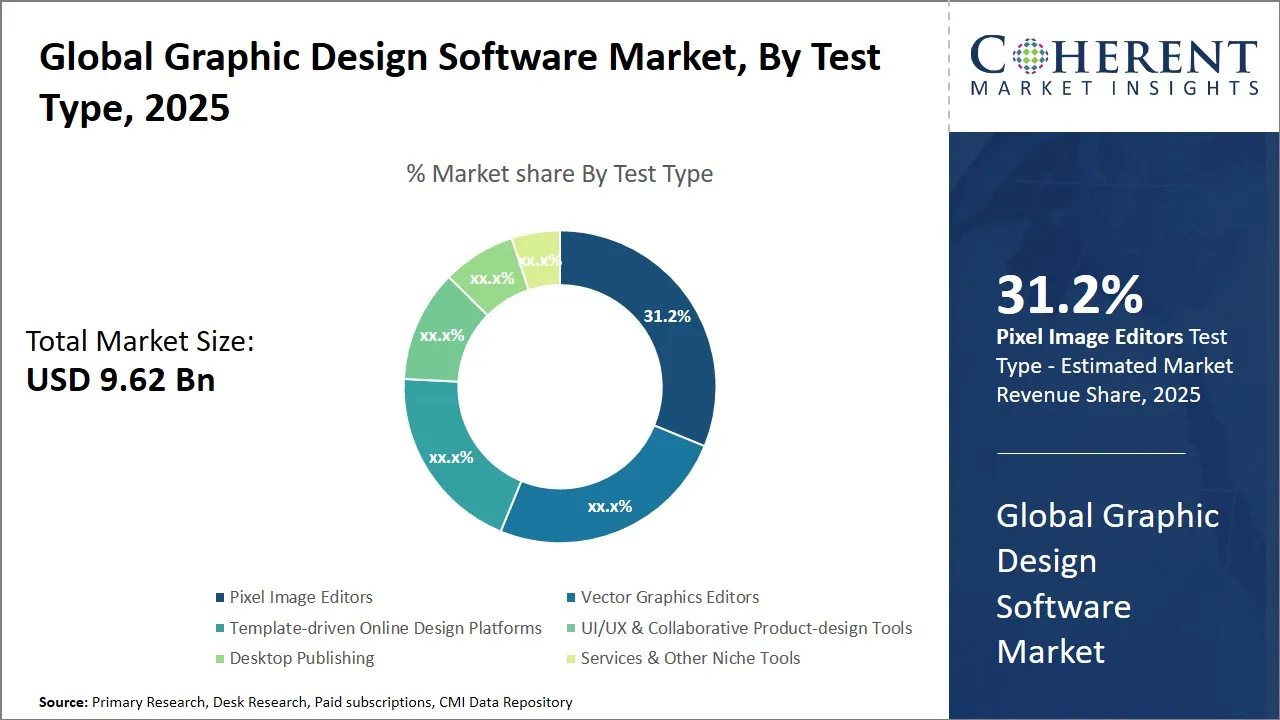
- The pixel image editors segment leads the market holding an estimated share of 32.2 % in 2026.
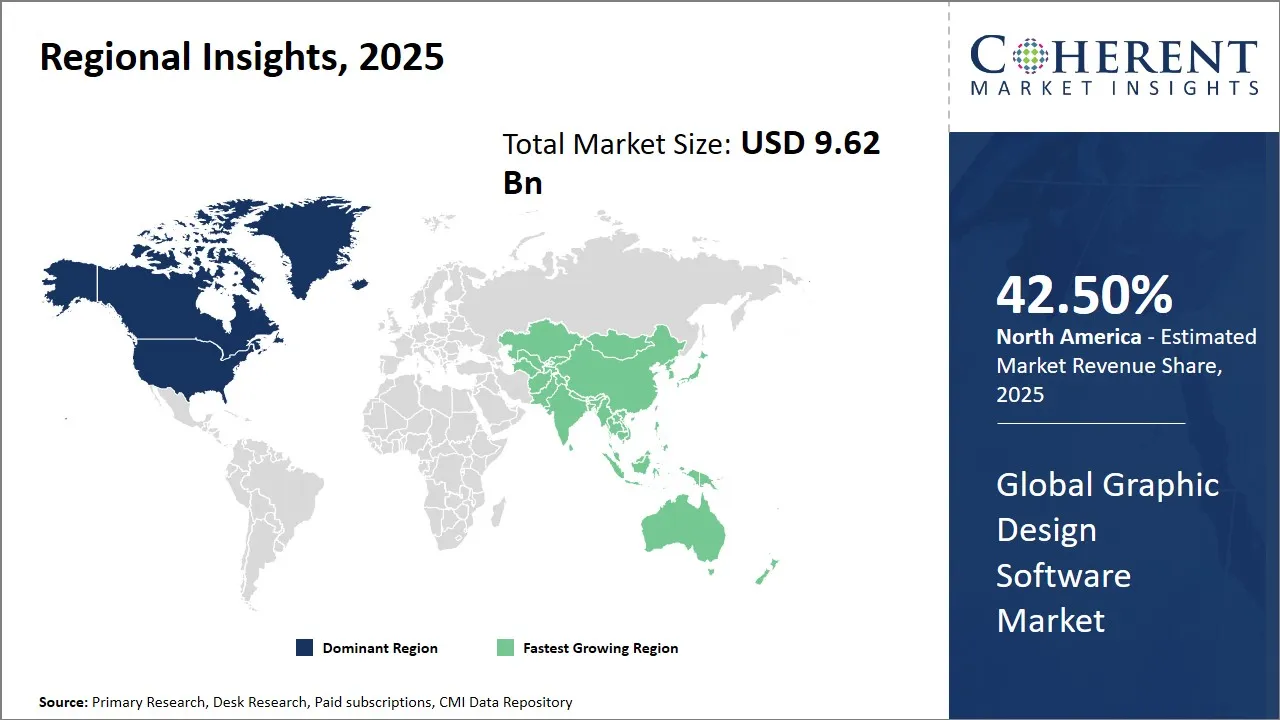
- North America is estimated to lead the market with a share of 42.5 % in 2026.
- Asia Pacific, holding a share of 21.3 % in 2026, is projected to be the fastest growing region.
Market Overview
A prominent trend in the graphic design software market is the integration of artificial intelligence and machine learning technologies to automate design processes and enhance user experience. Additionally, the rise of cloud-based software solutions is enabling greater collaboration and accessibility for designers worldwide. The increasing adoption of mobile-friendly design applications and the expansion of e-commerce platforms driving the need for customized graphics further propel the market growth, making innovation and usability key drivers in this competitive landscape.
Current Events and Its Impact
Current Events | Description and its Impact |
Financial Performance & Guidance |
|
IPO Preparation |
|
User Growth & Market Expansion |
|
Segmental Insights
- Current Industry Events of 2026
- Market Size Estimation
- Regional Breakdown
- Competitive Landscape
- Customer Intelligence
- Segmental Analysis
- Pricing Analysis
- Key Market Drivers, Challenges & Future Trends
- Customized Insights Section
Global Graphic Design Software Market Insights, by Test Type – Dominance of Pixel Image Editors Segment is Driven by Versatility and Widespread Adoption
The pixel image editors segment is projected to account for 32.2% of the market share in 2026. These editors, also known as raster graphics editors, allow users to manipulate images on a pixel-by-pixel level, offering unparalleled precision and flexibility. Social media, e-commerce, and digital marketing rely heavily on striking visuals, driving professionals and amateurs alike to adopt pixel-based editing software that delivers detailed and creative outcomes. Enhanced features like AI-powered editing tools, automated retouching, content-aware fills, and improved layering techniques make these editors more user-friendly and efficient.
Additionally, the integration of Pixel image editors with other creative software creates a versatile workflow for content creators. Compatibility with digital drawing tablets and support for various file formats encourage seamless collaboration between graphic designers, photographers, and marketers. Cloud storage and subscription-based models further boost accessibility, allowing users to work remotely and access their projects anytime. The continuous rise in smartphone photography and content creation has also led to increased adoption of Pixel Image Editors on mobile platforms, widening the market reach. With mobile apps offering powerful editing capabilities, even casual users participate in creating and refining visual content.
In September 2025, Adobe reported strong Creative Cloud growth and raised its full-year revenue guidance, crediting demand for AI-powered Photoshop features such as Generative Fill and automated retouching as key drivers.
Impact of AI on the Graphic Design Software Market
Artificial intelligence is transforming the global graphic design software market by automating repetitive tasks and enabling entirely new creative workflows. Modern tools integrate AI to handle background removal, layout suggestions, color palette generation, and even real-time design feedback, allowing designers to focus on higher-level concepts and strategy. Generative AI models now produce high-resolution images, textures, and design variations on demand, dramatically reducing turnaround time for marketing campaigns and product prototypes. This capability also lowers barriers for non-designers, expanding the market to small businesses and individuals who can create professional visuals with minimal training.
An example of this shift is Adobe’s Firefly platform, which recently integrated Google’s Gemini 2.5 Flash Image model into Adobe Express and Photoshop. Designers can now prompt Firefly to create brand-ready graphics or instantly modify complex scenes directly within their standard workflow.
Regional Insights
North America Graphic Design Software Market Analysis and Trends
The North America region is projected to lead the market with a 42.5% share in 2026, driven by a well-established technology ecosystem, high adoption of digital solutions, and the presence of major industry players. The U.S., in particular, serves as a hub for innovation with strong government policies supporting the digital creative industry, including intellectual property protections and investment incentives.
Key players such as Adobe Inc., Corel Corporation, and Autodesk maintain significant influence by offering a diverse range of graphic design tools catering to both professionals and hobbyists. Additionally, the presence of numerous creative agencies, media houses, and educational institutions fostering skilled talent continuously fuels the demand for sophisticated graphic design software. The trade environment also facilitates easy import and export of software technologies, supporting growth in this region.
Asia Pacific Graphic Design Software Market Analysis and Trends
The Asia Pacific region, holding a share of 21.3% in 2026, is expected to exhibit the fastest growth in the graphic design software market owing to rapid digital transformation, increasing internet penetration, and rising investments in creative industries across countries like China, India, Japan, and South Korea. Governments in this region have introduced favorable policies promoting technology adoption and supporting startups in the digital design space. The burgeoning freelance and small-to-medium enterprise sectors are increasingly utilizing graphic design software to enhance digital content creation.
Additionally, international software vendors are expanding their presence to tap into the vast consumer base, while regional players such as Wacom (Japan) and other emerging startups contribute localized innovations. The dynamic trade relationships and growing localization efforts by global companies have led to accelerated the market adoption in the Asia Pacific region.
Graphic Design Software Market Outlook for Key Countries
U.S. Graphic Design Software Market Analysis and Trends
The U.S. remains highly competitive and mature, led by industry giants such as Adobe with its Creative Cloud suite, which dominates professional segments. The robust infrastructure, extensive creative content industry, and early technology adoption culture underpin sustained demand. Innovations integrating AI and cloud computing in design software are pioneered here, influencing market trends globally. Moreover, government support for technology and a strong startup ecosystem encourage continuous advancements and diversification of graphic design solutions.
China Graphic Design Software Market Analysis and Trends
China graphic design software market is rapidly expanding, fueled by its fast-growing digital economy and supportive government policies like the “Digital China” initiative. Local companies and startups are increasingly innovating to cater to domestic preferences, while international brands have intensified localization efforts to overcome regulatory challenges and appeal to Chinese users. The rise of e-commerce, social media marketing, and gaming industries in China has amplified the demand for user-friendly, cost-effective graphic design software.
Germany Graphic Design Software Market Analysis and Trends
Germany continues to lead the Europe graphic design software market with a focus on industrial design, automotive, and manufacturing sectors that require specialized graphic design tools. The country benefits from strong intellectual property laws and investments in R&D, facilitating development and adaptation of cutting-edge software. German companies often collaborate with global software providers to customize solutions for various B2B applications. The market is supported by a large base of skilled professionals and design agencies, as well as favorable government policies promoting digital innovation.
India Graphic Design Software Market Analysis and Trends
India graphic design software market is characterized by a rapidly growing freelance and startup ecosystem, which drives the demand for affordable and scalable design solutions. The country benefits from widespread internet adoption and government initiatives like “Digital India,” which encourage digital skill development and entrepreneurship. International brands like Adobe have significant market penetration, but local players offering region-specific features and pricing models are also gaining traction. With increasing creative content creation for social media, advertising, and e-commerce, India presents a vibrant environment for graphic design software growth.
Japan Graphic Design Software Market Analysis and Trends
Japan is distinguished by advanced technology adoption and a strong presence of companies specializing in hardware accessories such as tablets and stylus devices complementing graphic design software. Key players like Wacom dominate the peripheral hardware segment, enhancing the user experience for software solutions. Japanese firms often collaborate closely with software developers to optimize applications for creative industries including manga, animation, and video game design. The country’s emphasis on precision and quality also influences preferences towards sophisticated design software offerings.
Market Players, Key Development, and Competitive Intelligence
Key Developments
- In August 2025, Adobe integrated Gemini 2.5 Flash Image to Adobe Firefly and Adobe Express
- In June 2025, Adobe extended its leadership in creative ideation with a major expansion of Adobe Firefly, bringing Firefly image and video generation to phones with Firefly’s new iOS and Android app.
- In March 2025, Alludo introduced CorelDRAW Go, a beginner-friendly online graphic design tool for creative enthusiasts and aspiring designers. This addition to the CorelDRAW family simplifies the creative process, equipping users with intuitive tools to design efficiently from anywhere.
- In March 2024, Canva, an all-in-one visual communication platform, announced the acquisition of Affinity, the award-winning creative software suite for professional photo editing, illustration, graphic design and page layout.
Top Strategies Followed by Graphic Design Software Market
- Established corporations, often industry pioneers, heavily invest in research and development (R&D) to drive continuous innovation, aiming to produce high-performance, feature-rich products that meet the evolving needs of professional designers.
- Adobe Inc. continues to invest aggressively in AI-driven R&D, evident in its Firefly generative-AI platform.
- Mid-level market participants occupy a crucial space by emphasizing cost-effective graphic design software solutions that strike a balance between affordability and quality.
- Corel (Alludo), focused on cost-effective, subscription-based packages and periodic lifetime-license promotions for CorelDRAW Graphics Suite. By offering flexible pricing and essential professional features, Corel appeals to price-sensitive designers and small studios that find Adobe’s full suite costly.
- Small-scale competitors within the graphic design software domain strategically carve out specialized niches by developing innovative products centered around unique features or user experiences that larger players may overlook.
- Sketch targets the specialized UI/UX design segment rather than competing across the entire creative spectrum. Its Mac-only, collaborative workflow and plugin ecosystem cater specifically to product-design teams.
Market Report Scope
Graphic Design Software Market Report Coverage
| Report Coverage | Details | ||
|---|---|---|---|
| Base Year: | 2025 | Market Size in 2026: | USD 10.51 Bn |
| Historical Data for: | 2020 To 2024 | Forecast Period: | 2026 To 2033 |
| Forecast Period 2026 to 2033 CAGR: | 9.3% | 2033 Value Projection: | USD 19.59 Bn |
| Geographies covered: |
| ||
| Segments covered: |
| ||
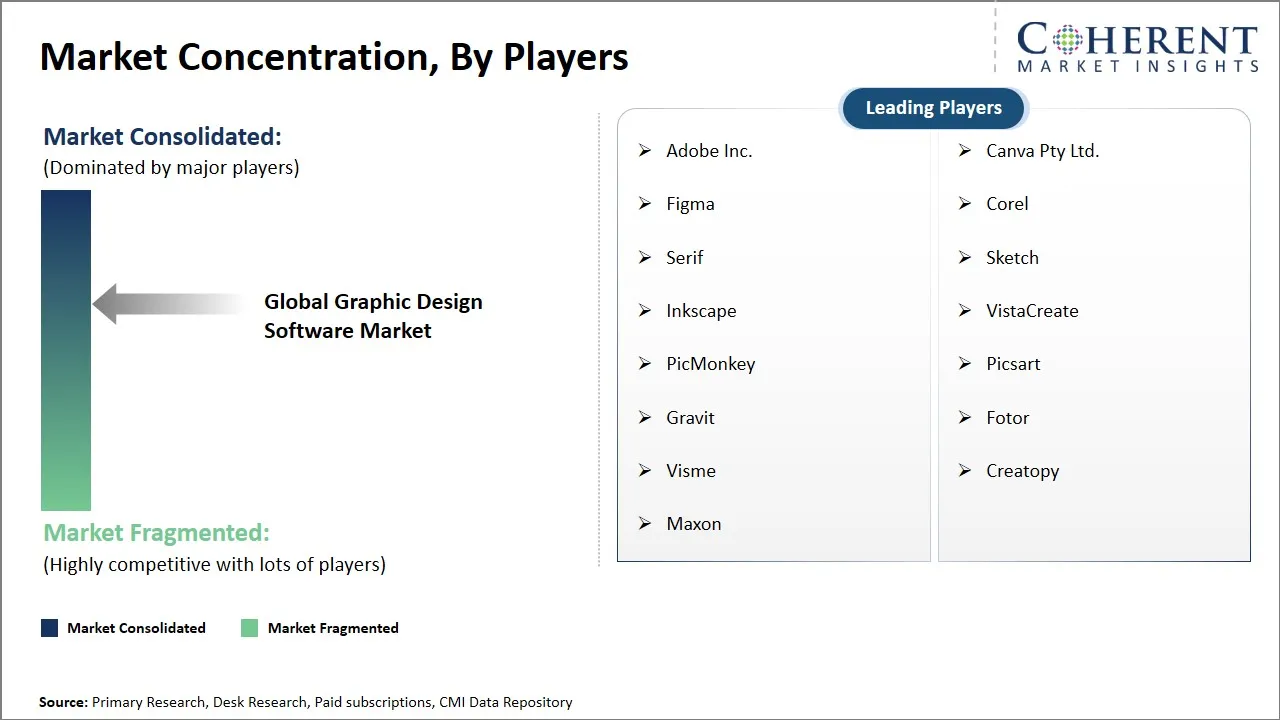
| Companies covered: | Adobe Inc., Canva Pty Ltd., Figma, Corel, Serif, Sketch, Inkscape, VistaCreate, PicMonkey, Picsart, Gravit, Fotor, Visme, Creatopy, and Maxon | ||
| Growth Drivers: |
| ||
| Restraints & Challenges: |
| ||
Market Dynamics
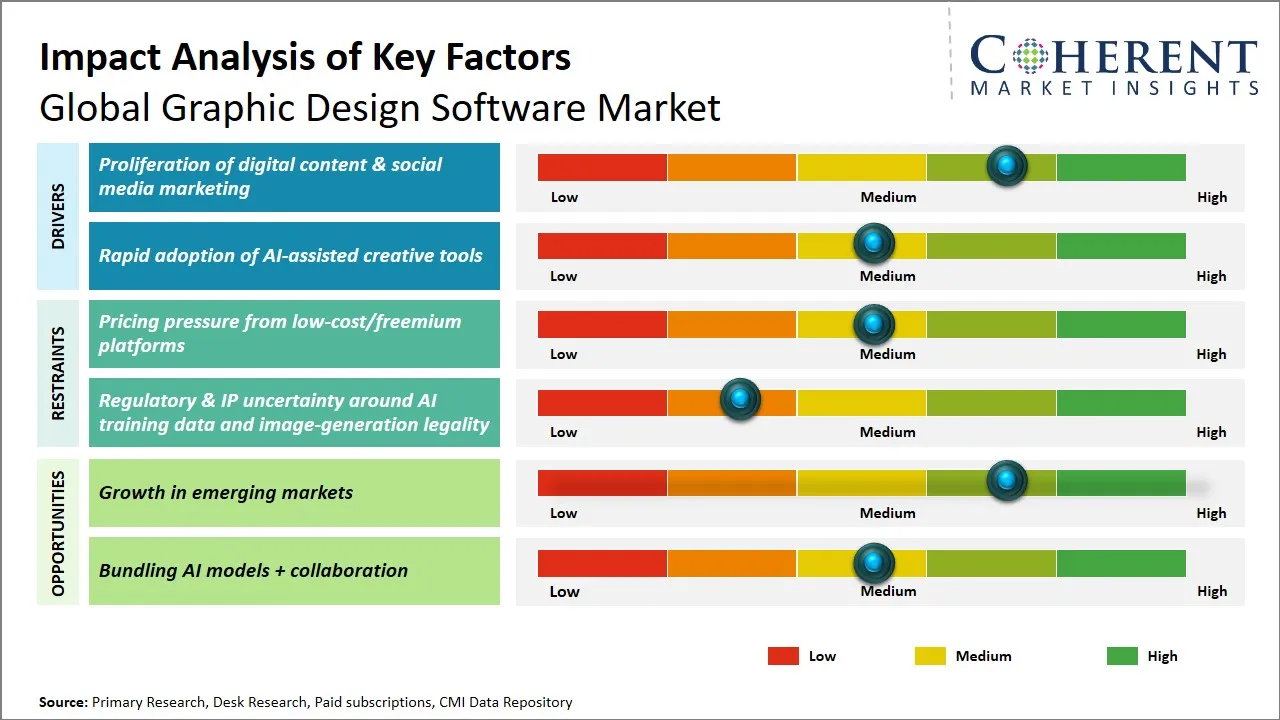
Global Graphic Design Software Market Driver - Proliferation of Digital Content & Social Media Marketing
As businesses and individuals increasingly rely on visually appealing and engaging content to capture the attention of their target audiences, the importance of creative tools that enable the production of high-quality graphics has grown exponentially. Social media marketing, in particular, has emerged as a dominant channel for brand communication and customer engagement, where the competition to stand out requires compelling visuals such as infographics, video thumbnails, advertisements, and branded posts.
In August 2025, Canva reported more than 180 million monthly active users, many of whom create Instagram posts, TikTok videos, and short-form marketing assets directly inside the platform. Furthermore, the rise in user-generated content across platforms amplifies the necessity for accessible yet powerful design tools, empowering even non-professional users to create visually striking content, thereby fueling the ongoing expansion and technological advancement of graphic design software offerings.
Global Graphic Design Software Market Opportunity – Growth in Emerging Markets
The expanding presence of digital infrastructure and increasing adoption of advanced technologies in emerging markets such as India, Brazil, Southeast Asia, and Africa present a significant growth opportunity for the global graphic design software market. These regions are witnessing rapid economic development, urbanization, and a burgeoning startup ecosystem, all of which fuel the demand for creative and marketing content. Moreover, improvements in internet penetration and smartphone usage in these regions enable wider access to cloud-based and subscription-based graphic design platforms.
Additionally, the growing young population, increasingly tech-savvy and inclined towards creativity-driven professions, further enhances market potential. Companies that adapt their product offerings to fit localized customer preferences, pricing sensitivities, and language requirements are better positioned to capture these emerging opportunities. Governments in these markets are also promoting digital literacy and creative skill development, which indirectly stimulates the demand for design software.
Analyst Opinion (Expert Opinion)
- The integration of large language and diffusion models—exemplified by Adobe Firefly’s partnership with Google’s Gemini 2.5 Flash Image model—is shifting design from manual creation to AI-assisted ideation. Tools that can instantly generate high-resolution images, layouts, and typography will increasingly define competitive advantage.
- Technologies pioneered by Figma’s browser-based, multiplayer editing architecture are setting new expectations for seamless collaboration. WebGL and WebAssembly advances enable full-featured design suites in the browser, reducing dependence on desktop-only software and allowing instant cross-device teamwork.
- Growing the demand for immersive experiences in gaming, retail, and marketing is pushing vendors to add 3D modeling and AR preview capabilities within traditional design tools. Features like Adobe’s Substance 3D and Corel’s expanding 3D asset libraries illustrate how AR/VR-ready workflows are becoming an essential complement to 2D graphic design.
Speak to the analyst
Want personalized insights?
Take the findings above to one of our principal consultants, or have the report rebuilt around the segments, geographies and competitors you actually track.
Market Segmentation
- Test Type Insights (Revenue, USD Bn, 2021 - 2033)
- Pixel Image Editors
- Vector Graphics Editors
- Template-driven Online Design Platforms
- UI/UX & Collaborative Product-design Tools
- Desktop Publishing
- Services & Other Niche Tools
- Regional Insights (Revenue, USD Bn, 2021 - 2033)
- North America
- U.S.
- Canada
- Latin America
- Brazil
- Argentina
- Mexico
- Rest of Latin America
- Europe
- Germany
- U.K.
- Spain
- France
- Italy
- Russia
- Rest of Europe
- Asia Pacific
- China
- India
- Japan
- Australia
- South Korea
- ASEAN
- Rest of Asia Pacific
- Middle East
- GCC Countries
- Israel
- Rest of Middle East
- Africa
- South Africa
- North Africa
- Central Africa
- North America
- Key Players Insights
- Adobe Inc.
- Canva Pty Ltd.
- Figma
- Corel
- Serif
- Sketch
- Inkscape
- VistaCreate
- PicMonkey
- Picsart
- Gravit
- Fotor
- Visme
- Creatopy
- Maxon
Sources
Primary Research Interviews
Stakeholders
- Senior Product Managers and UX Leads at leading design-software firms
- Independent Creative Agencies and Freelance Designers across North America, Europe, and APAC
- IT Procurement Managers at marketing and advertising enterprises using design suites
- Educators and Curriculum Developers at digital-media and design schools
- Cloud Infrastructure Providers supporting large-scale design collaboration platforms
- AI Research Scientists working on generative design tools and creative automation
Databases
- U.S. Patent and Trademark Office (USPTO) Filings on creative-software patents
- EUROSTAT ICT Sector Data
- United Nations Digital Economy Database
- OECD Digital Transformation Indicators
- Creative Commons Global Usage Data
Magazines
- Digital Creativity Today
- Graphic Arts Monthly
- UX & Visual Design Review
- Cloud & SaaS Innovator
Journals
- International Journal of Human–Computer Interaction
- Journal of Visual Communication and Design
- Computer Graphics Forum
- Journal of Creative Economy & Innovation
Newspapers
- The Design Observer
- TechTimes Global
- The Guardian (UK) – Technology Section
- The Economic Times (India) – IT & Startups
Associations
- International Council of Design (ico-D)
- Interaction Design Association (IxDA)
- World Federation of Advertising & Marketing Professionals (WFAMP)
- American Institute of Graphic Arts (AIGA)
- Asia-Pacific Designers’ Network (APDN)
Public Domain Sources
- U.S. Census Bureau – Digital Economy Indicators
- EUROSTAT – Information & Communication Sector Statistics
- World Bank – Global ICT Development Data
- UNESCO – Creative Industries Reports
- ResearchGate – Open Access design-technology papers
Proprietary Elements
- CMI Data Analytics Tool, Proprietary CMI Existing Repository of Information for the Last 8 Years
Get access to 250+ pages report
Every segment, forecast, competitor profile and data table behind the analysis above — available for instant download.
- ESOMAR Member
- ISO 9001:2015 Certified
- D-U-N-S Registered
- GDPR & CCPA Compliant
Missing comfort of reading report in your local language? Find your preferred language:
Transform your Strategy with Exclusive Trending Reports
Frequently Asked Questions
The global graphic design software market is estimated to be valued at USD 10.51 billion in 2026 and is expected to reach USD 19.59 billion by 2033.
The CAGR of the global graphic design software market is projected to be 9.3% from 2026 to 2033.
Proliferation of digital content & social media marketing and rapid adoption of AI-assisted creative tools are the major factors driving the growth of the global graphic design software market.
Pricing pressure from low-cost/freemium platforms and regulatory & IP uncertainty around AI training data and image-generation legality are the major factors hampering the growth of the global graphic design software market.
In terms of test type, the pixel image editors segment is estimated to dominate the market revenue share in 2026.
Generative-AI features like Adobe Firefly and Canva’s Magic Design automate complex tasks and attract new users.
Major customers include professional designers, marketing agencies, small businesses, and an expanding base of non-designers using template-driven tools.