

Global Hospital Equipment Leasing Market Size and Forecast – 2026 To 2033
The global hospital equipment leasing market is expected to grow from USD 81,127.2 Mn in 2026 to USD 326,190.0 Mn by 2033, registering a compound annual growth rate (CAGR) of 22% from 2026 to 2033. The market for hospital equipment leasing is poised for significant expansion, fueled by rising investments in healthcare infrastructure and the surging need for advanced medical equipment without considerable upfront capital expenditure.
According to the Organisation for Economic Co-operation and Development (OECD), in 2024, average health spending growth across OECD countries was estimated to be around 4%, while health spending represented 9.3% of gross domestic product (GDP) on average across OECD countries, reflecting sustained investments in healthcare systems and modernization initiatives that continue to drive the demand for equipment leasing solutions.
Key Takeaways of the Global Hospital Equipment Leasing Market
- X-ray machines are projected to hold 24.0 % of the global hospital equipment leasing market share in 2026, making it the dominant product segment across Europe due to stringent radiation safety regulations and continued modernization of diagnostic imaging infrastructure. For instance, the European Commission's Basic Safety Standards Directive (2013/59/Euratom) requires healthcare providers to optimize radiation protection and ensure the use of compliant imaging equipment, encouraging the replacement of older systems and supporting the demand for leased X-ray equipment.
- Long-term leases are projected to hold 67.5 % of the global hospital equipment leasing market share in 2026, making it the dominant duration of lease segment across North America due to the high capital cost of advanced imaging equipment and reimbursement-driven investment in compliant technologies. For instance, the Centers for Medicare & Medicaid Services (CMS) requires accreditation for suppliers of advanced diagnostic imaging services reimbursed under Medicare, encouraging healthcare providers to invest in high-value equipment through long-term financing models.
- Diagnostic equipment are projected to hold 46.0 % of the global hospital equipment leasing market share in 2026, making it the dominant application segment across Asia Pacific due to expanding diagnostic infrastructure and government-led healthcare modernization initiatives. For instance, India's Ayushman Bharat Pradhan Mantri Jan Arogya Yojana (PM-JAY) and the establishment of Ayushman Arogya Mandirs are strengthening diagnostic capacity across the country, driving the demand for advanced imaging and diagnostic equipment that is increasingly financed through leasing.
- North America maintains its dominance with an expected share of 34.5 % in 2026, bolstered by high healthcare expenditure, rapid adoption of advanced medical technologies, and continued investments in healthcare modernization. For instance, the government of Canada, through Canada Health Infoway, continues to invest in the modernization of diagnostic imaging and connected healthcare infrastructure, supporting the adoption of advanced medical equipment across healthcare facilities. These investments are expected to increase the demand for flexible financing models such as equipment leasing.
- Asia Pacific is expected to exhibit the fastest growth with an estimated contribution of 23.3 % share in 2026, driven by rapid healthcare infrastructure expansion, increasing public healthcare investments, and government initiatives to strengthen hospital capacity. For instance, under China's 14th Five-Year Plan (2021–2025), the government has prioritized the modernization of public hospitals, expansion of county-level healthcare infrastructure, and deployment of advanced medical equipment, creating significant opportunities for equipment leasing.
- Growing Adoption of Refurbished Medical Equipment: The growing adoption of refurbished medical equipment is creating new opportunities for hospital equipment leasing providers. Hospitals and diagnostic centers are increasingly leasing certified refurbished MRI, CT, X-ray, and ultrasound systems to reduce capital expenditure while maintaining access to reliable technologies. This trend is particularly gaining traction in emerging economies, where cost-effective healthcare infrastructure expansion is driving the demand for affordable leasing solutions.
- Increasing Demand for Hospital Beds: The increasing demand for hospital beds is creating significant growth opportunities for the global hospital equipment leasing market. Rising investments in hospital expansion, critical care capacity, and emergency preparedness are driving healthcare providers to lease hospital beds and related patient care equipment instead of purchasing them outright. Leasing offers greater financial flexibility while enabling hospitals to scale capacity in line with evolving patient demand.
Segmental Insights
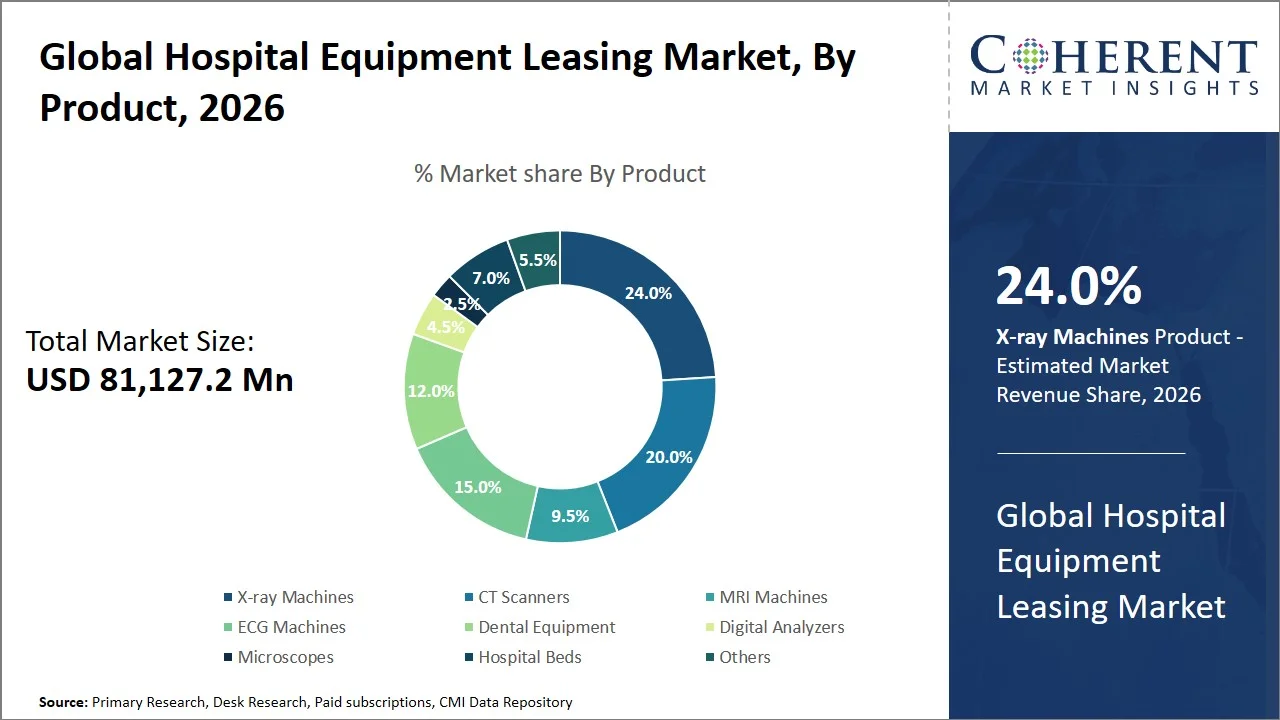
Why Do X-ray Machines Dominate the Global Hospital Equipment Leasing Market?
X-ray machines are projected to hold a market share of 24.0% in 2026, owing to their vast applicability across emergency medical facilities, orthopedics, pulmonology and general imaging departments. The high usage frequency, high technological evolution rate of these devices from analog to digital imaging systems and significant capital expenses for procurement further drives their preference towards leasing options. For instance, in October 2025, the U.S. Food and Drug Administration granted 510(k) clearance for a new mobile digital x-ray system, reflecting the ongoing innovation in the digital radiography market. The commercialization of new generations of X-ray systems is anticipated to speed up equipment replacement cycles, boosting the demand for hospital equipment leasing.
- Current Industry Events of 2026
- Market Size Estimation
- Regional Breakdown
- Competitive Landscape
- Customer Intelligence
- Segmental Analysis
- Pricing Analysis
- Key Market Drivers, Challenges & Future Trends
- Customized Insights Section
Why Do Long-term Leases Represent the Largest Duration of Lease Segment in the Hospital Equipment Leasing Market?
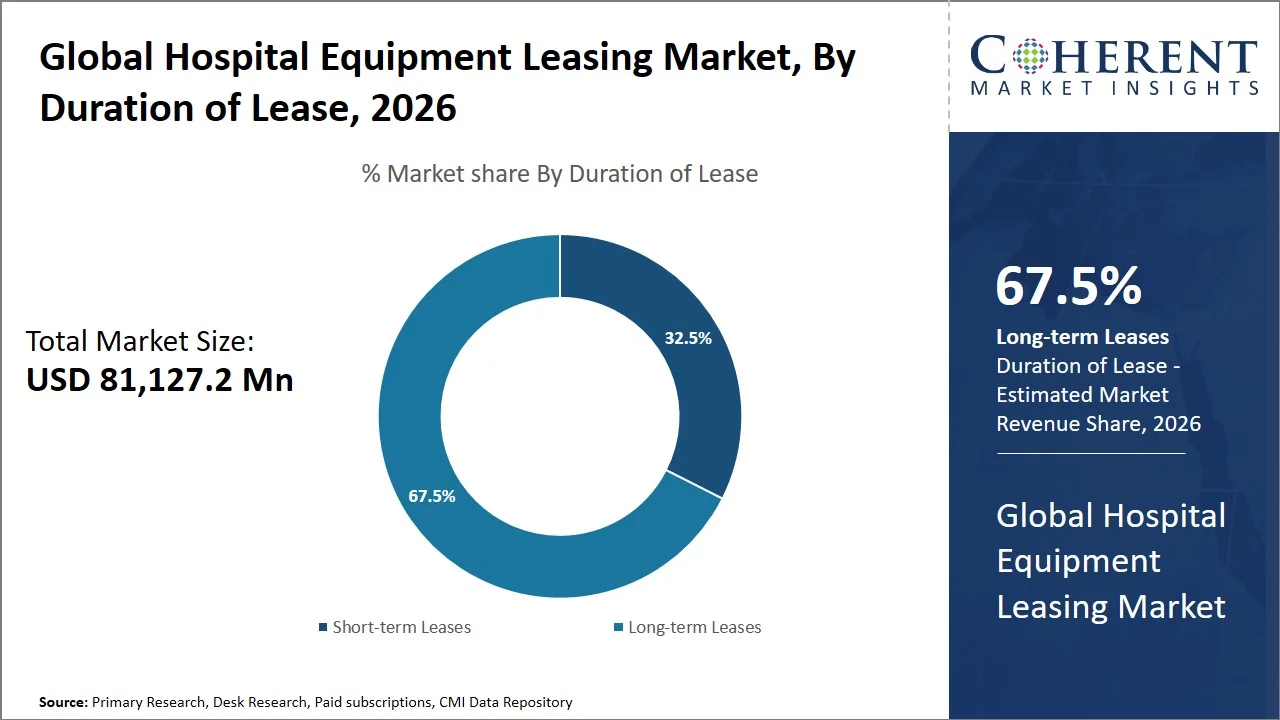
Long-term leases are projected to hold a market share of 67.5% in 2026, because they facilitate healthcare facilities to maintain a consistent payment model for long-term use of significant capital medical equipment. They are widely opted for patient monitoring, diagnostic and imaging, and surgical equipment where equipment is extensively used on a daily basis and requires long-term lifecycle management. For instance, in October 2024, the U.K. government announced a USD 2.0 billion (£1.5 billion) capital investment for new surgical hubs, diagnostic scanners, radiotherapy machines, and other National Health Services (NHS) equipment upgrades under the Autumn Budget 2024, reinforcing financing strategies and long-term procurement to support multi-year equipment leasing.
Diagnostic Equipment Segment Dominates the Global Hospital Equipment Leasing Market
The diagnostic equipment segment is projected to hold a market share of 46.0% in 2026, driven by the critical role of these devices in disease diagnosis, routine health screening, and clinical decision-making. High upfront costs of advanced medical imaging and laboratory equipment, coupled with rapid technological advancements, have encouraged healthcare providers to adopt leasing as a cost-effective procurement strategy. For instance, under Australia's 2024–25 budget, the government committed approximately USD 113 million (AUD 162.6 million), to reform Medicare-funded diagnostic imaging services by expanding MRI access, improving nuclear medicine imaging, and ensuring the sustainability of CT services, supporting sustained demand for advanced diagnostic equipment.
Currents Events and their Impact
Current Events | Description and its Impact |
European Commission Proposes Simplification of EU Medical Device Regulations (December 2025) |
|
U.S. FDA Quality Management System Regulation (QMSR) Becomes Effective (February 2026) |
|
Hospital Equipment Leasing Market Dynamics
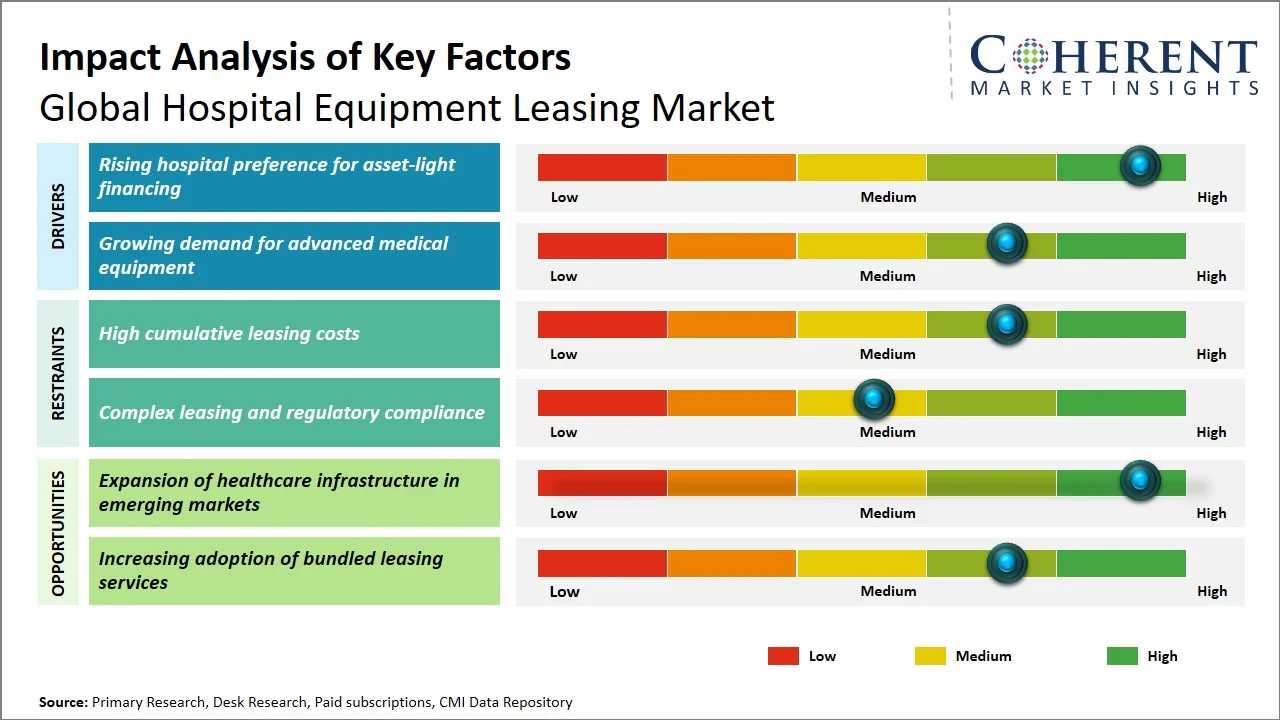
Market Drivers
- Rising hospital preference for asset-light financing: Hospitals are increasingly adopting asset-light financing models by leasing medical equipment instead of purchasing it outright, enabling them to preserve capital and improve financial flexibility. This approach allows healthcare providers to upgrade technologies more frequently while reducing the financial burden of equipment ownership. The trend is further supported by global initiatives such as the WHO Health Impact Investment Platform (HIIP), launched with multilateral development banks to mobilize over USD 1.5 billion for strengthening healthcare infrastructure through sustainable financing mechanisms.
- Growing demand for advanced medical equipment: To address the surging demand for state-of-the-art medical devices, health providers are leasing technologies in a bid to gain better access to new innovations at lower upfront investment costs. Increasing deployment of AI-enabled imaging systems, robotic-assisted surgical platforms, and advanced patient monitoring devices is further accelerating this trend. For instance, in January 2025, the U.S. Food and Drug Administration (FDA) issued draft guidance on AI-enabled medical devices to support the safe development and lifecycle management of AI-powered technologies, reinforcing the adoption of next-generation medical equipment across healthcare facilities.
Emerging Trends
- Expansion of Vendor-Managed Equipment Leasing Programs: Vendor managed lease arrangements allow healthcare providers to gain a comprehensive package including equipment, maintenance and upgrades all through one supplier agreement. This trend is simplifying procurement and providing better equipment lifecycle management through collaborations between the manufacturer and the financial institution.
- Growing Adoption of Usage-Based Leasing Models: Healthcare providers are increasingly adopting usage-based (pay-per-use) leasing models, where lease payments are linked to equipment utilization rather than fixed monthly installments. This flexible financing approach is gaining traction for high-value imaging and diagnostic equipment, helping hospitals optimize operating costs while improving access to advanced medical technologies.
Regional Insights
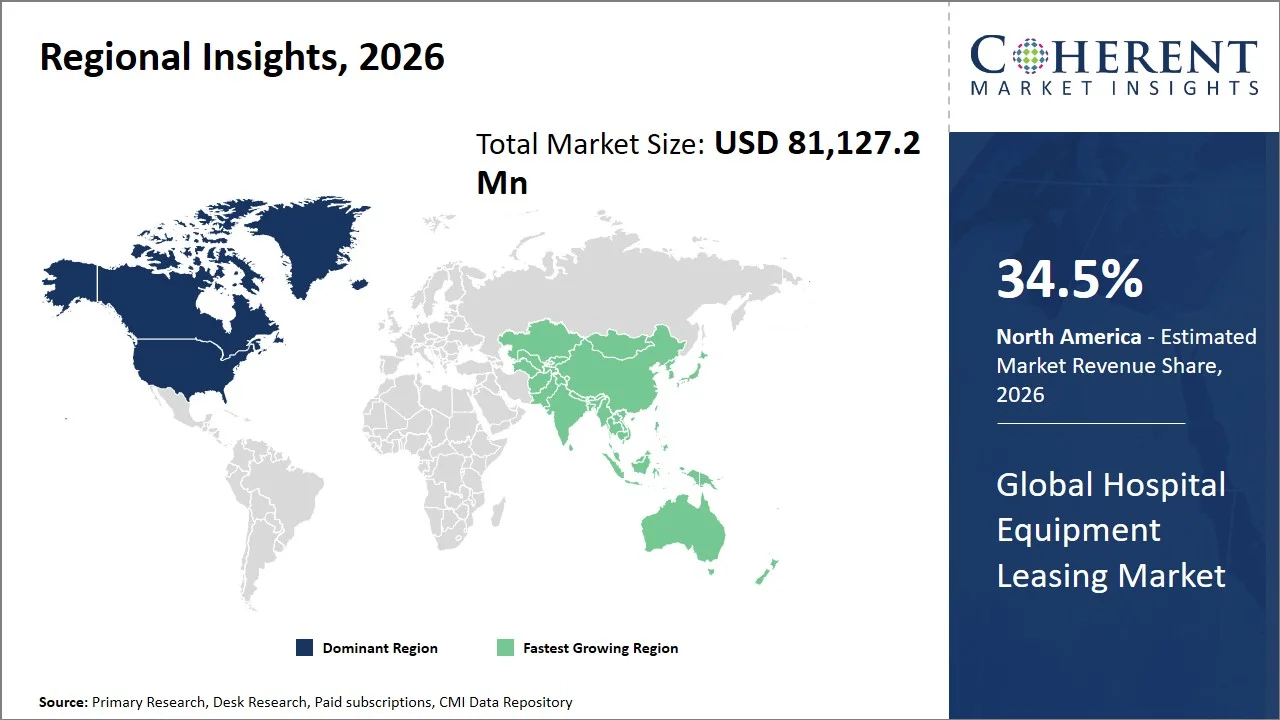
Why is North America a Strong Market for Hospital Equipment Leasing?
North America leads the global hospital equipment leasing market, accounting for an estimated 34.5% share in 2026, driven by highly established healthcare facilities and medical equipment financing, as well as increased usage of sophisticated medical equipment. Additionally, the region benefits from favorable government initiatives which encourage both improving access to health services and fostering investments in updated medical equipment, utilizing its programs with incentives like healthcare reimbursement and upgrades.
For instance, the U.S. Centers for Medicare & Medicaid Services (CMS) published its final rule for the CY 2025 Hospital Outpatient Prospective Payment System (OPPS), raising payment rates for hospital outpatient services and encouraging ongoing investments in cutting-edge medical equipment. Moreover, the advanced financial systems available in the market along with ongoing upgrades to hospital technology has encouraged the increased use of leases as an efficient acquisition method for hospitals.
Why Does the Asia Pacific Hospital Equipment Leasing Market Exhibit High Growth?
The Asia Pacific hospital equipment leasing market is expected to exhibit the fastest growth with an estimated contribution of 23.3% share to the global market in 2026, due to expanding healthcare infrastructure and soaring healthcare spending in the region. Many government initiatives and schemes implemented in various Asia Pacific countries encourage modern healthcare facility upgrades as well as public-private partnership (PPP) models for increasing access to quality healthcare.
For instance, administrative approvals for USD 3.85 billion (INR 33,081 crore) were granted under India’s Pradhan Mantri Ayushman Bharat Health Infrastructure Mission (PM-ABHIM) for the expansion of health infrastructure -critical care blocks, integrated public health labs, and health facilities-to enhance hospital equipment leasing opportunities. (Source: Press Information Bureau) Furthermore, rapid increase in healthcare spending in addition to expansion of diagnostic centers and hospitals is boosting the adoption of flexible leasing solutions.
Global Hospital Equipment Leasing Market Outlook for Key Countries
Why is the U.S. Leading Innovation and Adoption in the Hospital Equipment Leasing Market?
The U.S. dominates the hospital equipment leasing market due to the widespread adoption of technology refresh cycles among hospital technology decision makers and a thriving niche of specialty health care leasing companies. Hospitals are more actively pursuing integrated equipment leasing solutions bundled with software, maintenance, and ongoing management, thereby minimizing the total cost of ownership and providing reliable access to cutting-edge equipment.
Is Japan a Favorable Market for Hospital Equipment Leasing Market?
Japan is one of the most promising markets for the hospital equipment leasing market, due to its extensive portfolio of up-to-date medical equipment and the ongoing renewal of aging imaging and diagnostics units. Leased solutions allow hospitals and medical organizations to update equipment and control the total lifecycle costs of its devices, whilst keeping the equipment operational. Supported by Japan's well-developed medtech ecosystem and drive for modern solutions, the leasing demand will remain strong.
Is China Emerging as a Key Growth Hub for the Hospital Equipment Leasing Market?
China is positioned as a key growth hub in the global hospital equipment leasing market due to continued growth of public and private healthcare facility infrastructure and increased uptake of new age diagnostics and therapeutic devices. To cater to the evolving needs of the facilities and optimize capital expenditure, several hospitals (such as University of Vermont Health Network, Leeds Teaching Hospitals NHS Trust, and Royal Victoria Hospital Belfast) are leaning towards the leasing model for procuring advanced equipment and upgrading them periodically. The growing presence of domestic medical device manufacturers (such as Mindray Bio-Medical Electronics Co., Ltd., United Imaging Healthcare Co., Ltd., and Neusoft Medical Systems Co., Ltd) and expanding access to healthcare services are further strengthening the market's growth potential.
Why Does Germany Top the European Hospital Equipment Leasing Market?
Germany is the leader in the European market for hospital equipment leasing, attributed to the highest density of state-of-the-art healthcare infrastructure and widespread adoption of advanced diagnostic and surgical equipment. The leasing of medical devices has been embraced by healthcare institutions in order to renew aging medical equipment and improve the efficient usage of assets, while preserving the access to current generation technologies with minimal capital outlay. Germany's robust medical technology sector and healthcare financing market are expected to sustain the demand for hospital equipment leasing.
Is the Hospital Equipment Leasing Market Developing in India?
India is a high-potential market for hospital equipment leasing driven by the increasing establishment of multispecialty hospitals, secondary and specialty healthcare centers and diagnostic imaging centers. Rising preference for hospital equipment leasing is witnessed across India as it helps healthcare providers acquire sophisticated imaging equipment, surgical equipment and life-saving critical care equipment with lower capital expenditure upfront. Higher involvement of the private sector and the continued need for upgradation of technology are further accelerating the adoption of leasing solutions across the country.
Evolution of Leasing Models in the Global Hospital Equipment Leasing Market
Leasing Model | Key Features | Primary Equipment | Market Impact |
Operating Lease | Low upfront cost; equipment returned at lease end | X-ray, Ultrasound, ECG | Improves financial flexibility |
Finance Lease | Ownership option at lease expiry | MRI, CT, PET-CT | Preferred for high-value assets |
Equipment-as-a-Service (EaaS) | Bundles maintenance, software upgrades, and lifecycle management | AI imaging, patient monitoring | Accelerates technology adoption |
Pay-per-Use Leasing | Payments based on equipment utilization | MRI, CT, Robotic Surgery | Reduces financial risk for low-volume facilities |
Refurbished Equipment Leasing | Certified pre-owned equipment with maintenance support | MRI, CT, X-ray | Expands affordability in emerging markets |
How is the expansion of healthcare infrastructure in emerging markets creating new growth opportunities in the hospital equipment leasing market?
The proliferation of healthcare infrastructure in the emerging economies present substantial opportunity to leasing hospital equipment globally. As the expenditure in healthcare centers & clinics grows, the demand for modern hospital equipment is steadily picking up pace, thus enabling healthcare providers to adopt leasing models to reduce upfront capital costs. For instance, in October 2025, Asian Development Bank (ADB) approved the policy-based loan of USD 500 million for the reform and transformation of the healthcare sector in Indonesia, focusing on strengthening healthcare infrastructure and expanding access to quality medical services. It is anticipated that these investments are expected to accelerate the adoption of leased medical equipment across newly developed healthcare facilities.
Market Players, Key Development, and Competitive Landscape
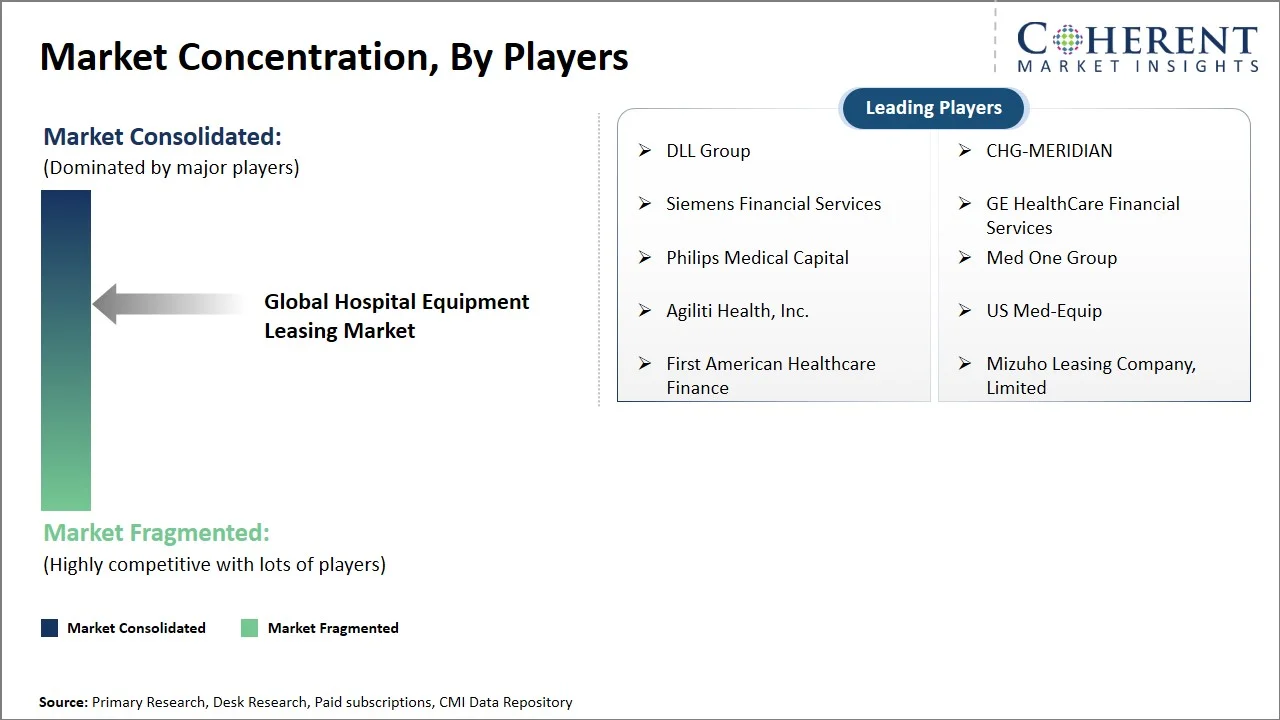
Key Developments
- In January 2026, Antin Infrastructure Partners agreed to acquire Emsere, a global provider of clinical trial medical equipment rental and logistics solutions. Emsere manages a portfolio of over 13,000 medical devices and serves pharmaceutical companies and contract research organizations across more than 100 countries. The acquisition reflects increasing investment in specialized medical equipment leasing platforms, driven by growing demand for flexible, capital-efficient access to mission-critical healthcare equipment.
- In September 2025, Fortis Healthcare, through its wholly-owned subsidiary, International Hospital Limited (IHL), entered into a 15-year lease agreement with R.R. Lifesciences Limited for a fully operational 200-bed multi-specialty hospital in Greater Noida in India. The agreement covers the hospital land, building, and medical equipment, enabling Fortis Healthcare to assume full operational and financial control while following an asset-light expansion strategy.
Competitive Landscape
The global hospital equipment leasing moderately consolidated, with competition centered on expanding equipment portfolios, offering flexible financing solutions, and strengthening long-term partnerships with healthcare providers. Market participants are increasingly focusing on digital lease management platforms, value-added lifecycle services, and customized financing options to differentiate their offerings while supporting hospitals' transition toward asset-light procurement models. Key focus areas include:
- Expansion of leasing portfolios for high-value diagnostic imaging, surgical, and patient monitoring equipment.
- Development of flexible financing models, including operating leases, finance leases, and equipment-as-a-service (EaaS) offerings.
- Strategic partnerships with hospitals, OEMs, and financial institutions to strengthen market presence and customer reach.
- Integration of digital asset management, predictive maintenance, and lifecycle support services to enhance equipment utilization and customer retention.
- Geographic expansion into emerging markets through localized financing solutions and healthcare infrastructure partnerships.
Market Report Scope
Hospital Equipment Leasing Market Report Coverage
| Report Coverage | Details | ||
|---|---|---|---|
| Base Year: | 2025 | Market Size in 2026: | USD 81,127.2 Mn |
| Historical Data for: | 2020 To 2024 | Forecast Period: | 2026 To 2033 |
| Forecast Period 2026 to 2033 CAGR: | 22% | 2033 Value Projection: | USD 326,190.0 Mn |
| Geographies covered: |
| ||
| Segments covered: |
| ||
| Companies covered: | DLL Group, CHG-MERIDIAN, Siemens Financial Services, GE HealthCare Financial Services, Philips Medical Capital, Med One Group, Agiliti Health, Inc., US Med-Equip, First American Healthcare Finance, and Mizuho Leasing Company, Limited | ||
| Growth Drivers: |
| ||
| Restraints & Challenges: |
| ||
Analyst Opinion (Expert Opinion)
- In the coming years, the global hospital equipment leasing market is expected to witness substantial growth as healthcare providers increasingly shift toward asset-light financing models to manage rising equipment costs and accelerate technology adoption. Growing investments in digital healthcare, AI-enabled diagnostic systems, and hospital modernization are expected to further strengthen the demand for leasing solutions, particularly for high-value medical equipment.
- The maximum opportunities will probably exist within diagnostic equipment segment, particularly X-ray machines and CT scanners, across Asia Pacific, especially India and China. Rapid expansion of healthcare infrastructure, increasing government investments in public hospitals, and rising demand for advanced diagnostic services are expected to drive leasing adoption in these markets.
- In order to obtain a competitive advantage, market participants should expand OEM partnerships, offer flexible leasing models such as equipment-as-a-service (EaaS) and pay-per-use financing, and strengthen digital asset management and predictive maintenance capabilities. Additionally, expanding portfolios of refurbished medical equipment and establishing localized financing solutions in emerging markets will help companies capture a broader customer base and improve long-term competitiveness.
Speak to the analyst
Want personalized insights?
Take the findings above to one of our principal consultants, or have the report rebuilt around the segments, geographies and competitors you actually track.
Market Segmentation
- Product Insights (Revenue, USD Mn, 2021 - 2033)
- X-ray Machines
- CT Scanners
- MRI Machines
- ECG Machines
- Dental Equipment
- Digital Analyzers
- Microscopes
- Hospital Beds
- Others
- Duration of Lease Insights (Revenue, USD Mn, 2021 - 2033)
- Short-term Leases
- Long-term Leases
- Application Insights (Revenue, USD Mn, 2021 - 2033)
- Diagnostic Equipment
- Therapeutic Equipment
- Others
- Regional Insights (Revenue, USD Mn, 2021 - 2033)
- North America
- U.S.
- Canada
- Latin America
- Brazil
- Argentina
- Mexico
- Rest of Latin America
- Europe
- Germany
- U.K.
- Spain
- France
- Italy
- Russia
- Rest of Europe
- Asia Pacific
- China
- India
- Japan
- Australia
- South Korea
- ASEAN
- Rest of Asia Pacific
- Middle East
- GCC Countries
- Israel
- Rest of Middle East
- Africa
- South Africa
- North Africa
- Central Africa
- North America
- Key Players Insights
- DLL Group
- CHG-MERIDIAN
- Siemens Financial Services
- GE HealthCare Financial Services
- Philips Medical Capital
- Med One Group
- Agiliti Health, Inc.
- US Med-Equip
- First American Healthcare Finance
- Mizuho Leasing Company, Limited
Sources
Primary Research Interviews
- Hospital chief financial officers (CFOs) and procurement directors responsible for capital equipment acquisition
- Biomedical engineering and clinical engineering managers from hospitals and healthcare systems
- Executives from hospital equipment leasing companies and medical equipment financing providers
- Product managers and sales directors from medical device OEMs (diagnostic imaging, patient monitoring, surgical equipment)
- Healthcare consultants specializing in hospital asset management and capital planning
- Hospital administrators and supply chain managers from multispecialty hospitals and diagnostic centers
Stakeholders
- Hospital equipment leasing companies and medical equipment financing providers
- Medical device manufacturers (OEMs)
- Banks, financial institutions, and captive finance companies
- Healthcare distributors and group purchasing organizations (GPOs)
- End-use Sectors
- Hospitals and health systems
- Diagnostic imaging centers
- Ambulatory surgery centers (ASCs)
- Specialty clinics
- Diagnostic laboratories
- Long-term care and rehabilitation facilities
- Regulatory & Health Bodies
- U.S. Food and Drug Administration (FDA)
- Centers for Medicare & Medicaid Services (CMS)
- European Commission (Medical Devices)
- European Medicines Agency (EMA)
- Pharmaceuticals and Medical Devices Agency (PMDA), Japan
- National Medical Products Administration (NMPA), China
Databases
- FDA Medical Device Registration and Listing Database
- FDA 510(k) Premarket Notification Database
- CMS Healthcare Cost Report Information System (HCRIS)
- OECD Health Statistics
- World Bank Open Data
- WHO Global Health Observatory (GHO)
Magazines
- Healthcare Purchasing News
- Medical Design & Outsourcing
- Health Facilities Management (HFM)
- Medical Device Network
- Healthcare Finance News
- Hospital Management
Journals
- Journal of Healthcare Management
- BMJ Health & Care Informatics
- Journal of Medical Systems
- International Journal of Health Planning and Management
- Journal of Healthcare Engineering
Newspapers
- The Wall Street Journal
- Financial Times
- The Economic Times
Associations
- American Hospital Association (AHA)
- Healthcare Financial Management Association (HFMA)
- Medical Device Manufacturers Association (MDMA)
- Advanced Medical Technology Association (AdvaMed)
- European Hospital and Healthcare Federation (HOPE)
- Asia Pacific Medical Technology Association (APACMed)
Public Domain Sources
- World Health Organization (WHO) – Medical Devices and Health Technologies
- Organisation for Economic Co-operation and Development (OECD) – Health Statistics & Health at a Glance
- World Bank – Health Expenditure and Healthcare Infrastructure Indicators
- U.S. Food and Drug Administration (FDA) – Medical Devices
- Centers for Medicare & Medicaid Services (CMS) – Hospital Payment and Quality Programs
- European Commission – Medical Devices Regulation (MDR) and In Vitro Diagnostic Regulation (IVDR)
Proprietary Elements
- CMI Data Analytics Tool, Proprietary CMI Existing Repository of information for last 10 years.
Get access to 250+ pages report
Every segment, forecast, competitor profile and data table behind the analysis above — available for instant download.
- ESOMAR Member
- ISO 9001:2015 Certified
- D-U-N-S Registered
- GDPR & CCPA Compliant
Missing comfort of reading report in your local language? Find your preferred language:
Transform your Strategy with Exclusive Trending Reports
Frequently Asked Questions
The global hospital equipment leasing market is estimated to be valued at USD 81,127.2 Mn in 2026 and is expected to reach USD 326,190.0 Mn by 2033.
X-ray machines dominate due to their widespread use across hospitals and diagnostic centers, lower acquisition cost compared to MRI and CT systems, and frequent replacement with digital imaging technologies.
Hospital equipment leasing is a financing arrangement that enables healthcare providers to use medical equipment for a specified period through periodic lease payments instead of purchasing it outright.
The CAGR of the global hospital equipment leasing market is projected to be 22% from 2026 to 2033.
An operating lease allows healthcare providers to use medical equipment without ownership, with the lessor retaining ownership and often providing maintenance and upgrade services.
Hospital equipment leasing enables healthcare providers to periodically upgrade to newer medical technologies, reducing equipment obsolescence while ensuring continued access to advanced diagnostic and therapeutic systems.
Rising hospital preference for asset-light financing, and growing demand for advanced medical equipment are the major factors driving the growth of the global hospital equipment leasing market.