

India Asset Tokenization Market Size and Forecast – 2026-2033
The India asset tokenization market is estimated to be valued at USD 133.5 Mn in 2026 and is expected to reach USD 245.7 Mn by 2033, exhibiting a compound annual growth rate (CAGR) of 9.1% from 2026 to 2033.
Key Takeaways of the India Asset Tokenization Market
- The real estate segment is expected to account for 31.2 % of the India asset tokenization market share in 2026.
- The blockchain networks segment is projected to hold 35.8 % of the market share in 2026.
- The institutional investors segment is estimated to hold 23.8 % of the asset tokenization market share in 2026.
Market Overview
One of the most notable tendencies of the India asset tokenization market is the growing interest of institutional investors and regulatory facilitation of the establishment of tokenized assets into regular finance. Smart contracts and decentralized finance (DeFi) platforms are innovating to provide a secure and efficient operation. Moreover, the other industry, e.g., real estate, commodities, are also actively implementing the concept of tokenization, which only increases the market growth and promotes the emergence of new investment opportunities.
Current Events and Its Impact
Current Events | Description and its Impact |
SEBI frameworks for on-chain securities experiments and sandbox expansion |
|
AA-framework and CKYC upgrades for investor onboarding |
|
Segmental Insights
- Current Industry Events of 2026
- Market Size Estimation
- Regional Breakdown
- Competitive Landscape
- Customer Intelligence
- Segmental Analysis
- Pricing Analysis
- Key Market Drivers, Challenges & Future Trends
- Customized Insights Section
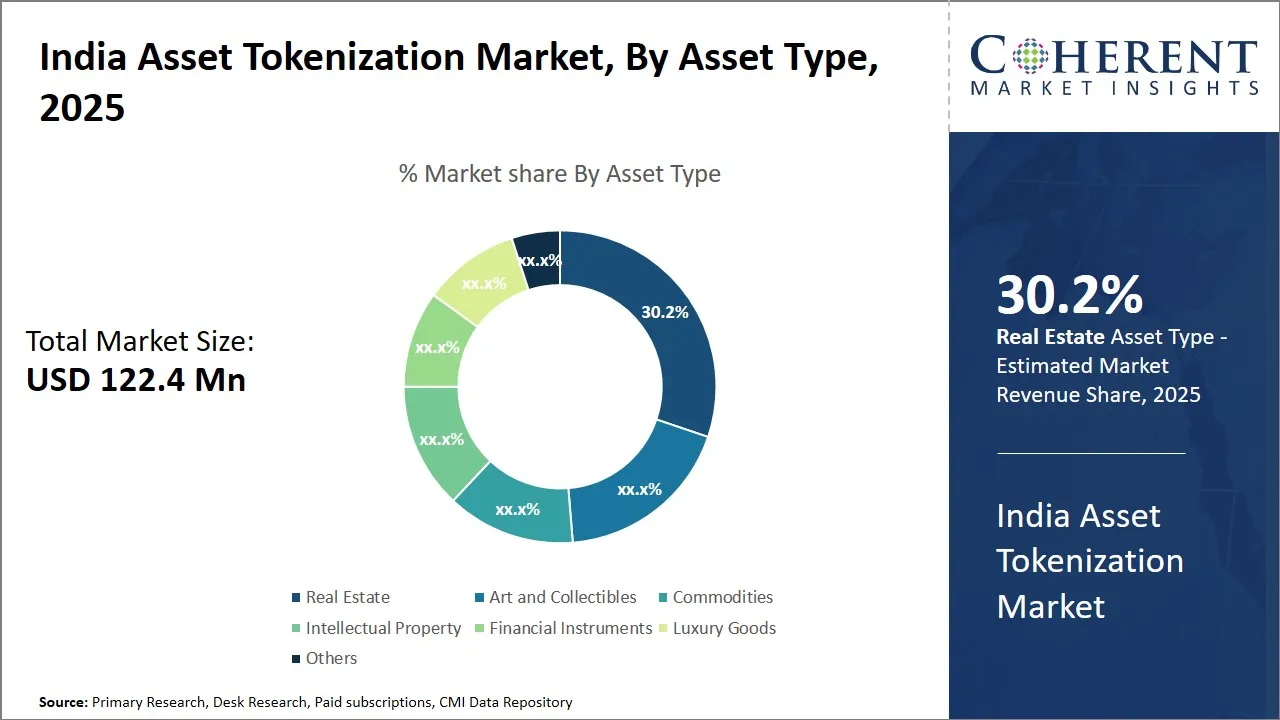
India Asset Tokenization Market Insights, By Asset Type - Real Estate Segment Dominates the Market Primarily Driven by its Strong Suitability for Tokenization and the Substantial Value Tied Up in Physical Assets
Real estate segment is expected to command 31.2% of the India asset tokenization market share in 2026. This eminence is driven by various inherent features and market forces that drive real estate tokenization to be ahead of other asset classes. A traditionally illiquid and capital-intensive asset, real estate gains multiple advantages through tokenization which improves its liquidity, fractional ownership, and transparency.
Democratization of investment opportunities is one of the key factors that would lead to the dominance of real estates. The tokenization process divides high-value assets into small, affordable units and allows retail investors and other small-scale institutional investors to access a segment of the market that has traditionally been the domain of highly-net-worth individuals or large institutions. This partial ownership greatly reduces the entry barriers extending the investor base and hastens the inflow of capital into the sector.
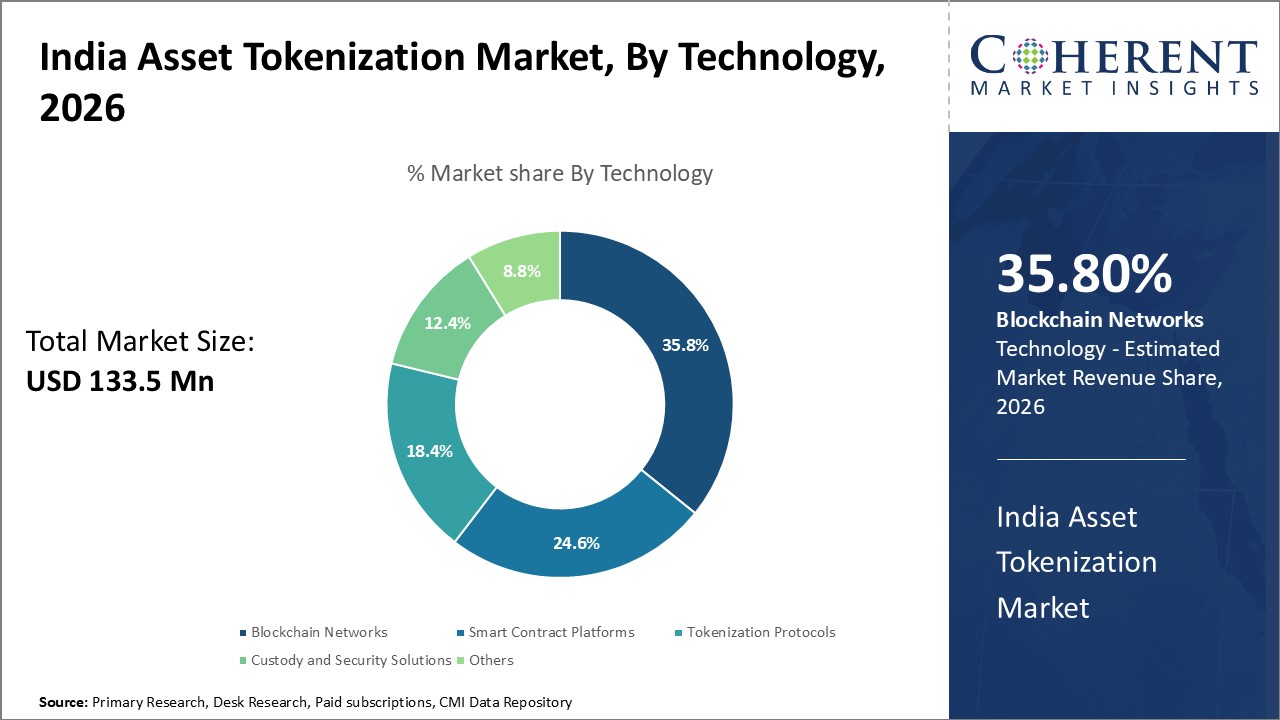
India Asset Tokenization Market Insights, By Technology - Blockchain Networks Segment Dominates the Market due to Backbone of Tokenization Technologies
Blockchain networks segment is projected to hold 35.8% of the market share in 2026 as it is central to the growth and stability of the ecosystems. Assets rely on blockchain networks as the cornerstone of infrastructure upon which asset tokens can be issued, transferred and validated, which is sufficient to make asset tokenization a successful endeavor. The main force behind the adoption of blockchain network is its in-built potential to provide decentralized, secure, and transparent ledgers.
Blockchain provides a secure system that prevents fraud and the probability of forgery in a market within a tainted system of trust to readily document the ownership of assets and past transactions; thus, eliminating a major pain point in the current asset management procedure.
India Asset Tokenization Market Insights, By End User - Institutional Investors Segment is Leading due to Engagement in Asset Tokenization
Institutional investors segment is expected to constitute 24.8% of the India asset tokenization market share in 2026, which is growing due to the preference of the innovation and diversification of asset management strategy. Their overwhelming power is motivated by the special benefits tokenization has in portfolio building, risk management, and capital efficiency.
The potential to unlock the liquidity of otherwise liquidity-illiquid investments, including in the context of private equity, infrastructure funds, and real estate, is one of the key forces that influence the institutional interest. Institutions handle large-scale portfolios and need to be flexible to change the exposure as the asset tokenization of the assets offers the possibility to enter and exit faster and achieve a more agile portfolio.
Regulatory Landscape & Compliance Pointers
- SEBI regulates of tokenized assets held in the form of investment trust products (e.g., SM REIT, fractional ownership), with platforms allowed to run only within approved structures as a way of safeguarding retail and institutional investors.
- The GIFT City sandbox, the IFSCA, offers a low-scale regulatory testing platform and is developing full tokenization-focused guidelines to cover the legal legitimacy, risk management and compliance of smart contracts.
- The tokenized asset protocols, which interface with traditional finance and fiat settlement, are monitored by RBI, including anti-money laundering (AML), Know Your Customer (KYC), and systemic risk requirements.
- There is no specific statue on asset tokenization at the moment, and as such, platforms need to adhere to the current rules of the securities act, trust, and digital asset law any bypass of SEBIs perimeter might attract enforcement action.
- Institutional grade platforms should have end to end connectivity with any legacy banking and custody system, have automated compliance gateways and a transparent audit trail, to meet operational and regulatory due diligence.
Key Cybersecurity & Custody Risk Metrics
- Security of a Private Key: Tests the strength of privacy keys, like, multi-sign wallets and hardware security module (HSM) and cold storage protocols, to ensure that the key is stolen or compromised.
- Smart Contract Audits: Frequency and quality of third-party audits on smart contracts, which guarantees the integrity of written code and reduces vulnerabilities potentially exploited to cause an exploit or asset loss.
- Network Security: Evaluation of blockchain network resistance to threats like 51% attack, Sybil attack, and routing attack, like consensus mechanism strength and diversity of nodes.
- Custody Controls: Assessment of custody solutions, such as segregation of duties, multi-party computation (MPC), and insurance cover against digital assets in custody.
- Incident Response and Recovery: Measures on the detection of incidents, response, and recovery strategy on breaches, hacks, or system failure, such as regular exercises in disaster recovery.
Market Players, Key Development, and Competitive Intelligence
Key Development
- In June 2025, Canton Blockchain raised USD 135 Mn to tokenize real-world assets. Digital Asset, the enterprise blockchain company behind the Canton Network, has raised USD 135 Mn as strategic funding to expedite the process of adopting its privacy-aware infrastructure to real-world assets (RWAs). According to the CMC News, the venture financing was co-led by DRW Venture Capital and TradeWeb Markets and it was supported by financial giants such as BNP Paribas, Circle Ventures, Citadel Securities, and the Depository Trust and Clearing Corporation (DTCC).
Top Strategies Followed by India Asset Tokenization Market Players
- The presence of competition in the market introduces significant competitive actions by the established players whose priority is making huge investment in research and development (R&D), in order to propel innovation in the development of high-performance and secure tokenization products. These market leaders are interested in building strong platforms that are transparent, scalable and meet regulatory requirements which is imperative in winning the confidence of institutional investors and regulatory authorities.
- For example, the institutional/regulatory compatibility is reflected in the GIFT City sandbox structure of the International Financial Services Centres Authority (IFSCA) that facilitates regulated real-estate tokenization through Terazo and Tokeny of a development project of approximately USD 50 Mn.
- The strategy taken by mid-level players in the India asset tokenization market is slightly different but effective as the players consider the middle ground between quality and affordability. These are companies that serve mostly price-sensitive users who want to receive secure tokenization services without the high price mark that is typically attached to high-end platforms. Mid-level players cut out a larger market niche by differentiating their offerings to offer core functionalities and adequate levels of security at reasonable charges.
- An example of a start-up would be Spydra Technologies, which provides Indian businesses with a low-code asset tokenization platform with an emphasis on faster go-to-market and reduced cost.
- The small-scale participants in the India asset tokenization ecosystem can be described as niche innovators that specialize in features or very novel products that are tailored to the demands of a particular market. Their lightsomeness enables them to implement the latest technologies like blockchain improvement, AI-based analytics, or decentralized finance (DeFi) sequences to make their solutions stand out of giant competitors.
- For example, firms like Spydra (once again) offer multi-industry applications (supply-chain, IP, carbon credits) and plug-and-play blockchain modules.
Market Report Scope
India Asset Tokenization Market Report Coverage
| Report Coverage | Details | ||
|---|---|---|---|
| Base Year: | 2025 | Market Size in 2026: | USD 133.5 Mn |
| Historical Data for: | 2020 To 2024 | Forecast Period: | 2026 To 2033 |
| Forecast Period 2026 to 2033 CAGR: | 9.1% | 2033 Value Projection: | USD 245.7 Mn |
| Segments covered: |
| ||
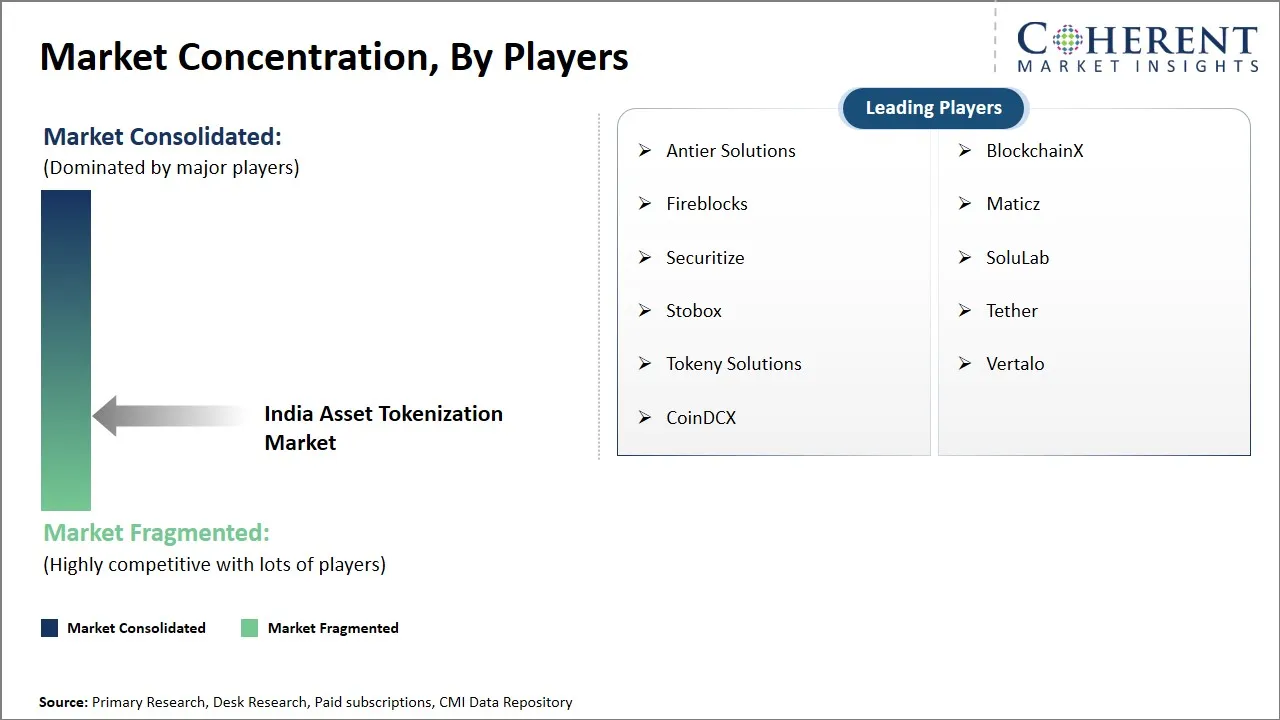
| Companies covered: | Antier Solutions, BlockchainX, Fireblocks, Maticz, Securitize, SoluLab, Stobox, Tether, Tokeny Solutions, Vertalo, and CoinDCX | ||
| Growth Drivers: |
| ||
| Restraints & Challenges: |
| ||
India Asset Tokenization Market Dynamics
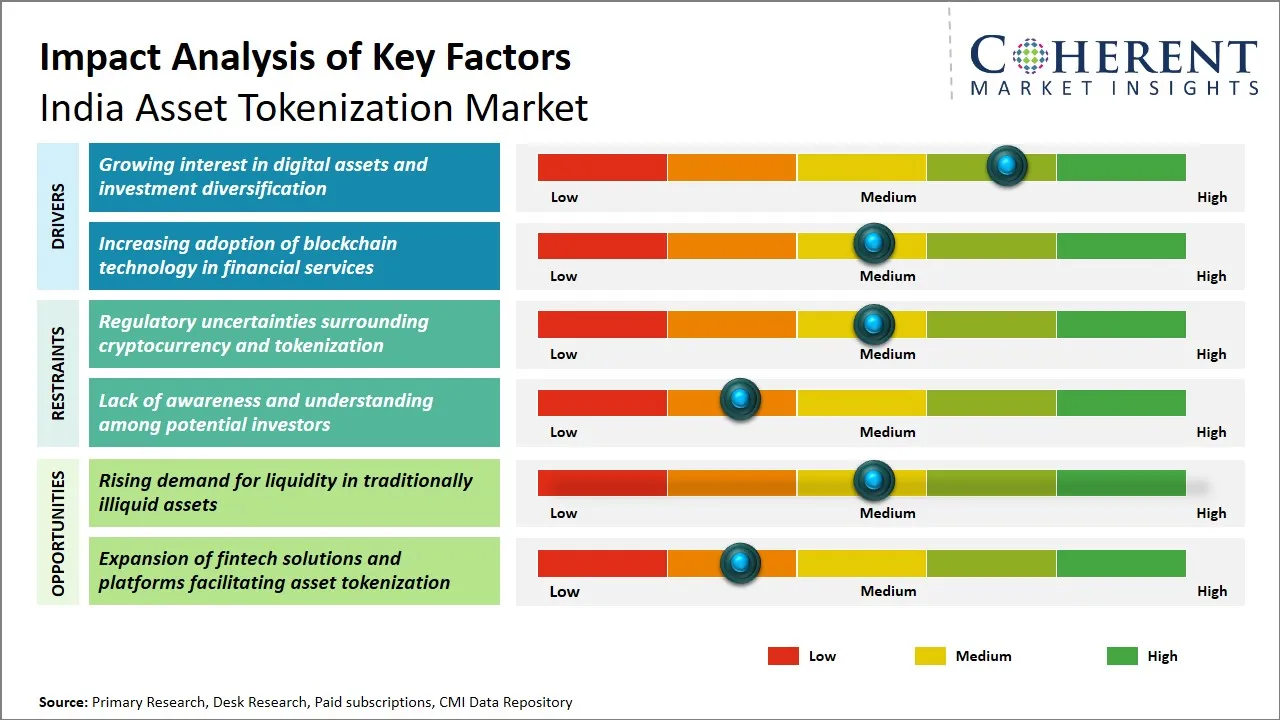
India Asset Tokenization Market Driver - Growing Interest in Digital Assets and Investment Diversification
The increase in interest in digital assets among Indian investors is a major factor that is causing the Indian country to adopt asset tokenization. Due to the current uncertainties experienced in the traditional investment avenues due to challenges like volatility and limited accessibility, investors are turning to available alternatives that are offering greater flexibility in terms of liquidity, transparency and fractional ownership. Asset tokenization will allow a blockchain-based depiction of physical assets, by permitting investors to diversify their portfolios beyond conventional assets such as equities and fixed deposits. This movement can be driven by a wider adoption and acceptance of cryptocurrencies and blockchain technology in India, along with regulatory clarity being born of digital assets.
As an illustration, a report by Infosys reports that tokenization of real-estate and art assets in India offers fractional ownership and enhanced accessibility, thereby demonstrating the eagerness to diversify by the investors beyond equity/fixed-income.
India Asset Tokenization Market Opportunity - Rising Demand for Liquidity in Traditionally Illiquid Assets
The market of India asset tokenization will enjoy a tremendous growth due to the rising liquidity requirements in traditionally illiquid assets, which is a significant growth prospect. In the past, real estate, fine art, and private equity as well as infrastructure projects have been difficult to trade because they are highly entry-barred, thickly-traded, and are not readily available. The concept of tokenization converts these assets into tokens on blockchain platforms, which allows them to be made in fractional ownership and can be easily transferred. The innovation enables investors to purchase, sell or trade shares of high value assets faster and at reduced transaction costs essentially opening up capital that is locked in illiquid holdings. In a market such as India where diversification of wealth is gaining the foremost significance among institutional and retail investors, the capacity of changing illiquid assets to liquid and tradable tokens improves the flexibility of portfolio and the handling of risk.
Sandbox assets In India, tokenization of the real estate infrastructure in the GIFT City (IFSC) has been given the green light by the IFSCA Expert Committee on Asset Tokenization in Gujarat. This gives us a working window into the manner in which illiquid assets can be made available and availed.
Analyst Opinion (Expert Opinion)
- The India asset tokenization market will grow at a high rate and this is based on the observation that there is the growing use of blockchain technology and the liquidity requirement of traditionally illiquid assets. The India Blockchain Forum (2023) and Digital Assets Conference (2022) also shed some light on the key progress, and such companies as WazirX and Kishore Biyanis Future Group are considering new models of tokenization of real estate and financial assets. The recent introduction of a platform that allows fractional ownership of real estate as tokens that is being introduced by WazirXs resonates with the response of the market to the need of consumers to have easy access to investment opportunities.
- The regulatory background and compliance were discussed at these conferences, as the stakeholders want to know more about the legal implications related to tokenized assets. Nevertheless, the volatility of the market and the necessity to have strong cybersecurity tools were often mentioned as obstacles on the way to wider usage.
- The companies that are oriented to the establishment of partnerships with financial institutions and increased user education about the advantages of tokenization will probably obtain a bigger market share. Finally, the development of the market of India asset tokenization will rely on its capability to create something new tackling regulatory dilemmas and instilling confidence in the investor in a fast-changing digital environment.
Speak to the analyst
Want personalized insights?
Take the findings above to one of our principal consultants, or have the report rebuilt around the segments, geographies and competitors you actually track.
Market Segmentation
- Asset Type Insights (Revenue, USD Mn, 2021 - 2033)
- Real Estate
- Art and Collectibles
- Commodities
- Intellectual Property
- Financial Instruments
- Luxury Goods
- Others
- Technology Insights (Revenue, USD Mn, 2021 - 2033)
- Blockchain Networks
- Smart Contract Platforms
- Tokenization Protocols
- Custody and Security Solutions
- Others
- End User Insights (Revenue, USD Mn, 2021 - 2033)
- Institutional Investors
- Retail Investors
- Asset Managers
- Fundraisers and Issuers
- Others
- Key Players Insights
- Antier Solutions
- BlockchainX
- Fireblocks
- Maticz
- Securitize
- SoluLab
- Stobox
- Tether
- Tokeny Solutions
- Vertalo
- CoinDCX
Sources
Primary Research Interviews
- Blockchain Technology Head – Leading Financial Institution in India
- Regulatory Affairs Manager – Securities and Exchange Board of India (SEBI)
- Product Development Lead – Indian FinTech Startup specializing in Asset Tokenization
- Legal Advisor – Corporate Law Firm specializing in Digital Assets and Securities
Stakeholders
- Financial Institutions
- Regulatory Bodies (SEBI, RBI)
- Technology Providers (Blockchain and Smart Contract Developers)
- Real Estate and Infrastructure Companies (as asset owners)
- Institutional and Retail Investors
- Legal and Compliance Experts
Databases
- Securities and Exchange Board of India (SEBI) Database
- Reserve Bank of India (RBI) Financial Data Repository
- India Ministry of Corporate Affairs (MCA) Registry Data
- National Stock Exchange (NSE) and Bombay Stock Exchange (BSE) Market Data
- Indian Blockchain and Crypto Asset Market Reports by industry analysts
Magazines
- India FinTech Journal – Trends in tokenization and digital assets
- Economic & Political Weekly – Financial market innovations in India
- Blockchain India – Developments in blockchain for asset management
- Digital Finance India – Regulatory updates on digital assets and securities
Journals
- Indian Journal of Finance – Studies on digital securities and market impact
- Journal of Emerging Technologies in Finance – Tokenization technologies and applications
- International Journal of Blockchain and Cryptocurrency – Research on asset tokenization
- Journal of Digital Economy – Economic implications of asset tokenization in India
Newspapers
- The Economic Times – News and insights on India’s asset tokenization market
- Business Standard – Financial regulations and market trends in digital assets
- Mint – Technology adoption and investments in tokenized assets
- Hindustan Times – Public and governmental perspective on asset tokenization
- The Hindu Business Line – Market dynamics and sectoral impacts of asset tokenization
Associations
- Blockchain India Council
- Indian FinTech Association
- Association of Securities Exchanges of India
- Digital Asset and Blockchain Technology Forum
- Confederation of Indian Industry (CII) - FinTech and Digital Economy Initiatives
Public Domain Sources
- Securities and Exchange Board of India (SEBI) – Asset tokenization guidelines and regulations
- Reserve Bank of India (RBI) – Policy statements on digital currencies and digital assets
- Ministry of Finance, Government of India – Reports on digital economy and financial innovation
- World Bank – Reports on emerging digital finance markets including India
Proprietary Elements
- CMI Data Analytics Tool, Proprietary CMI Existing Repository of information for last 8 years.
Get access to 250+ pages report
Every segment, forecast, competitor profile and data table behind the analysis above — available for instant download.
- ESOMAR Member
- ISO 9001:2015 Certified
- D-U-N-S Registered
- GDPR & CCPA Compliant
Missing comfort of reading report in your local language? Find your preferred language:
Transform your Strategy with Exclusive Trending Reports
Frequently Asked Questions
The India asset tokenization market is estimated to be valued at USD 133.5 Mn in 2026 and is expected to reach USD 245.7 Mn by 2033.
The CAGR of the India asset tokenization market is projected to be 9.1% from 2026 to 2033.
Growing interest in digital assets and investment diversification and increasing adoption of blockchain technology in financial services are the major factors driving the growth of the India asset tokenization market.
Regulatory uncertainties surrounding cryptocurrency and tokenization and lack of awareness and understanding among potential investors are the major factors hampering the growth of the India asset tokenization market.
In terms of asset type, the real estate segment is estimated to dominate the market revenue share in 2026.
Antier Solutions, BlockchainX, Fireblocks, Maticz, Securitize, SoluLab, Stobox, Tether, Tokeny Solutions, Vertalo, and CoinDCX are the major players.