

India Liquid Detergent Market Size and Forecast: 2026-2033
The India Liquid Detergent Market is expected to grow from USD 2.12 Bn in 2026 to USD 3.42 Bn by 2033, registering a compound annual growth rate (CAGR) of 7.1% from 2026 to 2033. Driven by structural consumption shifts in urban India, the liquid detergent market is witnessing strong expansion. A key quantified driver behind this trend is rapid urbanization in the country.
India’s urban population is projected to reach nearly 600 million by 2036, accounting for around 40% of the total population. This rising urban concentration directly expands the addressable market for modern laundry products such as liquid detergents. Urban households are more likely to use washing machines. As a result, they tend to prefer premium and convenience-driven detergent formats over traditional alternatives.
(Source: pib.gov)
Key Takeaways of the India Liquid Detergent Market
- The conventional segment is expected to dominate the market, accounting for 72.6 % of the market share by the end of 2026. Conventional detergent’s affordability, excellent stain ability and availability in both urban and rural areas are the primary reasons for their dominance. A key driver in the category is Indian consumers’ preference for cost‑effective products, which is evident from the dominant market position held by Hindustan Unilever Limited’s Surf Excel Liquid and Procter & Gamble’s Ariel.
- The residential segment is expected to lead the market, accounting for approximately 65.4 % of the market share in 2026. This is largely attributed to the rising number of urban households, and the increased usage of washing machines in Tier 1 and Tier 2 cities as well as growing awareness of fabric hygiene and care. For example, Kantar data show that liquid‑detergent penetration in India rose from about 15.9% on a moving‑annual‑total (MAT) basis in July 2021 to 19.8% in July 2022, with a roughly 40% growth in the same period, indicating stronger adoption in urban, washing‑machine‑using households.
- The supermarket and hypermarket segment is expected to hold 34.5 % of the market share in 2026, driven by the rapid expansion of organized retail and evolving consumer shopping habits. Liquid detergents are primarily sold through supermarkets and hypermarkets, which are the most popular organized distribution channel in India because they offer urban consumers greater convenience and more competitive pricing.
An example of a liquid detergent brand widely available and promoted in Indian supermarkets and hypermarkets is Ariel Matic Liquid, positioned for front‑load and semi‑automatic washing machines and commonly stocked in major retail chains such as DMart and Reliance Retail.
- Sustainability & Low-Impact Cleaning Alignment: Eco-friendly and biodegradable liquid detergents are increasingly aligning with India’s broader shift toward sustainable materials consumption and reduced chemical runoff in domestic wastewater systems.
- Market Expansion Catalysts (Appliance + Urbanization Synergy): Rapid growth in washing machine penetration, especially front-load and semi-automatic machines, combined with expanding urban housing development, is structurally expanding the addressable market for liquid detergents.
- Profitability Outlook (Premiumization & Concentration Advantage): Profitability is significantly higher for companies offering concentrated, machine-specific, and premium liquid detergents, laundry care products that deliver higher perceived value and stronger brand differentiation.
Segmental Insights
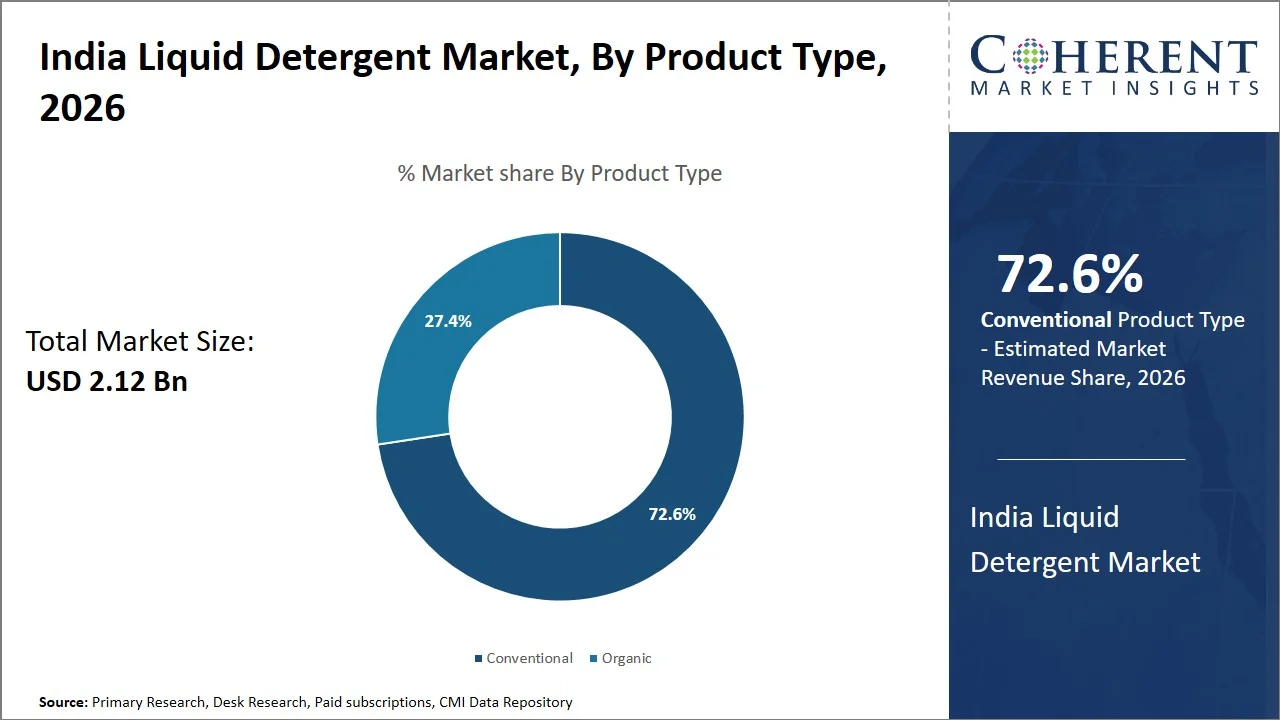
Why Does the Convention Segment Dominate the India Liquid Detergent Market?
The conventional segment is expected to account for 72.6% share of the market in 2026, which can be attributed to its affordability and accessibility across various consumer bases. Conventional detergents may contain synthetic surfactants and are popular among a wide range of people because they are relatively inexpensive. This cost benefit makes them the choice of the people of middle- and lower-middle income groups, who always consider the budget more than anything else.
Furthermore, regular liquid detergent brands include Ariel, Surf Excel, Tide, Oxi‑Clean, and Persil have also developed a good place in the market for many years by strong marketing and distribution system. They have been effective for many fabrics and stains, which has established consumer trust in their effectiveness and led to repeat purchases and brand loyalty. These detergents are also popular among users who need to be able to rely on their laundry products to clean well and efficiently, which is achieved due to the rapid action they offer.
- Current Industry Events of 2026
- Market Size Estimation
- Regional Breakdown
- Competitive Landscape
- Customer Intelligence
- Segmental Analysis
- Pricing Analysis
- Key Market Drivers, Challenges & Future Trends
- Customized Insights Section
Why is Residential the Most Preferred Application in the India Liquid Detergent Market?
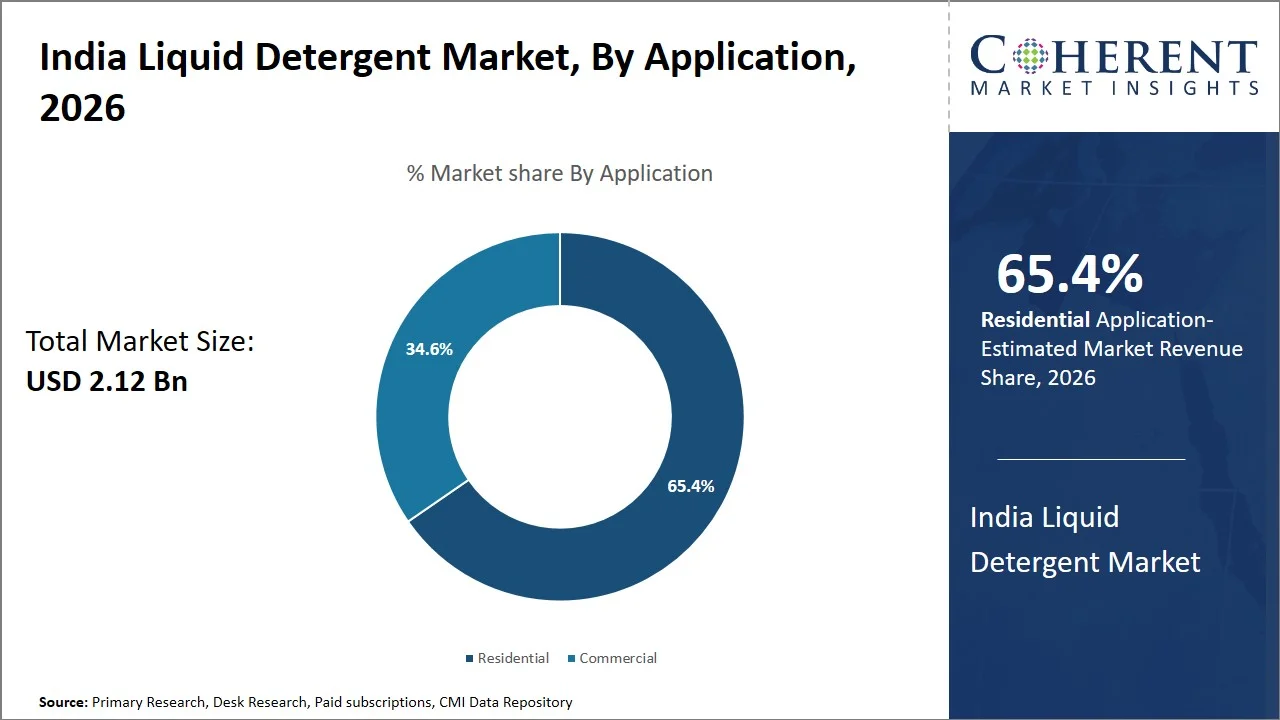
The residential segment is expected to lead and hold 65.4% of the Indian liquid detergent market share in 2026, as it is majorly used inside the home as per demographic and socio-economic factors. Rapid urbanization has created more nuclear families and dual income families, consequently increased the frequency of laundry activity, and added the convenience and effective detergent solution. Liquid detergents are user-friendly and convenient as compared to powder detergents and are well suited to urban lifestyles, especially when consumers want to maximize time and efficiency.
Households also have become more aware of hygiene and cleanliness and this has spurred them to use liquid detergents, particularly post-pandemic. Liquid detergents in India are more popular with consumers wanting to keep their home and family environment clean because of their perceived cleaning ability and their ability to dissolve in water. Also, liquid detergents are less harsh on garments and fabrics, making them more appealing to families that care about maintaining the quality of their clothes and fabrics after repeated washes.
Supermarket and Hypermarket Segment Dominates the India Liquid Detergent Market
The supermarkets and hypermarket segment are expected to hold 34.5% of the market share in 2026 as consumers appreciate their convenience of offering a full-service shopping experience. These outlets feature an array of different brands and even product categories in one place, enabling customers to easily compare features, price, and quantity. This diversity is particularly significant for many detergent consumers who are looking for different formulations, depending on the type of fabric, fragrance and price, with supermarkets and hypermarkets being the most used channels by many of them.
Consumers are attracted by the appealing offers in-shop and discounts shown in supermarkets/hypermarkets, which are really an incentive to them to make their purchases in these stores. Retailers may have partnerships with detergent companies for example, Unilever’s partnerships with retail and appliance companies to promote its laundry brands (Persil/OMO/Surf Excel). In July 2024, Unilever announced a partnership with Samsung to explore a connected laundry experience and joint promotions that can support co‑marketing and promotional offers in retail channels. (Source: Unilever)
Currents Events and their Impact
Current Events | Description and its Impact |
Rising Penetration of Automatic Washing Machines in India |
|
Expansion of Quick-Commerce and E-Commerce Grocery Platforms |
|
India Liquid Detergent Market Dynamics
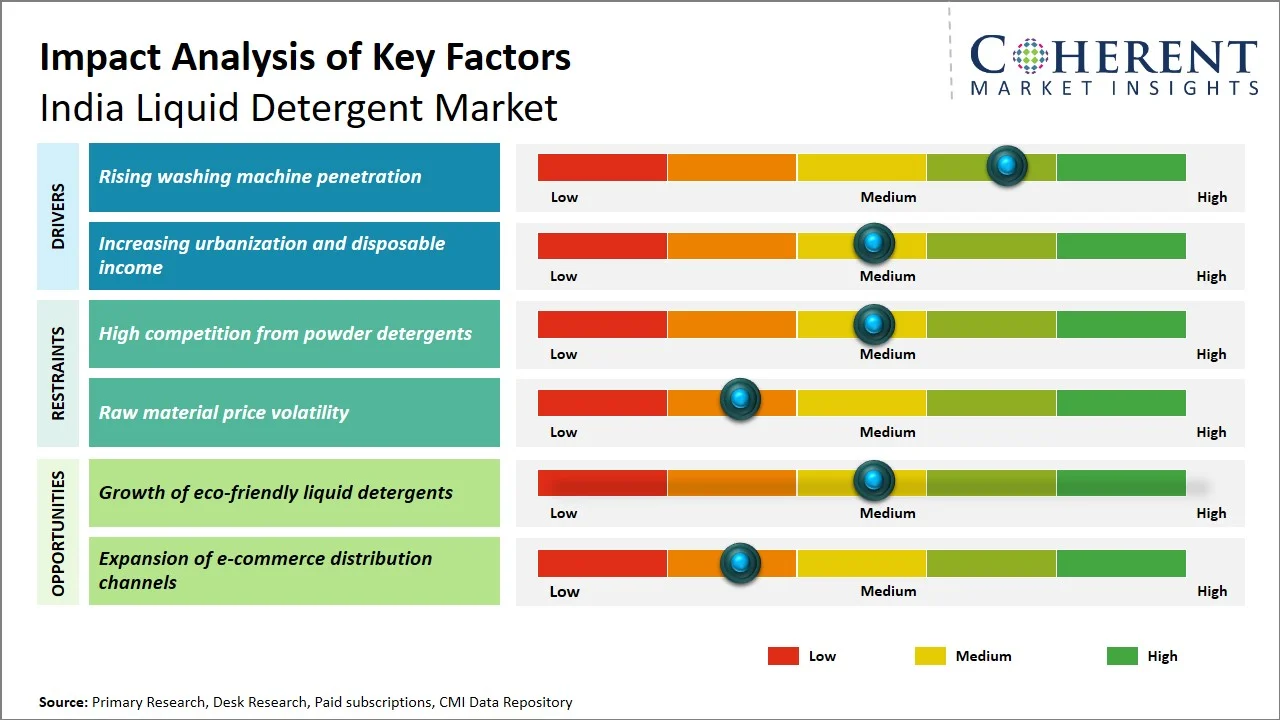
Market Drivers
- Rising Washing Machine Penetration Fuels Demand for Liquid Detergents: Consumers are becoming more interested in automatic laundry methods that reduce workload and time, and they are moving away from powder detergents to liquid versions that are believed to be more suitable for washing machines. Liquid detergents dissolve more quickly than powdered ones and will not leave residue of the detergent on clothes or inside the machine, which means they will wash more efficiently and help the fabric to stay in better condition. Besides, as people become more aware of their spending power and their experiences with imported cleaning products, the Indian consumers are gradually becoming more inclined toward convenience and efficiency in cleaning products, which will further increase the India liquid detergent market.
- Increasing Urbanization and Disposable Income: Increasing urbanization and rising disposable income are major driving factors behind the growth of the India liquid detergent market because they directly influence lifestyle changes, washing habits, and product preferences. Urban households are generally smaller, with increased use of saving time appliances such as washing machines, and as more and more people move to cities for employment and education, there is increased demand for convenient and efficient cleaning products, such as liquid detergent, compared with powder detergent. The World Bank highlights that India’s urban population is expected to rise significantly, reaching around 40% of the total population by 2036. (Source: World Bank Group)
Emerging Trends
- Premiumization and Advanced Fabric Care Innovation: The trend for premiumization and the development of more specialized cleaning solutions for fabrics is also identified, with liquid detergents becoming cleaner and with more advanced features, including the ability to enhance fabric fragrance, protect color, provide antibacterial effect, and provide delicate fabric care. Liquid detergents are becoming a part of consumers' expectations for better washing results and longer garment life, giving brands the power to charge more and attract customer loyalty.
- Rising Automatic Washing Machine Adoption and Concentrated Formulations: Increased use of automatic washing machines is creating the demand for liquid detergent for the front-load and top-load washing machines, which are designed to give the machine low foam, water-saving cleaning. The use of concentrated formulations which require less dosage is becoming more popular because they are convenient, efficient and take up less storage space.
How the rising demand for eco-friendly liquid detergents is unlocking new growth opportunities in the India liquid detergent market?
One of the most significant growth drivers in the India liquid detergent market is the increasing preference for eco-friendly liquid detergents. This is not only about the 'green products' but about the changes in the product innovation, branding and market expansion across urban and rural India.
Refillable and concentrated eco-friendly liquid detergents, for instance, are being launched by FMCG companies and newcomers that optimize the use of plastic, as well as minimize transportation emissions, in response to the sustainability requirements of consumers living in cities. A good example of a real market is the Surf Excel Matic range by Hindustan Unilever, which features concentrated liquid detergents without phosphates along with refill pouches, specifically for washing machines, and aims to achieve sustainability without compromising on one's environment.
(Source: Hindustan Unilever Limited)
Macro and Micro Economic Factors Impacting India Liquid Detergent Market
Factor type | Factor | Impact on India liquid detergent market |
Macroeconomic | Rising disposable income | Urban and semi‑urban households spend more on premium and liquid detergents; supports shift from bar/detergent cake to liquid formats. |
Macroeconomic | Urbanization and household formation | More nuclear families and single‑occupant homes in cities increase demand for convenient, machine‑compatible liquid detergents. |
Microeconomic | Consumer price sensitivity | Many Indian consumers trade up from powder to liquid only when price‑per‑wash or bundled offers are competitive; price wars and discounts are common |
Microeconomic | Branding and perceived benefits | Consumers associate liquid detergents with better fabric protection, color retention, and less residue; brands invest heavily in advertising and claims. |
Market Players, Key Development, and Competitive Intelligence
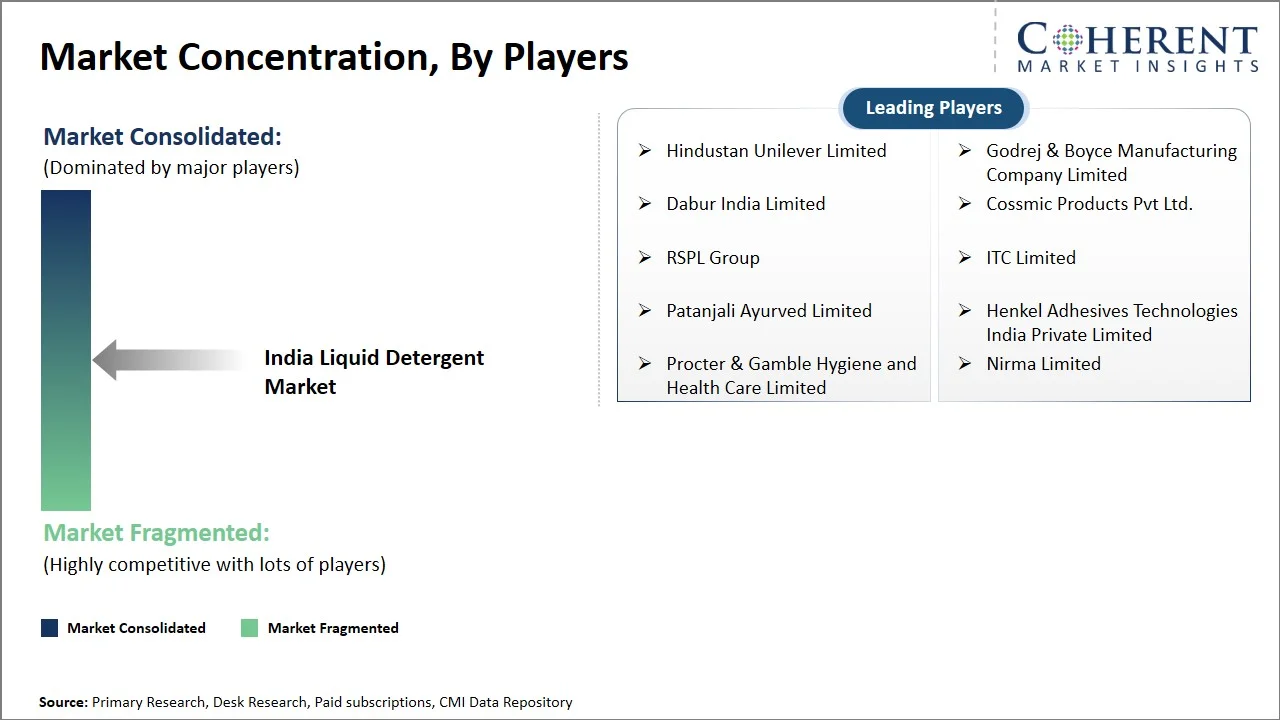
Key Developments
- In April 2025, Henkel unveiled concentrated formulas for its all, Persil, and Snuggle liquid laundry products. The revamped initiative, as stated by Henkel, encompasses updated packaging and formulas, aiming to deliver enhanced cleaning and fabric care in every load.
- In February 2025, Hindustan Unilever entered into a strategic partnership with Whirlpool to enhance the laundry experience in India. This collaboration integrates Whirlpool's top-load washing machines with Surf Excel Matic Liquid Detergent.
- In December 2023, Godrej Consumers launched 'Godrej Fab', a new liquid detergent brand aimed at the mass market. The product has been introduced in the South Indian states of Tamil Nadu, Andhra Pradesh, Karnataka, and Kerala in India.
Competitive Landscape
The penetration of automatic washing machines, urbanization, and the convenience-oriented fabric care solution preference of consumers are all contributing to the India liquid detergent market's high competitiveness. Both large FMCG players and emerging and regional brands are playing the game with strong brand equity, distribution and advertising scale, and targeted price and affordable pricing, respectively, for the former and the latter. Key focus areas are:
- Machine compatible and fast performing formulations optimized for front load and top load washing machines
- Ongoing innovation in fragrance, antibacterial, fabric protection and special fabric-care scent
- Diversifying into concentrated liquids, refill packs, eco-friendly formulations, baby-care laundry solutions, and sensitive-skin detergents.
Market Report Scope
India Liquid Detergent Market Report Coverage
| Report Coverage | Details | ||
|---|---|---|---|
| Base Year: | 2025 | Market Size in 2026: | USD 2.12 Bn |
| Historical Data for: | 2020 To 2024 | Forecast Period: | 2026 To 2033 |
| Forecast Period 2026 to 2033 CAGR: | 7.1% | 2033 Value Projection: | USD 3.42 Bn |
| Segments covered: |
| ||
| Companies covered: | Hindustan Unilever Limited, Godrej & Boyce Manufacturing Company Limited, Dabur India Limited, Cossmic Products Pvt Ltd., RSPL Group, ITC Limited, Patanjali Ayurved Limited, Henkel Adhesives Technologies India Private Limited, Procter & Gamble Hygiene and Health Care Limited, and Nirma Limited | ||
| Growth Drivers: |
| ||
| Restraints & Challenges: |
| ||
Analyst Opinion (Expert Opinion)
- The India liquid detergent market is on the verge of a structural turning point as was seen in urban fabric care markets earlier in Southeast Asia. Penetration has been fairly low compared to powder detergents, but the category is maturing from a niche premium urban product to a mainstream format for household cleaning. The three main drivers of the long-term shift are the growing penetration of automatic washing machines, the increasing hygiene standards and expectations of the urban middle-class, and the consumer's preference for fabric-friendly and convenient products in modern appliances.
- In the coming 10 years, the market is expected to transform from a price-sensitive replacement category to a differentiated fabric-care ecosystem. The premiumization acceleration will be at a higher pace than volume growth. Fragrance, anti-bacterial, color protection, sensitive-skin and machine-specific performance are becoming more important to consumers and they are willing to pay for them. This provides an opportunity for segmentation instead of full commoditization.
- Front load washing machine adoption in metro and tier-1 cities is likely to be the strongest structural tailwind. Liquid detergents are better suited to low water automated systems, making them well-suited to the trends of appliance modernization. With the spread of the appliance to tier-2 and high-income tier-3 cities, it is probable that liquid detergent will become the preferred format for the younger households and not an alternative premium option.
Speak to the analyst
Want personalized insights?
Take the findings above to one of our principal consultants, or have the report rebuilt around the segments, geographies and competitors you actually track.
Market Segmentation
- Product Type Insights (Revenue, USD Bn, 2021 - 2033)
- Conventional
- Organic
- Application Insights (Revenue, USD Bn, 2021 - 2033)
- Residential
- Commercial
- Sales Channel Insights (Revenue, USD Bn, 2021 - 2033)
- Supermarket and Hypermarket
- Convenience stores
- Online
- Others
- Key Players Insights
- Hindustan Unilever Limited
- Godrej & Boyce Manufacturing Company Limited
- Dabur India Limited
- Cossmic Products Pvt Ltd.
- RSPL Group
- ITC Limited
- Patanjali Ayurved Limited
- Henkel Adhesives Technologies India Private Limited
- Procter & Gamble Hygiene and Health Care Limited
- Nirma Limited
Sources
Primary Research Interviews
- Manufacturers and brand owners: Procter & Gamble India (P&G), Hindustan Unilever (Surf Excel), RSPL Group (Ghadi), Nirma — interviews with marketing or supply‑chain leads.
- Contract/Private label packers and formulators in India (Mumbai/Gujarat).
- Grocery / Modern trade procurement heads: Big Bazaar/DMart, Reliance Retail category managers.
- E‑commerce channel leads: Amazon India, Flipkart grocery category managers.
Stakeholders
- Large FMCG players: Hindustan Unilever, P&G India, RSPL Group, Nirma, Henkel India.
- Retailers and distributors: Reliance Retail, DMart (Avenue Supermarts), Big Bazaar, modern trade and neighbourhood kirana networks.
- Institutional buyers (laundromats, hotels) and commercial laundry service providers
- End‑use sectors:
- Household/residential laundry consumers (urban & rural segments)
- Commercial laundry (hotels, hospitals, institutional laundries)
- Regulatory & Certification Bodies:
- Bureau of Indian Standards (BIS) — product and labeling standards for detergents.
- Food Safety and Standards Authority of India (FSSAI) — (where relevant for any fragranced products in contact with textiles used in food sectors).
- Environmental Ministry / CPCB — wastewater discharge norms affecting detergent formulation and surfactant choices.
Databases
- UN Comtrade (relevant HS codes for liquid detergent and surfactant raw materials).
- India EXIM (customs/EXIM) and SEAIR/Export import databases for shipment-level export/imports of liquid detergents.
- Statista (Laundry care market size & forecasts for India).
Magazines
- Packaging and consumer goods trade press in India (Economic Times Retail, Business Standard FMCG).
- Industry portals and trade data providers (Eximpedia, Seair)
Journals
- Journal of Cleaner Production / Energy and Buildings (for environmental impacts of surfactants and wastewater).
- Academic and industry studies on surfactant biodegradability and toxicity (used to support sustainability discussions).
Newspapers
- The Wall Street Journal
- Business Standard (India)
Associations
- Consumer Goods Forum (regional India chapters) and local FMCG associations.
- Indian Chemical Council (manufacturers of surfactants and raw materials).
Proprietary Elements
- CMI Data Analytics Tool
- Proprietary CMI Existing Repository of information for last 10 years.
Get access to 250+ pages report
Every segment, forecast, competitor profile and data table behind the analysis above — available for instant download.
- ESOMAR Member
- ISO 9001:2015 Certified
- D-U-N-S Registered
- GDPR & CCPA Compliant
Missing comfort of reading report in your local language? Find your preferred language:
Transform your Strategy with Exclusive Trending Reports
Frequently Asked Questions
The India liquid detergent market is estimated to be valued at USD 2.12 Bn in 2026 and is expected to reach USD 3.42 Bn by 2033.
The CAGR of India liquid detergent market is projected to be 7.1% from 2026 to 2033.
Rising washing machine penetration and Increasing urbanization and disposable income are the major factors driving the growth of the India liquid detergent market.
High competition from powder detergents and raw material price volatility are the major factors hampering the growth of the India liquid detergent market.
In terms of product type, conventional is estimated to dominate the market revenue share in 2026.
Hindustan Unilever Limited, Godrej & Boyce Manufacturing Company Limited, Dabur India Limited, Cossmic Products Pvt Ltd., RSPL Group, ITC Limited, Patanjali Ayurved Limited, Henkel Adhesives Technologies India Private Limited, Procter & Gamble Hygiene and Health Care Limited, and Nirma Limited are the major players.