

India Mill Roll Market Size and Forecast – 2026 To 2033
The India mill roll market is expected to grow from USD 376.3 Mn in 2026 to USD 572.0 Mn by 2033, registering a compound annual growth rate (CAGR) of 6.2% from 2026 to 2033. The rising steel production and infrastructure-led demand in India is driving the demand for mill rolls.
For instance, on April 17, 2026, the Maharashtra government signed a memorandum of understanding with Shyam Steel Industries Ltd to set up an integrated steel plant in Gondpipri, India marking a major step in expanding industrial activity in the state's eastern belt.
(Source: Times of India)
Key Takeaways of the India Mill Roll Market
- The work rolls segment is expected to account for 47.2 % of the India mill roll market share in 2026. Increasing demand for high-quality flat steel in automotive and infrastructure sectors are driving the growing need for work rolls in rolling mills. In February 2026, the South Western Railway (SWR) emerged as a central beneficiary of domestic logistics activity, reporting its highest-ever monthly freight loading in December 2025, as the market pivoted from global export dependency towards domestic-led growth. (Source: Times of India)
- The cast iron rolls segment is estimated to capture 37.6 % of the market share in 2026. Rising demand for long steel products in construction and infrastructure are driving the growing need for durable and cost-effective cast iron rolls in rolling mills. India emerged as a net exporter of finished steel during the first 11 months (April - February) of the fiscal year 2025-2026, achieving exports of 6.02 million mt, against imports of 5.6 million mt. In the given period, Indian steel exports were up by 36% (Source: The EconomicTimes)
- The hot rolling mills segment is projected to hold 72.8 % of the India mill roll market share in 2026. Expansion of integrated steel plants and capacity additions in primary steelmaking are driving higher installation and utilization of hot rolling mills in India. On April 20, 2026, JSW Steel, India, and South Korea’s POSCO, both leaders in steel production globally, have signed a joint venture agreement for setting up a 6 mtpa greenfield steel plant in the state of Odisha. The agreement marks a significant step towards deepening strategic collaboration between two of the world’s most respected steel companies. (Source: JSW)
- Demand from Construction & Infrastructure: Initiating with expanding urban networks, India's building activities support steady need for steel shapes seen on bridges, rail systems, homes, and expressways. Steady growth in metal demand follows support from government programs, including connected production zones, upgraded city areas, and extended road systems. As facilities operate across expanded shifts, equipment faces heavier loads, prompting greater need for pipe-like components during shaping processes exposed to intense temperatures. Given this trend, heavy-duty alloy components face shorter service lives throughout manufacturing units.
- Growing need in Automotive & Manufacturing: Despite being overlooked, activity by manufacturers of vehicles and industrial machines influences demand within the mill roll industry. Flat steel and structural steel shaped with accuracy, serves construction elements, mechanical parts, appliances, along with everyday goods. As output grows, both in traditional and electric models, and machine tools advance, producers adjust rolling techniques. These changes aim at tighter tolerances, smoother finishes. Precision becomes central when supply chains respond to broader manufacturing shifts. As a result, tougher alloy rolls and durable work rolls see wider use where long runs and steady output matter most.
Segmental Insights
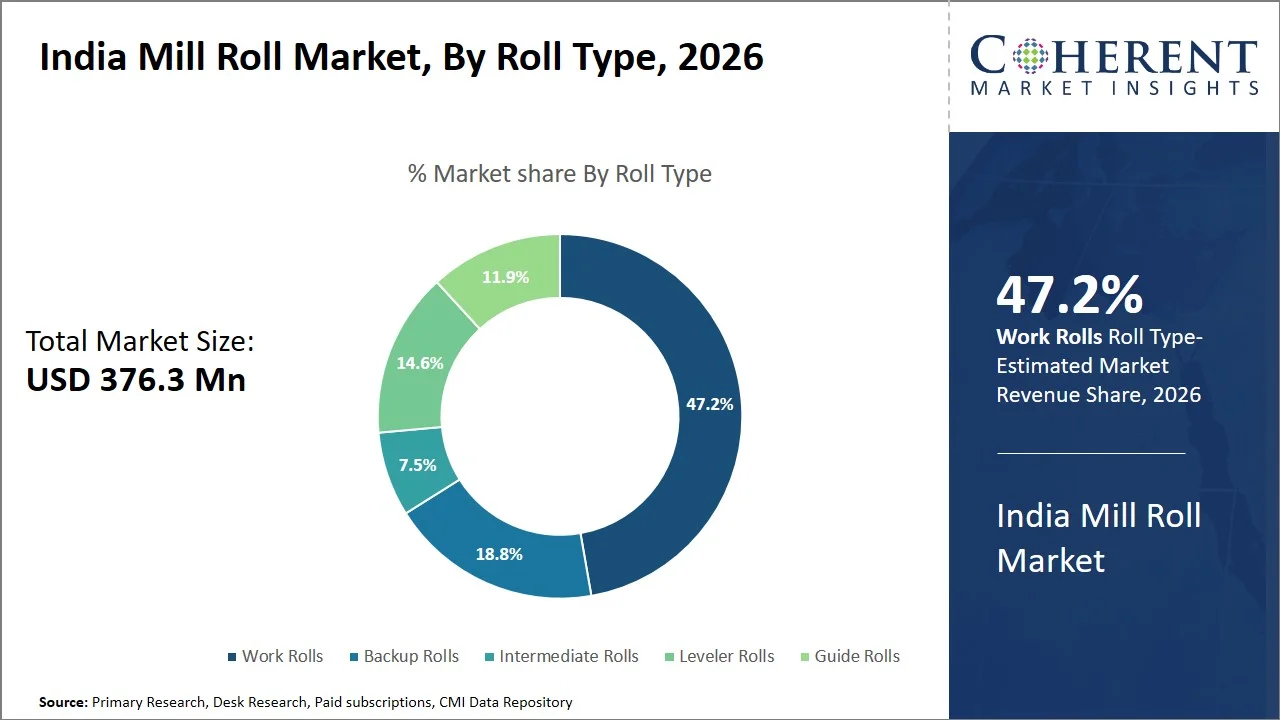
Why Does the Work Rolls Segment Dominate the India Mill Roll Market ?
The work rolls segment is expected to account for 47.2% of the India mill roll market share in 2026. Steady growth in India's output of automotive flat steel brings increased need for work rolls used in finishing stages. As tighter rules now govern surface quality and part dimensions, higher-grade rolling tools gain importance across plants. With performance expectations shifting, facilities like those at JSW Steel add more cold-rolling capacity, which, in turn, raises reliance on accurate roll assemblies for complex mill arrangements. At Tata Steel Limited, similar movements unfold as modernized treatment lines support industries that depend on slim metal forms, notably car panels along with domestic appliance parts.
On April 24, 2025, Tata Steel commemorated 25 years of its Cold Rolling Mill (CRM) Complex at Jamshedpur, a landmark facility that has redefined India’s capabilities in manufacturing high-quality cold rolled and galvanized steel for the automotive, appliance, and construction sectors.
(Source: TataSteel)
- Current Industry Events of 2026
- Market Size Estimation
- Regional Breakdown
- Competitive Landscape
- Customer Intelligence
- Segmental Analysis
- Pricing Analysis
- Key Market Drivers, Challenges & Future Trends
- Customized Insights Section
Why are Cast Iron Rolls the Most Preferred Material Type?
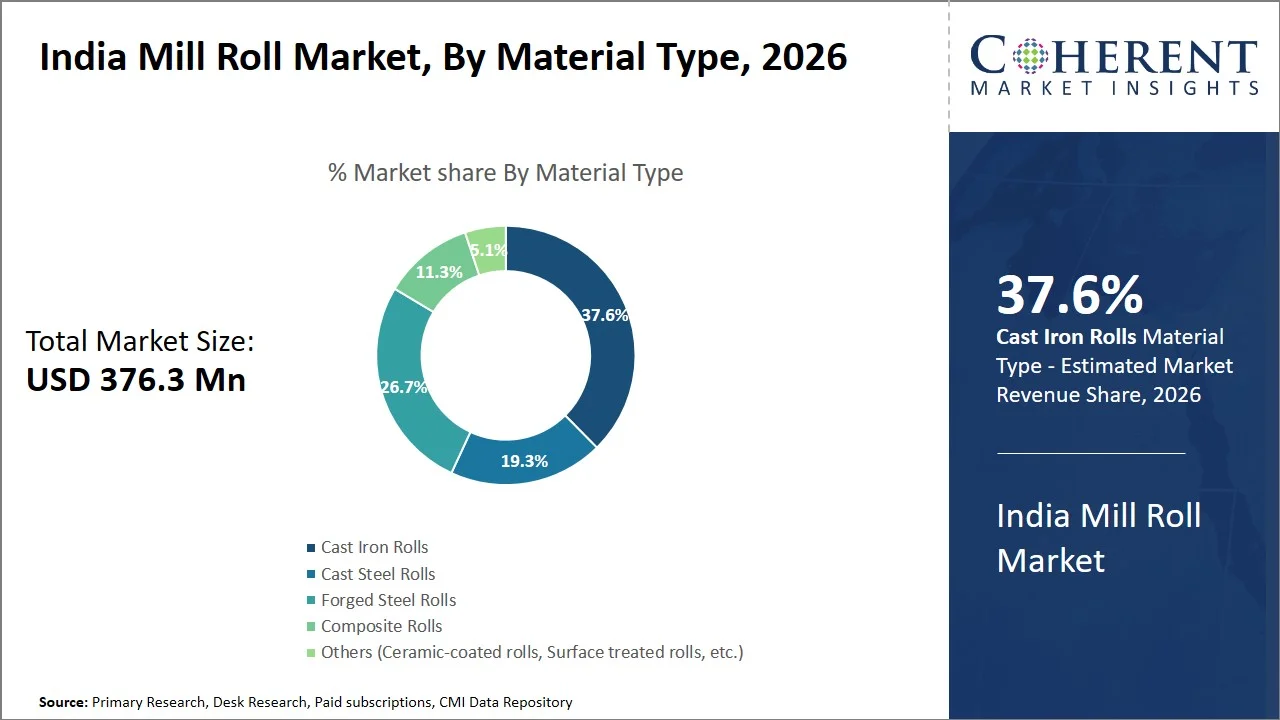
The cast iron rolls segment is expected to account for 37.6% of the India mill roll market share in 2026. Even with basic makeup, cast iron rolls appear often, their consistent durability meeting reasonable pricing where mirror-like finishes hold little value. Across Indian long product operations, facilities making Thermo-Mechanically Treated (TMT) bars or heavy profiles, like those run by Steel Authority of India Limited, favor these rolls early and midway through rolling; intense shaping forces along with regular replacements reduce any benefit pricier alloys might offer.
On March 25, 2026, Jindal Steel Limited completed a major capacity expansion at its Angul Integrated Steel Complex in Odisha. The company has doubled capacity to 12 million tons per annum (MTPA), reinforcing domestic manufacturing strength while reducing import dependencies in critical sectors.
(Source: BusinessStandard)
Hot Rolling Mills Segment Dominates the India Mill Roll Market
The hot rolling mills segment is expected to account for 72.8% of the India mill roll market share in 2026. Beginning with heat-based shaping, the process dominates India's mill activities where construction-grade shapes emerge, along with flattened forms and twisted deformed rods bound for infrastructure projects. Operated by leading metal producers such as Steel Authority of India Limited and Tata Steel Limited, industrial sites in Bokaro and Jamshedpur run broad configurations producing rolled long materials and wide sheets. These units rarely pause, functioning amid severe thermal stress that wears down cylindrical tools more quickly than expected, creating repeated demand for fresh components over time.
For instance, on March 4, 2026, Steel Authority of India Limited (SAIL), a leading Indian steel producer, announced it is expanding its IISCO steel plant in Burnpur and has selected Primetals Technologies as supplier for a new pelletizing plant, three 165-ton ladle furnaces, and two 165-ton RH degassers. This major greenfield project will significantly boost their steel capacity and enable SAIL IISCO to produce high-grade hot-rolled coil (HRC) and API-grade steel for the oil and gas industries.
(Source: Primetals)
Currents Events and their Impact
Current Events | Description and its Impact |
Introduction of National Steel Policy India |
|
(Source: PIB)
India Mill Roll Market Dynamics
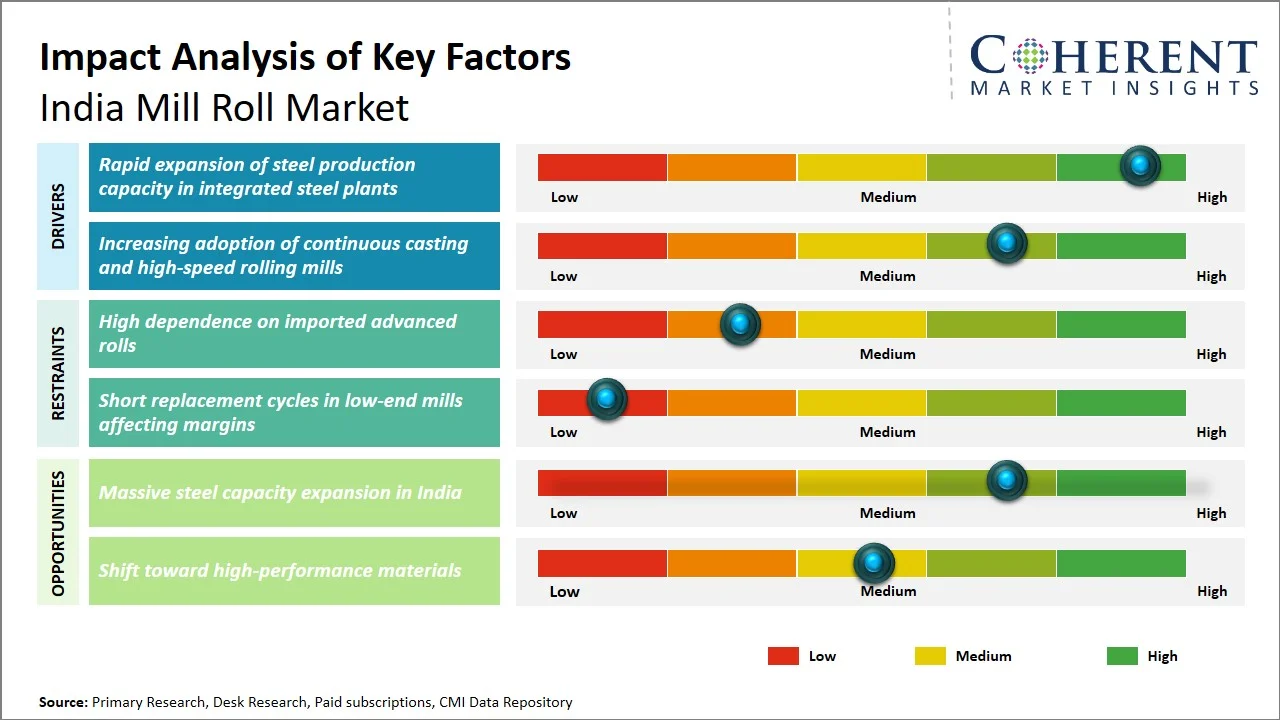
Market Drivers
- Rapid expansion of steel production capacity in integrated steel plants: Hot rolling stands out across India's rolling mill sector, mainly due to its role in fabricating structural elements like beams, flat products, and TMT reinforcement bars meant for buildings and civil works. Despite intense conditions, plants under Steel Authority of India Limited and Tata Steel Limited maintain uninterrupted output of hot-rolled strips and plates. Located chiefly in Bokaro and Jamshedpur, such units operate without pause, exposed to severe heat and pressure. Owing to this constant strain, rolling components degrade more rapidly than usual. As a result, periodic replacement is unavoidable. Even when performance stays stable, internal stress accumulates within machinery. Therefore, regular renewal of parts forms an inherent aspect of maintenance there. India registered 10.4% growth in crude steel production in 2025. India's crude steel output stood at 164.9 MT in 2025 compared with 149.4 MT in 2024. (Source: Times of India)
- Increasing adoption of continuous casting and high-speed rolling mills: Now appearing across Indian steel facilities, a move toward continuous casting paired with rapid rolling methods supports greater output amid growing need for flat products. Recent expansions show this trend clearly. At Kalinganagar, Tata Steel has extended both its continuous casting lines and fast-moving hot strip setup to deliver automotive-class sheet metal featuring precise dimensional consistency. Meanwhile, progress at SAIL's Rourkela site includes updated continuous casters joined directly to swift-rolling units, raising volume potential for both flat and structural grades. On May 22, 2025, Tata Steel Limited expanded its Kalinganagar Phase-II integrated steel facility, which includes advanced continuous casting systems linked to modern downstream rolling facilities. The expansion is designed to produce high-strength automotive and coated steels using continuous processing from casting to rolling, improving productivity and reducing intermediate handling. (Source: TataSteel)
Emerging Trends
- Shift toward high-performance alloy and indefinite chill rolls: With rising demand for durability, Indian steel facilities now favor alloy and composite rolls over traditional cast iron ones. Where intense heat and repeated stress occur, such as in flat steel production, this shift becomes noticeable. Hot strip operations particularly see this change take hold. Performance under pressure drives material choices here.
- Integration of continuous casting with high-speed rolling lines: New and upgraded integrated steel plants are directly linking continuous casting machines with hot and cold rolling mills, reducing transfer time and increasing roll wear intensity, which is reshaping roll consumption patterns.
- Rising demand from automotive-grade flat steel production: Expansion of cold rolling and galvanized steel lines for OEMs are increasing the use of precision work rolls designed for tight thickness control and superior surface finish requirements.
India Mill Roll Market - Import Value/Volume of Mill Rolls
Metric | Value |
Total Import Shipments | ~24,186 shipments (2024–2025 TTM) |
Total Import Records | ~24,583 records |
Number of Importing Companies | ~2,295 importers |
Countries Supplying India | 50+ countries |
Average Import Price | ~USD 2.24 per unit |
Typical Shipment Value | ~USD 1,852 per shipment |
Typical Quantity | ~5,589 units |
How is massive steel capacity expansion in India creating new growth opportunities in the India mill roll market?
India’s steel capacity expansion is also being driven by newer investment announcements beyond traditional integrated plant upgrades, such as ArcelorMittal Nippon Steel India’s ongoing development of its Hazira steel complex expansion in Gujarat, which is being scaled to increase crude steel capacity and strengthen downstream hot and cold rolling lines for value-added steel. Just like before, the Dolvi facility of JSW Steel in Maharashtra has now boosted output of crude steel and hot-rolled coils through recent upgrades. Instead of older methods, it uses upgraded continuous casting paired with fast rolling technology. As local needs are rising, construction and industrial production drive this change. Rather than scattered efforts, such expansions show a move to bigger units built around performance gains. As a result, India’s network of rolling mills grows more robust each year.
The Indian steel industry delivered a robust performance in the financial year 2025-2026, consolidating its position as the world’s second-largest producer while navigating global uncertainties and price pressures. India’s crude steel output continued its upward trajectory in 2025-2026, growing by over 10.7% year-on-year to around 168.4 million tons during April-March, reflecting sustained industrial momentum. (Source: PIB)
Market Players, Key Development, and Competitive Intelligence
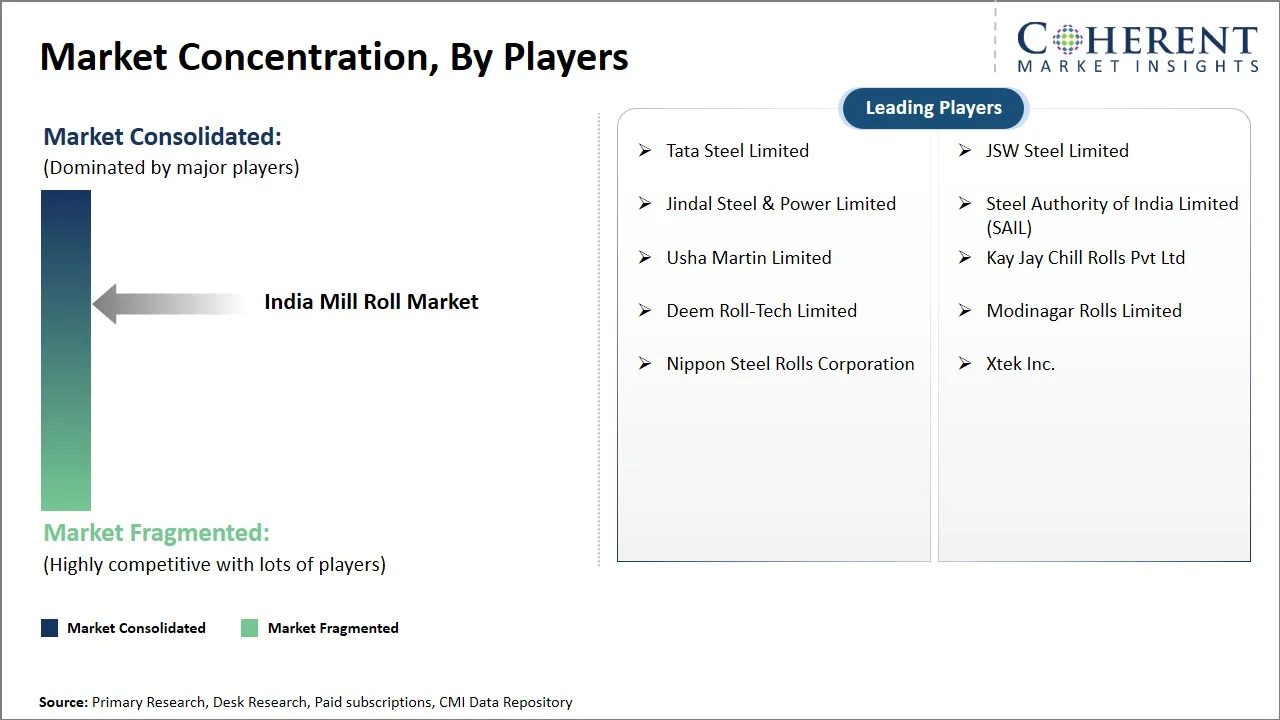
Key Developments
- On April 4, 2026, Rashtriya Ispat Nigam Limited (RINL), the corporate entity of Visakhapatnam Steel Plant (VSP), recorded a 52% surge in key production areas in 2025-2026 financial year compared to that of the previous fiscal. It reported a 22% rise in annual turnover amid improved efficiency.
- On April 2, 2026, the largest steelmaking public sector company, Steel Authority of India Limited (SAIL), achieved its highest-ever performance in FY 2025-2026, setting new benchmarks in both sales and production. Strengthening its brand presence and customer reach, the company recorded best-ever sales of 20.14 million tons (MT), reflecting an impressive 11.5% growth over the previous year’s 18.07 million tons MT. This growth was broad-based, with sales rising across all product categories.
Competitive Landscape
Fragmentation defines the structure of the India mill roll market, where layers of producers face off across differing scales of operation. Beginning with Tata Steel Limited, domestic leaders influence how rolls perform under heat and pressure during processing. Instead of relying on imports, regional producers focus on cost-effective materials such as standard cast iron types. On the opposite end, international sources, especially from Japan and Germany, deliver specialized versions for precise industrial needs. While Indian firms serve smaller mills locally, foreign suppliers meet complex performance demands abroad. Shaping mill operations across zones, these patterns define material choices without favoring one method over another. High-speed steel and alloy-based rolls belong mostly to these international sources, favored for extended durability and consistent output quality.
Market Report Scope
India Mill Roll Market Report Coverage
| Report Coverage | Details | ||
|---|---|---|---|
| Base Year: | 2025 | Market Size in 2026: | USD 376.3 Mn |
| Historical Data for: | 2020 To 2024 | Forecast Period: | 2026 To 2033 |
| Forecast Period 2026 to 2033 CAGR: | 6.2% | 2033 Value Projection: | USD 572.0 Mn |
| Segments covered: |
| ||
| Companies covered: | Tata Steel Limited, JSW Steel Limited, Jindal Steel & Power Limited, Steel Authority of India Limited (SAIL), Usha Martin Limited, Kay Jay Chill Rolls Pvt Ltd, Deem Roll-Tech Limited, Modinagar Rolls Limited, Nippon Steel Rolls Corporation, and Xtek Inc. | ||
| Growth Drivers: |
| ||
| Restraints & Challenges: |
| ||
Analyst Opinion (Expert Opinion)
- Currently, India's mill roll sector responds less to rising demand and more to deeper changes within steel production methods. As integrated facilities expand, connections between continuous casting and hot rolling grow tighter, raising both consumption rates and requirements for roll resilience. One sees local producers still holding firm in economical categories - cast iron and chilled variants - especially those serving re-roll units making TMT bars. Yet, challenges mount in advanced areas due to stronger interest in alloyed and high-speed steel rolls. Performance needs now shift under quiet technological tides.
- Ahead lies a gradual move in direction of durable, premium roll options as steel output grows across India and standards tighten. As automotive-grade sheet and coated variants rise in volume, so does need for sophisticated alloyed and composite rollers - this trend favors performance over older cast models. With faster rolling methods entering wider use, outdated iron-based versions may fade slowly from top-tier operations. Yet where expenses matter most, smaller re-rollers continue relying on established roll forms, keeping two distinct paths alive within the sector. Over time, divergence persists - not equally, but clearly shaped by purpose.
Speak to the analyst
Want personalized insights?
Take the findings above to one of our principal consultants, or have the report rebuilt around the segments, geographies and competitors you actually track.
Market Segmentation
- Roll Type Insights (Revenue, USD Million, 2021 - 2033)
- Work Rolls
- Backup Rolls
- Intermediate Rolls
- Leveler Rolls
- Guide Rolls
- Material Type Insights (Revenue, USD Million, 2021 - 2033)
- Cast Iron Rolls
- Cast Steel Rolls
- Forged Steel Rolls
- Composite Rolls
- Others (Ceramic-coated rolls, Surface treated rolls, etc.)
- Material Type Insights (Revenue, USD Million, 2021 - 2033)
- Hot Rolling Mills
- Cold Rolling Mills
- End User Insights (Revenue, USD Million, 2021 – 2033)
- Construction
- Automotive & Transportation
- Shipbuilding & Offshore
- Energy & Power
- Others (Machinery Manufacturing, Mining & Minerals Processing, etc.)
- Key Players Insights
- Tata Steel Limited
- JSW Steel Limited
- Jindal Steel & Power Limited
- Steel Authority of India Limited (SAIL)
- Usha Martin Limited
- Kay Jay Chill Rolls Pvt Ltd
- Deem Roll-Tech Limited
- Modinagar Rolls Limited
- Nippon Steel Rolls Corporation
- Xtek Inc.
Sources
Primary Research Interviews
- Steel Mill Production Managers
- Mill Roll Manufacturers and Suppliers
- Industrial Equipment Distributors
- Rolling Mill Operations Engineers
Databases
- India Brand Equity Foundation (IBEF) Database
- Ministry of Steel Government of India Database
- Indian Steel Association Database
- Federation of Indian Chambers of Commerce Database
Magazines
- Steel World Magazine
- Indian Steel & Metal Magazine
- Industrial Engineering Magazine
- Manufacturing Today India
Journals
- Journal of Iron and Steel Research
- International Journal of Advanced Manufacturing Technology
- Indian Journal of Engineering and Materials Sciences
Associations
- Steel Authority of India Limited (SAIL)
- Indian Steel Association (ISA)
- Federation of Indian Chambers of Commerce & Industry (FICCI)
- Confederation of Indian Industry (CII)
- Indian Machine Tool Manufacturers' Association (IMTMA)
Public Domain Sources
- Ministry of Steel, Government of India
- Export-Import Bank of India Reports
- Reserve Bank of India Industrial Reports
- National Sample Survey Office Data
- India Trade Portal
Proprietary Elements
- CMI Data Analytics Tool
- Proprietary CMI Existing Repository of information for last 10 years
Get access to 250+ pages report
Every segment, forecast, competitor profile and data table behind the analysis above — available for instant download.
- ESOMAR Member
- ISO 9001:2015 Certified
- D-U-N-S Registered
- GDPR & CCPA Compliant
Missing comfort of reading report in your local language? Find your preferred language:
Transform your Strategy with Exclusive Trending Reports
Frequently Asked Questions
The India mill roll market is expected to stand at USD 376.3 Mn in 2026 and is expected to reach USD 572.0 Mn by 2033.
The CAGR of the India mill roll market is projected to be 6.2% from 2026 to 2033.
Rapid expansion of steel production capacity in integrated steel plants and increasing adoption of continuous casting and high-speed rolling mills are the major factors driving the growth of the India mill roll market.
High dependence on imported advanced rolls and short replacement cycles in low-end mills affecting margins are the major factors hampering the growth of the India mill roll market.
In terms of roll type, work rolls are estimated to dominate the market revenue share in 2026.
They are essential for shaping and reducing thickness of steel during rolling processes.
Lifespan varies depending on usage, material quality, and maintenance practices.