

India Smart Hospitals and Digital Transformation Market Size and Forecast – 2026 To 2033
The India smart hospitals and digital transformation market is expected to grow from USD 2.8 Bn in 2026 to USD 7.9 Bn by 2033, registering a compound annual growth rate (CAGR) of 16.1%. The India smart hospitals and digital transformation market is poised for significant expansion, fueled by the rapid implementation of the Ayushman Bharat Digital Mission (ABDM), which is accelerating the adoption of interoperable digital health infrastructure across the country.
According to the Ministry of Health and Family Welfare, by February 2025, over 739.8 million (73.98 Crore) Ayushman Bharat Health Accounts (ABHAs) had been created, more than 363,520 health facilities were registered on the Health Facility Registry (HFR), and over 159,020 health facilities were using ABDM-enabled software, highlighting the rapid digital transformation of India's healthcare ecosystem.
Key Takeaways of the India Smart Hospitals and Digital Transformation Market
- Software and digital platforms are projected to hold 55.9% of the India smart hospitals and digital transformation market share in 2026, making it the dominant offering type segment, owing to the increasing adoption of interoperable digital health solutions. For instance, in September 2022, the National Health Authority (NHA) notified the Health Data Management Policy (HDMP) under the Ayushman Bharat Digital Mission, establishing a standardized framework for secure digital health data exchange, consent management, and interoperability across digital health platforms.
- General and multispecialty hospitals are projected to hold 72.0%of the India smart hospitals and digital transformation market share in 2026, making it the dominant type of hospitals segment, driven by their need to integrate clinical, diagnostic, and administrative functions on unified digital platforms. For instance, the National Accreditation Board for Hospitals & Healthcare Providers (NABH) Digital Health Standards require accredited hospitals to implement electronic clinical documentation, digital patient records, and secure health information management systems to enhance quality of care.
- Private is projected to hold 72.4% of the India smart hospitals and digital transformation market share in 2026, making it the dominant type segment, supported by higher investments in advanced healthcare technologies and digital innovation. For instance, in January 2025, the Ministry of Electronics and Information Technology (MeitY) launched the IndiaAI Mission with an outlay of USD 1.22 billion (INR 10,371.92 crores) to strengthen AI infrastructure, datasets, and application development, supporting wider adoption of AI-enabled digital healthcare solutions by private healthcare providers.
Segmental Insights
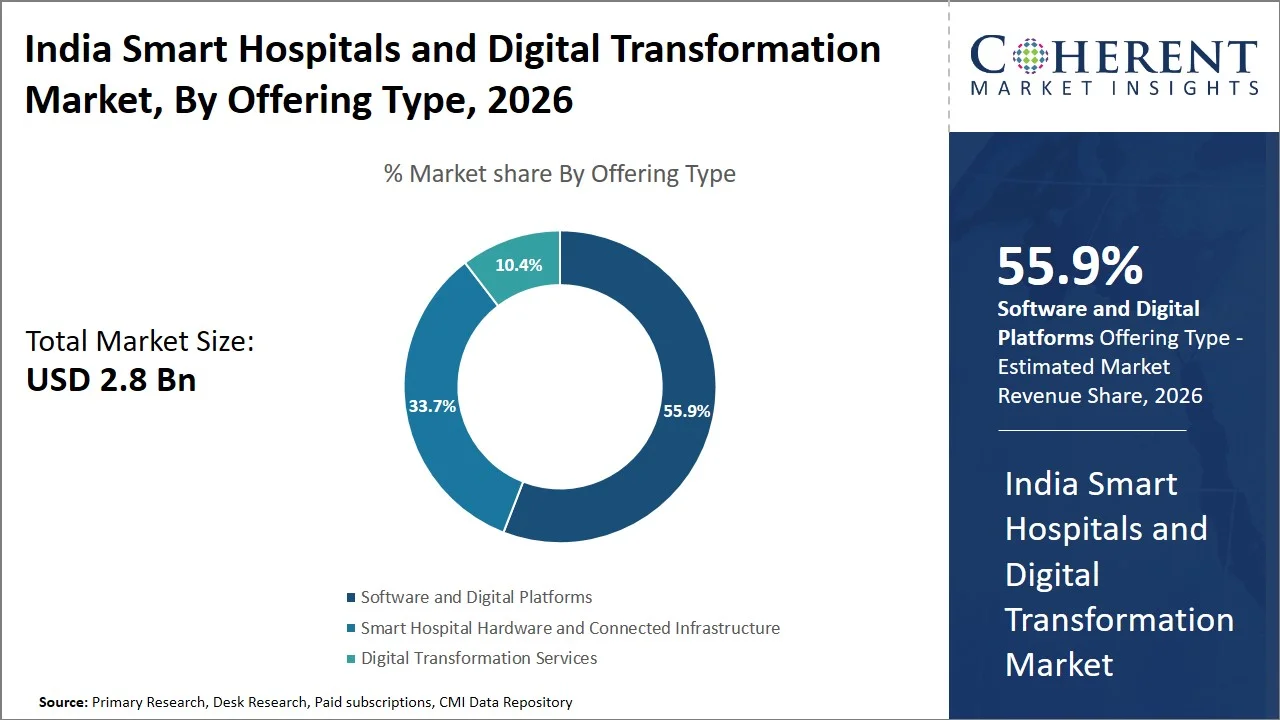
Why Do Software and Digital Platforms Dominate the India Smart Hospitals and Digital Transformation Market?
Software and digital platforms are projected to hold a market share of 55.9% in 2026, attributed to their capacity to centralize and interconnect clinical, financial, and administrative workflow processes to achieve value-driven and interoperable healthcare. These platforms enable electronic health records (EHRs), hospital information systems (HIS), digitally engage with patients and integrate AI-powered analytics to optimize hospital management, and foster collaboration between patients and healthcare providers. For instance, in October 2022, the National Health Authority (NHA) under Ayushman Bharat Digital Mission (ABDM), launched a new service named “Scan & Share” which will help patients and caregivers to be quickly on boarded on the hospital's Out Patient service queue through the ABHA linked QR code. The service will significantly boost the hospital’s software integrated outpatient workflow.
- Current Industry Events of 2026
- Market Size Estimation
- Regional Breakdown
- Competitive Landscape
- Customer Intelligence
- Segmental Analysis
- Pricing Analysis
- Key Market Drivers, Challenges & Future Trends
- Customized Insights Section
Why Does General and Multispecialty Hospitals Represent the Largest Type of Facilities Segment in the India Smart Hospitals and Digital Transformation Market?
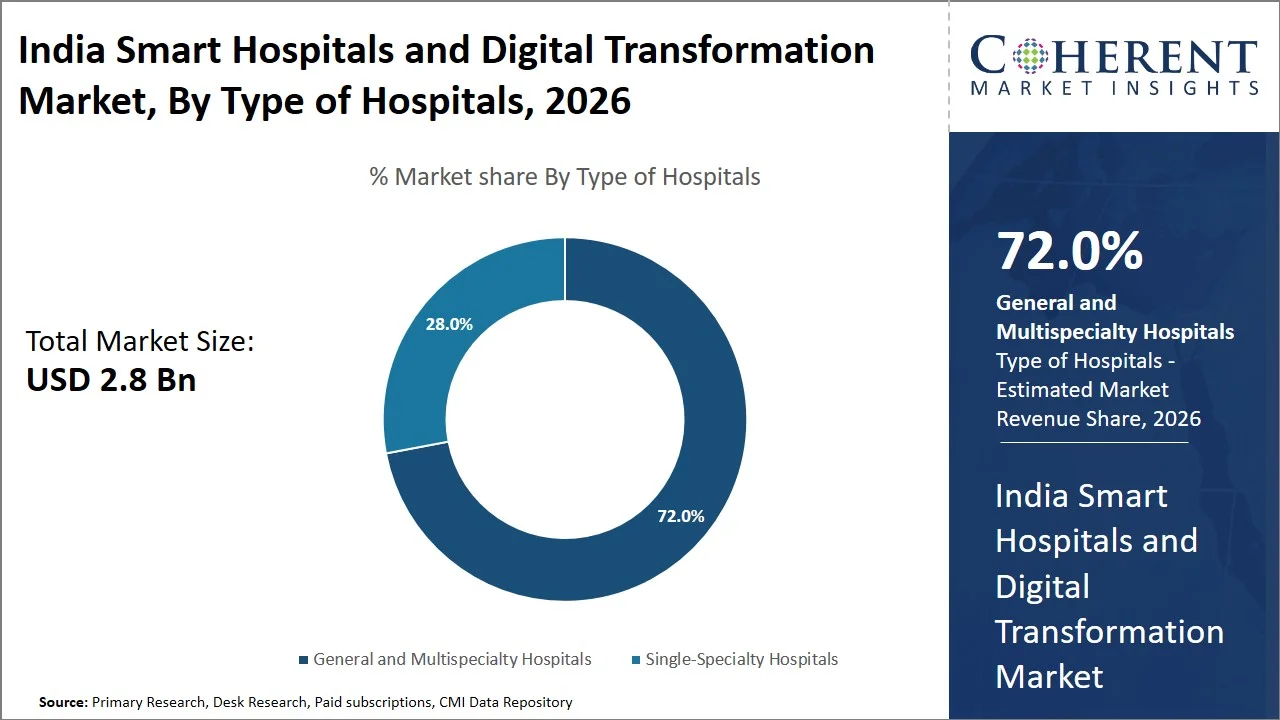
General and multispecialty hospitals are projected to hold 72.0% of the market share in 2026, due to larger patient turnover, multidisciplinary care coordination, and complicated workflows mandating the support of integrated and interoperable clinical systems. General and multispecialty hospitals in the country are adopting a variety of clinical applications and smart technologies including hospitals information systems (HIS) and clinical decision support systems (CDSS) to streamline hospital operations and clinical operations. For instance, National Accreditation Board for Hospitals & Healthcare Providers (NABH) introduced digital health accreditation programme for hospitals to assess hospitals digital infrastructure, Hospital Information Systems (HIS), Electronic Medical Records (EMRs), cybersecurity, protection of data privacy, patient’s consent related to data privacy, and decision-making in a clinical setup. This initiative was also synchronized with the ongoing national plans of Ayushman Bharat Digital Mission (ABDM), National Health Claims Exchange (NHCX) and the Digital India Mission.
Private Segment Dominates the India Smart Hospitals and Digital Transformation Market
The private segment is expected to hold 72.4% of the India smart hospitals and digital transformation market share in 2026, due to their higher financial flexibility and quicker technology uptake combined with persistent investments in digital health. These hospitals are quickly leveraging cloud-based Hospital Information Systems (HIS), AI based clinical software tools and business analytics to enhance their process efficiency and gain better clinical outcomes. For instance, In April 2025, Manipal Hospitals signed a partnership with Google Cloud to bring rapid innovation in AI for digital health in India by adopting secure cloud infrastructure, AI-assisted clinical documentation, Imaging Analytics, and patient engagement solutions across all the hospitals in their network.
Current Events and their Impact
Current Events | Description and its Impact |
National Health Authority (NHA) Announces National AI Policy for Healthcare and Launches NHA Digital Academy (April 2026) |
|
Ministry of Health & Family Welfare Strengthens Cybersecurity and Interoperability Under ABDM (August 2025) |
|
India Smart Hospitals and Digital Transformation Market Dynamics
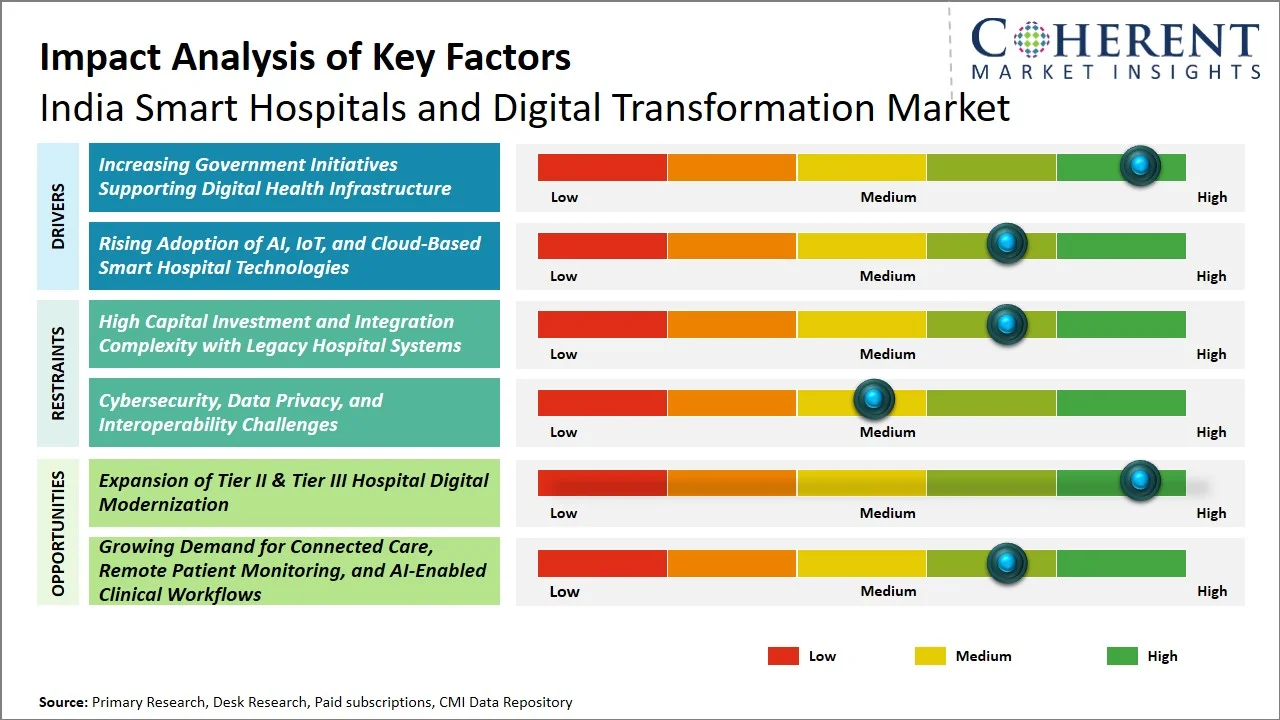
Market Drivers
Increasing Government Initiatives Supporting Digital Health Infrastructure
The Indian government's continued focus on strengthening digital health infrastructure is accelerating the adoption of smart hospital technologies and connected healthcare Policy initiatives promoting standardized electronic health records, interoperability, and secure health data exchange are enabling hospitals to modernize clinical workflows and improve care delivery. For instance, in September 2025, the Bureau of Indian Standards (BIS) released IS 17428:2025 – Digital Health Information Systems – Functional Requirements, establishing standardized requirements for digital health information systems to enhance interoperability, data quality, and healthcare IT implementation across hospitals. The standard is expected to support the wider deployment of smart hospital technologies in India.
Rising Adoption of AI, IoT, and Cloud-Based Smart Hospital Technologies
The growing adoption of AI, IoT, and cloud-based technologies is transforming hospital operations by enabling intelligent clinical workflows, connected medical devices, predictive diagnostics, and real-time patient monitoring. These technologies enhance care coordination, improve asset utilization, and support data-driven decision-making across healthcare facilities. For instance, in February 2026, the Ministry of Science & Technology announced the establishment of three Centres of Excellence (CoEs) on Artificial Intelligence for Healthcare under the Union Budget 2025–26, aimed at accelerating AI research, clinical innovation, and digital healthcare applications across India. The initiative is expected to support the next generation of smart hospital technologies.
Rising Investments in Healthcare Infrastructure Modernization
Rising investments in healthcare infrastructure modernization are accelerating the adoption of smart hospital technologies across India as healthcare providers upgrade facilities with intelligent medical devices, digital imaging, automated workflows, and integrated hospital information systems. These investments are enabling hospitals to improve operational efficiency, clinical decision-making, and patient experience. For instance, in February 2025, the Government of India announced the establishment of 200 Day Care Cancer Centres in district hospitals under the Union Budget 2025–26, supporting the modernization of healthcare infrastructure and creating opportunities for the deployment of digital health and smart hospital
Emerging Trends
Expansion of Digital Twins for Hospital Planning and Asset Management
Healthcare providers are beginning to adopt digital twin technology to create virtual replicas of hospital infrastructure, enabling predictive maintenance of medical equipment, optimization of facility operations, and simulation-based planning for capacity expansion. This trend is improving asset utilization while reducing operational downtime and maintenance costs.
Growing Adoption of Edge AI and Intelligent Medical Devices
Hospitals are increasingly integrating Edge AI-enabled medical devices capable of processing clinical data locally for real-time diagnostics, imaging analysis, and patient monitoring without relying solely on cloud infrastructure. This trend enhances response times, supports low-latency clinical decision-making, and strengthens data privacy within hospital environments.
Rise of Hospital Command Centers for Real-Time Operational Intelligence
Hospitals are increasingly deploying AI-powered command centers that consolidate data from clinical, diagnostic, bed management, and emergency departments into a single operational dashboard. These platforms enable real-time resource allocation, patient flow optimization, and predictive capacity management, improving hospital efficiency and reducing operational bottlenecks.
Key Regulatory Frameworks Accelerating Smart Hospital Adoption in India
Regulation / Initiative | Regulatory Authority | Key Focus | Impact on Smart Hospitals |
Ayushman Bharat Digital Mission (ABDM) | National Health Authority (NHA) | Digital health ecosystem & interoperability | Enables interoperable health records and connected care |
Electronic Health Record (EHR) Standards for India | Ministry of Health & Family Welfare | Standardized electronic health records | Facilitates seamless health information exchange |
Health Data Management Policy (HDMP) | National Health Authority | Consent management & health data privacy | Strengthens secure digital health data sharing |
Telemedicine Practice Guidelines | National Medical Commission (NMC) | Virtual healthcare delivery | Expands digital consultations and remote care |
Digital Personal Data Protection Act | Ministry of Electronics & IT (MeitY) | Personal data protection | Enhances cybersecurity and patient data governance |
How is the expansion of Tier II & Tier III hospital digital modernization creating new growth opportunities in the India smart hospitals and digital transformation market?
Digital transformation in hospital information systems, artificial-intelligence diagnostics tools, telemedicine technologies and the cloud platforms used by clinically- oriented medical devices and systems has become widely acknowledged in numerous hospitals in major tier- II and tier- III cities. Rapid expansion in infrastructure in these areas is poised to fuel the growth in India smart hospitals and digital transformational market segment. For instance, in June 2024, the National Health Authority (NHA), in collaboration with the Insurance Regulatory and Development Authority of India (IRDAI), launched the National Health Claims Exchange (NHCX) as a centralized system that aims to create an interoperable, digitally standardized system between hospitals, insurers, and governments to manage health insurance claims to shorten processing time and improve workflows within their smart hospitals.
Market Players, Key Development, and Competitive Intelligence
Key Developments
- In April 2026, Apollo Hospitals launched its 76th hospital, a 400-bed next-generation smart hospital in Hyderabad integrating AI-enabled clinical workflows, digital health platforms, and advanced medical technologies to enhance connected care and operational efficiency. The launch strengthens India's smart hospital ecosystem by accelerating the adoption of digitally integrated healthcare infrastructure and intelligent hospital management systems.
- In March 2026, Infosys announced the acquisition of Optimum Healthcare IT, a leading healthcare digital transformation and consulting firm, to strengthen its capabilities in AI-powered cloud, data, and healthcare IT transformation. The acquisition expands Infosys' expertise in electronic health records (EHRs), clinical applications, and provider-focused digital transformation, enabling healthcare organizations to accelerate smart hospital modernization and connected care initiatives.
- In December 2025, Trivitron Healthcare, in partnership with ResoHealth, launched Trivitron Digital.AI, a next-generation digital health platform designed to accelerate hospital digitization and clinical interoperability across India. The cloud-native platform integrates AI-powered automation, Laboratory Information Systems (LIS), Web-PACS, and Personal Health Records (PHR) to unify diagnostic, clinical, and administrative workflows while supporting global interoperability standards such as Health Level Seven (HL7), Fast Healthcare Interoperability Resources (FHIR), Digital Imaging and Communications in Medicine (DICOM), and Ayushman Bharat Health Account (ABHA).
Competitive Landscape
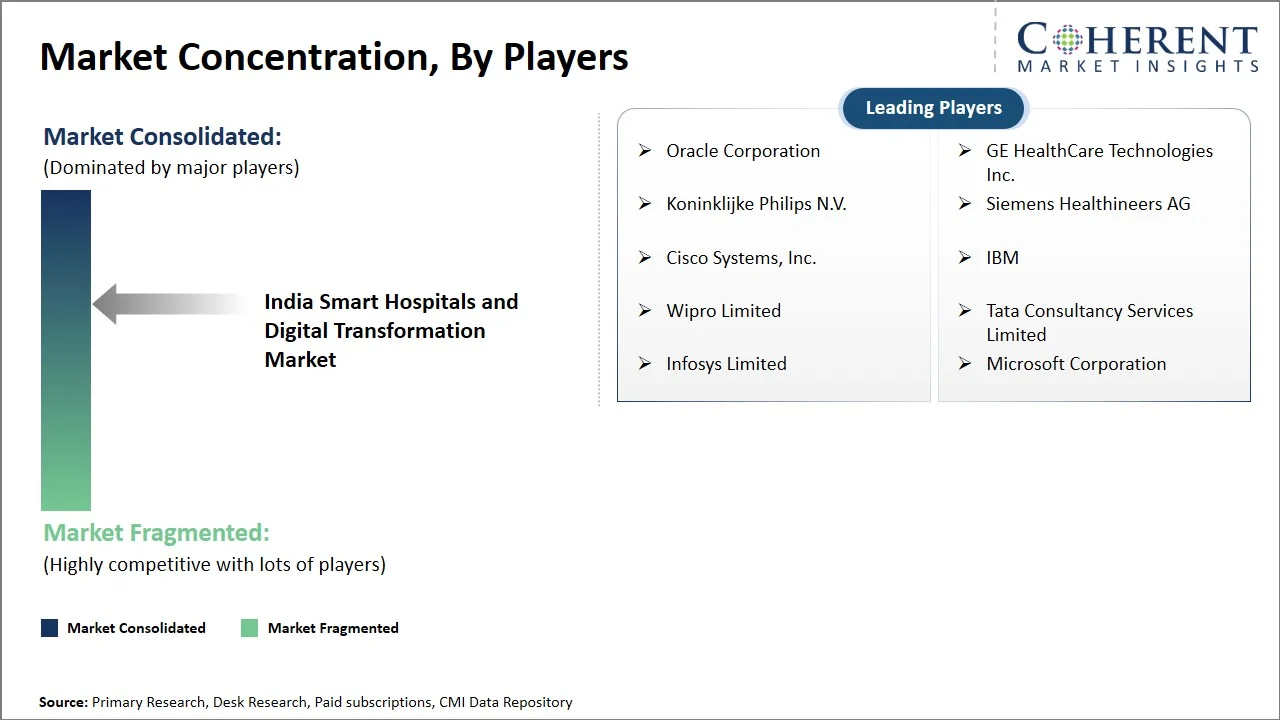
The India smart hospitals and digital transformation market is moderately consolidated, with competition centered on healthcare IT providers, medical technology companies, cloud solution vendors, and digital health platform developers. Market participants are strengthening their positions through AI-enabled healthcare solutions, interoperable hospital information systems, cloud-based digital platforms, and strategic collaborations with healthcare providers. Key focus areas include:
- Development of AI-powered clinical decision support and hospital automation solutions
- Expansion of interoperable Electronic Health Record (EHR) and Hospital Information System (HIS) platforms
- Strategic partnerships to strengthen cloud-based digital health ecosystems and smart hospital infrastructure
- Investment in cybersecurity, health data interoperability, and connected care technologies
Market Report Scope
India Smart Hospitals and Digital Transformation Market Report Coverage
| Report Coverage | Details | ||
|---|---|---|---|
| Base Year: | 2025 | Market Size in 2026: | USD 2.8 Bn |
| Historical Data for: | 2020 To 2024 | Forecast Period: | 2026 To 2033 |
| Forecast Period 2026 to 2033 CAGR: | 16.1% | 2033 Value Projection: | USD 7.9 Bn |
| Segments covered: |
| ||
| Companies covered: | Oracle Corporation, GE HealthCare Technologies Inc., Koninklijke Philips N.V., Siemens Healthineers AG, Cisco Systems, Inc., IBM, Wipro Limited, Tata Consultancy Services Limited, Infosys Limited, and Microsoft Corporation | ||
| Growth Drivers: |
| ||
| Restraints & Challenges: |
| ||
Analyst Opinion (Expert Opinion)
- In the coming years, the India smart hospitals and digital transformation market is expected to witness robust long-term growth as hospitals increasingly transition from standalone digital solutions to AI-enabled, interoperable, and data-driven healthcare ecosystems. Government-led digital health initiatives, expanding private healthcare investments, and the growing adoption of intelligent clinical technologies will accelerate the development of connected and patient-centric hospitals across the country.
- The maximum growth opportunity lies within software and digital platforms for general and multispecialty hospitals, particularly across Tier II and Tier III cities in India, where healthcare infrastructure modernization and digital adoption are gaining significant momentum. AI-enabled Hospital Information Systems (HIS), Electronic Health Records (EHRs), clinical decision support, and interoperability solutions are likely to witness the strongest demand.
- In order to create an advantage for themselves, the competitors should prioritize the development of ABDM-compliant, cloud-native, and interoperable platforms supporting standards such as HL7, FHIR, and DICOM. Strategic collaborations with hospital networks, scalable Software-as-a-Service (SaaS) deployment models, and investments in AI-driven workflow automation, cybersecurity, and predictive analytics will be critical differentiators in India's evolving smart hospital landscape.
Speak to the analyst
Want personalized insights?
Take the findings above to one of our principal consultants, or have the report rebuilt around the segments, geographies and competitors you actually track.
Market Segmentation
- Offering Type Insights (Revenue, USD Bn, 2021 - 2033)
- Software and Digital Platforms
- Smart Hospital Hardware and Connected Infrastructure
- Digital Transformation Services
- Type of Hospitals Insights (Revenue, USD Bn, 2021 - 2033)
- General and Multispecialty Hospitals
- Single-Specialty Hospitals
- Type Insights (Revenue, USD Bn, 2021 - 2033)
- Private
- Public
Sources
Primary Research Interviews
- Chief Information Officers (CIOs), Chief Digital Officers (CDOs), and Chief Technology Officers (CTOs) from multi-specialty and tertiary care hospitals
- Hospital administrators and digital transformation heads from private and government healthcare institutions
- Executives from Hospital Information System (HIS), Electronic Health Record (EHR), and healthcare IT solution providers
- Clinical informatics specialists, biomedical engineers, and healthcare interoperability experts
- AI, cloud computing, cybersecurity, and Internet of Things (IoT) solution providers serving the healthcare sector
Stakeholders
- Smart hospital technology providers and healthcare IT companies
- Multi-specialty hospitals, corporate hospital chains, and government hospitals
- Diagnostic centers and ambulatory healthcare providers
- Cloud service providers, system integrators, and managed IT service providers
- Medical device manufacturers and connected healthcare solution providers
- Health insurance companies and Third-Party Administrators (TPAs)
- End-use Sectors
- Multi-specialty hospitals
- Super-specialty hospitals
- Government hospitals
- Specialty clinics
- Diagnostic and imaging centers
- Ambulatory Surgical Centers (ASCs)
- Regulatory & Health Bodies
- Ministry of Health & Family Welfare (MoHFW), India
- National Health Authority (NHA)
- National Medical Commission (NMC)
- National Accreditation Board for Hospitals & Healthcare Providers (NABH)
- Ministry of Electronics and Information Technology (MeitY)
- Bureau of Indian Standards (BIS)
- Centre for Development of Advanced Computing (C-DAC)
Databases
- Ayushman Bharat Digital Mission (ABDM) Portal
- National Health Authority (NHA) Digital Health Repository
- National Digital Health Blueprint (NDHB)
- National Health Portal (NHP)
- Clinical Trials Registry – India (CTRI)
- National Programme for Prevention and Control of Non-Communicable Diseases (NP-NCD) Dashboard
Magazines
- Express Healthcare
- Healthcare Radius
- Medgate Today
- BioSpectrum India
- Medical Buyer
Journals
- Journal of Medical Systems
- International Journal of Medical Informatics
- Journal of Biomedical Informatics
- Journal of Healthcare Informatics Research
- BMJ Health & Care Informatics
Associations
- Healthcare Information and Management Systems Society (HIMSS India)
- NATHEALTH
- Association of Healthcare Providers (India) (AHPI)
- Confederation of Indian Industry (CII) – Healthcare Council
- Healthcare Federation of India (NAREDCO Healthcare)
Public Domain Sources
- Ministry of Health & Family Welfare (MoHFW)
- National Health Authority (NHA)
- Ministry of Electronics and Information Technology (MeitY)
- Bureau of Indian Standards (BIS)
- Press Information Bureau (PIB)
- National Medical Commission (NMC)
- National Accreditation Board for Hospitals & Healthcare Providers (NABH)
Proprietary Elements
- CMI Data Analytics Tool
- Proprietary CMI Existing Repository of information for last 10 years.
Get access to 250+ pages report
Every segment, forecast, competitor profile and data table behind the analysis above — available for instant download.
- ESOMAR Member
- ISO 9001:2015 Certified
- D-U-N-S Registered
- GDPR & CCPA Compliant
Missing comfort of reading report in your local language? Find your preferred language:
Transform your Strategy with Exclusive Trending Reports
Frequently Asked Questions
The India smart hospitals and digital transformation market is estimated to be valued at USD 2.8 Bn in 2026 and is expected to reach USD 7.9 Bn by 2033.
Software and digital platforms dominate due to their ability to integrate clinical, operational, and administrative workflows while enabling AI-driven analytics, interoperability, and real-time healthcare management.
Smart hospitals and digital transformation comprise advanced digital technologies and connected healthcare solutions that enhance hospital operations, clinical decision-making, and patient care through integrated, data-driven systems.
The CAGR of the India smart hospitals and digital transformation market is projected to be 16.1% from 2026 to 2033.
Increasing government initiatives supporting digital health infrastructure, and rising adoption of AI, IoT, and cloud-based smart hospital technologies are the major factors driving the growth of the India smart hospitals and digital transformation market.
High capital investment and integration complexity with legacy hospital systems, and cybersecurity, data privacy, and interoperability challenges are the major factors hampering the growth of the India smart hospitals and digital transformation market.
In terms of type of hospitals, general and multispecialty hospitals are estimated to dominate the market revenue share in 2026.