

Global Industrial Kiln Market Size and Forecast – 2026-2033
The Global Industrial Kiln Market is estimated to be valued at USD 7.12 Bn in 2026 and is expected to reach USD 10.57 Bn by 2033, exhibiting a compound annual growth rate (CAGR) of 5.8% from 2026 to 2033.
Key Takeaways of the Industrial Kiln Market
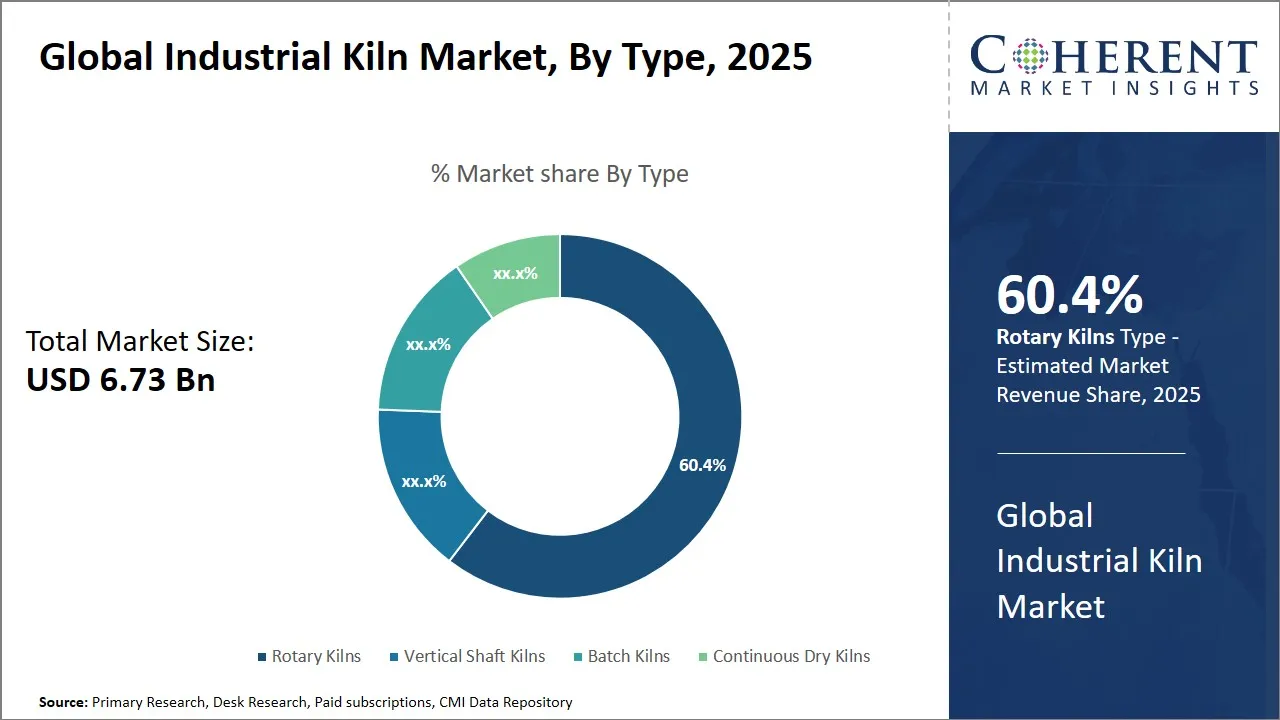
- The rotary kilns segment leads the market holding an estimated share of 61.4 % in 2026.
- The wood processing segment leads the market holding an estimated share of 45.8% in 2026.
- Asia Pacific is estimated to lead the market with a share of 44. 6% in 2026.
- North America, holding a share of 20. 3% in 2026, is projected to be the fastest growing region.
Market Overview
Key trends shaping the industrial kiln market include the adoption of energy-efficient and eco-friendly kiln technologies aimed at reducing carbon emissions. Digitalization and automation are playing a crucial role in enhancing process control, improving product quality, and reducing operational costs. Additionally, there is a growing focus on customized kiln solutions to meet specific industrial applications, while emerging economies present lucrative opportunities due to expanding manufacturing bases. Sustainability concerns continue to drive innovation and regulatory compliance in this sector.
Current Events and Its Impact
Current Events | Description and its impact |
Geopolitical and Trade Developments |
|
Economic and Infrastructure Trends |
|
Segmental Insights
- Current Industry Events of 2026
- Market Size Estimation
- Regional Breakdown
- Competitive Landscape
- Customer Intelligence
- Segmental Analysis
- Pricing Analysis
- Key Market Drivers, Challenges & Future Trends
- Customized Insights Section
Global Industrial Kiln Market Insights, by Type – Rotary Kilns Lead Due to their Versatility and Efficiency in Industrial Applications
Rotary kilns, holding an estimated share of 61.4% in 2026, dominate the global industrial kiln market. Unlike batch or vertical shaft kilns, rotary kilns provide consistent thermal treatment by allowing raw materials to move steadily through the rotating drum under controlled heat conditions, ensuring uniform processing. This efficiency translates to enhanced product quality and reduced energy consumption, a critical consideration for industrial players today.
Moreover, rotary kilns are highly customizable, accommodating various materials such as minerals, cement, and metals, which broadens their application base and market appeal. Their design flexibility allows for modifications in size, temperature range, and construction materials to meet specific industry requirements. Another contributing factor to their market share is the durability and longevity of rotary kilns, attributed to robust construction and maintenance support, which reduces downtime and operational costs over time.
Environmental regulations and the push towards sustainable industrial processes also underline rotary kilns' importance. Their ability to incorporate advanced control systems for emissions and waste heat recovery supports industrial compliance with increasingly stringent environmental standards. Finally, the increasing demand for refractory and high-quality industrial products globally continues to propel the adoption of rotary kilns.
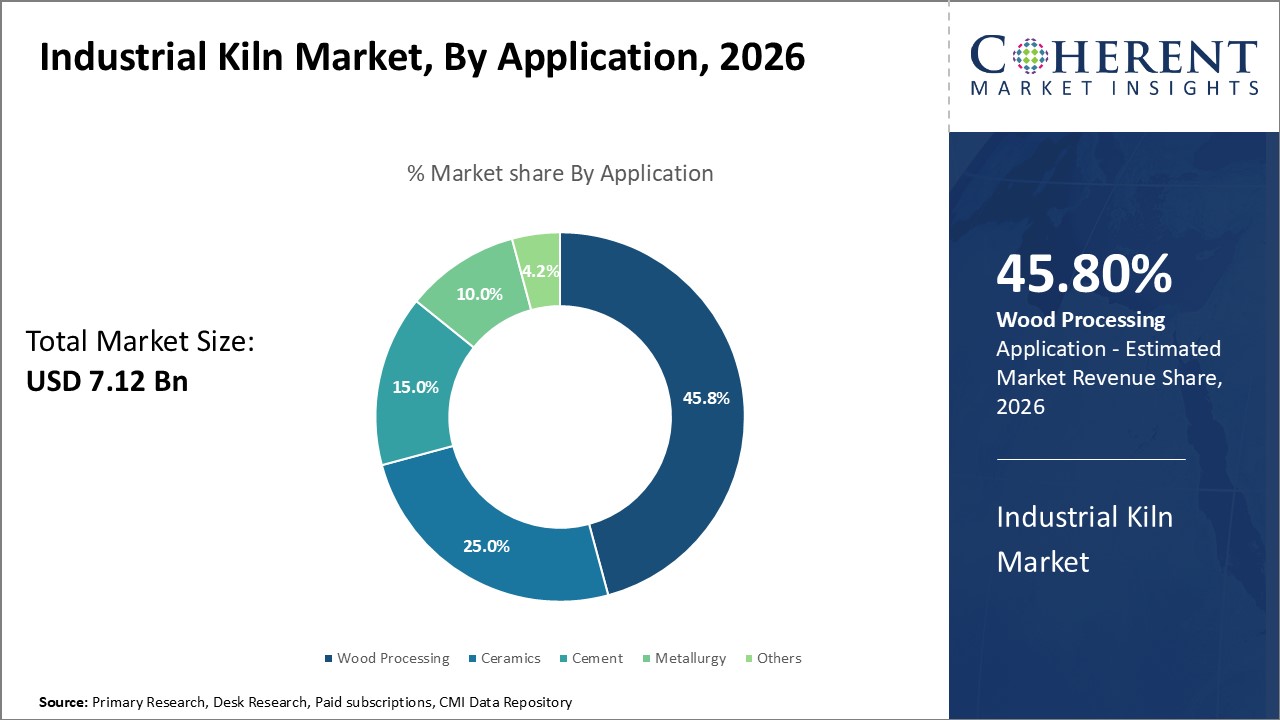
Global Industrial Kiln Market Insights, by Application – Wood Processing Leads the Market Driven by Growing Demand for Sustainable and High-Quality Timber Products
The wood processing segment is expected to hold the largest share of 45.8% in the global industrial kiln market in 2026. As the construction, furniture, and paper industries expand globally, the requirement for quality-treated wood has surged, upholding the significant market share of kiln application in wood processing. Industrial kilns specifically enable controlled drying processes that replace traditional air drying methods, substantially reducing the time required and improving the overall stability of the wood. This leads to superior mechanical properties and better resistance to warping or cracking, critical for applications where wood performance and longevity are non-negotiable.
Kiln drying is considered an environment-friendly process compared to chemical treatments, as it reduces the need for toxic preservatives and allows for natural protection of wood fibers. Furthermore, technological advancements in kiln design, such as energy-efficient heating systems and automated controls, have enhanced operational effectiveness while lowering energy consumption. Geographic expansion in regions with rich forestry resources and growing wood product manufacturing activity also underscores the prominence of this segment within the global industrial kiln market.
Price Analysis of the Industrial Kiln Market
Kiln Type | Typical Price Range (USD) |
Small Rotary Kiln | 3,000 – 15,000 |
Mid‑Scale Rotary Kiln | 12,000 – 45,000 |
Large‑Scale Rotary Kiln | 50,000 – 300,000+ |
Mini Gas/Electric Kiln | 7,500 – 65,000 (commercial) |
Vertical Shaft Kiln | 13,000 – 500,000 +; up to 10 Mn for 250–350 TPD units |
Lab/Specialty Furnaces | 3,000 – 33,000 |
Regional Insights

Asia Pacific Industrial Kiln Market Analysis and Trends
In the global industrial kiln market, Asia Pacific, holding an estimated share of 44.6% in 2026, is expected to hold the dominant position due to its vast industrial base and strong manufacturing ecosystem. Countries like China, India, Japan, and South Korea have well-established ceramics, cement, and metallurgy industries, which are primary users of industrial kilns. The region benefits from abundant raw materials, cost-effective labor, and progressive government initiatives aimed at industrial modernization and infrastructure development.
Additionally, increasing investment in renewable energy sources and environmental regulations have pushed manufacturers to adopt advanced, energy-efficient kiln technologies. Major players contributing to this dominance include Chinese companies such as Henan Zhengzhou Mining Machinery Co., and international firms like Thermax Ltd., which have significant manufacturing and R&D operations in the region, catering to both local and export markets. The region’s integrated supply chains and strong export orientation further reinforce its leadership in the market.
North America Industrial Kiln Market Analysis and Trends
North America, holding an estimated share of 20.3% in 2026, maintains the fastest growth in the industrial kiln market, propelled by technological advancements, infrastructure modernization, and a shift toward sustainable manufacturing practices. The U.S. and Canada are investing heavily in green infrastructure and clean energy, leading to increased demand for low-emission and electric kilns, particularly in the cement, ceramics, and advanced materials sectors. The revival of domestic manufacturing—fueled by government incentives such as the Inflation Reduction Act (IRA) and CHIPS Act—has further bolstered kiln demand in high-tech industries like semiconductors, aerospace ceramics, and EV battery components.
Manufacturers such as FLSmidth (U.S. operations) and L&L Special Furnace Co. are introducing smart kiln systems with IoT-enabled diagnostics and AI-based temperature control, enhancing operational efficiency and aligning with stringent EPA emission standards.
Industrial Kiln Market Outlook for Key Countries
China Industrial Kiln Market Analysis and Trends
China industrial kiln market is driven by its massive production capacity in cement, ceramics, and metallurgy. The country’s ongoing urbanization and infrastructure projects necessitate high-performance kiln technologies capable of handling large volumes with energy efficiency. Leading companies like Henan Zhengzhou Mining Machinery Co. and Jinan Huate Technology Co., Ltd. dominate local manufacturing, emphasizing innovation in rotary and tunnel kilns. Additionally, government emphasis on reducing industrial emissions has accelerated the adoption of cleaner, more efficient kilns, ensuring China remains at the forefront of the market.
India Industrial Kiln Market Analysis and Trends
India kiln market growth is powered by a diverse industrial base, including brick production, ceramics, cement, and mineral processing. Government initiatives promoting Make in India and infrastructure upgrades further boost the demand for industrial kilns. Key industry players such as Thermax Ltd. and L&T Technology Services provide tailored kiln solutions emphasizing energy efficiency and compliance with environmental norms. The country’s expanding construction sector and rural industrialization are critical drivers that sustain kiln market expansion with rising demand for customized and scalable kiln systems.
U.S. Industrial Kiln Market Analysis and Trends
The U.S. maintains leadership in advanced kiln technologies, particularly emphasizing automation, digital integration, and energy-efficient designs within ceramics, aerospace, and heavy metals industries. Large industrial kiln manufacturers such as FEECO International, North American Kilns, and Harrop Industries are pivotal for innovation, offering custom-built systems that cater to stringent regulatory standards and diverse industrial needs. The focus on sustainability and automation reflects the U.S. market’s maturation, supporting steady demand in specialized applications.
Germany Industrial Kiln Market Analysis and Trends
Germany industrial kiln market is synonymous with precision engineering and innovation, rooted in its robust manufacturing and automotive sectors. German companies like Ipsen International and LOI Thermprocess set global standards with advanced heat treatment, vacuum, and controlled atmosphere kilns. Government policies supporting industrial innovation and energy efficiency foster steady growth, supported by strong export capabilities. Germany’s focus on R&D and adherence to strict environmental policies ensures its industrial kiln solutions remain highly sought after internationally.
Saudi Arabia Industrial Kiln Market Analysis and Trends
Saudi Arabia represents a crucial growth engine for industrial kilns within the Middle East, underpinned by heavy investments in infrastructure and industrial diversification programs like Vision 2030. The nation’s expanding cement, petrochemical, and construction sectors drive the demand for both domestic production and imported kilns. Companies such as Al Babtain Power & Telecom and global suppliers like FIVES Group engage deeply with local projects, providing technology that meets regional environmental and industrial requirements. Enhanced logistics and trade facilitation contribute to Saudi Arabia’s rapidly evolving kiln market, emphasizing modernization and sustainability.
Market Players, Key Development, and Competitive Intelligence
Key Developments
- In April 2025, Nabertherm GmbH, headquartered in Lilienthal, Germany, introduced its LH..DB furnace range, tailored for thermal post-processing of metal additively manufactured components, as well as the debinding and sintering of ceramic parts. The furnace series is available in two different sizes, with oven volumes of 120 and 216 liters.
- In November 2023, Roca Group, the world leader in the design, production and commercialization of bathroom furnishings, invested in the world’s first electric tunnel kiln for ceramic sanitaryware. In an effort to decarbonize the inherent energy and carbon-intensive production of ceramic goods, the company has taken a decisive step towards electrifying its production processes at its Laufen plant in Gmunden (Austria) due to the cutting-edge technology from Keramischer OFENBAU, world technology leader in the manufacture of ceramic kilns.
- In September 2023, the world's first groundbreaking ammonia-hydrogen zero-carbon combustion kiln of DLT Technology commenced mass production application, officially entering operation at Monalisa Group.
- In June 2023, Metso launched RotarEkiln, an electrically powered, indirectly heated rotary kiln. The electric heating system of the RotarEkiln provides a sustainable alternative to the fuel-powered indirect rotary kilns available in the market.
Top Strategies Followed by Industrial Kiln Market Players
- Established players dominate the industry by heavily investing in research and development (R&D), continuously innovating to create high-performance, energy-efficient, and environment-friendly kiln solutions that meet evolving industrial demands.
- FLSmidth has committed over USD 30 million annually to kiln technology R&D as part of its "MissionZero" initiative. It developed the FUELFLEX Pyrolyzer and the zero-emission electric ZE-Kiln, aiming to decarbonize cement production.
- Mid-level companies in the industrial kiln market strategically position themselves by offering cost-effective solutions that strike a balance between quality and affordability
- Nutec Bickley offers modular kiln systems and customizable refractory insulation to reduce cost per unit. In 2024, it introduced a gas-electric hybrid shuttle kiln designed for ceramics producers in India and Vietnam, priced 18–25% lower than European equivalents.
- Meanwhile, small-scale players carve out a competitive niche by specializing in unique features or innovative kiln designs that address specific market demands
- Adams Kilns specializes in continuous kilns for precision aerospace and ceramics processing.
Market Report Scope
Industrial Kiln Market Report Coverage
| Report Coverage | Details | ||
|---|---|---|---|
| Base Year: | 2025 | Market Size in 2026: | USD 7.12 Bn |
| Historical Data for: | 2020 To 2024 | Forecast Period: | 2026 To 2033 |
| Forecast Period 2026 to 2033 CAGR: | 5.8% | 2033 Value Projection: | USD 10.57 Bn |
| Geographies covered: |
| ||
| Segments covered: |
| ||
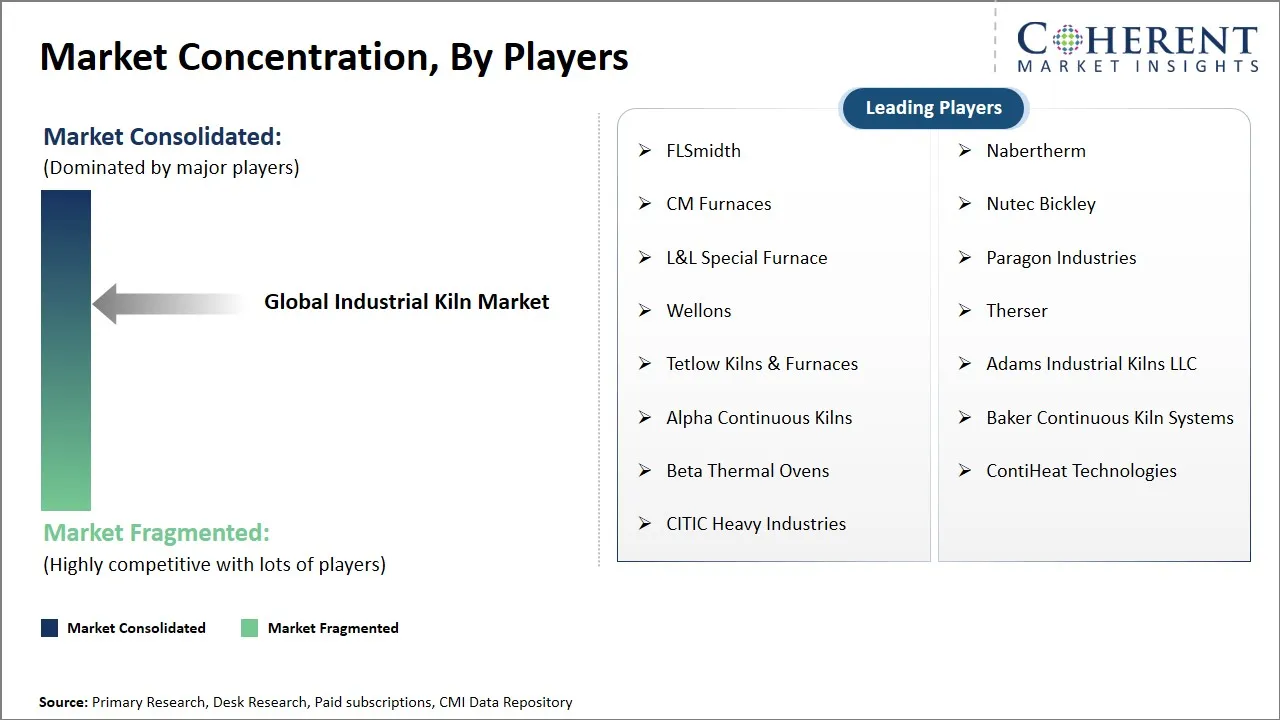
| Companies covered: | FLSmidth, Nabertherm, CM Furnaces, Nutec Bickley, L&L Special Furnace, Paragon Industries, Wellons, Therser, Tetlow Kilns & Furnaces, Adams Industrial Kilns LLC, Alpha Continuous Kilns, Baker Continuous Kiln Systems, Beta Thermal Ovens, ContiHeat Technologies, and CITIC Heavy Industries | ||
| Growth Drivers: |
| ||
| Restraints & Challenges: |
| ||
Market Dynamics
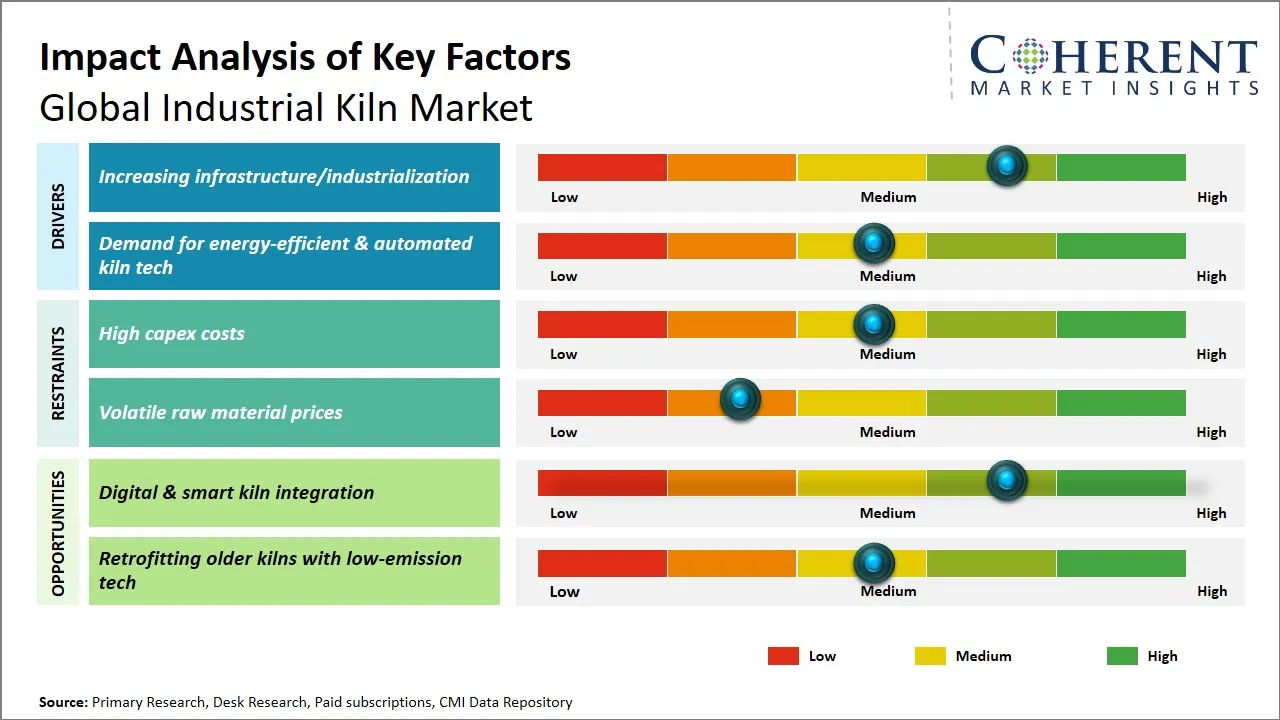
Global Industrial Kiln Market Driver – Increasing Infrastructure/Industrialization
As countries invest heavily in constructing power plants, cement factories, steel manufacturing units, ceramics production, and other heavy industries, the requirement for advanced thermal processing equipment intensifies. Industrial kilns, which are integral for heat treatment, calcination, drying, and sintering processes, are essential components for these sectors to enhance production efficiency and product quality. India's National Infrastructure Pipeline (NIP) – Ongoing through 2025, with a projected outlay of USD 1.4 trillion, focuses on building highways, smart cities, industrial corridors, and housing.
Rapid urbanization further exacerbates the need for new roads, bridges, and buildings, propelling large-scale industrial projects that rely extensively on kiln operations. Moreover, expanding manufacturing capabilities in developing regions stimulate demand for versatile and energy-efficient kilns to meet rigorous quality standards while reducing operational costs.
Global Industrial Kiln Market Opportunity – Digital & Smart Kiln Integration in the Global Industrial Kiln Market
As industries increasingly adopt Industry 4.0 principles, there is a rising demand for intelligent kiln systems equipped with IoT sensors, automation, and advanced data analytics, which enable real-time monitoring and precise control of kiln operations. These smart kilns facilitate enhanced energy efficiency by optimizing temperature cycles and reducing fuel consumption, thereby lowering operational costs and minimizing environmental impact. Nabertherm GmbH (Germany), active in APAC & North America, launched its “Nabertherm Control Centre” in 2024 – a cloud-based kiln monitoring platform that allows remote control, energy use tracking, and fault diagnostics via smartphone or desktop.
Additionally, digital integration supports predictive maintenance by analyzing equipment performance and identifying potential failures before they occur, leading to reduced downtime and improved asset longevity. The ability to remotely control and monitor kiln systems also offers improved safety standards and operational flexibility, particularly in hazardous industrial environments. Furthermore, regulatory pressures on emission reductions and increasing customer expectations for sustainable manufacturing solutions are driving manufacturers to adopt smart kiln technologies.
Analyst Opinion (Expert Opinion)
- The cement industry remains the core demand driver for industrial kilns, especially rotary types, as nations push for infrastructure development. In emerging economies like India, Indonesia, and Vietnam, rapid urbanization and government-led infrastructure programs are triggering expansion of kiln capacity. Cement manufacturers are upgrading to high-efficiency kilns to cope with emission standards while ramping up output. The demand here is long-term and volume-driven, with replacement cycles and greenfield projects ensuring stability.
- Ceramic production—ranging from traditional pottery to advanced industrial ceramics—has seen a technological shift post-COVID, especially in Asia Pacific. Countries like China, South Korea, and Japan are investing in electric and hybrid kilns to decarbonize and digitalize ceramic firing processes. Meanwhile, in Europe and North America, the push toward artisanal and medical ceramics is increasing demand for smaller, precise, and digitally controlled kilns, boosting growth in the mid-range kiln segment.
- Industrial kilns are increasingly used for high-temperature sintering in sectors like battery materials, defense composites, and aerospace ceramics. These applications demand tight temperature control and non-standard kiln configurations, opening a high-margin opportunity for specialized kiln manufacturers. In North America and Europe, startups and R&D centers are procuring custom kilns for lithium-ion battery cathode production, while aerospace firms require advanced furnaces for sintering ceramic matrix composites—pointing to a new frontier in kiln demand beyond legacy sectors.
Speak to the analyst
Want personalized insights?
Take the findings above to one of our principal consultants, or have the report rebuilt around the segments, geographies and competitors you actually track.
Market Segmentation
- Type Insights (Revenue, USD Bn, 2021 - 2033)
- Rotary Kilns
- Vertical Shaft Kilns
- Batch Kilns
- Continuous Dry Kilns
- Application Insights (Revenue, USD Bn, 2021 - 2033)
- Wood Processing
- Ceramics
- Cement
- Metallurgy
- Others
- Regional Insights (Revenue, USD Bn, 2021 - 2033)
- North America
- U.S.
- Canada
- Latin America
- Brazil
- Argentina
- Mexico
- Rest of Latin America
- Europe
- Germany
- U.K.
- Spain
- France
- Italy
- Russia
- Rest of Europe
- Asia Pacific
- China
- India
- Japan
- Australia
- South Korea
- ASEAN
- Rest of Asia Pacific
- Middle East
- GCC Countries
- Israel
- Rest of Middle East
- Africa
- South Africa
- North Africa
- Central Africa
- North America
- Key Players Insights
- FLSmidth
- Nabertherm
- CM Furnaces
- Nutec Bickley
- L&L Special Furnace
- Paragon Industries
- Wellons
- Therser
- Tetlow Kilns & Furnaces
- Adams Industrial Kilns LLC
- Alpha Continuous Kilns
- Baker Continuous Kiln Systems
- Beta Thermal Ovens
- ContiHeat Technologies
- CITIC Heavy Industries
Sources
Primary Research Interviews
Stakeholders
- Cement and Lime Producers (e.g., Production Heads, Kiln Operators)
- Industrial Furnace & Kiln Manufacturers (e.g., FLSmidth, Nutec Bickley, L&L Special Furnace Co.)
- Energy and Process Engineers in Glass, Ceramics, and Metallurgy Sectors
- Technical Heads from Construction and Material Science Divisions
- EPC Contractors managing rotary kiln installations
- Sustainability Consultants and Emissions Auditors specializing in high-temperature industries
Databases
- Industrial Equipment Intelligence Archive (IEIA)
- Global Infrastructure Monitor (GIM)
- Materials Engineering Data Exchange (MEDEX)
- Manufacturing Output Index Tracker (MOIT)
Magazines
- Thermal Processing Monthly
- KilnTech World Journal
- Industrial Ceramics Magazine
- Cement & Materials Insight
Journals
- Journal of High-Temperature Processing & Applications
- Advanced Materials Manufacturing Review
- International Journal of Industrial Heat Systems
- Journal of Sustainable Cement Practices
Newspapers
- Global Manufacturing Times
- Engineering Business Daily
- Asia Pacific Construction Chronicle
- North American Industrial Tribune
Associations
- World Kiln Manufacturers Association (WKMA)
- Asia Cement Technology Council (ACTC)
- North American Kiln Engineering Forum (NAKEF)
- Global Federation of Ceramic Engineers (GFCE)
- Rotary Kiln Users and Manufacturers Consortium (RKUMC)
Public Domain Sources
- U.S. Energy Information Administration (EIA)
- EU Industrial Emissions Database (EUID)
- Ministry of Heavy Industries (India)
- United Nations Industrial Development Organization (UNIDO)
- World Cement Association Publications
Proprietary Elements
- CMI Data Analytics Tool, Proprietary CMI Existing Repository of Information for Last 8 Years
Get access to 250+ pages report
Every segment, forecast, competitor profile and data table behind the analysis above — available for instant download.
- ESOMAR Member
- ISO 9001:2015 Certified
- D-U-N-S Registered
- GDPR & CCPA Compliant
Missing comfort of reading report in your local language? Find your preferred language:
Transform your Strategy with Exclusive Trending Reports
Frequently Asked Questions
The global industrial kiln market is estimated to be valued at USD 7.12 billion in 2026 and is expected to reach USD 10.57 billion by 2033.
The CAGR of the global industrial kiln market is projected to be 5.8% from 2026 to 2033.
Increasing infrastructure/industrialization and demand for energy-efficient & automated kiln tech are the major factors driving the growth of the global industrial kiln market.
High capex costs and volatile raw material prices are the major factors hampering the growth of the global industrial kiln market.
In terms of type, the rotary kilns segment is estimated to dominate the market revenue share in 2026.
Modern industrial kilns are highly efficient, with energy efficiency improvements of up to 20–30% over legacy systems, due to better insulation, automation, and heat recovery technologies. Smart kilns can also optimize fuel usage and reduce emissions through real-time control systems.
Fuels used in industrial kilns include natural gas, electricity, coal, petroleum coke, and increasingly, alternative fuels like biomass, hydrogen blends, or waste-derived fuels, depending on the kiln type and industry.