

Global Inverter Market Size and Forecast – 2026-2033
The Global Inverter Market is estimated to be valued at USD 29.58 Bn in 2026 and is expected to reach USD 85.63 Bn by 2033, exhibiting a compound annual growth rate (CAGR) of 16.4% from 2026 to 2033.
Key Takeaways of the Global Inverter Market
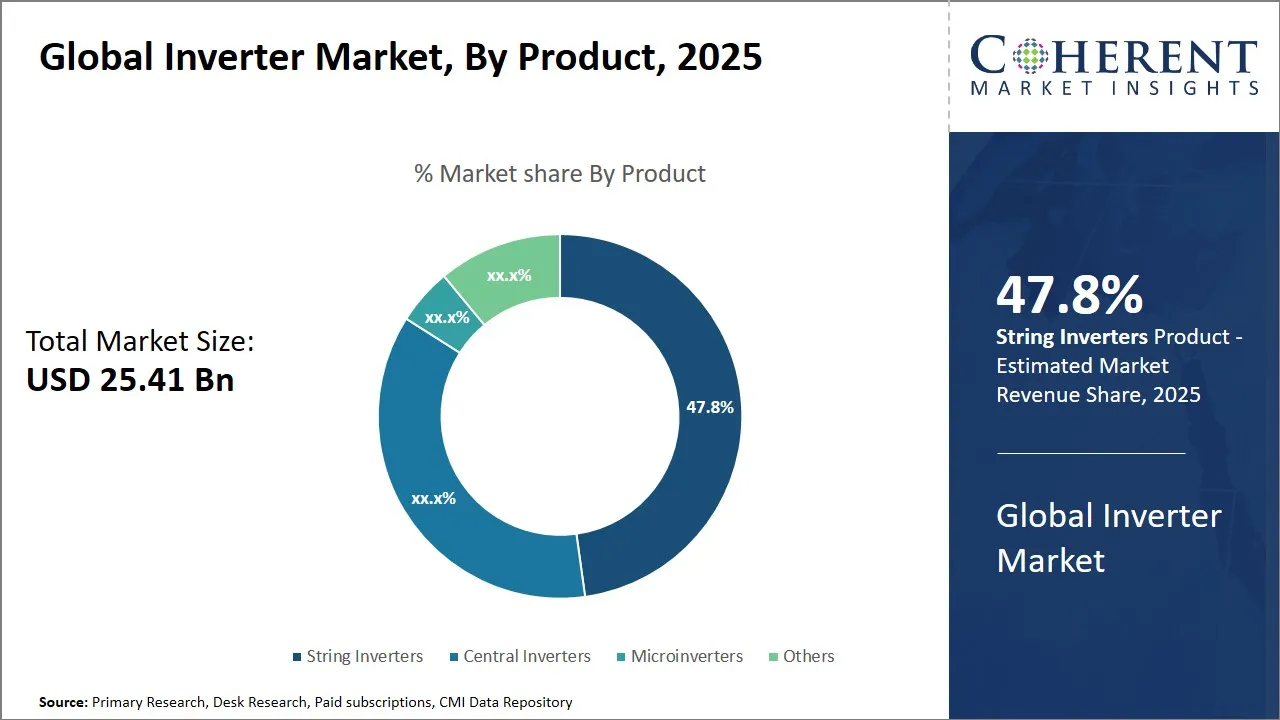
- The string inverters segment is expected to lead the market, holding a share of 48.8 % in 2026.
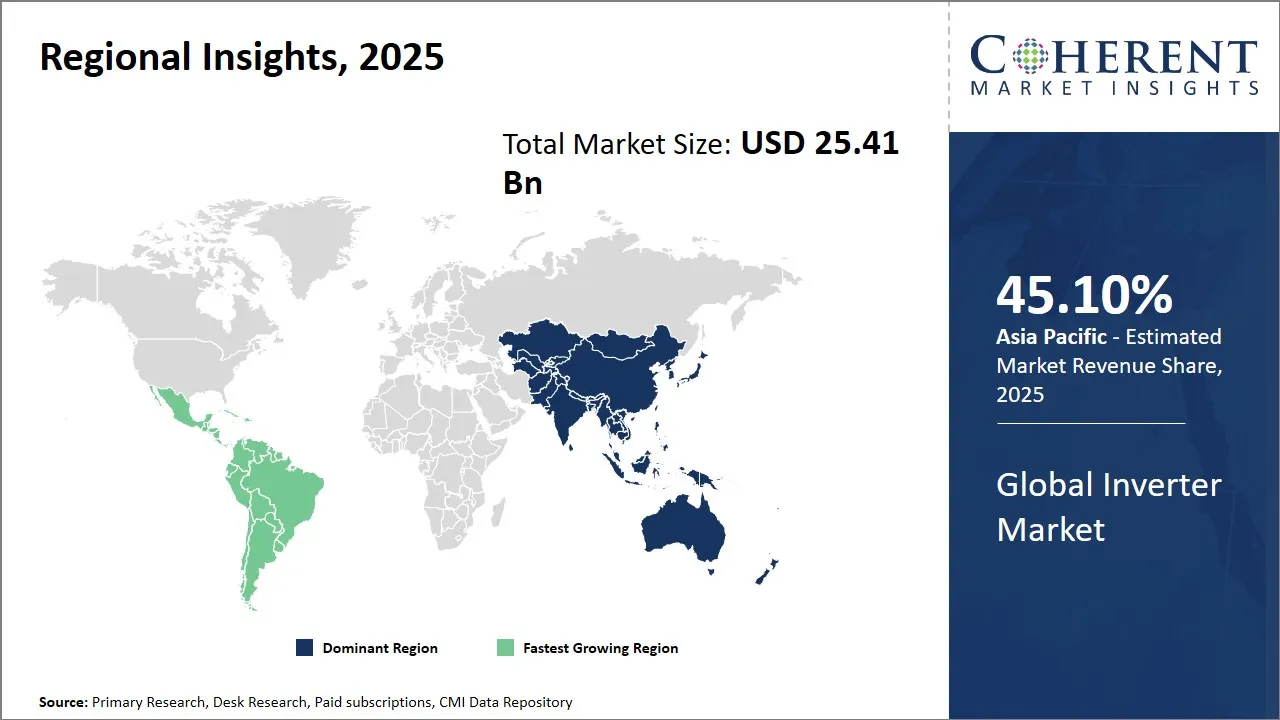
- Asia Pacific, expected to hold a share of 45.1 % in 2026, is projected to dominate the market.
- Latin America, projected to hold a share of 7.3% in 2026, shows the fastest growth in the market.
Market Overview
The market is seeing fast integration of smart inverter technologies that enhance energy management and grid stability, as well as advancements in power electronics driving higher efficiency and reduced costs in inverter production. Also, the rise in solar PV modules and the growing focus on sustainable and green energy sources are prominent factors propelling market expansion. The use of electric vehicles and the need for reliable power conversion also underscore the inverter market’s promising outlook.
Current Events and Its Impact
Current Events | Description and its Impact |
NATO air & missile defense expansion (Eastern flank modernization) |
|
South China Sea military exercises & airspace tensions |
|
Segmental Insights
- Current Industry Events of 2026
- Market Size Estimation
- Regional Breakdown
- Competitive Landscape
- Customer Intelligence
- Segmental Analysis
- Pricing Analysis
- Key Market Drivers, Challenges & Future Trends
- Customized Insights Section
Global Inverter Market Insights, By Product – String Inverters Lead Owing to their Cost-Effectiveness and Efficiency in Solar Energy Conversion
String inverters, projected to hold 48.8% of the market in 2026, remain the dominant segment because they provide the best balance of cost, efficiency, and installation simplicity for residential and commercial PV systems. Their ability to connect multiple panels in series reduces system design complexity and lowers both upfront and long-term maintenance costs compared to central inverters and microinverters.
Modern string inverters also benefit from advanced Maximum Power Point Tracking (MPPT) technology, improved reliability, and broad compatibility with different PV module types, making them suited for the fast-growing rooftop solar segment. Their small design and easy integration further add to adoption across small-to-medium-scale installations.
SMA Solar Technology’s Sunny Boy & Sunny Tripower string inverter series, widely used in residential and commercial PV projects across Europe and the U.S., demonstrates how cost-effective, high-efficiency string inverters continue to dominate global solar deployments.
Pricing Analysis of the Inverter Market
Item | Typical unit price (USD) | Low (USD) | High (USD) | Unit |
Fighter-aircraft AESA fire-control radar (e.g., AN/APG-81 class) | USD 5,000,000 | USD 3,000,000 | USD 8,000,000 | per radar |
Airborne multi-mode AESA (tanker/AEW/ISR class, mid-size) | USD 1,000,000 | USD 500,000 | USD 3,000,000 | per radar unit |
Naval/shipboard AESA family (per-ship installation, e.g., AN/SPY-6 scale) | USD 100,000,000 | USD 20,000,000 | USD 300,000,000 | per shipset |
Land-based Theater/Long-Range AESA (LTAMDS/long-range air-defense radar) | USD 130,000,000 | USD 60,000,000 | USD 200,000,000 | per system |
Over-the-Horizon (OTH) radar program (national scale) | USD 4,000,000,000 | USD 500,000,000 | USD 6,000,000,000+ | major program/national installation |
Coastal Surveillance Radar (land-based, fixed/site, medium range, turnkey) | USD 500,000 | USD 50,000 | USD 20,000,000 | per installed site |
Counter-UAS surveillance radar (compact, portable to fixed) | USD 150,000 | USD 10,000 | USD 2,000,000 | per system |
Surveillance/primary radar (land border/airport class, mid capability) | USD 2,000,000 | USD 300,000 | USD 10,000,000 | per system) |
Radar transmit/receive (T/R) module — GaN-based (military grade) | USD 3,000 | USD 300 | USD 50,000 | per T/R module |
GaN RF power device (discrete GaN transistor/IC) | USD 50 | USD 5 | USD 500 | per part |
Automotive 4D mmWave radar module (Tier-1 module: automotive supply quality) | USD 140 | USD 20 | USD 300 | per module |
mmWave Radar-on-Chip/mmWave SoC (TI family) — per chip (1k qty list) | USD 22 | USD 8 | USD 50 | per silicon die/radar SoC |
Small 60 GHz hobby/module sensor (development board) | USD 60 | USD 30 | USD 200 | per module |
Complete coastal surveillance suite (multi-sensor + C2 + comms) — turnkey (govt contract) | USD 5,000,000 | USD 500,000 | USD 50,000,000 | per region/multi-site turnkey package |
Small commercial radar (maritime shipborne, compact X-band) | USD 200,000 | USD 40,000 | USD 1,000,000 | per unit |
Solar Inverters & Rooftop Solar Surge
Aspect | String inverters | Microinverters | Hybrid inverters | Smart monitoring (system-level) |
Short description | Centralized inverter that serves a string (strings of panels) — single MPPT per string or multiple-MPPT per inverter. | One small inverter per panel (module-level power electronics). Each panel has its own MPPT. | Inverter that can manage PV + battery (Bi-directional; grid-tie + storage), often supports backup/ESS. | Cloud/edge dashboards, data logging, remote control, alerts, firmware updates and analytics (can be supplied by inverter OEM or third party). |
Typical installed market role | Residential & C&I where panels face similar orientation and shading is limited; dominant by value/volume in many regions. | Best for complex roofs, shading, high mismatch, panel-level monitoring, and residential with premium ADAS features. | Growing for residential + C&I where battery pairing or islanding capability is required. | Increasingly mandatory for warranty, performance guarantees, O&M and VPP/grid services; expected to be included with most modern inverters. |
Pros (major) | Lower cost per kW; mature, high-efficiency options; simpler replacement/servicing at inverter level. | Higher energy harvest in mismatch/shade; easier panel-level troubleshooting; safer DC isolation options. | Enables self-consumption and backup, supports time-shifting and grid services; consolidates PV+storage. | Remote O&M lowers operating cost, provides performance guarantees, enables VPP participation and firmware security patches. |
Cons (major) | Single point of failure for string; lower per-panel visibility; harvest suffers under partial shading. | Higher BOM & installation cost per W; more points of failure (but distributed); historically higher upfront cost (falling). | Larger upfront cost vs simple on-grid inverter; complexity in controls and warranty terms. | Adds cyber-attack surface if not secured; requires connectivity and may incur subscription fees. (Notable vulnerabilities reported across some vendors). |
Typical price range (residential scale, indicative USD) | USD 0.08–USD 0.25/W installed for inverter hardware portion (string inverter only). | USD 0.15–USD 0.40/W (module-level cost; includes microinverter hardware); higher for Enphase/ premium brands. | USD 0.20–USD 0.60/W (includes hybrid controls + battery-ready hardware). | Monitoring/platform fees: USD 0–USD 5+/month per system; enterprise/utility telemetry much higher. |
Market share | Still dominant globally by volume/value for distributed & C&I; used widely across APAC, LATAM, EU. (Estimate: majority share in many market reports). | Rapid growth: microinverter market ~USD 4–4.7B in 2024 and strong CAGR (double-digit forecasts); rising penetration in N.A. & Australia. (market size 2024 compendia). | Hybrid inverter market valued in the multiple billions (2024–25) and forecast strong CAGR as storage adoption rises (reports show USD ~10B+ 2025 valuation in some trackers). | Smart-connectivity/telemetry increasingly standard; “smart inverter connectivity” analyses project strong growth as monitoring/telemetry and VPP features expand. |
Best-fit roof & site | Large, simple roofs; ground-mounted string arrays; sites where cost-per-watt matters most. | Small/complex roofs, multiple orientations, heavy shading, high-value residential where per-panel optimization matters. | Homes aiming for islanding/backup, time-of-use arbitrage, or future-proofing for EV+storage. | All systems: essential for remote troubleshooting, warranty compliance and performance analytics; critical for commercial O&M. |
Installation complexity | Medium — single inverter location, simpler cabling. | Higher — many module-level devices to mount and wire, but simpler DC string runs. | Medium–High — battery integration, safety interlocks, AC-coupling/DC-coupling choices. | Low installation overhead; requires comms (Wi-Fi/Ethernet/RS485/Gateway) and proper cybersecurity hygiene. |
Typical warranty/reliability notes | 5–12 years (extendable to 15–20 yrs with paid warranty). | Often 10–25 years (many microinverter makers offer long product warranties as selling point). | Warranties vary — inverter & battery separately warranted; hybrid inverters often 5–10 yrs standard, extendable. | Monitoring platforms often tied to warranty/updates; firmware support windows matter for security & performance. |
Notable vendors (examples) | Sungrow, Huawei, Fronius, SMA, Growatt, GoodWe. | Enphase (market leader in micro), SolarEdge (via Optimizers + inverters historically), APsystems, Hoymiles. | SolarEdge (StorEdge historically), Sungrow, SMA, Growatt, Huawei, Fronius. | SolarEdge monitoring (HD), Enphase Envoy + Enlighten, Fronius Solar.web, Huawei FusionSolar, OEM/third-party platforms (also OpenEMS, etc.). |
Key trend/takeaway | Cost-sensitive installations still favor strings — but string inverters are adding module-level power electronics (MLPE) options (optimizers) to close the gap. | Microinverters gaining in residential markets with complex roofs; price declines and warranty terms are accelerating adoption (but shipment volatility seen). | Hybrid market is the fastest-growing subsegment as household storage adoption and grid services expand — policies & incentives for storage accelerate this. | Monitoring is a de-facto requirement for modern installations (O&M, warranties, VPP). Security hardening and lifecycle firmware updates are now a procurement checklist after vulnerability disclosures |
Energy Storage & Hybrid/Smart Inverters
Category | Description | Key Smart Features |
Hybrid Inverters (Solar + Battery) | Inverters capable of managing solar PV generation and battery storage simultaneously |
|
DC-Coupled Hybrid Inverters | PV array connected directly to the battery through the inverter (higher efficiency) |
|
AC-Coupled Hybrid Inverters | Allows retrofit installation with existing PV systems |
|
Smart ESS Inverters (Battery Inverters) | Dedicated battery inverters for energy management in ESS setups |
|
All-in-One ESS + Hybrid Inverter Systems | Integrated battery + inverter in one enclosure |
|
Industrial Hybrid Inverters (Three-Phase) | Hybrid inverters for C&I and small utility-scale systems |
|
Utility-Scale Hybrid PCS (Power Conversion Systems) | Grid-scale inverter systems connected to large ESS installations |
|
Smart Microgrid Inverters | Inverters designed for decentralized grids and remote areas |
|
IoT-Enabled Smart Inverters (Any Type) | Any inverter with embedded connectivity and analytics |
|
Regional Insights
Asia Pacific Inverter Market Analysis and Trends
Asia Pacific, expected to hold a share of 45.1% in 2026, dominates the global inverter market, stemming from a robust manufacturing ecosystem, abundant raw material availability, and significant adoption of renewable energy, particularly solar power. Countries such as China, India, Japan, and South Korea have established strong industrial bases with major inverter manufacturers like Huawei, Sungrow, and Delta Electronics headquartered here.
Government initiatives focused on clean energy adoption—such as China’s Renewable Energy Law and India’s National Solar Mission—provide substantial policy support encouraging inverter deployment for solar and industrial applications. Also, Asia Pacific benefits from well-developed supply chains and trade dynamics that make possible cost-effective production and export, adding to its leadership position. The presence of a large consumer base in both residential and commercial sectors further makes demand for inverters in energy storage, grid management, and electric vehicles.
Latin America Inverter Market Analysis and Trends
Latin America, expected to hold a share of 7.3% in 2026, is becoming a high-growth region in the global inverter market, because of rising renewable energy investments, favorable policy reforms, and strong demand for distributed solar. Brazil, Mexico, and Chile lead the market with large-scale solar and wind projects, making demand for utility-grade inverters and hybrid PCS systems.
Growth is further supported by Brazil’s fast growing rooftop PV market, enabled by net-metering policies and competitive pricing, which boosts adoption of residential and C&I string and hybrid inverters. In addition, grid instability and increasing interest in energy independence are accelerating the uptake of battery-coupled systems across the region.
Rural electrification programs in Central America and the Andean region also support growing deployment of off-grid and mini-grid inverters. Improved investment frameworks and public–private partnerships attract global manufacturers such as SMA, Huawei, Fronius, and GoodWe, adding to technology availability and market competitiveness across Latin America.
Global Inverter Market Outlook for Key Countries
China Inverter Market Analysis and Trends
China inverter market continues to lead because of its vast production capabilities, government subsidies, and export orientation. As the world’s largest producer and consumer of solar panels, China boasts key players like Huawei and Sungrow, whose innovative string inverters and energy storage solutions dominate both domestic and international markets. The government’s commitment to peak carbon emissions before 2030 adds to continuous investment in grid modernization and renewable integration, making China a formidable force in inverter technologies across multiple industrial applications.
India Inverter Market Analysis and Trends
India inverter market is growing fast, because of aggressive national solar targets and the expansion of rural electrification programs. Big companies such as ABB India and Delta Electronics India are offering advanced inverters benefiting from policies like the National Solar Mission and incentives for domestic manufacturing. The growing adoption of energy storage systems and increasing focus on smart grid technologies are further making demand. Also, government-led reforms encouraging private sector participation in renewable energy projects add to the overall market ecosystem for inverters.
Germany Inverter Market Analysis and Trends
Germany continues to be a leading market in Europe because of its strong renewable energy policies, including the Energiewende initiative aimed at transitioning to sustainable energy. Local and global players such as SMA Solar Technology and Siemens AG have a big presence, offering sophisticated inverter solutions that cater to the residential, commercial, and utility-scale segments. Germany’s established electrical infrastructure added with government incentives for solar PV self-consumption and energy efficiency contributes to sustained market activity in inverter technologies.
U.S. Inverter Market Analysis and Trends
The U.S. inverter market sees diversification across residential, commercial, and industrial sectors with a focus on integrating renewable energy and electric vehicles. Prominent companies such as Enphase Energy, SolarEdge Technologies, and General Electric add to innovation in smart inverters and grid-edge solutions. Supportive policies at federal and state levels, like the Investment Tax Credit (ITC) and renewable portfolio standards, alongside growing investments in energy storage, make the U.S. a big hub for technology development and market growth within the inverter segment.
U.A.E. Inverter Market Analysis and Trends
The U.A.E. inverter market grows because of visionary government programs such as the Dubai Clean Energy Strategy 2050 and the Mohammed bin Rashid Al Maktoum Solar Park. International manufacturers including Schneider Electric and ABB have made strong footholds through partnerships and technology deployments in large-scale solar and energy storage projects. Strategic trade advantages, a stable regulatory environment, and fast urbanization add to the adoption of advanced inverter solutions, making the UAE a significant contributor to the Middle East and Africa region’s accelerating inverter market growth.
Market Players, Key Development, and Competitive Intelligence
Key Developments
- In September 2025, Sungrow, the global leading PV inverter and energy storage system provider, successfully hosted its Southeast Asia new product launch in Manila, unveiling two flagship innovations: 1+X 2.0 Modular Inverter and PowerTitan 3.0 Energy Storage System (ESS).
- In July 2025, Enphase Energy, Inc., a global energy technology company and the world's leading supplier of microinverter-based solar and battery systems, announced that it is continuing to expand its product offering in Europe to meet the needs of customers with initial shipments of IQ8P Microinverters, with peak output AC power of 480 W, in Italy and Switzerland to support newer, high-powered solar modules.
- In November 2024, SolarEdge Technologies, Inc., a global leader in smart energy technology, announced that as part of its focus on its core solar activities, it will cease all activities of its Energy Storage division.
- In June 2024, Fronius USA announced its updated partner program, offering exclusive benefits and specialized trainings aimed at elevating the quality of solar installation, service, and support customers receive when using Fronius Solar Energy products.
Top Strategies Followed by Inverter Market Players
- Established companies dominate the sector with huge investments in research and development, aiming to innovate and make high-performance, reliable inverter solutions that meet evolving customer demands.
- Huawei invested significantly in AI-driven PV diagnostics, launching its next-gen FusionSolar Smart String Inverter with AI Boost and L4 autonomous O&M features.
- Mid-level players in the inverter market use a slightly different approach, focusing on offering cost-effective solutions that strike a balance between quality and affordability.
- GoodWe positioned its EH/ET series hybrid inverters as affordable alternatives to SolarEdge and SMA, expanding rapidly across developing markets.
- Small-scale players in the inverter market thrive by adopting more specialized strategies that emphasize innovation and niche targeting.
- Voltronic Power specializes in off-grid and backup inverters (Axpert series) widely used in rural and telecom applications across Africa and South Asia.
Market Report Scope
Inverter Market Report Coverage
| Report Coverage | Details | ||
|---|---|---|---|
| Base Year: | 2025 | Market Size in 2026: | USD 29.58 Bn |
| Historical Data for: | 2020 To 2024 | Forecast Period: | 2026 To 2033 |
| Forecast Period 2026 to 2033 CAGR: | 16.4% | 2033 Value Projection: | USD 85.63 Bn |
| Geographies covered: |
| ||
| Segments covered: |
| ||
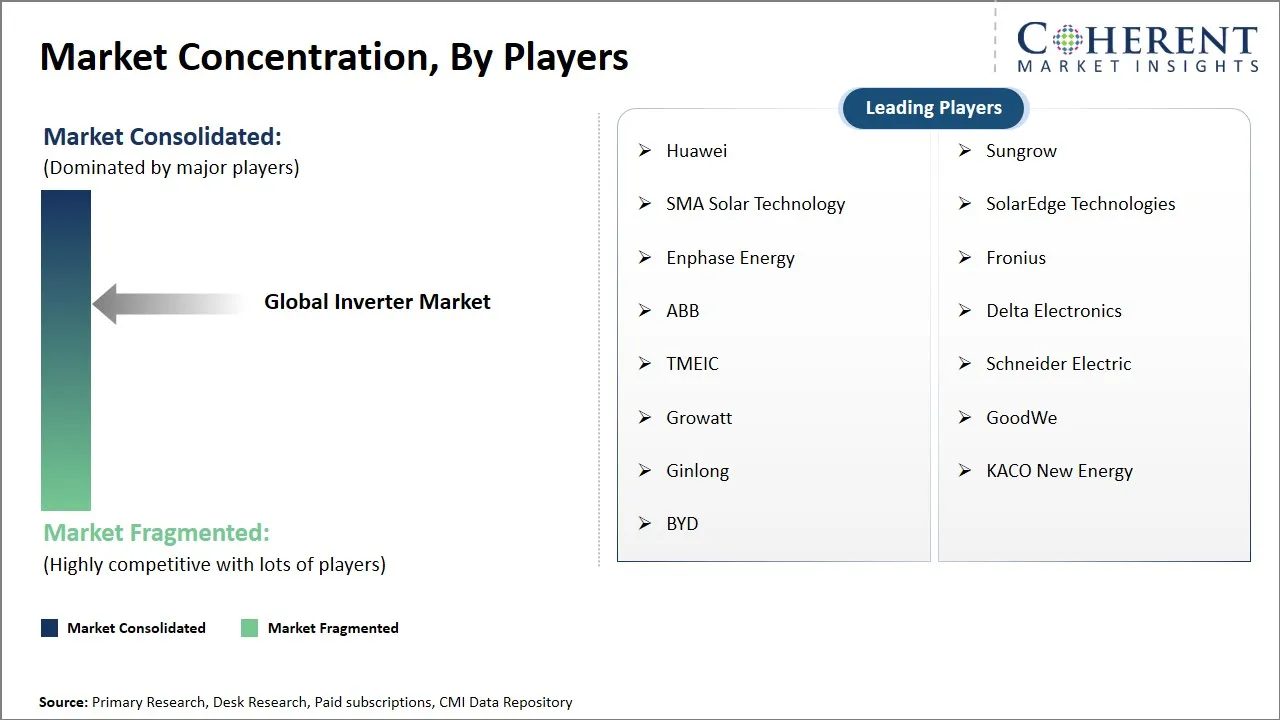
| Companies covered: | Huawei, Sungrow, SMA Solar Technology, SolarEdge Technologies, Enphase Energy, Fronius, ABB, Delta Electronics, TMEIC, Schneider Electric, Growatt, GoodWe, Ginlong, KACO New Energy, and BYD | ||
| Growth Drivers: |
| ||
| Restraints & Challenges: |
| ||
Market Dynamics
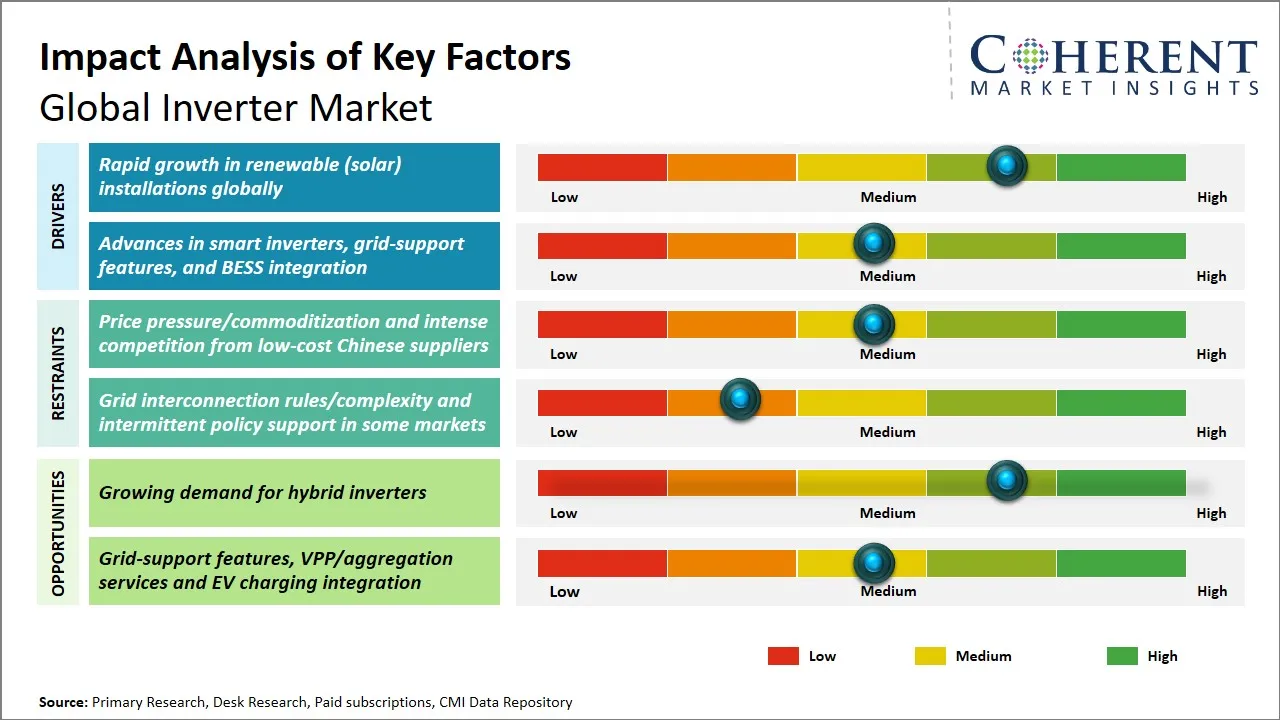
Global Inverter Market Driver – Rapid Growth in Renewable (Solar) Installations Globally
The rapid expansion of global solar PV installations is a key driver of inverter demand, as inverters are essential for converting DC solar output into usable AC power. Falling solar costs, supportive government policies, and rising sustainability goals are accelerating residential, commercial, and utility-scale deployments. The need for smart inverters with advanced monitoring and grid-support functions is also increasing alongside battery-coupled systems.
As per SolarPower Europe, in 2023–2024, global solar additions exceeded 420 GW, led by China, the U.S., and Europe, causing surge orders for inverters from major PV projects like China’s Jiuquan 3.5 GW solar base, which deployed large-scale string and central inverters from Sungrow and Huawei.
Global Inverter Market Opportunity – Growing Demand for Hybrid Inverters
Hybrid inverters, which integrate solar and battery storage in a single system, are seeing accelerating demand as users seek energy independence, backup power, and optimized consumption. Declining battery prices and government incentives for storage-backed solar systems—especially in regions with unstable grids—further strengthen this opportunity.
In 2023–2024, Brazil’s rooftop solar boom and rising adoption of home batteries led to rapid growth in sales of GoodWe EH/ET hybrid inverter series, as reported by the company, which became one of the top-selling hybrid solutions for residential PV + storage systems.
Analyst Opinion (Expert Opinion)
- The market is becoming dangerously exposed to semiconductor and power-electronics supply constraints, especially for IGBTs, SiC devices, and microcontrollers. Manufacturers may talk about diversification, but the reality is that even top-tier players remain tied to a handful of Asian suppliers—making production timelines fragile and price stability almost impossible during demand spikes.
- Grid compliance expectations are outpacing what many inverter manufacturers can realistically deliver. Utilities are tightening requirements around grid-forming capabilities, cybersecurity, and advanced reactive power control, yet a large portion of mid-tier and emerging-market brands are still selling hardware that barely meets last-generation standards. This widening compliance gap is stalling project approvals and sidelining lower-cost suppliers.
- Price competition is eroding margins at an unsustainable rate, particularly in residential and C&I segments. The influx of aggressively priced Chinese products has compressed profitability across global markets, forcing even established brands to cut R&D budgets or exit certain regions. If this race to the bottom continues, innovation—especially in hybrid and storage-enabled inverters—will suffer.
Speak to the analyst
Want personalized insights?
Take the findings above to one of our principal consultants, or have the report rebuilt around the segments, geographies and competitors you actually track.
Market Segmentation
- Product Insights (Revenue, USD Bn, 2021 - 2033)
- String Inverters
- Central Inverters
- Microinverters
- Others
- Regional Insights (Revenue, USD Bn, 2021 - 2033)
- North America
- U.S.
- Canada
- Latin America
- Brazil
- Argentina
- Mexico
- Rest of Latin America
- Europe
- Germany
- U.K.
- Spain
- France
- Italy
- Russia
- Rest of Europe
- Asia Pacific
- China
- India
- Japan
- Australia
- South Korea
- ASEAN
- Rest of Asia Pacific
- Middle East
- GCC Countries
- Israel
- Rest of Middle East
- Africa
- South Africa
- North Africa
- Central Africa
- North America
- Key Players Insights
- Huawei
- Sungrow
- SMA Solar Technology
- SolarEdge Technologies
- Enphase Energy
- Fronius
- ABB
- Delta Electronics
- TMEIC
- Schneider Electric
- Growatt
- GoodWe
- Ginlong
- KACO New Energy
- BYD
Sources
Primary Research Interviews
Stakeholders
- Solar EPC Companies and Installers (e.g., Project Managers, Site Engineers)
- Inverter Manufacturers and Suppliers (e.g., SMA, Fronius, Sungrow — technical teams & product managers)
- Battery Storage Integrators & Microgrid Developers
- Utility Companies & Independent Power Producers (IPPs) involved in large-scale solar projects
- Rooftop Solar Developers & C&I Solar Asset Owners
- Distributors of Solar Components (PV modules, inverters, charge controllers)
- Smart Grid & IoT Energy Management Consultants
- Renewable Energy Policy Advisors from Emerging Markets
Databases
- International Renewable Energy Grid Statistics (IREGS)
- U.S. Energy Infrastructure Database (USEID)
- Asia-Pacific Solar Deployment Registry (APSDR)
- European Distributed Energy System Archive (EDESA)
- Latin America Renewable Installations Index (LARII)
Magazines
- Solar Power Innovations Monthly
- Global PV & Storage Review
- Renewable Energy Engineering Today
- Smart Grid & Inverter Technology Weekly
- Energy Storage Systems World Magazine
Journals
- Journal of Renewable Power Electronics
- International Journal of Solar Energy Systems
- Journal of Grid Integration & Power Conversion
- IEEE Journal of Photovoltaics
- Journal of Energy Storage Technology
Newspapers
- The Energy Transition Times
- Global Renewable Daily
- CleanTech Chronicle
- The Guardian (UK) – energy section
- The Economic Times (India) – renewable energy section
Associations
- Global Solar & Inverter Manufacturers Association (GSIMA)
- International Photovoltaic Technology Council (IPVTC)
- National Solar Energy Association (NSEA)
- Energy Storage & Power Conversion Society (ESPCS)
- Smart Inverter Standards Consortium (SISC)
Public Domain Sources
- U.S. Energy Information Administration (EIA)
- EUROSTAT
- International Energy Agency (IEA)
- United Nations Environment Programme (UNEP)
- World Bank – Renewable Energy Indicators
- ResearchGate (for academic literature)
Proprietary Elements
- CMI Data Analytics Tool, Proprietary CMI Existing Repository of information for last 8 years
Get access to 250+ pages report
Every segment, forecast, competitor profile and data table behind the analysis above — available for instant download.
- ESOMAR Member
- ISO 9001:2015 Certified
- D-U-N-S Registered
- GDPR & CCPA Compliant
Missing comfort of reading report in your local language? Find your preferred language:
Transform your Strategy with Exclusive Trending Reports
Frequently Asked Questions
The global inverter market is estimated to be valued at USD 29.58 billion in 2026 and is expected to reach USD 85.63 billion by 2033.
The CAGR of global inverter market is projected to be 16.4% from 2026 to 2033.
Rapid growth in renewable (solar) installations globally and advances in smart inverters, grid-support features, and BESS integration are the major factors driving the growth of the global inverter market.
Price pressure/commoditization and intense competition from low-cost Chinese suppliers and grid interconnection rules/complexity and intermittent policy support in some markets are the major factors hampering the growth of the global inverter market.
In terms of product, string inverters are estimated to dominate the market revenue share in 2026.
Yes, they enhance safety, enable real-time monitoring, and support grid stability.
They allow energy storage, backup power, and better optimization of solar energy.