

Japan Patient Care Monitoring Equipment Market Size and Forecast - 2026-2033
According to Coherent Market Insights, the Japan patient care monitoring equipment market is estimated to be valued at USD 2.26 Bn in 2026 and is expected to reach USD 3.75 Bn by 2033, exhibiting a compound annual growth rate (CAGR) of 7.3% from 2026 to 2033. This growth is driven by increasing healthcare investments, an aging population requiring continuous monitoring, and advancements in remote patient care technologies. The rising demand for real-time health data and personalized patient management also contributes significantly to market expansion during this period.
Key Takeaways of the Japan Patient Care Monitoring Equipment Market
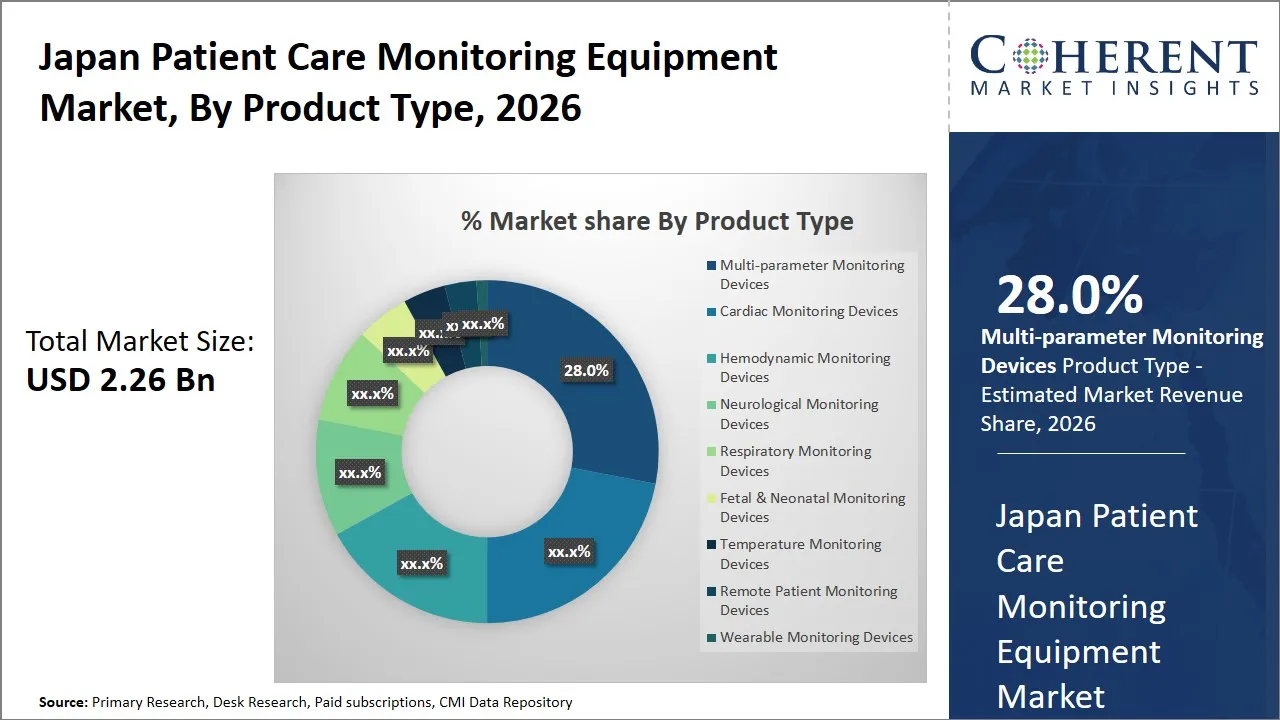
- Multi-parameter monitoring devices segment is expected to lead the Japan patient care monitoring equipment market, capturing 28% share in 2026.
- The cardiology Monitoring segment is estimated to represent 33% of the market share in 2026.
- The hospital segment is projected to dominate with 35% of the Japan patient care monitoring equipment market share in 2026.
Market Overview
- Japan patient monitoring equipment market is technologically advanced but highly competitive, with demand largely coming from replacement cycles and upgrades toward connected, centralized, and software-enabled monitoring platforms.
- Aging population, high chronic disease load (cardio-respiratory and metabolic), shorter inpatient stays, and persistent nursing shortages are pushing hospitals toward continuous, centralized, and workflow-efficient monitoring.
- Japan patient care monitoring equipment market is expanding as hospitals modernize monitoring infrastructure and healthcare providers increasingly deploy remote and portable monitoring solutions to improve patient management and reduce hospital burden.
- Staff shortages and hospital bed optimization efforts are forcing hospitals to deploy centralized monitoring and automated alert systems to improve patient oversight without proportionally increasing staff.
Current Events and Its Impact
Current Events | Description and its Impact |
Rapid Aging Population in Japan |
|
Expansion of Home Healthcare & Remote Monitoring |
|
Segmental Insights
- Current Industry Events of 2026
- Market Size Estimation
- Regional Breakdown
- Competitive Landscape
- Customer Intelligence
- Segmental Analysis
- Pricing Analysis
- Key Market Drivers, Challenges & Future Trends
- Customized Insights Section
Why Does the Multi-parameter Monitoring Devices Segment Dominate the Japan Patient Care Monitoring Equipment Market in 2026?
The multi-parameter monitoring devices segment is expected to hold the largest share of 28% in 2026, due to their ability to simultaneously track a range of vital signs, providing a holistic view of a patient’s condition. These devices integrate heart rate, blood pressure, oxygen saturation, respiratory rate, and temperature into one platform, and this is beneficial in clinical decision-making and patient safety. Such integrated monitoring solutions are necessary with the increasing complexity of the cases of patients presented in the Japanese healthcare institutions, in particular, in the cases of the aging populations with multiple comorbidities. Such need is in accordance with the rising cases of chronic diseases and serious illnesses that demand constant and precise monitoring.
For instance, in June 2025, Nihon Kohden launched an advanced multi-parameter patient monitoring system that integrates cardiac, respiratory, and hemodynamic monitoring with centralized ICU dashboards for Japanese clinical networks.
(Source- https://in.nihonkohden.com/en/products/patient-monitoring)
Why Does the Cardiology Monitoring Segment Dominate the Japan Patient Care Monitoring Equipment Market in 2026?
The cardiology monitoring segment is projected to hold the largest share of 33% in 2026, attributed to the high burden of cardiovascular diseases (CVD) in Japan, including ischemic heart disease, arrhythmias, and heart failure. The ageing population in the country is a big demographic at risk of developing cardiac conditions, thus creating a huge demand for advanced cardiology monitoring equipment such as ECG monitors, event monitors, Holter monitors as well as implantable loop recorders. The monitoring devices in cardiology allow early diagnosis, constant rhythm analysis, and evaluation of cardiac functionality, without which it is impossible to cope with the disease and decrease the morbidity rates related to heart diseases.
Hospitals Segment Dominates the Japan Patient Care Monitoring Equipment Market
Hospitals segment is expected to capture the highest share of 35% in 2026, due to their role as primary centers for comprehensive medical care and acute patient management. The varied needs of hospital clinical environments require a wide range of patient monitoring devices to support critical, perioperative, and chronic care across different patient scenarios. Hospitals in Japan have a well-developed infrastructure and professional healthcare experts, which are the best place to install new modern devices.
The adoption of equipment in hospitals is majorly due to the fact that the number of patients with complex health profile is on the increase and the increasing patient turnover in hospitals particularly in Japan because of the demographic trends. Constant observation in intensive care, emergency rooms and surgical departments is necessary, which assists in minimizing complications and enhancing patient outcomes. Also, hospitals are the centers of multidisciplinary care, and the needed devices should be in accordance with the bigger health IT ecosystems to facilitate the exchange of data and clinical decision-making.
PMDA Regulatory Framework Governing Patient Care Monitoring Equipment in Japan
- The Japanese Pharmaceuticals and Medical Devices Agency regulates patient care monitoring equipment by a rigid compliance system that aims to ensure safety, performance reliability and the clinical effectiveness of the device is able to guarantee the safety and efficacy of products prior to their market entry. The manufacturers are required to meet the requirements of quality management system, risk management standards, and clinical evaluation procedures in accordance to Pharmaceutical and Medical device Act of Japan, and approvals depend on the risk category of device and expected medical use.
- Post-market surveillance is also crucial, as it is necessary that the firms constantly oversee product performance, report adverse events and ensure that connected monitoring systems are cybersecure and updated with software. This control system will make sure that the monitoring devices implemented in hospitals and home medical care settings are of high quality in terms of patient safety and technological dependability in Japan.
Market Players, Key Developments, and Competitive Intelligence
Key Developments
- In January 14, 2026, Edwards Lifesciences was highlighted for reshaping critical care medicine with its integrated portfolio that includes smart monitoring technologies, alongside its core structural heart products. The company’s critical care and monitoring tech positioning was noted as part of broader industry trends in cardiovascular and intensive care solutions.
- In April 2025, Dräger launched the Atlan A100 anesthesia workstation, designed to enhance perioperative care with advanced ventilation and monitoring integration.
- In May 2025, Mindray launched BeneVision V Series patient monitor, an advanced, high-acuity system designed for critical care, featuring industry-first, cable-lite, full-parameter wireless monitoring to improve workflow. It integrates ultrasound-driven hemodynamic assessment (HemoSight) with vital signs, offering 4K resolution, intelligent alarms, and seamless, wire-free mobility for improved patient care.
Technology & Innovation Metrics in Japan Patient Care Monitoring Equipment Market
Technology and Innovation Metric | Impact in Japan |
| Adoption of Multi-parameter Monitoring Systems | High adoption across ICUs and growing use in general wards to enable centralized and continuous patient monitoring. |
| Wireless & Wearable Monitoring Adoption | Increasing deployment in step-down units and home-care settings to allow patient mobility while maintaining monitoring continuity. |
AI-Enabled Early Warning Systems | Emerging adoption in large hospitals for predicting patient deterioration and reducing emergency response delays. |
| Remote Patient Monitoring Expansion | Rising adoption driven by aging population and policy shift toward home and community-based care. |
Cloud & Data Analytics Integration | Growing deployment enabling centralized data storage, predictive analytics, and hospital network monitoring optimization. |
Top Strategies Followed by Japan Patient Care Monitoring Equipment Players
Player Type | Strategic Focus | Examples |
Established Market Leaders | Established companies maintain market leadership by investing heavily in R&D, forming strategic partnerships with healthcare providers and OEMs, and expanding distribution networks globally to strengthen market reach and capture emerging growth opportunities. | Philips Healthcare continues to expand its patient monitoring portfolio through continuous R&D investments and strategic hospital partnerships across Japan, enabling wider deployment of integrated monitoring and connected care solutions. |
Mid-Level Players | Mid-level companies compete by offering reliable and cost-effective monitoring devices, using partnerships and production collaborations to improve technology access, expand distribution, and maintain competitive pricing across hospitals and care facilities. | Fukuda Denshi strengthens its presence in Japan by supplying affordable patient monitoring and diagnostic systems widely adopted in mid-sized hospitals and clinics, balancing performance with cost efficiency. |
Small-Scale Players | Small-scale companies compete by targeting niche monitoring needs through innovative solutions such as wearable, wireless, or AI-enabled devices, often leveraging partnerships with local tech firms and healthcare providers to expand market access. | AMI Inc., a Japanese medtech startup, focuses on AI-based cardiac monitoring solutions, partnering with local healthcare institutions to deploy specialized diagnostic and monitoring technologies. |
Market Report Scope
Japan Patient Care Monitoring Equipment Market Report Coverage
| Report Coverage | Details | ||
|---|---|---|---|
| Base Year: | 2025 | Market Size in 2026: | USD 2.26 Bn |
| Historical Data for: | 2020 To 2024 | Forecast Period: | 2026 To 2033 |
| Forecast Period 2026 to 2033 CAGR: | 7.3% | 2033 Value Projection: | USD 3.75 Bn |
| Segments covered: |
| ||
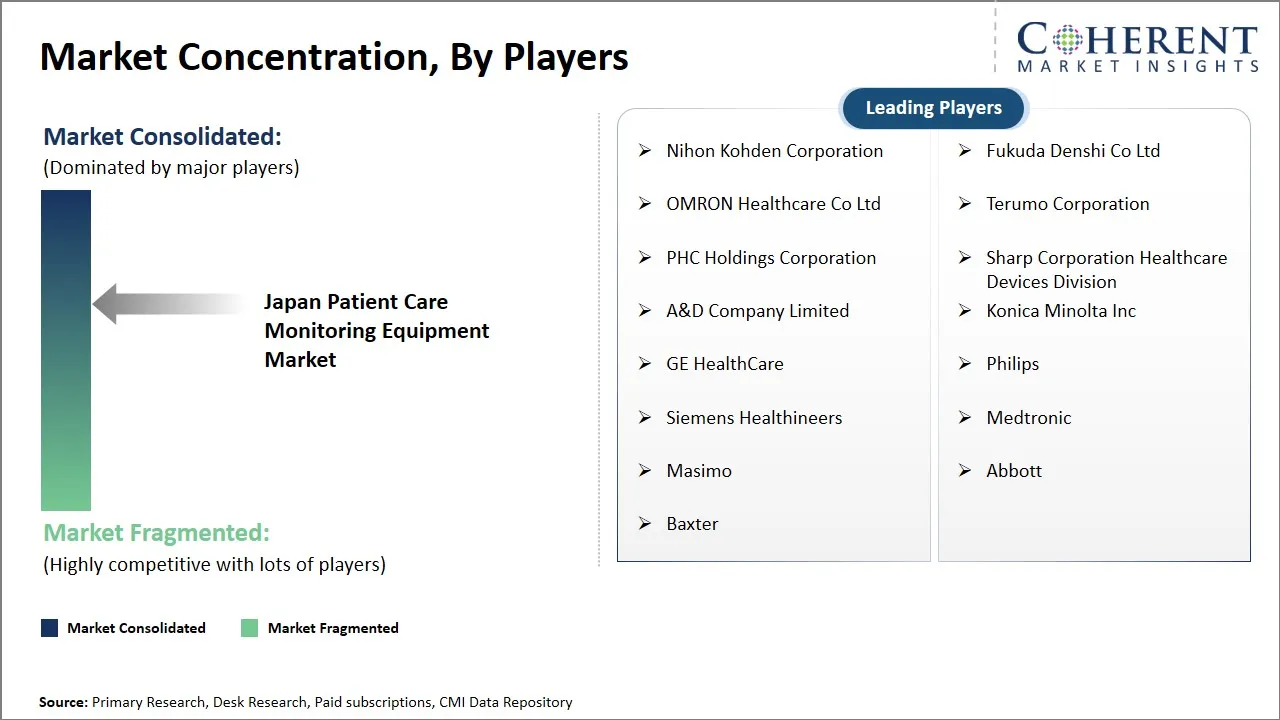
| Companies covered: | Nihon Kohden Corporation, Fukuda Denshi Co Ltd, OMRON Healthcare Co Ltd, Terumo Corporation, PHC Holdings Corporation, Sharp Corporation Healthcare Devices Division, A&D Company Limited, Konica Minolta Inc, GE HealthCare, Philips, Siemens Healthineers, Medtronic, Masimo, Abbott, and Baxter | ||
| Growth Drivers: |
| ||
| Restraints & Challenges: |
| ||
Japan Patient Care Monitoring Equipment Market Dynamics
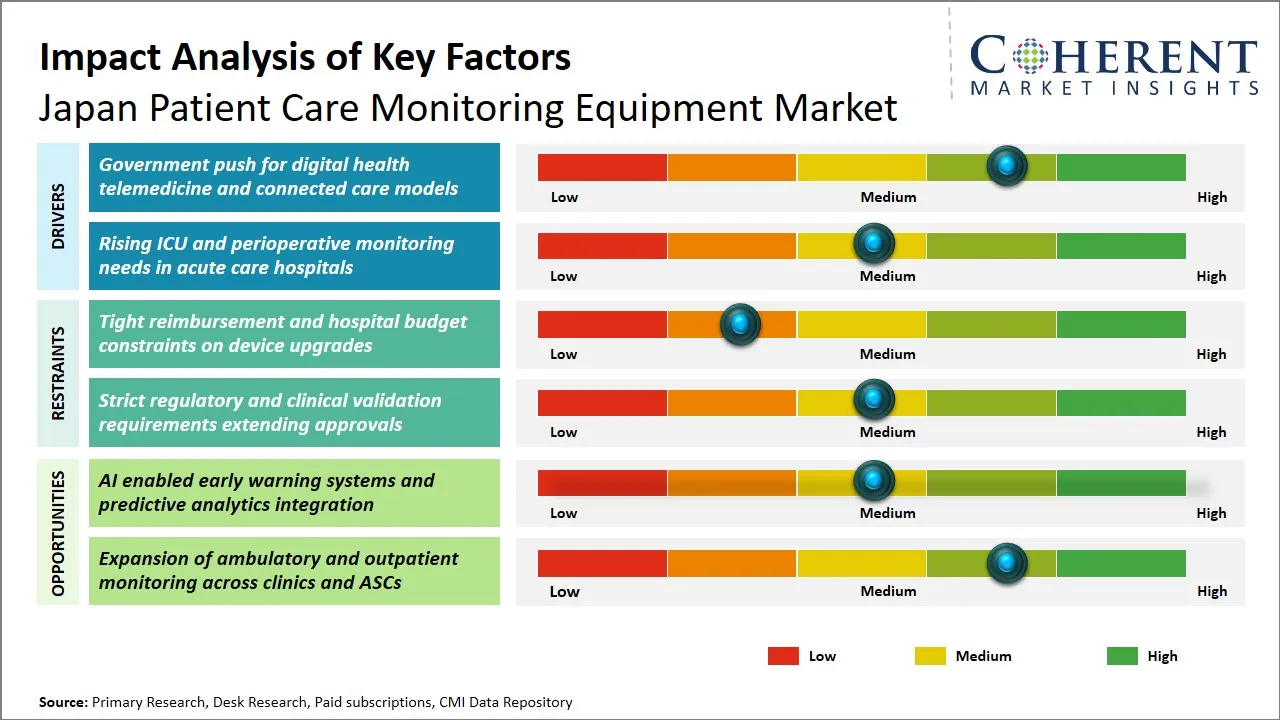
Japan Patient Care Monitoring Equipment Market Driver - Government Push for Digital Health Telemedicine and Connected Care Models
The strong initiative by the Japanese government towards digital health and telemedicine is a major factor that has contributed to the use of patient care monitoring equipment in Japan. Policymakers are swinging into supporting connected care models to facilitate remote patient management and real-time control of health data in response to a growing and aging population and the rise in prevalence of chronic diseases.
The government is also promoting the use of advanced monitoring technology by encouraging healthcare providers to incorporate them through regulatory changes, funding programs, and the implementation of strategic measures to ensure that patients are continuously monitored when they are not in the normal clinical environment. These are the actions to expand their reimbursement policy concerning telehealth services, enhance digital infrastructure, and develop public-partnership with the goal of fastening innovation in medical equipment. These actions are also intended to improve the accessibility and efficiency of healthcare as well as to ease the load on hospital resources.
For instance, on January 8, 2026, Schiller AG announced the launch of the ARGUS PRO LifeCare 3 monitor-defibrillator, a new advanced solution designed for emergency care and monitoring, at events including the World Health Expo in Dubai scheduled for February 9-12, 2026.
Source:https://www.schiller.ch/en-my/news/schiller-launches-the-argus-pro-lifecare-3
Japan Patient Care Monitoring Equipment Market Opportunity - AI-Enabled Early Warning Systems and Predictive Analytics Integration
The market of the Japan patient care monitoring equipment offers an important opportunity due to embedding AI-based early warning systems and predictive analytics. As the population of Japan is aging very fast and chronic conditions are rising, health care givers are facing an increased pressure to improve patient outcomes and at the same time make better use of available resources. Artificial intelligence-driven surveillance systems integrating predictive analytics would be able to sift through large volumes of real-time patient data to identify subtle physiological variations, which can be used to identify health degeneration in its early stages before clinical abnormalities develop. These systems enable preventive action to be taken and hospital readmission is minimized and critical events are also avoided which is in line with the Japanese vision of healthcare and the aim of efficiently enhancing cost reduction in healthcare.
For instance, in May 2025, Spacelabs Healthcare announced that its Rothman Index predictive analytics platform used with patient monitoring systems was featured in an international film titled Caring with Courage, highlighting how data analytics linked to patient monitoring transforms clinical care. The film was presented by the International Council of Nurses at its annual meeting in Helsinki, Finland.
Analyst Opinion (Expert Opinion)
- The Japan patient care monitoring equipment market is expected to keep expanding in the future because hospitals and home care providers are reacting to the global population that is steadily growing older and the increase in the number of chronic illnesses necessitating continuous monitoring. The uptake of wireless multiparameter monitors, wearables and AI-enabled early warning systems is gaining more and more traction as providers aim to shorten hospital stays without compromising patient safety through remote monitoring and connected care. The regulatory facilitation to digital health, development of telemedicine, and smart hospital system investment are opening up new business opportunities, yet the influence of cost, data security, and integrability with the existing systems of the Japanese hospitals present a significant challenge to both suppliers entering the country or expanding their operations.
- Industry knowledge sharing and policy guidance industry-based events such as HIMSS Global Health Conference, MEDICA in Germany, and Japan Health Expo during 2023 to 2025 have seen digital monitoring, remote patient care and mental health and telehealth solutions including online counseling platform actively discussed, encouraging cross sector collaboration and technology showcase. The recent efforts affecting the market perspectives are hospital alliance using remote monitoring solutions in post discharge cardiac, Japanese government sponsored digital health pilots in home based elderly care, and the partnerships between device makers and computer program developers in implementing forecasting analytics in ICU watch, which is further reinforcing the demand for sophisticated patient monitoring systems in Japan in the long run.
Speak to the analyst
Want personalized insights?
Take the findings above to one of our principal consultants, or have the report rebuilt around the segments, geographies and competitors you actually track.
Market Segmentation
- Product Type Insights (Revenue, USD Bn, 2021 - 2033)
- Multi-parameter Monitoring Devices
- Cardiac Monitoring Devices
- ECG Monitors
- Event Monitors
- Holter Monitors
- Implantable Loop Recorders
- Hemodynamic Monitoring Devices
- Neurological Monitoring Devices
- Respiratory Monitoring Devices
- Capnography Monitors
- Pulse Oximeters
- Spirometers
- Fetal & Neonatal Monitoring Devices
- Temperature Monitoring Devices
- Remote Patient Monitoring Devices
- Wearable Monitoring Devices
- Monitoring Parameter Insights (Revenue, USD Bn, 2021 - 2033)
- Cardiology Monitoring
- Neurology Monitoring
- Respiratory Monitoring
- Fetal & Neonatal Care Monitoring
- Chronic Disease Monitoring
- Post-operative Monitoring
- Emergency & Trauma Monitoring
- End User Insights (Revenue, USD Bn, 2021 - 2033)
- Hospitals
- Ambulatory Surgical Centers (ASCs)
- Specialty Clinics
- Home Healthcare Settings
- Long-Term Care Facilities
- Rehabilitation Centers
- Modality Insights (Revenue, USD Bn, 2021 - 2033)
- Bedside Monitoring Systems
- Portable Monitoring Systems
- Wearable Monitoring Systems
- Remote/Connected Monitoring Systems
- Patient Group Insights (Revenue, USD Bn, 2021 - 2033)
- Adult Monitoring
- Pediatric Monitoring
- Neonatal Monitoring
- Geriatric Monitoring
- Key Players Insights
- Nihon Kohden Corporation
- Fukuda Denshi Co Ltd
- OMRON Healthcare Co Ltd
- Terumo Corporation
- PHC Holdings Corporation
- Sharp Corporation Healthcare Devices Division
- A&D Company Limited
- Konica Minolta Inc
- GE HealthCare
- Philips
- Siemens Healthineers
- Medtronic
- Masimo
- Abbott
- Baxter
Sources
Primary Research Interviews
Industry Stakeholders
- Ministry of Health Labour and Welfare Japan officials
- Hospital biomedical equipment procurement managers
- Medical device manufacturing executives
- Clinical engineering department heads
- Digital health technology developers
- Healthcare system integrators
End Users
- Hospital ICU physicians
- Nursing supervisors in acute care hospitals
- Home healthcare service providers
- Long term elderly care facility administrators
- Telemedicine platform clinicians
- Rehabilitation center medical staff
Government and International Databases
- Ministry of Health Labour and Welfare Japan database
- Japan Pharmaceuticals and Medical Devices Agency database
- World Health Organization Global Health Observatory
- OECD Health Statistics database
- World Bank Health Nutrition and Population Statistics
- United Nations Population and Health databases
Trade Publications
- Japan Medical Device News
- MedTech Dive
- Healthcare IT News
- Medical Design and Outsourcing
- Biomedical Instrumentation and Technology Magazine
- HealthTech Magazine
Academic Journals
- Journal of Medical Systems
- IEEE Journal of Biomedical and Health Informatics
- Journal of Clinical Monitoring and Computing
- The Lancet Digital Health
- JMIR Medical Informatics
- Journal of Healthcare Engineering
Reputable Newspapers
- The Japan Times
- Nikkei Asia
- The Financial Times
- The Wall Street Journal Asia edition
- The Guardian Healthcare section
- The New York Times Health section
Industry Associations
- Japan Federation of Medical Devices Associations
- Japan Association for the Advancement of Medical Equipment
- Medical Device Manufacturers Association Japan
- Asia Pacific Medical Technology Association
- International Federation of Medical and Biological Engineering
- Healthcare Information and Management Systems Society
Public Domain Resources
- ClinicalTrials.gov database
- National Institute of Population and Social Security Research Japan
- Open Government Data Japan Portal
- WHO Global Health Expenditure Database
- OECD iLibrary Health Datasets
- United Nations Data Portal
Proprietary Analytical Tools
- Hospital procurement analytics dashboards
- Healthcare electronic medical record analytics systems
- Clinical patient monitoring data analytics platforms
- Device utilization analytics systems
- Healthcare supply chain analytics platforms
- Hospital performance benchmarking systems
Proprietary Elements
- CMI Data Analytics Tool: Proprietary analytics tool to analyze real-time market trends, consumer behavior, and technology adoption in market
- Proprietary CMI Existing Repository of Information for Last 8 Years
Get access to 250+ pages report
Every segment, forecast, competitor profile and data table behind the analysis above — available for instant download.
- ESOMAR Member
- ISO 9001:2015 Certified
- D-U-N-S Registered
- GDPR & CCPA Compliant
Missing comfort of reading report in your local language? Find your preferred language:
Transform your Strategy with Exclusive Trending Reports
Frequently Asked Questions
The Japan patient care monitoring equipment market is estimated to be valued at USD 2.26 billion in 2026 and is expected to reach USD 3.75 billion by 2033.
The CAGR of Japan patient care monitoring equipment market is projected to be 7.3% from 2026 to 2033.
Reimbursement policies influence Japan patient care monitoring equipment sales by determining hospital and home care investment capacity, with favorable coverage encouraging adoption of advanced monitoring systems while limited reimbursement slows upgrades.
Japan patient care monitoring equipment improves clinical decision making by enabling real-time patient data tracking, early risk detection, and timely medical intervention across hospital and remote care settings.
Government push for digital health telemedicine and connected care models and rising ICU and perioperative monitoring needs in acute care hospitals are the major factors driving the growth of the Japan patient care monitoring equipment market.
Tight reimbursement and hospital budget constraints on device upgrades and strict regulatory and clinical validation requirements extending approvals are the major factors hampering the growth of the Japan patient care monitoring equipment market.
In terms of product type, multi-parameter monitoring devices are estimated to dominate the market revenue share in 2026.