

Global Laboratory Glassware Market Size and Forecast – 2026 to 2033
The global laboratory glassware market is estimated to be valued at USD 2.84 Bn in 2026 and is expected to reach USD 3.97 Bn by 2033, exhibiting a compound annual growth rate (CAGR) of 4.9% from 2026 to 2033. This steady growth reflects increasing investments in research and development, expanding pharmaceutical and biotechnology sectors, and rising the demand for precise and reliable laboratory equipment worldwide. The market’s expansion underscores its critical role in scientific and industrial advancements.
Key Takeaways of the Global Laboratory Glassware Market
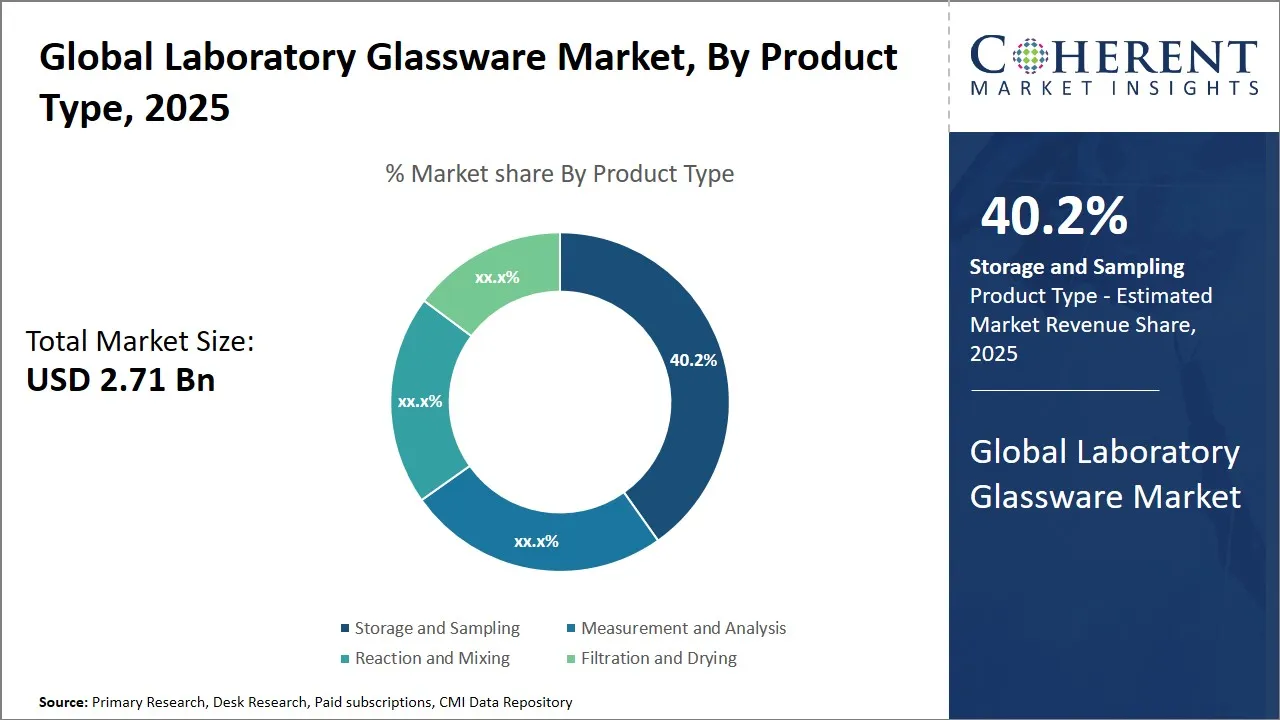
- In 2026, the storage and sampling segment is expected to dominate the global laboratory glassware market, accounting for 41.2 % share.
- By base material, borosilicate segment is estimated to lead the market with a 41.3 % share in 2026.
- In terms of capacity, the Micro ≤1 mL segment is projected to hold the largest share at 21.2 % share in 2026.
- North America is expected to lead the market, holding a share of 39.9 % in 2026. Asia Pacific is anticipated to be the fastest-growing region, with an estimated market share of 23.5% in 2026.
Market Overview
Key trends shaping the laboratory glassware market include the growing adoption of automation and smart laboratory solutions, which enhance efficiency and reduce human error. Additionally, there is a notable shift towards sustainable and environmentally friendly glassware products, driven by regulatory pressures and corporate sustainability goals. The rise in pharmaceutical manufacturing and diagnostics, coupled with innovation in glass material technology, is further propelling the market growth, creating opportunities for manufacturers to develop advanced, durable, and versatile glassware solutions.
Current Events and Its Impact
Current Events | Description and its Impact |
Technological Advancements in Automated Cleaning Systems |
|
Regional manufacturing shifts and infrastructure |
|
Segmental Insights
- Current Industry Events of 2026
- Market Size Estimation
- Regional Breakdown
- Competitive Landscape
- Customer Intelligence
- Segmental Analysis
- Pricing Analysis
- Key Market Drivers, Challenges & Future Trends
- Customized Insights Section
Laboratory Glassware Market Insights, By Product Type - Storage and Sampling Leading the Product Type Segment Due to Versatility and Critical Role in Sample Integrity
Storage and sampling segment is projected to account for 41.2% of the market share in 2026, because of its essential nature in maintaining the quality and integrity of samples in the various laboratory settings. The product lines included under this segment are broadly based products that are necessary in the containment, preservation, and transportation of specimens, reagents, and chemical samples, with little contamination and destruction over time.
For example, Glassco, a major Indian company manufacturing and exporting laboratory glass ware and equipment produced its wide product range consisting of volumetric flasks, beakers, filtration assembly, cylinders, burettes, and vials. The company which is located in Haryana, India, distributes the ISO/ASTM/DIN/USP and NABL-standard labware to more than 107 countries and exports over 600 containers per year.
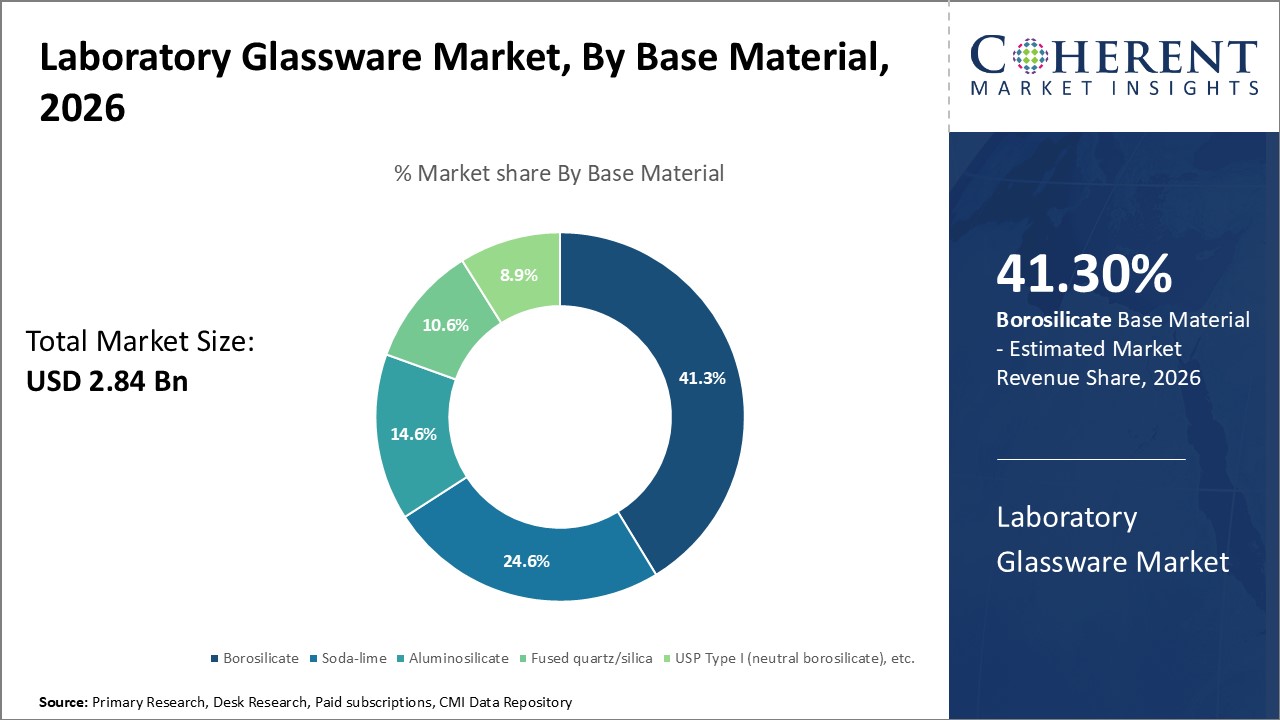
Laboratory Glassware Market Insights, By Base Material - Borosilicate Glass Dominance Driven by Superior Chemical and Thermal Resilience
Borosilicate has the highest share of 41.3% share in 2026, due to its superior qualities which suit perfectly the demanding needs of laboratory use. Borosilicate glass is known to be highly resistant to thermal shock, chemical corrosion, or mechanical stress and is therefore widely used in the various scientific processes, including mundane chemical reactions through the analysis of the sample with high precision.
The coefficient of thermal expansion is low and borosilicate glass has the inherent composition, which means it can maintain its rapid change of temperature without cracking and deformation. This thermal ability is essential in laboratories where the heating and cooling cycle is often encountered, e.g., sterilization, autoclaving or reaction set ups.
Laboratory Glassware Market Insights, By Capacity - Micro ≤1mL Capacity Glassware Flourishes Due to Rising Demand for High-Throughput and Precision Applications
Micro ≤1mL segment is expected to capture 21.2% share in 2026, driven by a jump of demand on high accuracy and small volumes of handling in the laboratories across the world. With the growth in scientific research into an increased molecular analysis and a miniaturized method of conducting tests, the necessity of glassware capable of precisely measuring, holding and transferring small amounts of liquids has escalated substantially.
Micro glassware is also essential in use in areas of molecular biology, genomics, proteomics, and pharmaceutical research where small volumes of samples are common either because scarcity, cost or safety of the reagents and biological materials. This ability segment comprises micro vials, micro test tubes, and micro pipettes which are made to hold sophisticated procedures that need little sample consumption without affecting the accuracy of measurements.
Regional Insights
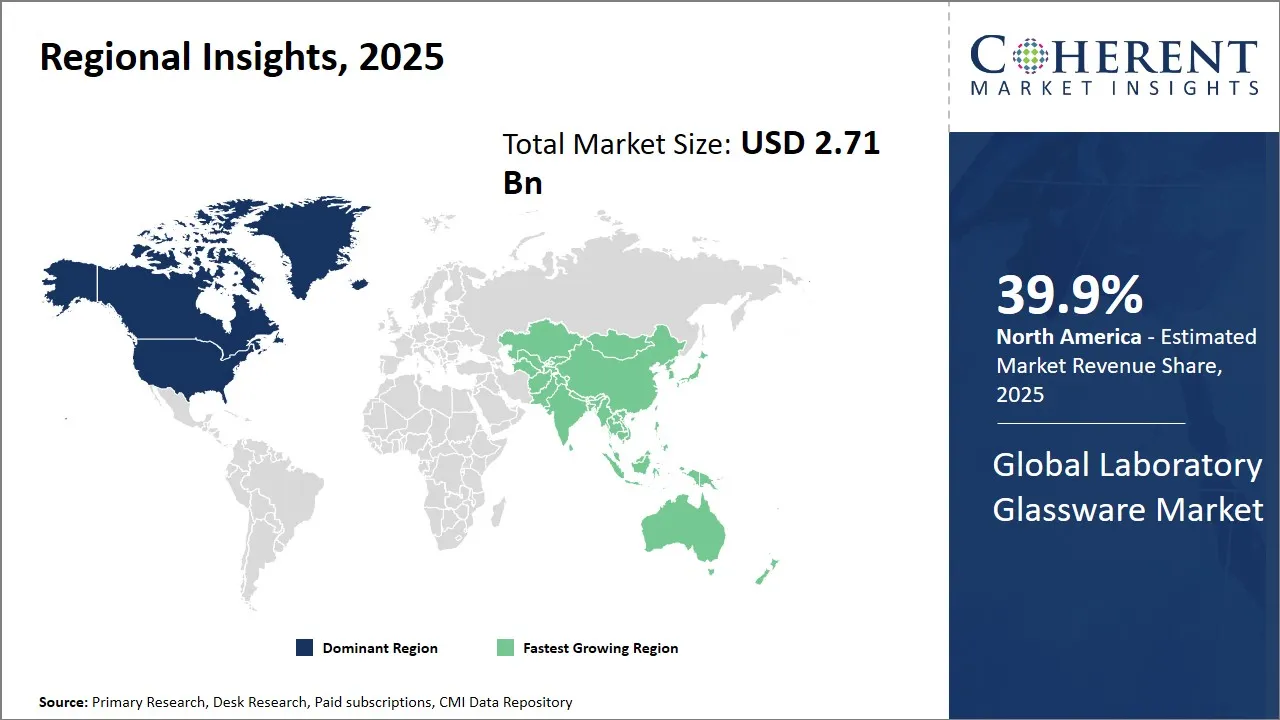
North America Laboratory Glassware Market Analysis and Trends
In North America, the leadership in laboratory glassware market is led by a mature and advanced research environment with share of 39.9% in 2026, good representation of pharmaceutical and biotechnology sectors, and well-developed government support of scientific research. Most academic and clinical research centers are located in the U.S., which makes the demand on the quality laboratory glassware massive.
Corning Inc., Kimble Chase, and DWK Life Sciences are major companies in the region that are playing critical roles in the region through continuous innovation and provision of a complete glassware solution that has played a significant role in advanced laboratory applications. There is also established trade relations and supply chain infrastructure which make it easy to distribute products and be available all over North America.
Asia Pacific Laboratory Glassware Market Analysis and Trends
The global market of laboratory glassware has a rising fastest growth in Asia Pacific with 23.5% share in 2026, driven by the growing pharmaceutical, healthcare and academic industries in such countries as China, India, Japan, and South Korea. The rationale of growing involvement of government efforts to achieve a higher medical research infrastructure and investing on biotechnology research and development is a major growth driver.
The developing economies in the Southeast Asia also play a role because of the increased awareness and use of quality laboratory products. The major manufacturers like Borosil Glass Works (India), Shinagawa Glass (Japan) and Xuzhou Glass Instruments Co. (China) have set up manufacturing facilities here, to serve the increasing demand by having local production and customized products.
Laboratory Glassware Market Outlook for Key Countries
U.S. Laboratory Glassware Market Analysis and Trends
The laboratory glassware market in the U.S. has been typified by the high demand of products that comprise precision glassware which is as a result of pharmaceutical, biotechnology as well as academic research market. The major market players such as Corning Inc. and DWK Life Sciences lead with their developed line of products and tailor-made solutions to fulfill the high standards of regulations. The perpetual nature of drug discovery and development investment and a culture of innovation keep the demand growing both in commercial and governmental research laboratories.
In September 2026, Harvard Bioscience, a U.S.-based manufacturer of specialized life science and laboratory equipment, expanded its distribution agreement with Fisher Scientific, a global leader in laboratory supply and distribution. The new arrangement allows Fisher to sell Harvard Bioscience products such as pumps, spectrophotometers, and electroporation systems across the U.S., extending an existing partnership already active in Europe.
China Laboratory Glassware Market Analysis and Trends
The China laboratory glassware market has a high rate of development as there is great support of the modernization of healthcare and biotechnology within the country. Growing partnerships between research centers and the industry improve the usage of high-quality glassware needed in clinical diagnostics and the pharmaceutical industry even faster.
Among the leading competitors in China laboratory glassware market, Xuzhou Glass Instruments Co., Ltd. stands out as one of the largest manufacturers, specializing in volumetric flasks, beakers, and chemical-resistant glassware used across academic and industrial laboratories. Nantong Huaou Industry and Trade Co., Ltd. and Jiangsu Rongtai Laboratory Glass Co., Ltd. also play key roles, producing precision laboratory bottles and burettes widely utilized in pharmaceutical and chemical research applications.
Germany Laboratory Glassware Market Analysis and Trends
Germany still sets the pace in Europe with a strong pharmaceutical and chemical industry and focus on precision engineering. Innovation and the introduction of the quality governments support the consistent demand, and the country is in one of the most convenient positions to export or not only to Europe but also in other countries.
Major players are SCHOTT AG, which has a DURAN borosilicate glass, which has conquered the markets in Europe labs because of its excellent thermal and chemical resistance. DWK Life Sciences GmbH is a company that was created through the combination of DURAN, Wheaton, and Kimble that supply high quality laboratory glassware used in the pharmaceutical and analytical industries.
India Laboratory Glassware Market Analysis and Trends
The laboratory glassware market in India is also facing a growing market of pharmaceutical production and an increase in academic research. The trend by the government to be self-reliant in healthcare infrastructure and the Make in India programs promote local manufacturing by companies such as the Borosil Glass Works. Demand in the different segments of the laboratory such as clinical diagnostics, chemical analysis, and educational institutions are driven by competitive pricing, as well as an ever-growing regulatory focus on quality control.
The companies that operated in India are the top leading companies led by Borosil Glass Works Ltd., which is one of the largest domestic manufacturers in the production of volumetric and general-purpose glass ware that comply with the ISO and ASTM standards. Glassco Laboratory Equipments Pvt. Ltd. is another large exporter that exports more than 600 containers of laboratory glassware at a time to the international customers.
End User Feedback and Unmet Needs - Laboratory Glassware Market
- End users in the global laboratory glassware market, especially in sectors like pharmaceuticals and healthcare, value durability and precision in their glassware. Positive feedback highlights how specific products, like volumetric flasks, offer reliable accuracy in critical procedures, improving both efficiency and product quality. However, smaller labs often face challenges with the high cost of advanced glassware, limiting accessibility and adoption.
- Key unmet needs include affordable, customizable solutions tailored to smaller-scale labs and the integration of glassware with automated systems. Addressing these gaps would not only improve user satisfaction but also open up growth opportunities for manufacturers. Offering more cost-effective and adaptable products could enhance customer loyalty and drive innovation, making glassware solutions more accessible and efficient for all users.
Market Players, Key Developments, and Competitive Intelligence
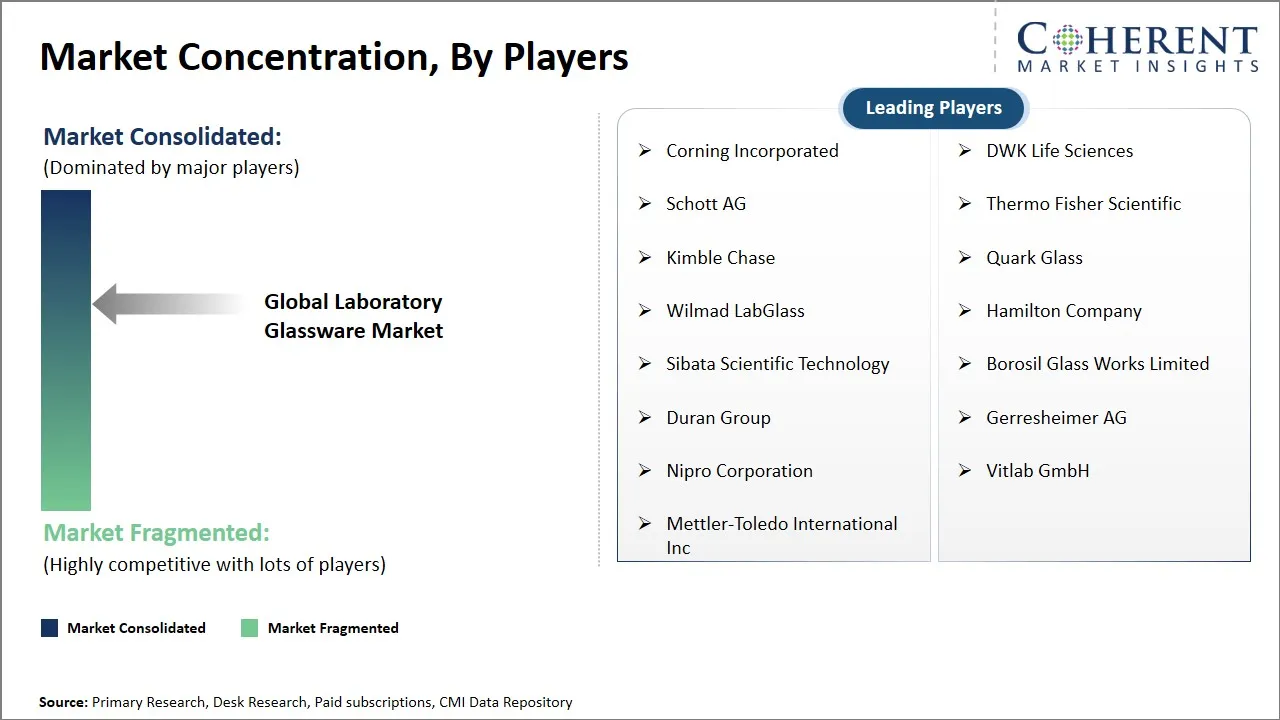
Key Developments
- In September 2025, Surplus Solutions, a U.S.-based provider of refurbished laboratory equipment and services, announced the acquisition of Certified Genetool, a San Francisco company known for supplying certified lab instruments and technical services for over two decades. Surplus Solutions, part of the NMS Capital portfolio, aims to expand its refurbishment and resale capabilities through this deal, strengthening its role in the biotechnology, pharmaceutical, and life sciences sectors that rely heavily on Laboratory Glassware and high-quality lab equipment.
- In July 2025, Borosil Scientific Limited, India’s long-established leader in laboratory glassware and scientific solutions, featured in Business Connect Magazine for its transformation into a full-spectrum lab solutions provider. Under CEO Mr. Vinayak Patankar, the company expanded beyond glassware into analytical vials, filtration products, instruments, and pharma primary packaging through acquisitions such as Klasspack and Goel Scientific Glass Works.
- In April 2025, researchers from Kindai University in Japan led by Professor Kazuo Yamagata reported that standard laboratory glassware may impair in-vitro fertilization (IVF) embryo development. The study, published in Biology of Reproduction, found that zinc leaching from common lab glass instruments disrupted chromosome segregation and gene activation during early stages of embryo growth. Kindai University, known for its advanced reproductive biology research, linked the issue to pipettes, glass filters, and observation dishes releasing zinc into culture media.
- In December 2023, Neste, the Finnish renewable energy leader, announced a strategic partnership with Eppendorf, a German manufacturer known for its laboratory equipment and consumables, to create a new line of renewable lab plastics. The collaboration introduced Eppendorf Consumables BioBased, including tubes and pipette tips made with Neste RE, a feedstock derived entirely from renewable raw materials such as used cooking oil. The products match the quality of traditional lab consumables while significantly reducing fossil dependence.
Top Strategies Followed by Global Laboratory Glassware Market Players
- Well-established market leaders make heavy investments in research and development (R&D) to spur innovation and generate high-performance and reliable laboratory glassware to meet the demanding industry standards. To remain abreast with the changing customer demands, these companies specialize in the development of strong product portfolio that includes specialized glassware which is used in different scientific applications. They also strategize the partnerships and alliances with key players in the industry or original equipment manufacturers (OEMs) to enhance the presence in the market and co-develop the integrated solutions.
- Examples: Thermo Fisher Scientific, Kimble Chase (now part of DWK Life Sciences), and Gerresheimer AG lead global production with extensive product portfolios for analytical, pharmaceutical, and life science labs. Moreover, DWK Life Sciences, Corning Incorporated, and SCHOTT AG exemplify dominant players investing substantially in R&D to deliver precision-engineered laboratory glassware
- Characteristics of the mid-level players in the laboratory glassware market. As a sub-group in the glassware market, main priorities of the middle level players include offering low-end products but of quality sought by price sensitive markets like academic institutions, small labs, and startups. They have based their strategy on their ability to ensure a balanced trade-off between affordability and satisfactory product performance, a niche, which is part of them against premium players of high-end glassware.
- Examples: Glas-Col, Kartell Labware, and United Scientific Supplies emphasize affordable, mid-range glassware for educational and industrial testing applications. These firms focus on balancing quality and price, serving institutions and smaller labs through regional partnerships and localized distribution.
- Small-scale players cut their own niche market by focusing on a niche in the laboratory glassware industry (e.g. making highly customized, small-batch or innovative products that would satisfy particular scientific niche that larger firms do not serve). This is the most important level of innovation; such companies are the first to use the newest manufacturing technologies, including 3D printing and automation, in order to add some special features that will add functionality, durability, or convenience.
- Examples: Chemglass Life Sciences, Scientific Glassblowing Company (U.K.), and Radleys specialize in customized laboratory glassware such as jacketed reactors, condensers, and distillation assemblies. Their differentiation lies in precision craftsmanship, short lead times, and adaptation of automation and CAD-based design to meet bespoke research and pilot-scale requirements.
Market Report Scope
Laboratory Glassware Market Report Coverage
| Report Coverage | Details | ||
|---|---|---|---|
| Base Year: | 2025 | Market Size in 2026: | USD 2.84 Bn |
| Historical Data for: | 2020 To 2024 | Forecast Period: | 2026 To 2033 |
| Forecast Period 2026 to 2033 CAGR: | 4.9% | 2033 Value Projection: | USD 3.97 Bn |
| Geographies covered: |
| ||
| Segments covered: |
| ||
| Companies covered: | Corning Incorporated, DWK Life Sciences, Schott AG, Thermo Fisher Scientific, Kimble Chase, Quark Glass, Wilmad LabGlass, Hamilton Company, Sibata Scientific Technology, Borosil Glass Works Limited, Duran Group, Gerresheimer AG, Nipro Corporation, Vitlab GmbH, and Mettler-Toledo International Inc | ||
| Growth Drivers: |
| ||
| Restraints & Challenges: |
| ||
Laboratory Glassware Market Dynamics
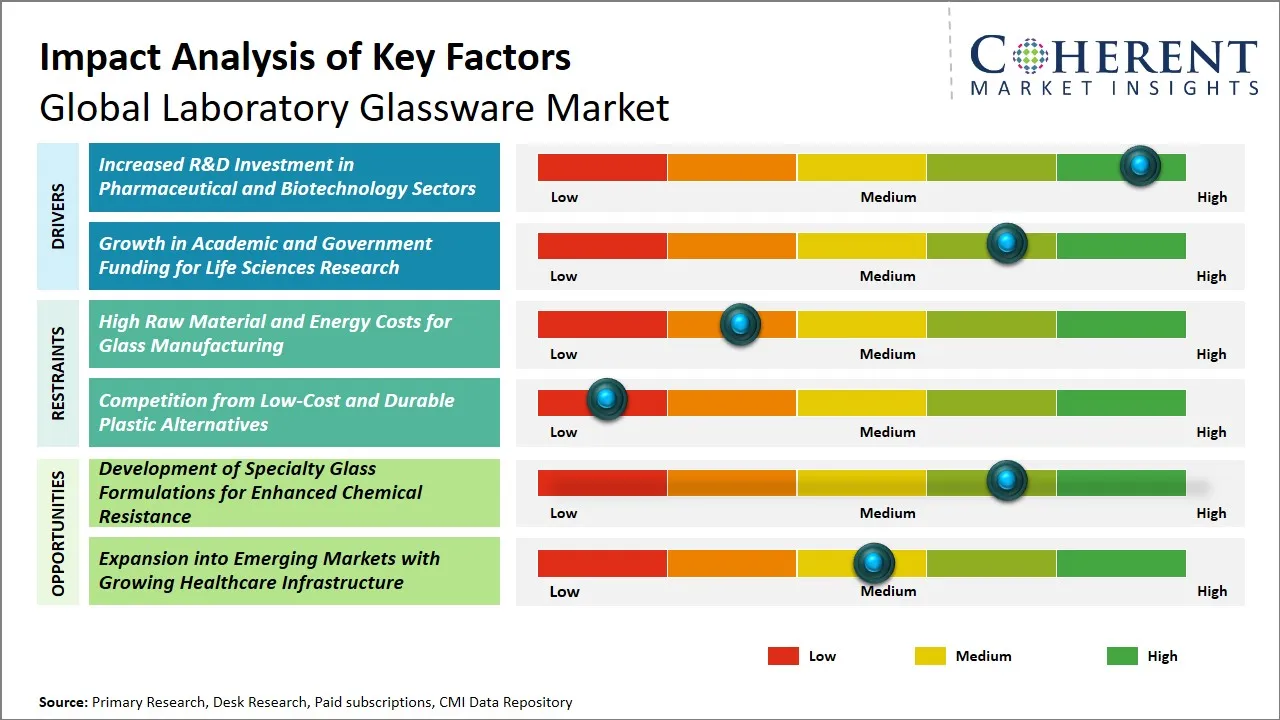
Laboratory Glassware Market Driver - Increased R&D Investment in Pharmaceutical and Biotechnology Sectors
The increasing research and development spending in pharmaceutical and biotechnology sectors largely contributes to the exportation of laboratory glassware in the global market. With the growing intensity of these sectors in finding new drugs, biopharmaceuticals, and advanced therapies, the necessity of the accurate and stable laboratory equipment becomes the primary factor. Glassware is a chemical-resistant and durable material that is necessary in carrying out experiments, quality testing, and formulation. Increased laboratory facilities, particularly with regard to gene therapy, personalized medicine, and vaccine development, necessitate advanced laboratory equipment, which in turn pushes the demand of special glassware including petri dishes, beakers, flasks, and test tubes.
In April 2025, Roche, the Swiss pharmaceutical and diagnostics giant, announced a USD 50 billion five-year investment plan in the U.S. aimed at upgrading and expanding its research and manufacturing network. The move includes major upgrades at R&D centers in Arizona, Indiana, and California, alongside a new 30,000-square-foot cardiovascular, renal, and metabolism research facility in Boston’s Harvard Enterprise Research Campus.
Laboratory Glassware Market Opportunity - Development of Specialty Glass Formulations for Enhanced Chemical Resistance
The global laboratory glassware market provides a tremendous potential due to the creation of specialty glasses formulations that would provide increased chemical resistance. Following the ever-expanding limits of scientific research through the efforts of laboratories around the globe, glassware to meet the requirements of hostile chemicals, elevation, and extended contact with corrosive elements with integrity and precision is on the rise. Although traditional borosilicate glass has found extensive application, it has some limitations in the presence of very acidic or alkaline reagents, and may degrade, contaminate, or break.
For example, companies such as SCHOTT AG, Corning Incorporated, and DWK Life Sciences are actively investing in advanced glass formulations to meet this demand. SCHOTT has developed its FIOLAX and DURAN ranges that deliver superior resistance against harsh chemicals and thermal stress, widely used in pharmaceutical and biotech laboratories.
Analyst Opinion (Expert Opinion)
- This is because of the increasing number of laboratory glassware in the market owing to improvement in material science, rules that have become more stringent in terms of safety and the rise in pharmaceutical and biological research. More attention to precision testing and sustainability is the reason why more durable, reusable, and chemically resistant glassware is in demand. The major industry conferences such as ArabLab Dubai, Analytica Munich, and Pittcon Conference and Expo have become an essential source of the exchange of innovations and global cooperation in the areas of laboratory technology and laboratory standards.
- The recent trends indicate a good momentum in the regions. SCHOTT, Corning, and DWK Life Sciences are increasing the production and launching additional specialty lines of glasses in terms of improved chemical resistance and zero-defect quality. The initiatives of the government, like the Indian Make in India program and U.S. science funding programs, are increasing the domestic manufacturing and research and development, which is strengthening the stability of the global supply and encouraging the laboratory glassware supply to be in the positive perspective.
Speak to the analyst
Want personalized insights?
Take the findings above to one of our principal consultants, or have the report rebuilt around the segments, geographies and competitors you actually track.
Market Segmentation
- Product Type Insights (Revenue, USD Bn, 2021 - 2033)
- Storage and Sampling
- Bottles (Reagent, Aspirator, Wash)
- Vials and Sample Containers
- Specimen Containers
- Desiccators
- Measurement and Analysis
- Volumetric Flask
- Graduated Cylinders
- Burettes and Pipettes
- Condensers
- Separatory Funnels
- Reaction and Mixing
- Beakers
- Flasks (Erlenmeyer, Round-Bottom, Volumetric)
- Test Tubes and Culture Tubes
- Petri Dishes
- Reactors and Reaction Vessels
- Filtration and Drying
- Funnels (Buchner, Filtering)
- Filter Flasks
- Crucibles
- Thimbles
- Storage and Sampling
- Base Material Insights (Revenue, USD Bn, 2021 - 2033)
- Borosilicate
- Soda-lime
- Aluminosilicate
- Fused quartz/silica
- USP Type I (neutral borosilicate), etc.
- Capacity Insights (Revenue, USD Bn, 2021 - 2033)
- Micro ≤1mL
- Small 1 mL–50mL
- Medium 50 mL–500mL
- Large 500 mL–5L
- Bulk/Lab-scale 5L
- Application Insights (Revenue, USD Bn, 2021 - 2033)
- Sample preparation
- Synthesis/reaction
- Titration/quantitative analysis
- Filtration/extraction
- Storage/transport
- Microscopy/cytology
- Microbiology/culture
- Chromatography sample handling
- End User Insights (Revenue, USD Bn, 2021 - 2033)
- Academic and research institutes
- Pharmaceutical and Biotechnology Companies
- Chemical and Industrial Plants
- Hospitals and Diagnostic Centers
- Others
- Distribution Channel Insights (Revenue, USD Bn, 2021 - 2033)
- Online
- Offline
- Regional Insights (Revenue, USD Bn, 2021 - 2033)
- North America
- U.S.
- Canada
- Latin America
- Brazil
- Argentina
- Mexico
- Rest of Latin America
- Europe
- Germany
- U.K.
- Spain
- France
- Italy
- Russia
- Rest of Europe
- Asia Pacific
- China
- India
- Japan
- Australia
- South Korea
- ASEAN
- Rest of Asia Pacific
- Middle East
- GCC Countries
- Israel
- Rest of Middle East
- Africa
- South Africa
- North Africa
- Central Africa
- North America
- Key Players Insights
- Corning Incorporated
- DWK Life Sciences
- Schott AG
- Thermo Fisher Scientific
- Kimble Chase
- Quark Glass
- Wilmad LabGlass
- Hamilton Company
- Sibata Scientific Technology
- Borosil Glass Works Limited
- Duran Group
- Gerresheimer AG
- Nipro Corporation
- Vitlab GmbH
- Mettler-Toledo International Inc
Sources
Primary Research Interviews
- Industry Stakeholders List
- Laboratory Equipment Manufacturers
- Scientific Instrument Distributors
- R&D Managers in Life Sciences
- Procurement Heads in Academic Labs
- Quality Assurance Specialists in Pharma Firms
- Laboratory Infrastructure Consultants
- End Users List
- Clinical Diagnostic Laboratories
- Biotechnology Companies
- Research Universities
- Environmental Testing Labs
- Food & Beverage Testing Facilities
- Contract Research Organizations (CROs)
Government and International Databases
- U.S. Food and Drug Administration (FDA)
- European Medicines Agency (EMA)
- World Health Organization (WHO)
- Organization for Economic Co-operation and Development (OECD)
- National Institute of Standards and Technology (NIST)
- Eurostat
Trade Publications
- Laboratory Equipment Magazine
- Lab Manager Magazine
- Analytical Scientist
- Nature Lab Automation
- Lab News (U.K.)
- Technology Networks – Analytical Chemistry
Academic Journals
- Journal of Laboratory Automation (JALA)
- Analytical Chemistry
- Lab on a Chip
- Journal of Chromatography A
- Applied Spectroscopy
- Biotechniques
Reputable Newspapers
- The Wall Street Journal – Science & Tech section
- Financial Times – Healthcare & Industry coverage
- The Guardian – Science section
- The New York Times – Health & Innovation section
- Business Standard – Pharma & Research industry
- Nikkei Asia – Technology & Manufacturing
Industry Associations
- American Chemical Society (ACS)
- Laboratory Products Association (LPA)
- International Organization for Standardization (ISO)
- European Federation of Clinical Chemistry and Laboratory Medicine (EFLM)
- Association of Analytical Communities (AOAC International)
- National Institute for Bioprocessing Research and Training (NIBRT)
Public Domain Resources
- World Bank Open Data
- United Nations Industrial Development Organization (UNIDO) Reports
- PubChem Database
- PubMed Central (PMC)
- ScienceDirect Open Access
- U.S. Census Bureau – Manufacturing Data
Proprietary Elements
- CMI Data Analytics Tool: Proprietary analytics tool to analyze real-time market trends, consumer behavior, and technology adoption in market
- Proprietary CMI Existing Repository of Information for Last 8 Years
Get access to 250+ pages report
Every segment, forecast, competitor profile and data table behind the analysis above — available for instant download.
- ESOMAR Member
- ISO 9001:2015 Certified
- D-U-N-S Registered
- GDPR & CCPA Compliant
Missing comfort of reading report in your local language? Find your preferred language:
Transform your Strategy with Exclusive Trending Reports
Frequently Asked Questions
The global laboratory glassware market is estimated to be valued at USD 2.84 Bn in 2026 and is expected to reach USD 3.97 Bn by 2033
The CAGR of the global laboratory glassware market is projected to be 4.9% from 2026 to 2033.
Increased R&D investment in pharmaceutical and biotechnology sectors and growth in academic and government funding for life sciences research are the major factors driving the growth of the global laboratory glassware market.
High raw material and energy costs for glass manufacturing and competition from low-cost and durable plastic alternatives are the major factors hampering the growth of the global laboratory glassware market.
In terms of product type, the storage and sampling is estimated to dominate the market revenue share in 2026.
Corning Incorporated, DWK Life Sciences, Schott AG, Thermo Fisher Scientific, Kimble Chase, Quark Glass, Wilmad LabGlass, Hamilton Company, Sibata Scientific Technology, Borosil Glass Works Limited, Duran Group, Gerresheimer AG, Nipro Corporation, Vitlab GmbH, and Mettler-Toledo International Inc are the major players.
North America is expected to lead the global laboratory glassware market.