

Global Light Field Market Size and Forecast – 2026 to 2033
The global light field market is estimated to be valued at USD 160.68 Bn in 2026 and is expected to reach USD 430.02 Bn by 2033, exhibiting a compound annual growth rate (CAGR) of 15.1% from 2026 to 2033.
Key Takeaways of the Global Light Field Market
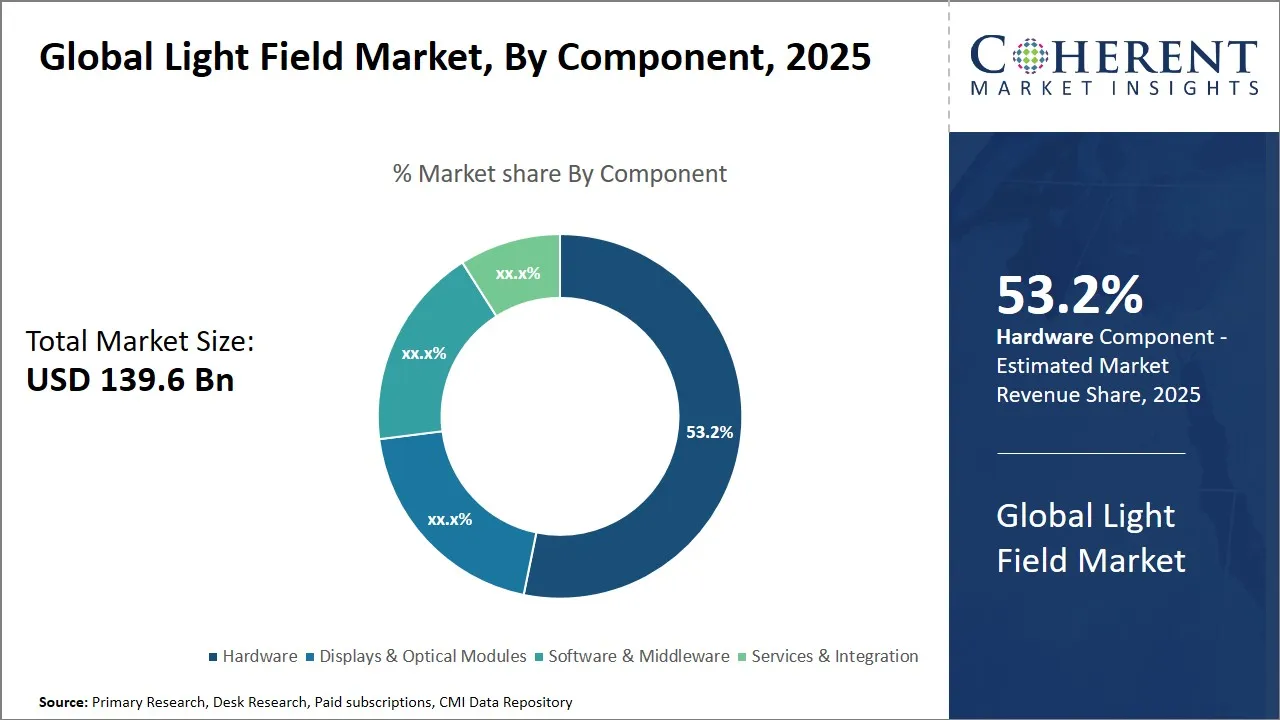
- The hardware segment is expected to lead the market holding a share of 54.2% in 2026.
- The plenoptic segment is projected to dominate with a share of 25.7% in 2026.
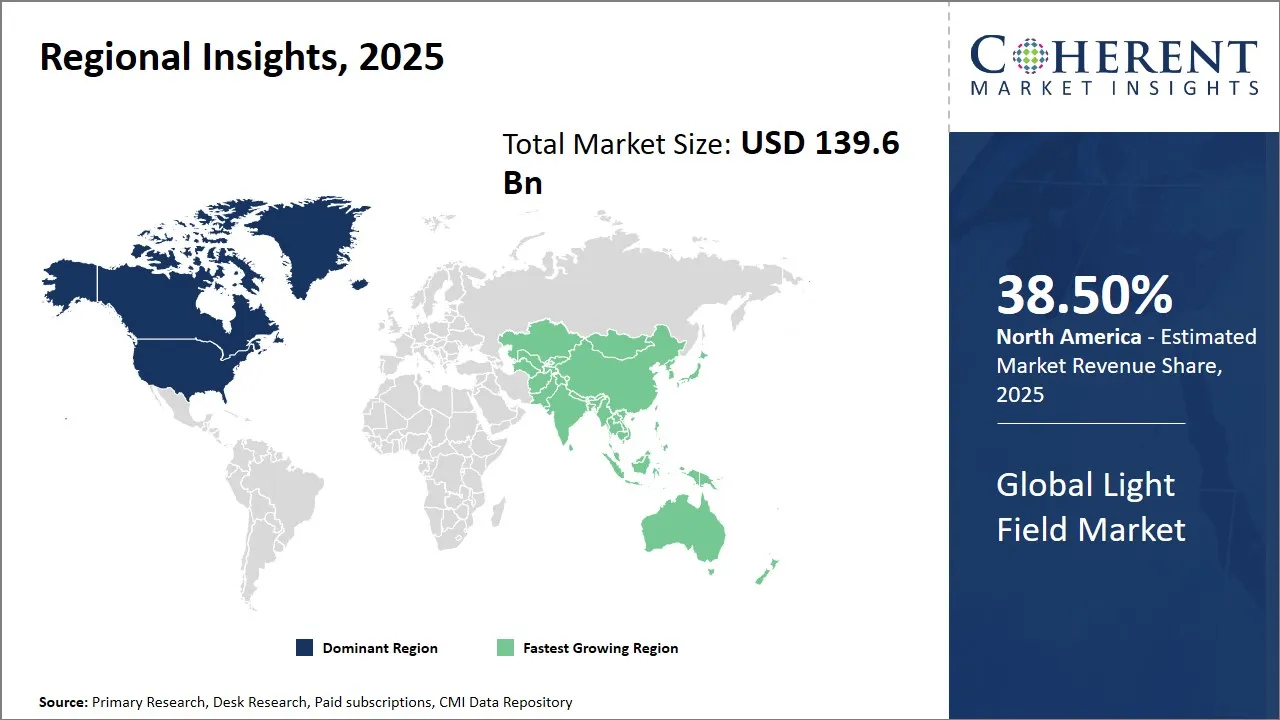
- North America, expected to hold a share of 38.5% in 2026, dominates the market.
- Asia Pacific, projected to hold a share of 32.3% in 2026, shows the fastest growth in the market.
Market Overview
The market is seeing a big shift towards the use of light field technology in virtual and augmented reality devices, enhancing user experiences with improved depth perception and image quality. Also, advancements in hardware and software solutions are enabling cost-effective production and broader commercialization. Increasing investments in research and development activities and collaborations between technology providers and end users are further adding to the market expansion, making light field technology a key enabler in next-generation imaging platforms.
Current Events and Its Impact
Current Events | Description and its Impact |
Geopolitical and Trade Developments |
|
Regulation & Standards (AI/Imaging) |
|
Technology Infrastructure & Compute Availability |
|
Economic & Industry Trends |
|
Segmental Insights
- Current Industry Events of 2026
- Market Size Estimation
- Regional Breakdown
- Competitive Landscape
- Customer Intelligence
- Segmental Analysis
- Pricing Analysis
- Key Market Drivers, Challenges & Future Trends
- Customized Insights Section
Global Light Field Market Insights, By Component – Hardware Leads Owing to Rapid Advancements and Critical Role in Light Field Technology Implementation
The hardware segment, projected to hold 54.2% of the global light field market share in 2026, leads due to its essential role in capturing, processing, and displaying light field data. Core components such as microlens arrays, optical modules, sensors, and light-field displays determine image realism, depth accuracy, and immersive visual output.
Advancements in display brightness, refresh rates, color reproduction, and the miniaturization of optical modules have accelerated adoption in AR/VR headsets, 3D visualization tools, medical imaging, automotive sensing, and industrial inspection. Growing demand for realistic immersive experiences and precise depth mapping further adds to hardware innovation.
Looking Glass Factory’s 32" and 65" holographic light-field displays (launched 2023–2024) showcase real-time, glasses-free 3D visualization—demonstrating how next-generation hardware is enabling enterprise-grade medical, engineering, and entertainment applications.
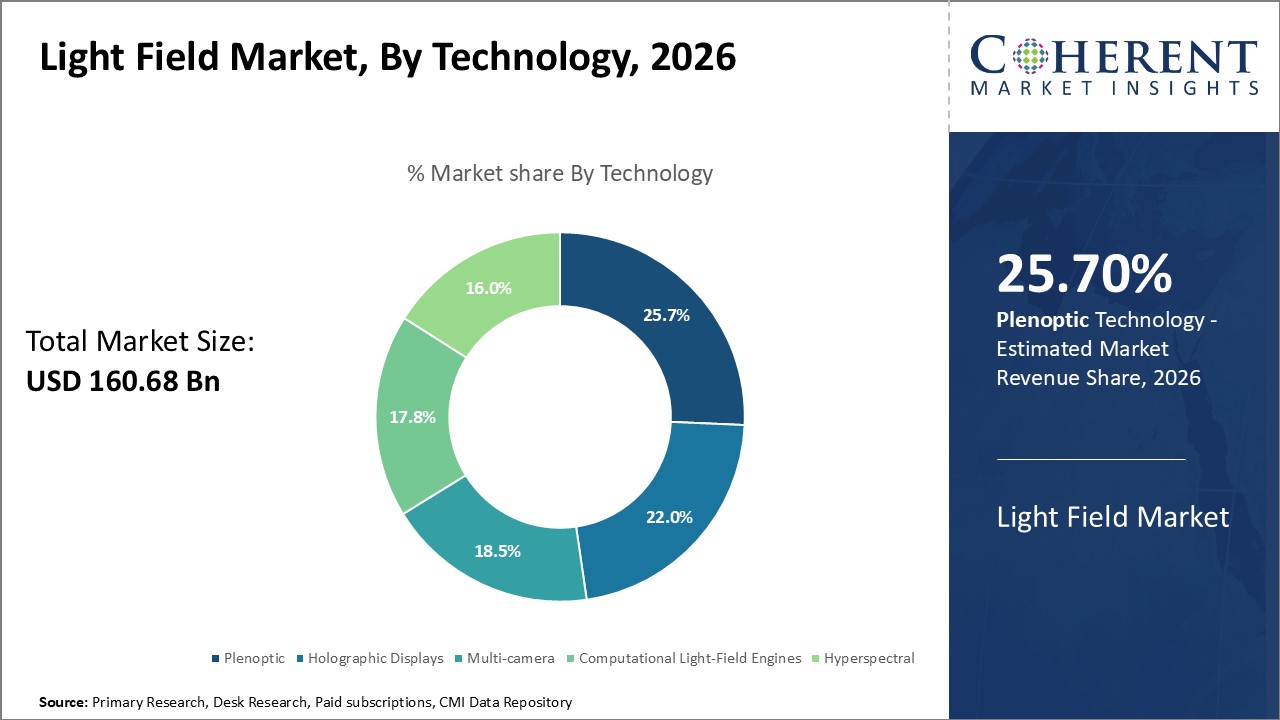
Global Light Field Market Insights, By Technology – Plenoptic Technology Leads the Market Because of its Efficiency and Versatility in Capturing Comprehensive Light Information
The plenoptic segment, expected to account for 25.7% of the market share in 2026, leads because it captures both the intensity and direction of light rays, enabling post-capture refocusing, accurate depth extraction, and high-quality 3D reconstruction. Its efficiency and versatility make it a preferred imaging technology across media, automotive, medical, and AR/VR applications.
Advances in microlens array design, image sensors, and computational algorithms have improved plenoptic systems’ resolution and real-time performance, adding to adoption in interactive visualization and immersive content workflows. Plenoptic setups also simplify optical complexity by shifting much of the depth and focus processing into software.
Raytrix’s R5 and R12 plenoptic industrial cameras deliver high-speed 3D capture for machine vision and microscopy, showing how plenoptic technology is already being used commercially for precision depth measurement and scientific imaging.
Pricing Analysis of the Light Field Market
Product/Component | Approx. Price (USD) |
Looking Glass 16″ Light Field Display | 3,000 |
Looking Glass 27″ Light Field Display | 10,000 |
Looking Glass Go (portable 6″ light-field display) | 225 (sale) |
Raytrix R5 (R5 M, GigE) | ~6,400 |
Raytrix R5 (R5 C, GigE) | ~7,800 |
Raytrix R5 (NIR, GigE) | ~10,800 |
Raytrix Light Field Engine (GPU processing workstation) | ~4,300 |
Raytrix High-Speed GPU (for light-field processing) | ~2,000 |
Cubert ULTRIS 5 (hyperspectral light-field camera) | Estimated 25,000–75,000 |
Light Field Vendor Performance Comparison Breakdown
Vendor/Device | Device type | Spatial resolution (panel/sensor) | Angular resolution (views/angular samples) | Viewing cone/FOV | Latency/Refresh | Typical applications | Price (USD)/Notes |
Looking Glass Factory — 27" Light Field Display | Desktop/group light-field display | 5120×2880 (5K). | Up to 100 views (manufacturer). | ~53° optimal viewing cone. | 60 Hz refresh (5K). | Multi-user 3D visualization, enterprise, medical, design. | Listed/preorder (Looking Glass store; 16" & 27" prices public). |
Leia Inc. — 12.3" Automotive & Monitor Lightfield (OEM) | Automotive infotainment/monitor light-field | Example: 4K/3840×2160 (monitor mode); automotive panels vary (est.). | 8 views (passive automotive variant) (published in OEM partnership). | Automotive cluster FOV ~30–50° (device dependent) (est.). | Head-tracked/passive modes; refresh ≈ panel spec (est. 60Hz+). | Automotive HUD/infotainment, shared 3D HMIs. | OEM pricing/Quote; mass-production 12.3" modules announced with Continental. |
CREAL — AR Light-field Glasses (prototype/eval kit) | Near-eye light-field/AR HMD | Uses micro projectors; perceived full-res for eye (vendor claims). (no conventional panel px published). | CREAL projects per-eye focal planes/continuous depth rather than fixed discrete "views" — angular behavior: continuous depth cues (vendor claim). | Target AR comfortable FOV for glasses ~30°–40° (product depends). (est.). | Latency targets low to avoid vergence-accommodation conflict; vendor focuses on visual comfort (no public ms spec). | AR eyewear, consumer AR, enterprise AR (natural focus cues). | Eval kits/OEM deals — Quote/N/A (no public MSRP). |
Wooptix — Liquid-lens single-lens light-field camera (prototype/research) | Capture: single-lens video light-field camera | Sensor dependent; reported single-lens real-time capture using liquid lens — sensor res varies (est. 4–12 MP). | Captures angular info via liquid-lens focus sweep/computational reconstruction — angular samples (est. 20–100 effective angular samples depending on method). | Capture FOV = lens FOV (device dependent). | Real-time capture claimed (latency low) — prototype/research stage; exact ms not public. | VFX, cinematography, real-time volumetric capture, mobile imaging R&D. | Research/custom; pricing: Quote/N/A (prototype/licensing model). |
Raytrix — R5 (Plenoptic industrial camera) | Capture: plenoptic/MLA light-field camera (industrial) | Sensor: e.g., 2048×2048 sensor, 4.2 Megarays (product family varies). Raytrix lists sensor/raw specs. | Angular samples ~7×7 to 11×11 (≈49–121 micro-views) depending on MLA design (common plenoptic ranges; vendor custom MLA). | FOV depends on lens; plenoptic angular sampling determined by MLA geometry. | Frame rates variable: e.g., 25–180 fps depending on interface/mode (R5 PDF examples). | Machine vision, microscopy, metrology, industrial QA. | USD 6.4k–USD 10.8k |
Holografika — HoloVizio 722RC (large real-3D wall) | Large-scale multi-view 3D display/LED wall | 2D equivalent per angle: 1280×768 (per-angle); total 3D rays ≈73 Megapixels (vendor spec). | Implied angular views = ~73M ÷ 983,040 ≈ 74 views (calculated from vendor 3D rays ÷ 2D per-angle) — (est./derived). | Viewing angle ~70° (vendor spec). | Refresh/input via GigE/Infiniband — suitable for real-time visualization; latency depends on system. | Large-scale visualization, scientific, simulation, enterprise demo rooms. | Enterprise systems — Quote/N/A (high cost, installation projects). |
Light-Field Display — Angular vs Spatial Resolution Benchmark
Device/Tech | Panel (spatial) resolution (pixels) | Published/Estimated Angular resolution (number of distinct views/perspectives) | Views per degree (approx.) — based on published viewing cone when available | Approx. per-view 2D-equivalent pixels (panel_pixels ÷ views) — and approx. per-view H×W |
Looking Glass 16" Spatial OLED | 3,840 × 2,160 = 8,294,400 px | 45 – 100 views (published range). | Viewing cone 53° (optimal) → 0.85 – 1.89 views/°. | 82,944 – 184,320 px/view → ≈ 288×288 to 429×429 equivalent. |
Looking Glass 27" (5K) | 5,120 × 2,880 = 14,745,600 px | 45 – 100 views (manufacturer: up to 100 perspectives). | Viewing cone 53° → 0.85 – 1.89 views/°. | 147,456 – 327,680 px/view → ≈ 384×384 to 572×572 equivalent. |
Holografika HoloVizio 722RC (large LED wall) | Total 3D rays: ~73,000,000 (3D resolution reported) — 2D single-angle = 1,280 × 768 = 983,040 px | Derived ~74 distinct angular views (73M ÷ 983,040 ≈ 74). (calculated) | Viewing cone variable (large installation) — assume ~60° → ~1.23 views/° (estimate). | ~983,040 px/view (manufacturer gives 2D equivalent per angle). Equivalent ~1280×768 per view. |
Sony/Spatial Reality Display (15.6") | 3,840 × 2,160 = 8,294,400 px (15.6" 4K model) | 2-eye stereoscopic/eye-tracked multi-view — effectively ~2 to ~9 per configuration (Sony uses micro-optics + per-eye rendering; angular behavior is head-tracked rather than a classical many-view LF). (Categorized: low angular multiplicity) | Effective views/° depends on system: with stereo/eye-tracked rendering the perceptual angular coverage differs from static many-view displays (N/A). | Per-eye 2D equivalent typically ~half the panel per eye in stereo modes (estimate) → ~4.1M px/eye (~2048×2048 square equivalent). |
Leia — 12.3" automotive (Continental) | Published as automotive-grade; typical automotive 12.3" infotainment panels are ~1920×720 to 3840×1080 depending on OEM. (Leia publishes 8-view passive display) | 8 views (published for passive automotive variant). | Automotive FOV small for driver cluster; assume ~40° → ~0.20 views/° (8 ÷ 40 = 0.20) — note: low views/deg because FOV large relative to views. | If panel is 3840×1080 = 4,147,200 px → per-view ≈ 518,400 px/view (~720×720 equiv). If 1920×720 → per-view ≈ 240,000 px/view (~490×490 equiv). (Estimated — vendor-specific panel varies). |
Acer/SpatialLabs 15.6" (example) | 3,840 × 2,160 = 8,294,400 px (UHD) | Acer SpatialLabs uses lenticular + eye-tracking; ~9 – 12 effective views in shared or head-tracked modes (manufacturer and reviews indicate per-eye 2K equivalent in 3D mode). | Typical viewing cone ~50° → ~0.18–0.24 views/° (if 9–12 over full cone) — NOTE: SpatialLabs often uses per-eye stereo or head-tracked multi-view. | Per-view ≈ ~690,000 – 920,000 px/view (if 12→ 8,294,400/12 ≈ 691,200; if 9→ 921,600) → ≈ 832×832 to 960×960 equivalents. |
Raytrix (plenoptic industrial camera — capture example) | Sensor native resolution varies. Example R5 capture produces ~5–12 MP raw sensor data (model-dependent). | Angular samples: typical plenoptic MLA cameras capture 7×7 to 11×11 micro-views (i.e., ~49 – 121 angular samples) (estimated/common literature ranges). | Not applicable as 'views/°' for capture; angular sampling is per lenslet grid. | Per-view pixels ≈ sensor_pixels ÷ angular_views. Example: 12 MP ÷ 49 ≈ 245,000 px/view (~495×495). |
Regional Insights
North America Light Field Market Analysis and Trends
North America, expected to hold a share of 38.5% in 2026, dominates the global light field market in 2026, because of a well-established technology ecosystem, significant R&D investments, and the presence of numerous innovation hubs. The U.S. leads with its strong network of technology companies, research institutions, and government initiatives supporting advanced imaging and augmented reality technologies. Government policies have added to innovation through grants and intellectual property protections, encouraging startups and established players to develop cutting-edge light field technologies.
Also, the region benefits from a mature supply chain and comprehensive trade agreements that facilitate the import and export of high-tech components. Big companies such as Lytro (now part of Google), Intel, and Magic Leap have contributed immensely by pioneering light field cameras, augmented reality devices, and light field displays, making North America a leader in innovation and commercialization of this technology.
Asia Pacific Light Field Market Analysis and Trends
The Asia Pacific, expected to hold a share of 32.3% in 2026, exhibits the fastest growth in the global light field market, propelled by rapidly expanding end-user industries such as consumer electronics, automotive, healthcare, and entertainment. The region’s growth is supported by large-scale manufacturing capabilities, government incentives for high-tech sectors, and increasing investments in digital and AI-driven imaging technologies.
Countries like China, Japan, and South Korea are adding to adoption through supportive policies, infrastructure development, and strategic partnerships between domestic and international firms. The huge consumer base and the growing demand for immersive experiences in gaming and media also stimulate market growth. Big players influencing the market include Sony, Canon, Samsung, and Pioneer, each advancing the light field market through innovations in camera sensors, display technologies, and computational photography.
Global Light Field Market Outlook for Key Countries
U.S. Light Field Market Analysis and Trends
The U.S. light field market sees a lot of high-tech companies and startups focused on light field imaging, computational photography, and AR/VR hardware. Silicon Valley is a hotspot for innovation where companies like Google, Intel, and Magic Leap are pushing the boundaries of immersive imaging technologies. Government programs pushing advanced manufacturing and research, alongside collaborations with academic institutions, fortify the U.S. market ecosystem, fostering fast prototyping and commercialization.
China Light Field Market Analysis and Trends
China light field market sees high expansion because of strong government backing within national initiatives like "Made in China 2026," which emphasize innovation in imaging technologies and smart manufacturing. Large electronics conglomerates such as Huawei and DJI are actively using light field technologies to enhance smartphone cameras and drone imaging systems. Also, China’s strong manufacturing infrastructure allows for cost-effective production and scalability. Strategic collaborations with global technology leaders further add to the adoption and use of light field imaging across digital entertainment and automotive sensors.
Japan Light Field Market Analysis and Trends
Japan continues to lead with its strong heritage in optics and imaging devices, anchored by global corporations like Sony, Canon, and Panasonic. These companies have extensive experience in camera sensor technology that is critical for light field applications. Japan’s focus on precision manufacturing and quality control translates to high-reliability products used in fields ranging from medical imaging to industrial inspection. The government supports research and development through various technology promotion grants, encouraging continuous innovation in light field capture and display.
South Korea Light Field Market Analysis and Trends
South Korea light field market sees fast adoption of new display and imaging technologies, led by major electronics manufacturers such as Samsung and LG. These companies invest a lot in R&D for advanced display panels and computational imaging, both crucial components of light field technology applications in smartphones, VR headsets, and automotive displays. The South Korean government supports these industries through subsidies and partnerships between research institutes and manufacturers, facilitating the addition of light field systems to consumer electronics and automotive sectors.
Germany Light Field Market Analysis and Trends
Germany light field market benefits from strong engineering and automotive industries, with companies like Zeiss and Bosch focusing on light field technology development for industrial and automotive imaging applications. Precision optics firms contribute expertise in lens design and sensor integration. The German government’s focus on Industry 4.0 and digital transformation adds to the deployment of advanced imaging systems in manufacturing and quality control. This makes a dynamic ecosystem where innovation in light field technology is used for both consumer and industrial use cases.
Market Players, Key Development, and Competitive Intelligence
Key Developments
- In July 2025, CREAL announced the closing of an USD 8.9 million equity funding round, led by ZEISS with participation from new and existing investors, including members of the UBS private investor network.
- In April 2025, Looking Glass, a company that originally started on Kickstarter and has since released various sizes of glasses-free 3D displays, debuted a 27″ model that the company is positioning as a digital signage solution. Utilizing the same “light field technology” as the rest of its offerings, the Looking Glass display is said to provide realistic 3D visuals within a 53-degree viewing angle.
- In September 2024, CREAL announced a license agreement with ZEISS with the aim to create a digitized vision care platform that hopes to revolutionize the current vision diagnostic and treatment procedures. By leveraging CREAL’s light field display technology, ZEISS will bring to market devices that allow for the digital examination of eye conditions as well as virtual simulation of classic ophthalmic lenses, contact lenses.
- In February 2023, Light Field Lab, a developer of a holographic display platform, secured USD 50 million in series B funding.
Top Strategies Followed by Light Field Market Players
- Established market leaders typically invest a lot in research and development (R&D) to drive innovation and create high-performance light field products that distinguish them from competitors.
- Looking Glass Factory invested significantly in R&D to launch its 27″ and 65″ light-field displays and developed Hololuminescent Displays (HLD) with new optical architectures, wider viewing cones, and upgraded rendering engines.
- Mid-level competitors in the light field market adopt a more cost-conscious strategy, focusing on offering solutions that strike an optimal balance between quality and affordability.
- Leia Inc., a mid-tier player in light-field and 3D display tech, made cost-optimized light-field displays for consumer devices such as the Lume Pad 2 and automotive dashboards through its Continental OEM partnership.
- Small-scale players in the global light field market get competitive advantages by focusing on niche segments and specialized features that may be overlooked by larger competitors.
- Raytrix GmbH, a smaller but highly specialized light-field camera manufacturer, focuses exclusively on industrial plenoptic cameras for microscopy, metrology, and machine-vision — a niche category where high precision is valued over mass scale.
Market Report Scope
Light Field Market Report Coverage
| Report Coverage | Details | ||
|---|---|---|---|
| Base Year: | 2025 | Market Size in 2026: | USD 160.68 Bn |
| Historical Data for: | 2020 To 2024 | Forecast Period: | 2026 To 2033 |
| Forecast Period 2026 to 2033 CAGR: | 15.1% | 2033 Value Projection: | USD 430.02 Bn |
| Geographies covered: |
| ||
| Segments covered: |
| ||
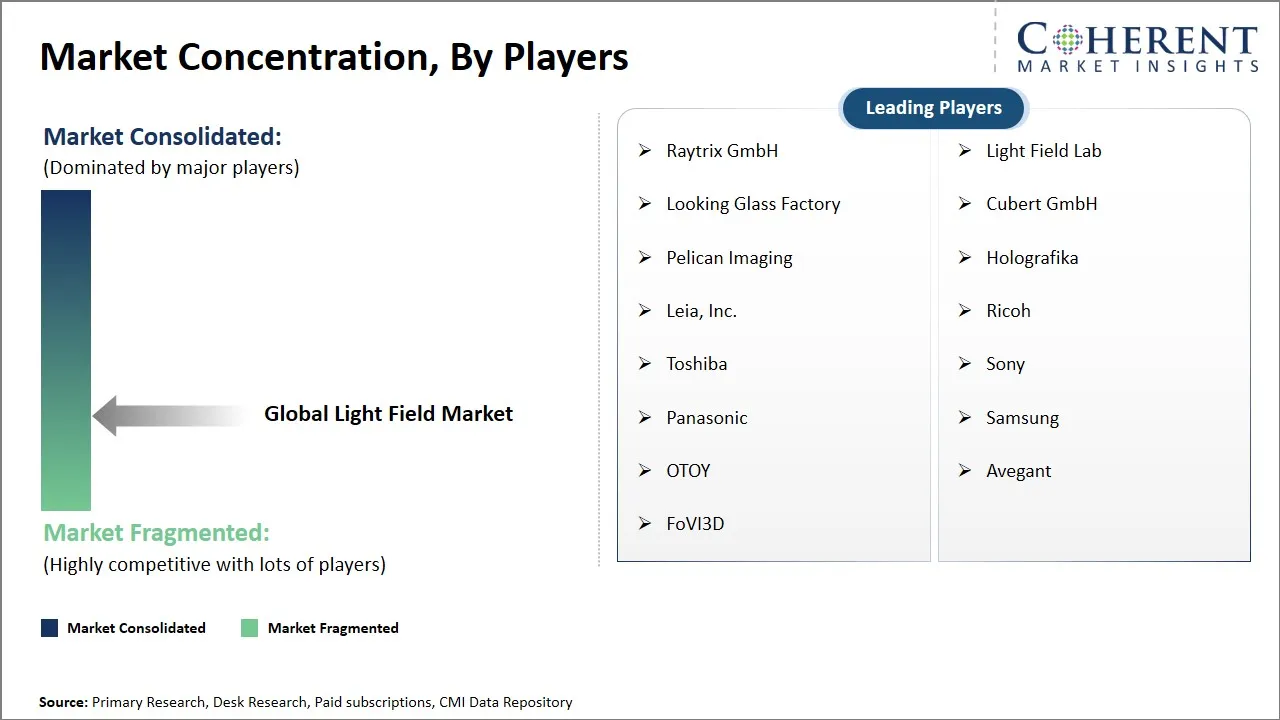
| Companies covered: | Raytrix GmbH, Light Field Lab, Looking Glass Factory, Cubert GmbH, Pelican Imaging, Holografika, Leia, Inc., Ricoh, Toshiba, Sony, Panasonic, Samsung, OTOY, Avegant, and FoVI3D | ||
| Growth Drivers: |
| ||
| Restraints & Challenges: |
| ||
Market Dynamics
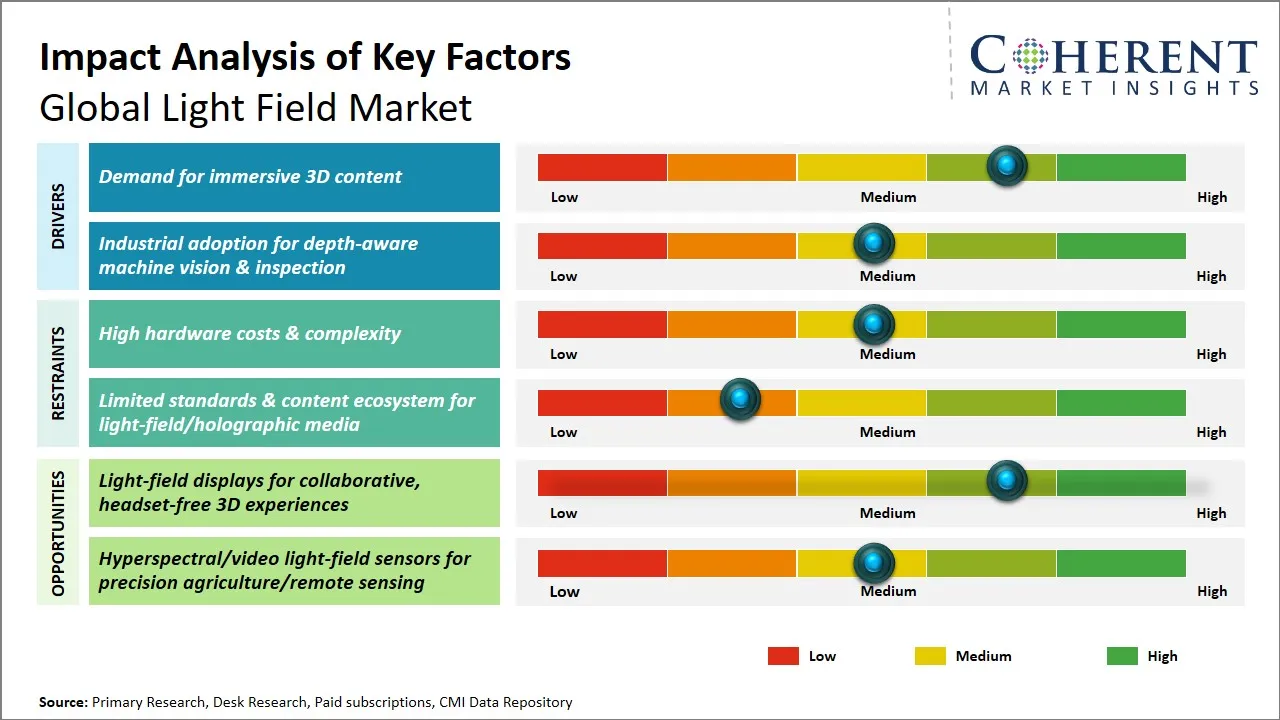
Global Light Field Market Driver – Demand for Immersive 3D Content
The growing need for immersive and realistic 3D content across entertainment, gaming, AR/VR, automotive, and simulation is accelerating light-field adoption. Light-field technology delivers natural depth, multi-view perspectives, and comfortable glasses-free 3D viewing, overcoming limitations of traditional stereoscopic displays. As users and industries seek richer engagement and lifelike visualization, demand for light-field–enabled content and hardware continues to rise.
Looking Glass Factory reported a surge in enterprise demand for holographic 3D visualization with the launch of its 27″ and 65″ light-field displays, driven by creators and studios rebuilding 3D content pipelines for immersive experiences.
Global Light Field Market Opportunity – Light-Field Displays for Collaborative, Headset-Free 3D Experiences
Light-field displays offer a major opportunity by enabling multi-user, glasses-free 3D interaction—ideal for design reviews, education, healthcare, engineering, and collaborative visualization. Their natural depth cues, real-time parallax, and shared viewing experience eliminate the barriers and discomfort of headsets, making them suitable for group workflows and professional environments. Advances in resolution, rendering, and optics continue to expand commercial applicability.
Holografika’s HoloVizio systems are being deployed in medical and automotive design labs to enable multi-person, headset-free 3D collaboration, allowing teams to view and manipulate 3D data simultaneously.
Analyst Opinion (Expert Opinion)
- Despite aggressive roadmaps and flashy demos, core enabling technologies—whether it’s display resolution, compute efficiency, sensor accuracy, or optical miniaturization—are not keeping pace with commercial expectations. The industry talks about “next-gen capabilities,” but the truth is that many solutions are still stuck in prototype-level reliability, making real-world deployments painfully slow.
- Pricing remains a persistent bottleneck, driven by expensive components, low manufacturing scale, and complex system integration. Vendors often claim that “costs will come down with scale,” but scale itself is impossible without competitive pricing. This circular dependency continues to suffocate early market acceleration.
- Competing standards, incompatible platforms, and inconsistent performance benchmarks mean customers cannot easily compare solutions or plan long-term investments. Without interoperability or unified metrics, the market operates more like a patchwork of isolated technologies rather than a coherent industry—slowing adoption and undermining buyer confidence.
Speak to the analyst
Want personalized insights?
Take the findings above to one of our principal consultants, or have the report rebuilt around the segments, geographies and competitors you actually track.
Market Segmentation
- Component Insights (Revenue, USD Bn, 2021 - 2033)
- Hardware
- Displays & Optical Modules
- Software & Middleware
- Services & Integration
- Technology Insights (Revenue, USD Bn, 2021 - 2033)
- Plenoptic
- Holographic Displays
- Multi-camera
- Computational Light-Field Engines
- Hyperspectral
- Regional Insights (Revenue, USD Bn, 2021 - 2033)
- North America
- U.S.
- Canada
- Latin America
- Brazil
- Argentina
- Mexico
- Rest of Latin America
- Europe
- Germany
- U.K.
- Spain
- France
- Italy
- Russia
- Rest of Europe
- Asia Pacific
- China
- India
- Japan
- Australia
- South Korea
- ASEAN
- Rest of Asia Pacific
- Middle East
- GCC Countries
- Israel
- Rest of Middle East
- Africa
- South Africa
- North Africa
- Central Africa
- North America
- Key Players Insights
- Raytrix GmbH
- Light Field Lab
- Looking Glass Factory
- Cubert GmbH
- Pelican Imaging
- Holografika
- Leia, Inc.
- Ricoh
- Toshiba
- Sony
- Panasonic
- Samsung
- OTOY
- Avegant
- FoVI3D
Sources
Primary Research Interviews
Stakeholders
- Construction Companies and Contractors
- Formwork Manufacturers and Suppliers
- Architects and Structural Engineers involved in large-scale infrastructure projects
- Real Estate Developers and Building Construction Companies
- Equipment Leasing Firms specializing in formwork solutions
- Sustainability Experts and Green Building Consultants (for eco-friendly formwork systems)
Example Interview Records
- Interview with Senior Project Manager, HorizonBuild Infrastructure Pvt. Ltd., India, 2024
- Discussion with Technical Director, NovaForm Systems GmbH, Germany, 2024
- Interview with Lead Structural Engineer, TerraDesign Consultants, U.A.E., 2025
- Conversation with Procurement Head, Skylink Real Estate Developers, Singapore, 2025
- Interview with Operations Manager, FormLease Solutions Inc., U.S., 2024
- Consultation with Sustainability Advisor, GreenConstruct Advisory Group, U.K., 2024
Databases
- Eurostat
- U.S. Census
- Construction Global
- OECD
- Global Construction Activity Ledger (GCAL)
- International Formwork Utilization Database (IFUD)
- Asia-Pacific Infrastructure Input Tracker (APIIT)
- Urban Mega-Projects Procurement Registry (UMPR)
Magazines
- Construction Today
- Concrete Construction
- Building Design + Construction (BD+C)
- Formwork Construction Magazine
- Structural Systems Review
- Global Infrastructure Outlook Magazine
Journals
- Journal of Construction Engineering and Management
- Construction and Building Materials
- Automation in Construction
- Journal of Building Engineering
- International Journal of Modular Infrastructure (IJMI)
- Advanced Materials for Civil Structures Journal
Newspapers
- The Construction Index
- Construction Week Online
- The Guardian (U.K.)
- The Economic Times (India)
- Infrastructure Daily Bulletin
- Global Civil Engineering Times
Associations
- International Concrete Repair Institute (ICRI)
- The Concrete Society (U.K.)
- National Association of Home Builders (NAHB)
- The Formwork Association (U.K.)
- American Concrete Institute (ACI)
- Global Formwork Technology Council (GFTC)
- Asia Construction Sustainability Forum (ACSF)
Public Domain Sources
- U.S. Census Bureau
- EUROSTAT
- United Nations Economic Commission for Europe (UNECE)
- World Bank
- ResearchGate
- International Building Materials Archive (IBMA)
Proprietary Elements
- CMI Data Analytics Tool
- Proprietary CMI Existing Repository of information for last 8 years
Get access to 250+ pages report
Every segment, forecast, competitor profile and data table behind the analysis above — available for instant download.
- ESOMAR Member
- ISO 9001:2015 Certified
- D-U-N-S Registered
- GDPR & CCPA Compliant
Missing comfort of reading report in your local language? Find your preferred language:
Transform your Strategy with Exclusive Trending Reports
Frequently Asked Questions
The global light field market is estimated to be valued at USD 160.68 Bn in 2026 and is expected to reach USD 430.02 Bn by 2033.
The CAGR of the global light field market is projected to be 15.1% from 2026 to 2033.
Demand for immersive 3D content and industrial adoption for depth-aware machine vision & inspection are the major factors driving the growth of the global light field market.
High hardware costs & complexity and limited standards & content ecosystem for light-field/holographic media are the major factors hampering the growth of the global light field market.
In terms of component, the hardware is estimated to dominate the market revenue share in 2026.
Raytrix GmbH, Light Field Lab, Looking Glass Factory, Cubert GmbH, Pelican Imaging, Holografika, Leia, Inc., Ricoh, Toshiba, Sony, Panasonic, Samsung, OTOY, Avegant, and FoVI3D are the major players.
North America is expected to lead the global light field market in 2026.