

Global Live Animals Market Size and Forecast – 2026 To 2033
The Global Live Animals Market is estimated to be valued at USD 2,895.6 Mn in 2026 and is expected to reach USD 4,325.2 Mn by 2033, exhibiting a compound annual growth rate (CAGR) of 5.90% from 2026 to 2033. Steady market growth is supported by increasing demand for live animals across agriculture, meat and dairy production, breeding, pharmaceuticals, and research applications, along with growing focus on animal health, productivity, and organized livestock management worldwide. Increased demand for meat, organized livestock farming, breeding animals, egg production, and dairy products help drive market growth.
Live animals remain essential across slaughterhouses, meat processors, dairy farms, poultry farms, and breeding operations, where buyers increasingly prefer animals with strong health status, clear traceability records, and higher productivity potential. This shift is encouraging greater investment in organized livestock systems, as seen in the following instance. In February 2026, the World Bank highlighted that private investment is reshaping livestock farming in Kenya, where livestock keeping supports Mns of producers and is becoming a strong commercial value-chain opportunity. This reflects growing investment in organized livestock systems, animal productivity, and market-linked farming models.
Key Takeaways of the Global Live Animals Market
- The cattle and buffalo segment is expected to account for 34.8% of the market share in 2026, supported by their central role in meat, dairy, breeding, and replacement herd economics. In January 2026, United States Department of Agriculture National Agricultural Statistics Service reported 86.2 Mn cattle and calves on U.S. farms, reinforcing the scale of cattle-based live animal trade.
- Slaughter and meat production is expected to hold 48.6% of the market share in 2026, as processors prioritize steady animal procurement to secure meat supply chains. In June 2026, Food and Agriculture Organization (FAO) highlighted rapid growth in terrestrial animal-source food supply, with poultry and pig meat strongly shaping livestock production systems globally.
- Meat processors and slaughterhouses are expected to account for 39.7% of the market share in 2026, as they remain the primary bulk buyers of live animals for regulated slaughter, carcass processing, chilling, and meat distribution. In May 2026, United States Department of Agriculture (USDA) opened Phase 4 of its Meat and Poultry Processing Expansion Program to support processor capacity expansion and strengthen livestock supply chains.
- Asia Pacific is expected to dominate with 36.7% of the market share in 2026, supported by large livestock populations, food security priorities, and strong rural livelihood dependence. In June 2026, FAO emphasized that the terrestrial animal-source food supply was growing rapidly, and poultry and pig meat played a significant role in influencing livestock production systems around the world.
- North America is expected to hold 22.8% of the market share in 2026, with growth supported by organized livestock reporting, breeding herd recovery, and high-value cattle and meat supply chains. In February 2026, Statistics Canada reported 11.1 Mn cattle and calves as of January 1, 2026, up 2.5% year-over-year.
- Animal Health and Traceability are Becoming Strategic Priorities: Livestock buyers and processors; animal exporters are increasingly looking for strong health records, visibility of vaccinations, and movement documentation. This trend is influencing the way animal procurement is being considered, impacting animal availability, pricing stability and buyer confidence throughout live animal supply chains and directly impacting disease risk, biosecurity compliance, and movement controls across the border.
- Commercialization of Livestock Trade is Reshaping Market Access: The market is shifting from a small-scale, local exchange to more professionalized and organized livestock market procurement processes, including the feed lot, processor, producer groups, and livestock listing platforms. That enhances price discovery, decreases transaction inefficiencies and helps bigger buyers to guarantee a consistent animal supply, thus making livestock commercialization a factor of long-term maturity in the market.
Segmental Insights
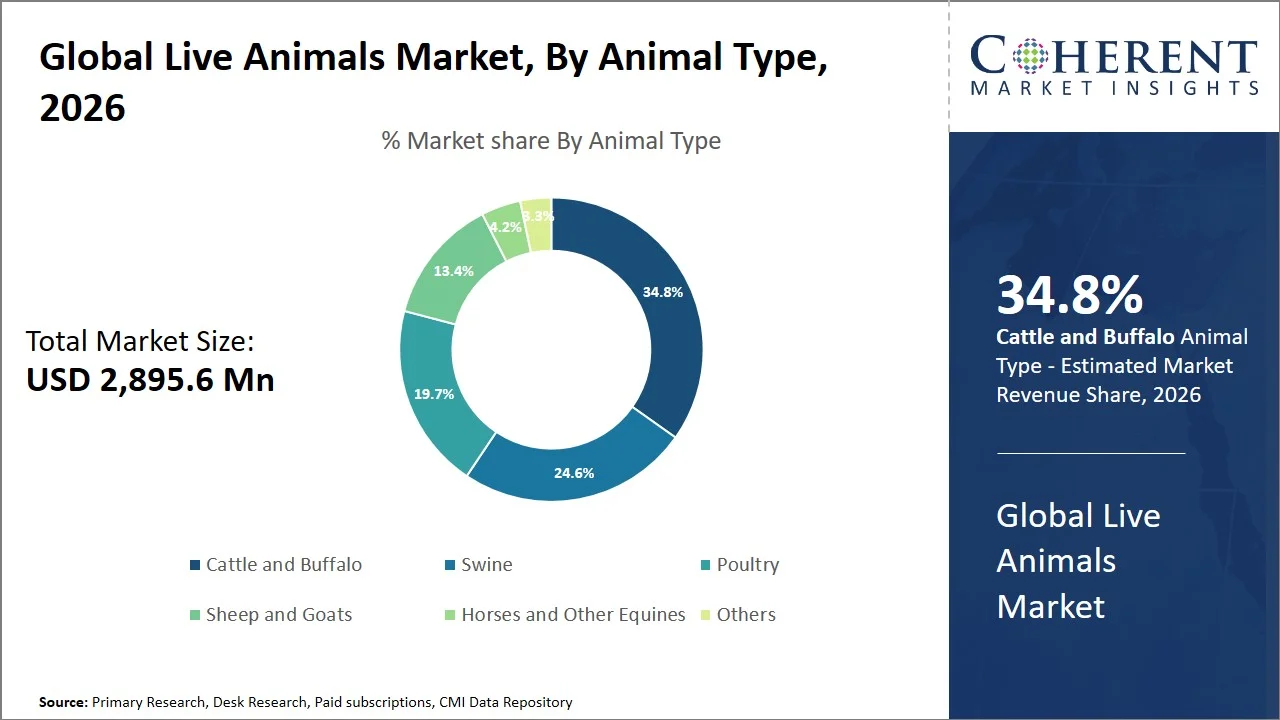
Why Does Cattle and Buffalo Dominate the Global Live Animals Market?
Cattle and buffalo are projected to account for 34.8% of the total market share in 2026, due to the multiple value pools of beef, dairy, breeding, hides, manure and replacement herd trade. The segment has strong downstream relevance, as meat processors prefer heavier live animals to improve carcass yield and value realization, dairy farmers require high-yielding cows and buffaloes to enhance milk productivity, and breeders depend on superior genetics for effective herd replacement and productivity improvement. Organized animal ID, veterinary certification, herd improvement and traceability bolsters supply-side leadership and increases the confidence of buyers. In March 2026, Brazil’s Ministry of Agriculture promoted cattle-sector export readiness in Goiás and included the implementation of the National Individual Identification Plan for Cattle and Buffaloes, linking traceability with sanitary compliance and market access. (Source: Brazil Ministry of Agriculture)
- Current Industry Events of 2026
- Market Size Estimation
- Regional Breakdown
- Competitive Landscape
- Customer Intelligence
- Segmental Analysis
- Pricing Analysis
- Key Market Drivers, Challenges & Future Trends
- Customized Insights Section
Why Does Slaughter and Meat Production Represent the Largest Purpose Segment in the Live Animals Market?
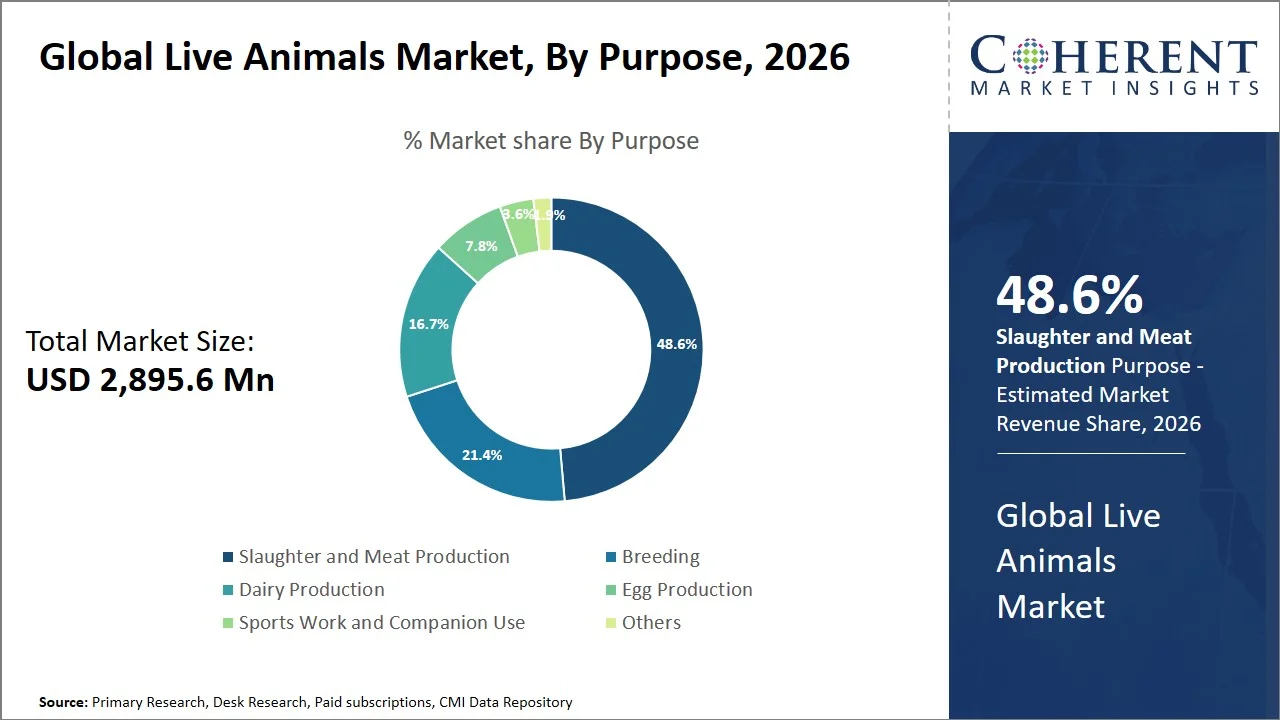
Slaughter and meat production is expected to account for 48.6% of the market share in 2026, as live animal trade is primarily monetized through conversion into beef, pork, poultry, mutton, and other meat products. The segment dominates because food processors, wholesalers, retailers, and foodservice operators require continuous animal inflows to maintain carcass output, portioning, cold-chain utilization, and contract supply. Demand is linked to protein consumption and processed meat formats, while supply-side strength comes from slaughter scheduling, animal grading, veterinary inspection, chilling capacity, and logistics that convert live animals into standardized commercial meat. In March 2026, the Australian Bureau of Statistics reported quarterly livestock slaughter and meat production data, including higher cattle slaughter and increased beef output, confirming active processing demand across red meat supply chains. (Source: Australian Bureau of Statistics)
Why Do Meat Processors and Slaughterhouses Dominate the Global Live Animals Market?
Meat processors and slaughterhouses are expected to hold 39.7% of the market share in 2026, as they are the largest institutional buyers converting fragmented livestock supply into commercial meat volumes. Their dominance is supported by bulk procurement capability, carcass optimization, food safety infrastructure, chilling and deboning lines, and established distribution networks with retailers, exporters, and foodservice buyers. Unlike farms or breeding centers, processors directly influence live animal pricing through throughput needs, quality specifications, and procurement contracts. End-use relevance is strongest where export-grade beef, pork, poultry, and value-added meat require regulated slaughter and standardized processing. In January 2026, FriGol signed an industrial processing services agreement with RioBeef in Rondônia, covering slaughtering and deboning of cattle purchased by FriGol to diversify procurement and expand premium beef supply. (Source: FriGol)
Global Live Animals Market Dynamics
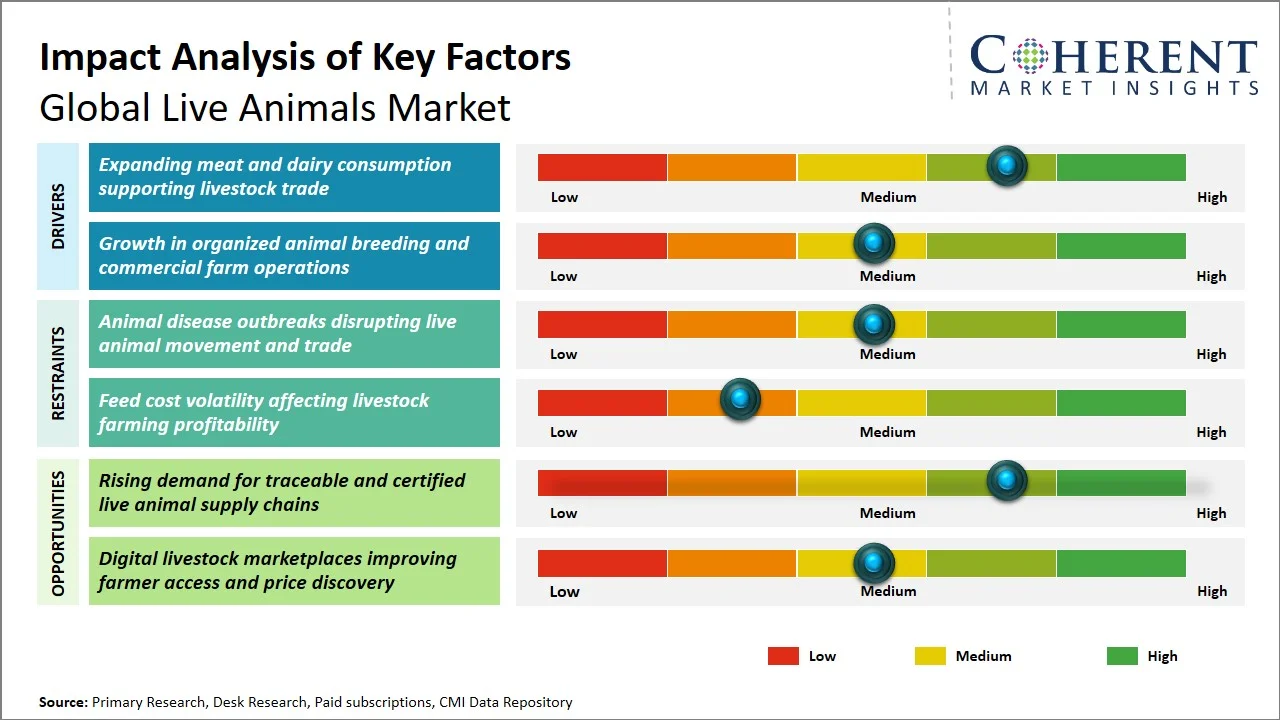
Key Market Drivers
- Expanding Meat and Dairy Consumption Supporting Livestock Trade
Livestock trade relies on having a reliable supply of animals to keep slaughtering and processing plants busy, and there is a continuing trend for increased meat and dairy consumption. The driver is particularly crucial for cattle, buffalo, swine, poultry, sheep and goats – which provide both fresh protein and value-added products. The driver is especially important for cattle, buffalo, swine, poultry, sheep, and goats, as these animals support both fresh protein consumption and value-added processing. Demand is also supported by organized retail, foodservice recovery, urban protein consumption, and dairy-based product diversification. In June 2026, the European Commission reported that EU per capita meat consumption is expected to remain stable in 2026 despite high prices, while EU milk production is expected to increase slightly, supported by resilient dairy demand. This confirms that animal-source food demand continues to sustain live animal procurement and trade flows. (Source: European Commission)
- Growth in Organized Animal Breeding and Commercial Farm Operations
The shift from fragmented livestock ownership toward organized breeding, feedlot-based operations, and commercially managed farms is improving supply reliability in the global live animals market. Large farms and breeding operators are investing in herd renewal, breed productivity, reproductive efficiency, animal health, and structured procurement systems to meet processor and dairy-sector requirements. This supports higher-quality animal supply, better price realization, and stronger linkage between farmers and institutional buyers. In May 2026, Kazakhstan’s Prime Minister’s office reported a national livestock modernization push, including higher budget financing for livestock farming, increased subsidy rates for breeding stock, high-tech feedlot projects, and agreements to import highly productive breeding animals. This reflects how organized breeding and commercial farm modernization are becoming central to livestock supply expansion. (Source: Prime Minister of Kazakhstan)
Emerging Market Trends
- Traceability-led Livestock Trading
Traceability is becoming a core commercial requirement in the live animals market, moving beyond basic animal identification toward full visibility of movement, ownership, health history, and transaction records. Buyers are increasingly valuing animals that can be verified through structured documentation, as traceability lowers disease-response risk and improves confidence in cross-border and processor-linked trade. This trend benefits organized farms, certified breeders, auction operators, and exporters that can provide verified records. It also improves market access for producers supplying formal slaughterhouses, dairy farms, and breeding centers. Over time, traceability-led trading is expected to create pricing advantages for compliant suppliers, while smaller informal sellers may face higher barriers unless they adopt digital identification and movement documentation.
- Processor-linked Procurement and Contract-based Livestock Supply
Live animal procurement is gradually becoming more structured as meat processors, slaughterhouses, dairy operators, and large farms seek predictable supply rather than relying only on spot-market purchases. Contract-based sourcing helps buyers manage animal quality, weight consistency, delivery timing, and disease-risk exposure. For producers, processor-linked arrangements can improve sales certainty, reduce price volatility, and encourage investment in feed, genetics, veterinary care, and farm management. This trend is particularly relevant for cattle, swine, poultry, and small ruminants, where end users require consistent animal condition for meat yield, milk productivity, or breeding performance. The direction of the market indicates stronger integration between farmers, aggregators, processors, and logistics providers.
Current Events and their Impact
Current Events | Description and its Impact |
June 2026 – Canada Revises Livestock Traceability Regulatory Approach |
|
May 2026 – Australia Advances Transition from Live Sheep Exports by Sea |
|
May 2024 – Great Britain Bans Live Animal Exports for Slaughter and Fattening |
|
Regional Insights
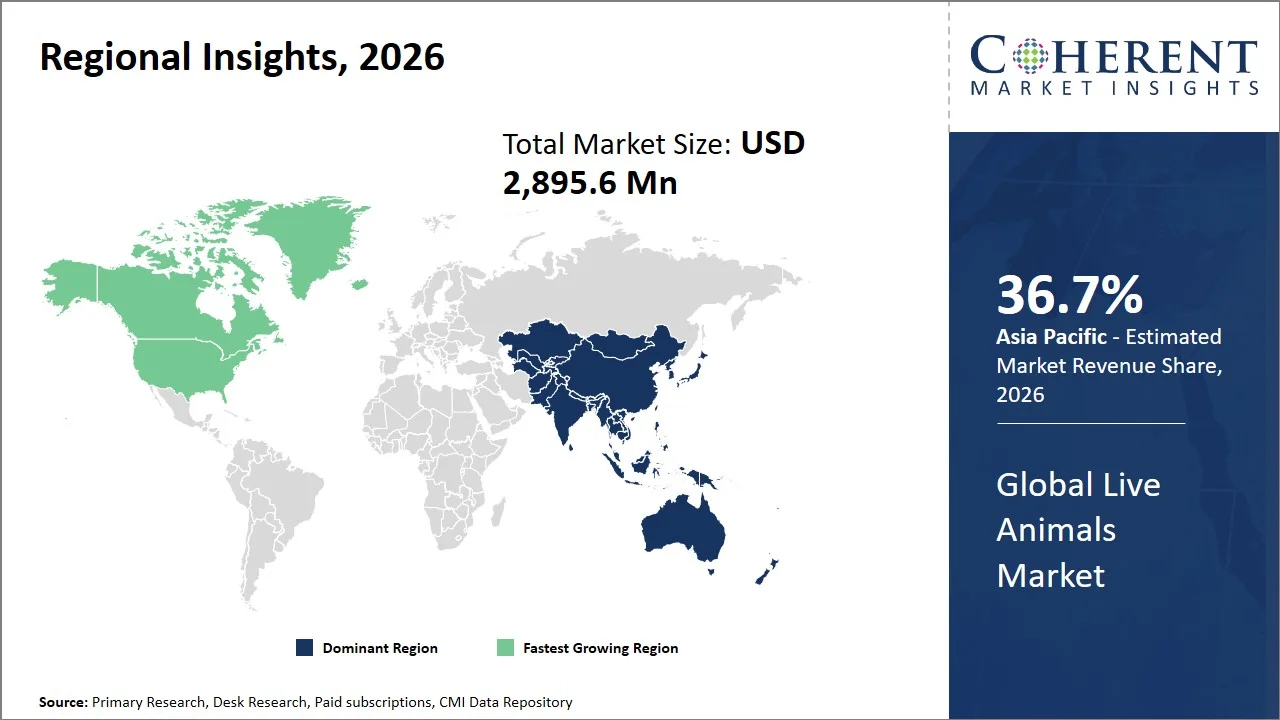
Why Does Asia Pacific Dominate the Global Live Animals Market?
Asia Pacific is expected to dominate the global live animals market with 36.7% share in 2026, supported by large livestock populations, strong dairy and meat consumption, and active animal movement for breeding, slaughter, and farm productivity improvement. The region’s leadership is strengthened by cattle, buffalo, poultry, swine, sheep, and goat demand across India, China, Australia, Indonesia, and Southeast Asia. Commercial farms and cooperatives are increasingly sourcing improved breeds to raise milk yield, meat output, and herd quality. In February 2026, ASOHI reported that 1,383 dairy cattle from Australia arrived at Cilacap, Indonesia, with quarantine and animal health checks conducted before distribution to partner farmers, supporting Indonesia’s dairy herd expansion.
Why is North America Emerging as the Fastest-Growing Region in the Global Live Animals Market?
North America is expected to emerge as the fastest-growing region with 22.8% share in 2026, owing to its organized cattle, hog, poultry, dairy, and meat-processing supply chains. The region benefits from structured auctions, feedlots, veterinary controls, large slaughter infrastructure, and strong demand from meat processors and dairy operators. Tight cattle availability is also raising live animal values, making herd rebuilding, breeding stock management, and procurement efficiency commercially important. The region’s growth is value-led rather than purely volume-led, as buyers compete for quality animals with verified health and weight profiles. In June 2026, USDA Economic Research Service (ERS) raised its 2026 slaughter steer price outlook to US$ 250.16 per cwt, reflecting strong cattle pricing and tight supply conditions. (Source: USDA ERS)
Global Live Animals Market Outlook for Key Countries
Why is China a Key Market for the Global Live Animals Market?
China is a key market for the global live animals market due to its large-scale consumption of pork, beef, poultry, eggs, and dairy products, combined with ongoing modernization of commercial breeding and animal production systems. The country’s livestock sector supports both domestic protein security and industrialized meat processing, with swine, cattle, sheep, poultry, and dairy animals forming critical supply pools. Demand is supported by urban food consumption, cold-chain expansion, and the need for more standardized animal supply into slaughter and dairy systems. In May 2026, China’s Ministry of Agriculture and Rural Affairs reported that 2025 national meat, egg, and milk output reached 100.72 million tons, 34.98 million tons, and 40.91 million tons, respectively, underscoring the scale of livestock-based supply.
Why is Mexico Important in the Global Live Animals Market?
Mexico is important in the global live animals market due to its strategic position in the North American cattle trade, beef production, and cross-border livestock supply chains. The country has a strong ranching base, especially in northern states, and traditionally supplies live cattle into U.S. feedlots and processing systems. However, disease-control disruptions are pushing domestic feedlot use, slaughter, and beef export orientation, making Mexico’s live animals market more integrated with value-added meat production. In May 2026, Reuters reported that Mexico’s cattle sector was shifting toward processed beef exports after live cattle exports to the U.S. were disrupted by screwworm controls, with beef exports to the U.S. rising around 23% between January and April 2026.
Why Does Australia Support Growth in the Global Live Animals Market?
Australia supports growth in the global live animals market through its established livestock export infrastructure, strong biosecurity systems, and recognized role in supplying cattle, sheep, goats, and breeding animals to overseas markets. The country is especially relevant for Asian and Middle Eastern buyers that require live animals for breeding, dairy expansion, feedlot finishing, and religious or seasonal slaughter demand. Australia’s competitive position is strengthened by animal welfare standards, export licensing, quarantine systems, and long-distance logistics capability. In April 2026, Australia’s Department of Agriculture, Fisheries and Forestry stated that Australia exports livestock by sea and air, including sheep, goats, cattle, deer, buffalo, and camelids, and that the livestock export industry contributes over US$1.6 billion to the economy.
Why is India Important in the Global Live Animals Market?
India is important in the global live animals market due to its large cattle, buffalo, goat, sheep, poultry, and dairy animal base, which supports rural livelihoods, milk production, meat processing, and breeding demand. The country’s live animals market is shaped by strong dairy consumption, smallholder ownership, cooperative procurement, and government-backed breed improvement and animal health programs. Buffaloes and cattle remain central to dairy economics, while goats, sheep, and poultry support meat and egg supply across rural and urban markets. In November 2025, India’s Department of Animal Husbandry and Dairying released Basic Animal Husbandry Statistics 2025 stated that livestock GVA increased by nearly 195% from 2014–15 to 2023–24 and contributed 31% to agricultural GVA in 2023–24.
Why is Brazil a Strategic Country in the Global Live Animals Market?
Brazil is a strategic country in the global live animals market because of its large commercial cattle base, strong beef export ecosystem, and growing relevance in live cattle and bovine genetics trade. The country benefits from extensive pasture systems, established veterinary controls, export-oriented livestock value chains, and strong demand from slaughterhouses, breeders, and international buyers. Brazil’s position is also supported by sanitary upgrades that improve market access and strengthen buyer confidence in animal movement and animal-origin products. In June 2025, Pan American Health Organization (PAHO) confirmed that Brazil was officially recognized as free of foot-and-mouth disease without vaccination, a major sanitary milestone that strengthens confidence in livestock trade and animal health controls.
Technology Adoption Landscape in the Global Live Animals Market
Technology | Adoption Level | Key Application Area | Business Impact |
Electronic animal identification and RFID tags | High | Animal movement, ownership records, slaughter reporting | Improves traceability, disease response, and buyer confidence in formal livestock trade |
Digital health certificates and movement permits | High | Interstate and cross-border livestock movement | Reduces paperwork delays, improves regulatory compliance, and supports faster trade clearance |
Genomic selection and artificial insemination | Medium | Breeding centers, dairy farms, cattle and buffalo productivity | Enhances herd quality, reproductive efficiency, and productivity-linked animal valuation |
Precision livestock monitoring sensors | Medium | Commercial farms, feedlots, dairy herds | Supports early disease detection, better feeding decisions, and lower productivity losses |
Livestock marketplace and auction management platforms | Medium | Direct sales, dealer networks, farm-to-processor transactions | Improves price discovery, buyer access, and transaction transparency |
GPS-enabled livestock transport monitoring | Medium | Long-distance animal transport and export logistics | Supports welfare compliance, route control, and reduced transport-related animal losses |
How are Traceable Supply Chains and Processor-linked Procurement Creating New Growth Opportunities in the Global Live Animals Market?
Traceable supply chains and processor-linked procurement are creating a major growth opportunity by moving live animal trade toward verified, quality-based, and commercially integrated models. Buyers such as slaughterhouses, meat processors, dairy farms, and breeding centers increasingly need predictable animal supply with clear records of origin, health, movement, and ownership. This creates opportunities for producers that can supply animals under documented standards rather than informal spot-market conditions. For livestock traders, digital identification and structured procurement can improve buyer trust, support premium pricing, and reduce transaction risk. For processors, closer supplier relationships improve throughput planning, carcass consistency, and compliance with food safety and animal welfare expectations. The opportunity is commercially important because it strengthens the connection between farm-level production and downstream meat, dairy, and breeding value chains, allowing organized participants to scale faster and differentiate on reliability, animal quality, and compliance readiness.
Market Players, Key Development, and Competitive Intelligence
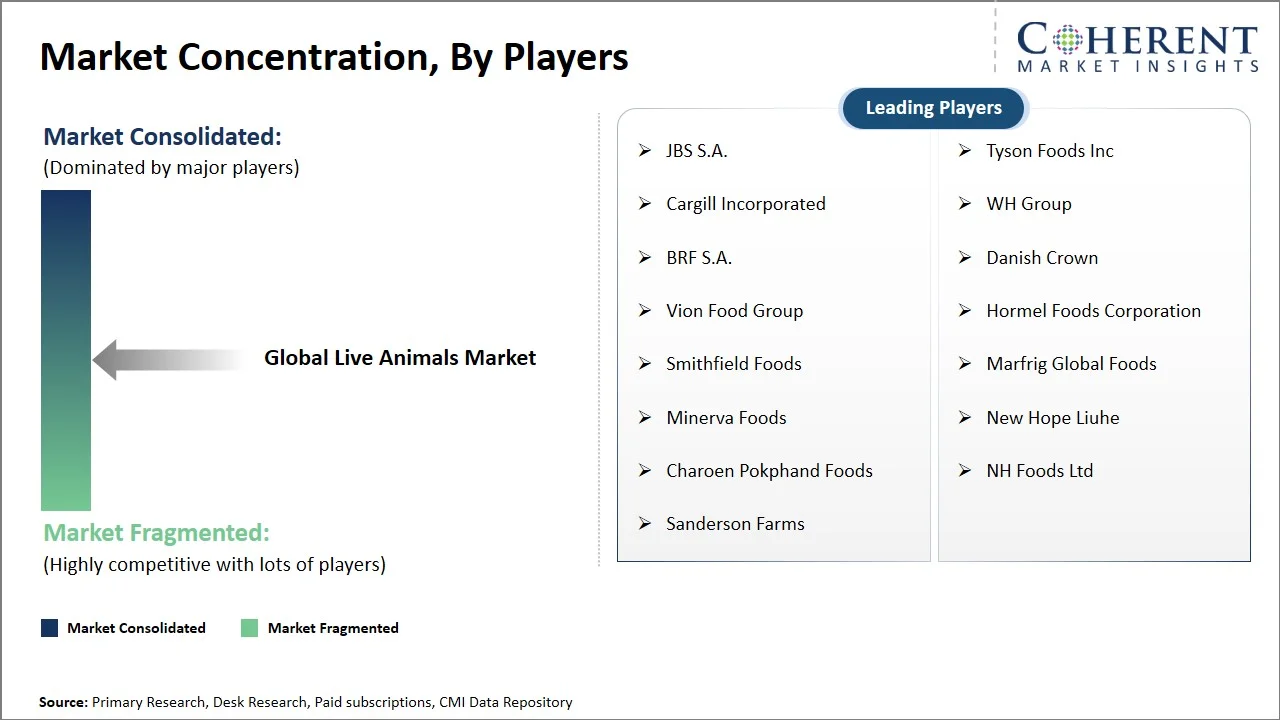
Key Developments
- In February 2026, JBS USA broke ground on a US$ 150 million expansion at its Cactus, Texas beef production facility in the U.S. The project includes a new fabrication floor and expanded ground beef room, improving cattle-processing efficiency, production capacity, and long-term procurement opportunities for regional cattle producers.
- In November 2025, Tyson Foods announced network changes to strengthen its long-term beef business, including ending operations at its Lexington, Nebraska beef facility and converting its Amarillo, Texas beef facility to a single full-capacity shift in the U.S. The company stated that production would be increased at other beef facilities to optimize volumes.
- In February 2026, Cargill Animal Nutrition & Health opened a USD 3.18 Mn dairy feed plant in Wazirabad, Punjab, India. The facility has an annual production capacity of 400,000 metric tons and will supply feed under Provimi and Purina brands, supporting dairy farmers, young animals, and milking cows.
Competitive Landscape
The global live animals market remains highly fragmented at the farm and trader level, while becoming more structured around processors, breeding centers, large dairy farms, commercial feedlots, livestock exporters, auction operators, and integrated poultry and swine producers. Competition is increasingly shaped by animal quality, health status, traceability, supply reliability, and the ability to serve institutional buyers consistently.
Key area include:
- Product quality and differentiation: Players compete through breed quality, live weight, health status, reproductive potential, and suitability for slaughter, dairy, or breeding applications.
- Technology adoption and process efficiency: Digital identification, farm records, breeding tools, and transport monitoring improve operational efficiency and buyer confidence.
- Pricing and cost competitiveness: Feed cost, animal weight gain, veterinary care, and logistics directly influence selling price and margins.
- Capacity expansion and supply reliability: Larger farms, feedlots, and aggregators gain advantage by supplying steady animal volumes to processors and dairy farms.
- Certifications, compliance, and quality control: Veterinary certification, welfare compliance, and movement documentation are becoming stronger procurement filters.
- Distribution network and customer reach: Traders with access to processors, exporters, auction yards, and farm networks can capture stronger transaction volumes.
- Breed and purpose-based specialization: Suppliers differentiate through dairy animals, breeding stock, slaughter animals, poultry, swine, and small ruminants.
- Partnerships and supplier agreements: Contract supply arrangements with processors and commercial farms improve price stability and long-term market access.
Market Report Scope
Live Animals Market Report Coverage
| Report Coverage | Details | ||
|---|---|---|---|
| Base Year: | 2025 | Market Size in 2026: | USD 2,895.6 Mn |
| Historical Data for: | 2020 To 2024 | Forecast Period: | 2026 To 2033 |
| Forecast Period 2026 to 2033 CAGR: | 5.90% | 2033 Value Projection: | USD 4,325.2 Mn |
| Geographies covered: |
| ||
| Segments covered: |
| ||
| Companies covered: | JBS S.A., Tyson Foods Inc, Cargill Incorporated, WH Group, BRF S.A., Danish Crown, Vion Food Group, Hormel Foods Corporation, Smithfield Foods, Marfrig Global Foods, Minerva Foods, New Hope Liuhe, Charoen Pokphand Foods, NH Foods Ltd, and Sanderson Farms | ||
| Growth Drivers: |
| ||
| Restraints & Challenges: |
| ||
Analyst Opinion (Expert Opinion)
- The global live animals market is expected to maintain a positive outlook over the forecast period, supported by sustained demand from meat processors, slaughterhouses, dairy farms, poultry farms, and breeding centers. Commercial buyers will increasingly prefer traceable, healthy, and productivity-oriented animals rather than purely price-led procurement.
- The strongest growth pockets are likely to come from cattle and buffalo, slaughter and meat production, direct sales, and processor-led end-user demand. Asia Pacific will remain central due to its large livestock base and protein consumption needs, while North America offers strong growth potential through organized livestock systems, traceability, and high-value processing channels.
- Key risks include animal disease outbreaks, feed-cost volatility, transport restrictions, welfare regulation, climate stress, and fragmented smallholder supply. Market players should focus on traceability, veterinary assurance, breed improvement, commercial farm partnerships, and processor-linked supply models to build competitive advantage and reduce exposure to informal and unstable trading channels.
Speak to the analyst
Want personalized insights?
Take the findings above to one of our principal consultants, or have the report rebuilt around the segments, geographies and competitors you actually track.
Market Segmentation
- Animal Type Insights (Revenue, USD Mn, 2021 - 2033)
- Cattle and Buffalo
- Swine
- Poultry
- Sheep and Goats
- Horses and Other Equines
- Others
- Purpose Insights (Revenue, USD Mn, 2021 - 2033)
- Slaughter and Meat Production
- Breeding
- Dairy Production
- Egg Production
- Sports Work and Companion Use
- Others
- End User Insights (Revenue, USD Mn, 2021 - 2033)
- Meat Processors and Slaughterhouses
- Livestock Farmers
- Dairy Farms
- Poultry Farms
- Breeding Centers
- Others
- Sales Channel Insights (Revenue, USD Mn, 2021 - 2033)
- Direct sales
- Indirect sales
- Regional Insights (Revenue, USD Mn, 2021 - 2033)
- North America
- U.S.
- Canada
- Latin America
- Brazil
- Argentina
- Mexico
- Rest of Latin America
- Europe
- Germany
- U.K.
- Spain
- France
- Italy
- Russia
- Rest of Europe
- Asia Pacific
- China
- India
- Japan
- Australia
- South Korea
- ASEAN
- Rest of Asia Pacific
- Middle East
- GCC Countries
- Israel
- Rest of Middle East
- Africa
- South Africa
- North Africa
- Central Africa
- North America
Source
Primary Research Interviews
- Livestock farmers and commercial farm owners
- Cattle, buffalo, swine, poultry, sheep, and goat breeders
- Meat processors and slaughterhouse procurement heads
- Dairy farm operators and animal husbandry managers
- Livestock traders, auction operators, and animal transporter
- Veterinary doctors, animal health experts, and breeding consultants
- Feed suppliers, livestock nutrition companies, and farm input distributors
- Importers and exporters of live cattle, poultry, swine, sheep, goats, and breeding animals
Stakeholders
- Livestock producers and commercial farms dealing in cattle, buffalo, swine, poultry, sheep, goats, equines, and other live animals
- Meat processors and slaughterhouses: JBS S.A., Tyson Foods Inc., Smithfield Foods, Marfrig Global Foods, Minerva Foods, Danish Crown, Vion Food Group, WH Group, BRF S.A., Hormel Foods Corporation
- Poultry and integrated livestock companies: Charoen Pokphand Foods, New Hope Liuhe, NH Foods Ltd., Wayne-Sanderson Farms
- Breeding and genetics companies: Genus PIC, Hendrix Genetics, Aviagen, Cobb-Vantress, ABS Global, Semex, Hy-Line International
- End-use sectors: Meat processing, slaughterhouses, dairy farms, poultry farms, breeding centers, egg production farms, sports and companion animal operators
- Supporting ecosystem: Animal feed manufacturers, veterinary medicine suppliers, livestock transporters, quarantine service providers, livestock market yards, auction platforms, and cold-chain operators
Databases
- FAOSTAT – live animals, livestock production, and animal population data
- UN Comtrade Database – HS Codes 0101 to 0106 for live animals trade
- ITC Trade Map – live animal import/export flows
- World Bank WITS – country-level live animal trade data
- USDA NASS – cattle, hog, poultry, sheep, and livestock inventory data
- USDA AMS – livestock auction, direct sales, feeder cattle, and slaughter animal pricing reports
- USDA ERS – livestock, dairy, and meat market outlook data
- Eurostat – livestock population, slaughtering, and EU animal trade statistics
- OECD-FAO Agricultural Outlook – meat, dairy, and livestock projections
- WOAH WAHIS – animal disease notification and livestock health surveillance data
- National Livestock Census sources: India DAHD, China MARA, Brazil MAPA, Australia ABARES, Statistics Canada
Magazines / Industry Publications
- Feedstuffs
- The Cattle Site
- The Pig Site
- Poultry World
- Dairy Global
- Beef Central
- Meat + Poultry
- National Hog Farmer
- Progressive Dairy
- Global Ag Media
- Livestock Weekly
- World Poultry
- Animal Pharm
Journals
- Animal
- Animal Production Science
- Livestock Science
- Frontiers in Animal Science
- Journal of Animal Science
- Poultry Science
- Translational Animal Science
- Veterinary World
- Preventive Veterinary Medicine
- Animal Feed Science and Technology
- Journal of Dairy Science
- Meat Science
- Small Ruminant Research
Newspapers
- Financial Times – livestock trade, meat supply chains, and food inflation trends
- The Wall Street Journal – meat processors, cattle markets, and agricultural commodity trends
- The Hindu BusinessLine – India livestock, dairy, and poultry sector updates
- Australian Financial Review – livestock exports and agricultural trade
- Valor Econômico – Brazil cattle, beef, and livestock export developments
Associations
- World Organisation for Animal Health
- Food and Agriculture Organization of the United Nations
- International Meat Secretariat
- Global Dairy Platform
- International Dairy Federation
- National Cattlemen’s Beef Association
- National Pork Producers Council
- U.S. Meat Export Federation
- North American Meat Institute
- Australian Livestock Exporters’ Council
- Meat & Livestock Australia
- Brazilian Association of Meat Exporting Industries
- Brazilian Association of Animal Protein
- Indian Dairy Association
- National Egg Coordination Committee
- International Poultry Council
Public Domain Sources
- FAO – livestock production, food security, animal-source food, and agriculture statistics
- WOAH – animal disease surveillance, animal health standards, and disease outbreak notifications
- USDA – livestock inventory, meat production, animal trade, and livestock price reporting
- USDA APHIS – animal health, import/export, quarantine, and disease-control regulations
- European Commission – animal health law, livestock movement, animal welfare, and EU agri-food statistics
- EFSA – animal welfare and livestock health scientific opinions
- CFIA – livestock traceability, animal movement, and food safety regulations
- DAFF Australia – live animal export regulation and animal welfare standards
- India DAHD – livestock census, dairy, poultry, and animal husbandry programs
- Brazil MAPA – livestock traceability, animal health, and cattle export policies
- China Ministry of Agriculture and Rural Affairs – livestock production and animal disease control updates
Proprietary Elements
- CMI Data Analytics Tool
- Proprietary CMI Existing Repository of information for last 10 years.
Get access to 250+ pages report
Every segment, forecast, competitor profile and data table behind the analysis above — available for instant download.
- ESOMAR Member
- ISO 9001:2015 Certified
- D-U-N-S Registered
- GDPR & CCPA Compliant
Missing comfort of reading report in your local language? Find your preferred language:
Transform your Strategy with Exclusive Trending Reports
Frequently Asked Questions
The CAGR of the global live animals market is projected to be 5.90% from 2026 to 2033.
Slaughter and meat production dominates the market, accounting for an estimated 48.6% share in 2026, due to high procurement of live animals for beef, pork, poultry, mutton, and other meat processing.
Technology adoption such as RFID tagging, digital health records, genetic selection, and livestock monitoring is improving traceability, animal health management, breeding productivity, and compliance across live animal trade.
The key growth opportunity lies in traceable and quality-certified livestock supply, as processors, dairy farms, exporters, and breeding centers increasingly prefer verified animals with strong health, origin, and productivity records.
The global live animals market is estimated to be valued at USD 2,895.6 million in 2026 and is expected to reach USD 4,325.2 Mn by 2033.
Expanding meat and dairy consumption supporting livestock trade and growth in organized animal breeding and commercial farm operations are the major factors driving the growth of the global live animals market.
Animal disease outbreaks disrupting live animal movement and trade and feed cost volatility affecting livestock farming profitability are the major factors hampering the growth of the global live animals market.