

Global Mango Puree Market Size and Forecast – 2026 To 2033
The Global Mango Puree Market is estimated to be valued at USD 2,031.4 Mn in 2026 and is expected to reach USD 3,306.1 Mn by 2033, exhibiting a compound annual growth rate (CAGR) of 7.2% from 2026 to 2033. This gradual development is backed by the rising demand for natural fruit-based ingredients, growing popularity of mango puree in smoothies, juices, dairy products, frozen desserts, baby food and bakery applications, and growing usage of aseptic puree formats by food processors.
In addition, the global mango puree market is seeing more product innovation with the launch of clean label products and new mango puree uses, such as providing natural flavor, color, sweetness and texture in convenient food and beverage products. Odwalla launched its new line of natural juices and smoothies in March 2025, featuring a mango smoothie that was labelled as a 100% puree smoothie, showing a trend towards using mango puree in premium ready-to-drink smoothie applications.
Key Takeaways of the Global Mango Puree Market
- Conventional mango puree is expected to dominate with 63.4 % of the market share in 2026, supported by bulk availability, price efficiency, and fit across beverages, desserts, sauces, and foodservice manufacturing. In October 2025, Jain Farm Fresh Food Limited highlighted Alphonso mango purée formats, while its processing profile states annual mango handling capacity of around 150,000 MT, strengthening India’s bulk puree supply base.
- Alphonso mango puree is expected to lead the product type segment with 31.6 % of the market share in 2026, backed by its premium aroma, color, and strong positioning in beverages, ice creams, yogurts, baby food, sauces, and bakery fillings. In May 2025, SKOT India announced the production of aseptic Alphonso mango puree for the 2025 season in 215 kg drums and 3.1 kg cans. (Source: SKOT INDIA)
- Aseptic bags and drums are expected to hold 46.8 % of global mango puree market share in 2026, as food processors prioritize long shelf life, export suitability, bulk handling, and lower contamination risk. In May 2025, SKOT India announced production of Aseptic Alphonso Mango Puree 2025, offered in 215 kg aseptic drums and 3.1 kg cans for beverages, smoothies, ice creams, yogurts, baby food, jams, sauces, and bakery fillings. This instance is directly relevant because it shows how mango puree manufacturers are using aseptic drum packaging to serve bulk industrial buyers, maintain hygiene, support export-quality supply, and enable year-round use of seasonal mango puree.
- Asia Pacific is expected to remain the dominant region with 35.4 % of the global mango puree market share in 2026, led by India’s mango processing clusters, variety depth, and export-ready pulp ecosystem. From April 2024–March 2025, Agricultural and Processed Food Products Export Development Authority (APEDA) reported that India exported 63,253.19 MT of mango pulp worth USD 80.34 million, with Saudi Arabia, the U.S., the U.K., Germany, and Canada as major destinations. (Source: APEDA)
- Europe is expected to emerge as the fastest-growing region with 24.6 % of the market share in 2026, supported by usage in dairy, beverages, bakery fillings, baby food, smoothies, and fruit snacks. In August 2024, Centre for the Promotion of Imports identified dairy products and innovative beverages as the two major categories driving mango puree growth in Europe, with the U.K., Germany, France, Spain, and Italy offering key opportunities.
- Smoothie innovation is strengthening demand from the beverage segment in global mango puree market: Beverage applications are gaining strategic importance as mango puree adds natural sweetness, thickness, tropical flavor, and color to fruit-based drinks. In September 2023, Tropicana expanded into the smoothie category with Tropicana Kids, including Pineapple & Mango flavor; the product listing shows mango puree as an ingredient, supporting puree demand in convenient children’s beverage formats. (Source: Grocery Gazette)
- Baby food applications are strengthening clean-label positioning: Mango puree is increasingly preferred in infant nutrition due to its natural sweetness, smooth texture, potassium content, and compatibility with no-added-sugar positioning. In July 2022, Gerber launched Natural 1st Foods Mango, highlighting 20% DV of potassium, 2.5 servings of fruit per jar, and no added sugar, artificial flavors, or colors.
Segmental Insights
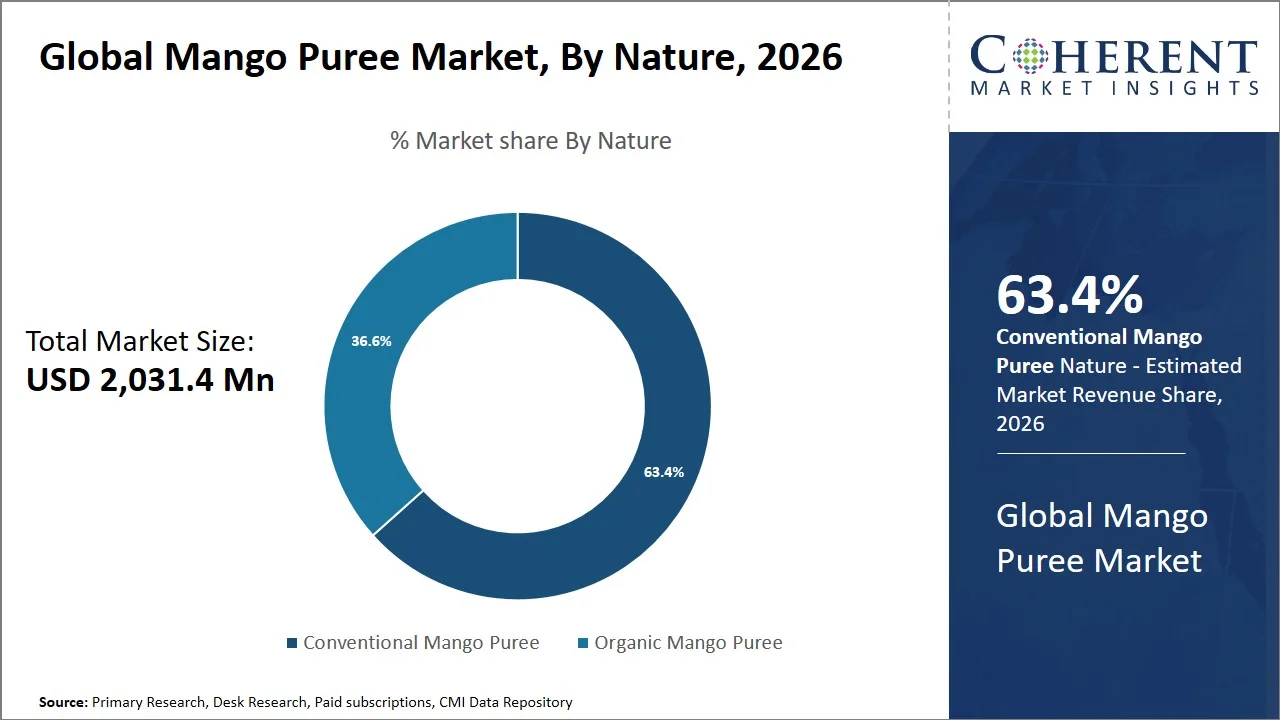
Why Does Conventional Mango Puree Dominate the Global Mango Puree Market?
Conventional mango puree is projected to account for 63.4% of the global mango puree market in 2026, owing to the scale, stability and year-round availability of puree in bulk quantities to support large mango-based foodservice, dessert, dairy, and beverage manufacturers. For consumers, organic puree is not a major preference, as conventional puree is more widely chosen due to lower cost, higher supply availability, and consistent flavor quality compared to organic-certified options. The conventional processing of mangoes is supported by the availability of raw mangos across the country, existence of pulping units, aseptic storage and export markets on the supply side making it easier to cater for industrial processing. It is especially relevant in juices, nectars, smoothies, ice creams, yogurts, jams, and bakery fillings. In September 2025, Plant Science Today published a two-decade assessment of Indian fresh mangoes and mango pulp, noting stable export performance for mango pulp to Saudi Arabia and the U.S., supporting the segment’s bulk trade relevance. (Source: Plant Science Today)
- Current Industry Events of 2026
- Market Size Estimation
- Regional Breakdown
- Competitive Landscape
- Customer Intelligence
- Segmental Analysis
- Pricing Analysis
- Key Market Drivers, Challenges & Future Trends
- Customized Insights Section
Why Does Alphonso Mango Puree Represent the Largest Product Type Segment in the Market?
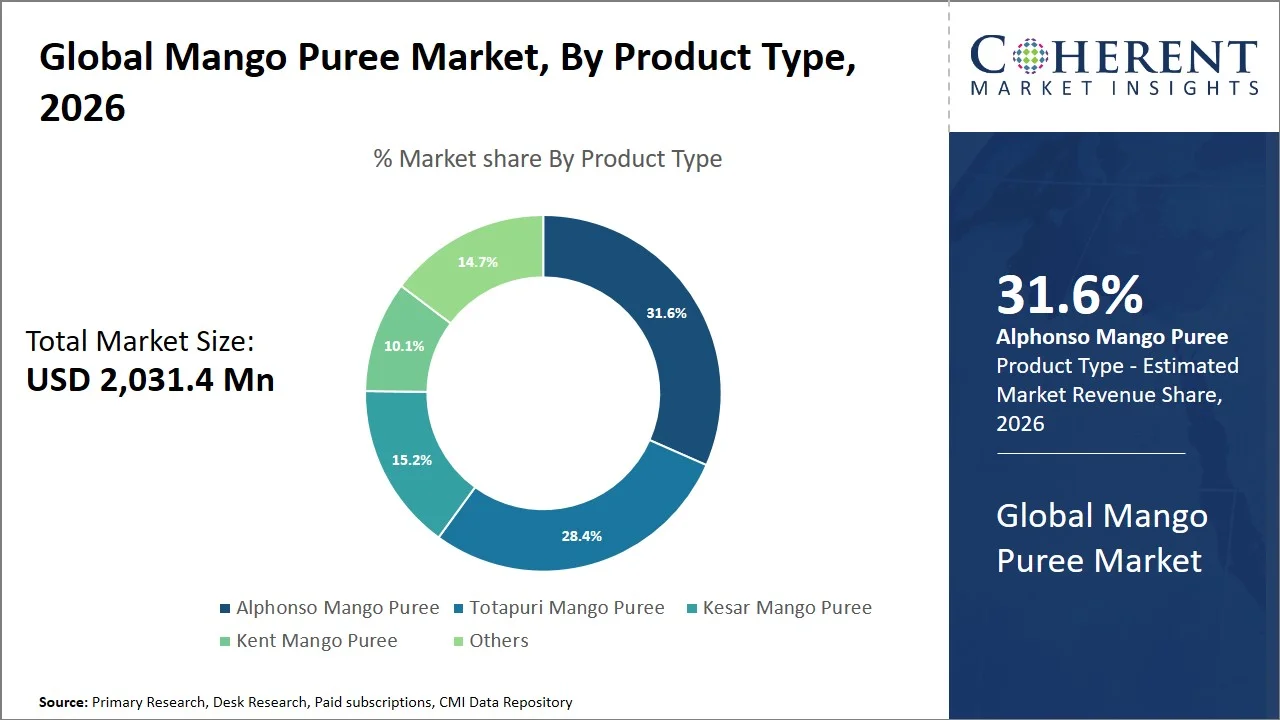
Alphonso mango puree is expected to represent the largest product type segment with 31.6% share in 2026, because of the premium taste profile, strong aroma, rich golden color, and its suitability for high-value food and beverage formulations, Demand is centered on mango flavored beverages, ice cream, yogurts, baby food, cakes/pastries, sorbets, and confectionery applications, where mango flavor and smoothness are important. In addition, Alphonso is also able to support the premium product positioning owing to its wide association with the quality of mangoes from India. On the demand side, processed puree is one way of converting a seasonal fruit into a stable product that can be utilized outside the harvest period. In March 2025, Shimla Hills promoted Alphonso mango puree/pulp as a premium F&B ingredient for desserts, baby food, dairy products and beverages with its export relevance and premium quality. (Source: ShimlaHills)
Why Does Aseptic Bags and Drums Dominate the Mango Puree Packaging Segment?
Aseptic bags and drums are expected to dominate the packaging segment with 46.8% share in 2026, as mango puree is largely traded as a bulk industrial ingredient rather than only as a retail-ready product. Demand from beverage plants, dairy processors, baby food manufacturers, and bakery ingredient buyers favors packaging that supports long shelf life, lower contamination risk, container-load efficiency, and easier storage at ambient conditions. On the supply side, aseptic filling helps processors preserve puree quality without relying heavily on preservatives, while 215 kg drums reduce handling complexity for large-volume buyers. This format is particularly suitable for export shipments and repeated use in formulation lines. In June 2025, SKOT India stated that Totapuri mango puree is usually packed aseptically in sterile bags inside drums, with each drum holding about 215 kg and offering up to 24 months of unopened shelf life. (Source: SKOT INDIA)
Currents Events and their Impact
Current Events | Description and its Impact |
European Union Tightens Packaging and Packaging Waste Rules for Food Packaging (February 2025 onward) |
|
U.S. FDA Extends Food Traceability Rule Timeline under FSMA (June 2026 onward) |
|
India Reinforces Standards for Mango Pulp and Puree under FSSAI Rules (November 2024 onward) |
|
Global Mango Puree Market Dynamics
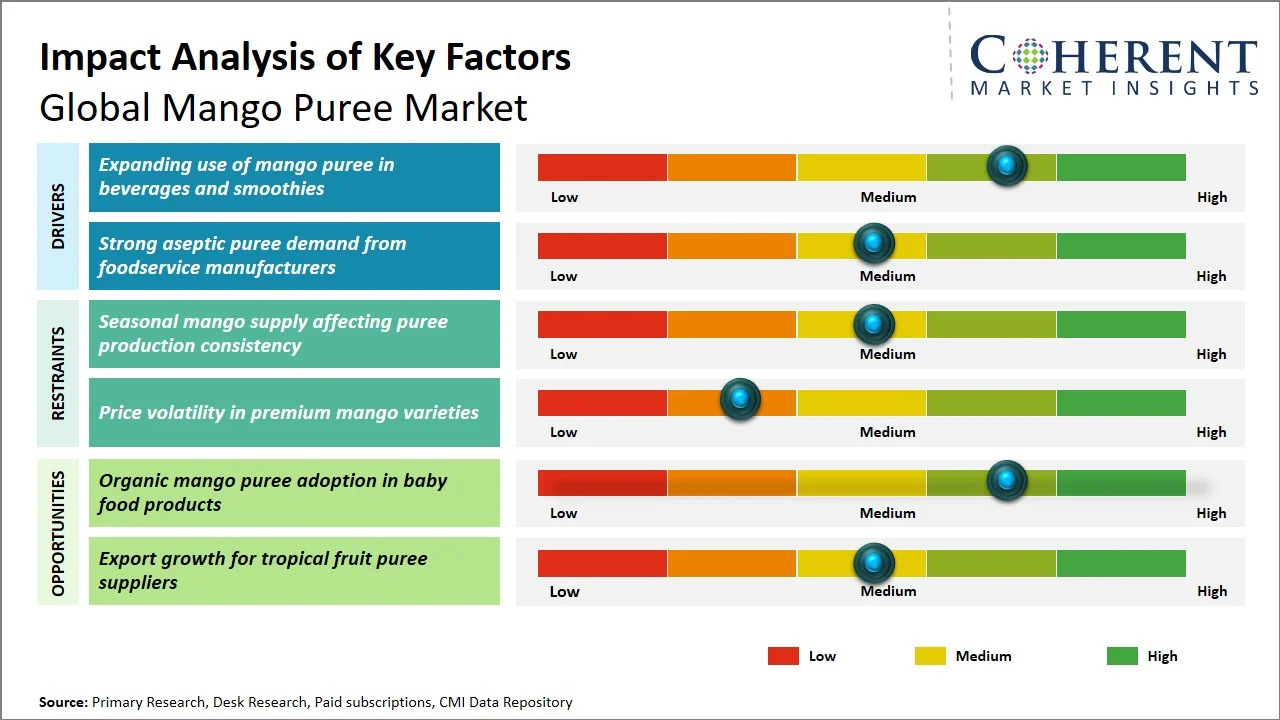
Market Drivers
- Beverage and smoothie formulation is lifting puree usage: Mango puree is gaining stronger adoption in beverages because it delivers three commercial advantages at once: natural fruit flavor, color, and body. Beverage manufacturers are using puree to create thicker smoothies, nectars, fruit drinks, and kids’ beverages without depending only on synthetic mango flavors. This supports higher ingredient demand from RTD beverage brands, smoothie makers, café chains, and private-label juice manufacturers. The segment also benefits from consumer preference for tropical flavors and fruit-based refreshment formats. March 2025, Prepared Foods reported that Odwalla debuted a new line of natural juices and smoothies, including Mango, described as a high-quality 100% puree smoothie, showing how mango puree is being positioned as a core ingredient in premium smoothie launches.
- Aseptic formats are strengthening industrial and foodservice supply: Demand for aseptic mango puree continues to get robust support from foodservice manufacturers, beverage plants, dairy processors, bakery ingredient suppliers and institutional buyers, who are looking for reliable bulk ingredients that have reduced spoilage potential. Aseptic bags and drums can be used to store and transport mango puree at ambient temperature, avoid dependence on cold chain and provide stability in Brix, color, viscosity and flavor during large batch production. This packaging format is commercially important because mango is seasonal, while foodservice and packaged food manufacturers require year-round supply continuity. In January 2026, IBC Machine highlighted mango processing lines that fill concentrated and non-concentrated mango pulp/puree into aseptic bags in drums, bag-in-box containers, and metal cans, reflecting rising investment in industrial-scale puree processing infrastructure
Emerging Trends
- Clean-label fruit ingredients are reshaping formulation strategies: Mango puree is becoming an increasing favorite ingredient for clean label applications since it allows producers to substitute man-made flavor systems with a natural fruit flavor, color, sweetness and texture for formulations. It's particularly applicable to the beverages, baby food, dairy alternatives, yogurts, desserts, bakery fillings and fruit snacks categories, in which consumers are scrutinizing ingredients more closely. Mango puree is also a useful product for food manufacturers, as it can be used as an aid to mouthfeel and as a claim support in their product formulation. This is opening up opportunities for suppliers to provide puree formats without preservatives, traceable, organic or with minimum processing. The trend also highlights the importance of quality certificates, control of residues, traceability of origin and sensory uniformity, as global food brands become more and more demanding in choosing fruit ingredients that can serve as marketing claims, as well as being viable and reliable in large-scale production.
- Variety-led premiumization is creating differentiated demand: The mango puree market is shifting from simple fruit pulp to a variety-led positioning where Alphonso, Kesar, Totapuri, and Kent purees have different commercial roles. Alphonso is used in premium quality desserts, smoothies, yogurts and dessert drinks due to its rich flavor and strong aroma, while Totapuri is used in high-volume drinks and concentrates as a processing aid and for its tangy taste. This trend is significant because customers are no longer just choosing puree based on price but also on flavor quality, color consistency, geographical origin, and how well the product fits the application. This opens up a range of opportunities for suppliers to sell application-specific puree lines such as those for beverages, baby food, baking and dairy. As years go by, processors will increasingly compete for premium contracts from international food and beverage giants by having greater knowledge of sourcing, traceability and the blending.
Regional Insights
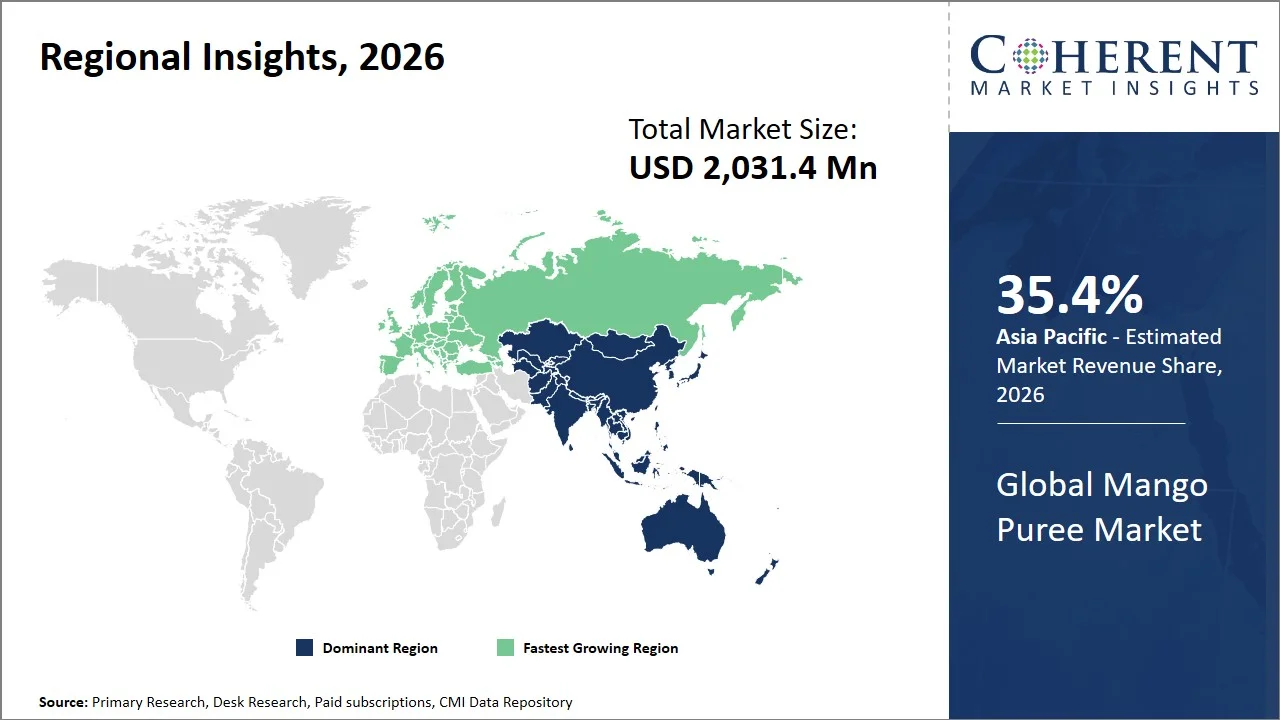
Why Does Asia Pacific Dominate the Global Mango Puree Market?
Asia Pacific is expected to dominate the global mango puree market with 35.4% share in 2026, supported by strong mango availability, established fruit-processing clusters, and lower-cost sourcing across India, Thailand, and other tropical producing countries. The region benefits from large raw material availability for Alphonso, Totapuri, Kesar, and Southeast Asian mango varieties, enabling processors to serve beverage, dairy, dessert, baby food, and foodservice manufacturers with both premium and industrial-grade puree.
Why is Europe Emerging as the Fastest-Growing Region in the Global Mango Puree Market?
Europe is expected to emerge as the fastest-growing region with 24.6% share in 2026, supported by rising use of fruit purees in dairy alternatives, smoothies, ice cream, bakery fillings, desserts, and foodservice applications. Since mango production is limited within Europe, processors and ingredient suppliers depend on imported tropical purees and advanced blending capabilities to meet clean-label and natural fruit ingredient demand. In the 2025–26 period, AGRANA Fruit highlighted its fruit solutions for dairy, ice cream, bakery, and foodservice industries, including fruit purees and coulis as part of its fruit specialties portfolio, reflecting Europe’s growing ingredient-level demand for puree-based applications.
Global Mango Puree Market Outlook for Key Countries
Why is Mexico a Strategic Export Supplier in the Mango Puree Market?
Mexico is important in the mango puree market because it combines large-scale mango production, proximity to the U.S., and strong export logistics. The country’s mango supply base supports processors and ingredient buyers seeking varieties such as Tommy Atkins, Ataulfo/Honey, Kent, and Keitt for beverages, nectars, frozen fruit preparations, and puree-based formulations. Its location gives it a commercial advantage in serving North American food and beverage manufacturers with shorter shipping routes compared with Asian suppliers. Mexico’s role is also supported by established phytosanitary systems and a mature fresh mango export network, which indirectly strengthens raw material availability for processing. In June 2026, the National Mango Board reported Mexico shipped about 53.1 million boxes by the week ending June 13, 2026, with the season projected at approximately 81 million boxes. (Source: National Mango Board)
Why Does India Remain a Core Processing Hub in the Mango Puree Market?
India is a key market for mango puree on the back of its vast mango cultivation, robust varietal base and vibrant mango pulp processing ecosystem. Alphonso and Kesar are used for premium puree production while Totapuri is popularly utilized in industrial beverages, dairy products and food products for its processing suitability and pulp yield. States like Andhra Pradesh, Tamil Nadu, Maharashtra and Gujarat have processing clusters, which allow large-scale aseptic pulp production for export markets in India. The country also benefits from long-standing trade relationships with the Middle East, North America, and Europe.
Why is Thailand Important for Value-Added Mango Processing?
Thailand is important in the mango puree market because it has a strong tropical fruit-processing base and globally recognized mango varieties that are suitable for puree, canned pulp, frozen fruit, and beverage ingredients. The country’s competitive strength lies in its ability to convert fresh mango supply into value-added formats for export-oriented food manufacturers. Thai processors serve demand from bakery, beverages, desserts, dairy products, ice cream, confectionery, and foodservice channels, where flavor consistency and convenient ingredient formats are essential. Thailand also benefits from regional trade access across Asia and established food-processing capabilities. In August 2025, Erawan Food described canned mango pulp as a puree extracted from ripe mangoes and positioned it as an ingredient for beverages, desserts, jams, ice creams, bakery, and sauces.
Why is Brazil Strengthening its Role in Global Mango Supply?
It is worth noting that Brazil is gaining relevance in the mango puree market, thanks to its robust base for tropical fruit exports, year-round production capacity and reliable supply from the São Francisco Valley and other fruit-producing regions. Brazilian mangoes are used for fresh export and processed fruit such as juice, nectar, dessert, sauces and frozen mango. It has strategic trading position, serving the three continents: Europe, the U.S and Middle East. Puree manufacturers have access to varieties like Palmer, Tommy Atkins, Keitt and Kent, which are sought for their color, sweetness and processing application in Brazil. In 2024, Brazil exported over USD 1.28 billion worth of fruit, according to FreshPlaza, mango exports alone accounted for over USD 348 million and more than 258,000 tons of mangoes were exported.
Why is the U.S. a Major Demand Center for Mango Puree Applications?
The U.S. is significant for its high value demand for smoothies, juices, baby food, dairy desserts, sauces, frozen novelties, and clean label packaged foods as a demand center for mango puree. Domestic production is small and the country imports from Mexico, India, Brazil, Peru and other mango-producing countries. Mango puree is a key ingredient in U.S. food products, providing a source of tropical flavor, natural color and thickness, and fruit-based positioning. In addition, mango promotion helps increase consumer awareness of mangoes, which has an indirect impact on applications that use pureed mangoes. (Source: U.S. Department of Agriculture, Agricultural Marketing Service (AMS))
Technology Adoption Landscape – Global Mango Puree Market
Technology | Key Features | Processing / Commercial Advantage | Market Relevance | |
Aseptic processing and filling | Sterilization of mango pulp/puree followed by filling into aseptic bags, drums, or bag-in-box formats under sterile conditions. | Extends shelf life, reduces contamination risk, supports ambient storage, and enables bulk exports without heavy cold-chain dependence. | Highly relevant for industrial buyers in beverages, dairy, baby food, bakery fillings, and foodservice. APEDA notes that aseptic mango pulp is sterilized and packed in aseptic bags, supporting export-ready ingredient supply. | |
Thermal pasteurization and retort processing | Heat treatment, hermetic sealing, and retort processing for canned, bottled, flexible-pack, or aseptically packed mango pulp/puree. | Improves microbiological safety, stabilizes product quality, and supports regulatory compliance for shelf-stable puree formats. | Important for conventional mango puree, canned pulp, retail packs, and institutional supply. FSSAI defines thermally processed mango pulp/puree across canned, bottled, flexible-pack, and aseptic formats. | |
High pressure processing (HPP) | Non-thermal preservation using high pressure to reduce microbial load while limiting heat damage to color, flavor, and nutrients. | Helps retain fresh-like sensory quality and can improve refrigerated shelf life for premium puree and smoothie applications. | Adoption is stronger in premium chilled beverages, smoothies, baby food, and clean-label puree formats. A food science study found HPP-treated purees were microbiologically stable for at least four months under refrigeration. | |
Optical sorting and AI-based grading | Camera, sensor, and AI-based sorting of fruit by color, size, shape, defects, and foreign material before pulping. | Improves raw material consistency, reduces manual sorting errors, lowers waste, and supports better color and flavor uniformity in puree batches. | Relevant for large processors handling Alphonso, Totapuri, Kesar, Kent, and export-grade fruit. Optical sorting systems can detect and reject products based on color, shape, and structural abnormalities. | |
Automated pulping, destoning, and refining lines | Integrated washing, peeling/cutting, destoning, pulping, refining, deaeration, and transfer systems for continuous processing. | Increases throughput, improves pulp recovery, reduces labor dependence, and standardizes texture and fiber content. | Critical for high-volume puree production in India, Thailand, Mexico, and Brazil. APEDA describes mango pulp preparation as cutting, destoning, refining, and packing, with different preservation routes for aseptic, canned, and frozen pulp. | |
Frozen puree and cold-chain preservation | Pasteurized puree is rapidly frozen and stored under controlled low-temperature conditions for later use. | Preserves natural flavor, aroma, and color while allowing processors to manage seasonal mango availability. | Relevant for premium desserts, bakery, dairy, and foodservice buyers needing closer-to-fresh mango profiles. FAO notes that mango purée can be frozen, canned, or stored in barrels for later processing. | |
How are advanced aseptic processing and automation creating new growth opportunities in the mango puree market?
Technological advancement in aseptic processing, automated pulping, sterilization, and precision filling is creating strong growth opportunities in the global mango puree market. These systems help processors convert seasonal mango supply into shelf-stable puree that can be stored, transported, and used year-round by beverage, dairy, bakery, baby food, and foodservice manufacturers. Better automation also improves pulp yield, texture consistency, food safety, and batch-level quality control, which is critical for export contracts and large-scale industrial buyers. This can increase adoption among manufacturers seeking preservative-free fruit ingredients with longer shelf life and lower cold-chain dependency. For instance, in January 2026, IBC Machine highlighted mango pulp/puree/juice processing lines with one-head or double-head aseptic fillers capable of filling concentrated mango puree into 220 kg aseptic bags in drums, with capacities from 1 ton to 5 tons per hour. This shows how processing-line innovation is supporting scalable production and wider commercial use of mango puree. (Source: IBC Machine)
Market Players, Key Development, and Competitive Intelligence
Key Developments
- In June 2025, Dole Packaged Foods launched Dole Whip Mango in the U.S. freezer aisle as part of its fruit-first frozen treat range. The product was introduced in Pineapple and Mango flavors and made with fruit purée as the first ingredient, targeting convenient, dairy-free, gluten-free frozen dessert consumption. This development supports the mango puree market by increasing the use of mango-based formulations in retail frozen desserts and expanding puree-led innovation beyond beverages into indulgent fruit-first snacking.
- In February 2025, Lat Eko Food’s RŪDOLFS Organic showcased its organic baby food portfolio at Gulfood 2025, including fruit-based puree products such as Mango, Banana and Quince Puree. The product is positioned as a clean-label baby food puree for infants from four months, with 100% fruit, no added preservatives, no artificial colors or flavors, dairy-free composition, and no added sugar. This development supports the mango puree market by strengthening demand from organic baby food, pouch-based fruit puree, and premium infant nutrition applications.
- In January 2025, Döhler and The Perfect Purée of Napa Valley launched Tastecraft fruit-based solutions across North America through specialty, produce, and broadline distributors. The partnership expanded access to freeze-dried fruit solutions for foodservice professionals and strengthened Döhler’s foodservice channel strategy in the region. This development is relevant to the mango puree market as it reflects increasing demand for convenient, premium fruit-based ingredient systems used by restaurants, beverage operators, bakeries, and hospitality customers.
Competitive Landscape
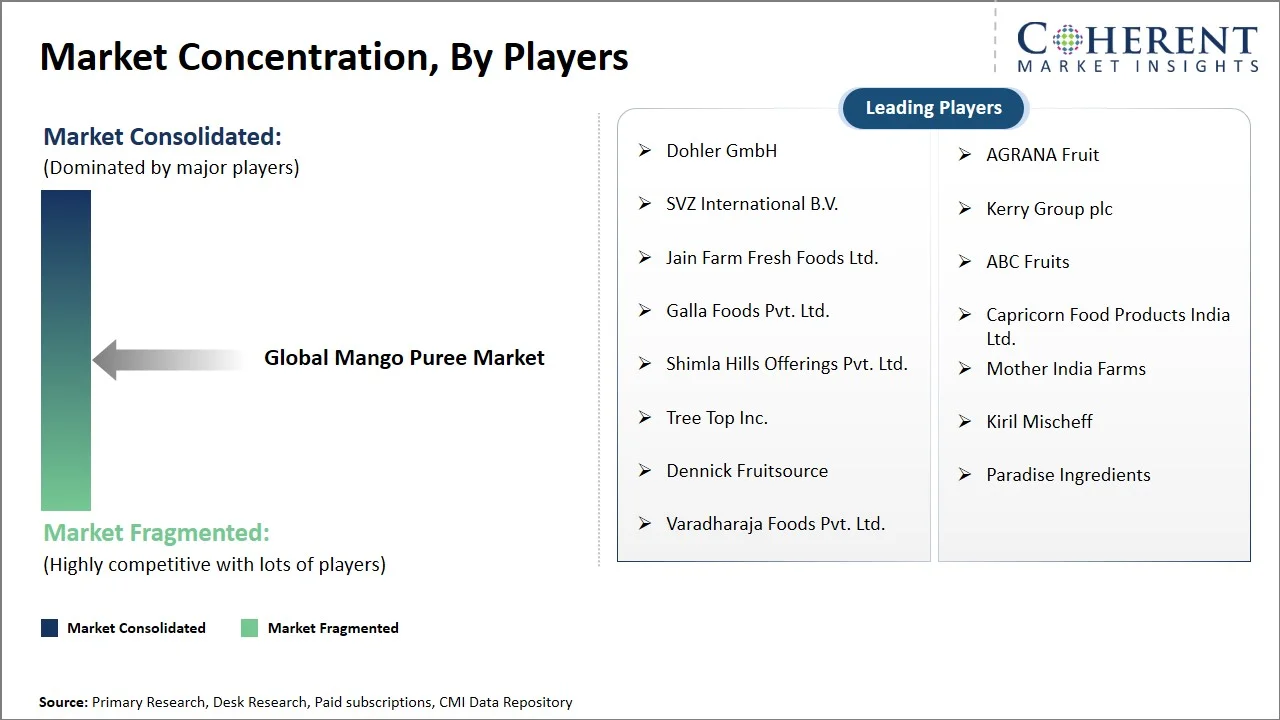
The global mango puree market is moderately fragmented, with several regional and international processors competing on fruit sourcing, product quality, aseptic processing capacity, pricing, certifications, and export reach. Companies are focusing on supplying consistent puree quality for beverages, dairy, desserts, baby food, bakery, and foodservice applications. Competition is also increasing around organic puree, clean-label products, variety-specific puree such as Alphonso and Totapuri, and bulk aseptic packaging formats.
Key focus areas include
- Expansion of aseptic processing and bulk packaging capacity to support year-round industrial supply
- Stronger sourcing networks for Alphonso, Totapuri, Kesar, Kent, and other mango varieties
- Development of organic, preservative-free, and clean-label mango puree products
- Focus on food safety certifications, traceability, residue control, and export compliance
- Partnerships with beverage, dairy, baby food, dessert, and foodservice manufacturers
- Expansion into Europe, North America, and the Middle East through distributors and ingredient suppliers
- Product differentiation through Brix consistency, flavor profile, color stability, and customized puree blends
Market Report Scope
Mango Puree Market Report Coverage
| Report Coverage | Details | ||
|---|---|---|---|
| Base Year: | 2025 | Market Size in 2026: | USD 2,031.4 Mn |
| Historical Data for: | 2020 To 2024 | Forecast Period: | 2026 To 2033 |
| Forecast Period 2026 to 2033 CAGR: | 7.2% | 2033 Value Projection: | USD 3,306.1 Mn |
| Geographies covered: |
| ||
| Segments covered: |
| ||
| Companies covered: | Dohler GmbH, AGRANA Fruit, SVZ International B.V., Kerry Group plc, Jain Farm Fresh Foods Ltd., ABC Fruits, Galla Foods Pvt. Ltd., Capricorn Food Products India Ltd., Shimla Hills Offerings Pvt. Ltd., Mother India Farms, Tree Top Inc., Kiril Mischeff, Dennick Fruitsource, Paradise Ingredients, and Varadharaja Foods Pvt. Ltd. | ||
| Growth Drivers: |
| ||
| Restraints & Challenges: |
| ||
Analyst Opinion (Expert Opinion)
- The global mango puree market is expected to grow steadily in the long-run on the back of increasing demand for fruit-based ingredients in beverages, dairy products, desserts, baby food, bakery, confectionery, sauces, and foodservice applications. Higher inclination towards natural flavors, clean-label ingredients and convenient fruit-based formulations is expected to help wider adoption of mango puree by food and beverage manufacturers
- The strongest opportunities are likely to emerge in beverages and dairy-based applications, where mango puree is widely used in smoothies, juices, nectars, yogurts, ice creams, milkshakes, and frozen desserts. Asia Pacific is expected to remain the leading region due to strong mango production, established processing clusters, and export-oriented aseptic puree supply, while Europe is expected to grow faster with rising demand for tropical fruit ingredients in premium beverages, dairy alternatives, desserts, and baby food.
- To gain a competitive advantage, market players should focus on aseptic processing, organic mango puree, variety-specific puree such as Alphonso, Totapuri, and Kesar, and stronger food safety certifications. Companies that can offer consistent Brix levels, stable color, natural taste, longer shelf life, traceable sourcing, and customized puree formats will be better positioned to capture demand from beverage, dairy, baby food, bakery, dessert, and foodservice brands.
Speak to the analyst
Want personalized insights?
Take the findings above to one of our principal consultants, or have the report rebuilt around the segments, geographies and competitors you actually track.
Market Segmentation
- Nature Insights (Revenue, USD Mn, 2021 - 2033)
- Conventional Mango Puree
- Organic Mango Puree
- Product Type Insights (Revenue, USD Mn, 2021 - 2033)
- Alphonso Mango Puree
- Totapuri Mango Puree
- Kesar Mango Puree
- Kent Mango Puree
- Others
- Packaging Type Insights (Revenue, USD Mn, 2021 - 2033)
- Aseptic Bags and Drums
- Cans
- Pouches
- Bottles and Jars
- Others
- Application Insights (Revenue, USD Mn, 2021 - 2033)
- Beverages
- Dairy and Desserts
- Baby Food
- Bakery and Confectionery
- Sauces and Dressings
- Others
- Regional Insights (Revenue, USD Mn, 2021 - 2033)
- North America
- U.S.
- Canada
- Latin America
- Brazil
- Argentina
- Mexico
- Rest of Latin America
- Europe
- Germany
- U.K.
- Spain
- France
- Italy
- Russia
- Rest of Europe
- Asia Pacific
- China
- India
- Japan
- Australia
- South Korea
- ASEAN
- Rest of Asia Pacific
- Middle East
- GCC Countries
- Israel
- Rest of Middle East
- Africa
- South Africa
- North Africa
- Central Africa
- North America
- Key Players Insights
- Dohler GmbH
- AGRANA Fruit
- SVZ International B.V.
- Kerry Group plc
- Jain Farm Fresh Foods Ltd.
- ABC Fruits
- Galla Foods Pvt. Ltd.
- Capricorn Food Products India Ltd.
- Shimla Hills Offerings Pvt. Ltd.
- Mother India Farms
- Tree Top Inc.
- Kiril Mischeff
- Dennick Fruitsource
- Paradise Ingredients
- Varadharaja Foods Pvt. Ltd.
Sources
Primary Research Interviews
- Fruit processing and aseptic puree manufacturers (mango pulp & concentrate producers)
- Beverage, dairy, bakery, and baby food product developers using mango puree as an ingredient
- Foodservice & HoReCa procurement managers sourcing fruit-based ingredients
- Export–import traders and commodity brokers dealing in tropical fruit purees
- Quality assurance, food safety, and regulatory compliance teams in fruit processing plants
- Packaging and aseptic processing equipment suppliers (hot-fill, cold chain, drum/BIB systems)
Stakeholders
- Mango puree manufacturers and tropical fruit processing companies
- Beverage and juice manufacturers (RTD drinks, smoothies, flavored drinks)
- Baby food and infant nutrition companies
- Dairy and ice cream manufacturers using fruit inclusions
- Bakery and confectionery producers
- Exporters, importers, and global commodity trading houses
- Cold chain logistics and aseptic packaging providers
Regulatory & Health / Food Bodies
- Food Safety and Standards Authority of India (FSSAI)
- U.S. Food and Drug Administration (FDA) – Juice HACCP & food import compliance
- European Food Safety Authority (EFSA)
- Codex Alimentarius Commission (FAO/WHO)
- Ministry of Food Processing Industries (MoFPI), India
- General Administration of Customs China (GACC)
- U.S. Department of Agriculture (USDA) – fruit and processed food standards
Databases
- FAOSTAT (FAO) – Mango production and global horticulture data
- ITC Trade Map – mango puree/pulp export-import statistics
- UN Comtrade Database – HS Code 200799 (fruit puree/pulp)
- World Bank Commodity Price Data (agri-commodities)
- OECD-FAO Agricultural Outlook Database
- USDA Foreign Agricultural Service (FAS) GAIN Reports
- Eurostat Food & Beverage Processing Statistics
Magazines / Industry Portals
- FoodNavigator
- Fruit Processing Magazine
- Food Ingredients First
- Dairy Reporter
- Beverage Industry
- Fresh Plaza (fruit trade updates)
- Food Processing Technology
- Packaging Strategies (aseptic & fruit packaging focus)
Journals
- Journal of Food Processing and Preservation
- International Journal of Food Science & Technology
- Food Chemistry
- LWT – Food Science and Technology
- Journal of Agricultural and Food Chemistry
- Postharvest Biology and Technology
Newspapers
- Economic Times – Agro & FMCG updates
Trade Media
- The Financial Express (Agro & food processing section)
- Business Standard (Agriculture exports coverage)
- Reuters Agriculture Commodities Desk
- Bloomberg Food & Soft Commodities coverage
Associations
- International Society for Horticultural Science (ISHS)
- Food Processing Suppliers Association (FPSA)
- Fruit Processing & Fruit Juice Association (global/regional bodies)
- Confederation of Indian Food Trade & Industry (CIFTI)
- National Association of Juice & Beverage Manufacturers (NAJMB – regional equivalents)
- ASEAN Food Processing Federation
- Global Cold Chain Alliance (GCCA)
Public Domain Sources
- FAO – Global Mango Production & Trade Statistics
- World Bank – Agricultural Value Chain & Rural Economy Data
- USDA – Tropical Fruit Import Reports
- EU Agricultural Market Observatory (AMO)
- India Horticulture Database (NHB – National Horticulture Board)
- APEDA (Agricultural & Processed Food Products Export Development Authority)
- UN FAO Food Outlook Reports
Proprietary Elements
- CMI Data Analytics Tool, Proprietary CMI Existing Repository of information for last 10 years.
Get access to 250+ pages report
Every segment, forecast, competitor profile and data table behind the analysis above — available for instant download.
- ESOMAR Member
- ISO 9001:2015 Certified
- D-U-N-S Registered
- GDPR & CCPA Compliant
Missing comfort of reading report in your local language? Find your preferred language:
Transform your Strategy with Exclusive Trending Reports
Frequently Asked Questions
The CAGR of the global mango puree market is projected to be 7.2% from 2026 to 2033.
The global mango puree market is estimated to be valued at USD 2,031.4 million in 2026 and is expected to reach USD 3,306.1 million by 2033.
Aseptic bags and drums are expected to lead the market with 46.8% share in 2026, due to longer shelf life and bulk industrial use.
Beverages and smoothies are expected to dominate, supported by rising demand for fruit-based drinks and clean-label formulations.
Expanding use of mango puree in beverages and smoothies and strong aseptic puree demand from foodservice manufacturers are the major factors driving the growth of the global mango puree market.
Seasonal mango supply affecting puree production consistency and price volatility in premium mango varieties are the major factors hampering the growth of the global mango puree market.
In terms of nature, conventional mango puree is estimated to dominate the market revenue share in 2026.