

Global Medical Advocacy Services Market Size and Forecast – 2026 to 2033
The Global Medical Advocacy Services Market is estimated to be valued at USD 7.11 Bn in 2026 and is expected to reach USD 14.48 Bn by 2033, exhibiting a compound annual growth rate (CAGR) of 10.7% from 2026 to 2033. This robust growth reflects increasing demand for patient-centered care, rising healthcare complexities, and growing awareness of medical advocacy supporting improved patient outcomes globally.
Key Takeaways of the Global Medical Advocacy Services Market
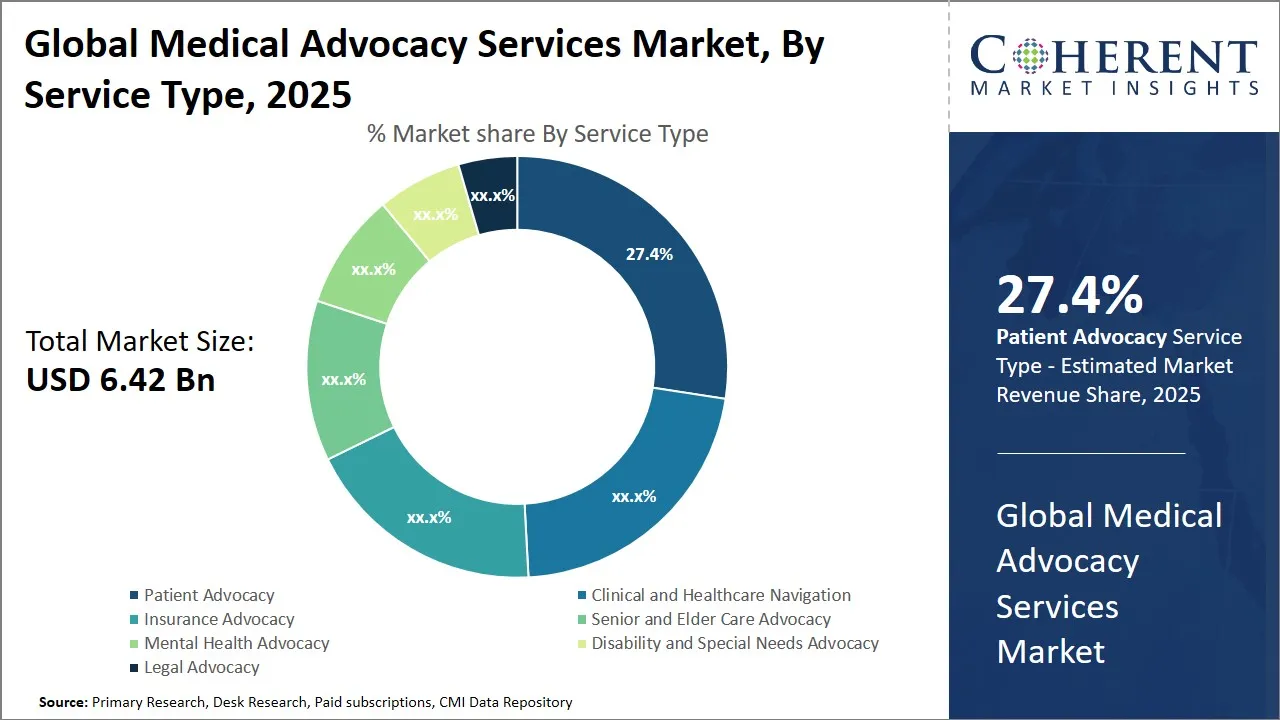
- In 2026, patient advocacy is expected to lead the global medical advocacy services market, accounting for 28.4 % of the total market share.
- In-person consultation remains the most preferred mode of service, representing an estimated 49.9 % of the market share in 2026.
- Within the application area segment, medical billing and claims assistance is projected to hold the top position, capturing 31.5 % share of the market in 2026.
- North America is expected to lead the market, holding a share of 40.3 % in 2026. Asia Pacific is anticipated to be the fastest-growing region, with a market share of 25.3% in 2026.
Market Overview
A significant market trend is the integration of advanced digital technologies such as AI and telehealth platforms within medical advocacy services, enhancing accessibility and efficiency. Additionally, an aging global population and rising chronic disease burden are fueling the demand for personalized advocacy, while insurers and healthcare providers increasingly collaborate to streamline patient navigation and reduce costs, driving sustained market expansion.
Current Events and Its Impact
Current Events | Description and its Impact |
Tech Giants (e.g., Amazon, Google) Expanding into the Healthcare Sector |
|
Hospital and Payer Vertical Integration Accelerates |
|
Segmental Insights
- Current Industry Events of 2026
- Market Size Estimation
- Regional Breakdown
- Competitive Landscape
- Customer Intelligence
- Segmental Analysis
- Pricing Analysis
- Key Market Drivers, Challenges & Future Trends
- Customized Insights Section
Medical Advocacy Services Market Insights, By Service Type - Patient advocacy contributes the highest market share owing to increasing emphasis on patient-centered care and personalized support
The patient advocacy segment is expected to hold a leading position in the world medical advocacy services market, holding 28.4% of the market share in 2026. The segment growth is driven by the ongoing transformation of the healthcare landscape, which is increasingly moving toward a patient-centered care model that emphasizes clear communication, informed decision-making, and active patient participation throughout the treatment process.
In May 2026, eight digital health companies, Best Buy Health, BioIntelliSense, Cadence, CoachCare, CopilotIQ, Bioformis, HealthSnap, and Impilo launched the Remote Monitoring Leadership Council, a patient advocacy and policy group promoting broader access to remote patient monitoring (RPM). The alliance aims to strengthen patient-centered care, expand adoption through data sharing, and collaborate with U.S. policymakers to make RPM a core part of modern healthcare.
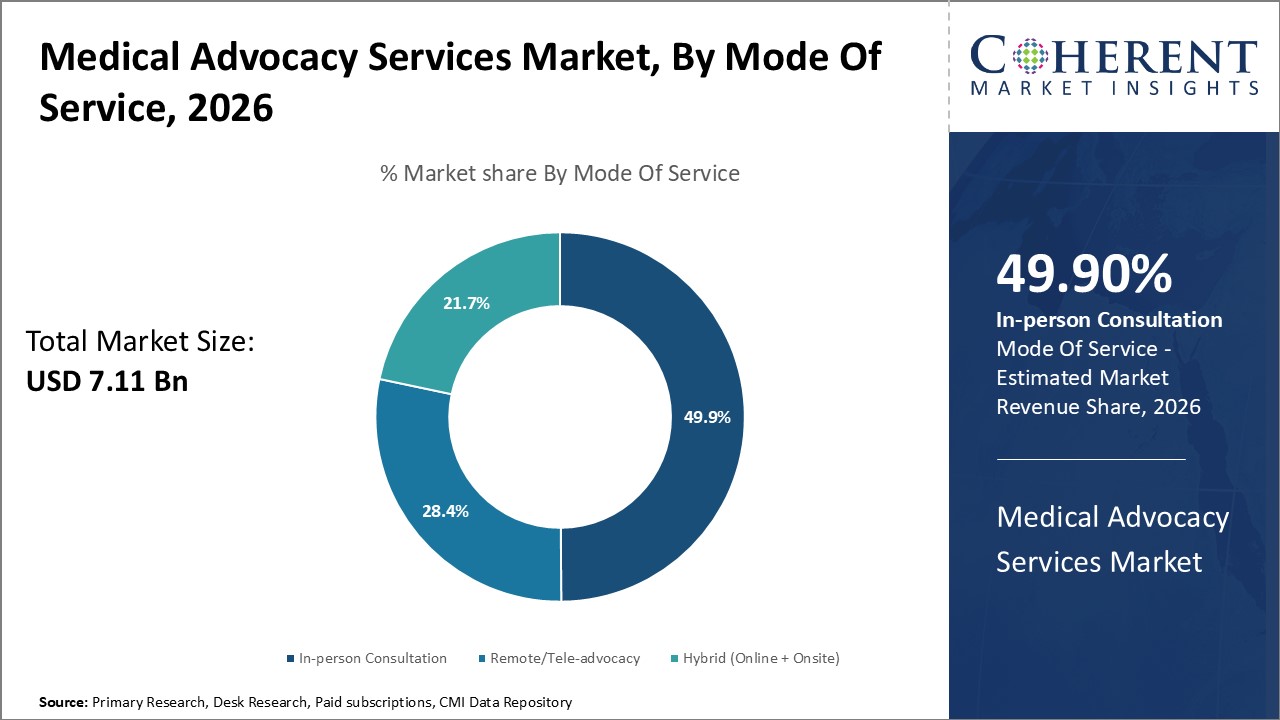
Medical Advocacy Services Market Insights, By Mode of Service - In-person consultation holds the largest market share driven by the necessity for direct, personalized interactions and trust-building in healthcare advocacy
In 2026, the in-person consultation segment is projected to remain the dominant form of medical advocacy service, accounting for 49.9% of the global market, primarily driven by patients’ strong preference for direct, face-to-face interaction with their advocates. Honesty and compassion become two essential elements in the cases of sensitive health conditions, and most patients would like to be reassured by an actual face-to-face interaction.
Face-to-face meetings are especially valued in complex or emotionally sensitive situations such as cancer diagnoses, end-of-life care planning, and chronic disease management where advocates must not only convey information but also provide emotional support and build trust with patients.
Medical Advocacy Services Market Insights, By Application Area - Medical billing and claims assistance leads the market owing to the complexity of healthcare financial processes and rising patient demand for cost transparency
The medical billing and claims assistance segment is projected to command the highest share within the global medical advocacy services market with a share of 31.5% in 2026 due to the intricate nature of healthcare billing systems and the widespread need for expert support in managing insurance claims and out-of-pocket expenses.
Medical bills, reimbursement procedures, and claim denials often intimidate patients and families, leading to unexpected financial burdens. Billing advocates help navigate these complexities by ensuring accuracy, compliance with insurance policies, and prompt resolution of billing disputes.
Role of Artificial Intelligence (AI) in the Medical Advocacy Services Market
- AI is transforming the global medical advocacy services market by automating case management, enhancing accuracy, and personalizing the support of patients. Predictive analytics assist in identifying patients that require the early intervention, and NLP tools facilitate the reviews and communication of claims. This saves manual work and expenditure and enables the advocates to concentrate on complicated cases. The use of AI-driven platforms to guide patients through the benefits, pair them with the right providers, or fix billing or authorization issues is implemented by such companies as Accolade, Included Health, and Personify Health.
- Beyond efficiency, AI provides new opportunities to increase growth with scalable advocacy-as-a-service business models and data-driven decisions. In order to measure care results, staffing optimization and demonstrate ROI to employers and payers, the providers employ AI. However, there are still issues of data privacy, bias, and excessive reliance on automation which may erode trust. The most successful companies will incorporate AI accuracy with human sensitivity, applying technology to supplement rather than substitute individualized directions and long-term relationship with a member.
Regional Insights
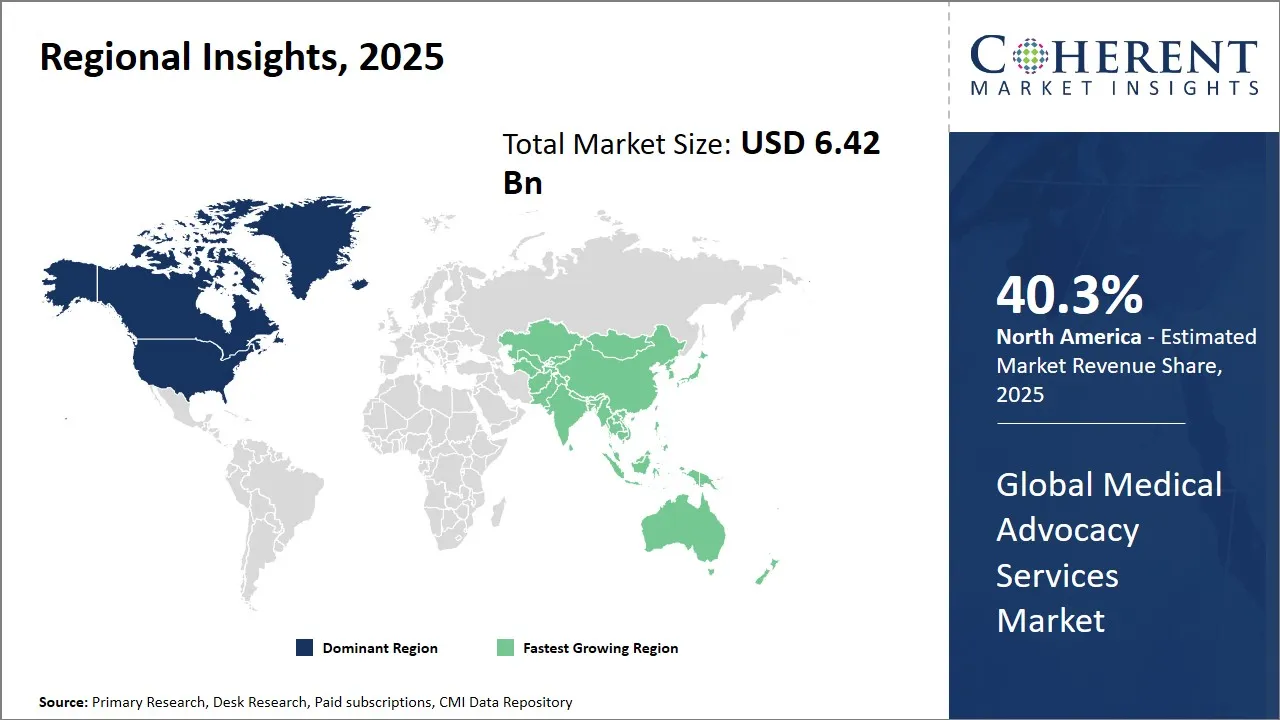
North America Medical Advocacy Services Market Analysis and Trends
North America is expected to lead the global medical advocacy services market in 2026, accounting for an estimated 40.3% share. This is driven by its advanced healthcare infrastructure, high prevalence of chronic diseases, and strong government initiatives supporting patient rights and healthcare navigation services. Prominent players, such as Patient Advocate Foundation, Medics on Call, and Health Advocate, have established their positions by offering a complete package of services, such as insurance support, medical billing navigation, and individual patient education.
In October 2024, Personify Health, a U.S.-based health tech firm, introduced a personalized care navigation and advocacy solution combining human expertise with AI support to improve care access and lower costs. CEO Chris Michalak said the platform enhances trust and engagement for 20 million members, aligning with the medical advocacy services market’s goal of transparent, patient-centered healthcare.
Asia Pacific Medical Advocacy Services Market Analysis and Trends
In 2026, the Asia Pacific region is projected to record the fastest growth in the medical advocacy services market, with a share of 25.3%. The growth is caused by economic development, increased healthcare spending, growing patient awareness, and rising access to healthcare in developing nations. The fact that the government policies in countries such as India, China, or Singapore are aimed at healthcare reform and patient rights also promotes the demand in such services. Moreover, the growth of the private healthcare industry and the increased population of the middle-class has also formed new opportunities in providing advocacy services to the clients.
In July 2024, China’s National Health Commission (NHC) launched a three-year campaign to tackle rising obesity, urging healthy eating, exercise, and family involvement. Mr. Guo Yanhong, NHC’s Health Emergency Response Director, said the goal is to curb obesity-related diseases, aligning with the medical advocacy services market focus on prevention and public health awareness.
Medical Advocacy Services Market Outlook for Key Countries
U.S. Medical Advocacy Services Market Trends
The healthcare systems and a consumer-based market structure have enhanced the U.S. medical advocacy services market, which has reached a mature and sophisticated level. Specialized U.S.-based organizations such as Health Advocate and Patient Advocate Foundation are interested in the provision of individual navigation through insurance claims, dispute management, and chronic disease management.
In June 2026, the Taxpayer Advocate Service (TAS), part of the U.S. Internal Revenue Service (IRS), announced plans to launch Phoenix, a new Salesforce-based case management system to replace its outdated platform. The upgrade aims to speed up case handling and improve taxpayer support, reflecting similar digital efficiency trends seen in the medical advocacy services market.
Germany Medical Advocacy Services Market Trends
The healthcare system of Germany can be described as universal and tightly controlled by the government, which affects the market of medical advocacy services. Companies like Mediservice and Medizinische Expertenberatung are under the regulatory environment that stresses the rights of the patients and comprehensive health insurance advice. The well-organized healthcare system and strict policies of the country introduce demand to the expert advocacy that will help patients manage the administrative issues and improve treatment outcomes.
In January 2026, the Federal Ministry of Health of Germany, led by Prof. Karl Lauterbach, introduced the Action Plan for a Diverse, Inclusive, and Barrier-Free Healthcare System to ensure equal access for all, especially people with disabilities and marginalized groups. The move, aligned with UN Sustainable Development Goals, strengthens the medical advocacy services market by promoting inclusive, patient-centered healthcare nationwide.
India Medical Advocacy Services Market Trends
The medical advocacy services market in India is rapidly developing due to the rise in healthcare expenditure, the expansion of the middle class, and the governmental work to enhance the availability of healthcare services with different schemes such as Ayushman Bharat. Local firms such as Max Healthcare and patient counseling special agencies are significant in dealing with the fractured state of the healthcare. Their advocate services are aimed at making the patients aware of the treatment choices, insurance coverage, and aftercare management, which is necessary in a healthcare system that is characterized by diverse healthcare delivery and coverage.
On October 03, 2026, ACCESS Health International, a global health non-profit, helped launch three digital tools under India’s Ayushman Bharat PM-JAY in Uttar Pradesh — Ayushman Sampark helpline, Ayushman Sarathi hospital locator app, and Ayushi AI chatbot. Supported by SACHIS and state leaders, the initiative boosts accessible, accountable care, aligning with the medical advocacy services market focus on digital, patient-centered healthcare.
China Medical Advocacy Services Market Trends
China is still on the forefront with sweeping governmental reforms to gain universal health coverage and advance the quality of healthcare services. Major health care organizations like China Medical System and hospital chains have used advocacy services to help patients to make insurance claims, to navigate their treatment, and to resolve medical disagreements. Urbanization and the adoption of technology increase the adoption of digital advocacy, which is consistent with the overall trend of healthcare modernization and the use of patient-centered care in China.
In February 2026, China Medical University (CMU) and Healthcare System (Taiwan) showcased breakthroughs in AI-driven drug discovery and allogeneic CAR-T therapy at the 8th Healthcare Expo Taiwan. Led by Dr. Chang-Hai Tsai and in partnership with Kyoto University, the project achieved over 90% tumor reduction in pre-clinical studies, marking a major step in cancer treatment. The advancement supports the medical advocacy services market goal of integrating cutting-edge innovation with patient-focused healthcare solutions.
Market Players, Key Developments, and Competitive Intelligence
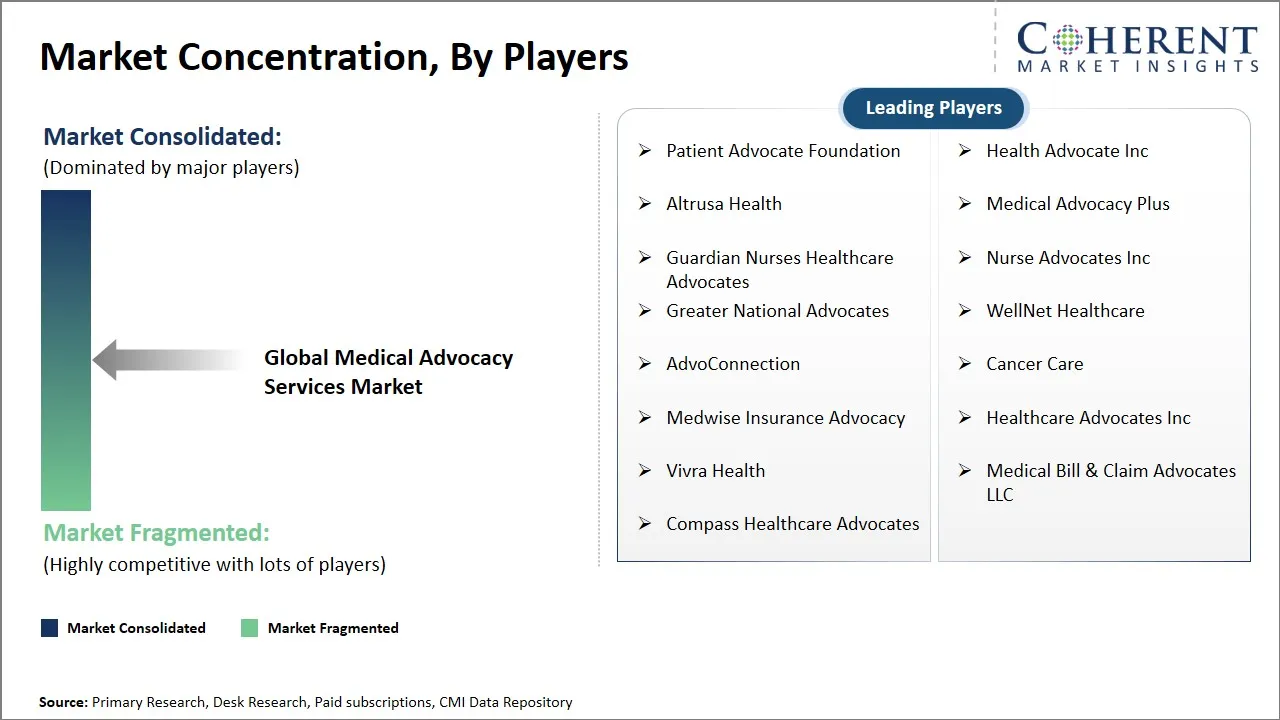
Key Developments
- On October 11, 2025, the Oregon Health Authority canceled its planned Medicaid reentry benefits program, which aimed to provide healthcare for people leaving prisons. The agency cited new federal Medicaid rules under the “One Big Beautiful Bill” and administrative challenges as reasons.
- On October 10, 2025, India’s Ministry of Health and Family Welfare, led by Union Health Minister Shri J. P. Nadda, launched new features for the Tele MANAS App, a national mental health support platform under the government’s National Tele Mental Health Programme, to strengthen medical advocacy services and improve access to mental healthcare. The upgraded app now supports 10 regional languages, includes accessibility options for people with disabilities, a chatbot named Asmi for mental health guidance, and an emergency response module.
- On October 10, 2025, the National Alliance on Mental Illness (NAMI), the largest U.S. grassroots mental health organization, launched a new Scientific Advisory Council to connect top scientists, clinicians, and advocates in advancing research-driven mental health care and medical advocacy services.
- On October 09, 2025, in Cape Town, South Africa, a global alliance hosted by the World Health Organization (WHO), led a session at the International Federation of Gynecology and Obstetrics (FIGO) World Congress XXV 2025 in collaboration with the United Nations Population Fund (UNFPA), FIGO, Jhpiego (an international nonprofit affiliated with Johns Hopkins University), and Aligning Maternal and Newborn Health initiative (AlignMNH) to promote teamwork among health professionals for improved maternal and newborn care.
Top Strategies Followed by Global Medical Advocacy Services Market Players
- Established players that dominate the market through heavy investments on research and development (R&D) to come up with high-performance products and services capable of satisfying the changing healthcare requirements. These investments enable them to keep on improving the quality, efficiency and scope of their advocacy solutions hence having a competitive advantage. Additionally, these market giants actively establish alliances and partnerships with key players in the industry, such as Original Equipment Manufacturers (OEMs) and health institutions, to consolidate their operations and promote collaborative innovation.
- Established players in the medical advocacy services market, such as Health Advocate Inc, Patient Advocate Foundation, and Guardian Nurses Healthcare Advocates, maintain dominance through continuous R&D and strategic partnerships. For instance, Health Advocate Inc has expanded its integrated health solutions by combining AI-enabled data analytics with personalized advocacy support, improving service efficiency for major employers and insurers.
- Mid-level players in the medical advocacy field place themselves in the middle ground of costs, aiming to strike the right balance between quality and cost to service price sensitive consumers and health care providers. They address cost-efficient markets that demand effective patient advocacy, but not at high prices, which major companies are commonly charged.
- Companies such as Medical Advocacy Plus, AdvoConnection, and Compass Healthcare Advocates focus on affordable, reliable solutions for hospitals and employers. Compass, for instance, streamlines billing and insurance resolution for mid-sized businesses, expanding in cost-sensitive regions.
- Small players, in their turn, distinguish themselves by creating specialized and innovative products extending to niche markets of the medical advocacy market. Using the state-of-the-art technologies, they can add new features or offerings that may not be considered by larger players and thus can respond to a particular healthcare issue or local demand.
- Smaller firms like Nurse Advocates Inc, WellNet Healthcare, and Vivra Health target niche needs. Vivra Health uses tele-advocacy to support elderly and chronic care patients, showing agility and innovation in underserved local markets
Market Report Scope
Medical Advocacy Services Market Report Coverage
| Report Coverage | Details | ||
|---|---|---|---|
| Base Year: | 2025 | Market Size in 2026: | USD 7.11 Bn |
| Historical Data for: | 2020 To 2024 | Forecast Period: | 2026 To 2033 |
| Forecast Period 2026 to 2033 CAGR: | 10.7% | 2033 Value Projection: | USD 14.48 Bn |
| Geographies covered: |
| ||
| Segments covered: |
| ||
| Companies covered: | Patient Advocate Foundation, Health Advocate Inc, Altrusa Health, Medical Advocacy Plus, Guardian Nurses Healthcare Advocates, Nurse Advocates Inc, Greater National Advocates, WellNet Healthcare, AdvoConnection, Cancer Care, Medwise Insurance Advocacy, Healthcare Advocates Inc, Vivra Health, Medical Bill & Claim Advocates LLC, and Compass Healthcare Advocates | ||
| Growth Drivers: |
| ||
| Restraints & Challenges: |
| ||
Medical Advocacy Services Market Dynamics
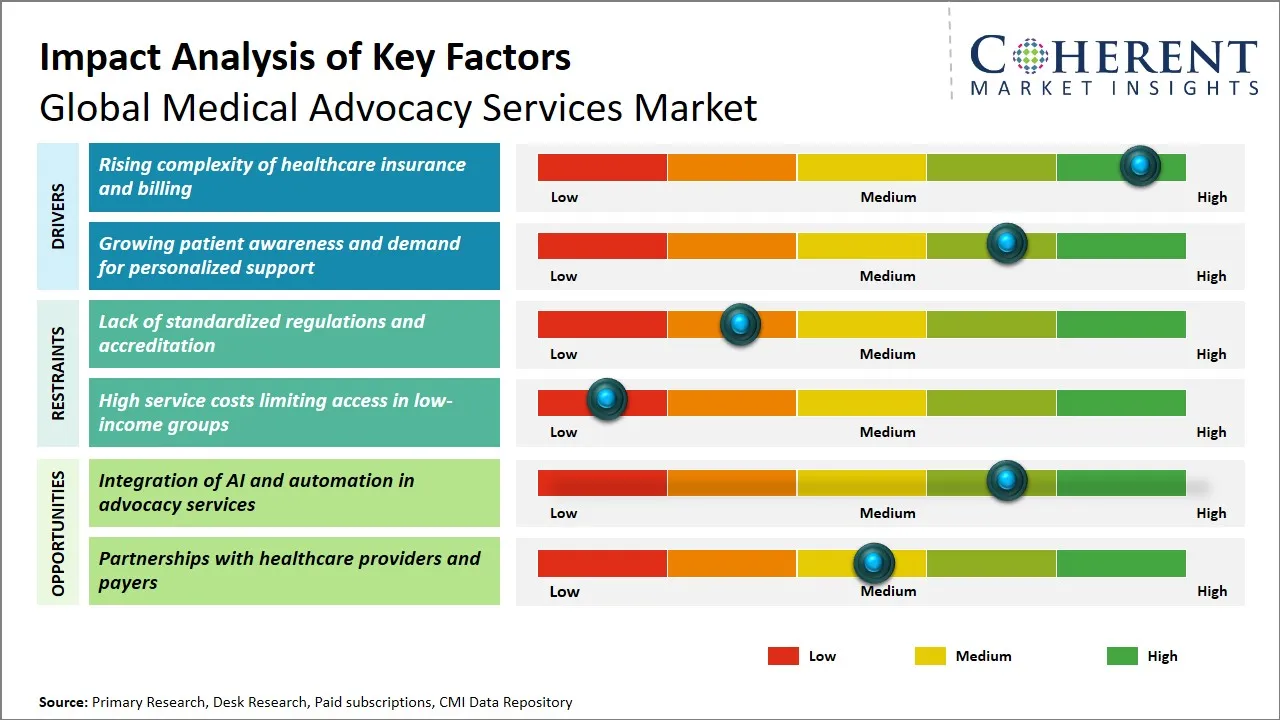
Medical Advocacy Services Market Driver - Rising Complexity of Healthcare Insurance and Billing
The increasing complexity of healthcare insurance policies and billing processes is increasing the need for medical advocacy service worldwide. There is growing challenge of patients struggling to cope with complex insurance plans, vouchers and complex billing documents and it is mostly leading to confusion, claim rejections and unwanted out-of-pocket payments. Since healthcare coverage is dynamic as new policies are introduced frequently, different reimbursement schemes and different payer conditions, people, in particular, people with chronic illnesses or people undergoing specialized care, need experienced assistance to handle all these administration overheads.
In April 2020, Wellpay, a U.S.-based health fintech startup, launched its Intelligent Patient Financial Hub offering zero-interest payment plans and free medical bill advocacy services to ease COVID-19 billing pressures. Backed by 8vc, Mubadala Capital-Ventures, and Montage Ventures, the USD 3.8 million-funded platform supports both patients and providers, aligning with the medical advocacy services market focus on financial transparency and patient empowerment.
Medical Advocacy Services Opportunity - Integration of AI and Automation in Advocacy Services
The emergence of artificial intelligence (AI) and automation is a valuable opportunity in the international market of providing medical advocacy services and will reshape the process of providing patient support and healthcare navigation. The efficiency can also be increased by AI-driven tools that will allow automatization of routine processes that include data collection and appointment scheduling, as well as follow-up communications and making medical advocates concentrate more on personalized interaction with patients and addressing more complex issues. Moreover, machine learning algorithms have the potential to handle big data to recognize patient needs, forecast the results of treatment, and customize advocacy measures in real time. This not only enhances patient experience but also maximizes resource distribution among advocacy services.
For example, Homecare Homebase (HCHB), a U.S.-based home health software provider, announced three new AI and automation tools within its HCHB Intelligence Suite to improve workflow efficiency and patient care. The tools include Intake Central, which automates referral management; Curate: Medications, which simplifies medication documentation; and Predict: Hospitalization Risk, which uses machine learning to identify patients at higher risk of hospitalization.
Analyst Opinion (Expert Opinion)
- The medical advocacy services market is also at a growing pace since patients demand more transparency and help in their complicated healthcare systems. Digitalization, AI-based care coordination, and the increased regulatory support of patient rights will promote growth. Nevertheless, relying on opportunities to combine advocacy with telehealth, insurance, and chronic care platforms could be seen as a chance to provide more efficient and equitable care despite the challenges such as low awareness and unequal quality of services.
- Certain developments within the recent past like the World Mental Health Congress and Telehealth and Patient Advocacy Summit have enhanced the discussion of patient empowerment and data-driven health reform across the globe. The efforts such as Tele MANAS in India, the U.S. restructuring of HHS and the digital bill advocacy model of Wellpay show how governments and businesses are incorporating advocacy into the care delivery system, creating a more responsible and patient-centered healthcare system.
Speak to the analyst
Want personalized insights?
Take the findings above to one of our principal consultants, or have the report rebuilt around the segments, geographies and competitors you actually track.
Market Segmentation
- Service Type Insights (Revenue, USD Bn, 2021 - 2033)
- Patient Advocacy
- Clinical and Healthcare Navigation
- Insurance Advocacy
- Senior and Elder Care Advocacy
- Mental Health Advocacy
- Disability and Special Needs Advocacy
- Legal Advocacy
- Mode of Service Insights (Revenue, USD Bn, 2021 - 2033)
- In-person Consultation
- Remote/Tele-advocacy
- Hybrid (Online + Onsite)
- Application Area Insights (Revenue, USD Bn, 2021 - 2033)
- Medical Billing and Claims Assistance
- Treatment Coordination and Care Planning
- Legal Rights and Ethical Consultation
- Health Education and Resource Guidance
- Access to Experimental or Clinical Trials
- Patient Safety and Complaint Resolution
- End User Insights (Revenue, USD Bn, 2021 - 2033)
- Hospitals and Clinics
- Insurance Companies
- Employers (Corporate Health Programs)
- Nonprofit and Patient Support Organizations
- Government and Public Health Agencies
- Independent Advocacy Firms
- Regional Insights (Revenue, USD Bn, 2021 - 2033)
- North America
- U.S.
- Canada
- Latin America
- Brazil
- Argentina
- Mexico
- Rest of Latin America
- Europe
- Germany
- U.K.
- Spain
- France
- Italy
- Russia
- Rest of Europe
- Asia Pacific
- China
- India
- Japan
- Australia
- South Korea
- ASEAN
- Rest of Asia Pacific
- Middle East
- GCC Countries
- Israel
- Rest of Middle East
- Africa
- South Africa
- North Africa
- Central Africa
- North America
- Key Players Insights
- Patient Advocate Foundation
- Health Advocate Inc
- Altrusa Health
- Medical Advocacy Plus
- Guardian Nurses Healthcare Advocates
- Nurse Advocates Inc
- Greater National Advocates
- WellNet Healthcare
- AdvoConnection
- Cancer Care
- Medwise Insurance Advocacy
- Healthcare Advocates Inc
- Vivra Health
- Medical Bill & Claim Advocates LLC
- Compass Healthcare Advocates
Sources
Primary Research Interviews
- Industry Stakeholders List
- Hospital Administration Representatives
- Healthcare Policy Advisors
- Insurance Claims Managers
- Independent Medical Advocates
- Patient Rights Attorneys
- Healthcare IT and Case Management Professionals
- End Users List
- Chronic Disease Patients
- Elderly Caregivers
- Corporate Health Program Members
- Veterans and Military Healthcare Beneficiaries
- Family Caregivers
- Patients with Disabilities or Special Needs
Government and International Databases
- World Health Organization (WHO)
- Centers for Medicare & Medicaid Services (CMS)
- U.S. Department of Health and Human Services (HHS)
- National Health Service (NHS – UK)
- Eurostat Health Database
- OECD Health Statistics
Trade Publications
- Healthcare Finance News
- Modern Healthcare
- Health Affairs Blog
- MedCity News
- Becker’s Hospital Review
- Managed Healthcare Executive
Academic Journals
- Journal of Patient Experience
- Health Services Research (HSR)
- Journal of Health Economics
- The Patient – Patient-Centered Outcomes Research
- BMJ Quality & Safety
- BMC Health Services Research
Reputable Newspapers
- The New York Times (Health Section)
- The Guardian (Healthcare Reports)
- The Washington Post (Health Policy)
- Financial Times (Healthcare Insights)
- Reuters Health
- The Wall Street Journal (Health & Science)
Industry Associations
- National Association of Healthcare Advocacy (NAHAC)
- Alliance of Professional Health Advocates (APHA)
- American Hospital Association (AHA)
- National Patient Advocate Foundation (NPAF)
- International Alliance of Patients’ Organizations (IAPO)
- World Medical Association (WMA)
Public Domain Resources
- U.S. National Library of Medicine (NLM)
- OpenAIRE
Proprietary Elements
- CMI Data Analytics Tool: Proprietary analytics tool to analyze real-time market trends, consumer behavior, and technology adoption in market
- Proprietary CMI Existing Repository of Information for Last 8 Years
Get access to 250+ pages report
Every segment, forecast, competitor profile and data table behind the analysis above — available for instant download.
- ESOMAR Member
- ISO 9001:2015 Certified
- D-U-N-S Registered
- GDPR & CCPA Compliant
Missing comfort of reading report in your local language? Find your preferred language:
Transform your Strategy with Exclusive Trending Reports
Frequently Asked Questions
The global medical advocacy services market is estimated to be valued at USD 7.11 Bn in 2026 and is expected to reach USD 14.48 Bn by 2033.
The CAGR of global medical advocacy services market is projected to be 10.7% from 2026 to 2033.
Rising complexity of healthcare insurance and billing and growing patient awareness and demand for personalized support are the major factors driving the growth of the global medical advocacy services market.
Lack of standardized regulations and accreditation and high service costs limiting access in low-income groups are the major factors hampering the growth of the global medical advocacy services market.
In terms of service type, patient advocacy is estimated to dominate the market revenue share in 2026.
Patient Advocate Foundation, Health Advocate Inc, Altrusa Health, Medical Advocacy Plus, Guardian Nurses Healthcare Advocates, Nurse Advocates Inc, Greater National Advocates, WellNet Healthcare, AdvoConnection, Cancer Care, Medwise Insurance Advocacy, Healthcare Advocates Inc, Vivra Health, Medical Bill & Claim Advocates LLC, and Compass Healthcare Advocates are the major players.
North America is expected to lead the global medical advocacy services market in 2026.