

Global Medical Apparel Market Size and Forecast – 2026 To 2033
The Global Medical Apparel Market is estimated to be valued at USD 129.64 Bn in 2026 and is expected to reach USD 201.46 Bn by 2033, growing at a compound annual growth rate (CAGR) of 6.5% from 2026 to 2033. Growth is supported by greater demand for specialized, antimicrobial, performance-oriented, and sustainable medical apparel as healthcare providers place stronger emphasis on infection protection, clinician comfort, functional garment design, and occupational safety.
Manufacturers are consequently investing in advanced barrier materials, breathable fabrics, ergonomic construction, and procedure-specific apparel. In November 2024, Cardinal Health highlighted continued innovation within its Surgical Drapes and Gowns portfolio, with dedicated R&D, regulatory, clinical, and manufacturing teams developing clinically differentiated gowns designed to meet AAMI performance requirements and improve clinician protection and comfort.
Key Takeaways of the Global Medical Apparel Market
- Scrubs and uniforms are expected to hold 31.8 % of the global medical apparel market in 2026 because they are worn across routine clinical shifts, support role identification, and require regular replacement as healthcare workforces expand. In September 2025, Uniform Advantage introduced new scrub silhouettes, cargo designs, and seasonal colorways, underscoring continuous product refresh in frontline workwear.
- Cotton and cotton blends are expected to account for 39.6 % of the market in 2026 because healthcare buyers balance breathability, wearer comfort, laundering durability, and institutional cost requirements. In June 2024, NHS Supply Chain launched its standardized healthcare uniform framework, specifying recycled polyester/cotton fabric sourced through the Better Cotton Initiative for clinical garments.
- Reusable medical apparel is expected to represent 67.0 % of the market in 2026 as hospitals increasingly evaluate garments on lifecycle cost, laundering compatibility, waste reduction, and repeated-use performance rather than purchase price alone. In February 2025, Barts Health NHS Trust awarded a three-year contract for reusable theatre gowns and subsequently replaced single-use gowns across six sites.
- North America is expected to account for 33.8 % of the global medical apparel market in 2026, supported by established hospital procurement systems, a large professional healthcare workforce, strong branded workwear adoption, and omnichannel purchasing. In May 2026, U.S.-based Superior Group of Companies reported first-quarter Healthcare Apparel net sales of USD 28.6 million, indicating continued commercial depth in the category.
- Asia Pacific is expected to hold 27.2 % of the market in 2026 and expand fastest as hospital networks, medical education, workforce capacity, and public healthcare investment broaden the addressable buyer base. In February 2026, India’s Union Budget increased funding for health infrastructure, new AIIMS, medical colleges, nursing education, and hospital upgrades, reinforcing future institutional apparel procurement needs.
Segmental Insights
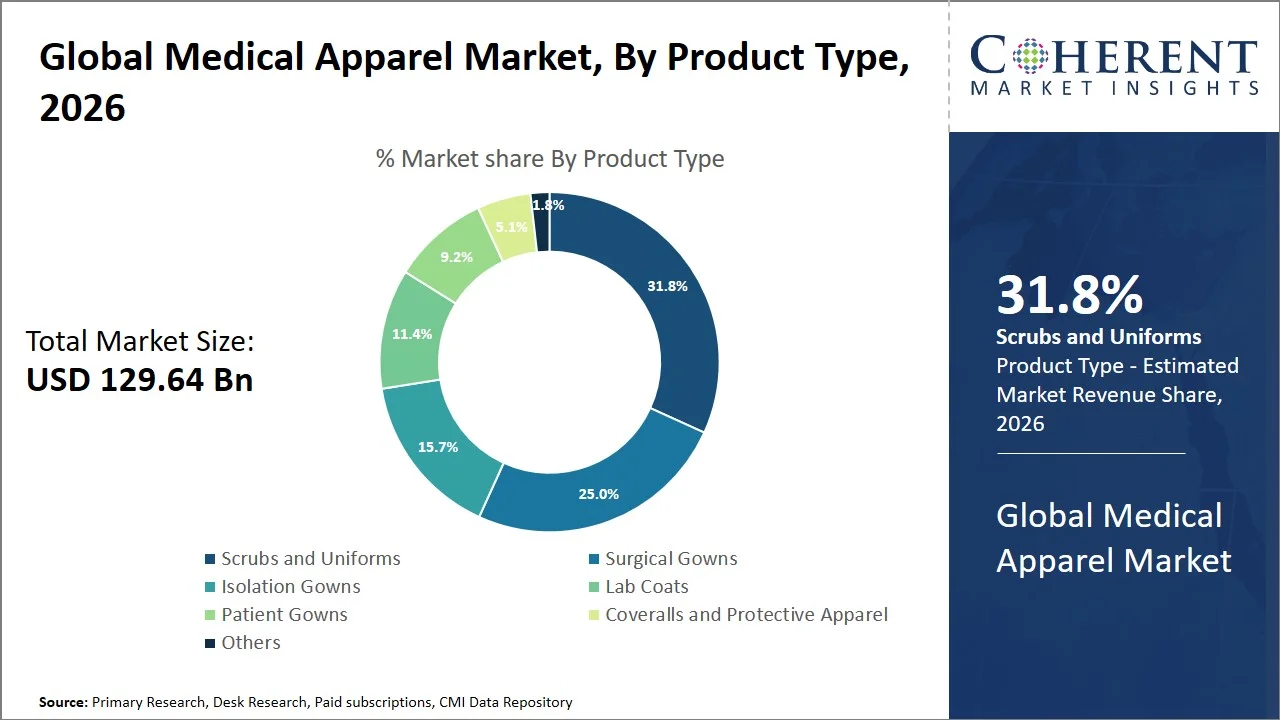
Why Do Scrubs and Uniforms Dominate the Global Medical Apparel Market?
Scrubs and Uniforms are expected to hold 31.8% of the global medical apparel market in 2026 because they serve the broadest recurring wearing requirement across clinical operations, including nursing, physician, allied-health, diagnostic, and support roles. Unlike procedure-specific gowns, scrubs function as everyday workwear, creating continuous demand across multiple shifts, departments, sizes, and color-coded uniform systems. Manufacturers also benefit from flexible styling, embroidery, private-label programs, and both institutional and direct-to-professional sales channels, allowing the category to capture demand beyond centralized hospital procurement. Suppliers maintaining shade consistency, size availability, and rapid replenishment are therefore commercially advantaged. In April 2026, NSW Health reported that thousands of uniforms were being ordered as more than 1,900 clinical and support staff were onboarded for the Northern Beaches Hospital transition, demonstrating the procurement scale created by standardized workforce outfitting.
- Current Industry Events of 2026
- Market Size Estimation
- Regional Breakdown
- Competitive Landscape
- Customer Intelligence
- Segmental Analysis
- Pricing Analysis
- Key Market Drivers, Challenges & Future Trends
- Customized Insights Section
Why Do Cotton and Cotton Blends Represent the Largest Material Segment in the Global Medical Apparel Market?
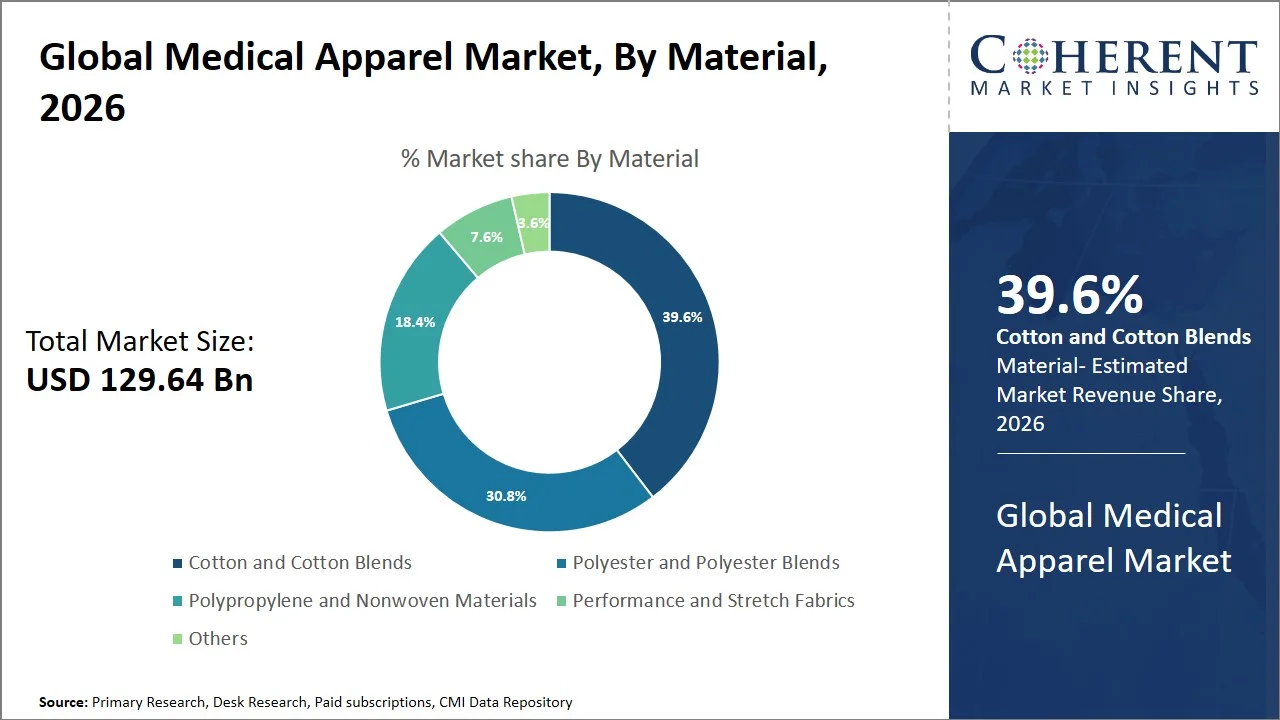
Cotton and Cotton Blends are expected to represent 39.6% of the global medical apparel market in 2026 because they balance wearer comfort with the operating requirements of frequently laundered healthcare garments. Cotton contributes softness, moisture absorption, and breathability, while blended constructions improve shape retention, color durability, drying performance, and resistance to repeated washing. This combination makes the material suitable across scrubs, lab coats, patient apparel, and general clinical uniforms where staff comfort must coexist with institutional maintenance economics. Established cotton and polyester supply chains also support scalable garment conversion, embroidery, and standardized color programs. In September 2025, HCSC Linen Services stated that its healthcare scrubs are made from 65% polyester and 35% cotton to provide longer-lasting color and comfort while supporting hygienic cleaning, illustrating the practical role of cotton blends in managed healthcare textile programs.
Why Does Reusable Medical Apparel Dominate the Usability Segment of the Global Medical Apparel Market?
Reusable Medical Apparel is expected to account for 67.0% of the global medical apparel market in 2026 because hospitals with established laundry, sterilization, and textile-service infrastructure can operate garments as circulating clinical assets rather than repeatedly procuring one-use inventory. This model supports controlled garment allocation, scheduled reprocessing, quality inspection, repair, and replenishment across scrubs, surgical gowns, lab coats, and patient clothing. It also creates recurring service opportunities for healthcare laundries and suppliers capable of providing durable fabrics, validated barrier performance, and traceable garment management. Reusables can therefore strengthen supply continuity where facilities have dependable reprocessing capacity and standardized handling protocols. In August 2024, an ANZ Journal of Surgery article led by Royal Melbourne Hospital researchers highlighted evidence supporting reusable sterile surgical gowns as equivalent in infection-prevention effectiveness to disposable alternatives when required standards are met, strengthening the clinical case for reusable apparel adoption.
Current Events and their Impact
Current Event | Description and Its Impact |
October 2025 – European Commission adds EN 13795-1:2025 to the MDR harmonized standards framework |
|
December 2025 – U.S. FDA updates recognized ASTM standards for surgical and isolation gowns |
|
Global Medical Apparel Market Dynamics
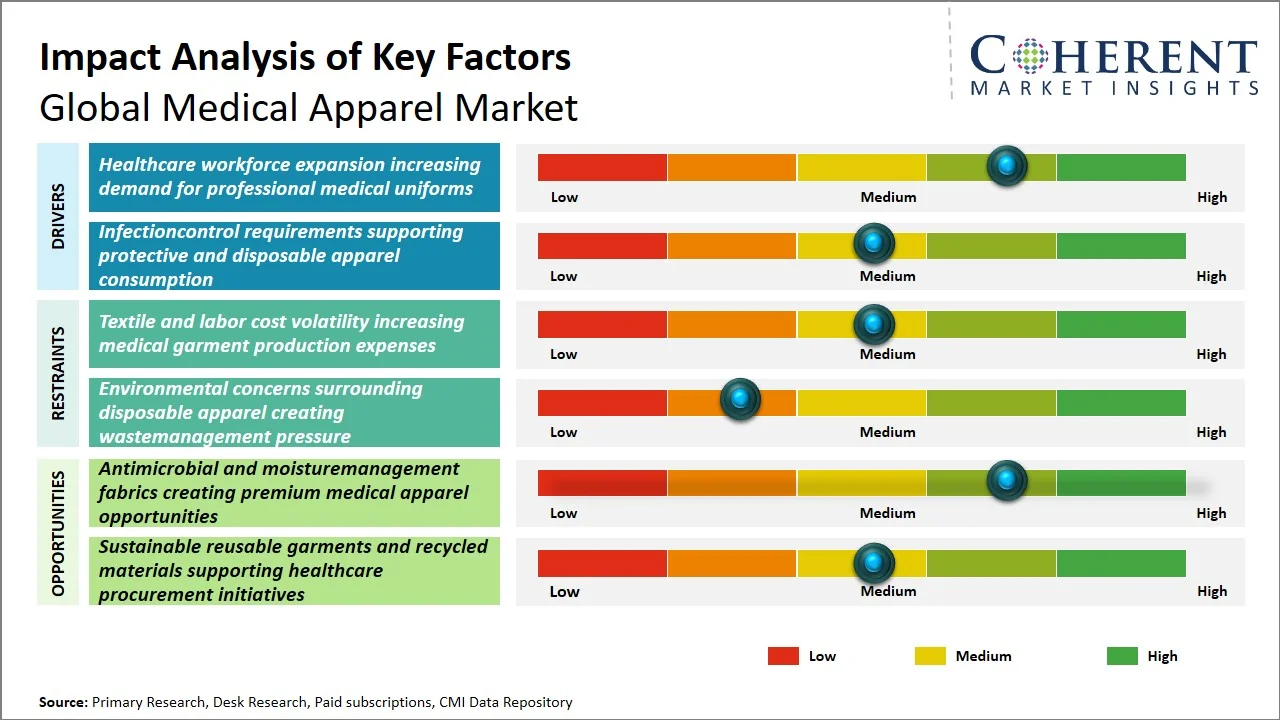
Key Market Drivers
- Healthcare workforce expansion increasing demand for professional medical uniforms: Healthcare workforce expansion increases medical-apparel demand through an operational procurement mechanism: every newly hired nurse, physician, technician, or support professional must be equipped with role-appropriate uniforms and then supplied through scheduled replacement cycles. This creates predictable institutional purchasing rather than one-time discretionary demand, benefiting uniform manufacturers, textile-service providers, private-label suppliers, and distributors able to manage sizing, embroidery, inventory, and multi-site fulfillment. Larger workforces also encourage health systems to formalize dress standards and consolidate procurement, raising the value of reliable enterprise supply capabilities. In May 2025, the World Health Organization reported continued expansion of the global nursing workforce while calling for further investment in nursing jobs and more equitable workforce distribution, reinforcing the long-term requirement to equip a broader clinical workforce with professional apparel.
- Infection control requirements supporting protective and disposable apparel consumption: Infection-control requirements translate directly into protective-apparel consumption because healthcare facilities must match garment barrier performance to anticipated exposure, procedure type, and contamination risk. This supports surgical gowns, isolation gowns, and protective coveralls while increasing the importance of validated materials, seam integrity, fluid resistance, labeling, and staff training. Manufacturers with documented performance evidence and consistent quality systems benefit, alongside distributors capable of maintaining appropriate protection levels across institutional inventories. Procurement teams also face greater pressure to differentiate garments according to intended exposure rather than treating protective apparel as interchangeable. In December 2024, CDC/ National Institute for Occupational Safety and Health (NIOSH) updated its healthcare protective-clothing resources describing surgical gowns, isolation gowns, and coveralls as barriers used to protect healthcare personnel and patients from microorganism transfer through blood and body fluids, reinforcing risk-based garment selection.
Emerging Market Trends
- Role-Coded Uniform Systems Becoming Workforce Infrastructure: Healthcare organizations are increasingly standardizing uniforms by role, department, color, branding, and approved styles across multiple facilities. This creates demand for suppliers capable of maintaining consistent fabrics, colors, sizing, embroidery, and replenishment programs. Over the forecast period, centralized uniform systems are expected to simplify procurement, improve staff identification, and strengthen opportunities for scalable medical-apparel manufacturers and specialized distributors.
- Institutional Procurement and Digital Self-Service Are Converging: Medical apparel purchasing is shifting toward hybrid models combining centralized institutional controls with digital employee ordering. Healthcare providers increasingly require approved product lists, spending limits, centralized billing, personalization, and direct fulfillment. Suppliers offering integrated digital ordering, inventory visibility, returns management, and employee allowance systems can strengthen recurring sales and customer retention, while traditional distributors dependent on manual procurement may face increasing competitive pressure.
Regional Insights
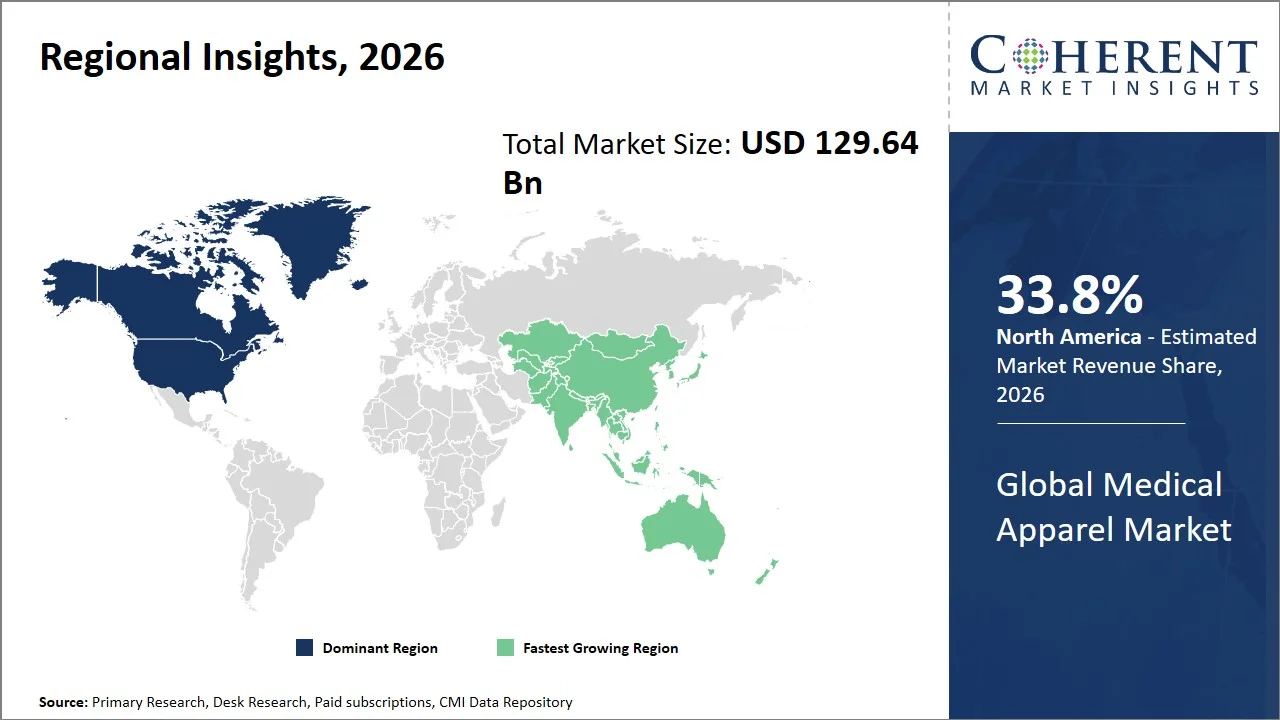
Why Does North America Dominate the Global Medical Apparel Market?
North America is expected to account for 33.8% of the global medical apparel market in 2026 because healthcare providers operate large, formalized purchasing programs across hospitals, ambulatory facilities, laboratories, long-term care, and physician networks. Demand extends beyond basic uniforms to surgical gowns, isolation apparel, lab coats, and role-specific workwear that must meet institutional performance and replacement requirements. The region also benefits from mature healthcare distribution, textile-service networks, standardized infection-prevention practices, and strong acceptance of performance fabrics, supporting both contract and individual purchases. Workforce shortages additionally keep recruitment and retention high on provider agendas, sustaining the need to equip new clinical staff. In January 2025, Health Canada published its pan-Canadian health-workforce study, identifying significant current and projected gaps across nursing and other health professions and recommending expansion of education and training capacity, reinforcing long-term professional-apparel requirements.
Why Is Asia Pacific Emerging as the Fastest-Growing Region in the Global Medical Apparel Market?
Asia Pacific is expected to hold 27.2% of the global medical apparel market in 2026 and emerge as the fastest-growing region because it combines expanding healthcare consumption with a broad apparel and technical-textile production base. This gives domestic suppliers shorter production cycles and cost flexibility while helping global brands localize sourcing and assortments. Growth is also supported by formalization of professional uniforms outside tertiary hospitals, including diagnostic networks, specialty practices, eldercare, and community care, where standardized clothing becomes increasingly important as service networks scale. Commercial opportunity therefore extends from basic institutional garments toward differentiated scrubs, protective gowns, and performance fabrics suited to varied climates and purchasing power. In May 2025, World Health Organization convened a dedicated State of the World’s Nursing session for the Western Pacific to examine regional nursing data and policy priorities, reinforcing expansion of the professional healthcare workforce using medical apparel.
Global Medical Apparel Market Outlook for Key Countries
Why Is the U.S. a Key Market for the Medical Apparel Market?
The U.S. is a key medical apparel market because it combines a very large clinical workforce with frequent purchasing across hospitals, ambulatory surgery centers, physician offices, laboratories, dental practices, and long-term care providers. Buyers typically separate everyday workwear from procedure-specific protective apparel, creating opportunities for both branded scrub suppliers and technically specified gown manufacturers. Employer uniform programs, individual clinician purchases, centralized health-system contracts, and specialist distributors provide multiple routes to market, while rigorous performance expectations increase the importance of consistent sizing, fabric durability, barrier claims, and dependable replenishment. Hospital employment alone creates a substantial recurring replacement base. In May 2026, the U.S. Bureau of Labor Statistics reported that general medical and surgical hospitals employed about 1.9 million registered nurses in 2025, accounting for 56% of registered-nurse employment and illustrating the concentrated institutional user base for professional healthcare apparel.
How Does China Support Growth in the Global Medical Apparel Market?
China supports growth in the global medical apparel market through the combination of a very large healthcare delivery system and substantial textile and apparel manufacturing capacity. Domestic hospitals, community health centers, clinics, public-health institutions, and eldercare facilities create broad requirements for uniforms, gowns, lab coats, and protective clothing, while local manufacturing supports high-volume conversion of woven and nonwoven materials. This structure enables suppliers to compete across value-priced institutional procurement, private healthcare demand, and export-oriented production. China is therefore commercially relevant from both demand and supply perspectives: extensive healthcare utilization sustains apparel consumption while manufacturing depth supports scale and cost competitiveness. In February 2026, China’s National Bureau of Statistics reported 1.107 million medical and health institutions, 38,000 hospitals, and 6.03 million registered nurses at the end of 2025, demonstrating the scale of facilities and personnel requiring continuous medical-apparel supply.
Why Is India Important in the Global Medical Apparel Market?
India is important to the global medical apparel market because it combines a large, cost-sensitive healthcare system with a deep domestic garment-manufacturing base capable of serving institutional and export requirements. Procurement spans government hospitals, private chains, diagnostic centers, nursing colleges, and specialty practices, creating demand across uniforms, lab coats, and protective apparel. Commercial opportunity is increasingly linked to workforce professionalization: standardized training, registration systems, and organized healthcare employers encourage more consistent dress codes, sizing systems, and replenishment practices. Suppliers combining affordable production with breathable fabrics, laundering durability, and reliable multi-city distribution are well positioned. In July 2025, the Indian Nursing Council highlighted that its Nurse Registration & Tracking System, a live register of nurses, was included in World Health Organization State of the World’s Nursing 2025 framework, indicating greater formal visibility and organization of a core medical-apparel user group.
Why Is Germany a Strategic Country in the Global Medical Apparel Market?
Germany is a strategic medical apparel market because its healthcare system combines a large professional workforce, extensive hospital and long-term care activity, and strong expectations around occupational quality, hygiene, durability, and procurement documentation. These characteristics favor suppliers offering reliable reusable uniforms, lab coats, surgical apparel, and protective garments with consistent specifications rather than competing only on unit price. Germany’s established laundry and textile-service infrastructure also support lifecycle-based purchasing for reusable garments, while healthcare facilities require dependable replenishment across multiple employee categories. The country additionally functions as an important European reference market for quality-oriented institutional procurement. In January 2026, Germany’s Federal Statistical Office reported that nearly 6.2 million people worked in the healthcare sector at the end of 2024, with healthcare employment increasing from the preceding year, demonstrating the scale of the workforce requiring professional and clinical apparel.
Why Is Japan an Important Growth Market for the Global Medical Apparel Market?
Japan is an important growth market for medical apparel because population ageing is shifting care delivery toward a wider mix of hospitals, outpatient care, rehabilitation, long-term care, and community-based services. This broadens the uniform requirement beyond acute-care clinicians to nursing, caregiving, diagnostic, and support personnel. Japanese buyers also place strong emphasis on fit, mobility, easy-care performance, cleanliness, and professional presentation, supporting durable reusable garments and specialized clinical apparel rather than undifferentiated work clothing. Suppliers addressing functional storage, laundering durability, role identification, and suitable sizing can strengthen institutional positioning. In July 2026, Japan’s Ministry of Health, Labour and Welfare held the fourth meeting of its committee examining the training and securing of nursing personnel toward 2040, including nursing-demand projections and workforce-security measures, confirming continued policy attention to the clinical workforce underpinning medical-apparel consumption.
Technology Adoption Landscape in the Global Medical Apparel Market
Technology | Adoption Level | Key Application Area | Business Impact |
Spunbond-Meltblown-Spunbond (SMS) Nonwoven Fabrication | High | Surgical gowns, isolation gowns, disposable protective apparel | Supports scalable production of lightweight barrier materials with controlled fluid resistance and consistent fabric performance. |
Ultrasonic Seam Welding and Sealing | Medium | Protective gowns and high-barrier apparel | Reduces needle-generated seam openings and supports stronger barrier integrity while increasing equipment-validation requirements. |
Automated Digital Pattern Nesting and CNC Fabric Cutting | High | Scrubs, uniforms, lab coats, patient apparel | Improves fabric yield, cutting consistency, manufacturing throughput, and economics across broad size and style portfolios. |
UHF RFID Garment Identification | Medium | Reusable uniforms, gowns, laundry and textile-service operations | Enables garment-level inventory visibility, laundering traceability, loss control, and more accurate replenishment planning. |
Synthetic-Blood and Hydrostatic Barrier Testing Systems | High | Surgical and isolation gown quality control | Provides repeatable evidence of fluid-barrier performance and strengthens product qualification, quality assurance, and compliance documentation. |
Automated Roll-to-Garment Conversion Lines | High | High-volume disposable gowns and protective apparel | Integrates roll feeding, cutting, component placement, and sealing to increase throughput, reduce labor dependence, and improve production consistency. |
How Are Adaptive Access Patient Garments Creating New Growth Opportunities in the Global Medical Apparel Market?
Adaptive Access patient garments represent an underdeveloped opportunity because conventional patient gowns often prioritize clinical access and low procurement cost over mobility, dignity, caregiver efficiency, and compatibility with complex care pathways. Hospitals, rehabilitation centers, long-term care facilities, and home-care providers can benefit from garments designed around easier dressing, secure closures, catheter and monitoring access, bariatric fit, assisted mobility, and repeated laundering. Suppliers can capture this opportunity through clinical co-design, modular opening systems, durable fastening technologies, softer barrier-compatible fabrics, and clearly differentiated product families for surgery, recovery, rehabilitation, and extended care. Commercial success will require evidence that improved garment architecture simplifies caregiver tasks without compromising infection-control practices or laundry operations. Manufacturers must also manage sizing breadth, closure durability, textile testing, and institutional trial programs. The opportunity is likely to favor specialist apparel developers and vertically integrated textile suppliers that can translate patient-care workflows into scalable garment specifications rather than competing primarily on basic gown price.
Market Players, Key Development, and Competitive Landscape
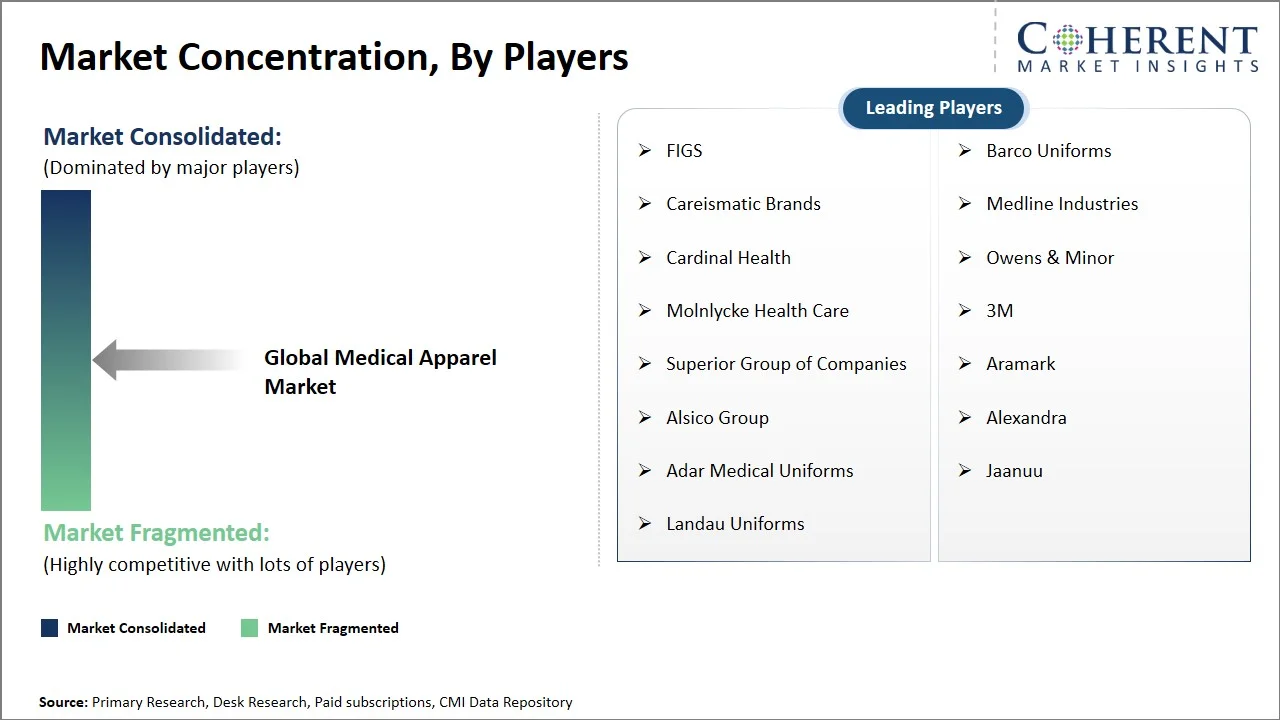
Key Developments
- In July 2026, FIGS expanded three of its established scrub-pant styles with a new mid-rise fit and adjustable rushed waistband, responding to customer requests for additional fit choices. This is important for the global medical apparel market because it illustrates how professional healthcare apparel is moving toward more granular product architecture, allowing brands to expand SKU depth and encourage repeat purchasing without abandoning recognizable core styles.
- In July 2025, JAANUU introduced spill-resistant scrubs using a proprietary PFC-free water-repellent finish across selected styles and colors. This is important for the global medical apparel market because it shows how material-chemistry choices are becoming part of product differentiation, enabling suppliers to address liquid repellency and chemical-selection considerations simultaneously while creating additional value beyond conventional fabric and styling attributes.
- In July 2025, Medline launched its ComfortTemp Patient Warming System incorporating disposable blankets and patient gowns designed for perioperative temperature management. This is important for the global medical apparel market because it extends patient apparel beyond a passive garment function into an integrated clinical workflow, creating scope for suppliers to compete through procedure-specific functionality and compatibility with associated medical equipment.
Competitive Landscape
The global medical apparel market is fragmented, with pockets of stronger concentration in institutional protective apparel and branded professional workwear. Competition spans medical-textile manufacturers, scrub and uniform specialists, PPE producers, healthcare distributors, textile-service providers, private-label suppliers, and regional garment manufacturers. Competitive advantage differs by category: regulated protective apparel places greater weight on barrier verification and quality systems, while professional uniforms compete more heavily on assortment management, fit, brand positioning, fulfillment, and institutional service. Regional suppliers remain important where short lead times, customization, local tender knowledge, and customer relationships influence purchasing decisions.
Key focus areas include
- Product consistency and clinical suitability: Maintaining repeatable fabric, construction, sizing, and garment performance across high-volume orders.
- Regulatory and testing capability: Building defensible documentation for protective apparel where barrier claims and medical-device requirements apply.
- Manufacturing and sourcing resilience: Qualifying alternative materials and production locations to reduce disruption and improve lead-time reliability.
- Pricing and portfolio architecture: Separating commodity products from differentiated apparel to protect margins without weakening institutional competitiveness.
- Institutional fulfillment capability: Managing employee sizing, personalization, replenishment, multi-site allocation, and contract-level service requirements.
- Channel reach: Combining healthcare distributors, direct institutional relationships, specialty retail, and digital ordering without creating channel conflict.
- Private-label and customization capability: Providing hospital-specific specifications, branding, garment programs, and rapid assortment adjustments for large accounts.
Market Report Scope
Medical Apparel Market Report Coverage
| Report Coverage | Details | ||
|---|---|---|---|
| Base Year: | 2025 | Market Size in 2026: | USD 129.64 Bn |
| Historical Data for: | 2020 To 2024 | Forecast Period: | 2026 To 2033 |
| Forecast Period 2026 to 2033 CAGR: | 6.5% | 2033 Value Projection: | USD 201.46 Bn |
| Geographies covered: |
| ||
| Segments covered: |
| ||
| Companies covered: | FIGS, Barco Uniforms, Careismatic Brands, Medline Industries, Cardinal Health, Owens & Minor, Molnlycke Health Care, 3M, Superior Group of Companies, Aramark, Alsico Group, Alexandra, Adar Medical Uniforms, Jaanuu, Landau Uniforms | ||
| Growth Drivers: |
| ||
| Restraints & Challenges: |
| ||
Analyst Opinion (Expert Opinion)
- The global medical apparel market leadership is likely to split increasingly between two distinct competitive models: scaled clinical-apparel suppliers built around specification control, compliance, institutional contracts, and manufacturing economics; and professional-workwear specialists built around brand equity, differentiated assortments, and user engagement. Companies positioned ambiguously between these models may find margin defense increasingly difficult. Clear portfolio architecture and category-specific capabilities should therefore become more important than simply offering the widest possible apparel range.
- Geographic concentration in sourcing could become a more important competitive vulnerability than product breadth. Medical-apparel suppliers dependent on narrow manufacturing footprints may face greater difficulty absorbing trade changes, transport disruption, raw-material shortages, or sudden institutional orders. Flexible multi-country sourcing, rapid material requalification, interoperable specifications, and visibility into upstream production are likely to become essential capabilities. Participants that can shift qualified production without materially changing garment performance should be better positioned to preserve service levels and contract economics.
- Suppliers should prioritize dual-qualified materials, internal testing competence, disciplined SKU management, and clear separation between value, standard, and specialized product tiers. Margin pressure is most likely where undifferentiated garments are supported by excessive assortment complexity or costly fulfillment. Investment should concentrate on capabilities that customers can verify quality consistency, supply continuity, fit-for-purpose design, documentation, and dependable service while avoiding excessive spending on novelty features that lack clear clinical, operational, or purchasing value.
Speak to the analyst
Want personalized insights?
Take the findings above to one of our principal consultants, or have the report rebuilt around the segments, geographies and competitors you actually track.
Market Segmentation
- Product Type Insights (Revenue, USD Bn, 2021 - 2033)
- Scrubs and Uniforms
- Surgical Gowns
- Isolation Gowns
- Lab Coats
- Patient Gowns
- Coveralls and Protective Apparel
- Others
- Material Insights (Revenue, USD Bn, 2021 - 2033)
- Cotton and Cotton Blends
- Polyester and Polyester Blends
- Polypropylene and Nonwoven Materials
- Performance and Stretch Fabrics
- Others
- Usability Insights (Revenue, USD Bn, 2021 - 2033)
- Reusable Medical Apparel
- Disposable Medical Apparel
- End User Insights (Revenue, USD Bn, 2021 - 2033)
- Hospitals
- Clinics and Ambulatory Centers
- Diagnostic Laboratories
- Longterm Care Facilities
- Dental and Specialty Practices
- Others
- Distribution Channel Insights (Revenue, USD Bn, 2021 - 2033)
- Direct Sales
- Indirect Sales
- Regional Insights (Revenue, USD Bn, 2021 - 2033)
- North America
- U.S.
- Canada
- Latin America
- Brazil
- Argentina
- Mexico
- Rest of Latin America
- Europe
- Germany
- U.K.
- Spain
- France
- Italy
- Russia
- Rest of Europe
- Asia Pacific
- China
- India
- Japan
- Australia
- South Korea
- ASEAN
- Rest of Asia Pacific
- Middle East
- GCC Countries
- Israel
- Rest of Middle East
- Africa
- South Africa
- North Africa
- Central Africa
- North America
- Key Players Insights
- FIGS
- Barco Uniforms
- Careismatic Brands
- Medline Industries
- Cardinal Health
- Owens & Minor
- Molnlycke Health Care
- 3M
- Superior Group of Companies
- Aramark
- Alsico Group
- Alexandra
- Adar Medical Uniforms
- Jaanuu
- Landau Uniforms
Sources
Primary Research Interviews
- Medical apparel, scrubs, uniforms, surgical gown, isolation gown, and protective-apparel manufacturers
- Cotton, polyester, polypropylene, nonwoven, performance-fabric, and barrier-material suppliers
- Hospitals, clinics, diagnostic laboratories, long-term care facilities, and specialty healthcare providers
- Distributors, hospital procurement teams, textile-service providers, commercial laundries, and infection-control experts
Stakeholders
- Medical apparel, healthcare uniform, and protective-garment manufacturers
- Fiber, yarn, woven fabric, nonwoven, coating, fastening, and accessory suppliers
- Distributors, institutional suppliers, textile-rental companies, laundries, and e-commerce providers
- Hospitals, ambulatory centers, laboratories, nursing facilities, dental practices, and healthcare professionals
End-use Sectors
- Hospitals and surgical facilities
- Clinics and ambulatory care centers
- Diagnostic and pathology laboratories
- Long-term care, nursing, and rehabilitation facilities
- Dental and specialty medical practices
- Other healthcare and institutional care facilities
Regulatory and Government Bodies
- U.S. FDA, CDC/NIOSH, OSHA, BLS, and Census Bureau
- European Commission, ECDC, Eurostat, and national medical-device authorities
- China NMPA, National Health Commission, SAMR, National Bureau of Statistics, and China Customs
- India CDSCO, Ministry of Health and Family Welfare, BIS, and MOSPI
- Japan MHLW, PMDA, Ministry of Economy, Trade and Industry, and Statistics Bureau
- WHO, ISO, AAMI, ASTM International, and accredited textile and medical-device testing laboratories
Databases
- UN Comtrade, ITC Trade Map, WTO, Eurostat, USITC, World Bank, and OECD
- WHO Global Health Observatory, ILOSTAT, BLS, and national healthcare-workforce databases
- Hospital, healthcare-facility, surgical-procedure, nursing-workforce, and health-expenditure databases
- FDA 510(k) database, European medical-device regulatory databases, WIPO PATENTSCOPE, Espacenet, company filings, catalogues, and pricing records
Magazines and Journals
- American Journal of Infection Control, Infection Control & Hospital Epidemiology, and Journal of Hospital Infection
- Textile Research Journal, Journal of Industrial Textiles, and Fibers and Polymers
- Journal of Healthcare Engineering, BMJ, and Healthcare
- AORN Journal, Nursing Management, and healthcare textile and infection-prevention publications
Associations
- Association for the Advancement of Medical Instrumentation
- Association of periOperative Registered Nurses
- Association for Professionals in Infection Control and Epidemiology
- International Association for Healthcare Textile Management
- INDA, Association of the Nonwoven Fabrics Industry
- EDANA, International Association Serving the Nonwovens and Related Industries
- Textile Services Association and national healthcare-textile associations
Public Domain Sources
- Product catalogues, specifications, technical datasheets, care instructions, and barrier-performance documentation
- Fabric composition, GSM, fluid resistance, breathability, tensile strength, laundering-cycle, and sizing data
- Healthcare workforce, hospital capacity, surgical activity, infection-control, textile-production, and trade statistics
- Trade data, annual reports, patents, product launches, procurement contracts, partnerships, manufacturing investments, and sustainability initiatives
Key Standards and Regulations
- ANSI/AAMI PB70 – Liquid barrier performance and classification of protective apparel and drapes
- ASTM F2407/F2407M – Surgical gowns intended for use in healthcare facilities
- ASTM F3352/F3352M – Isolation gowns intended for use in healthcare facilities
- EN 13795 – Surgical clothing and drapes used as medical devices
- EN 14126 – Protective clothing against infective agents
- ISO 13688 – General requirements for protective clothing
- ISO 16604 – Resistance of protective-clothing materials to penetration by blood-borne pathogens
- U.S. FDA 21 CFR 878.4040 requirements applicable to surgical apparel
- EU Medical Device Regulation (EU) 2017/745 and EU PPE Regulation 2016/425, where applicable
- Applicable OSHA bloodborne-pathogen, CE marking, UKCA, REACH, textile-labeling, biocompatibility, and quality-management requirements
Proprietary Elements
- CMI Data Analytics Tool, Proprietary CMI Existing Repository of information for the last 10 years
Get access to 250+ pages report
Every segment, forecast, competitor profile and data table behind the analysis above — available for instant download.
- ESOMAR Member
- ISO 9001:2015 Certified
- D-U-N-S Registered
- GDPR & CCPA Compliant
Missing comfort of reading report in your local language? Find your preferred language:
Transform your Strategy with Exclusive Trending Reports
Frequently Asked Questions
The CAGR of global medical apparel market is projected to be 6.5% from 2026 to 2033.
The global medical apparel market is estimated to be valued at USD 129.64 billion in 2026 and is expected to reach USD 201.46 billion by 2033.
Cotton blends, polyester blends, polypropylene, nonwoven materials, and performance fabrics are widely used in medical apparel.
Hospitals, clinics, diagnostic laboratories, long-term care facilities, and specialty healthcare practices are the major end users.
Role-coded uniform systems, digital procurement, sustainable apparel, performance fabrics, and reusable medical garments are key market trends.
Healthcare workforce expansion increasing demand for professional medical uniforms and Infection control requirements supporting protective and disposable apparel consumption are the major factor driving the growth of global medical apparel market.
Textile and labor cost volatility increasing medical garment production expenses and Environmental concerns surrounding disposable apparel creating waste management pressure are the major factor hampering the growth of global medical apparel market.