

Global Milk Replacer Market Size and Forecast: 2026-2033
The global milk replacer market is expected to grow from USD 4.72 Bn in 2026 to USD 7.93 Bn by 2033, registering a compound annual growth rate (CAGR) of 7.7%. The growth is strongly driven by measurable improvements in livestock productivity, cost efficiency, and rising dairy demand globally. Increasing the CP concentration from 16% to 26% in milk replacers fed to male pre-ruminant dairy calves at 1.5% of BW (DM basis) daily resulted in increased ADG, G:F, and the deposition of lean tissue. However, the effects of dietary CP would be expected to vary depending on ME intake (Source: nlm). Additionally, global milk production continues to expand at ~1–3% annually, reinforcing demand for efficient early-life nutrition solutions.
According to study published in ScienceDirect, calves were fed 2.84 L of their respective MR twice per day (5.68 L total) from d 1 to 42 of the experiment and 2.84 L once per day from d 43 to 49. Feeding crossbred calves MR24 increased ADG and gain per feed by 23.6% and 9.80%, respectively, compared with calves fed MR20 from d 1 to 56.
(Source: ScienceDirect)
Key Takeaways of the Global Milk Replacer Market
- Non-medicated segment is expected to hold 66.6 % of the global milk replacer market share in 2026, as the milk replacer industry is shifting from antibiotics to preventative nutrition and regulatory compliance. In the European Union, the European Medicines Agency’s ESVAC database and the European Environment Agency report that veterinary antimicrobial sales for food-producing animals declined by about 28% in 2022, reflecting sustained regulatory pressure and stewardship initiatives. Source: (Europa.eu) Additionally, large dairy companies such as Nestlé and Danone require antibiotic-free milk, which impels farmers to adopt non-medicated feeding. Sources: (Nestle)
- The powder segment is expected to capture 56% of the market share in 2026, as it is cost effective, has longer shelf life, and easy to transport. Milk replacers in powder form can help reduce transport cost by ~80% and have a shelf life of 12-18 months (liquid form shelf life is weeks). According to WildAgain Wildlife Rehabilitation, Inc. Powdered milk replacer is suitable for large scale production and automated feeding, which is now being used at more than 30% of large dairy farms globally, providing consistent and efficient feeding practices. (Source: ewildagain.org)
- By product type, whey-based milk replacers are expected to hold a 38.5 % share of the market in 2026, due to high digestibility and milk-like composition which helps in enhancing calf growth and feed efficiency. Whey is also widely available as 180-200 million tons are produced annually as a byproduct of cheese making and is an affordable and reliable source for producers.
- Europe region maintains dominance with an expected share of 43.5 % in 2026, due to a robust dairy sector, scientifically advanced feeding practices, and stringent antibiotic laws. According to European Union, the region has over 160 million tons of raw milk production per year, which drives the need for effective dairy nutrition products such as milk replacers for calves. (Source: European Union)
- Asia Pacific is the fastest growing region with 21.6 % share in 2026, owing to the growth in dairy consumption, herd size, and scientific feeding practices. The FAO predicts global milk demand to increase at an average of 2.4%- 2.5% annually to 2030, and much of it will come from Asia Pacific, where dairy modernization and increasing farm sizes are putting pressure on milk replacers. For instance, in India and China, the expansion of large-scale commercial dairy farms and cooperative dairy models (such as organized milk procurement networks) is accelerating the adoption of calf nutrition products, as farmers shift from traditional feeding practices to standardized, high-efficiency feeding systems to improve yield consistency and reduce calf mortality. (source: fao.org)
- Precision Livestock Nutrition Alignment: The milk replacer market is increasingly aligned with precision animal nutrition systems, where formulations are optimized for growth performance, immunity development, and feed conversion efficiency in early-life livestock Adoption is rising in commercial dairy farms as calf health becomes a direct driver of long-term herd productivity.
- Market Expansion Catalysts: Growth is being driven by industrialization of dairy farming, rising focus on calf survival rates, and regulatory pressure to reduce antibiotic usage in livestock feed.
Segmental Insights
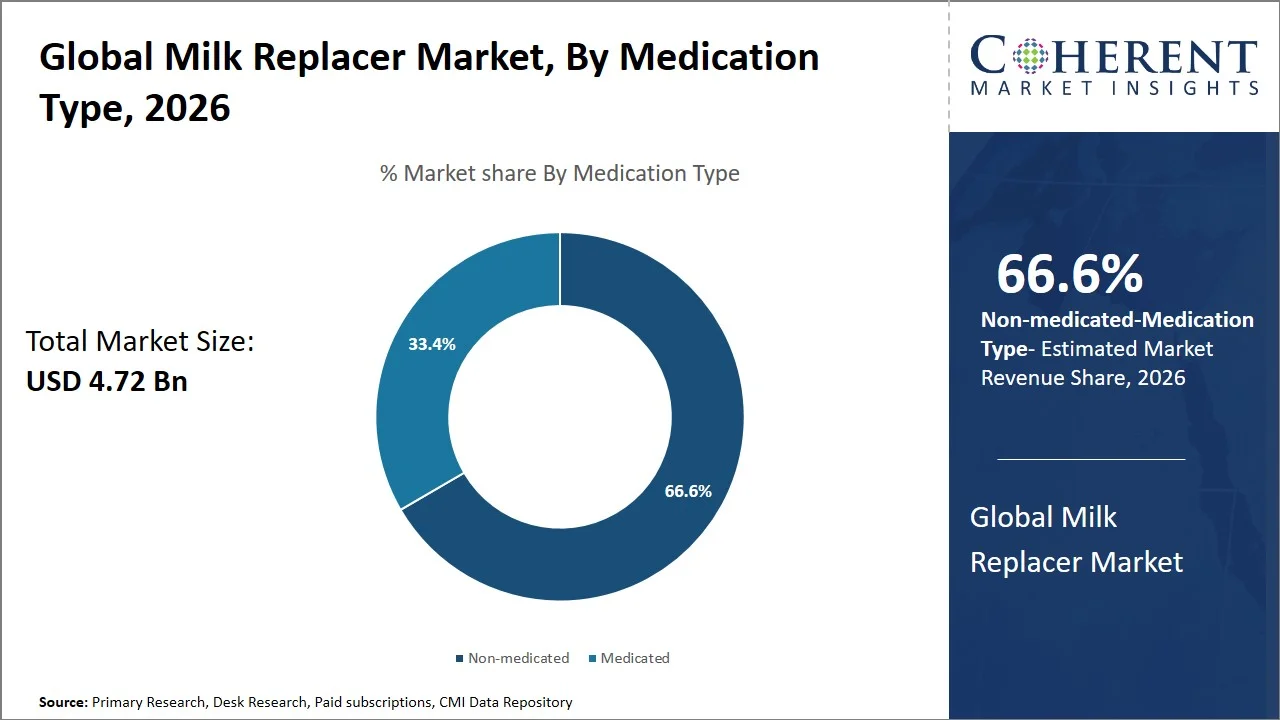
Why Does Non-Medicated Segment Dominate the Global Milk Replacer Market?
Non-medicated calf milk replacers are expected to hold 66.6% market share in 2026 due to a clear structural shift in dairy production. Strict regulations like the EU Veterinary Medicinal Products Regulation and the U.S. Veterinary Feed Directive have sharply limited routine antibiotic use, reducing demand for medicated products. At the same time, processors and consumers are pushing for antibiotic-free milk supply chains, accelerating adoption.
Cost advantages also matter—non-medicated replacers are cheaper to produce and avoid compliance costs. They are also easier to standardize, which fits large-scale farms using automation (around 30% using auto-feeders), where consistent formulation and feeding precision are critical.
- Current Industry Events of 2026
- Market Size Estimation
- Regional Breakdown
- Competitive Landscape
- Customer Intelligence
- Segmental Analysis
- Pricing Analysis
- Key Market Drivers, Challenges & Future Trends
- Customized Insights Section
Why is Powder the Most Preferred Form?
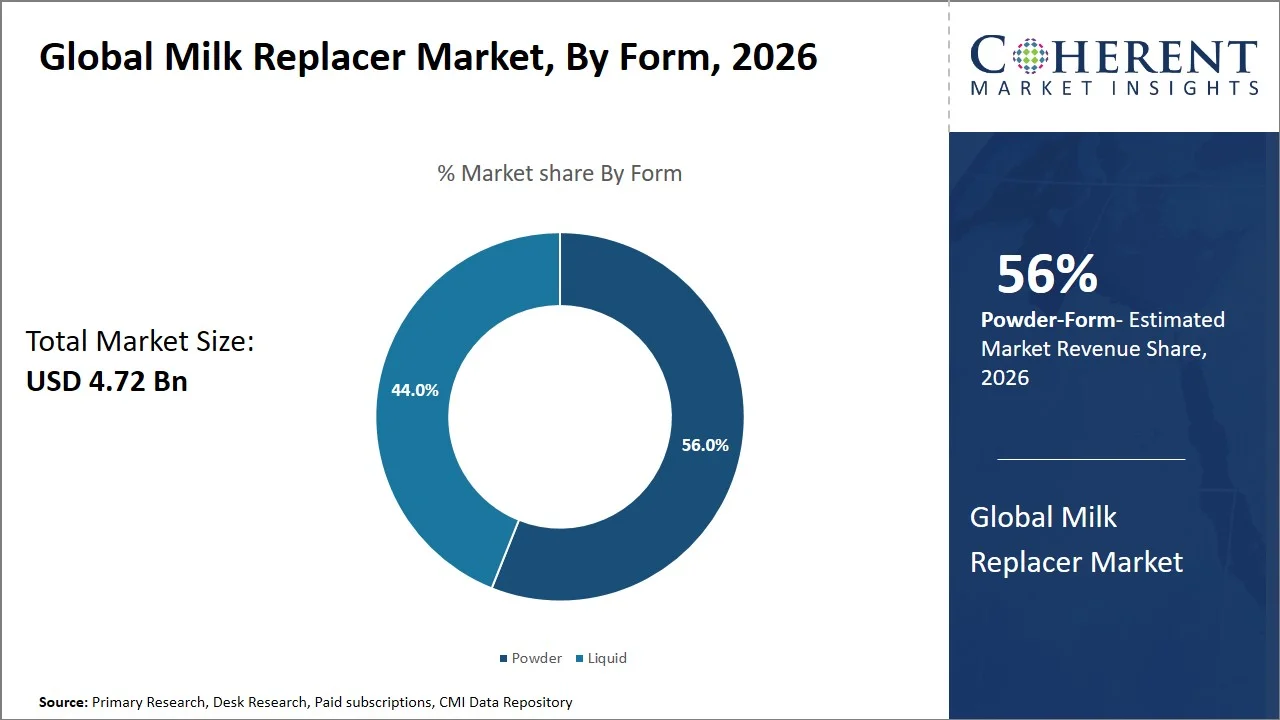
Powder is projected to hold 56% of the milk replacer market share in 2026, due to their cost, handling, and bulk feed benefits. Powder milk replacers are dehydrated to remove water, making them much lighter and smaller while eliminating the need for costly cold-chain transport and storage. It is particularly well-adapted to large dairy farms and developing regions with limited cold storage. Furthermore, powdered form reduces the risk of spoilage and allows bulk buying and stock control. These considerations directly benefit the world's dairy industry, in which consistency, scalability and cost efficiency are vital. Consequently, powdered milk replacers represent more than 65- 70% of total milk replacer consumption, and so are the preferred format consistent with the economics of industrial dairy production rather than simply a convenience choice.
Whey-based Segment Dominates the Global Milk Replacer
Whey-based milk replacers are expected to hold 38.5% share of the global market in 2026, supported by their cost efficiency and strong nutritional profile. Their high digestibility and close compositional similarity to natural milk proteins improve calf growth performance, feed conversion efficiency, and survival rates. Supply is structurally stable, as whey is a large-scale by-product of cheese manufacturing, with global output estimated at 180–200 million tons annually (FAO). This makes whey a consistently available input, particularly in dairy-intensive regions such as the European Union and the U.S., supporting its dominance in commercial formulations.
Currents Events and their Impact
Current Events | Description and its Impact |
Technological Shift: Precision Nutrition & Functional Formulations |
|
Industry Shift: Automation in Dairy Farming |
|
Global Milk Replacer Market Dynamics
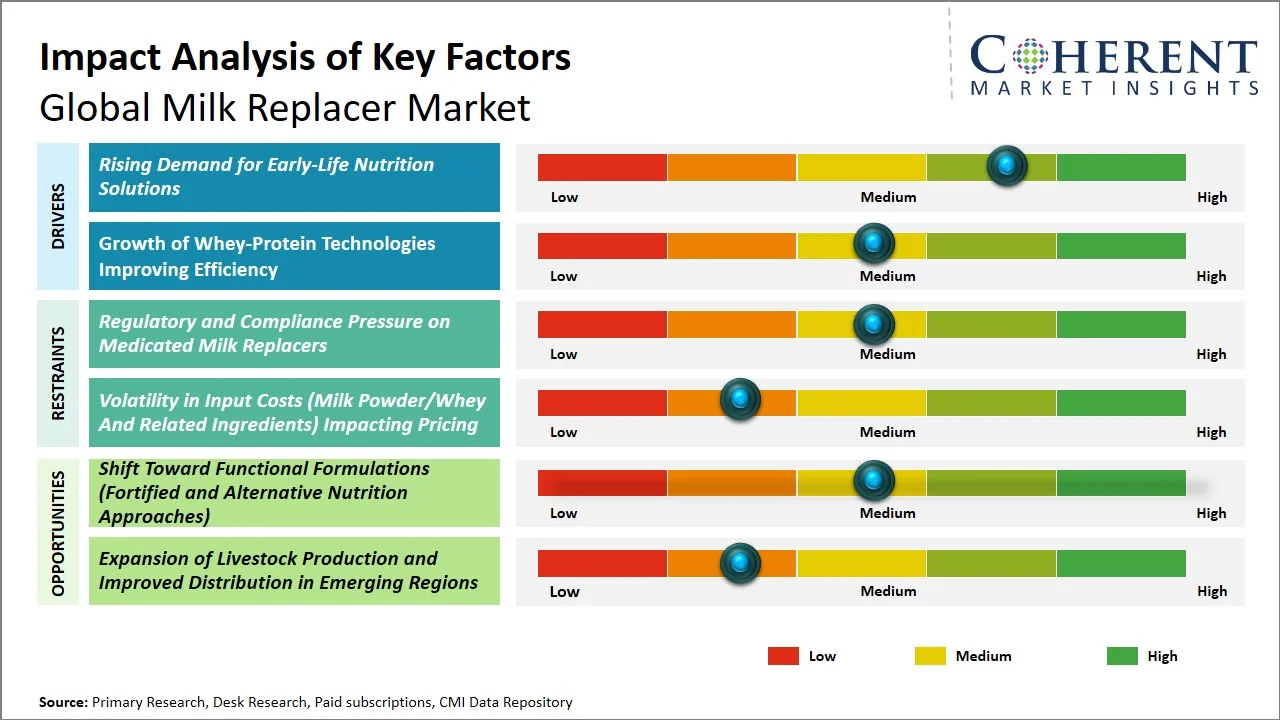
Market Drivers
- Rising Demand for Early-Life Nutrition Solutions: Nutrition in the early life of livestock is recognized as a key driver to increase animal productivity and the farm's profitability, driving the use of milk replacers. Improved pre-weaning nutrition practices promote better growth, immunity, and life-time performance of calves. Research by Trouw Nutrition B.V. (Nutreco N.V.) shows improved calf feeding programs can increase milk production in first lactation by 400 liters per cow, revealing the long-term economic advantages. (Source: Trouw Nutrition B.V.)
- Growth of Whey-Protein Technologies Improving Efficiency: Improvements in whey technologies are increasing the efficiency and quality of milk replacers, leading to their use in animal production. Techniques like ultrafiltration and enzymatic modification increase protein digestibility, and allow the creation of tailored nutritional components for young animals. The U.S. Department of Agriculture National Agricultural Statistics Service reported total dry whey production of 853 million pounds (USD 1,147 million) in 2024 in the U.S., underscoring the significant availability of dry whey for feed and nutrition use. This growing feedstock enhances the cost-effectiveness and adoption of whey products in milk replacers. (Source: usda.gov)
Emerging Trends
- Shift Toward Precision Nutrition & Functional Formulations: Milk replacers are transitioning from simple replacements to functional feed. More than 62% of farmers now follow tailored feeding programs, with high-protein replacers (22-26%) being used in ~58% of intensive farms to enhance growth and efficiency in calves. Moreover, almost 47% of formulations contain functional ingredients such as probiotics and prebiotics to improve immunity and gut health.
- Rising Focus on Sustainable & Alternative Ingredients: There is a growing preference for sustainable and ethical sources of milk replacers, such as plant-based and non-GMO variants. Already, plant-based products represent ~18-22% of new product development, in response to sustainability initiatives and regulatory push to minimize environmental footprint and antibiotic residues.
Regional Insights
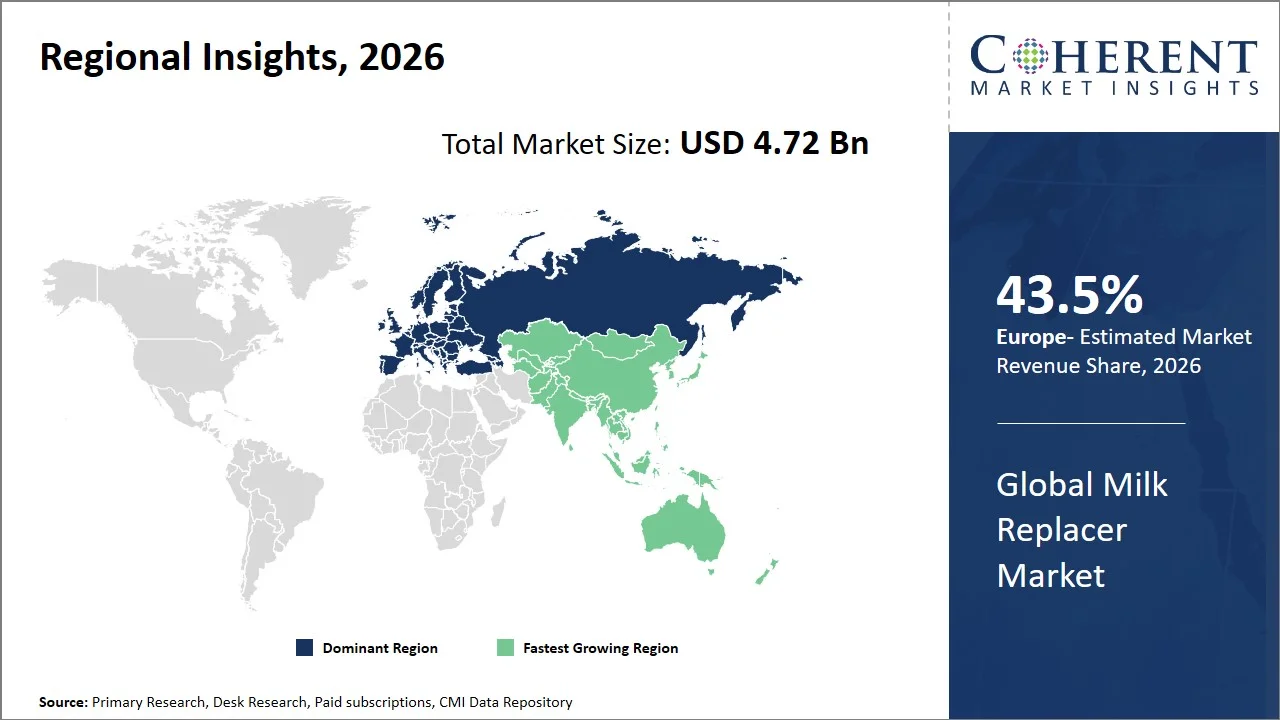
Why is Europe a Strong Market for Milk Replacer?
Europe leads the global milk replacer market, accounting for an estimated 43.5% share in 2026, due to the high industrialization of the dairy sector and favorable regulatory environment. The European parliament says the region accounts for some 28–30% of the global demand for milk replacer in 2022. The EU had almost 20 million dairy cows unevenly distributed across the Member States, with an average milk yield of 7,653 kg (amount of milk produced by one cow per day).
In addition, countries like Germany, the Netherlands, and Denmark have more than 65% of large-scale farms equipped with automatic calf feeding systems based on standardized milk replacer formulations. These factors make the use of milk replacer in Europe a necessity rather than a choice of input.
(Source: europarl.europa.eu)
Why Does Asia Pacific Milk Replacer Market Exhibit High Growth?
The Asia Pacific milk replacer market is expected to exhibit the fastest growth with 21.6% share in 2026, owing to rising livestock base and the increasing commercialization of dairy farming. It is also fueled by 25–35% growth in livestock population and increasing demand for quality dairy products. Milk replacers penetration is less than 30% at present and there is a lot of room for growth. Modernization programs for dairy led by the government have surged nearly 40% to hasten the shift to scientific feeding practices. Asia has ~352 million cattle and buffalo, making it the largest milk-producing region globally. (Source: fao.org)
Global Milk Replacer Market Outlook for Key Countries
Why is Germany Leading Innovation and Adoption in the Milk Replacer Market?
Germany is leading the way in innovation and adoption across Europe, underpinned by its advanced dairy infrastructure and strong policy support, with the adoption rates reaching as high as 89% of dairy farms. Technology integration is also high, with 68% of large farms using automated feeding systems, supporting reliance on standardized milk replacer products. According to Federal Ministry of Food and Agriculture, with Germany’s dairy herd of around 3.8 million cows and annual agricultural funding of some USD 6.76 billion (€6.2 billion) under EU programs, there is continuous innovation in feed efficiency and calf nutrition.
Is Canada a Favorable Market for Milk Replacer?
Canada is a favorable but mature market for milk replacers, characterized by high adoption rather than rapid growth. Canada benefits from a highly industrialized dairy sector and the widespread use of advanced feeding technologies. Milk replacers are routinely used to optimize calf growth and redirect whole milk toward commercial sale, improving farm profitability. However, growth remains moderate due to market maturity, with demand largely driven by efficiency improvements rather than expansion in herd size.
Is Milk Replacer Market Developing in India?
India is an emerging market for milk replacer with a good underlying dairy growth, but low adoption of scientific feeding practices. The country is the world’s largest milk producer with ~24–25% share in the global milk production. Milk production has grown from 146.3 million tons in 2014–2015 to ~239.3 million tons in 2023–2024, showing ~5.7% annual growth.
(Source: pib.gov)
Why Does France Top the Europe Milk Replacer Market?
France is a key market for milk replacers in Europe, accounting for around 3.9% of global milk production and ranking among the top milk-producing countries worldwide. The country produces approximately 23–24 billion liters of milk annually, supported by a large dairy herd of about 3.1 million cows. This scale is underpinned by relatively high productivity levels driven by improved genetics, intensive herd management practices, and ongoing modernization of dairy farming systems.
Global Milk Production Capacity by Country
Country | Milk Production (Million Tons/year) | Key Insight |
U.S. | ~102–105 | Highly industrialized dairy system with very high yield per cow |
China | ~41–47 | Expanding commercial dairy farms, but demand volatility and oversupply issues |
Brazil | ~35–37 | Large grazing-based system with moderate productivity |
How is the rising demand for efficient and performance-driven early-life nutrition creating new growth opportunities in the global milk replacer market ?
Rising demand for efficient and performance-driven early-life nutrition is reshaping the milk replacer market by repositioning it from a low-cost milk substitute to a strategic productivity tool in dairy farming. Modern dairy operations increasingly prioritize accelerated calf growth, stronger immunity, and higher lifetime milk yield, which requires precisely formulated nutrition with consistent protein, fat, vitamin, and functional additive profiles that whole milk cannot reliably deliver due to natural variability.
This shift is driving the adoption of scientifically formulated milk replacers that enable controlled nutrient intake, improved feed efficiency, and more predictable developmental outcomes. As a result, farmers are able to implement earlier weaning strategies, reduce dependency on variable whole milk, and redirect saleable milk toward commercial markets, improving overall farm revenue efficiency. This performance orientation is further reinforced in larger and more technologically advanced farms, where standardized feeding protocols and automation accelerate milk replacer penetration and ensure consistent calf growth outcomes across herds.
(Source: ScienceDirect)
Market Players, Key Development, and Competitive Intelligence
Key Developments
- In January 2026, Denkavit Futtermittel GmbH announced that it intends to launch the joint venture under the name “Denkavit MILCH plus” on June 1, 2026. The venture will oversee the nationwide sales of milk replacers and enhance the company's distribution network. This initiative aims to expand market reach and improve the availability of calf milk replacer products in key regions.
- In September 2025, De Heus India, part of De Heus Animal Nutrition, opened a new animal feed factory in Rajpura, Punjab. The factory, built with an investment of around USD 17 Mn, is one of the largest and most advanced in India, carrying an installed capacity of 180 kMT with the potential to expand to 240 kMT. The factory has separate production lines for cattle, buffalo, poultry, and pig feed. It uses the latest European technology and automation to produce high-quality animal feeds.
- In November 2024, Trouw Nutrition B.V. (Nutreco N.V.) launched Sprayfo Ultimo, a calf milk replacer formulated to replicate the fatty acid composition of cow’s milk and support early-life development. The product is designed to improve gut health, enhance resilience, and facilitate earlier breeding performance in calves.
Competitive Landscape
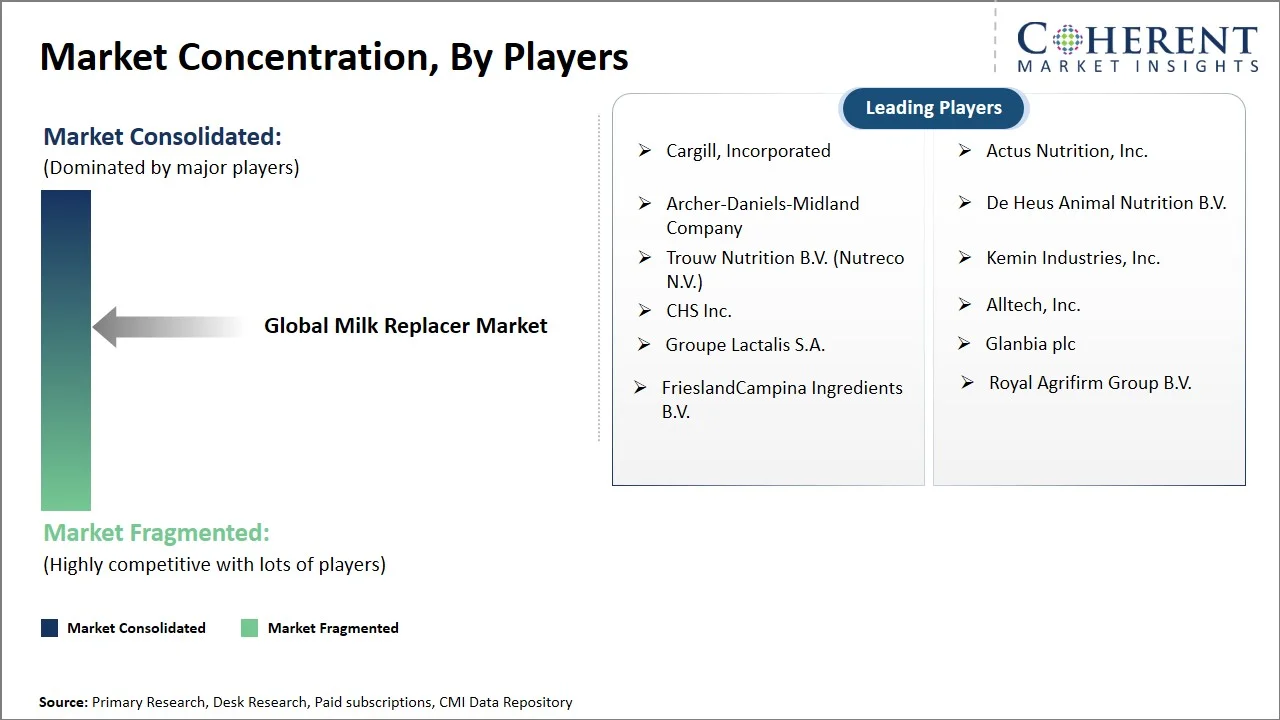
The global milk replacer market is competitive with a mix of global leaders and strong regional players. Large companies dominate through R&D, scale, and distribution, while smaller players compete on pricing and local customization. Key focus areas include:
- Nutritional performance and functional innovation
- Product diversification and species-specific solutions
- Strategic partnerships, M&A, and localized expansion
Market Report Scope
Milk Replacer Market Report Coverage
| Report Coverage | Details | ||
|---|---|---|---|
| Base Year: | 2025 | Market Size in 2026: | USD 4.72 Bn |
| Historical Data for: | 2020 To 2024 | Forecast Period: | 2026 To 2033 |
| Forecast Period 2026 to 2033 CAGR: | 7.7% | 2033 Value Projection: | USD 7.93 Bn |
| Geographies covered: |
| ||
| Segments covered: |
| ||
| Companies covered: | Cargill, Incorporated, Archer-Daniels-Midland Company, Trouw Nutrition B.V. (Nutreco N.V.), FrieslandCampina Ingredients B.V., Groupe Lactalis S.A., CHS Inc., Actus Nutrition, Inc., De Heus Animal Nutrition B.V., Kemin Industries, Inc., Alltech, Inc., Glanbia plc, and Royal Agrifirm Group B.V. | ||
| Growth Drivers: |
| ||
| Restraints & Challenges: |
| ||
Analyst Opinion (Expert Opinion)
- The industry’s future will be defined by the transition from basic milk replacer to precision early-life nutrition, where formulations are designed to optimize immunity, gut health, and feed efficiency. The commercialization of dairy farming, increasing regulatory pressure, and the antibiotic free rearing will boost the demand for functional, fortified and species-specific milk replacers. As dairy operations become more industrialized, especially in emerging markets, milk replacers will become a standard input, rather than an optional cost-saving product. Adoption will be closely tied to measurable ROI such as 15–25% lower calf mortality and 8–12% higher weight gain.
- The maximum opportunity is clearly in calf milk replacers, for dairy applications, in high growth low penetration markets, particularly India and Southeast Asia. India is the most underpenetrated large market with adoption still below 20% despite having one of the world’s largest cattle populations and a rapidly formalizing dairy sector. In India, the highest value entry point is for organized and semi-organized dairy farms supplying to co-operatives and private dairies that are improving through consistency, yield optimization and veterinary oversight.
- Players need to make an aggressive shift from a commodity sales model to a specification-led, performance-driven approach in order to gain competitive advantage. The best way is to embed products in feeding protocols through veterinarians, dairy consultants, and large farm operators, rather than traditional feed distributors. Driving adoption and pricing power will depend on showing measurable results on the farm such as better feed conversion ratios, lower disease occurrence, and faster growth cycles.
Speak to the analyst
Want personalized insights?
Take the findings above to one of our principal consultants, or have the report rebuilt around the segments, geographies and competitors you actually track.
Market Segmentation
- Medication Type Insights (Revenue, USD Bn, 2021 - 2033)
- Non-medicated
- Medicated
- Form Insights (Revenue, USD Bn, 2021 - 2033)
- Powder
- Liquid
- Product Type Insights (Revenue, USD Bn, 2021 - 2033)
- Whey-based
- Skim-based
- Blended
- Others
- Regional Insights (Revenue, USD Bn, 2021 - 2033)
- North America
- U.S.
- Canada
- Latin America
- Brazil
- Argentina
- Mexico
- Rest of Latin America
- Europe
- Germany
- U.K.
- Spain
- France
- Italy
- Russia
- Rest of Europe
- Asia Pacific
- China
- India
- Japan
- Australia
- South Korea
- ASEAN
- Rest of Asia Pacific
- Middle East
- GCC Countries
- Israel
- Rest of Middle East
- Africa
- South Africa
- North Africa
- Central Africa
- North America
- Key Players Insights
- Cargill, Incorporated
- Archer-Daniels-Midland Company
- Trouw Nutrition B.V. (Nutreco N.V.)
- FrieslandCampina Ingredients B.V.
- Groupe Lactalis S.A.
- CHS Inc.
- Actus Nutrition, Inc.
- De Heus Animal Nutrition B.V.
- Kemin Industries, Inc.
- Alltech, Inc.
- Glanbia plc
- Royal Agrifirm Group B.V.
Sources
Primary Research Interviews
- Milk replacer manufacturer (e.g., global calf nutrition product managers)
- Dairy nutritionist / Animal feed formulation specialist
- Supply Chain Director – animal nutrition / feed ingredients company
- Technical Manager – calf performance solutions provider (e.g., Trouw Nutrition / Nutreco division)
- Veterinary consultant specializing in dairy herd health and early-life nutrition
Stakeholders
- Milk replacer manufacturers and animal nutrition companies
(e.g., Cargill, ADM, Nutreco, De Heus, Land O’Lakes) - End-use Sectors:
- Calf raisers
- Heifer growers
- Dairy integrators
Databases
- UN Comtrade Database (HS codes related to animal feed, milk substitutes, whey derivatives)
- Eurostat – Animal feed and dairy production statistics
- FAOSTAT – Livestock population, dairy production, feed consumption trends
- USDA FAS (Foreign Agricultural Service) – Dairy and feed industry reports
Magazines
- Feed Strategy – Global feed and animal nutrition trends
- Dairy Global – Dairy production systems and calf nutrition insights
- World Dairy Diary – Industry updates on milk production and calf rearing
- All About Feed – Feed ingredients and formulation developments
- Dairy Herd Management – Farm-level nutrition practices and calf management
- The Dairy Site – Industry news on dairy productivity and calf health
Journals
- Animal Feed Science and Technology – Feed formulation and digestibility research
- Livestock Science – Ruminant nutrition and early-life feeding studies
- Journal of Animal Science – Protein/fat utilization in calves
- Animal Nutrition – Functional additives and gut health in young livestock
- Veterinary Research Communications – Calf health and mortality reduction studies
Newspapers
- Financial Times – Agri-food commodity and dairy supply chain trends
- The Wall Street Journal – Global dairy industry and feed cost dynamics
- Business Standard (India) – Dairy sector expansion and feed market trends
- The Economic Times – India dairy modernization and feed adoption trends
Associations
- International Dairy Federation (IDF)
- National Milk Producers Federation (NMPF)
- European Dairy Association (EDA)
- American Dairy Science Association (ADSA)
- International Feed Industry Federation (IFIF)
Public Domain Sources
- FAO – Dairy and livestock production reports
- OECD-FAO Agricultural Outlook – Global dairy demand projections
- USDA – Dairy production and calf nutrition guidelines
Proprietary Elements
- CMI Data Analytics Tool
- Proprietary CMI Existing Repository of information for last 10 years
Get access to 250+ pages report
Every segment, forecast, competitor profile and data table behind the analysis above — available for instant download.
- ESOMAR Member
- ISO 9001:2015 Certified
- D-U-N-S Registered
- GDPR & CCPA Compliant
Missing comfort of reading report in your local language? Find your preferred language:
Transform your Strategy with Exclusive Trending Reports
Frequently Asked Questions
The global milk replacer market is estimated to be valued at USD 4.72 Bn in 2026 and is expected to reach USD 7.93 Bn by 2033.
The CAGR of global milk replacer market is projected to be 7.7% from 2026 to 2033.
Rising demand for early-life nutrition solutions, and growth of whey-protein technologies improving efficiency are the major factors driving the growth of the global milk replacer market.
Regulatory and compliance pressure on medicated milk replacers and volatility in input costs (milk powder/whey and related ingredients) impacting pricing are the major factors hampering the growth of the global milk replacer market.
In terms of medication type, non-medicated is estimated to dominate the market revenue share in 2026.
Cargill, Incorporated, Archer-Daniels-Midland Company, Trouw Nutrition B.V. (Nutreco N.V.), FrieslandCampina Ingredients B.V., Groupe Lactalis S.A., CHS Inc., Actus Nutrition, Inc., De Heus Animal Nutrition B.V., Kemin Industries, Inc., Alltech, Inc., Glanbia plc, and Royal Agrifirm Group B.V. are the major players.
Europe is expected to lead the global milk replacer market in 2026.