

Global Mobile Phone Farming Market Size and Forecast – 2026 To 2033
The global mobile phone farming market is expected to grow from USD 20.50 Bn in 2026 to USD 47.50 Bn by 2033, registering a compound annual growth rate (CAGR) of 14% from 2026 to 2033. The global mobile phone farming market is driven by steady expansion of cloud-based device management platforms. On November 25, 2025, LambdaTest launched Appium 3 Beta Support on Cloud Device Infrastructure. LambdaTest became the first cloud testing platform to support Appium 3 Beta across its cloud-hosted Android and iOS device infrastructure. (Source: Appium)
Key Takeaways of the Global Mobile Phone Farming Market
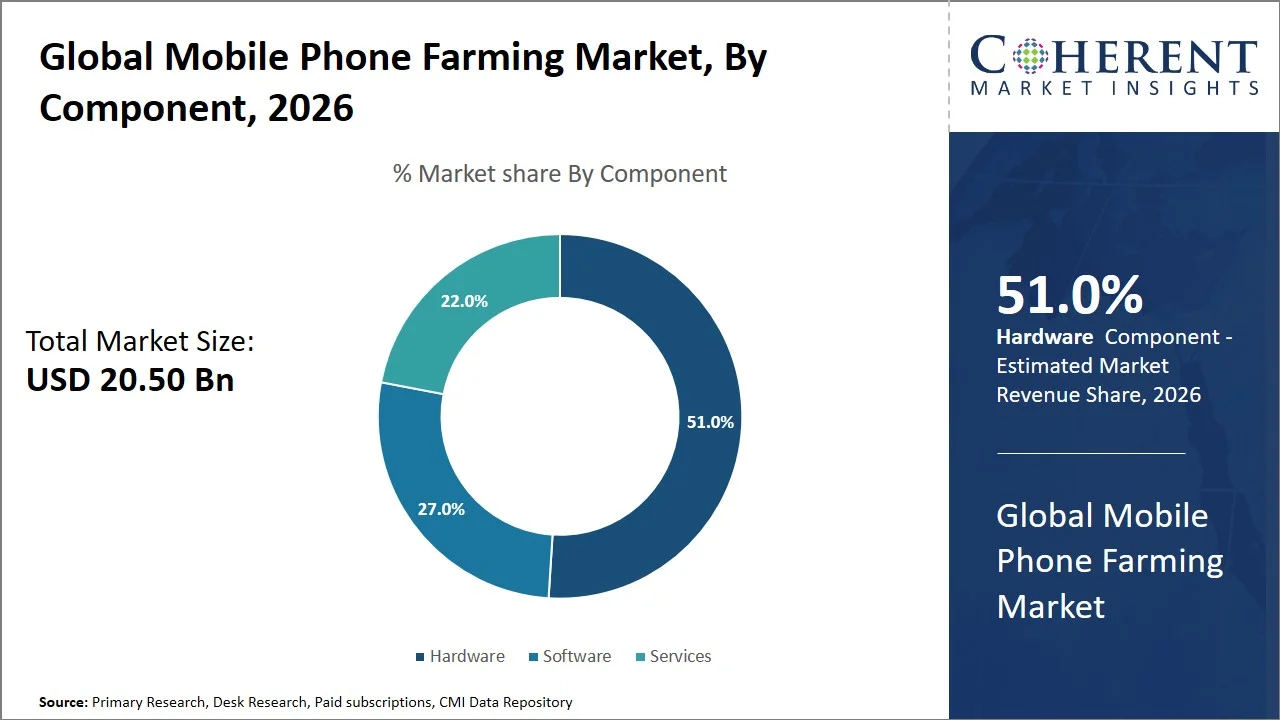
- The hardware segment is expected to account for 51.0 % of the global mobile phone farming market share in 2026. Need for real-device testing instead of emulators is driving the growth of the hardware segment. On June 12, 2025, BrowserStack announced support for Playwright tests on real iOS devices with Safari, becoming the first platform to close one of the most persistent gaps in browser test automation. (Source: BrowserStack)
- The physical smartphone farms segment is estimated to capture 47.0% of the market share in 2026. Growth of mobile fintech applications is majorly driving the growth of the segment. On February 18, 2026, Ericsson and Mastercard announced a collaboration to reshape how money moves across the world. By integrating the Ericsson Fintech Platform with Mastercard Move, the collaboration will empower telecom service providers, banks, and fintechs to expand digital wallet capabilities, launch new payment services, and reach unbanked or underbanked communities. (Source: Ericsson)
- The self-owned phone farms segment is estimated to capture 49.0% of the market share in 2026. The segment’s growth is driven by increasing AI-driven mobile analytics adoption. On January 9, 2024, AppsFlyer launched Creative Optimization, its new product that provides marketers with unparalleled insights into their creative assets and data-driven guidance on maximizing their impact. (Source: AppsFlyer)
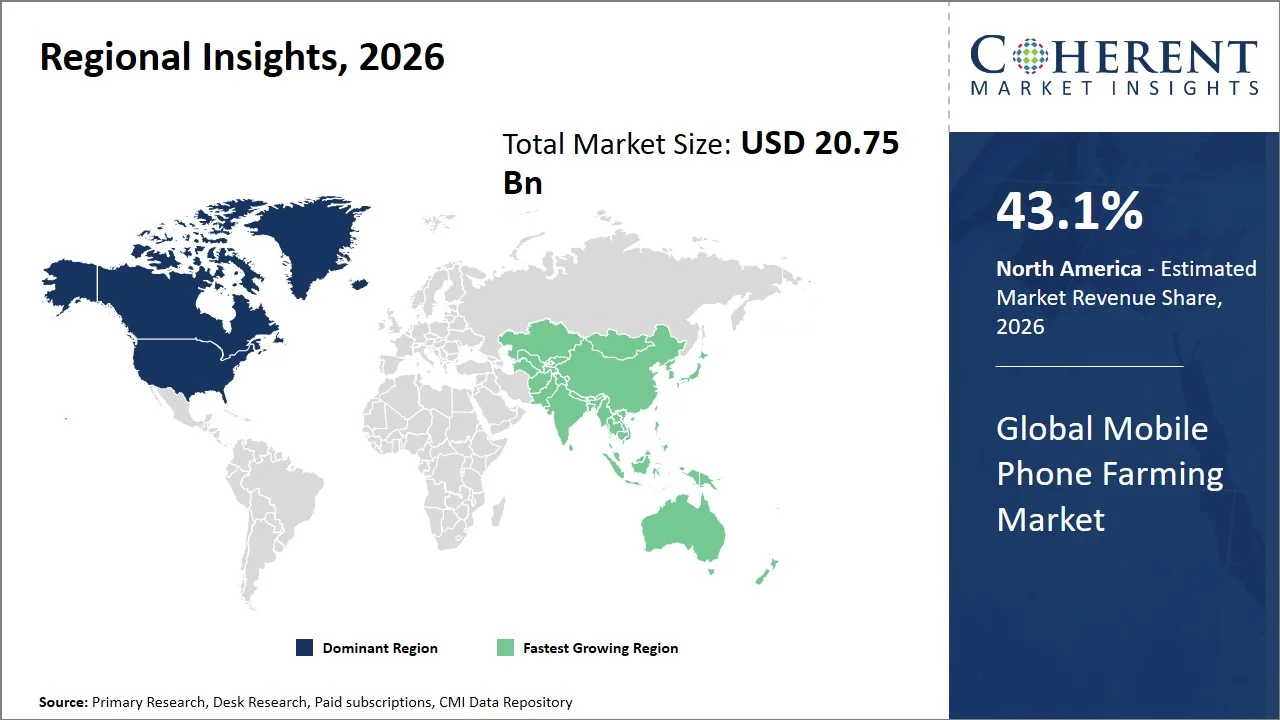
- Asia Pacific is expected to dominate the mobile phone farming market in 2026 with a market share of 43.0 %. The growth of remote device cloud farms for enterprises in Asia Pacific is a major factor driving the growth of the regional market. On June 6, 2025, Amazon announced a plan to invest more than USD 5 billion to meet Asia’s growing demand for cloud services. The investment will be focused on the Taipei region of Taiwan. (Source: Times of India)
- North America is expected to account for 29.0 % share in 2026 and is projected to record the fastest growth over the forecast period. Growing integration of mobile phone farms with IoT ecosystems is driving the growth of the mobile phone farming market in North America. On January 26, 2026, AT&T announced that its Connected Spaces solution is now available as its first end-to-end Internet of Things (IoT) offering listed on the AWS Marketplace, marking a significant milestone in simplifying smart business operations for small and medium-sized enterprises (SMEs). (Source: AT&T)
- AI-Powered Device Automation and Management: Phone farm operators are increasingly embracing artificial intelligence to automate device monitoring, workload allocation, app testing and performance optimization. AI aids to minimize manual intervention, enhance productivity and optimize device utilization in large scale smart phone networks.
- Shift Toward Cloud-Based Device Farms: Organizations are moving away from physical phone farms and shifting to cloud services based device farms that provide remote access to thousands of genuine handsets. The demand for scalable mobile application testing, continuous integration and worldwide access to devices without the requirement for large expenditures in hardware is driving this development.
Segmental Insights
Why Does Hardware Dominate the Global Mobile Phone Farming Market?
The hardware segment is expected to account for 51.0% of the global mobile phone farming market share in 2026. The main reason that hardware dominates the industry is due to large-scale deployment requirements for smartphones. Phone farming enterprises need hundreds or thousands of actual smartphones, tablets, and charging systems, cooling equipment, racks, and networking devices to carry out app testing, automation, and digital verification tasks. Hardware contributes for the largest share of total market income, as these physical products have the largest upfront and replacement cost. For example, BrowserStack announced that its Real Device Cloud now offers access to over 30,000 real Android and iOS devices in data centers around the world. The expansion reflects the industry’s continuous investment in massive physical device inventories, with smartphones and tablets representing a substantial capital expense that’s needed to enable enterprise-scale testing and automation workloads. (Source: BrowserStack)
- Current Industry Events of 2026
- Market Size Estimation
- Regional Breakdown
- Competitive Landscape
- Customer Intelligence
- Segmental Analysis
- Pricing Analysis
- Key Market Drivers, Challenges & Future Trends
- Customized Insights Section
Why are Physical Smartphone Farms the Most Widespread Device Environment?
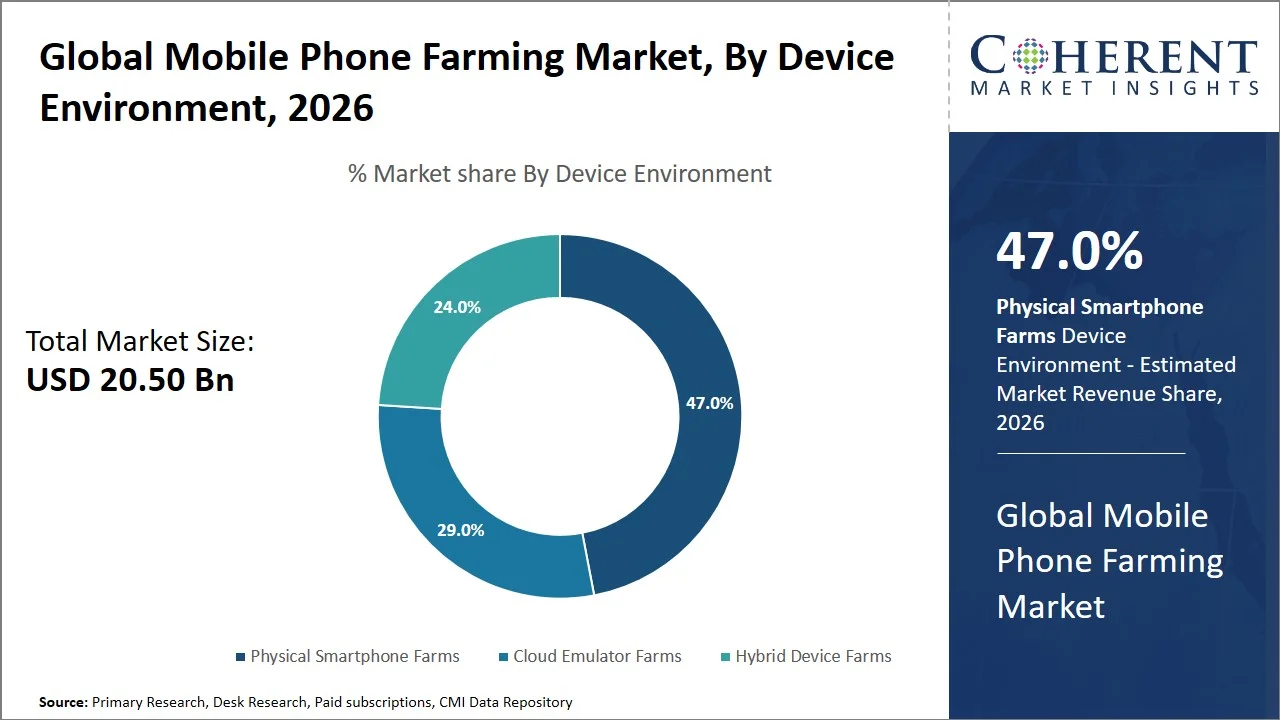
The physical smartphone farms segment is expected to account for 47.0% of the global mobile phone farming market share in 2026. Real-device accuracy and reliability is the key factor. Physical smartphone farms give developers real mobile devices running under real-world situations, so they can test apps, monitor performance, validate networks and analyze user experience more accurately than with virtual devices or emulators. This makes them the environment of choice for organizations and developers that need reliable results. On February 25, 2026, Sauce Labs announced the general availability of the Real Device Access API, marking a fundamental shift in how the company delivers its mobile testing infrastructure. The Access API removes that constraint entirely, exposing the device itself as programmable infrastructure and giving engineers direct control through simple HTTP requests. (Source: Sauce Labs)
Self-Owned Phone Farms Dominate the Global Mobile Phone Farming Market
The self-owned phone farms segment is expected to account for 49.0% of the global mobile phone farming market share in 2026. Greater control over devices and processes is one key factor for the growth of the self-owned phone farms segment. Self-owned phone farms give enterprises full control over device configuration, security settings, workloads, maintenance schedules and data handling, which offers greater dependability, customization and compliance compared to shared or third-party phone farm services. For example, HeadSpin continued to increase the deployment models it offers, including Dedicated Cloud, Cloud-Connected On-Premises and Air-Gapped On-Premises environments. (Source: Headspin)
Currents Events and their Impact
Current Events | Description and its Impact |
EU AI Act (Implementation Phase 2025–2026) |
|
Digital Markets Act (DMA) |
|
(Source: EU AI Act, European Commission)
Mobile Phone Farming Market Dynamics
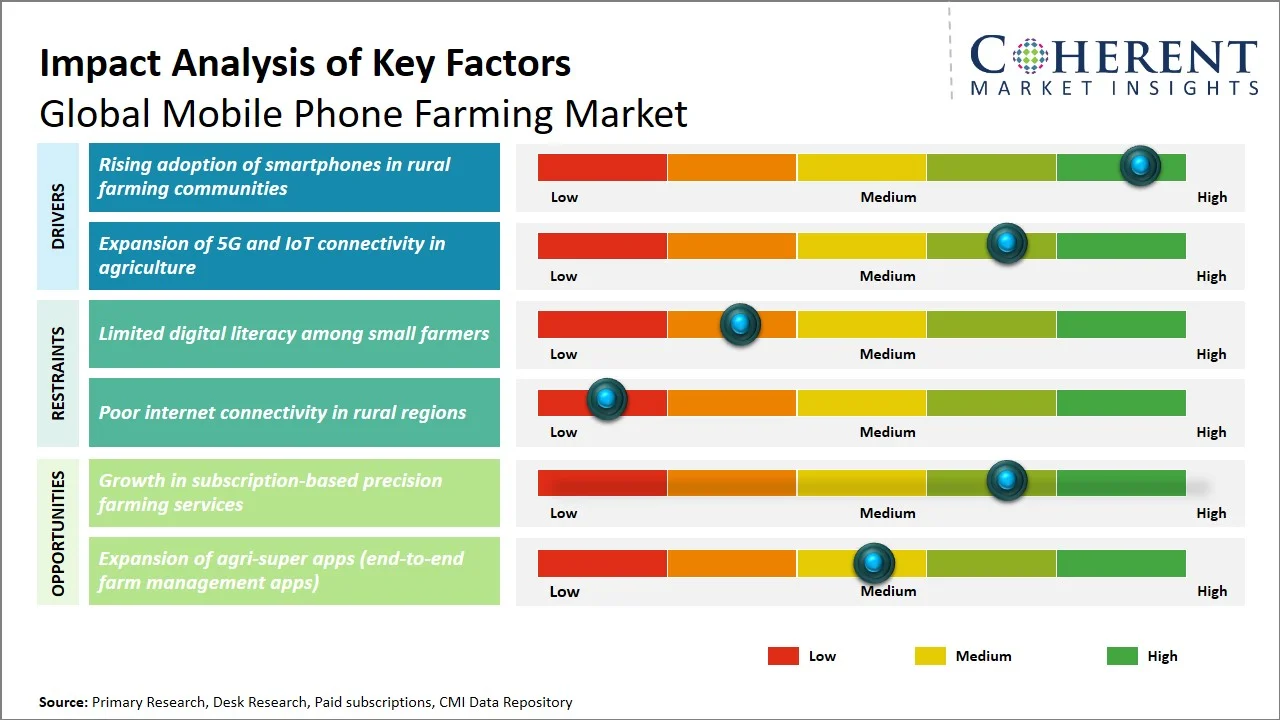
Market Drivers
Rising smartphone penetration globally
With more and more people using smartphones, the need for mobile apps, digital services, mobile advertising and app performance testing is also expanding. This is a key factor driving the mobile phone farming business. As smartphone adoption continues to expand in both developed and emerging economies, organizations need larger and more diverse device environments to test applications, verify advertisements, monitor user experiences, and ensure compatibility across different operating systems, screen sizes, and network conditions, fueling investment in phone farming infrastructure.
On March 11, 2026, Samsung Electronics announced the global availability of the Galaxy S26 series and the Galaxy Buds4 series. As Samsung’s third generation of AI phones, the Galaxy S26 Ultra, Galaxy S26+ and Galaxy S26 deliver the most intuitive and proactive Galaxy AI1 experiences yet, helping users accomplish more with fewer steps. The Galaxy S26 series recorded double-digit pre-order growth and the Galaxy S26 Ultra was chosen by over 70% of customers. (Source: Samsung)
Growth in mobile app testing and automation
The mobile phone farming industry is mostly driven by the rise in mobile app testing and automation as organizations increasingly rely on automated testing to accelerate application development and deliver a high-quality user experience. Mobile phone farms offer access to a large number of physical devices for ongoing testing, performance verification, bug finding, compatibility assessment, and automated quality assurance across a variety of operating systems and device configurations, enabling companies to reduce development time, boost software dependability, and facilitate faster application releases.
On December 31, 2025, Kobiton announced that it has added 7,460 new users to the platform and improved its Appium Self-Healing capability which automatically adjusts test scripts in response to changes in application interfaces. (Source: Kobiton)
Emerging Trends
- Expansion of 5G and Edge Computing Applications: The deployment of 5G networks creates the necessity for testing and validation of the next generation mobile applications. Phone farms are increasingly being used to assess network performance, low latency services, mobile gaming experiences, IoT connections and edge-computing-enabled applications across devices and locations.
- Growing Demand for Real-Device Testing and Digital Verification: The complexity of mobile apps has increased, leading to a preference for testing on real smartphones instead of emulators. Real device testing Mobile advertising verification User experience validation Security testing Cross-platform compatibility assessments to ensure consistent performance across varied device ecosystems.
Regional Insights
Why is Asia Pacific a Strong Market for Mobile Phone Farming?
Asia Pacific is expected to account for a market share of 43.0% in 2026. The largest mobile phone farming market is Asia Pacific, mainly because of the concentration of smartphone manufacturing and app development ecosystems in China, India, South Korea and Japan. The region is benefiting from the massive scale acquisition of low cost Android devices from vendors including as Xiaomi, OPPO and Vivo, which allows operators to deploy thousands of physical devices at relatively reduced rates. Major mobile gaming publishers, finance organizations and super-app developers across the area are using device farms to test applications on hundreds of handset models and network settings prior to commercial deployment. On October 12, 2024, Huawei Cloud updated its Cloud Test platform, adding further cloud-based real-device testing capabilities for HarmonyOS and Android apps. This version enabled developers to remotely access large-scale physical smartphone clusters for automated testing, performance validation and application compatibility verification for different device models.
Why Does the North America Mobile Phone Farming Market Exhibit High Growth?
North America is projected to account for 29.0% of the global mobile phone farming market and is expected to register the fastest growth. North America’s growth is driven by enterprise device farming, not low-cost traffic-generation enterprises. Large companies use real device farms for continuous integration, app testing, mobile security certification, and advertising verification. Companies like Google, Microsoft, and Amazon Web Services have significant mobile testing ecosystems backing cloud-based device testing platforms. The demand is particularly strong in areas such as banking, healthcare, e-commerce and digital advertising where application stability across thousands of device configurations is crucial. On April 30, 2026, HeadSpin announced the launch of ACE (AI Cognitive Engine), its generative AI-powered testing solution designed to help engineering and QA teams create, validate, and maintain automated tests with less manual effort. (Source: HeadSpin)
Global Mobile Phone Farming Market Outlook for Key Countries
Why is China Emerging as a Major Hub in the Mobile Phone Farming Market?
China is by far the biggest country market, with its overwhelming dominance in smartphone manufacture and mobile internet usage. The country houses manufacturing facilities of key smartphone brands such as Huawei, Xiaomi, OPPO, and vivo, so it’s easy to get hold of devices for large-scale phone farm deployments. Chinese mobile game publishers, e-commerce platforms and social media firms routinely test applications across hundreds of device types, Android versions and network circumstances, thus real-device infrastructure is a vital operational necessity.
Is the U.S. the Next Growth Engine for the Mobile Phone Farming Market?
The U.S. is the most advanced market for enterprise-grade mobile device farms, led by the software development, cloud computing, and digital advertising industries. Large-scale device environments are used by organizations to test applications on Apple, Samsung Electronics and Google devices prior to release. Leading cloud testing solutions, such as BrowserStack and Sauce Labs, offer remote access to thousands of physical devices so organizations can do automated testing, performance benchmarking, and user experience validation at scale.
Japan Mobile Phone Farming Market Analysis and Trends
The Japanese mobile phone farming market is characterized by a high degree of fragmentation of devices and tight quality criteria. Mobile app developers also often do rigorous testing on devices from domestic carriers and manufacturers to ensure smooth performance. The country’s vibrant mobile gaming industry and state-of-the-art 5G infrastructure generate a lot of demand for real-device testing, especially for latency-sensitive apps like multiplayer gaming, mobile payments, and augmented reality services. Japanese firms generally emphasize reliability and compatibility testing, rather than volume focused device farming activities.
India Mobile Phone Farming Market Analysis and Trends
India is one of the fastest growing mobile phone farming markets, driven by its fast-growing smartphone user base, burgeoning app economy and low-cost technological labor. Many companies building digital payment platforms, e-commerce apps, ride-hailing services and mobile gaming goods use massive device farms to test applications on hundreds of Android handset versions from companies such as Xiaomi, Samsung Electronics, and realme. With the variety of device specs, OS versions and network circumstances in India, it is very vital to test on real devices, leading to significant investment in local and cloud phone farm infrastructure.
South Korea Mobile Phone Farming Market Analysis and Trends
South Korea has one of the most advanced telecommunications ecosystems in the world and a major hub of mobile technology research. Samsung Electronics’ extensive reach and early deployment of 5G services has created a huge need for next generation mobile application testing across a multitude of device combinations. Gaming businesses, telecom operators and digital content providers in South Korea are using device farms extensively to evaluate application performance in high-speed network settings before commercial deployments.
Global Mobile Phone Farming Market - Device Farm Infrastructure & Replacement Cycle
Infrastructure Metric | 2024 Data | 2025 Data |
Average Enterprise Device Farm Size | 500–1,500 Devices | 700–2,000 Devices |
Real Devices Managed by Leading Cloud Providers | 20,000+ Devices | 25,000+ Devices |
Concurrent Automated Test Runs | 150 Mn | 190 Mn |
Average Device Replacement Cycle | 24 Months | 22 Months |
Physical Smartphone Share of Testing Environments | 72% | 74% |
Cloud Device Farm Share | 28% | 31% |
How is Adoption of AI-Powered Mobile Automation Solutions Creating New Growth Opportunities in the Mobile Phone Farming Market?
AI-powered solutions for mobile automation are offering enough growth potential in the mobile phone farming market. The solutions help in the smart administration of huge device fleets, decreasing manual work and increasing operational efficiency. AI algorithms can intelligently allocate testing workloads, detect device faults, optimize resource consumption, analyze application performance, and estimate maintenance needs across thousands of cellphones simultaneously. This enables organizations to speed up their mobile application development life cycle, increase testing accuracy, facilitate continuous integration and deployment (CI/CD) procedures, and reduce operating expenses. This results in an increase in demand for advanced phone farm infrastructure and AI-powered device management solutions. On September 15, 2025, LambdaTest announced the launch of general availability for KaneAI, its AI-native test authoring solution. This initiative aims to democratize access to AI-native test automation, allowing users worldwide to experience the full capabilities of KaneAI without committing to a paid subscription.
Market Players, Key Development, and Competitive Intelligence
Key Developments
- On July 15, 2025, Perforce Software, the DevOps company for global teams seeking AI innovation at scale, launched a breakthrough in agentic AI testing with the ability to turn plain language inputs into resilient, execution-ready test actions. With one input, users can now validate applications across web, Android, and iOS, without object locators, code, or maintenance.
- On May 6, 2025, BrowserStack announced the acquisition of Requestly, the popular open-source HTTP interception and API mocking tool that eliminates critical bottlenecks in modern web development. This strategic acquisition strengthens BrowserStack’s commitment to developer productivity by supporting Requestly’s growth as a beloved HTTP interception and mocking solution, providing developers with tools that significantly accelerate their workflow.
Competitive Landscape
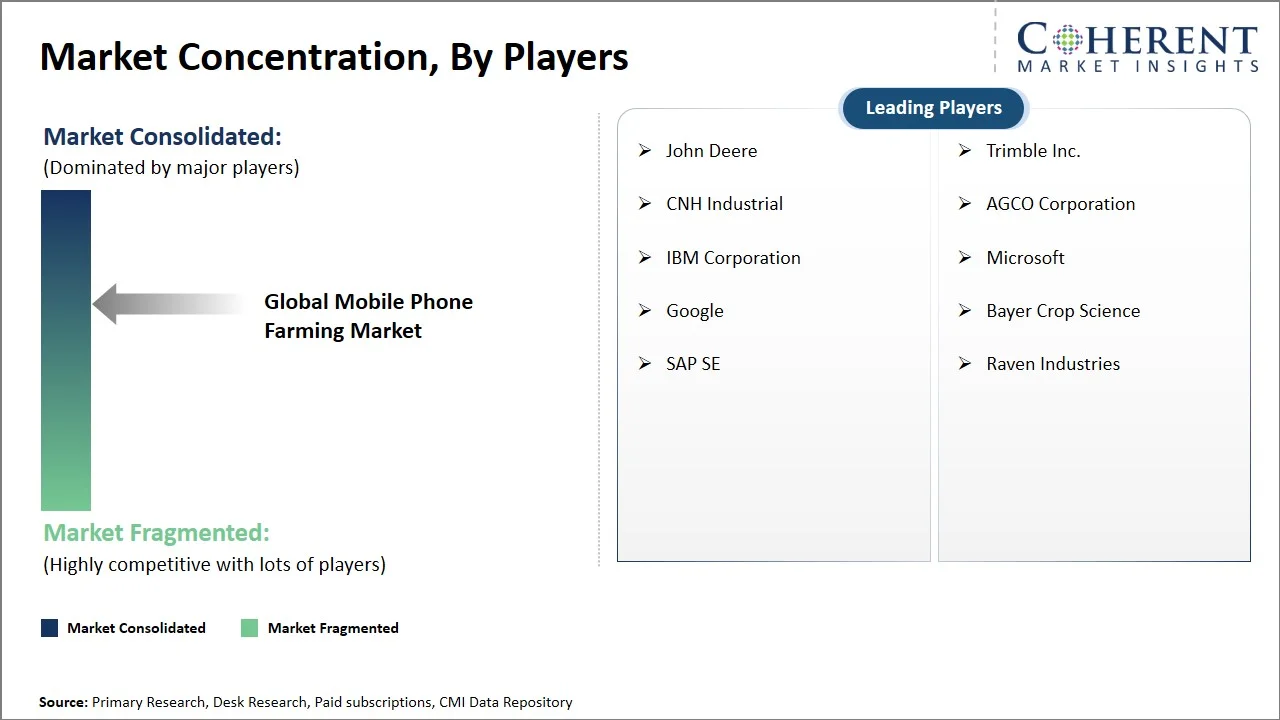
The global mobile phone farming market comprises smartphone manufacturers, cloud-based device testing providers, mobile automation platform suppliers, and business software firms. Investment in real-device testing infrastructure, AI-driven automation, remote device administration, and cloud access are driving market rivalry. Top players are busy building device inventory, building out AI capabilities, increasing test coverage for different operating systems and building scalable cloud-based phone farm solutions to defend their market position. Strategic collaborations, platform improvements and geographic expansion activities are also being widely implemented to increase customer reach and service capabilities.
Market Report Scope
Mobile Phone Farming Market Report Coverage
| Report Coverage | Details | ||
|---|---|---|---|
| Base Year: | 2025 | Market Size in 2026: | USD 20.50 Bn |
| Historical Data for: | 2020 To 2024 | Forecast Period: | 2026 To 2033 |
| Forecast Period 2026 to 2033 CAGR: | 14% | 2033 Value Projection: | USD 47.50 Bn |
| Geographies covered: |
| ||
| Segments covered: |
| ||
| Companies covered: | John Deere, CNH Industrial, AGCO Corporation, Trimble Inc., Bayer Crop Science, Topcon Corporation, Raven Industries, Ag Leader Technology, PrecisionHawk, Iteris, Samsung Electronics, Apple Inc., Xiaomi Corporation, Huawei, and Google LLC | ||
| Growth Drivers: |
| ||
| Restraints & Challenges: |
| ||
Analyst Opinion (Expert Opinion)
- The market is likely to be positively impacted by rising complexity of mobile applications, growing need for real-device testing, and growth of AI-driven automation technologies. Cloud-based device farms, 5G-enabled testing environments and enterprise digital transformation programs are predicted to provide strong development possibilities. Steady demand for mobile application quality assurance and automation is likely to drive long-term market growth, while regulatory compliance, cybersecurity, and infrastructure expenses are some of the hurdles that may be faced.
- The future of the mobile phone farming business is likely to be defined by the broad deployment of artificial intelligence, advanced analytics, edge computing and next generation mobile networks. The increased use of cloud-connected device farms could allow enterprises to access larger and more diverse testing environments without major hardware investments. The industry is expected to grow strongly through 2033 and beyond. Increasing demand across industries including fintech, e-commerce, gaming, digital advertising, telecommunications, business software, among others, may encourage continual innovation.
Speak to the analyst
Want personalized insights?
Take the findings above to one of our principal consultants, or have the report rebuilt around the segments, geographies and competitors you actually track.
Market Segmentation
- Component Insights (Revenue, USD Billion, 2021 - 2033)
- Hardware
- Smartphones and Android Devices
- Device Racks and Mounting Systems
- Charging Hubs and Power Management Units
- SIM Banks and SIM Management Hardware
- Routers, Modems and Network Equipment
- Cooling and Physical Monitoring Equipment
- Software
- Device Automation Software
- Android Emulator Platforms
- Mobile Device Management Platforms
- Remote Device Access Software
- Task Scheduling and Workflow Automation Software
- Proxy and IP Management Software
- Device Monitoring and Analytics Software
- Device Fingerprint Management Software
- Services
- Phone Farm Setup and Integration Services
- Managed Phone Farm Services
- Mobile App Testing and QA Services
- Device Monitoring and Maintenance Services
- Network Configuration and Optimization Services
- Ad Verification and Fraud Detection Testing Services
- Technical Support Services
- Hardware
- Device Environment Insights (Revenue, USD Billion, 2021 - 2033)
- Physical Smartphone Farms
- Cloud Emulator Farms
- Hybrid Device Farms
- Ownership Model Insights (Revenue, USD Billion, 2021 - 2033)
- Self-Owned Phone Farms
- Third-Party Hosted Phone Farms
- Managed Phone Farm Services
- Application Insights (Revenue, USD Billion, 2021 - 2033)
- App Testing and QA Automation
- Device Compatibility Testing
- Ad Verification and Campaign Monitoring
- Survey and Reward Task Automation
- Bandwidth Sharing Automation
- Engagement and Traffic Automation
- Cybersecurity Testing and Threat Simulation
- Customer Type Insights (Revenue, USD Billion, 2021 - 2033)
- Individual Operators
- App Developers
- QA Testing Companies
- Digital Marketing Agencies
- AdTech Companies
- Ad Verification and Fraud Detection Firms
- Cybersecurity Companies
- Telecom and Network Testing Companies
- Regional Insights (Revenue, USD Billion, 2021 - 2033)
- North America
- U.S.
- Canada
- Latin America
- Brazil
- Argentina
- Mexico
- Rest of Latin America
- Europe
- Germany
- U.K.
- Spain
- France
- Italy
- Russia
- Rest of Europe
- Asia Pacific
- China
- India
- Japan
- Australia
- South Korea
- ASEAN
- Rest of Asia Pacific
- Middle East
- GCC Countries
- Israel
- Rest of Middle East
- Africa
- South Africa
- North Africa
- Central Africa
- North America
- Key Players Insights
- John Deere
- CNH Industrial
- AGCO Corporation
- Trimble Inc.
- Bayer Crop Science
- Topcon Corporation
- Raven Industries
- Ag Leader Technology
- PrecisionHawk
- Iteris
- Samsung Electronics
- Apple Inc.
- Xiaomi Corporation
- Huawei
- Google LLC
Sources
Primary Research Interviews
- Mobile device farm operators and service providers
- Mobile application developers and testing companies
- Cloud infrastructure service providers
- Enterprise IT decision makers and QA managers
Magazines
- Mobile World Magazine
- App Developer Magazine
- Software Testing Magazine
- Enterprise Mobility Magazine
Journals
- Journal of Software Testing and Quality Assurance
- International Journal of Mobile Computing and Multimedia Communications
- IEEE Transactions on Mobile Computing
Associations
- Mobile Marketing Association (MMA)
- International Software Testing Qualifications Board (ISTQB)
- Cloud Security Alliance (CSA)
- Association for Software Testing (AST)
Public Domain Sources
- Government technology adoption reports
- Open source mobile testing community forums
- Public company annual reports and SEC filings
- International telecommunications regulatory publications
Proprietary Elements
- CMI Data Analytics Tool
- Proprietary CMI Existing Repository of information for last 10 years
Get access to 250+ pages report
Every segment, forecast, competitor profile and data table behind the analysis above — available for instant download.
- ESOMAR Member
- ISO 9001:2015 Certified
- D-U-N-S Registered
- GDPR & CCPA Compliant
Missing comfort of reading report in your local language? Find your preferred language:
Transform your Strategy with Exclusive Trending Reports
Frequently Asked Questions
The global mobile phone farming market is expected to stand at USD 20.50 Bn in 2026 and is expected to reach USD 47.50 Bn by 2033.
The CAGR of the global mobile phone farming market is projected to be 14% from 2026 to 2033.
In terms of component, the hardware segment is estimated to dominate the market revenue share in 2026.
Real devices provide more accurate performance, compatibility, and user experience testing results.
AI improves device management, workload optimization, automated testing, and predictive maintenance.
Rising demand for color accuracy and quality control in manufacturing and growth in automotive, textiles, plastics, paints and coatings industries are the major factors driving the growth of the global mobile phone farming market.
High cost of advanced spectrophotometers and imaging systems and need for frequent calibration and maintenance are the major factors hampering the growth of the global mobile phone farming market.