

Museum Market Size and Trends – 2026-2033
The global museum market is estimated to be valued at USD 10.30 Bn in 2026. The market is expected to reach USD 23.79 Bn by 2033, exhibiting a compound annual growth rate (CAGR) of 12.7% from 2026 to 2033.
Key Takeaways
- Based on Type, the Art museums segment is expected to account for 31.6% of the market share in 2026, owing to people's intrinsic need to gain cultural inspiration.
- Based on Revenue Source, the Admission Fees segment is expected to represent 41.2% of the market share in 2026, owing to the strong educational value and engaging experiences.
- Based on Governance, the Public segment is expected to account for 51.2% of the market share in 2026 due to their strong commitment to public accessibility and cultural stewardship.
- Based on Region, North America is projected to lead the global market with a share of 38.0% in 2026, followed by the Asia Pacific region, which is expected to hold a market share of 30.0%.
Market Overview
Increasing investments by government and private institutions in new museum projects and renovation of existing infrastructures are driving the growth of the industry and contributing to an expanding museum market share. Rapid digitization and adoption of technologies are also helping museums attract more visitors and expand their audience globally. Significant rise in cultural tourism and interest of people in arts and culture will further aid the expansion of the market between 2025 and 2032. However, factors such as high setup and maintenance costs of museums may hamper the industry growth. Continued investments in immersive learning experiences and usage of emerging technologies can create more opportunities for market participants going forward.
Current Events and Its Impact
Current Event | Description and its Impact |
Geopolitical Conflicts and Cultural Heritage Destruction |
|
Sustainability Mandates |
|
Role of Artificial Intelligence (AI) in Museum Market
The integration of artificial intelligence into museum market is enhancing visitor experiences and streamlining operations. This shift is driving museum market demand for advanced technologies that can digitize their extensive collections of written documents and further preserve these valuable materials. AI-driven data analysis involves processing complex datasets to identify patterns, predict trends, and generate actionable insights. Additionally, OpenAI’s collaborations with museums are transforming static exhibits into interactive, AI-powered experiences. With features like conversational AI tour guides, adaptive storytelling, and multilingual support, museums are seeing up to a 170% spike in attendance, especially among younger, tech-savvy audiences.
In September 2024, Los Angeles launched Dataland, a groundbreaking AI-driven art museum that redefines the traditional gallery experience. The space features immersive, interactive exhibits co-created by artists and artificial intelligence, exploring themes like surveillance, machine learning, and digital identity. Curated with public participation and real-time data integration, Dataland allows visitors to shape the art experience dynamically.
- Current Industry Events of 2026
- Market Size Estimation
- Regional Breakdown
- Competitive Landscape
- Customer Intelligence
- Segmental Analysis
- Pricing Analysis
- Key Market Drivers, Challenges & Future Trends
- Customized Insights Section
Segmental Insights
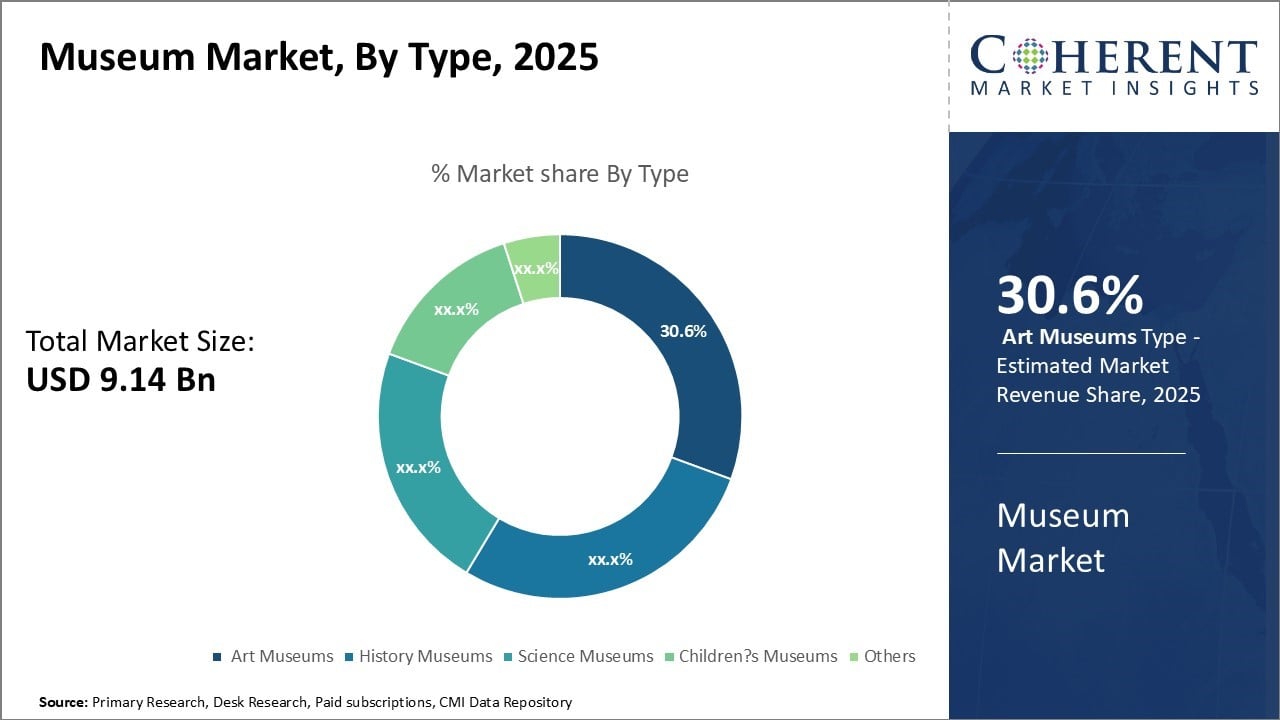
Museum Market, By Type Insights - Cultural Inspiration and Artistic Innovation Drive Art Museums Segment Growth
In terms of type, the art museums segment is expected to contribute 31.6% share of the market in 2026, owing to people's intrinsic need to gain cultural inspiration and appreciate artistic innovation. Art museums play a pivotal role in preserving and showcasing the rich cultural heritage and diverse artistic talents of humankind. They offer visitors a visually intriguing window into the various artistic movements and genres that have shaped civilizations over time. The rare collections of paintings, sculptures, and other artwork housed in these museums fuel people's intellectual curiosity and creative thinking.
IN April 2025, New Taipei City opened its first contemporary art museum, marking a significant cultural milestone for Taiwan’s most populous municipality. Located in Yingge District, the museum is housed in a repurposed Japanese-era dormitory complex and features rotating exhibitions, educational programs, and artist residencies.
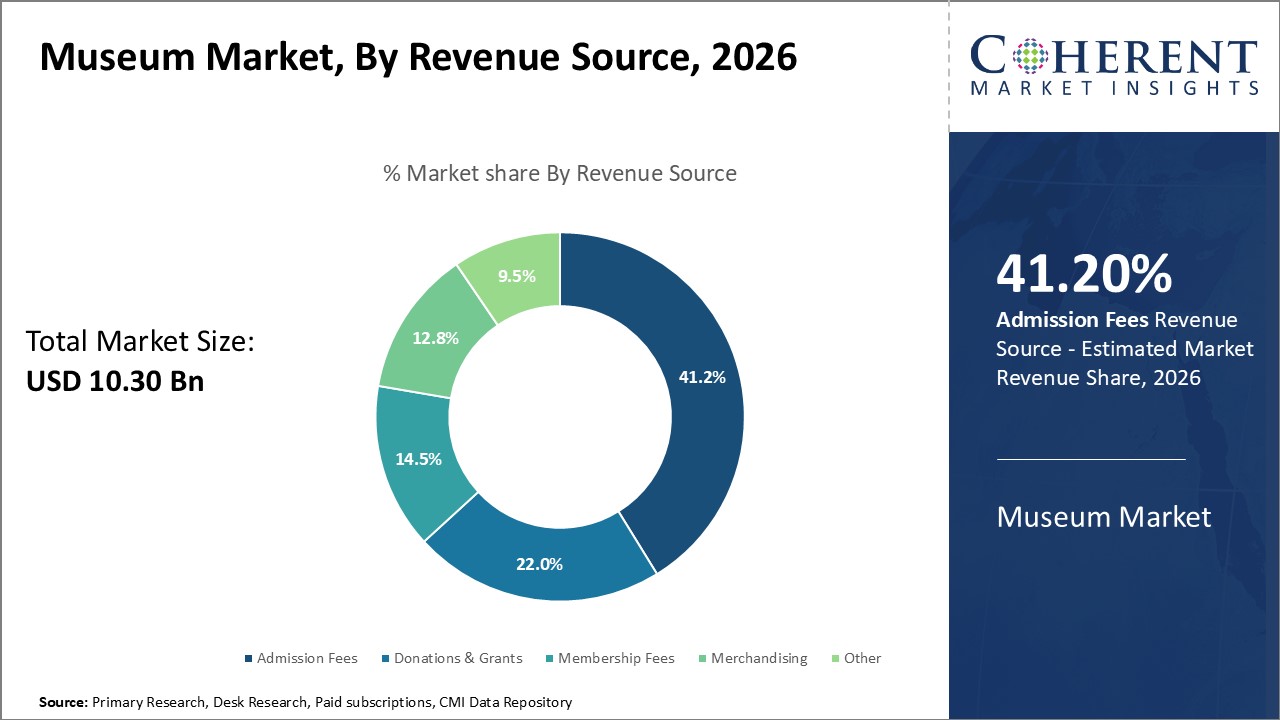
Museum Market Insights, By Revenue Source - Educational Value and Community Engagement Boosts Admission Fees Segment Growth
In terms of revenue source, the admission fees segment is expected to contribute 41.2% share of the market in 2026, owing to the strong educational value and engaging experiences that museums provide to visitors.
For instance, in March 2026, over 50 rural teachers from Maharashtra’s tribal areas visited the Chhatrapati Shivaji Maharaj Vastu Sangrahalaya (CSMVS) in Mumbai, engaging in a day-long workshop that redefined their perception of museums. Organized under CSMVS’s Museum on Wheels outreach, the program introduced educators to interactive, student-centric learning methods using artefacts and storytelling. Unlike other forms of entertainment, museums offer a fun and interactive way for people of all ages to broaden their knowledge on diverse topics ranging from history to science. This is further accelerating the museum market growth.
Museum Market Insights, By Governance - Public Accessibility and Cultural Stewardship Maintain Dominance
In terms of governance, the public segment is expected to contribute 51.2% share of the market in 2026, due to their strong commitment to public accessibility and cultural stewardship. As institutions run by local or national governments, public museums prioritize inclusiveness and bringing cultural treasures within reach of all citizens, regardless of their financial means. Many are located strategically in city centers and transportation hubs to optimize outreach. Their varied collection, as public trusts, belongs to the people.
In January 2025, India’s public museums undergone a transformation from static repositories into dynamic cultural hubs. Institutions like the Indian Museum in Kolkata and the Government Museum in Chennai are revamping exhibits, embracing interactivity, digital storytelling, and visitor participation. Supported by collaborations with historians, artists, and tech partners, these changes aim to engage younger audiences and foster a deeper connection with India’s diverse heritage. This is further positively influencing the museum market forecast.
Regional Insights
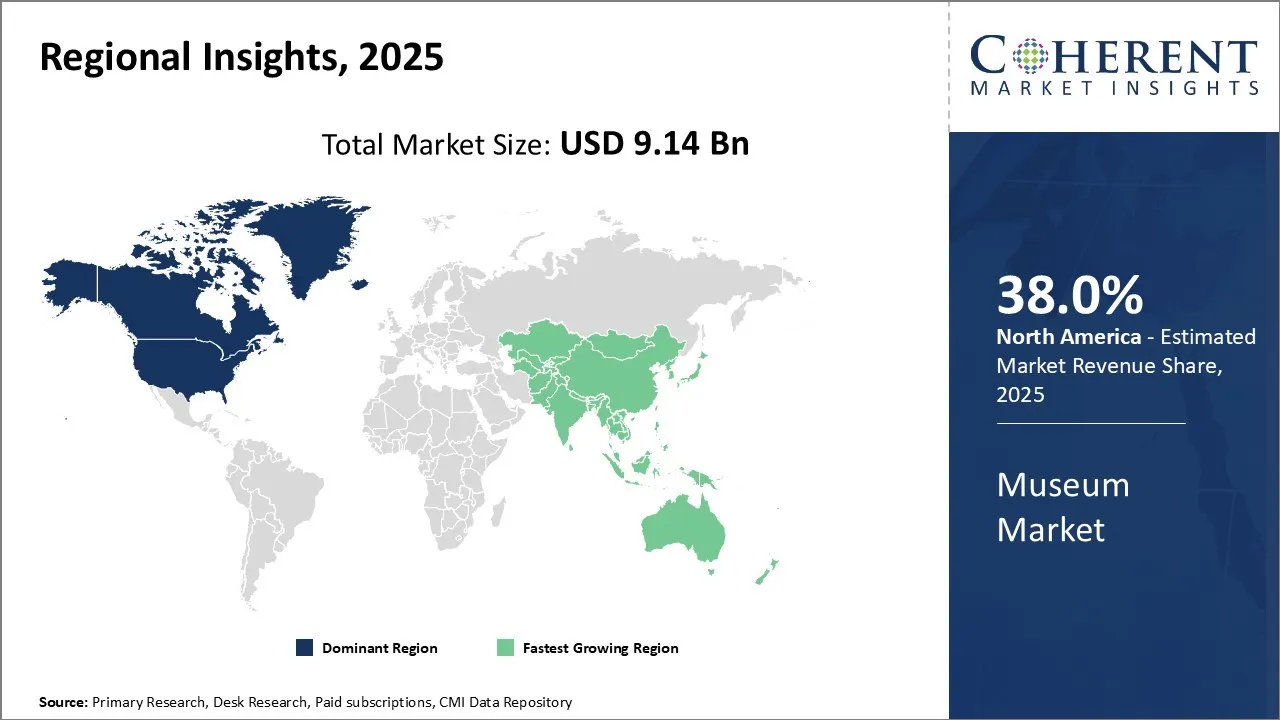
North America Museum Market Analysis & Trends
North America is anticipated to dominate the museum market in 2026, holding a 38.0% market share. This leadership is driven by robust government backing for cultural institutions and the presence of key industry players in the United States and Canada. Renowned museums, including the Metropolitan Museum of Art and the Smithsonian Institution, consistently draw significant visitor numbers each year, bolstered by efforts to enhance cultural tourism. According to U.S. federal data, museums contribute an estimated USD 50 billion annually to the U.S. economy through employment, tourism, and operational spending. The museums in North America are responsible for attracting millions of domestic and international tourists such as The Smithsonian Institution in Washington, D.C., welcomes over 20 million visitors per year across its 21 museums.
Asia Pacific Museum Market Analysis & Trends
The Asia Pacific region is expected to account for a 30% market share in 2026, demonstrating the fastest growth globally. This expansion is fueled by the rising income levels, greater awareness of art and history, and significant government investments in cultural infrastructure, particularly in China, Japan, and India. Additionally, emerging economies in the region are experiencing increased engagement in recreational activities. According to the museum market forecast, Asia Pacific's growing adoption of virtual and augmented reality technologies in museums is poised to accelerate market growth across the Asia-Pacific region by 30%, driven by a wave of AI-enhanced immersive experiences. Institutions are leveraging virtual tours, holographic reconstructions, and AI-powered storytelling to attract younger and global audiences, many of whom may never physically visit. These innovations vastly improve accessibility, education, and cultural engagement, especially in underserved or remote regions. However, each institution faces a high entry barrier, with initial investments exceeding USD 2 million for infrastructure, hardware, content creation, and integration.
Museum Market Outlook for Key Countries
U.S. Museum Market Trends
The U.S. Museum market value is projected to grow significantly, driven by increasing visitor numbers and a rise in cultural tourism. Major museums such as the Metropolitan Museum of Art reported a 31.5% increase in attendance compared to the previous year. There is a budget cut to the Institute of Museum and Library Services (IMLS) could end grant funding for up to 50% of small U.S. museums. This would stall crucial digitization efforts, force staff layoffs, and reduce public programming, especially in rural and underserved areas. Many museums rely on IMLS support to preserve collections and offer educational services. Without it, gaps in cultural access may widen, and recovery from pandemic-era challenges could stall, significantly impacting the U.S. Museum landscape.
China Museum Market Trends
The museum sector in China is expanding rapidly, with the government investing heavily in cultural infrastructure to support its cultural and educational objectives. For instance, the National Museum of China has seen a significant surge in visitors, reflecting the country's growing interest in cultural heritage and education. A key contributor to this growth is Alibaba Group, which has partnered with several museums across China to digitize cultural artifacts and enhance visitor experiences through technology.
Germany Museum Market Trends
Germany's rich cultural heritage supports a robust museum market, with significant investments in digital transformation to enhance visitor experiences. The German government has launched initiatives to digitize collections, making them more accessible to the public. For instance, in May 2024, the Prado Museum in Madrid prepared to reveal a remarkable painting by Italian master Caravaggio. Once misattributed to an unknown artist and almost sold, the artwork, titled Ecce Homo, portrays a solemn and bloodied Jesus crowned with thorns, depicted just before his crucifixion.
France Museum Market Trends
France continues to lead the global museum sector, with the Louvre Museum in Paris welcoming around 7.8 million visitors in 2022, according to data released by Musée du Louvre in 2023. This impressive visitor count highlights the enduring cultural appeal of the country. The French government places significant emphasis on cultural tourism, viewing it as a crucial contributor to the national economy and a major factor in driving both museum attendance and revenue growth.
U.K. Museum Market Trends
The U.K. Museum market is undergoing a transformative phase as institutions increasingly adopt digital technologies to improve visitor engagement and offer immersive experiences. For example, VR can recreate ancient ruins or provide guided tours of historical locations that are geographically inaccessible, bringing history to life in unprecedented ways.
Market Report Scope
Museum Market Report Coverage
| Report Coverage | Details | ||
|---|---|---|---|
| Base Year: | 2025 | Market Size in 2026: | USD 10.30 Bn |
| Historical Data for: | 2020 To 2024 | Forecast Period: | 2026 To 2033 |
| Forecast Period 2026 to 2033 CAGR: | 12.7% | 2033 Value Projection: | USD 23.79 Bn |
| Geographies covered: |
| ||
| Segments covered: |
| ||
| Companies covered: | The British Museum, The Louvre, The Metropolitan Museum of Art, The Smithsonian Institution, The Vatican Museums, The National Gallery, The State Hermitage Museum, The Museum of Modern Art (MoMA), The Natural History Museum, The Getty Center, The Rijksmuseum, and The Tate Modern | ||
| Growth Drivers: |
| ||
| Restraints & Challenges: |
| ||
Market Dynamics
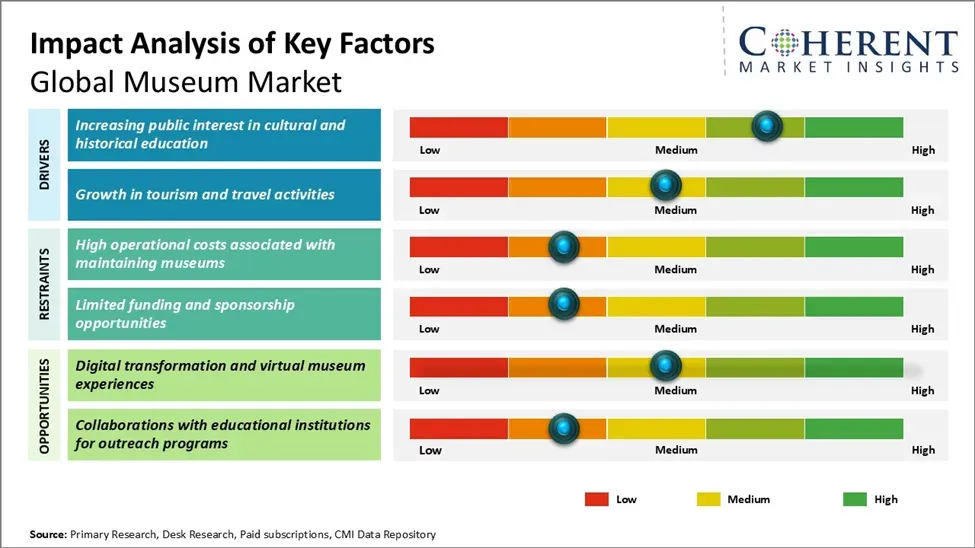
Museum Market Growth Factors
Increasing public interest in cultural and historical education
The modern world moves at a frenetic pace and people are constantly facing pressures of achieving more in less time. In such a scenario, museums provide a calm refuge where one can learn in a leisurely manner and quench their curiosity about faraway lands and eras. More and more people, especially the young generation, are realizing the importance of understanding their cultural roots and gaining perspectives about humanity's rich legacy. Museums have emerged as a prime destination for such educational pursuits that not only enlighten but also entertain through intriguing exhibits and interactive displays.
Museum Market Opportunity
Digital transformation and virtual museum experiences
One of the major opportunities for the market is the rising potential of digital transformation and virtual museum experiences. With smartphones and internet connectivity becoming ubiquitous, museums can offer unique virtual and augmented reality experiences to attract more visitors online as well as engage existing audiences. Digital cataloguing of exhibits and online databases help increase the global outreach of museum collections. Live streaming of events and virtual tours provide an alternative to physical visits. Furthermore, technologies such as 3D scanning and virtual/mixed reality offer immersive digital replicas of galleries for those unable to travel. According to museum market research, these innovations are reshaping visitor engagement and expanding access worldwide.
Key Developments
- In May 2025, The Raja Dinkar Kelkar Museum in Pune introduced a multilingual digital audio guide to enhance visitor engagement and accessibility. Available in English, Hindi, and Marathi, the guide provides detailed insights into over 300 artifacts across 20 galleries, including rare musical instruments, sculptures, and everyday objects from India’s past. Developed in collaboration with HopOn India, the app-based guide aims to offer an immersive, self-paced experience for users.
- In March 2025, The International Chess Federation (FIDE) unveiled the world’s first fully digital museum dedicated to the history of chess. the virtual museum features rare photographs, trophies, videos, and memorabilia from over 100 years of chess heritage. Divided into five interactive zones, the platform explores iconic matches, legendary players, and global milestones in chess. Accessible worldwide, the museum aims to educate and inspire both enthusiasts and newcomers by preserving the game’s rich legacy in a modern, immersive format.
- In December 2024, six major museums are set to open across Egypt, Nigeria, Indonesia, and India, marking a global celebration of art, heritage, and identity. These institutions aim to amplify regional narratives, from Nigeria’s Edo Museum of West African Art to Egypt’s long-awaited Grand Egyptian Museum. Indonesia and India will also unveil landmark cultural centers showcasing indigenous and contemporary art.
- In May 2024, Beijing witnessed the opening of China's first-ever national museum dedicated to scientists. This significant milestone aligned with National Science and Technology Labor Day, showcasing a commitment to celebrating scientific achievements and inspiring future innovation.
Analyst Opinion (Expert Opinion)
- The museum market is undergoing a profound transformation driven by evolving visitor expectations, technological integration, and shifting funding paradigms. My assessment is that institutions that proactively embrace digital innovation and diversify revenue streams will decisively outperform their peers, while those relying predominantly on traditional models risk obsolescence.
- A critical driver is the acceleration of digital engagement. For instance, the Smithsonian Institution reported a 44% increase in virtual attendance following the expansion of its online exhibitions in 2023. This indicates a growing global appetite for remote access to cultural assets, a trend museums must capitalize on by investing in immersive technologies such as augmented reality (AR) and virtual reality (VR). The Cleveland Museum of Art's implementation of VR tours resulted in a 30% uptick in engagement from younger demographics, underscoring the necessity for tech-forward strategies tailored to digital-native audiences.
- Moreover, dependence on government grants and donations remains precarious. The National Endowment for the Arts (NEA) reported a 7% reduction in federal arts funding in 2024, compelling museums to innovate alternative revenue mechanisms. Institutions like the Tate Modern have successfully expanded commercial ventures, with retail and hospitality operations contributing over 20% to their annual revenue—demonstrating the viability of experiential commerce as a financial pillar.
- Apart from this, there is a pronounced shift toward socially conscious curation. Museums addressing diversity, equity, and inclusion (DEI) not only fulfill ethical imperatives but also engage broader audiences. The Brooklyn Museum’s 2023 exhibition centered on marginalized artists drew a 35% increase in attendance, signaling market preference for institutions that reflect contemporary societal narratives.
Speak to the analyst
Want personalized insights?
Take the findings above to one of our principal consultants, or have the report rebuilt around the segments, geographies and competitors you actually track.
Market Segmentation
- Type Insights (Revenue, USD Bn, 2021 - 2033)
- Art Museums
- History Museums
- Science Museums
- Children’s Museums
- Others
- Revenue Source Insights (Revenue, USD Bn, 2021 - 2033)
- Admission Fees
- Donations and Grants
- Membership Fees
- Merchandising
- Others
- Governance Insights (Revenue, USD Bn, 2021 - 2033)
- Public
- Private
- Corporate
- Others
- Regional Insights (Revenue, USD Bn, 2021 - 2033)
- North America
- U.S.
- Canada
- Latin America
- Brazil
- Argentina
- Mexico
- Rest of Latin America
- Europe
- Germany
- U.K.
- Spain
- France
- Italy
- Russia
- Rest of Europe
- Asia Pacific
- China
- India
- Japan
- Australia
- South Korea
- ASEAN
- Rest of Asia Pacific
- Middle East
- GCC Countries
- Israel
- Rest of Middle East
- Africa
- South Africa
- North Africa
- Central Africa
- North America
- Key Players Insights
- The British Museum
- The Louvre
- The Metropolitan Museum of Art
- The Smithsonian Institution
- The Vatican Museums
- The National Gallery
- The State Hermitage Museum
- The Museum of Modern Art (MoMA)
- The Natural History Museum
- The Getty Center
- The Rijksmuseum
- The Tate Modern
Sources
Primary Research Interviews from the following stakeholders
Stakeholders
- Interviews with museum curators, exhibition designers, cultural heritage managers, digital technology integrators, conservation professionals, and visitor experience heads across global institutions.
Databases
- UNESCO Institute for Statistics – Culture and Communication
- Eurostat – Cultural Statistics
- U.S. Bureau of Economic Analysis – Arts, Entertainment & Recreation Sector
- National Endowment for the Arts (NEA), USA
- Ministry of Culture (France, India, China)
- China National Cultural Heritage Administration Statistics
- OECD Cultural Participation and Expenditure Data
- Japan Agency for Cultural Affairs Statistics
- Statistics Canada – Arts, Culture, Heritage Data
Magazines
- MuseumNext
- Exhibitionist (Journal of the National Association for Museum Exhibition)
- Museums Journal (UK)
- Art Newspaper – Museum & Heritage Section
- Museum-iD
- Digital Museum Magazine
- AV Magazine – Museum Technology Features
- World Archaeology
Journals
- Museum Management and Curatorship (Elsevier)
- Journal of Conservation and Museum Studies
- Curator: The Museum Journal
- International Journal of Heritage Studies
- Journal of Cultural Heritage
- Studies in Conservation
- Journal of Museum Education
Newspapers
- The Guardian – Culture & Museums
- The New York Times – Arts & Museums
- Financial Times – Arts and Exhibition Business
- The Hindu – Arts and Culture
- Le Monde – Culture Section
- Nikkei Asia – Cultural Economy
- South China Morning Post – Arts and Innovation
Associations
- International Council of Museums (ICOM)
- American Alliance of Museums (AAM)
- Museums Association (UK)
- ICOMOS – International Council on Monuments and Sites
- National Trust for Historic Preservation
- Federation of International Human Rights Museums (FIHRM)
- International Federation of Library Associations and Institutions (IFLA) – Cultural Heritage Section
Public Domain Sources
- UNESCO World Heritage Centre
- National Archives and Records Administration (NARA), USA
- Ministry of Culture, India – Museum and Library Services Reports
- European Commission – Creative Europe Reports
- U.S. National Park Service – Museum Program Data
- Cultural Heritage Sector – Australia Department of Infrastructure, Transport, Regional Development, Communications and the Arts
- Cultural Statistics – Office for National Statistics (UK)
- NITI Aayog – Cultural Infrastructure and Development
Proprietary Elements
- CMI Data Analytics Tool, and Proprietary CMI Existing Repository of information for last 8 years
Get access to 250+ pages report
Every segment, forecast, competitor profile and data table behind the analysis above — available for instant download.
- ESOMAR Member
- ISO 9001:2015 Certified
- D-U-N-S Registered
- GDPR & CCPA Compliant
Missing comfort of reading report in your local language? Find your preferred language:
Transform your Strategy with Exclusive Trending Reports
Frequently Asked Questions
The Museum Market is estimated to be valued at US$ 10.30 Bn in 2026, and is expected to reach US$ 23.79 Bn by 2033.
The CAGR of the Museum Market is projected to be 12.7% from 2026 to 2033.
Increasing public interest in cultural and historical education and growth in tourism and travel activities are the major factors driving the market growth for museums.
High operational costs associated with maintaining museums and limited funding and sponsorship opportunities are the major factors hampering the market growth for museums.
In terms of type, the art museums segment is estimated to dominate the market revenue share in 2026.
The British Museum, The Louvre, The Metropolitan Museum of Art, The Smithsonian Institution, The Vatican Museums, The National Gallery, The State Hermitage Museum, The Museum of Modern Art (MoMA), The Natural History Museum, The Getty Center, The Rijksmuseum, and The Tate Modern are the major players.
North America is expected to lead the Global Museum Market in 2026.