

Global Natural Polymers Market Size and Forecast – 2026 to 2033
According to Coherent Market Insights, the global natural polymers market is estimated to be valued at USD 16.69 Bn in 2026 and is expected to reach USD 28.23 Bn by 2033, expanding at a compound annual growth rate (CAGR) of 7.8% from 2026 to 2033.
Key Takeaways of the Natural Polymers Market
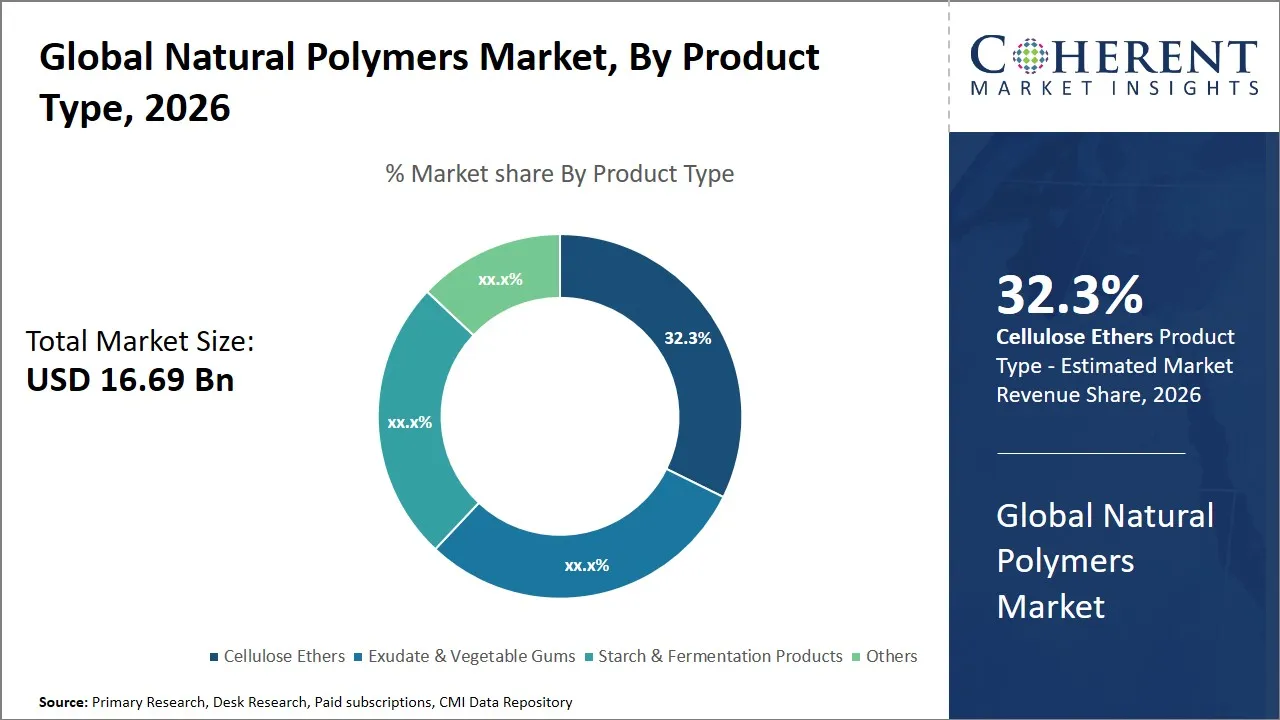
- Cellulose ethers segment is expected to account for 32.3% of the natural polymers market share in 2026.
- The construction segment is estimated to capture 21.6% of the market share in 2026.
- The powder segment is projected to hold 45.8% of the global natural polymers market share in 2026.
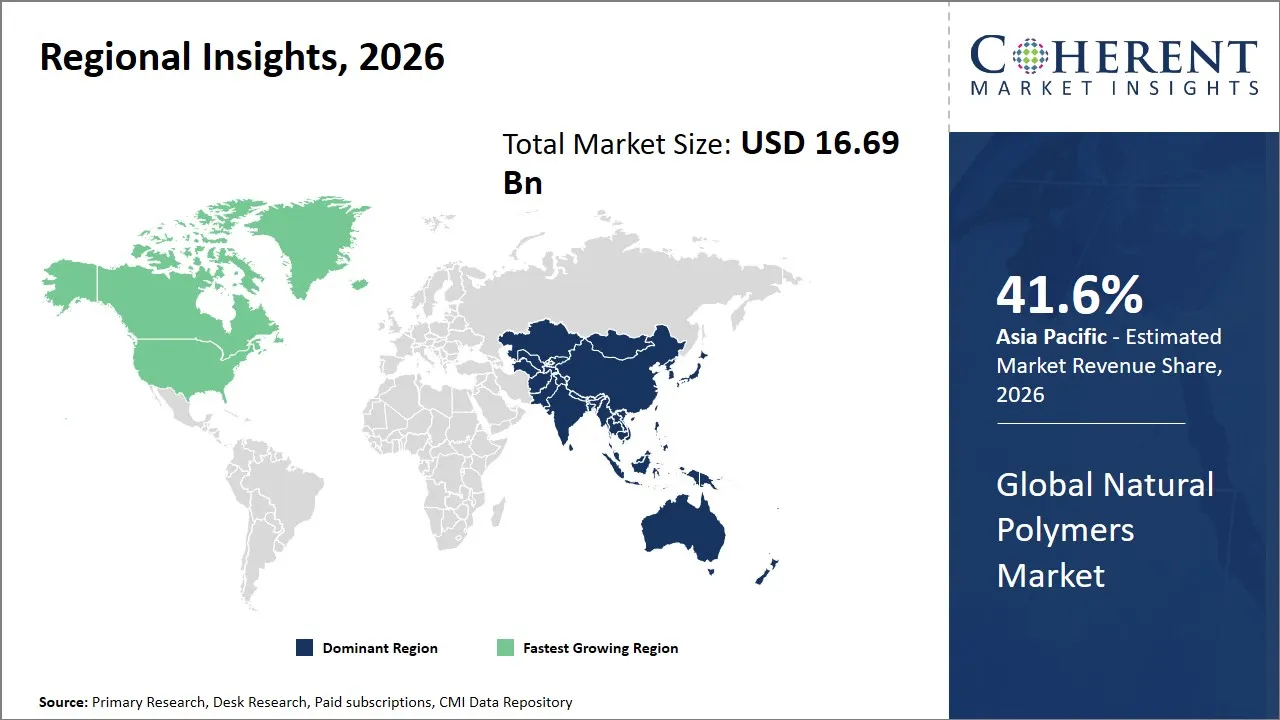
- The Asia Pacific region is expected to lead the natural polymers market with a 41.6% share in 2026.
- North America will hold 21.3% share in 2026 and record the fastest growth.
Market Overview
- Key market trends include the rising adoption of eco-friendly natural polymers as alternatives to synthetic plastics, propelled by government regulations aimed at reducing environmental pollution.
- Innovations in polymer extraction and processing technologies are enhancing product performance and broadening application scopes.
- Additionally, growing awareness among end-users about the environmental impact of synthetic polymers is fueling demand for natural, synthetic polymers, reinforcing their role in the global push towards sustainable materials.
Currents Events and Its Impacts
Current Events | Description and its Impact |
Surge in Biodegradable Polymers Demand & Regulatory Push (2026) |
|
Shifting Construction & Material Innovation Trends |
|
Segmental Insights
- Current Industry Events of 2026
- Market Size Estimation
- Regional Breakdown
- Competitive Landscape
- Customer Intelligence
- Segmental Analysis
- Pricing Analysis
- Key Market Drivers, Challenges & Future Trends
- Customized Insights Section
Why Does the Cellulose Ethers Segment Dominate the Global Natural Polymers Market in 2026?
Cellulose ethers segment is expected to hold 32.3% of the global natural polymers market share in 2026, due to their remarkable versatility and broad range of functional properties. They are mostly used due to their distinctive chemical structure as this provides them with a superb water retention capability, film-forming properties, thickening and stabilizing properties. All of these features render Cellulose Ethers priceless in a variety of end-use applications, which explains their high demand.
For instance, HPMC (Hydroxypropyl Methylcellulose) is used in tile adhesives to enhance adhesion and improve overall performance in construction materials. This specific application in the construction industry is expected to continue driving demand for cellulose ethers, contributing to their dominance in the global natural polymers market.
Construction Sector Catalyzes Demand in the Application Segment
The construction segment is projected to account for 21.6% share in 2026, driven by global urbanization and infrastructure establishment. The use of natural polymers as additives is becoming more important in the construction materials in that they enhance performance and at the same time appeal to the environmental sustainability issues.
The demand to have building materials that are eco-friendly is one of the factors that contribute to growth in this segment. The natural polymers, including cellulose ethers and starch, products, are used to modify the properties of cement, mortar and plaster by increasing the water retention, workability and adhesion of cement. This minimizes cracking, contraction and wastage of materials thereby creating more energy saving buildings.
The increase in the construction business, particularly in the developing economies, drives the use of natural polymers in cementitious and gypsum formulations. The focus on sustainable construction approximation and green building qualifications undertaken by the government promotes the use of bio-based additives.
Why Does the Powder Form Dominate the Natural Polymers Market?
Powder segment is expected to command 45.8% of the market share in 2026, owing to their ease of handling, storage stability, and compatibility with diverse processing methods. This is due to the tremendous benefits that the powdered form has during the manufacturing, formulation and end-use processes, hence, it is a preferred form of choice by the industry players.
Natural polymers are available in fine powder form and can be accurately measured and easily mixed with other components to produce products of good quality and efficient production processes. This makes it easier to use in mass production of construction materials, food preparations, drugs and personal care items. They are dry and therefore reduce the risk of microbial contamination thereby increasing shelf life, which plays a crucial role in preserving the integrity of the product.
Regional Insights
Asia Pacific Natural Polymers Market Analysis and Trends
The Asia Pacific region is projected to lead the market with a 41.6% share in 2026, due to the high rate of industrialization, growing environmental sensitivity, and the growing pressure among packaging and textile industries. The government initiatives in favor of sustainable development including subsidies on bio-based products and strict control over synthetic polymers increase the market growth further.
Both China and India which are the major players in the region have received a significant interest of investment either by local companies or multinational companies such as NatureWorks, Novamont, etc., which are aimed at increasing the production capacities. Plentiful supply of biomass resources and the changing manufacturing technologies also make Asia Pacific a competitive market that is becoming more competitive.
North America Natural Polymers Market Analysis and Trends
The North America region is expected to exhibit the fastest growth in the market contributing 21.3% share in 2026, due to the already established industrial ecosystem, robust technological setup, and the existence of the major biotech and chemical companies. The area enjoys the positive government policies that promote the usage of sustainable materials and bio-based polymers innovation.
Various stakeholders, such as the research institutions, and industry giants like DuPont and NatureWorks LLC have extensively invested in the development of advanced natural polymers like polylactic acid (PLA) and starch-based bioplastics through research and development. Also, the supply chain networks in North Americas have become mature and the trade relationships between the region and other countries make it easy to distribute and commercialize the natural polymers in various industries such as packaging, health care and agricultural markets.
Natural Polymers Market Outlook for Key Countries
Why is the U.S. Natural Polymers Market Leading in Innovation and Growth?
Innovation and robust policy provisions that support bio-based materials dominate the U.S. natural polymers market. NatureWorks LLC and Cargill are some of the companies that have major roles in the development of biodegradable polymers and their derivatives, starch. Availability of multiple start-ups and research partnerships with major universities enhances the speed of development and commercialization of new natural polymer products especially in packaging and medical use.
Why is China Emerging as a Global Leader in Natural Polymers Production?
The China natural polymers market has a good business opportunity due to its large supply of raw materials and government-funded sustainability requirements. The Chinese firms such as Sinopec and Changchun Dacheng Industry are the foremost in the production of polymers whereas foreign entrants form alliances to take advantage of the volume of production. With the focus of the country in minimizing plastic pollution, the requirement of natural polymers in flexible packaging and agricultural films has increased, which has created a competitive and innovative market environment.
Germany Natural Polymers Market Trends
Germany has maintained good natural polymers market in Europe through robust industrial production and environmental friendly policy. Such companies like BASF and Covestro devote their huge funds to natural polymer research and application creation. Strict environmental laws, as well as consumer preference of green products in the countries promotes market development in the usage of biodegradable packaging and automotive components produced using natural polymers.
India Natural Polymers Market Trends
The market of natural polymers is growing in India because of the rising environmental requirements and high number of consumers looking at the products as a sustainable option. Such companies as Godrej, Haldia Petrochemicals are essential to intensify biopolymers and natural starch derivatives production. The government initiatives to encourage Make in India and bio-economy are enhancing infrastructure growth and innovation and making India a strategic development center in natural polymers in Asia Pacific.
Japan Natural Polymers Market Trends
The natural polymers market in Japan focuses on the technological advancement and quality standards of the natural production of polymers. Companies like Mitsubishi Chemical and Toray industries are now driving the development of cellulose-derived polymers and biodegradable materials used widely in electronics, healthcare and packaging industries. The high commitment of Japan polymers policies on sustainability and active involvement in international environment related agreements affect the high interest of the Japanese towards environmentally friendly polymers.
Price Volatility & Feedstock Dependency
Feedstock | Price Volatility | Impact on Natural Polymers Market | Key Raw Material Suppliers |
Corn Starch | High | High volatility due to weather changes, crop yields, and global demand. | Cargill, ADM, Tate & Lyle |
Natural Rubber | High | Vulnerable to global demand, transportation costs, and natural disasters | Michelin, Bridgestone, Goodyear |
Cellulose | Low | Low volatility, as cellulose comes from renewable, abundant sources. | Eastman, Rayonier Advanced Materials |
Market Players, Key Development, and Competitive Intelligence

Key Developments
- In August 2022, Ashland announced a strategically significant expansion of its Viatel bioresorbable polymer manufacturing and research and development site at the National Science Park, home to a network of innovative organizations, in Mullingar, Ireland.
- In August 2021, GC International Corporation Company Limited, a subsidiary of PTT Global Chemical Public Company Limited (GC) and Cargill Incorporated (Cargill), joint owners of NatureWorks LLC (NatureWorks), announced the construction of a new fully integrated biopolymer production facility in Thailand. This project supports sustainable development in Thailand, specifically, the Bio-Circular-Green (BCG) economy model, further driving economic growth, improving competitiveness and helping the country achieve its Sustainable Development Goals (SDGs).
Top Strategies Followed by Global Natural Polymers Market Players
Player Type | Strategic Focus | Example |
Established Market Leaders | Heavy investment in R&D and innovation | For example, BASF has been heavily investing in research and development, and creating natural polymers such as polyhydroxyalkanoates (PHA), which are biodegradable plastics, which can be used in a wide range of applications, including packaging and medical devices. Moreover, Dow Chemical has been working towards developing renewable and biodegradable products by substituting the traditional synthetic plastics using plant based raw materials to meet the increasing demand of sustainability products. These initiatives enable them to be on the top of the market through provision of high performance and eco-friendly products. |
Mid-Level Players | Balance cost and sustainability | For example, CP Kelco (Tate & Lyle) is involved in manufacturing cost-effective natural hydrocolloids, i.e. pectin and xanthan gum, which finds wide application in the food and beverage sector. They can provide low priced solutions to the customers at low operational efficiencies and scales yet still high quality. |
Small-Scale Players | Niche specialization & innovative variants | For instance, NatureWorks is a small-scale player that is specializing in Ingeo, a biopolymer comprised of renewable plant-based materials, which has diverse applications, including packaging, automotive and textiles. In order to remain competitive, the small players embrace the latest technologies, such as high and advanced bioprocessing processes and new polymer modification processes, which add value to their products in terms of functionality and environmental sustainability. |
Market Report Scope
Natural Polymers Market Report Coverage
| Report Coverage | Details | ||
|---|---|---|---|
| Base Year: | 2025 | Market Size in 2026: | USD 16.69 Bn |
| Historical Data for: | 2020 To 2024 | Forecast Period: | 2026 To 2033 |
| Forecast Period 2026 to 2033 CAGR: | 7.8% | 2033 Value Projection: | USD 28.23 Bn |
| Geographies covered: |
| ||
| Segments covered: |
| ||
| Companies covered: | Archer Daniels Midland Company, BASF SE, Cargill, Incorporated, DuPont de Nemours, Inc., Dow Inc., Celanese Corporation, Ashland Global Holdings Inc., CP Kelco, Eastman Chemical Company, FMC Corporation, and Ingredion Incorporated | ||
| Growth Drivers: |
| ||
| Restraints & Challenges: |
| ||
Natural Polymers Market Dynamics
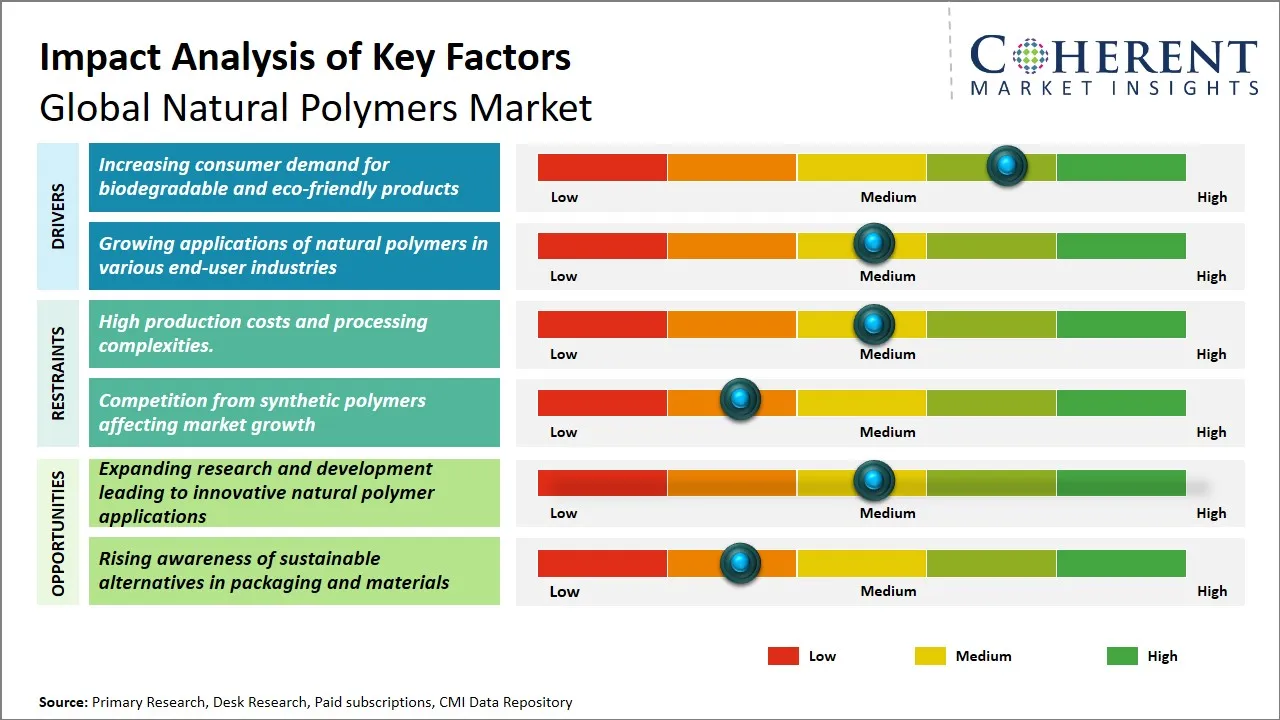
Natural Polymers Market Driver - Increasing Consumer Demand for Biodegradable and Eco-Friendly Products
One of the factors that will continue to spur the development of the natural polymers market across the globe is the growing consumer preference towards biodegradable and green products. With the increase in the awareness of the detrimental environmental effects of synthetic plastics and non-renewable materials, consumers are actively pursuing viable alternatives that have the least ecological footprints. Natural polymers, obtained by renewable sources (animals and plants), are bioplastics and less toxic which is close to the values of environmentally conscious consumers. This paradigm change can be observed especially in industries such as packaging, personal care, agriculture and textile where end-users are increasingly demanding materials that can decompose easily without leaving behind long term pollution. Besides, the regulatory pressures and efforts towards ensuring sustainability also bolster this trend.
For example, companies such as NatureWorks LLC have increased the manufacture of PLA-based products by exploiting the increasing consumer market in biodegradable plastics to replace petroleum-based plastics.
Natural Polymers Market Opportunity - Expanding Research and Development Driving Innovative Natural Polymer Applications
The natural polymers market in the world is set to experience a tremendous growth occasioned by the increasing levels of research and development (R&D) aimed at discovering new uses and improvement of functional properties of natural polymers. With the sustainability and environmental issues still prevailing in the mind of consumers, as well as in regulatory circles, there is an increasing amount of companies and research institutions that are putting huge investments in R&D in developing biodegradable, non-toxic and renewable polymer solutions. This progressive innovation pipeline is facilitating the development of natural polymers with better mechanical strength, thermal balance and biocompatibility, which has extended their applications in various industries, including packaging, pharmaceuticals, agriculture and textiles.
Novamont, an Italian firm, has taken the development of MATER-BI, which is a family of biodegradable and compostable bioplastics based on natural polymers such as starch, cellulose and other vegetable sources, a step forward.
Analyst Opinion (Expert Opinion)
- The natural polymers market has been on an upward growth path due to growth in demand of biodegradable and environmentally friendly materials in different sectors such as packaging, textile, and pharmaceutical. The Global Natural Products Expo (2023) and the International Biopolymers Forum (2022) provided insights into the new innovations, and such companies as Novamont and BASF are at the forefront of creating sustainable polymer solutions with less impact on the environment.
- The recent introduction of a new biodegradable polymer packaging material by Novamonts demonstrates how the industry is focused and determined to achieve sustainability and satisfy the needs of the consumers who are attracted to green materials. The conferences saw discussions focusing on the increasing realization of the advantages of natural polymers especially in the effort to reduce dependency on petroleum-based materials.
- The obstacles to wider adoption have also been observed in the form of challenges in scaling of production, and greater expenses than traditional polymers. Those companies that invest in the area of R&D in order to advance the performance and processing of natural polymers and collaborations with manufacturers in order to advance the supply chains will have a high probability of succeeding. After all its capacity to constantly innovate and react suitably to the changing consumer demands towards sustainability and functionality will be the key to growth in the natural polymers market.
Speak to the analyst
Want personalized insights?
Take the findings above to one of our principal consultants, or have the report rebuilt around the segments, geographies and competitors you actually track.
Market Segmentation
- Product Type Insights (Revenue, USD Bn, 2021 - 2033)
- Cellulose Ethers
- Exudate & Vegetable Gums
- Starch & Fermentation Products
- Others
- Application Insights (Revenue, USD Bn, 2021 - 2033)
- Construction
- Food & Beverages
- Medical
- Oilfield
- Cosmetics and Toiletries
- Inks And Paints
- Adhesives
- Others
- Form Insights (Revenue, USD Bn, 2021 - 2033)
- Powder
- Granules
- Films
- Others (e.g., beads, liquids)
- Regional Insights (Revenue, USD Bn, 2021 - 2033)
- North America
- U.S.
- Canada
- Latin America
- Brazil
- Argentina
- Mexico
- Rest of Latin America
- Europe
- Germany
- U.K.
- Spain
- France
- Italy
- Russia
- Rest of Europe
- Asia Pacific
- China
- India
- Japan
- Australia
- South Korea
- ASEAN
- Rest of Asia Pacific
- Middle East
- GCC Countries
- Israel
- Rest of Middle East
- Africa
- South Africa
- North Africa
- Central Africa
- North America
- Key Players Insights
- Archer Daniels Midland Company
- BASF SE
- Cargill, Incorporated
- DuPont de Nemours, Inc.
- Dow Inc.
- Celanese Corporation
- Ashland Global Holdings Inc.
- CP Kelco
- Eastman Chemical Company
- FMC Corporation
- Ingredion Incorporated
Sources
Primary Research Interviews
- CEO – Leading Starch Producer (e.g., Cargill or ADM)
- Supply Chain Director – Major Natural Polymer Distributor (e.g., Ashland or CP Kelco)
- Production Lead – Cellulose Derivatives Manufacturer (e.g., Borregaard)
- Sustainability Officer – Biopolymer Certification Authority (e.g., ACS GCI Natural Polymers Consortium)
Stakeholders
- Manufacturers
- End-use Sectors
- Food & Beverages (thickeners, stabilizers)
- Pharmaceuticals (excipients, drug delivery)
- Packaging & Textiles
- Oil & Gas (drilling fluids, water treatment)
- Regulatory & Certification Bodies (e.g., FDA for food contact, REACH for EU polymers, EPA guidelines)
- E-commerce Platforms and Retailers (Alibaba, Sigma-Aldrich, industrial suppliers)
- Technology Integration Players: Biodegradable packaging and advanced composites producers
Databases
- UN Comtrade Database (HS codes for natural polymers, e.g., alginic acid, cellulose derivatives)
- India Import Export (EXIM) Database
- USGS Mineral Commodity Summaries (related commodities like starches, celluloses)
- Eurostat Trade Statistics for Chemicals
- OEC World Trade Data for natural polymers
Magazines
- Chemical Processing Magazine – Trends in biopolymers supply
- Food Processing – Starch and natural polymer applications
- Packaging World – Sustainable polymers innovations
- Industrial Minerals – Market dynamics for natural polymers
- Oil & Gas Journal – Natural polymers in drilling fluids
Journals
- Journal of Applied Polymer Science – Natural polymer properties and applications
- Journal of Polymer Materials – Synthesis and characterization
- Carbohydrate Polymers – Cellulose and starch research
- Resources Policy – Supply chain analysis
- Journal of Hazardous Materials – Environmental impact of processing
Newspapers
- The Wall Street Journal – Global demand for biopolymers
- The Guardian – Sustainability in natural polymer production
- Business Standard (India) – Imports and Asia market growth
- Chemical Week – Supply disruptions
- Reuters – Price volatility in biobased materials
Associations
- ACS GCI Natural Polymers Consortium
- European Bioplastics
- GO!PHA (renewable carbon materials)
- Bio-based Industries Consortium
- American Chemical Society Green Chemistry Institute
- International Starch Association (for starch segment)
Public Domain Sources
- FDA – Guidelines for natural polymers in food/pharma
- European Commission – REACH regulations on biopolymers
- WHO – Safety standards for polymer exposure
- USGS – Trade assessments for related natural commodities
- OECD – Sustainability reports for biobased chemicals
Proprietary Elements
- CMI Data Analytics Tool
- Proprietary CMI Existing Repository of information for last 8 years.
Get access to 250+ pages report
Every segment, forecast, competitor profile and data table behind the analysis above — available for instant download.
- ESOMAR Member
- ISO 9001:2015 Certified
- D-U-N-S Registered
- GDPR & CCPA Compliant
Missing comfort of reading report in your local language? Find your preferred language:
Transform your Strategy with Exclusive Trending Reports
Frequently Asked Questions
The global natural polymers market is estimated to be valued at USD 16.69 Bn in 2026 and is expected to reach USD 28.23 Bn by 2033.
Natural polymers are biologically derived macromolecules, typically from plants or animals, including starch, cellulose, chitosan, natural rubber, gelatin, proteins, and alginates. They are biodegradable and renewable.
The CAGR of global natural polymers market is projected to be 7.8% from 2026 to 2033.
Polysaccharides, proteins, polyesters, and natural rubber.
Increasing consumer demand for biodegradable and eco-friendly products and growing applications of natural polymers in various end-user industries are the major factors driving the growth of the global natural polymers market.
High production costs and processing complexities and competition from synthetic polymers affecting market growth are the major factors hampering the growth of the global natural polymers market.
Archer Daniels Midland Company, BASF SE, Cargill, Incorporated, DuPont de Nemours, Inc., Dow Inc., Celanese Corporation, Ashland Global Holdings Inc., CP Kelco, Eastman Chemical Company, FMC Corporation, and Ingredion Incorporated are the major players.