

Global Necklace Market Size and Forecast – 2026 To 2033
The Global Necklace Market is estimated to be valued at USD 42.82 Bn in 2026 and is expected to reach USD 68.31 Bn by 2033, exhibiting a compound annual growth rate (CAGR) of 6.9% from 2026 to 2033. The steady growth is attributed to the growing demand for necklaces among consumers, driven by their higher purchasing power, changing fashion trends, and increased access to various designs available through e-commerce channels worldwide. The demand is also picking up, with consumers moving towards layered, light-weight, gemstone and personalized necklace options for their daily wear outfits as well as for special gift-giving occasions.
In May 2026, Dorsey launched its first enamel capsule, including necklaces, bracelets, and anklets designed for effortless layering, with retail prices ranging from USD 180 to USD 480, highlighting the market’s movement toward accessible premium, style-led necklace collections. (Source: Vogue)
Key Takeaways of the Global Necklace Market
- The pendant necklaces segment is projected to hold the largest market share of 34.6 % in 2026 as it has high gifting relevance, is personalized in nature, and fits well into every day and occasion jewelry purchases. In June 2026, Tiffany & Co. showcased its Blue Book 2026: Hidden Garden collection, featuring high-value necklace designs that strengthened the premium appeal of pendant-led fine jewelry collections.
- By material, gold is expected to lead with 38.4 % of the market share in 2026, as consumers continue to view gold necklaces as both adornment and long-term value preservation. In April 2026, the World Gold Council reported that India accounted for 22% of global jewelry demand in Q1 2026, underlining gold’s deep cultural and investment-linked relevance.
- By price range, the mass segment is expected to account for 41.8 % of the market share in 2026, supported by accessible designs, gifting purchases, and frequent style refresh cycles. In May 2026, Pandora reported 2% organic growth in Q1 2026, with network expansion supporting sales resilience despite softer consumer sentiment in key markets.
- Asia Pacific is anticipated to be the leading region, accounting for 36.7 % of the total market share in 2026, supported by robust demand for gold jewelry, strong bridal and wedding-related jewelry purchases, and well-established organized jewelry retail channels across India, China, and Southeast Asia. In June 2026, Chow Tai Fook reported FY2026 revenue growth of 5.3% to USD 12.04 billion, reflecting resilient regional jewelry demand.
- North America is expected to be the fastest-growing region with 27.6 % of the market share in 2026, supported by fashion jewelry upgrades, bridal-linked purchases, and stronger omnichannel retail execution. In March 2026, Signet Jewelers reported FY2026 sales of US$ 6.81 billion, with same-store sales growth and higher average unit retail across bridal and fashion categories.
- Personalized Layering and Everyday Styling: Necklace demand is moving beyond single occasion-led purchases toward stackable, modular, and identity-driven styling. Brands that offer adjustable lengths, initials, charms, birthstones, and mix-and-match pendant formats can improve repeat purchases, expand basket size, and build stronger emotional engagement with younger consumers seeking expressive but wearable jewelry.
- Omnichannel Trust and Premium Experience: Necklace brands are increasingly driving toward the store experience, digital discovery, product authentication and after-sales trust. Retailers that offer boutique consultation, online visualization, clear pricing, and trustworthy certification are more likely to attract both mass and premium customers and alleviate purchase hesitation for high dollar jewelry products.
Segmental Insights
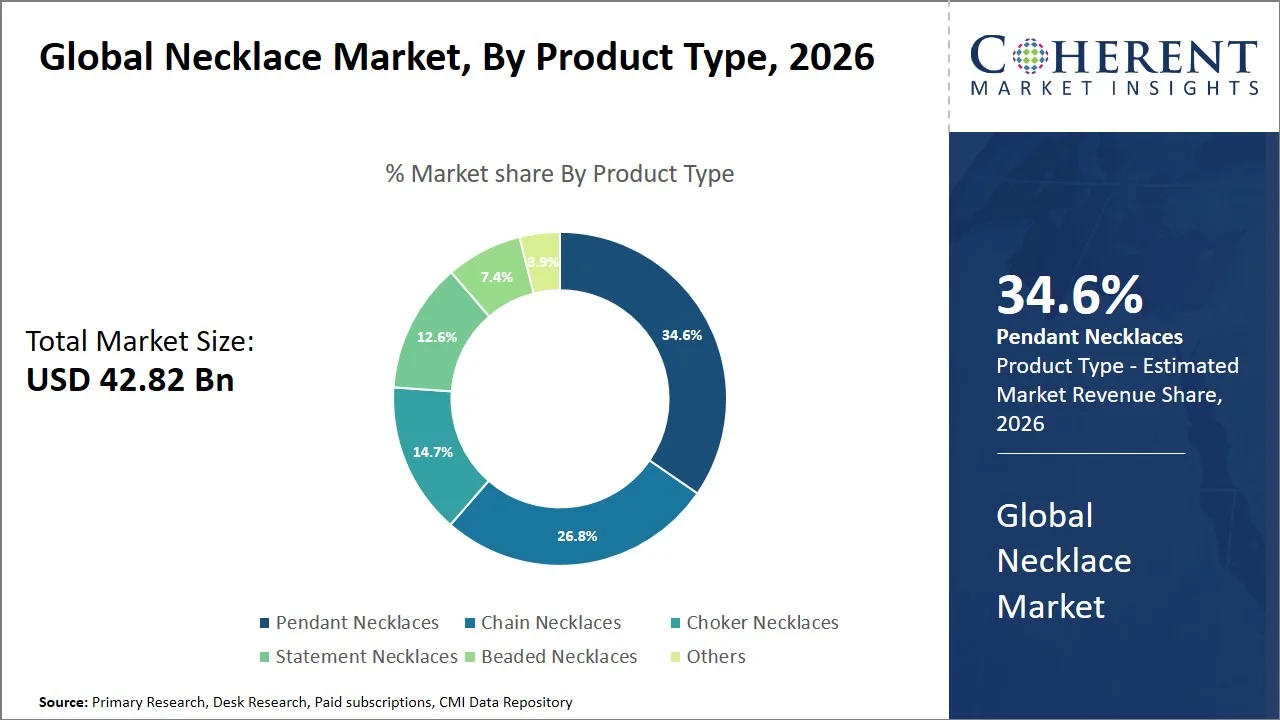
Why Does the Pendant Necklaces Segment Dominate the Global Necklace Market?
Pendant necklaces are expected to dominate the global necklace market with 34.6% share in 2026, as they offer the widest design flexibility across casual wear, gifting, religious motifs, initials, gemstones, and luxury statement pieces. Their leadership is supported by strong demand from women consumers seeking wearable pieces that can be styled daily or layered for occasion wear. On the supply side, pendant formats allow brands to refresh collections faster by changing charms, lockets, symbols, stones, or chain lengths without redesigning the entire necklace category. This improves SKU rotation and supports both online and boutique-led merchandising. Furthermore, pendant necklaces remain highly adopted for birthdays, anniversaries, self-purchase, and sentimental gifting. In July 2025, Louis Vuitton unveiled its Silver Lockit 2025 collection with Felix, including a necklace and bracelet format, reinforcing pendant-led storytelling and cause-linked jewelry positioning. (Source: Teenvogue)
- Current Industry Events of 2026
- Market Size Estimation
- Regional Breakdown
- Competitive Landscape
- Customer Intelligence
- Segmental Analysis
- Pricing Analysis
- Key Market Drivers, Challenges & Future Trends
- Customized Insights Section
Why Does Gold Represent the Largest Material Segment in the Global Necklace Market?
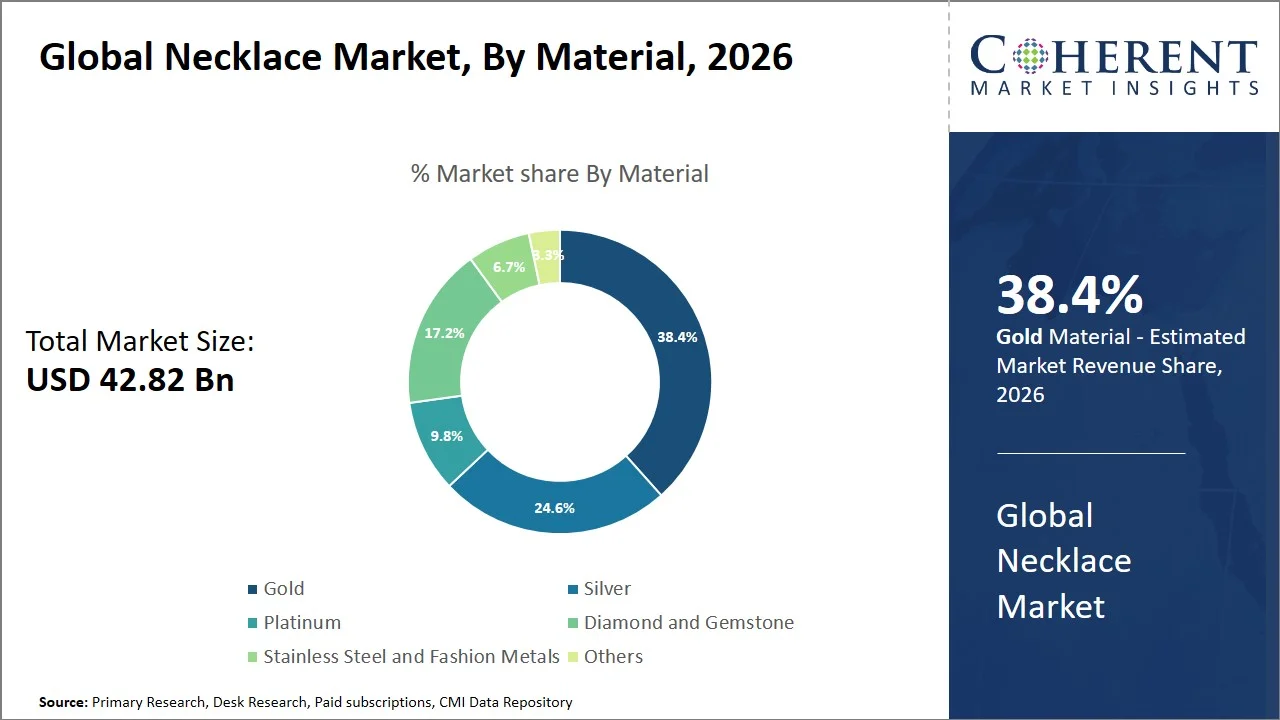
With a key position in bridal jewelry, festive shopping, every day wear, value retention and gift giving in the realm of heirlooms, gold is projected to be the biggest material category accounting for 38.4% of the market share in 2026. Gold necklaces reign supreme due to the consumer perception of purity, resale value, cultural continuity and long-term ownership, particularly in markets across Asia Pacific and the Middle East. Jewelers on the supply side apply hallmarking, lightweight casting, karatage variation, design localization in the region and chain-making automation to achieve their goal of increased affordability while maintaining visual appeal. Gold necklaces are being enthusiastically used in wedding sets, temple designs, mangalsutra formats, chain laden and in the case of gifts during special occasions. As per the official investor presentation of Kalyan Jewellers in May 2026, the company had reported a gold revenue of USD 386.44million in India as compared to USD 266.81 million in Q4FY25, which speaks volumes about the firm's traction in the gold jewelry segment in its retail business. (Source: Kalyan Jewellers)
Why Does the Mass Segment Dominate the Global Necklace Market?
The mass segment is expected to dominate the global necklace market with 41.8% share in 2026, as necklaces are frequently purchased as fashion accessories, affordable gifts, impulse buys, and seasonal style upgrades. This segment can be aided by the consumers who are looking for trendy designs but are not willing to invest in fine jewelry with a significant price tag. Higher demand comes from younger and online shoppers, gift-giving and consumers looking for several designs for rotation as opposed to a costly single one. The supply-side benefits are being able to produce more and more, plated metals, sterling silver, synthetic stones, charm formats and quick online merchandising which allow brands to release new collections at affordable prices. Adoption levels are high for daily, work, travel, college fashion, festive giving and trendy for social media. In April 2026, James Avery's Mother's Day collection of charms, bracelets, rings, earrings and necklaces became a giftable format, making it easier for everyone to enjoy a wearable occasion jewelry moment.
Global Necklace Market Dynamics
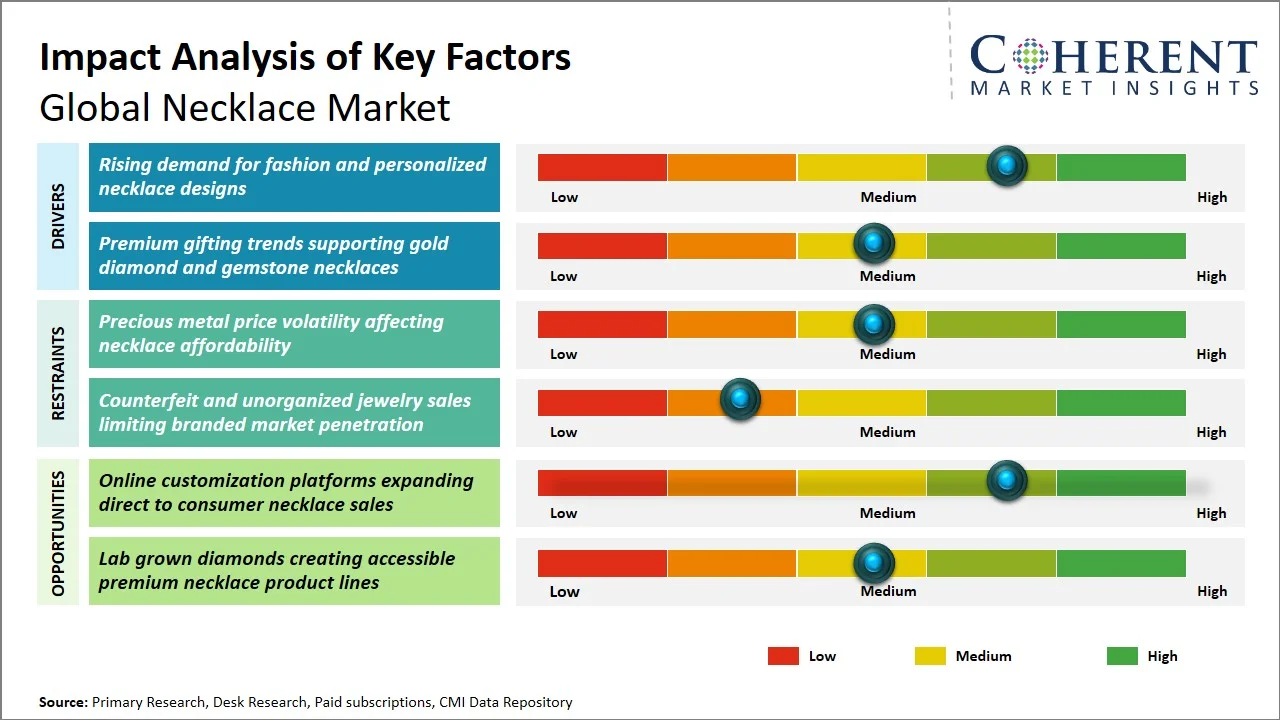
Key Market Drivers
- Rising Demand for Fashion and Personalized Necklace Designs: Necklaces are a highly visible, giftable and versatile category which is seeing an increased frequency of category presence as a result of fashion and personalized designs. Consumers are shifting toward multi-layered chains, initials, symbolic pendants, gemstone accents, and even adjustable-length designs so that one necklace could be worn on a number of occasions. This driver also benefits supply-side economics, with brands being able to offer more product assortments with modular pendants, stone variations, engraving and made-to-order configurations, without completely new product platforms. In March 2026, Angara introduced Lee Harris x Angara fine jewelry, which aligns with the current trend of colorful aesthetics and sculptural pieces, along with long necklaces, designed to be worn in multiple layers or doublings. (Source: Angara)
- Premium Gifting Trends Supporting Gold, Diamond, and Gemstone Necklaces: Gold, diamond, and gemstone necklaces combine emotional value with luxury appeal, making them preferred choices for premium gifting and strengthening their commercial importance across weddings, anniversaries, festivals, and milestone celebrations.. Consumers want to buy high-end jewelry for their weddings, anniversaries, milestone occasions, and family gifts, and are drawn to certified materials, unique stones, and meaningful design stories. The value of the metal is no longer the only basis for supply-side differentiation; it is becoming more about provenance, traceability, craftsmanship and ethical sourcing. This assists in making the brand withstand high raw material price fluctuations and maintain premium pricing. Also, in January 2026, GemFair and De Beers London released a limited edition jewelry collection of ethically sourced artisanal diamonds, ensuring traceability from the mine to the market, further bolstering the premium jewelry positioning based on provenance. In January 2026, GemFair and De Beers London launched a capsule jewelry collection using ethically-sourced artisanal diamonds, with traceability from mine site to market and 12 unique pieces, reinforcing provenance-led premium jewelry positioning.
Emerging Market Trends
- Modular Necklace Design and SKU Flexibility: Necklace brands are increasingly designing collections around interchangeable pendants, layered chains, detachable charms, convertible lengths, and mix-and-match styling. This trend is commercially important because it allows companies to expand design variety without increasing manufacturing complexity at the same pace. Retailers can offer more frequent refreshes, seasonal capsules, and occasion-specific edits while using common chain bases, clasps, and pendant formats. For consumers, modularity supports personalization, wardrobe versatility, and repeat purchase behavior. For suppliers, it improves inventory productivity by separating core components from fashion-sensitive design elements. This is especially relevant in mass and premium price bands, where buyers want freshness, but brands must protect margins through standardized production platforms and faster merchandising cycles.
- Proof-Backed Luxury and Responsible Material Positioning: Responsible sourcing, certified purity, diamond disclosure, and material traceability are becoming stronger purchase filters in the necklace market, especially for gold, diamond, gemstone, and premium gifting categories. Consumers are increasingly evaluating not only design and price, but also whether the product carries credible assurance around origin, treatment, purity, and ethical sourcing. This trend is shifting competition from purely aesthetic differentiation toward trust-based differentiation. Brands that build transparent sourcing systems, provide clear certificates, and communicate material integrity can reduce purchase hesitation in high-value necklaces. The trend also benefits organized retailers, as smaller unverified sellers face higher pressure to improve documentation, quality control, and after-sales assurance.
Current Events and their Impact
Current Events | Description and its Impact |
March 2026 – India’s Hallmarking of Gold Jewelry and Gold Artefacts Amendment Order, 2026 |
|
February 2026 – BIS IS 19469:2025 for Diamond Disclosure and Consumer Confidence |
|
April 2025 – U.S. Reciprocal Tariff Policy on Imported Goods |
|
Regional Insights
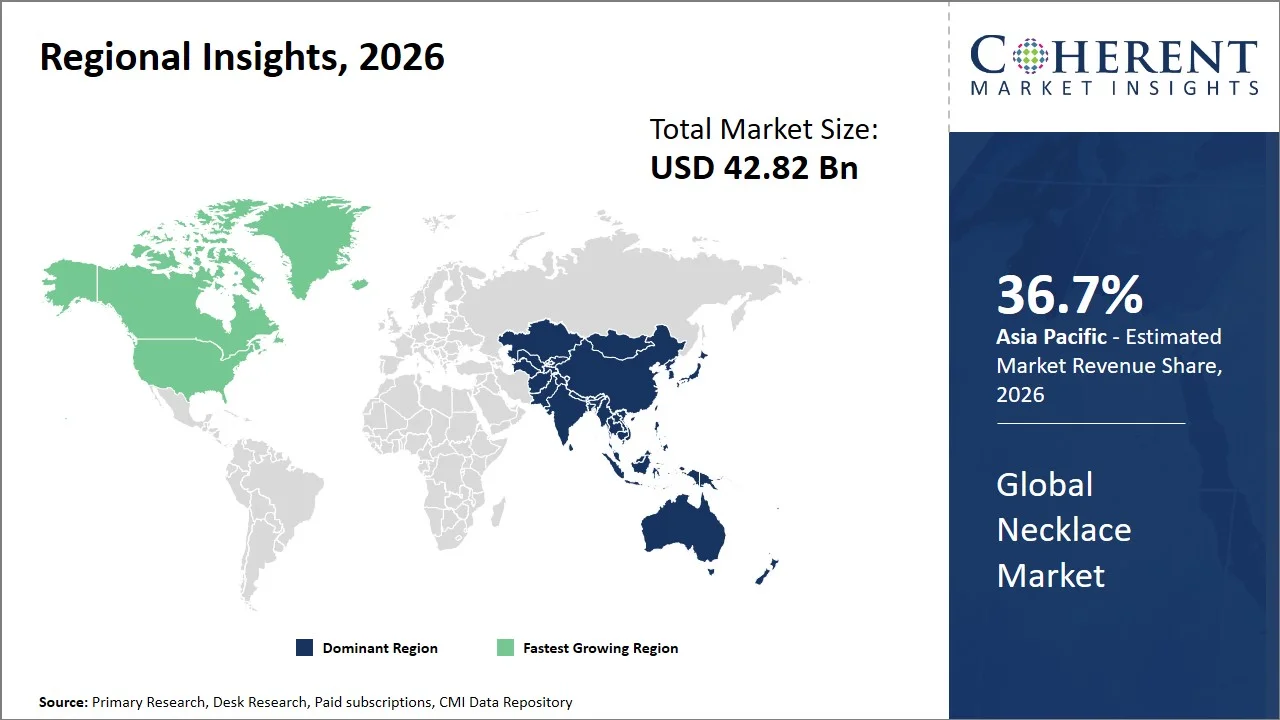
Why Does Asia Pacific Dominate the Global Necklace Market?
Asia Pacific dominates the global necklace market with an expected 36.7% share in 2026, supported by deep cultural attachment to gold jewelry, strong wedding and festive purchasing, and large-scale jewelry manufacturing ecosystems across China, India, Japan, Hong Kong, and Southeast Asia. Necklace adoption is especially strong in bridal sets, daily gold chains, pendant gifting, temple-inspired designs, and gemstone-led occasion wear. The region also benefits from dense jewelry-store networks, high family-gifting frequency, and strong acceptance of gold as both ornament and value-retention asset. On the supply side, advanced polishing, casting, chain-making, and gemstone-setting clusters help brands serve mass, premium, and luxury buyers efficiently. In March 2026, Hong Kong Trade Development Council (HKTDC) reported that Hong Kong’s fine jewelry exports increased by 5% in 2025, supporting Asia Pacific’s role as a regional jewelry trading hub.
Why is Europe Emerging as the Fastest-Growing Region in the Global Necklace Market?
Europe is emerging as the fastest-growing region with an expected 27.6% share in 2026, supported by its premium jewelry heritage, strong luxury tourism, design-led craftsmanship, and rising demand for traceable and responsibly manufactured necklaces. The region’s growth is shaped by Italian goldsmithing, French luxury retail, Swiss trade flows, and expanding digital luxury engagement across affluent consumers. European necklace buyers increasingly prefer refined chains, gemstone pendants, minimalist premium pieces, and heritage-inspired designs that combine craftsmanship with material assurance. Supply-side growth is also supported by machinery, prototyping, laser cutting, and digital production technologies used by high-end manufacturers. In September 2026, Vicenzaoro’s T.GOLD doubled into two annual events, giving jewelry professionals more access to machinery and technologies for efficient goldsmithing and precious-metal processing. (Source: T Gold)
Global Necklace Market Outlook for Key Countries
Why is the U.S. a Key Market for the Global Necklace Market?
The U.S. is a key necklace market because jewelry purchases are strongly linked to gifting, bridal occasions, fashion self-purchase, and premium retail experiences. Necklace demand is supported by high discretionary spending, strong department-store and specialty-jeweler channels, and rapid adoption of online jewelry discovery. Consumers frequently purchase necklaces for Valentine’s Day, Mother’s Day, anniversaries, graduations, and milestone gifting, making the category highly seasonal but commercially resilient. The U.S. also supports premium necklace demand through diamond, gemstone, and personalized pendant formats, while fashion necklaces benefit from social-media-led styling and accessible online pricing. In January 2026, the National Retail Federation projected record Valentine’s Day spending of US$ 29.1 billion, with average planned spending reaching US$ 199.78, reinforcing the strength of U.S. occasion-led gifting.
Why is India Important in the Global Necklace Market?
India is important in the global necklace market due to its deep gold-jewelry culture, wedding-heavy consumption pattern, and strong domestic manufacturing base. Necklaces are central to bridal jewelry sets, festive purchases, religious gifting, daily-wear chains, and family wealth transfer, making the category structurally important beyond fashion trends. India also serves global export markets through established gold, diamond, gemstone, and silver jewelry manufacturing clusters in Mumbai, Surat, Jaipur, Thrissur, Hyderabad, and Kolkata. Organized retailers are improving trust through hallmarking, transparent pricing, and omnichannel expansion, while exporters are increasingly focusing on value-added studded jewelry. In February 2026, GJEPC reported that India’s gem and jewelry exports stood at US$ 23.19 billion during April 2025–January 2026, with gold jewelry exports growing 5.53% year-on-year to US$ 9.71 billion.
Why Does China Support Growth in the Global Necklace Market?
China supports growth in the global necklace market through its large consumer base, strong gold-jewelry retail network, high mall-based luxury penetration, and rising preference for heritage gold and high-purity designs. Necklace demand is supported by gifting, bridal purchases, self-reward consumption, and wealth-preservation behavior, although elevated gold prices are shifting consumers toward lighter, fixed-price, and design-led formats. China’s supply chain also has strong capabilities in retail digitization, online-to-offline jewelry selling, and rapid product refreshes. Premium necklace buyers increasingly value craftsmanship, brand identity, and store experience rather than weight alone. In April 2026, China’s National Bureau of Statistics reported that retail sales of gold, silver, and jewelry by enterprises above designated size increased 12.6% year-on-year in Q1 2026, showing category resilience.
Why is Japan a Strategic Country in the Global Necklace Market?
Japan is a strategic necklace market because it combines mature luxury consumption, refined design preferences, pearl-jewelry heritage, and strong trust in branded craftsmanship. Consumers favor elegant necklaces, pearl strands, minimalist pendants, premium chains, and gift-ready fine jewelry suited for anniversaries, weddings, formal occasions, and everyday understated styling. Japan also acts as a premium sourcing and distribution point for buyers from East Asia, supported by organized trade shows and established wholesale networks. Product quality, finishing precision, authenticity, and after-sales service carry high importance, making Japan attractive for premium and luxury necklace brands. In January 2026, International Jewelry Tokyo highlighted IJT 2026 as Japan’s largest jewelry trade show, featuring 620 exhibitors and 1.25 million jewelry pieces on display and available for sourcing.
Why is Italy an Important Growth Market for the Global Necklace Market?
Italy is an important growth market for necklaces because it anchors Europe’s goldsmithing, luxury design, and export-oriented jewelry manufacturing ecosystem. Italian necklace producers are highly relevant in gold chains, lightweight pendants, handcrafted luxury designs, and premium private-label production for international brands. The country’s jewelry districts, including Vicenza, Arezzo, and Valenza, support specialized craftsmanship, precious-metal processing, gemstone setting, and high-end finishing. Italy’s market strength is also linked to its ability to redesign necklaces for affordability without losing visual appeal, which is commercially important during periods of high gold prices. In January 2026, Reuters reported that Italian jewelers were producing lighter designs to offset record gold prices, with Italy accounting for 11.2% of the global jewelry market in 2024.
Technology Adoption Landscape in the Global Necklace Market
Technology | Adoption Level | Key Application Area | Business Impact |
CAD/CAM Jewelry Design | High | Necklace design, pendant modeling, chain architecture | Shortens design cycles, improves precision, and supports faster collection refreshes. |
3D Printing and Wax/Resin Casting | Medium | Custom pendants, prototypes, intricate necklace components | Enables complex designs, made-to-order production, and lower prototype cost. |
Laser Cutting, Welding, and Engraving | High | Chain finishing, pendant detailing, personalization | Improves product accuracy, reduces manual defects, and supports customized gifting. |
AR/Virtual Try-On Tools | Medium | Online necklace visualization and styling | Reduces purchase hesitation and improves digital conversion for high-consideration jewelry. |
Automated Stone Setting and Inspection | Medium | Diamond and gemstone necklace production | Enhances consistency, reduces rework, and supports higher-quality premium pieces. |
Traceability and Digital Certification Systems | Medium | Gold purity, diamond origin, product authentication | Builds consumer trust, supports regulatory compliance, and strengthens premium positioning. |
Technology | Adoption Level | Key Application Area | Business Impact |
How are Omnichannel Personalization and Traceable Fine Jewelry Creating New Growth Opportunities in the Global Necklace Market?
Omnichannel personalization and traceable fine jewelry are creating a major growth opportunity by connecting emotional purchase intent with stronger product assurance. Necklaces are highly suitable for customization because pendants, initials, gemstones, chain lengths, charms, and engraving can be varied without changing the core product architecture. This allows brands to serve mass, premium, and luxury buyers through differentiated design tiers while improving repeat purchase potential. At the same time, traceability and certification help convert hesitant buyers in gold, diamond, and gemstone necklaces, where trust strongly influences purchase decisions. Retailers that integrate online visualization, store consultation, digital certificates, and after-sales services can create a more premium buying experience across both physical and digital channels. Commercially, this opportunity supports better margins, stronger gifting conversion, reduced counterfeit risk, and wider adoption among younger consumers who expect both design individuality and transparent product information.
Market Players, Key Development, and Competitive Landscape
Key Developments
- In April 2026, Brilliant Earth promoted its Mother’s Day jewelry gift collection, including an engravable diamond and gemstone locket, gemstone medallion necklace, butterfly diamond pendant, and other personalized necklace formats. The development highlights growing demand for sentimental, giftable, and customizable necklaces, especially in occasion-led purchases such as Mother’s Day, anniversaries, and family gifting
- In July 2025, Boucheron launched its Carte Blanche High Jewelry Collection “Impermanence,” designed by Claire Choisne and inspired by ikebana, wabi-sabi, and disappearing nature. The collection includes 28 high jewelry pieces designed as wearable botanical compositions. This reflects the luxury necklace market’s movement toward artistic storytelling, nature-led design, and collectible high jewelry positioning
Competitive Landscape
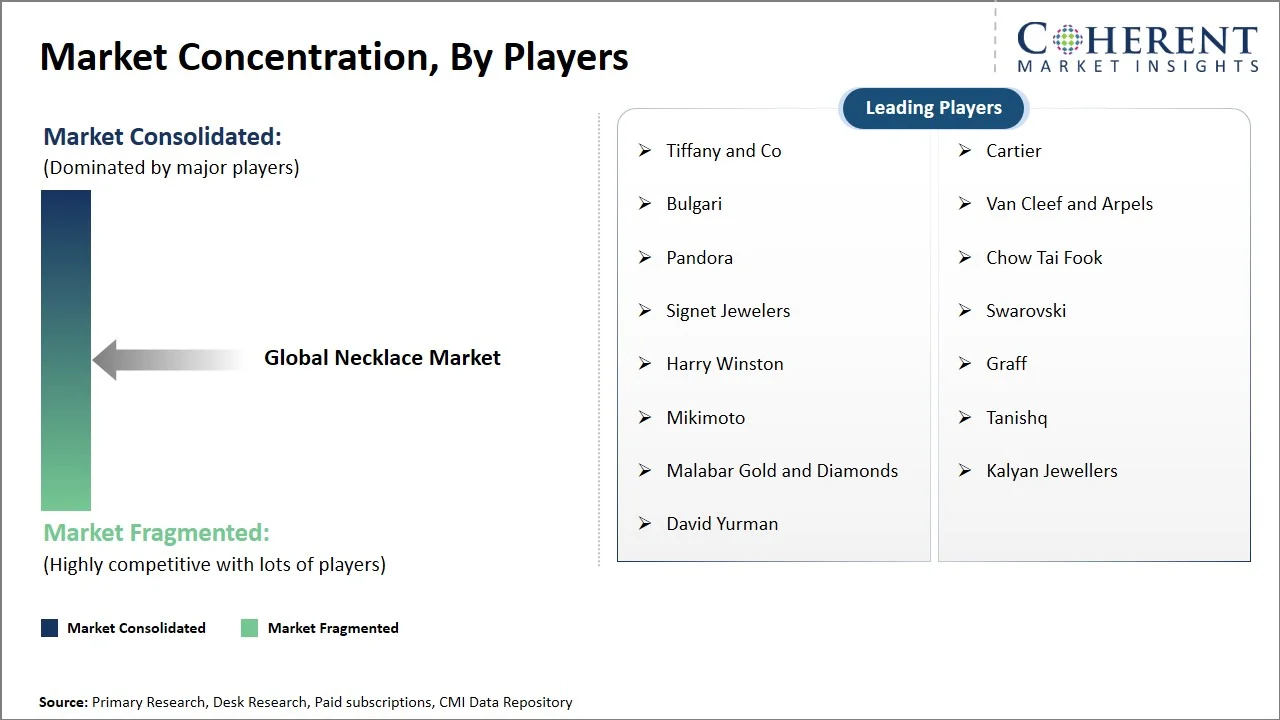
The global necklace market is moderately fragmented, with competition across luxury houses, organized jewelry retailers, D2C fine jewelry brands, fashion jewelry companies, regional gold jewelers, and online marketplaces. Competition is shaped by design freshness, material credibility, price positioning, retail reach, and consumer trust.
Key focus area include
- Product quality and differentiation through distinctive pendants, chain styles, gemstones, and finishing
- Technology adoption for CAD design, virtual try-on, digital engraving, and production efficiency
- Pricing competitiveness across mass, premium, and luxury necklace formats
- Supply reliability for gold, silver, diamonds, gemstones, chains, clasps, and finished components
- Certifications, hallmarking, diamond disclosure, and quality-control systems
- Distribution strength across jewelry stores, online retail, boutiques, and department stores
- Material differentiation by purity, karatage, gemstone grade, plating quality, and craftsmanship
- Expansion through e-commerce, omnichannel consultation, gifting platforms, and personalized product configurators
Market Report Scope
Necklace Market Report Coverage
| Report Coverage | Details | ||
|---|---|---|---|
| Base Year: | 2025 | Market Size in 2026: | USD 42.82 Bn |
| Historical Data for: | 2020 To 2024 | Forecast Period: | 2026 To 2033 |
| Forecast Period 2026 to 2033 CAGR: | 6.9% | 2033 Value Projection: | USD 68.31 Bn |
| Geographies covered: |
| ||
| Segments covered: |
| ||
| Companies covered: | Tiffany and Co, Cartier, Bulgari, Van Cleef and Arpels, Pandora, Chow Tai Fook, Signet Jewelers, Swarovski, Harry Winston, Graff, Mikimoto, Tanishq, Malabar Gold and Diamonds, Kalyan Jewellers, and David Yurman | ||
| Growth Drivers: |
| ||
| Restraints & Challenges: |
| ||
Analyst Opinion (Expert Opinion)
- The global necklace market is expected to maintain a positive outlook over the forecast period, supported by strong gifting behavior, fashion-led self-purchase, and sustained demand for gold, pendant, and personalized necklace formats. The category benefits from both emotional purchase intent and high visibility in everyday styling.
- The strongest growth pockets are likely to emerge in pendant necklaces, gold-based designs, affordable fashion jewelry, premium gemstone necklaces, and omnichannel retail formats. Asia Pacific remains structurally important due to cultural gold consumption, while North America offers strong upside through online jewelry adoption, fashion upgrades, and branded gifting.
- Key risks include gold price volatility, counterfeit products, weak disclosure practices for treated or lab-grown stones, tariff-related landed-cost pressure, and margin erosion in price-sensitive segments. Market players should focus on traceable materials, certified quality, modular designs, digital personalization, and stronger omnichannel service to gain competitive advantage.
Speak to the analyst
Want personalized insights?
Take the findings above to one of our principal consultants, or have the report rebuilt around the segments, geographies and competitors you actually track.
Market Segmentation
- Product Type Insights (Revenue, USD Bn, 2021 - 2033)
- Pendant Necklaces
- Chain Necklaces
- Choker Necklaces
- Statement Necklaces
- Beaded Necklaces
- Others
- Material Insights (Revenue, USD Bn, 2021 - 2033)
- Gold
- Silver
- Platinum
- Diamond and Gemstone
- Stainless Steel and Fashion Metals
- Others
- Price Range Insights (Revenue, USD Bn, 2021 - 2033)
- Mass
- Premium
- Luxury
- End User Insights (Revenue, USD Bn, 2021 - 2033)
- Men
- Women
- Children
- Distribution Channel Insights (Revenue, USD Bn, 2021 - 2033)
- Jewelry Stores
- Online Retail
- Department Stores
- Brand Owned Boutiques
- Others
- Regional Insights (Revenue, USD Bn, 2021 - 2033)
- North America
- U.S.
- Canada
- Latin America
- Brazil
- Argentina
- Mexico
- Rest of Latin America
- Europe
- Germany
- U.K.
- Spain
- France
- Italy
- Russia
- Rest of Europe
- Asia Pacific
- China
- India
- Japan
- Australia
- South Korea
- ASEAN
- Rest of Asia Pacific
- Middle East
- GCC Countries
- Israel
- Rest of Middle East
- Africa
- South Africa
- North Africa
- Central Africa
- North America
- Key Players Insights
- Tiffany and Co
- Cartier
- Bulgari
- Van Cleef and Arpels
- Pandora
- Chow Tai Fook
- Signet Jewelers
- Swarovski
- Harry Winston
- Graff
- Mikimoto
- Tanishq
- Malabar Gold and Diamonds
- Kalyan Jewellers
- David Yurman
Source
Primary Research Interviews
- Necklace manufacturers producing pendant necklaces, chain necklaces, choker necklaces, statement necklaces, beaded necklaces, and fashion necklaces
- Fine jewelry manufacturers producing gold, silver, platinum, diamond, gemstone, and pearl necklaces
- Fashion jewelry manufacturers using stainless steel, brass, alloy metals, plated metals, crystals, beads, enamel, resin, and synthetic stones
- Goldsmiths, diamond setters, gemstone cutters, chain-making units, casting units, polishing units, and jewelry finishing workshops
- Raw material suppliers providing gold, silver, platinum, diamonds, gemstones, pearls, crystals, beads, stainless steel, fashion metals, clasps, chains, and packaging materials
- Diamond, gemstone, pearl, and precious metal certification laboratories and grading agencies
- Jewelry designers, product development teams, CAD/CAM jewelry design specialists, and 3D printing service providers
- Necklace importers, exporters, wholesalers, distributors, and buying houses
- Organized jewelry stores, luxury jewelry boutiques, department stores, and specialty jewelry retailers
- E-commerce platforms, D2C jewelry brands, online marketplaces, and social-commerce jewelry sellers
- Bridal jewelry retailers, wedding jewelry consultants, stylists, fashion merchandisers, and gifting-category managers
- Jewelry repair, customization, engraving, and after-sales service providers
- Quality testing laboratories, hallmarking centers, compliance consultants, and product authentication specialists
- Industry experts, market consultants, trade associations, jewelry councils, and supply-chain specialists
Stakeholders
- Luxury and fine jewelry companies: Tiffany and Co, Cartier, Bulgari, Van Cleef and Arpels, Harry Winston, Graff, Chopard, Boucheron, Mikimoto, David Yurman
- Mass and premium jewelry brands: Pandora, Swarovski, Brilliant Earth, Blue Nile, Mejuri, Monica Vinader, Kendra Scott, Missoma
- Asia Pacific jewelry retailers and manufacturers: Chow Tai Fook, Tanishq, Malabar Gold and Diamonds, Kalyan Jewellers, Lukfook Jewelry, Lao Feng Xiang, Chow Sang
- Diamond and gemstone jewelry companies: De Beers Jewellers, Graff, Harry Winston, Blue Nile, Brilliant Earth, Gemfields-linked jewelry partners
- Gold and precious metal necklace manufacturers: gold chain manufacturers, goldsmithing clusters, bridal jewelry manufacturers, private-label necklace manufacturers, and OEM/ODM jewelry suppliers
- Fashion jewelry and accessory companies: Swarovski, Pandora, Kendra Scott, Kate Spade Jewelry, Coach Jewelry, Fossil Group jewelry brands
- Retailers and marketplace players: Amazon, Etsy, Walmart, Macy’s, Nordstrom, Bloomingdale’s, Selfridges, Harrods, Net-a-Porter, Farfetch
- Raw material suppliers: gold refiners, silver refiners, platinum group metal suppliers, diamond suppliers, gemstone suppliers, pearl suppliers, crystal suppliers, and recycled-metal suppliers
- End-use sectors: individual consumers, bridal buyers, fashion consumers, luxury buyers, gifting customers, tourists, stylists, and corporate gifting buyers
- Supporting ecosystem: jewelry packaging companies, logistics providers, secure transport companies, hallmarking centers, grading laboratories, authentication technology providers, and jewelry insurance providers
- Regulatory and certification bodies: Responsible Jewelry Council, World Gold Council, Kimberley Process, CIBJO, GIA, IGI, HRD Antwerp, BIS, FTC, LBMA, OECD, ISO, ASTM International
Databases
- UN Comtrade Database – import/export analysis for jewelry, precious metals, diamonds, gemstones, pearls, and imitation jewelry
- ITC Trade Map – global trade flows for necklaces, precious metal jewelry, imitation jewelry, diamonds, gemstones, and pearls
- World Gold Council – gold demand, gold jewelry consumption, investment trends, and regional gold jewelry insights
- Gem and Jewelry Export Promotion Council – India gem and jewelry exports, gold jewelry exports, diamond jewelry trade, and industry updates
- HKTDC Research – Hong Kong jewelry trade, exports, sourcing trends, and Asia Pacific jewelry market insights
- U.S. Census Bureau – jewelry retail sales, trade, household income, and consumer spending indicators
- U.S. Bureau of Economic Analysis – personal consumption expenditure for jewelry and watches
- U.S. International Trade Commission DataWeb – U.S. jewelry imports, exports, tariffs, and trade flows
- Eurostat – jewelry trade, household consumption, retail sales, and luxury goods indicators
- European Commission – product safety, precious metal rules, sustainability policy, and consumer protection regulations
- China National Bureau of Statistics – retail sales of gold, silver, jewelry, and consumer goods
- General Administration of Customs of China – jewelry, precious metal, diamond, and gemstone trade data
- Ministry of Commerce and Industry, India – gem and jewelry trade, exports, imports, and policy updates
- Directorate General of Commercial Intelligence and Statistics, India – jewelry export and import data
- Japan Customs – precious metal jewelry, pearl jewelry, and gemstone trade data
- OECD Data – household income, consumer spending, and responsible mineral supply-chain guidance
- World Bank Data – disposable income, urban population, household consumption, and macroeconomic indicators
Magazines / Industry Publications
- JCK
- National Jeweler
- Rapaport
- The Retail Jeweller
- Professional Jeweller
- Jewelry Focus
- Solitaire International
- Rough & Polished
- Idex Online
- Jewelry Outlook
- Vogue Business
- Business of Fashion
- WWD
- Luxury Tribune
- Retail Dive
- Modern Retail
- Fashion Network
- The Business of Fashion
Journals
- Gems & Gemology
- The Journal of Gemmology
- Journal of Jewelry Research
- International Journal of Retail & Distribution Management
- Journal of Retailing and Consumer Services
- International Journal of Consumer Studies
- Fashion and Textiles
- Journal of Fashion Marketing and Management
- Luxury Research Journal
- Journal of Brand Management
- Resources Policy
- Journal of Cleaner Production
- Sustainability
- Resources, Conservation and Recycling
- Minerals
- Materials Today: Proceedings
- Applied Surface Science
- Surface and Coatings Technology
Credible News Sources
- Financial Times – luxury jewelry, consumer spending, gold prices, and global retail trends
- The Wall Street Journal – jewelry retail, luxury goods, consumer demand, and company strategy
- CNBC – retail spending, luxury goods, jewelry sales, and consumer trends
- The New York Times – fashion, luxury, consumer lifestyle, and retail behavior
- The Guardian – responsible sourcing, sustainability, and consumer protection
- The Economic Times – India jewelry, gold demand, organized retail, and exports
- Business Standard – India gems and jewelry, retail, trade, and policy updates
- The Hindu BusinessLine – gold, jewelry exports, consumer goods, and retail updates
- China Daily – China jewelry retail, consumer demand, and luxury goods trends
- The Japan Times – Japan luxury retail, pearl jewelry, and consumer lifestyle trends
- South China Morning Post – Hong Kong and China jewelry trade, luxury retail, and consumer spending
Associations
- World Gold Council
- Responsible Jewelry Council
- CIBJO – The World Jewelry Confederation
- Kimberley Process Certification Scheme
- Gem and Jewelry Export Promotion Council
- International Gemological Institute
- Gemological Institute of America
- HRD Antwerp
- LBMA
- Jewelers of America
- American Gem Society
- National Association of Jewellers
- British Jewellers’ Association
- Antwerp World Diamond Centre
- Dubai Multi Commodities Centre
- Hong Kong Jewelry Manufacturers’ Association
- Hong Kong Trade Development Council
- China Gold Association
- Japan Jewelry Association
- India Bullion and Jewellers Association
- Retailers Association of India
- EuroCommerce
- The Consumer Goods Forum
Public Domain Sources
- World Gold Council – gold jewelry demand, gold consumption, price movement, and regional gold trends
- Kimberley Process – rough diamond certification, diamond trade control, and conflict-diamond prevention
- Responsible Jewelry Council – responsible sourcing, chain-of-custody standards, and jewelry supply-chain practices
- OECD – due diligence guidance for responsible mineral supply chains
- U.S. Federal Trade Commission – jewelry advertising, precious metal, gemstone, and diamond marketing guidance
- U.S. Census Bureau – jewelry retail sales, consumer spending, and demographic indicators
- U.S. Bureau of Economic Analysis – personal consumption expenditure for jewelry and watches
- U.S. International Trade Commission – jewelry import/export data, tariffs, and trade classifications
- European Commission – consumer product safety, sustainability, traceability, and circular economy regulations
- Eurostat – household consumption, retail trade, and jewelry import/export data
- Bureau of Indian Standards – gold hallmarking, jewelry purity standards, and compliance requirements
- Ministry of Commerce and Industry, India – gems and jewelry exports, trade policy, and manufacturing updates
- China National Bureau of Statistics – retail sales of gold, silver, and jewelry
- General Administration of Customs of China – jewelry, gold, diamond, gemstone, and pearl trade data
- UN Comtrade – global trade data for precious metal jewelry, imitation jewelry, diamonds, gemstones, and pearls
- ITC Trade Map – country-wise jewelry import/export analysis
- World Bank – income, urbanization, population, and household consumption indicators
- OECD – consumer expenditure, responsible sourcing, and macroeconomic indicators
Proprietary Elements
- CMI Data Analytics Tool, Proprietary CMI Existing Repository of information for last 10 years.
Get access to 250+ pages report
Every segment, forecast, competitor profile and data table behind the analysis above — available for instant download.
- ESOMAR Member
- ISO 9001:2015 Certified
- D-U-N-S Registered
- GDPR & CCPA Compliant
Missing comfort of reading report in your local language? Find your preferred language:
Transform your Strategy with Exclusive Trending Reports
Frequently Asked Questions
The CAGR of the global necklace market is projected to be 6.9% from 2026 to 2033.
The global necklace market is estimated to be valued at USD 42.82 billion in 2026 and is expected to reach USD 68.31 billion by 2033.
E-commerce is improving product accessibility, enabling wider design comparison, customization options, virtual discovery, and direct-to-consumer jewelry sales across mass, premium, and luxury necklace categories.
Key opportunities include personalized necklaces, lightweight gold designs, traceable diamond and gemstone jewelry, modular pendant formats, and omnichannel retail models that combine online convenience with in-store trust.
Rising demand for fashion and personalized necklace designs and premium gifting trends supporting gold diamond and gemstone necklaces are the major factors driving the growth of the global necklace market.
Precious metal price volatility affecting necklace affordability and counterfeit and unorganized jewelry sales limiting branded market penetration are the major factors hampering the growth of the global necklace market.
In terms of product type, pendant necklaces are estimated to dominate the market revenue share in 2026.