

North America Doughnuts Market Size and Forecast – 2026 To 2033
The North America Doughnuts Market is expected to grow from USD 4.85 Bn in 2026 to USD 6.91 Bn by 2033, registering a compound annual growth rate (CAGR) of 5.2% from 2026 to 2033. Market growth is being driven by high purchase frequency, strong consumer product affinity, and increasing demand for convenient snacking formats.
In May 2024, Rich Products’ consumer survey data reported that nearly 56% of U.S. consumers purchase doughnuts at least once a month. Further supporting market expansion, approximately 60–70% of North American consumers are increasingly opting for ready-to-eat, portable, and on-the-go snack options, positioning doughnuts as a preferred indulgent convenience food. (Source: Baking Business)
Key Takeaways of the North America Doughnuts Market
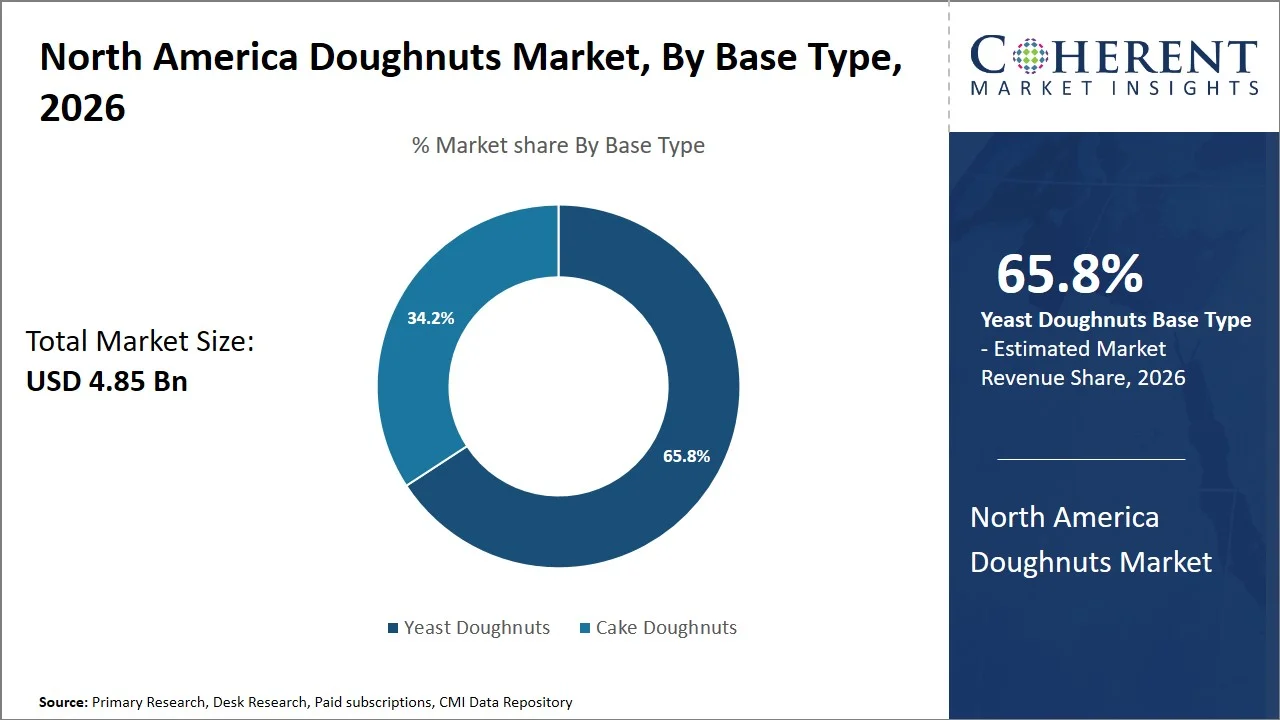
- The yeast doughnuts segment is the leading base type segment in North America doughnuts market, holding an estimated share of 65.8 % in 2026 due to their light texture and taste, low price point, and high correlation with traditional QSR brands. Big brands like Krispy Kreme and Dunkin' put a lot of marketing effort into yeast-raised products (glazed, for example), and some of their signature products make up over 50% of their sales, reinforcing their dominance. The company stated that reduced production costs, along with the flexibility to incorporate a wide range of fillings and flavors, further support rapid adoption across food service channels.(Source: Krispy Kreme)
- Multi-pack (3–12 pieces) packaging format is expected to dominate with 45.6 % share in 2026, supported by strong demand for shareable, value-driven, and occasion-based purchases across households, offices, parties, and gifting occasions. The format offers better unit economics for consumers while helping brands improve basket size and repeat purchases. For instance, on June 1, 2026, Krispy Kreme announced a National Doughnut Day offer where customers could buy any regular-priced dozen and get an Original Glazed dozen for US$ 2, reinforcing the commercial importance of dozen-based, shareable doughnut formats.
- Food service channels is the largest distribution channel with an estimated share of 71.3 % of the North America doughnuts market in 2026 owing to the popularity of cafes with high traffic and the consumer preference for fresh, ready to eat indulgent foods. Key drivers include impulse and repeat purchases (e.g. joint ventures to supply doughnuts to major restaurants) and the sensory benefits of in store purchases (i.e. freshness, aroma and appearance). Also, the prevalence of QSRs in North America ensures constant demand and the “leader” status of this channel. For instance, major chains such as Dunkin' Brands and Krispy Kreme continuously expand their foodservice partnerships with cafés, convenience stores, and quick-service restaurants, where freshly supplied doughnuts are served throughout the day. (Source: Krispy Kreme)
- Premiumization-Driven Consumer Shift: Consumers across North America doughnuts market, are increasingly gravitating toward premium, artisanal bakery products, and experience-led doughnut offerings, driven by the demand for unique flavors, limited-edition launches, and elevated café-style consumption experiences.
- Market Expansion Catalysts: Product innovation in hybrid doughnut formats, clean-label ingredients, health-oriented formulations, and the rapid growth of digital ordering and food delivery ecosystems are accelerating market expansion across both retail and foodservice channels.
- Profitability Outlook: Profitability is expected to remain the strongest for brands focusing on premium product positioning, differentiated food flavor innovation, and omnichannel distribution strategies, particularly across urban markets and high-frequency coffee-and-snacking occasions.
Segmental Insights
Why Does the Yeast Doughnuts Segment Dominate the North America Doughnuts Market?
The yeast doughnuts segment is expected to hold the largest share of 65.8% in the North America doughnuts market in 2026 supported by its mild flavor, soft texture, and light, fluffy structure. Growth in this segment is further driven by continuous product innovation, as manufacturers introduce new fillings, flavors, glazes, and toppings to meet evolving consumer preferences.
For instance, in June 2022, Golden Dough Foods launched a full-sized yeast-raised doughnut with extended shelf life under its Golden Dough & Co. and La Panadería Dulce brands. The new products come in 5 flavors: signature golden glaze, strawberry-flavored glaze, hot honey-flavored glaze, mango-flavored glaze, and spicy mango flavored glaze (Source: PR News)
- Current Industry Events of 2026
- Market Size Estimation
- Regional Breakdown
- Competitive Landscape
- Customer Intelligence
- Segmental Analysis
- Pricing Analysis
- Key Market Drivers, Challenges & Future Trends
- Customized Insights Section
Why are Multi-Pack (3–12 pieces) the Most Preferred Packaging Format?
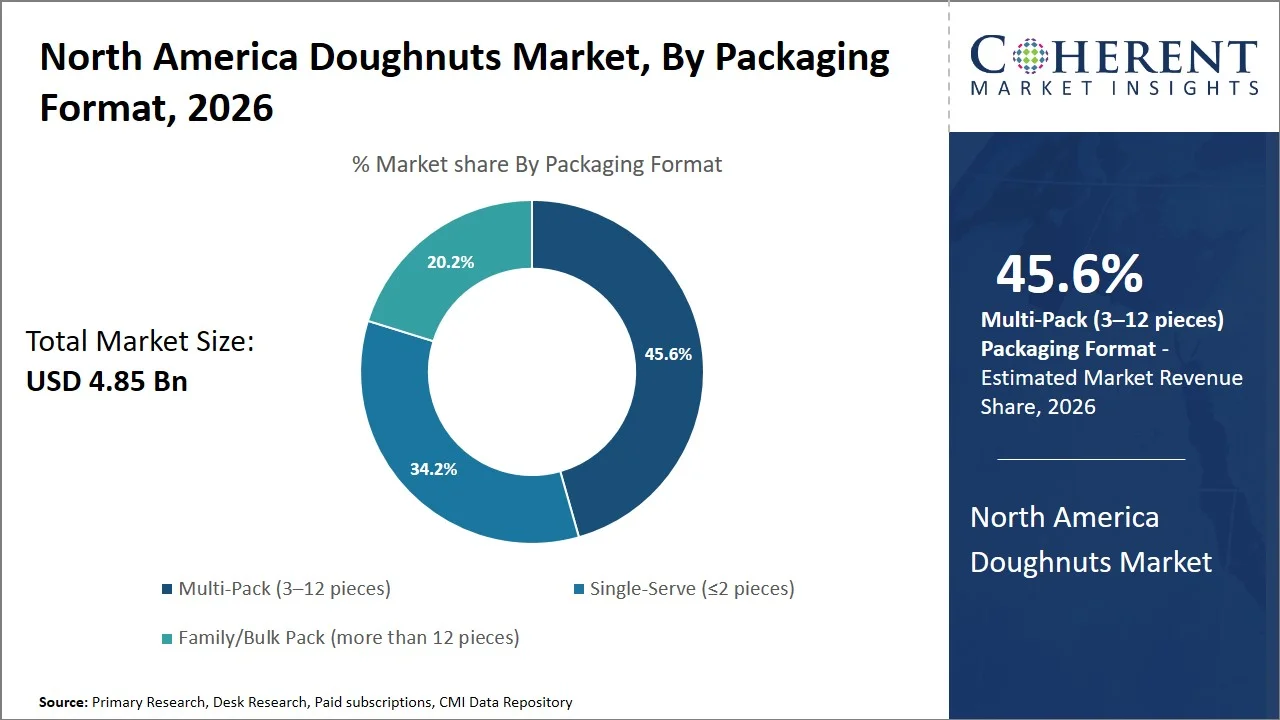
Multi-pack, which ranges from 3 packages to 12 packages, is likely to lead the North America doughnuts market with an estimated 45.6% share in 2026, backed by the good value perception, household sharing, and bulk-buying behavior. Multi-pack doughnuts are preferred by consumers for eating at home, using at work, for the family and weekly grocery shopping as they typically provide more value for money than single packs. Multi-packs also can help retailers optimize the use of their shelves, streamline restocking and enable quicker product rotation in bakery and
packaged foods aisles. Multi-piece formats are well distributed, for example, Krispy Kreme Original Glazed Doughnuts are available at Walmart in 6-count and 12-count sizes, as well as private label mini packs. But one-serving packages have also become popular, as more families consist of just a single person and more people snack on an individual basis. The U.S. Census Bureau reported that in 2024, one-person households made up 29% of the U.S. household population, representing 38.5 million of these households, which fuels the market for smaller, portable and portion-controlled doughnut packs. (Source: U.S. Census Bureau)
Food Service Channels Segment Dominates the North America Doughnuts Market
The food service channels segment is projected to account for 71.3% share of the market by 2026. Foodservice channels such as quick service restaurants, cafes, and bakeries allow consumers to enjoy donuts for a quick snack or treat. Quick-service restaurants also offer fresh donut options in a variety of flavors unlike packaged donuts. For instance, Krispy Kreme Doughnut Inc. has emerged as a key growth player, with approximately 51% of consumers showing a preference for purchasing freshly baked doughnuts through its Delivery Fresh Daily (DFD) distribution model. (Source: Food Business News)
Currents Events and their Impact
Current Events | Description and its Impact |
U.S. FDA Revokes Authorization for FD&C Red No. 3 in Food |
|
Canada Implements Mandatory Front-of-Package Nutrition Labelling |
|
U.S. FDA Proposes Front-of-Package Nutrition Labelling |
|
California Food Safety Act Restricts Certain Food Additives |
|
(Source: Food & Drug Administration, Government of Canada)
North America Doughnuts Market Dynamics
Market Drivers
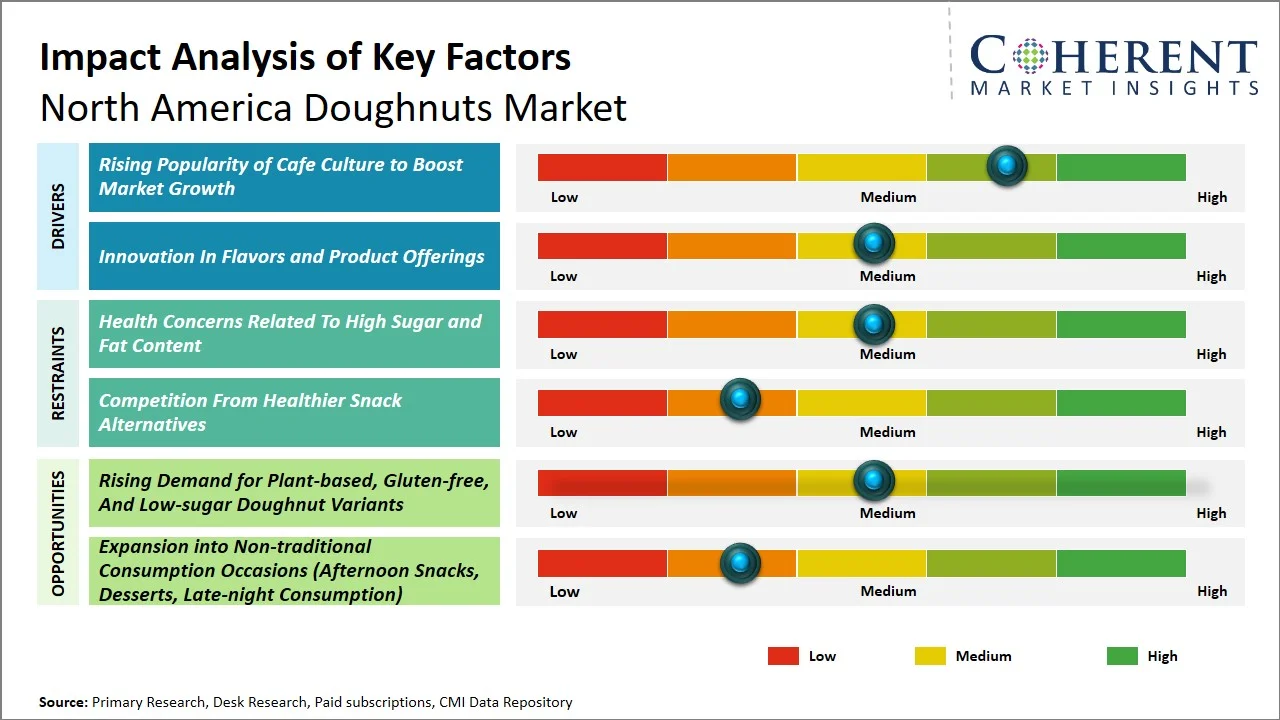
- Rising Popularity of Cafe Culture to Boost Market Growth: Cafes are extending the consumption occasion for donuts beyond breakfast, giving consumers the choice to enjoy them as a snack, dessert or during study or work breaks. Shipley Do-Nuts, a leading U.S. doughnut chain, reports that nearly 75% of its doughnuts are consumed in the morning alongside coffee, highlighting the strong breakfast and beverage-pairing demand for doughnuts. The premium donut experience that goes beyond the typical grab-and-go option that cafes offer, adds to the overall value proposition of the donut. (Source: Shipley Do-Nuts)
- Innovation in Flavors and Product Offerings: Limited-time flavor launches have become a key traffic-generation strategy, with brands introducing varieties inspired by global desserts, savory spices, and alcohol-flavored profiles. These offerings help attract novelty-seeking consumers, while savory options such as chili-lime appeal to shoppers looking for cross-category snacking experiences. Furthermore, rapid-fit lines incorporating natural colorants and encapsulated fillings have continued to maintain shelf stability since 2024, while reducing reformulation cycles. Chains copy the pace of fashion drops and drop new flavors every four to six weeks to stay relevant. Flavor flexibility is a hedge against commodity fluctuations, while premium positioning allows operators to hold onto margins even as input costs rise. In addition, Krispy Kreme launched the “Craving Cheesecake” collection in New York in April 2025 with three new cheesecake-inspired doughnut flavors: strawberry dream cheesecake, cookies and kreme cheesecake and caramel delight cheesecake. These flavors are available for a limited time at participating locations. (Source: Food Business News)
Emerging Trends
- Gourmet doughnut experiences: Doughnuts are evolving from basic bakery items into gourmet, experience-led products, supported by artisanal recipes, innovative flavors, premium fillings, and visually appealing designs. Brands are strengthening consumer engagement and improving price realization through limited-time launches, seasonal menus, themed collections, and customized offerings.
- The Move towards Healthier Options: Innovation is driving the industry as baked, low-sugar, gluten-free and plant-based doughnuts are leading the way for the healthier option, while brands target health-conscious and diet-specific consumers.
How is evolving consumer demand creating new growth opportunities in the North America doughnuts market?
Brands are shifting away from traditional glazed formats and experimenting with artisanal and gourmet products, as the demand for these premium and indulgent products increases. For instance, high-end chains and specialty bakeries in cities such as New York and Los Angeles are trying brioche doughnuts, new fillings (matcha, salted caramel, pistachio) and limited edition partnerships, which enables them to offer a much higher price point while establishing a strong brand presence. This transformation is morphing doughnuts from a low-cost commodity to a more experiential item, offering the opportunity of increased margins.
Flavor Innovation, Coffee Pairing Dependency Ratio (% of doughnut purchases made alongside coffee beverages)
Metric Level | Market Interpretation |
High Flavor Innovation + High Coffee Pairing | Experience-led café brands, premium positioning, strong morning/daypart traffic |
High Flavor Innovation + Low Coffee Pairing | Dessert-led brands driven by indulgence and impulse snacking |
Low Flavor Innovation + High Coffee Pairing | Legacy breakfast chains dependent on routine consumption |
Low Flavor Innovation + Low Coffee Pairing | Mature brands facing commoditization and weaker consumer engagement |
Market Players, Key Development, and Competitive Intelligence
Key Developments
- In March 2025, Krispy Kreme announced expansion into Brazil through a joint venture with Ipiranga's AmPm convenience store chain, leveraging AmPm's 1,500-location network for efficient scaling. This capital-light franchise strategy demonstrates how global brands are penetrating emerging markets through strategic partnerships with established retail infrastructure.
- In October 2024, Grupo Bimbo announced acquisitions in Eastern Europe and South America, including Don in Serbia, Slovenia, Croatia, and Montenegro, plus Wickbold in Brazil, expanding its global footprint in packaged bread and sweet baked goods markets. These transactions reflect active merger and acquisition strategies focused on geographic expansion and market consolidation.
- In August 2024, Krispy Kreme opened its first shop in Morocco in partnership with franchisee Americana, featuring local flavors and gluten-free options alongside the Hot Light Theatre Shop concept. This expansion demonstrates how global brands are adapting to regional preferences while maintaining core brand identity.
Competitive Landscape
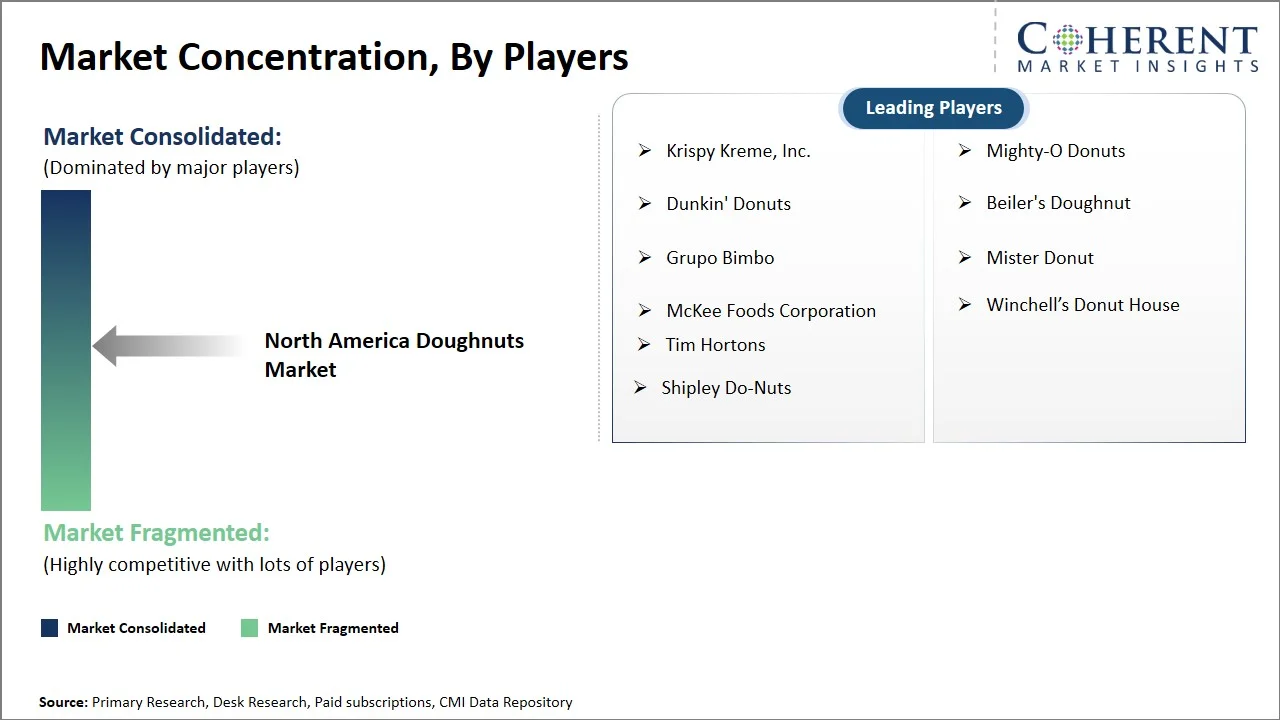
The North America doughnuts market is highly competitive, with large bakery chains, coffee shop brands, quick-service restaurants, supermarkets, convenience stores, and local artisanal doughnut shops competing on product taste, pricing, freshness, convenience, and brand loyalty. Key players are focusing on new flavors, premium doughnuts, seasonal product launches, digital ordering, delivery partnerships, and store expansion to attract regular consumers. Companies are also using coffee-and-doughnut combinations, loyalty programs, and limited-time offers to increase repeat purchases. The market competition is expected to remain strong as consumers continue to demand indulgent, convenient, and affordable bakery snacks.
Key focus areas include
- Launch of premium, filled, glazed, mini, and seasonal doughnuts to attract young consumers and increase product variety
- Expansion of café, QSR, supermarket, and convenience store distribution to improve product availability across urban and suburban areas
- Use of online ordering, delivery apps, and loyalty programs to increase customer engagement and repeat sales
- Focus on fresh, affordable, and on-the-go bakery products to support breakfast and snacking demand
- Partnerships with coffee chains, retailers, and foodservice operators to strengthen brand visibility and market reach
- Development of better-for-you options, including smaller portion sizes, vegan doughnuts, baked variants, and clean-label ingredients, to target health-conscious consumers
Market Report Scope
North America Doughnuts Market Report Coverage
| Report Coverage | Details | ||
|---|---|---|---|
| Base Year: | 2025 | Market Size in 2026: | USD 4.85 Bn |
| Historical Data for: | 2020 To 2024 | Forecast Period: | 2026 To 2033 |
| Forecast Period 2026 to 2033 CAGR: | 5.2% | 2033 Value Projection: | USD 6.91 Bn |
| Segments covered: |
| ||
| Companies covered: | Krispy Kreme, Inc., Dunkin' Donuts, Grupo Bimbo, McKee Foods Corporation, Tim Hortons, Shipley Do-Nuts, Mighty-O Donuts, Beiler's Doughnuts, Mister Donut, and Winchell’s Donut House | ||
| Growth Drivers: |
| ||
| Restraints & Challenges: |
| ||
Analyst Opinion (Expert Opinion)
- The North America doughnuts market is expected to witness steady growth due to strong consumer demand for convenient, indulgent, and ready-to-eat bakery products. Doughnuts remain a popular breakfast and snacking option across the U.S., Canada, and Mexico, supported by coffee shop culture, quick-service restaurants, supermarkets, and convenience stores. Rising preference for fresh, affordable, and on-the-go food products is expected to support market expansion.
- The strongest growth opportunities are likely to come from premium, filled, glazed, mini, and specialty doughnuts, as consumers are increasingly looking for new flavors, seasonal products, and unique bakery experiences. The U.S. is expected to remain the leading market due to the strong presence of major brands, large consumer base, and well-developed foodservice network. Canada and Mexico are also expected to grow steadily with rising bakery consumption and expanding retail availability.
- To gain a competitive advantage, market players should focus on product innovation, store expansion, digital ordering, delivery partnerships, and loyalty programs. Companies offering fresh products, attractive pricing, premium flavors, coffee-and-doughnut combinations, and better-for-you options such as smaller portions, baked doughnuts, vegan variants, and clean-label ingredients will be better positioned to capture demand across North America.
Speak to the analyst
Want personalized insights?
Take the findings above to one of our principal consultants, or have the report rebuilt around the segments, geographies and competitors you actually track.
Market Segmentation
- Base Type Insights (Revenue, USD Bn, 2021 - 2033)
- Yeast Doughnuts
- Cake Doughnuts
- Packaging Format Insights (Revenue, USD Bn, 2021 - 2033)
- Single-Serve (≤2 pieces)
- Multi-Pack (3–12 pieces)
- Family/Bulk Pack (more than 12 pieces)
- Distribution Channel Insights (Revenue, USD Bn, 2021 - 2033)
- Food Service Channels
- Retail Channels
- Supermarkets/Hypermarkets
- Convenience Stores
- Online Channels
- Others
- Key Players Insights
- Krispy Kreme, Inc.
- Dunkin' Donuts
- Grupo Bimbo
- McKee Foods Corporation
- Tim Hortons
- Shipley Do-Nuts
- Mighty-O Donuts
- Beiler's Doughnuts
- Mister Donut
- Winchell’s Donut House
Sources
Primary Research Interviews
- Doughnut manufacturers (e.g., Krispy Kreme executive)
- Supply Chain Director of bakery products producers (e.g., Grupo Bimbo)
- Dunkin' Brands product specialist
Stakeholders
- Manufacturers of doughnuts and bakery products (e.g., Krispy Kreme, Dunkin' Brands, Tim Hortons, Shipley Do-Nuts)
- End-use Sectors
- Quick-service restaurant chains (e.g., McDonald's, Starbucks)
- Grocery and retail bakers (e.g., General Mills, Entenmann's)
- Convenience stores and cafes (e.g., 7-Eleven, independent donut shops)
- Regulatory & Certification Bodies: FDA (food safety), USDA (bakery standards), ASTM International (food packaging).
- E-commerce Platforms and Retailers: Walmart, Amazon Fresh, specialty bakery suppliers like WebstaurantStore
- Technology Integration Players: Innovators in plant-based and smart baking (e.g., Hostess Brands, Maple Donuts for vegan options)
Databases
- UN Comtrade Database (HS Code 1905 for bakery products, including doughnuts)
- USITC DataWeb for bakery imports/exports
- Statistics Canada trade data for baked goods
- USDA Food Market Reports (bakery sector aggregates)
Magazines
- Modern Baking – Trends in donuts and bakery innovations
- Bakers Journal – North American doughnut production and flavors
- Bakery Business – Retail and wholesale donut trends
- Food Business News – Snack and indulgence bakery products
- Progressive Grocer – Consumer packaged doughnuts
Journals
- Journal of Food Science – Doughnut formulation and shelf-life studies
- Food Chemistry – Ingredients and quality testing for fried dough products
- Journal of Bakery and Snack Technology – Processing innovations
- International Journal of Food Engineering – Thermal impacts on doughnuts
- Trends in Food Science & Technology – Healthier doughnut advancements
Newspapers
- The Wall Street Journal – QSR demand for indulgent snacks like doughnuts
Associations
- American Bakers Association (ABA)
- Baking Association of Canada (BAC)
- Retail Bakers Association (RBA)
- International Dairy Deli Bakery Association (IDDBA)
- American Society of Baking (ASB)
- Wheat Foods Council
Public Domain Sources
- FDA – Guidelines for bakery product safety and nutrition labeling
- USDA – Reports on baked goods consumption and trade
- Health Canada – Food standards for fried snacks
- OECD – Food industry trade reports for North America
Proprietary Elements
- CMI Data Analytics Tool, Proprietary CMI Existing Repository of information for last 10 years.
Get access to 250+ pages report
Every segment, forecast, competitor profile and data table behind the analysis above — available for instant download.
- ESOMAR Member
- ISO 9001:2015 Certified
- D-U-N-S Registered
- GDPR & CCPA Compliant
Missing comfort of reading report in your local language? Find your preferred language:
Transform your Strategy with Exclusive Trending Reports
Frequently Asked Questions
The North America doughnuts market is estimated to be valued at USD 4.85 Bn in 2026 and is expected to reach USD 6.91 Bn by 2033.
The CAGR of the North America doughnuts market is projected to be 5.2% from 2026 to 2033.
Rising popularity of cafe culture to boost market growth and innovation in flavors and product offerings are the major factors driving the growth of the North America doughnuts market.
Online ordering, app-based delivery, and subscription snack models are increasing product accessibility and driving repeat purchases, especially in urban areas.
Mobile ordering, delivery apps, loyalty programs, and digital promotions are significantly increasing customer retention and impulse purchases, especially in urban markets across the U.S. and Canada.
Health concerns related to high sugar and fat content and competition from healthier snack alternatives are the major factors hampering the growth of the North America doughnuts market.
In terms of base type, yeast doughnuts are estimated to dominate the market revenue share in 2026.