

Global Offshore Containers Market Size and Forecast: 2026-2033
The global offshore containers market is expected to grow from USD 1.15 Bn in 2026 to USD 2.30 Bn by 2033, registering a compound annual growth rate (CAGR) of 5% from 2026 to 2033. The global offshore containers market is primarily driven by increasing growth in offshore logistics.
On May 12, 2026, Adani Ports and Special Economic Zone Ltd., India’s largest integrated transport utility, through its marine platform, Astro Offshore, contracted with Oceaneering International Inc., a U.S.-based engineering and applied technology company, to pursue specialized offshore and subsea opportunities in Europe. (Source: Adani)
Key Takeaways of the Global Offshore Containers Market
- The closed containers segment is expected to account for 41.0 % of the global offshore containers market share in 2026. Close containers are the most preferred as they provide protection against harsh marine conditions like rain, seawater, and UV exposure. On July 24, 2025, OEG, a leading energy solutions business, secured a significant five-year contract with Peterson Energy Logistics in Den Helder for 500 offshore containers to support its operations in the Dutch sector of the North Sea. (Source: OEG)
- The steel segment is estimated to capture 57.0 % of the market share in 2026. Steel containers offer superior durability and long shelf-life. On May 8, 2026, Winner Offshore delivered new DNV 2.7-1 certified steel tank containers for offshore fluid storage and transportation. (Source: Winner Offshore)
- The oil and gas industry segment is estimated to capture 34.0 % of the market share in 2026. Offshore containers are increasingly being adopted for deepwater oil and gas exploration projects. On May 13, 2026, TotalEnergies and the Egyptian Natural Gas Holding Company (EGAS) signed a Memorandum of Understanding (MoU) on exploration activities. The MoU covers a large area located in the north-western offshore of Egypt. (Source: TotalEnergies)
- Asia Pacific is expected to dominate the offshore containers market in 2026 with a market share of 37%. Growing number of offshore projects is a major factor driving the offshore containers market in Asia Pacific. On September 11, 2025, DOF Group announced a contract for moorings hook-up services in the APAC region. The contract will utilize Skandi Hercules with related mooring and subsea installation services. (Source: DOF)
- North America is expected to account for 28% share in 2026 and is projected to record the fastest growth over the forecast period. Significant investments in the region is a major factor driving the regional market. On May 13, 2025, OEG made a major investment in its first-ever fleet of cryogenic ISO tanks in North America, located at its Houston facility. (Source: OEG)
- Shift toward offshore renewable energy logistics: The rapid expansion of offshore wind and hybrid energy projects is reshaping the demand for offshore containers, with the greater use of modular, corrosion-resistant units for turbine installation, maintenance, and subsea cable operations.
- Stricter safety standards and certified designs: Growing enforcement of regulations such as DNV 2.7-1 and EN 12079 is driving the adoption of high-strength and structural steel, fire-resistant, and blast-protected container designs, especially for hazardous material transport.
Segmental Insights
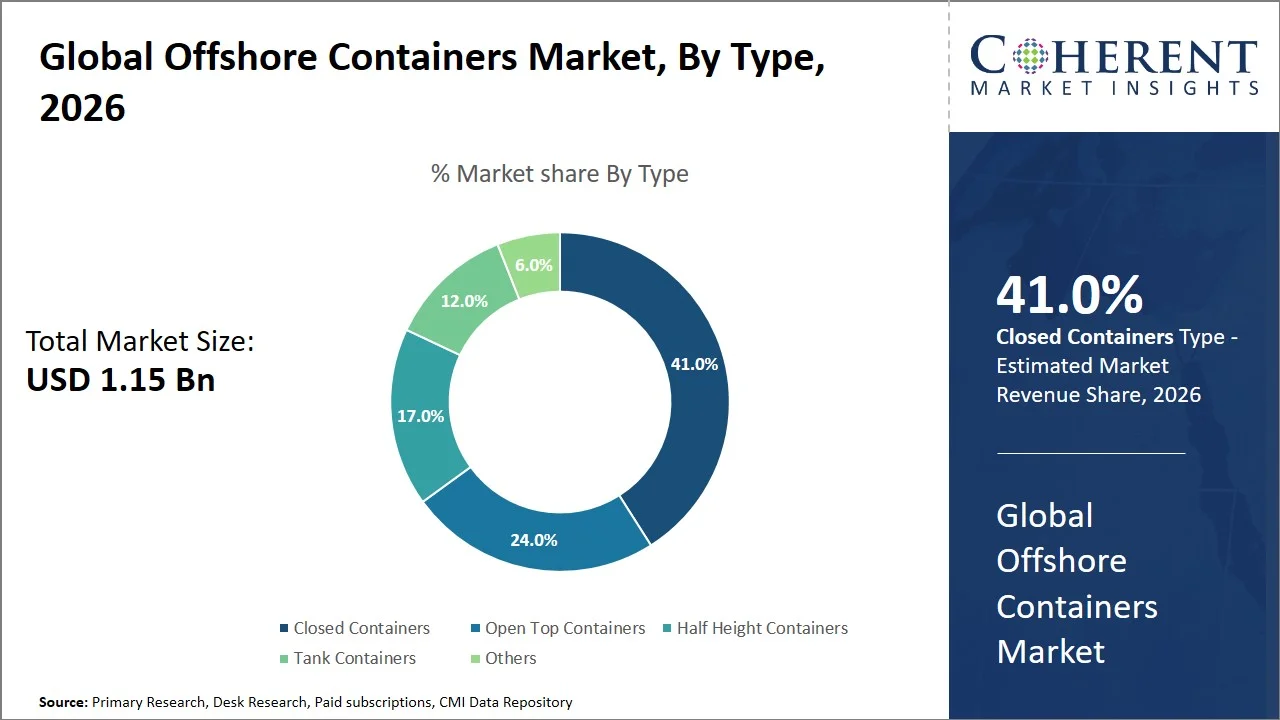
Why Do Closed Containers Dominate the Global Offshore Containers Market?
The closed containers segment is expected to account for 41.0% of the global offshore containers market share in 2026. Offshore containers are resilient in harsh conditions such as rain, extreme humidity, and ultra-violet radiations. On May 8, 2026, Winner Offshore, a manufacturer of offshore engineering equipment, announced that it has secured bulk orders for its DNV 2.7-1 certified Offshore Workspace Modules, marking the official entry of China’s customized offshore cabins into the high-end market. Built on a standard container frame, these modules integrate tool cabinets, testing equipment benches and explosion-proof lighting systems. (Source: Winner Offshore)
- Current Industry Events of 2026
- Market Size Estimation
- Regional Breakdown
- Competitive Landscape
- Customer Intelligence
- Segmental Analysis
- Pricing Analysis
- Key Market Drivers, Challenges & Future Trends
- Customized Insights Section
Why is Steel the Most Preferred Material?
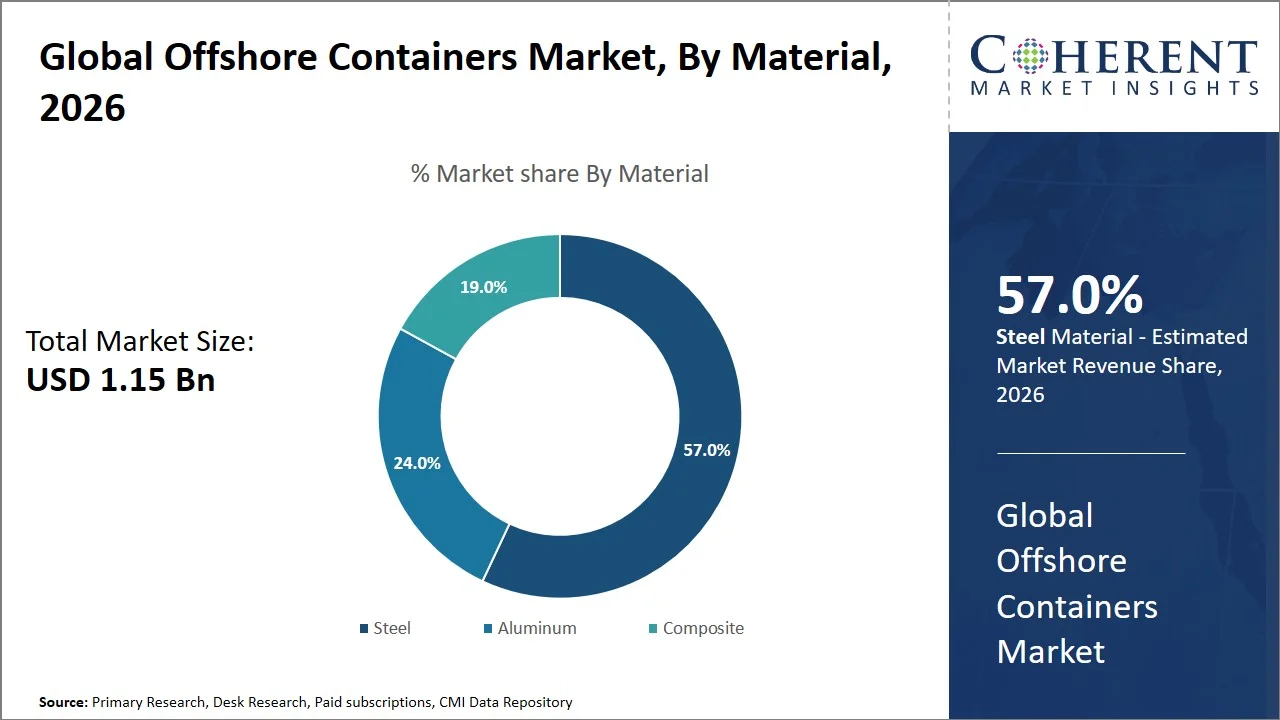
The steel segment is expected to account for 57.0% of the global offshore containers market share in 2026. Growing adoption of steel for improved resilience and durability is a major growth factor. On February 13, 2026, Jindal Stainless, India’s leading stainless-steel manufacturer, developed the country’s first stainless steel container for salt transport for Indian Railways. The integration of stainless steel into salt transport logistics marks a pioneering step towards more durable and sustainable freight operations. (Source: Jindal)
Oil and Gas Industry Segment Dominates the Global Offshore Containers Market
The oil and gas industry is expected to account for 34.0% of the global offshore containers market share in 2026. Rising need for containers in deep-sea oil and gas explorations is a major factor for the segment growth. On May 8, 2026, Winner Offshore deployed offshore-grade steel cargo baskets for oil & gas platform logistics in the South China Sea. The baskets are manufactured using offshore weathering steel and hot-dip galvanizing for marine corrosion resistance.
(Source: Winner Offshore)
Currents Events and their Impact
Current Events | Description and its Impact |
IMO Amendments on Lost Containers Reporting (2026) |
|
(Source: IMO)
Offshore Containers Market Dynamics
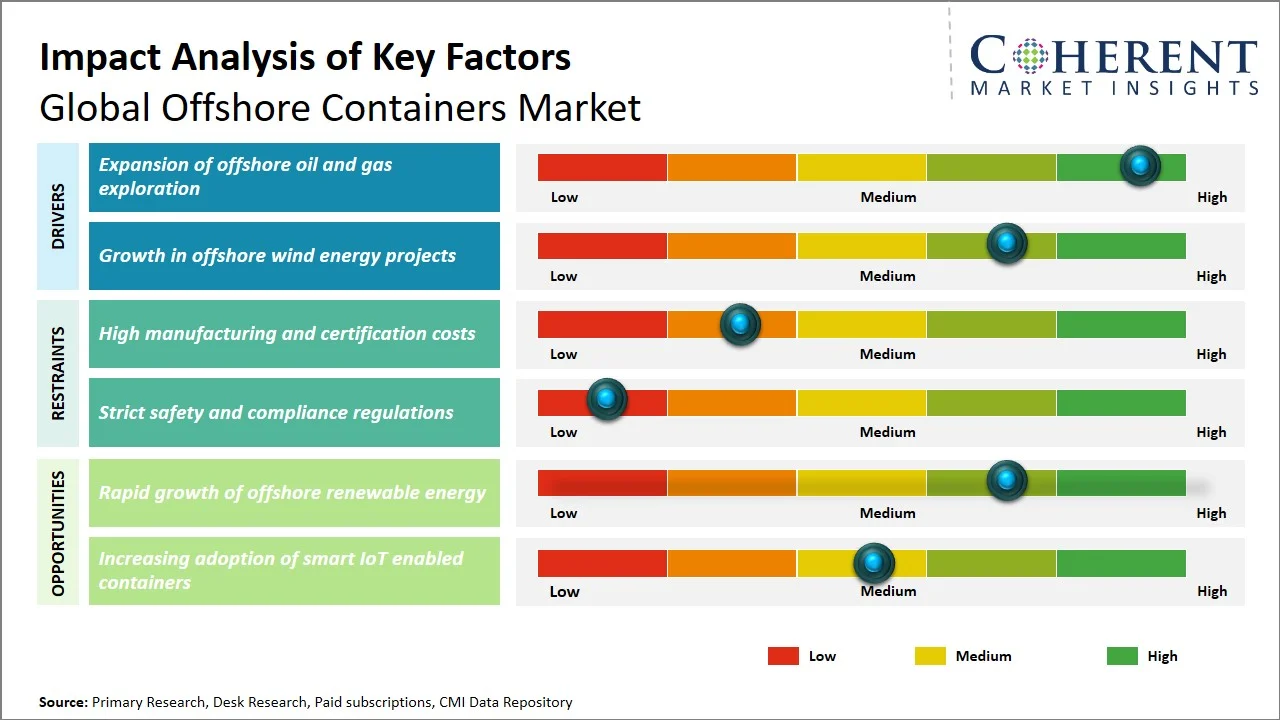
Market Drivers
- Expansion of offshore oil and gas exploration: The increasing focus on exploring and developing offshore oil and gas reserves is a significant driver propelling the demand for offshore containers. As energy companies venture into deeper and more remote offshore locations, the need for robust, reliable, and specialized containers designed to withstand harsh marine environments intensifies. These containers are essential for the safe storage and transportation of equipment, chemicals, and materials required for offshore drilling, production, and maintenance operations. On April 2, 2026, Shell, TotalEnergies, BP, Repsol, and Chevron showed interest in acquiring a majority stake in the Shenandoah ultra-deepwater oil field in the U.S. Gulf of Mexico. (Source: Reuters)
- Growth in offshore wind energy projects: The growth of offshore wind energy projects is accelerating globally due to rising demand for clean energy and strong government decarbonization targets, particularly in regions like Europe, China, and the Asia Pacific. Large-scale offshore wind farms are being developed to harness stronger and more consistent wind resources at sea, leading to increased investments in turbines, installation vessels, and supporting offshore logistics infrastructure. On March 31, 2026, Ørsted began the installation of turbines at the Sunrise Wind offshore project near New York. The project will use 84 Siemens Gamesa 11 MW turbines and will power hundreds of thousands of homes once completed. (Source: Offshore Wind)
Emerging Trends
- Smart and digitally connected containers: Offshore containers are increasingly being equipped with IoT sensors, GPS tracking, and real-time monitoring systems to improve cargo visibility, enhance safety, and enable predictive maintenance in offshore supply chains.
- Growth of leasing, modularization, and customization: Operators are shifting toward rental-based models and highly customized container solutions (tank, reefer, workshop, and waste units), enabling cost efficiency and flexibility in dynamic offshore projects.
Regional Insights
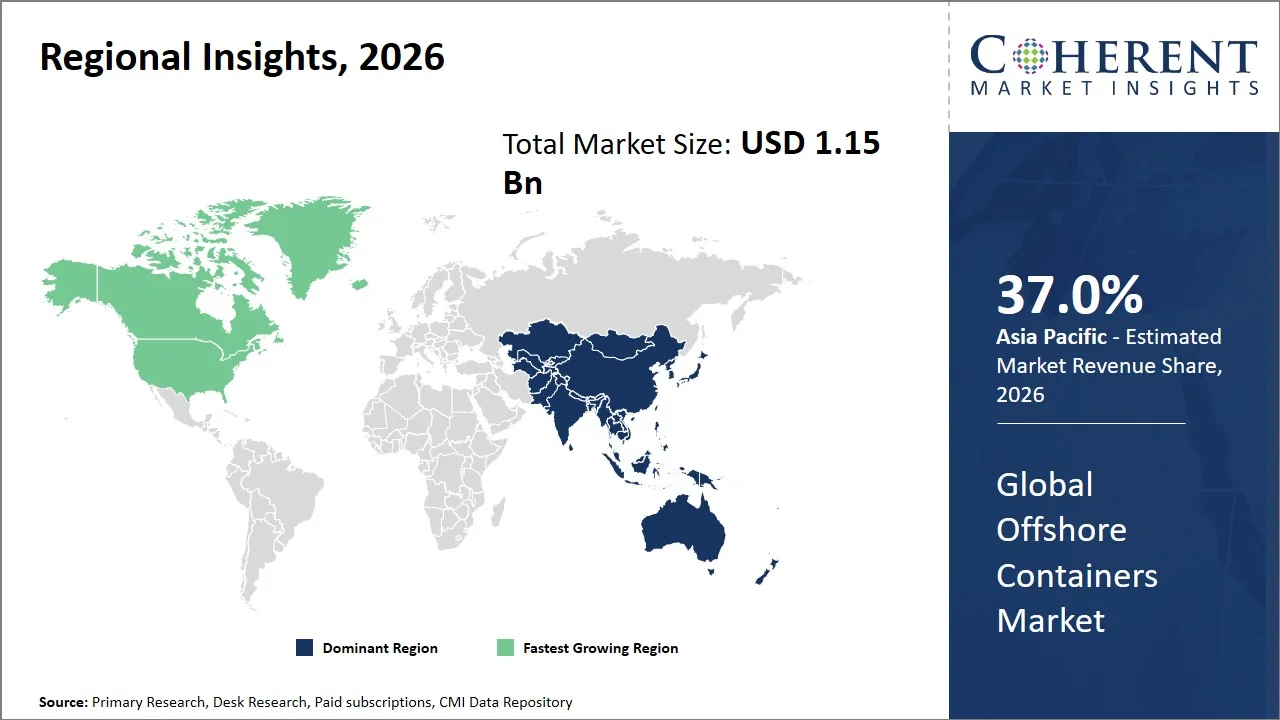
Why is Asia Pacific a Strong Market for Offshore Containers?
Asia Pacific is expected to account for a market share of 37% in 2026. Rapid industrialization, expanding maritime infrastructure, and government initiatives aimed at boosting offshore energy production significantly contribute to market expansion. The Asia Pacific ecosystem benefits from a growing shipbuilding industry and proximity to emerging offshore oil and gas fields, driving demand for innovative and cost-effective container solutions. Additionally, local manufacturers such as DNV Solutions (China), Sinokor Merchant Marine (South Korea), and local divisions of multinational companies are increasingly investing in product development to meet both international safety standards and regional operational demands. On April 30, 2026, Orient Overseas Container Line Ltd. (OOCL) announced the order of 12 13,600 TEU class LNG dual-fuel container vessels, marking another important step forward in the Company's efforts to advance low‑carbon shipping and energy transition. (Source: OOCL)
Why Does the North America Offshore Containers Market Exhibit High Growth?
North America is projected to account for 28% of the global offshore containers market and expected to register the fastest growth. OEG expanded its North American offshore logistics footprint by acquiring Trinity Rental Services and scaling its Gulf of Mexico fleet of DNV-certified offshore containers (CCUs), including baskets, tanks, and closed units, to support increasing offshore drilling and production activity in U.S. waters. On July 16, 2025, OEG announced the strategic expansion of its U.S. footprint and capabilities through the acquisition of Trinity Rental Services (TRS), and its vertically integrated affiliates. The acquisition strengthens the firm’s market position, further enhancing its capabilities and increasing its fleet availability and choice to support customers in the region. (Source: OEG)
Why is China Emerging as a Major Hub in the Offshore Containers Market?
China’s offshore containers market is expanding rapidly due to significant offshore oil exploration along its extensive coastline and investments in offshore wind projects. The country’s growing shipbuilding industry and manufacturing capabilities support large-scale production of diverse offshore container types. Domestic players such as COSCO Shipping and DNV Solutions leverage local supply chains and government incentives to meet rising demand. Moreover, the Chinese government fosters offshore infrastructure development through targeted policies, further propelling market growth.
Is the U.S. the Next Growth Engine for the Offshore Containers Market?
In the U.S. Gulf of Mexico, Chevron’s Anchor deepwater project and BP’s approved USD 5 billion Tiber - Guadalupe ultra-deepwater development have directly increased the deployment of steel offshore containers and modular cargo systems through service providers like Tiger Offshore Rentals and SOC for drilling support and subsea logistics.
Germany Offshore Containers Market Analysis and Trends
In Germany, offshore container demand is being reinforced by offshore wind expansion in the North Sea, where RWE’s Nordseecluster offshore wind project is driving the use of DNV-certified steel transport containers and modular equipment units for turbine installation and offshore construction logistics managed through European offshore service contractors.
In India, offshore container usage has increased with ONGC’s deepwater exploration and production activities in the Krishna–Godavari Basin and Mumbai High offshore fields, where logistics operators and marine contractors deploy DNV 2.7-1 certified steel containers and baskets for equipment transport and offshore platform supply operations.
How is Rapid Growth of Offshore Renewable Energy Creating New Growth Opportunities in the Offshore Containers Market?
The burgeoning expansion of the offshore renewable energy sector, particularly offshore wind farms, presents a substantial opportunity for the Global Offshore Containers Market. As countries worldwide intensify efforts to transition toward sustainable energy sources, investment in offshore renewable infrastructure is accelerating at an unprecedented pace. Offshore containers, crucial for the transportation, storage, and protection of equipment and materials in harsh marine environments, are witnessing escalated demand driven by this trend. The complexities involved in the installation and maintenance of offshore turbines and related infrastructure necessitate specialized containers that ensure safety, durability, and efficiency in logistics operations. On January 14, 2026, RWE announced that it had agreed to sell a 50% stake in its Norfolk Vanguard East and West offshore wind projects to investor KKR, after the German utility emerged as one of the winners in a milestone U.K. renewables auction. (Source: Reuters)
Global Offshore Containers Market - Certification Compliance Penetration
Certification | Estimated Global Penetration |
DNV 2.7-1 Offshore Container Standard | 65–75% |
EN 12079 Offshore Container Standard | 15–25% |
ISO 10855 Offshore Container Standard | 10–20% (rising) |
Global Offshore Containers Market - Inspection & Recertification Frequency
Activity Type | Frequency | Standard Reference |
Routine Visual Inspection | Every 12 months | DNV 2.7-1 / ISO 10855 |
Thorough Periodic Inspection (incl. NDT if required) | Every 48 months | ISO 10855-3 |
Lifting set inspection (slings, shackles, frames) | Every 6–12 months (depending on operator policy) | DNV 2.7-1 guidelines |
Comprehensive recertification cycle | Typically every 4–5 years (full cycle review) | DNV / ISO / operator rules |
Market Players, Key Development, and Competitive Intelligence
Key Developments
- On February 24, 2026, CMG Containers, a nationwide provider of container-based infrastructure and storage solutions, announced the expanded availability of shipping containers for sale in California, U.S. responding to increasing demand across construction, logistics, agriculture, energy, and commercial sectors throughout the state.
- On March 3, 2025, Oceaneering International, Inc. announced that its Subsea Robotics segment had debuted the newest addition to its Remotely Operated Vehicle (ROV) portfolio, the Momentum Electric Work Class ROV.
Competitive Landscape
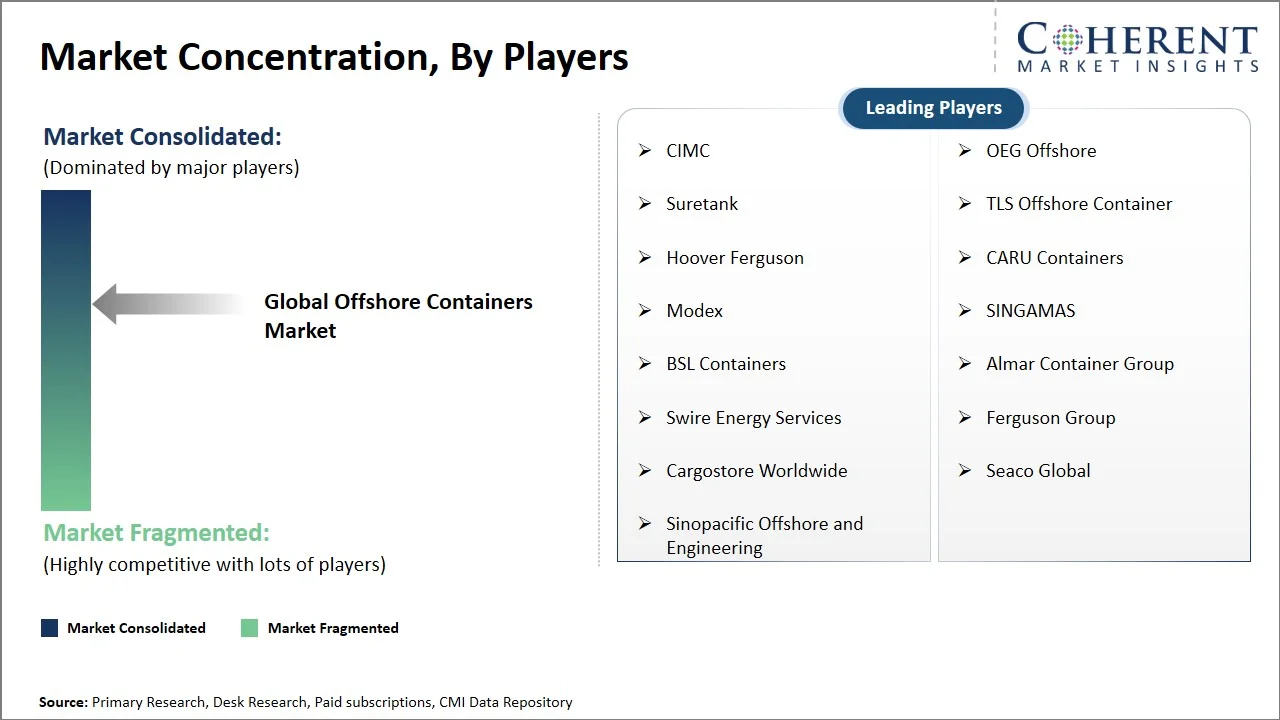
The offshore containers market is highly consolidated at the top and fragmented below Tier-1 players, with major global manufacturers and rental/service providers dominating supply to oil & gas and offshore wind operators. Key players include TLS Offshore Container, Hoover Ferguson, Suretank, OEG Offshore, CIMC, Modex, BSL Containers, and CARU Containers, which compete on certification (DNV 2.7-1 compliance), product durability, and global rental fleet size. Tier-1 companies are strengthening positions through acquisitions, regional expansion (especially Gulf of Mexico, North Sea, and Asia Pacific), and fleet modernization with smart and modular containers, while regional players compete on cost efficiency and customization.
Market Report Scope
Offshore Containers Market Report Coverage
| Report Coverage | Details | ||
|---|---|---|---|
| Base Year: | 2025 | Market Size in 2026: | USD 1.15 Bn |
| Historical Data for: | 2020 To 2024 | Forecast Period: | 2026 To 2033 |
| Forecast Period 2026 to 2033 CAGR: | 5% | 2033 Value Projection: | USD 2.30 Bn |
| Geographies covered: |
| ||
| Segments covered: |
| ||
| Companies covered: | CIMC, OEG Offshore, Suretank, TLS Offshore Container, Hoover Ferguson, CARU Containers, Modex, SINGAMAS, BSL Containers, Almar Container Group, Swire Energy Services, Ferguson Group, Cargostore Worldwide, Seaco Global, and Sinopacific Offshore and Engineering | ||
| Growth Drivers: |
| ||
| Restraints & Challenges: |
| ||
Analyst Opinion (Expert Opinion)
- The offshore containers market is a steady-growth, infrastructure-linked niche market rather than a cyclical one, supported by long-term offshore oil & gas production needs and accelerating offshore wind deployment. North America, particularly the U.S. Gulf of Mexico, is seen as a high-margin market due to deepwater activity and strong leasing demand, while Europe leads in regulatory-driven premium container adoption. It can also be observed that digitalization (IoT tracking, smart containers) and rental-based business models are becoming key profitability drivers, reducing capex burden for operators and increasing recurring revenue for suppliers.
- The offshore containers market is expected to grow steadily through 2030 as deepwater oil & gas exploration, offshore wind expansion, and subsea infrastructure projects intensify globally. Future demand will increasingly shift toward high-specification steel containers, smart monitoring-enabled cargo carrying units (CCUs), and modular multi-use container systems designed for both energy and wind applications. Growth will be particularly strong in North America (Gulf of Mexico), Europe (North Sea offshore wind), and Asia Pacific (offshore LNG and wind hubs). Over the long term, the industry is likely to evolve into a digitally managed offshore logistics ecosystem, where containers are fully traceable assets integrated into AI-based supply chain systems, improving safety, utilization rates, and lifecycle efficiency.
Speak to the analyst
Want personalized insights?
Take the findings above to one of our principal consultants, or have the report rebuilt around the segments, geographies and competitors you actually track.
Market Segmentation
- Type Insights (Revenue, USD Bn, 2021 - 2033)
- Closed Containers
- Open Top Containers
- Half Height Containers
- Tank Containers
- Others
- Material Insights (Revenue, USD Bn, 2021 - 2033)
- Steel
- Aluminum
- Composite
- Application Insights (Revenue, USD Bn, 2021 - 2033)
- Oil and Gas Industry
- Offshore Wind Energy
- Marine Transportation
- Defense and Offshore Support Operations
- Regional Insights (Revenue, USD Bn, 2021 - 2033)
- North America
- U.S.
- Canada
- Latin America
- Brazil
- Argentina
- Mexico
- Rest of Latin America
- Europe
- Germany
- U.K.
- Spain
- France
- Italy
- Russia
- Rest of Europe
- Asia Pacific
- China
- India
- Japan
- Australia
- South Korea
- ASEAN
- Rest of Asia Pacific
- Middle East
- GCC Countries
- Israel
- Rest of Middle East
- Africa
- South Africa
- North Africa
- Central Africa
- North America
- Key Players Insights
- CIMC
- OEG Offshore
- Suretank
- TLS Offshore Container
- Hoover Ferguson
- CARU Containers
- Modex
- SINGAMAS
- BSL Containers
- Almar Container Group
- Swire Energy Services
- Ferguson Group
- Cargostore Worldwide
- Seaco Global
- Sinopacific Offshore and Engineering
- Seaco Global
- Sinopacific Offshore and Engineering
Sources
Primary Research Interviews
- Offshore container manufacturers and suppliers
- Oil & gas industry executives and procurement managers
- Maritime shipping and logistics company representatives
- Offshore drilling contractors and platform operators
Magazines
- Offshore Engineer Magazine
- Maritime Logistics Professional
- Oil & Gas Journal Magazine
- Container Management Magazine
Journals
- Journal of Marine Science and Engineering
- Ocean Engineering International Journal
- Maritime Policy & Management Journal
Associations
- International Association of Drilling Contractors (IADC)
- Institute of Marine Engineering, Science & Technology (IMarEST)
- International Maritime Organization (IMO)
- Offshore Energy Association
Public Domain Sources
- International Energy Agency (IEA) reports
- U.S. Energy Information Administration (EIA)
- European Maritime Safety Agency (EMSA)
- Maritime and Coastguard Agency publications
Proprietary Elements
- CMI Data Analytics Tool
- Proprietary CMI Existing Repository of information for last 10 years
Get access to 250+ pages report
Every segment, forecast, competitor profile and data table behind the analysis above — available for instant download.
- ESOMAR Member
- ISO 9001:2015 Certified
- D-U-N-S Registered
- GDPR & CCPA Compliant
Missing comfort of reading report in your local language? Find your preferred language:
Transform your Strategy with Exclusive Trending Reports
Frequently Asked Questions
The global offshore containers market is expected to stand at USD 1.15 Bn in 2026 and is expected to reach USD 2.30 Bn by 2033.
The CAGR of the global offshore containers market is projected to be 5% from 2026 to 2033.
Expansion of offshore oil and gas exploration and growth in offshore wind energy projects are the major factors driving the growth of the global offshore containers market.
High manufacturing and certification costs and strict safety and compliance regulations are the major factors hampering the growth of the global offshore containers market.
In terms of type, the closed containers segment is estimated to dominate the market revenue share in 2026.
CIMC, OEG Offshore, Suretank, TLS Offshore Container, Hoover Ferguson, CARU Containers, Modex, SINGAMAS, BSL Containers, Almar Container Group, Swire Energy Services, Ferguson Group, Cargostore Worldwide, Seaco Global, and Sinopacific Offshore and Engineering are the major players.
Asia Pacific is expected to lead the global offshore containers market in 2026.