

Global Oil, Gas & NGL Water Detection Sensors Market Size and Forecast – 2026 To 2033
The global oil, gas & NGL water detection sensors market is expected to grow from USD 226.4 Mn in 2026 to USD 323.3 Mn by 2033, registering a compound annual growth rate (CAGR) of 5.2% from 2026 to 2033. The global oil, gas & NGL water detection sensors market growth is primarily driven by increasing need to prevent corrosion in pipelines caused by water in hydrocarbons.
For instance, in June 2025, the Alberta Energy Regulator reported that internal corrosion accounted for 43% of all pipeline leaks and ruptures in 2024, making it the leading cause of pipeline failures. The regulator specifically highlighted that water, solids, bacteria, and corrosive fluids inside pipelines accelerate internal corrosion, especially in steel pipelines transporting oil-well effluent.
(Source: Alberta Energy Regulator)
Key Takeaways of the Global Oil, Gas & NGL Water Detection Sensors Market
- The liquid phase segment is expected to account for 53.6 % of the global oil, gas & NGL water detection sensors market share in 2026. Growing demand from subsea oil operations is a key reason driving the segment growth. On March 21, 2025, Shell Brasil, a subsidiary of Shell plc, finalized its investment decision for Gato do Mato, a deep-water project in the pre-salt area of the Santos Basin, offshore Brazil. (Source: Shell)
- The natural gas segment is estimated to capture 43.1 % of the market share in 2026. Growing demand from hydrogen energy is a major factor driving the segment growth. On May 6, 2025, Honeywell announced a new Hydrogen Leak Detector (HLD) solution engineered specifically to identify microscopic hydrogen leaks in real time to help ensure the safety of hydrogen-powered systems. (Source: Honeywell)
- The moisture in gas segment is projected to hold 49.2 % of the global oil, gas & NGL water detection sensors market share in 2026. Pipeline operators continuously monitor moisture levels to prevent corrosion and comply with transmission standards. On January 17, 2025, Pipeline and Hazardous Materials Safety Administration amended the Federal pipeline safety regulations to implement congressional mandates in the Protecting our Infrastructure of Pipelines and Enhancing Safety Act of 2020 to enhance pipeline safety and reduce methane emissions from new and existing gas transmission pipelines (Source: PHMSA)
- North America is expected to dominate the global oil, gas & NGL water detection sensors market in 2026 with a market share of 28.6 %. Increasing initiatives of product advancement and technological development is driving the regional market. On November 13, 2025, Emerson introduced the Fisher ARMOR solution for improving the operation of natural gas utility grid systems. (Source: Emerson)
- Asia Pacific is expected to account for 25.4 % share in 2026 and is projected to record the fastest growth over the forecast period. A growth in LNG processing and storage facilities in Asia Pacific is a key driver. On December 10, 2025, Cryogenic Ogs said it had secured an order from Yokogawa India to supply LNG metering skids. The contract, valued at almost USD 110,000, is expected to be executed over a period of 2,428 weeks. (Source: Business Standard)
- Increase in Subsea Oil & Gas Operations: The growing use of sensors for monitoring underwater pipelines, wellheads and subsea equipment to facilitate enhanced deepwater exploration is expected to provide impetus to the market.
- Growth in Digital Oilfields and Decarbonization: There is increasing requirement of advanced sensors with the rise in number of energy transition projects like green hydrogen production, carbon capture & storage (CCS) and smart refining systems.
Segmental Insights
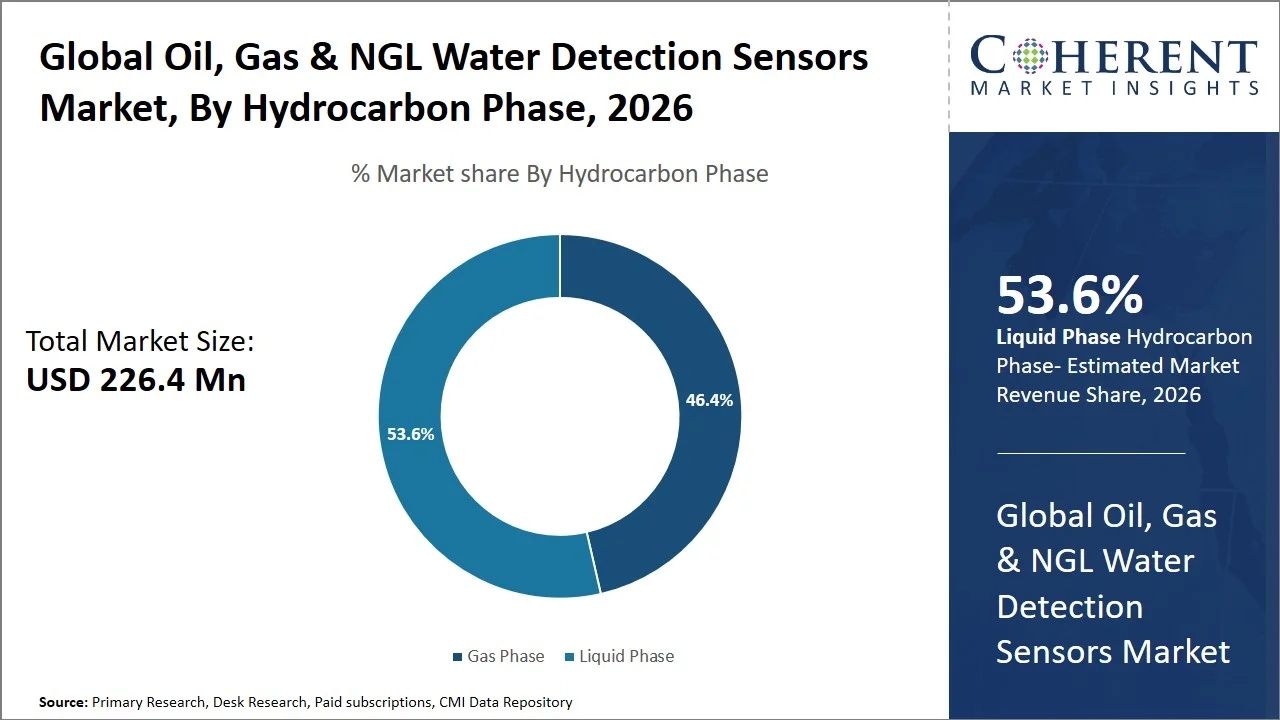
Why Does Liquid Phase Segment Dominate the Global Oil, Gas & NGL Water Detection Sensors Market?
The liquid phase segment is expected to account for 53.6% of the global oil, gas & NGL water detection sensors market share in 2026. The increasing scale of offshore and subsea oil operations are expected to increase the demand for liquid phase sensors. On June 6, 2025, the U.S. Energy Information Administration projected that 13 offshore oil and gas fields in the Gulf of Mexico are expected to begin production during 2025–2026, many using subsea tiebacks and underwater production systems. (Source: EIA)
- Current Industry Events of 2026
- Market Size Estimation
- Regional Breakdown
- Competitive Landscape
- Customer Intelligence
- Segmental Analysis
- Pricing Analysis
- Key Market Drivers, Challenges & Future Trends
- Customized Insights Section
Why is Natural Gas the Most Preferred Stream Type?
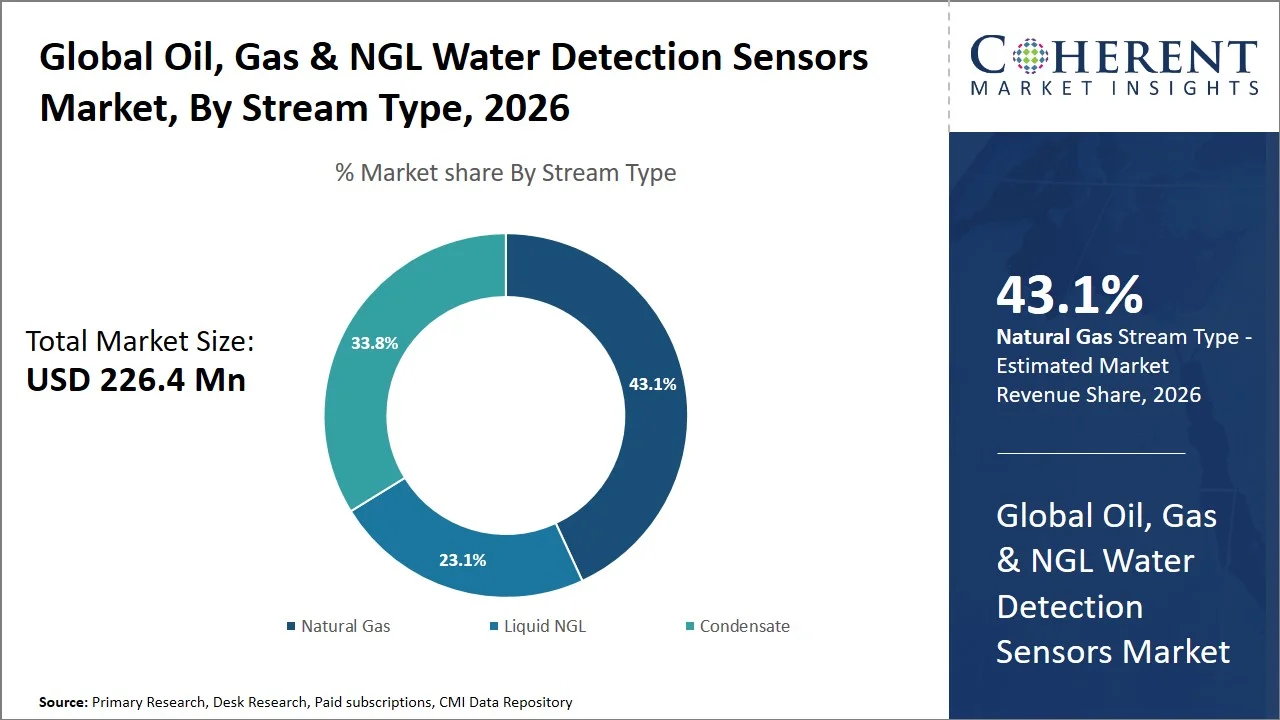
The natural gas segment is expected to account for 43.1% of the global oil, gas & NGL water detection sensors market share in 2026. The increasing requirement of advanced sensors for hydrogen production is driving the demand for the natural gas segment. On February 5, 2026, Researchers at Chalmers University developed a new hydrogen sensor specifically designed to operate effectively in high-humidity environments, a major challenge in hydrogen production and fuel-cell systems. The sensor can detect hydrogen concentrations down to 30 ppm and remained stable after 140 hours of humid-environment testing. (Source: Chalmers)
Moisture in Gas Segment Dominates the Global Oil, Gas & NGL Water Detection Sensors Market
The moisture in gas segment is expected to account for 49.2% of the global Oil, Gas & NGL water detection sensors market share in 2026. The presence of moisture in gas pipelines results in corrosion, which can lead to severe leakages. Operators constantly monitor pipeline networks to detect moisture. On May 28, 2025, the Department of Environmental Quality reported that a pipeline failure in northwest North Dakota, U.S., caused an estimated 73,000 barrels, or nearly 3.1 million gallons, of brine to spill in Williams County. (Source: North Dakota Monitor)
Currents Events and their Impact
Current Events | Description and its Impact |
PHMSA Gas Pipeline Leak Detection & Repair Rule (2025, U. S. ) |
|
EU Methane Emissions Regulation (EU, 2024–2027) |
|
(Source: Congress, European Commission)
Global Oil, Gas & NGL Water Detection Sensors Market Dynamics
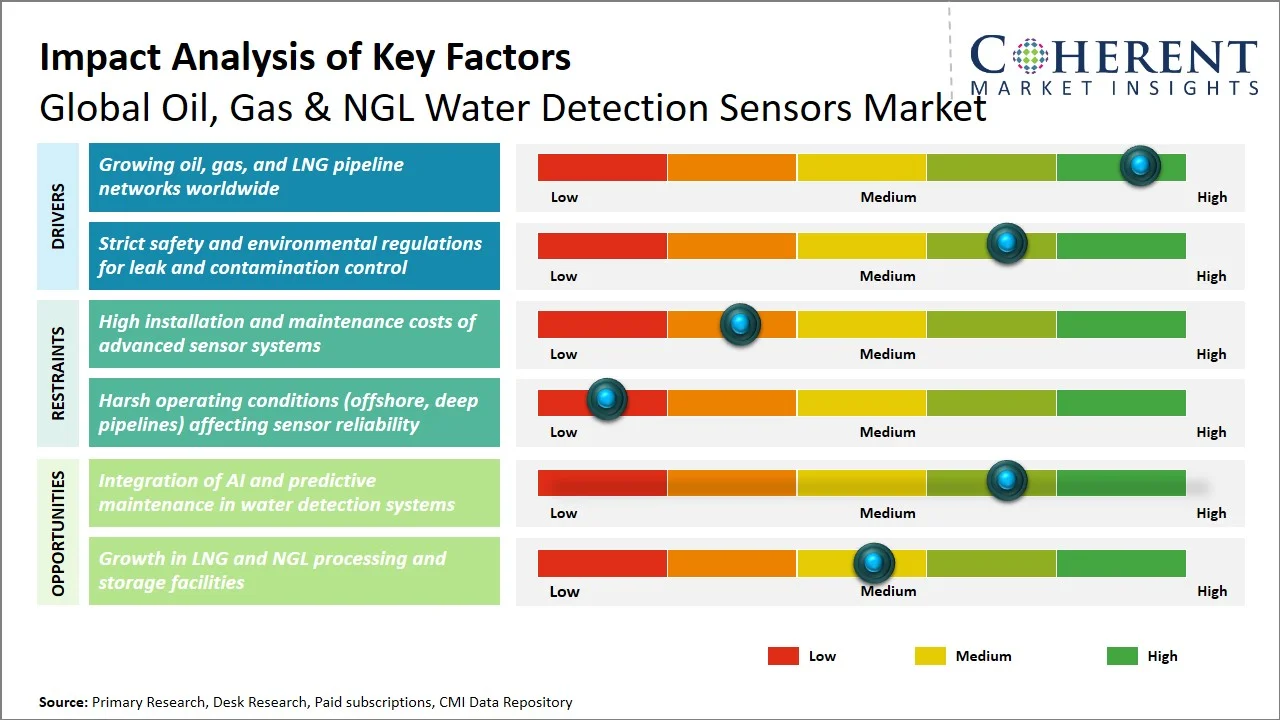
Market Drivers
- Growing oil, gas, and LNG pipeline networks worldwide: Recent pipeline expansion is being driven by specific large-scale projects such as the U.S. Gulf Coast LNG export-linked pipeline buildouts (supporting terminals like Plaquemines and Corpus Christi Stage 3), China’s West–East Gas Pipeline Phase IV expansion (improving inland gas distribution from Xinjiang to eastern industrial hubs), and India’s Jagdishpur, Haldia & Bokaro, Dhamra Gas Pipeline (JHBDPL) completion and integration into the national gas grid. In parallel, Europe is accelerating LNG-connected pipeline reinforcements through the Baltic Pipe and expanded interconnectors after reduced Russian gas flows, while the Middle East is expanding export-linked networks tied to Qatar’s North Field LNG expansion. (Source: U.S. Department of Energy)
- Strict safety and environmental regulations for leak and contamination control: Recent regulatory pressure is being shaped by specific frameworks such as the U.S. PHMSA 2025 methane leak detection and repair rule requiring continuous monitoring across 8 million miles of gas pipelines, the EU Methane Regulation (2024) mandating MRV (measurement, reporting, verification) of methane emissions across the entire oil and gas supply chain including imports, and Canada’s Federal Methane Regulations under the Canadian Environmental Protection Act tightening upstream leak detection requirements by 2030 targets. In parallel, India’s PNGRB technical standards for cross-country natural gas pipelines enforce stricter integrity management and gas quality (including moisture limits), while Australia’s offshore safety regulations under NOPSEMA require real-time monitoring of subsea pipeline integrity and contamination risks. (Source: Government of Canada)
Emerging Trends
- AI-driven predictive monitoring: Companies are increasingly integrating artificial intelligence and machine learning with water detection sensors to predict moisture intrusion and corrosion risks before they occur, improving preventive maintenance and reducing unplanned shutdowns.
- Adoption of wireless and low-power technologies: There is growing demand for wireless, battery-efficient, and sometimes energy-harvesting sensors that can be deployed in remote or hazardous environments such as offshore rigs and deep pipelines with minimal maintenance.
Regional Insights
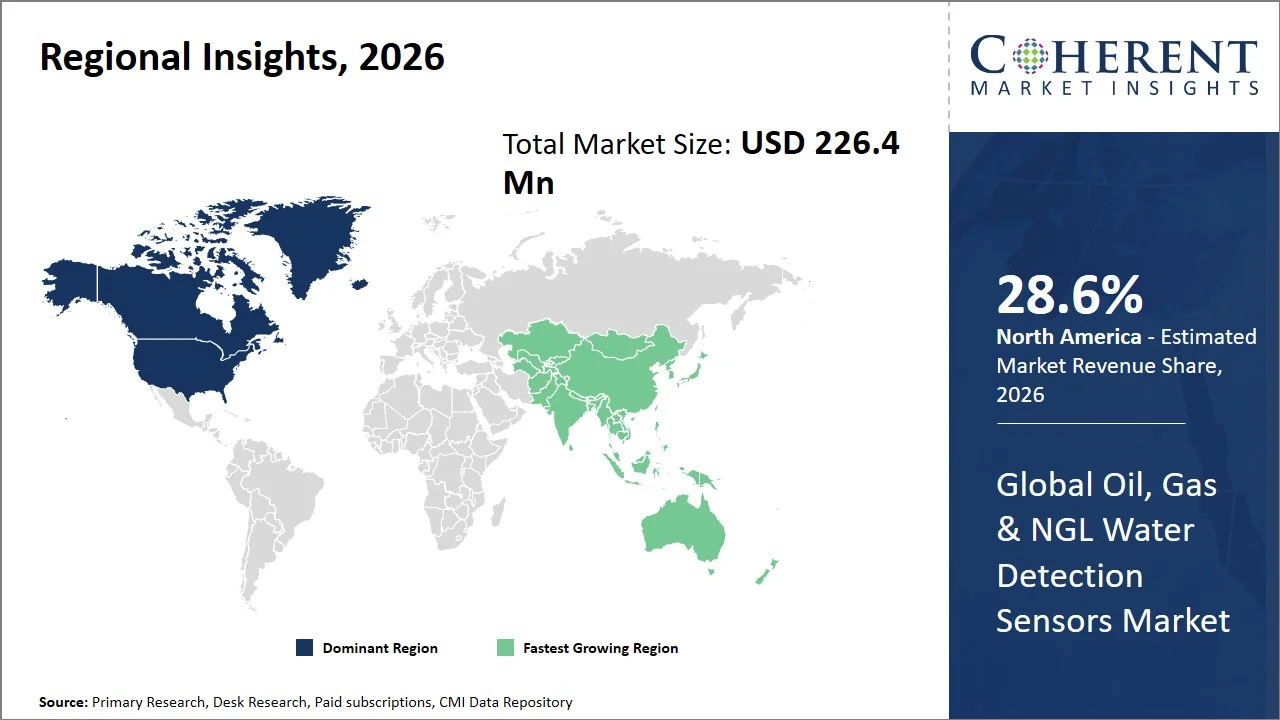
Why is North America a Strong Market for Oil, Gas & NGL Water Detection Sensors?
North America is expected to account for a market share of 28.6% in 2026. North America’s oil, gas & NGL water detection sensors market is strongly driven by the U.S. shale pipeline backbone and PHMSA-led methane and integrity compliance mandates, which are forcing operators to deploy continuous monitoring systems for moisture-related corrosion and leakage risks. Major midstream operators are increasingly integrating fiber-optic sensing, SCADA-linked water detection, and AI-based corrosion prediction tools across aging pipeline networks, especially in the Permian Basin–to–Gulf Coast LNG corridors where internal corrosion from formation water remains a key failure driver. On March 24, 2026, DataBahn.ai, the AI-native security data fabric company, announced Autonomous In-Stream Data Intelligence (AIDI), a new operating model for security data pipelines, where data is continuously interpreted, validated and acted on in real time as it flows. (Source: DataBahn)
Why Does Asia Pacific Oil, Gas & NGL Water Detection Sensors Market Exhibit High Growth?
Asia Pacific is expected to account for a market share of 25.4% in 2026 and is expected to register the fastest growth rate over the forecast period. Asia Pacific is the fastest-growing deployment region, driven by rapid pipeline expansion in China, India, Indonesia, and Southeast Asia, where new LNG terminals and cross-border gas pipelines are being built with embedded sensor networks from day one. China’s intelligent pipeline programs and India’s national gas grid expansion (JHBDPL and city gas networks) are pushing adoption of real-time moisture analyzers, leak detection systems, and digital pipeline monitoring platforms to manage long-distance transmission risks and reduce corrosion failures. On September 16, 2025, Hanwha Ocean, one of the leading shipbuilders in South Korea, selected ABB the contract to supply a complete electric power and propulsion system for Singapore’s first floating Liquefied Natural Gas (LNG) terminal. The contract is the latest milestone in the long-standing collaboration between ABB and Hanwha Ocean. (Source: ABB)
Why is U.S. Emerging as a Major Hub in the Oil, Gas & NGL Water Detection Sensors Market?
The U.S. market is defined by strict ESG-driven methane reduction policies, which are directly increasing deployment of advanced water detection systems to prevent corrosion-induced pipeline leaks. Operators are upgrading legacy infrastructure with smart pigging, inline corrosion monitoring, and real-time gas moisture measurement systems, especially in interstate transmission pipelines feeding LNG export terminals on the Gulf Coast, where water–CO₂ interaction accelerates internal corrosion.
Is China the Next Growth Engine for the Oil, Gas & NGL Water Detection Sensors Market?
China is expanding through state-led infrastructure modernization, where the government is integrating intelligent sensing systems into new pipeline corridors under national energy security programs and Belt & Road-linked energy projects. Large-scale pipelines such as the West–East Gas Pipeline network increasingly use automated leak detection, distributed fiber-optic sensing, and gas quality (including moisture) monitoring systems to manage long-distance transmission and reduce corrosion risks in high-pressure transport systems.
Germany Oil, Gas & NGL Water Detection Sensors Market Analysis and Trends
Germany is driven by energy transition restructuring after reduced Russian gas imports, leading to rapid integration of LNG import terminals (Wilhelmshaven, Brunsbüttel) and upgraded transmission networks across Europe. These systems require high-precision moisture analyzers and gas quality sensors to ensure pipeline compatibility, prevent hydrate formation, and maintain strict EU gas quality and emissions compliance across cross-border transmission corridors.
India oil, gas & NGL water detection sensors market is expanding through rapid national gas grid development and LNG import capacity additions (Dahej, Kochi, Ennore expansion), where pipeline operators must strictly control moisture levels to prevent hydrate formation and corrosion in long-distance transmission lines. Companies like GAIL and GAIL-linked transmission networks are increasingly deploying real-time gas analyzers, moisture detection systems, and SCADA-integrated pipeline integrity platforms to support rising LNG imports and city gas distribution growth.
Global Oil, Gas & NGL Water Detection Sensors Market - AI-Assisted Leak Detection & Subsea Sensor Intelligence
Parameter | Industry Reality / Observed Deployment |
Subsea sensor deployment depth | Typically 1,000 m – 3,000 m in deepwater oil & gas fields, with permanent reservoir monitoring systems installed on seafloor templates for continuous leak detection and plume tracking |
Autonomous Underwater Vehicle (AUV) integration | AUVs are deployed for 3D plume tracking, pipeline inspection, and data collection in offshore fields, enabling early detection of oil/gas leaks and chemical dispersion |
Offshore platform monitoring density | Modern offshore platforms use distributed sensor grids across risers, manifolds, and subsea templates |
Remote subsea diagnostics | Increasing use of AI-based remote analytics + acoustic signal processing to detect anomalies (leaks, pressure drops, gas seepage) without physical intervention |
Deepwater leak-detection accuracy | Hybrid systems (acoustic + fiber-optic + AI models) can detect low-intensity hydrocarbon leaks and plume formation in noisy deepwater environments, improving detection reliability vs traditional sensors |
How is Integration of AI and Predictive Maintenance in Water Detection Systems Creating New Growth Opportunities in the Global Oil, Gas & NGL Water Detection Sensors Market?
The integration of AI and predictive maintenance in water detection systems is creating new growth opportunities in the oil, gas & NGL water detection sensors market by shifting operations from reactive monitoring to real-time, data-driven forecasting of water ingress and corrosion risks in pipelines and LNG infrastructure. AI-enabled sensors can analyze pressure, flow, and moisture patterns to predict early-stage contamination or hydrate formation before failures occur, reducing downtime and maintenance costs while improving asset reliability. On January 19, 2026, DataMesh announced that it partnered with Yokogawa to introduce a joint AI-driven predictive maintenance solution, redefining how industrial facilities monitor, understand, and manage critical equipment. The solution is designed to address long-standing challenges in industrial operations and maintenance, including limited early fault detection, overreliance on manual experience, and low-confidence alarms. (Source: DataMesh)
Market Players, Key Development, and Competitive Intelligence
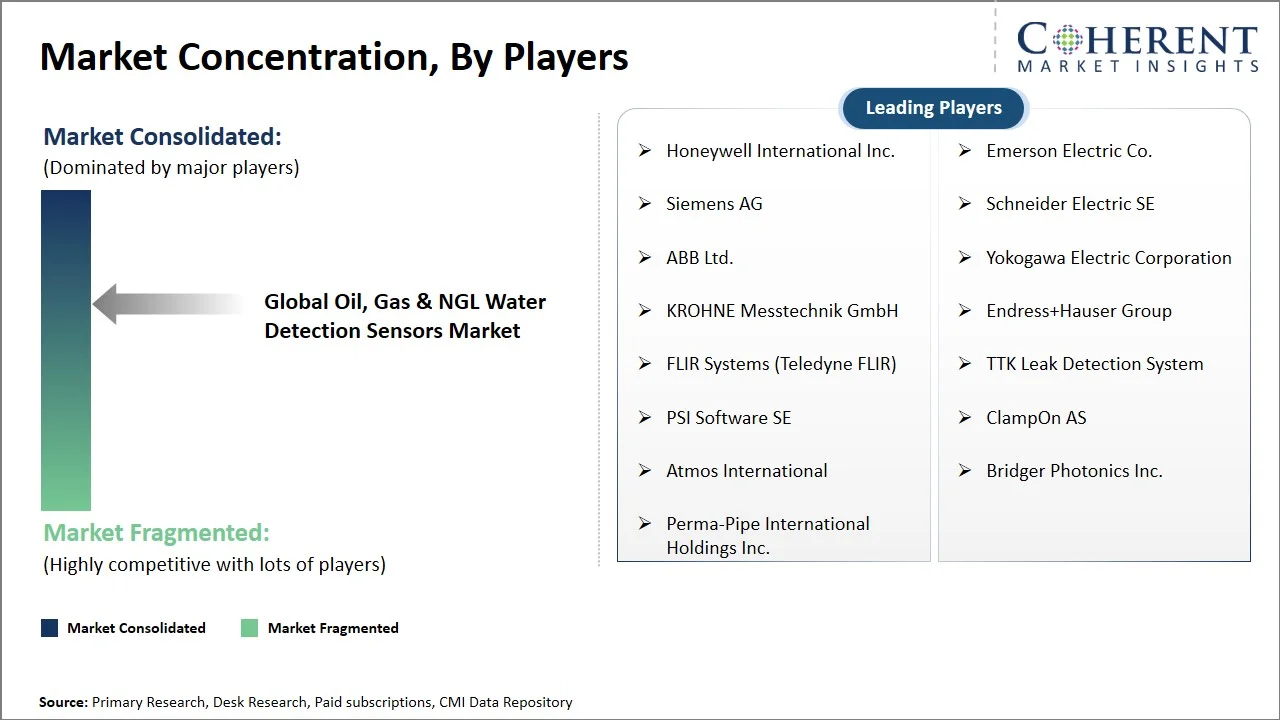
Key Developments
- On June 6, 2025, Geospace Technologies announced the launch of AquaLink, an advanced multi-device and multi-unit water IoT endpoint designed to transform submetering and leak detection in multi-unit residential and commercial properties.
- On February 20, 2025, LAIIER announced that it has partnered with Cox Engineering to drive mutual expansion in Boston and the East Coast. The collaboration signifies that LAIIER’s best-in-breed, wireless early water leak detection solution will be available as part of Cox Engineering’s growing portfolio of energy and sustainability related offerings, alongside building energy management systems, IoT monitoring, and turnkey HVAC retrofit solutions.
Competitive Landscape
The competitive landscape of the global oil, gas & NGL water detection sensors market is dominated by a mix of large industrial automation companies such as Honeywell, Siemens, Emerson, ABB, and Schneider Electric, along with specialized sensing and leak detection firms like TTK, ClampOn, and Atmos International. Competition is driven by technological innovation, particularly in IoT-enabled monitoring, AI-based analytics, and high-accuracy sensing solutions. Companies focus on strategic partnerships, product integration, and geographic expansion to strengthen their market position, while niche players compete by offering highly specialized and cost-efficient detection systems.
Market Report Scope
Oil, Gas & NGL Water Detection Sensors Market Report Coverage
| Report Coverage | Details | ||
|---|---|---|---|
| Base Year: | 2025 | Market Size in 2026: | USD 226.4 Mn |
| Historical Data for: | 2020 To 2024 | Forecast Period: | 2026 To 2033 |
| Forecast Period 2026 to 2033 CAGR: | 5.2% | 2033 Value Projection: | USD 323.3 Mn |
| Geographies covered: |
| ||
| Segments covered: |
| ||
| Companies covered: | Honeywell International Inc., Emerson Electric Co., Siemens AG, Schneider Electric SE, ABB Ltd., Yokogawa Electric Corporation, KROHNE Messtechnik GmbH, Endress+Hauser Group, FLIR Systems (Teledyne FLIR), TTK Leak Detection System, PSI Software SE, ClampOn AS, Atmos International, Bridger Photonics Inc., and Perma-Pipe International Holdings Inc. | ||
| Growth Drivers: |
| ||
| Restraints & Challenges: |
| ||
Analyst Opinion (Expert Opinion)
- The oil, gas & NGL water detection sensors market is a steadily expanding segment within industrial sensing, primarily driven by the oil and gas sector’s shift toward automation, safety compliance, and digital monitoring. They highlight that while traditional detection methods are still in use, there is a clear transition toward smart, connected sensor systems that offer real-time analytics and predictive insights. However, experts also note that the market remains moderately fragmented, with cost sensitivity and harsh operating environments limiting rapid adoption in some regions, especially in emerging economies.
- The future of the market is expected to be strongly influenced by digital transformation, AI integration, and expansion of energy infrastructure, particularly in LNG, offshore drilling, and subsea operations. It is anticipated that increased adoption of wireless, low-maintenance, and AI-enabled water detection systems that improve operational efficiency and reduce downtime. In the long term, emerging sectors such as hydrogen production, carbon capture and storage (CCS), and next-generation refining technologies are likely to create new demand streams, positioning advanced water detection sensors as a critical component of future energy ecosystems.
Speak to the analyst
Want personalized insights?
Take the findings above to one of our principal consultants, or have the report rebuilt around the segments, geographies and competitors you actually track.
Market Segmentation
- Hydrocarbon Phase Insights (Revenue, USD Million, 2021 - 2033)
- Gas Phase
- Liquid Phase
- Stream Type Insights (Revenue, USD Million, 2021 - 2033)
- Natural Gas
- Liquid NGL
- Condensate
- Measurement Type Insights (Revenue, USD Million, 2021 - 2033)
- Moisture in Gas
- Water in Liquid Hydrocarbons
- Free Water Detection
- Detection Technology Insights (Revenue, USD Million, 2021 - 2033)
- TDLAS (Laser-Based)
- Ceramic / Alumina Sensors
- Electrolytic (P₂O₅)
- Dielectric / RF Probes (Liquid)
- PPM Sensitivity Range Insights (Revenue, USD Million, 2021 - 2033)
- Trace: 1–10 ppm
- Low-ppm: 10–100 ppm
- Mid-ppm: 100–1,000 ppm
- Installation Type Insights (Revenue, USD Million, 2021 - 2033)
- Inline Probe
- Fast-Loop Sampling System
- Analyzer Shelter / Cabinet
- Portable / Validation Units
- End User Insights (Revenue, USD Million, 2021 - 2033)
- Gas Processing / Gas Treating Plants
- NGL Fractionation Plants
- Midstream Pipeline Operators
- Custody Transfer & Metering Stations
- Hydrocarbon Storage Facilities
- Refineries
- Petrochemical Plants
- Regional Insights (Revenue, USD Million, 2021 - 2033)
- North America
- U.S.
- Canada
- Latin America
- Brazil
- Argentina
- Mexico
- Rest of Latin America
- Europe
- Germany
- U.K.
- Spain
- France
- Italy
- Russia
- Rest of Europe
- Asia Pacific
- China
- India
- Japan
- Australia
- South Korea
- ASEAN
- Rest of Asia Pacific
- Middle East
- GCC Countries
- Israel
- Rest of Middle East
- Africa
- South Africa
- North Africa
- Central Africa
- North America
- Key Players Insights
- Honeywell International Inc.
- Emerson Electric Co.
- Siemens AG
- Schneider Electric SE
- ABB Ltd.
- Yokogawa Electric Corporation
- KROHNE Messtechnik GmbH
- Endress+Hauser Group
- FLIR Systems (Teledyne FLIR)
- TTK Leak Detection System
- PSI Software SE
- ClampOn AS
- Atmos International
- Bridger Photonics Inc.
- Perma-Pipe International Holdings Inc.
Sources
Primary Research Interviews
- Oil & Gas Equipment Manufacturers
- Water Detection Sensor Technology Providers
- Upstream & Downstream Oil Operations Managers
- Pipeline Infrastructure Engineers
Magazines
- Oil & Gas Journal
- Offshore Magazine
- Pipeline & Gas Journal
- World Oil Magazine
- Hart Energy E&P Magazine
Journals
- Journal of Petroleum Science and Engineering
- SPE Journal (Society of Petroleum Engineers)
- Journal of Natural Gas Science and Engineering
Associations
- American Petroleum Institute (API)
- International Association of Oil & Gas Producers (IOGP)
- Society of Petroleum Engineers (SPE)
- International Energy Agency (IEA)
- Gas Technology Institute (GTI)
Public Domain Sources
- U.S. Energy Information Administration (EIA)
- International Energy Statistics Database
- BP Statistical Review of World Energy
- OPEC Annual Statistical Bulletin
- National Energy Board Reports
Proprietary Elements
- CMI Data Analytics Tool
- Proprietary CMI Existing Repository of information for last 10 years
Get access to 250+ pages report
Every segment, forecast, competitor profile and data table behind the analysis above — available for instant download.
- ESOMAR Member
- ISO 9001:2015 Certified
- D-U-N-S Registered
- GDPR & CCPA Compliant
Missing comfort of reading report in your local language? Find your preferred language:
Transform your Strategy with Exclusive Trending Reports
Frequently Asked Questions
The global oil, gas & NGL water detection sensors market is expected to stand at USD 226.4 Mn in 2026 and is expected to reach USD 323.3 Mn by 2033.
The CAGR of the global oil, gas & NGL water detection sensors market is projected to be 5.2% from 2026 to 2033.
Growing oil, gas, and LNG pipeline networks worldwide and strict safety and environmental regulations for leak and contamination control are the major factors driving the growth of the global oil, gas & NGL water detection sensors market.
High installation and maintenance costs of advanced sensor systems and harsh operating conditions (offshore, deep pipelines) affecting sensor reliability are the major factors hampering the growth of the global oil, gas & NGL water detection sensors market.
In terms of hydrocarbon phase, liquid phase is estimated to dominate the market revenue share in 2026.
IoT enables real-time monitoring and remote data analysis for better detection accuracy.
They detect water early, allowing operators to take preventive actions against corrosion.